How to document a phylloxera block assessment and management decision
TL;DR
- A phylloxera block assessment record needs four things: a dated vine-by-vine or row-by-row symptom rating on a recognized scale (UC Davis 1-5), GPS-anchored block boundaries, a written management decision with rationale, and the assessor's name and credentials.
- Miss any of the four and the record won't hold up for an insurance claim, a grant application, or a regulatory audit.
What is a phylloxera block assessment and why does documenting it matter?
Phylloxera (Daktulosphaira vitifoliae) does not announce itself. By the time vines show obvious above-ground decline, root damage has usually been progressing for three to seven years [1]. That lag is the whole reason documentation matters. The written record you keep today becomes the only proof of when you first saw symptoms, what you saw, and what you decided to do about it.
Insurance adjusters, lenders financing a replant, cost-share administrators, and state department of agriculture inspectors all ask the same two questions: when did you know, and what did you do? A tidy field notebook does not answer them. They want dated entries tied to specific blocks, quantified severity ratings, and a written decision trail. California's CDFA requires documented pest management decisions as part of any Specialty Crop Block Grant compliance audit [2].
The documentation protects you internally too. Replanting a block costs $25,000 to $60,000 per acre once you add up vine removal, soil fumigation (where permitted), new plant material, and lost production [3]. A written record of decline across multiple assessment dates is the cleanest justification you have when a bank or an ownership group asks why you pulled out a ten-year-old block.
Good records give you trend data. If you've assessed Block 7 every August for four years and the average severity has climbed from 1.8 to 3.4, that trajectory tells you more than any single snapshot ever could.
What rating scale should you use to score phylloxera vine decline?
Use the UC Davis 1-5 vine decline scale. It's the most widely cited phylloxera rating system, developed in the late 1980s and 1990s as the AXR#1 rootstock failures swept through Napa and Sonoma [1]. The scale runs from 1 (no visible symptoms) to 5 (dead or nearly dead), with the middle ratings capturing early leaf reddening, reduced canopy, and trunk girdling. Cornell Cooperative Extension and Washington State University Extension both reference this scale or a functional equivalent in their phylloxera recommendations [4][5].
Here's how the five ratings translate to what you actually see in the field:
| Rating | Canopy description | Trunk/cordon signs | Typical root damage stage |
|---|---|---|---|
| 1 | Full, normal canopy | None visible | Nodosities only, limited |
| 2 | Slight chlorosis, minor gaps | None visible | Early tuberosity formation |
| 3 | 25-50% canopy reduction, early season reddening | Possible cracking | Tuberosities with secondary rot |
| 4 | >50% canopy loss, early defoliation | Visible decline, weak shoots | Extensive root rot, limited uptake |
| 5 | Dead or <10% live growth | Collapsed | Root system essentially destroyed |
Some growers add a "0" for vines confirmed on resistant rootstock with zero infestation evidence. Worth including if your block has mixed rootstock history.
The WSU Extension phylloxera guide suggests pairing the visual rating with a secondary "vigor index" based on shoot length at a fixed post-bloom date, which gives you an objective number next to the visual call [5]. You don't have to do both. But on a high-value block where a replant decision is worth hundreds of thousands of dollars, the second data point pays for itself.
Rate every vine in small blocks (under three acres). In larger blocks, rate a random 10% sample, and walk the full perimeter regardless. Never assess only the symptomatic vines. Skip the healthy-looking ones and you'll undercount early spread every time.
What information must a phylloxera assessment record actually contain?
No single federal form exists for phylloxera documentation. But the elements of a credible record are well settled across UC, WSU, and Cornell extension guidance [1][4][5].
The minimum fields:
- Date of assessment (not "fall 2024" but the actual calendar date)
- Block identifier (your internal block name or number, matched to your vineyard map)
- GPS coordinates or a georeferenced boundary map
- Rootstock identity for each vine, if known
- Scion variety
- Vine age and plant date
- Individual vine ratings using a named scale (e.g., UC Davis 1-5)
- Total vines assessed vs. total vines in block
- Percent of block at each rating category
- Assessor name, title, and employer
- Assessment method (100% survey vs. statistical sample, and if sample, the sampling design)
- Weather conditions (heavy drought stress can mimic or mask phylloxera symptoms)
- Any confounding factors observed (gopher damage, Eutypa, trunk disease)
- A management recommendation or decision, even if the decision is "monitor again next year"
That last field is the one most growers skip. A list of vine ratings with no written decision is an incomplete record. The decision doesn't have to run long. "Based on block average rating of 2.1 and rate of spread over two seasons, decision is to continue monitoring annually. Threshold for replant is block average reaching 2.8 or more than 20% of vines at rating 4+." That sentence is enough. It shows you looked at the data and made a considered call.
If you run a digital field platform, VitiScribe attaches vine-level rating data straight to block maps and generates a timestamped PDF assessment report, which is the exact format most grant administrators and insurance adjusters want to receive.
How do you map and GPS-document the affected area within a block?
Phylloxera spread is not random. It radiates outward from an introduction point in an irregular oval, following soil type, drainage, and equipment traffic routes [1]. Document that spatial pattern, because it tells you whether you're looking at one introduction or several, and it sets your replant boundary.
The simplest mapping approach for most operations is a row-and-vine coordinate system: rows numbered north to south (or from the road), vines numbered from the head of each row. A vine rated 4 at Row 12, Vine 8 plots onto any block map. If you already have GPS row lines in your farm management software or in Google Earth, drop a waypoint on every vine rated 3 or higher.
For formal documentation, export a KMZ or shapefile from your GPS device or tablet and attach it to the assessment record. Print a paper copy for the paper file. USDA NRCS and many state ag departments accept either format for EQIP or specialty crop paperwork [2].
At minimum, walk and record:
- The outer boundary of the affected zone (where you transition from rating 1-2 vines to rating 3+ vines)
- The core zone (rating 4-5 vines)
- Any isolated outlier vines more than 50 feet from the main zone (these point to a second introduction or spread on equipment)
Geotag your photos if the device supports it. Take at least one canopy overview and one close-up of exposed roots for any vine rated 4 or 5. Put the date and block ID in the file name, more than the metadata, because metadata is the first thing stripped when files get emailed or flattened to PDF.
How do you decide between replanting, managing in place, and roguing?
Once you've confirmed phylloxera and built a severity map, you have three real options: full block replant on resistant rootstock, rogue and fill individual vines while watching the block's trajectory, or manage the existing block for maximum remaining life without replanting. Each has a legitimate use case, and each needs its own documented rationale.
Full replant is the call when block average severity passes 2.5 to 3.0 on the UC Davis scale, when the affected zone covers more than 30 to 40% of the block, or when the block is already near the end of its economic life [1]. It's also right when you can't confirm the rootstock and suspect AXR#1 or own-rooted vines. WSU Extension notes that "delaying replant of severely infested blocks results in accelerating spread to adjacent blocks and compounding total site rehabilitation costs" [5]. That's a quote worth keeping in your decision record.
Roguing, meaning replacing individual dead or dying vines, buys time but does nothing to slow the infestation. It makes economic sense in high-value blocks where vine quality or AVA premiums justify the replacement cost, and where the block average is still under 2.0. Document roguing as a separate management action with its own dated record, including the rootstock identity of the replacement vines.
Managing in place means optimizing irrigation, nutrition, and canopy work to stretch productive life without replanting. It fits blocks in their last five to eight years of intended production, where the replant investment wouldn't be recovered. This one demands the most careful documentation, because you're accepting continued decline on purpose. You want the record to show that was a reasoned economic call, not neglect.
Whatever you choose, the decision record should include:
- The date and attendees of any meeting where the decision was made
- The severity data and trend data that supported it
- The economic rationale (estimated remaining yield value vs. replant cost)
- The timeline for next action (replant date, next assessment date, or end-of-life harvest target)
Most states have no regulation mandating a specific management response to phylloxera on private land. But if you sit in a phylloxera-regulated zone or take cost-share funding, check your program requirements. California's CDFA has historically routed pest management guidance through county agricultural commissioners [2].
What are the record-keeping requirements under pesticide and worker protection rules?
Phylloxera management often involves pesticide applications, soil fumigation before replant, or systemic treatments on established vines (though registered options for grape phylloxera on established US vineyards are limited). Any application tied to your phylloxera program needs its own record set, separate from but linked to your assessment records.
Under the EPA Worker Protection Standard, agricultural employers must retain pesticide application records for two years from the date of application [6]. Those records need the product name, EPA registration number, active ingredient, application rate, date and time, target pest, crop, total area treated, and applicator identity. This is not optional, and it is not the same document as your assessment record, though the two should cross-reference each other.
California requires all pesticide applications to be reported to the county agricultural commissioner within set timeframes under the state's pesticide use reporting system [7]. Oregon, Washington, and New York run equivalent state-level reporting. Thresholds and timelines vary, so confirm with your local extension service or county ag office.
Soil fumigation before replanting (chloropicrin, metam-sodium, or combinations where registered) carries its own documentation load under EPA and state rules, including buffer zone calculations, posting, and restricted entry intervals. Those records belong in your phylloxera file as evidence the replant site was properly prepared.
Hire a licensed pest control adviser (PCA) or certified crop adviser (CCA) to make management recommendations, and their written recommendation forms are legally required in California and a good idea everywhere else [7]. Keep those forms with your assessment records.
How do you structure the written management decision document?
The written management decision is the piece most growers skip or bury as a vague line in a field notebook. Done right, it's a one- to two-page document, and it's the first thing you'll reach for when an insurance adjuster or grant officer asks for your phylloxera history.
A defensible decision document has these sections:
Header: Property name, block ID, date of decision, names of decision-makers present.
Assessment summary: Reference to the assessment record by date, average severity score, affected area in acres and as a percentage of the block, rate of progression since the last assessment.
Rootstock status: Confirmed rootstock identity if available, year planted, source nursery if known. If rootstock is unknown or suspect, say so plainly. It's material to the decision.
Management options considered: A short description of each option evaluated (replant, rogue, manage in place), with a one-sentence note on why each was or wasn't chosen.
Decision and rationale: A clear statement of the chosen action, with economic and agronomic reasoning. Include any thresholds that would change your course.
Next action and timeline: A specific date for the next assessment, replant schedule, or other follow-up.
Signature and credentials: The person making the recommendation signs and notes their credentials (viticulturist, PCA license number, and so on).
Keep this document with the assessment record in the same file or folder. If you're managing multiple blocks at different stages, a block-by-block summary table showing current status, decision date, and next action helps both your own planning and any external review.
How often should you re-assess a phylloxera-affected block?
Annual assessment is the minimum standard from both UC Cooperative Extension and WSU Extension for any block confirmed to have phylloxera [1][5]. For blocks in early stages (average rating under 2.0), once a year at the same phenological stage (early post-veraison is typical) is enough. For blocks above 2.5 average or moving fast, a mid-season assessment can catch changes that affect your harvest decision.
Timing matters because symptom expression shifts through the season. Early symptoms (mild chlorosis, slightly reduced shoot growth) show best in June and July across most northern hemisphere wine regions. By September and October, drought stress and normal senescence mask or mimic the same signs. UC Cooperative Extension recommends an assessment window of roughly 6 to 8 weeks post-bloom through veraison as the most reliable period for telling symptoms apart [1].
Every re-assessment should reference the one before it. The progression data, meaning the change in block average and the change in affected footprint, is often more diagnostic than any single reading. A block moving from 1.5 to 2.5 in two seasons is a different animal from one holding at 2.0 for four years.
When you replant, document the post-replant monitoring plan too. New plantings on resistant rootstock are not immune if the rootstock choice was poor or a new biotype is present. Cornell's vineyard guidance notes that biotype B phylloxera, aggressive against 3309 and other widely used rootstocks, was documented in the eastern US as early as the late 1990s [4]. Rootstock performance belongs in your ongoing block records.
What should a phylloxera assessment file look like after five years of records?
After five years of steady documentation, a single-block phylloxera file should hold roughly this:
- Five dated assessment reports (one per year), each with vine-by-vine or row-level rating data
- Five block maps or GPS exports showing the affected zone boundary at each assessment date
- A run of geotagged photographs of the canopy and any exposed roots at each assessment
- One or more written management decision documents, updated whenever the decision changed
- Any PCA recommendation forms for pesticide applications
- Pesticide application records for any treatments, with EPA registration numbers
- Correspondence with nurseries about rootstock selection for replant, if you've reached that stage
- Invoices or contracts for roguing labor, soil fumigation, or vine removal (these build the economic record)
This file is also your evidence base if you ever apply for USDA EQIP cost-share for orchard and vineyard renovation (Practice Code 1102, which covers replanting of orchards and vineyards with improved stock) [8]. EQIP applications require documented pest or disease pressure as the basis for renovation, and a five-year phylloxera record is strong evidence.
A paper file works fine. A digital system like VitiScribe that links field ratings to block maps and spits out dated PDF summaries cuts the time to assemble this record from a few hours to a few minutes, which matters when you're chasing an application deadline.
Managing more than five or six blocks with phylloxera at various stages? Keep a database or a block-status summary table as a separate dashboard, updated after each season's assessments. See the vineyard operations overview for broader block management context.
How do insurance claims and grant programs use phylloxera documentation?
Crop insurance under USDA's Risk Management Agency does not usually cover phylloxera losses as a named peril in standard vineyard policies. But documented phylloxera-driven yield decline is relevant to yield history adjustments and replant cost coverage under some specialty crop policies [9]. Your agent will ask for assessment records when adjusting any claim tied to reduced productivity. Without dated, rated assessments, the claim rests on yield records alone, which is a much weaker footing.
USDA EQIP Practice Code 1102 (Orchard and Vineyard Renovation) provides cost-share for replanting vineyards hit by serious pests or diseases, and phylloxera qualifies [8]. NRCS offices typically want at minimum a written assessment by a qualified professional, documentation of the affected area, and a conservation plan. A multi-year assessment record makes those applications far stronger.
California's Specialty Crop Block Grant Program and similar programs in Oregon and Washington have funded phylloxera research and outreach, and grantees have to document outcomes. If your vineyard takes part in any externally funded research or demonstration project on phylloxera, your assessment records may be required deliverables under the grant agreement [2].
At the county level, California agricultural commissioner offices and their counterparts in other wine states sometimes track phylloxera spread for regional monitoring. Your records may feed those datasets, which have historically shaped rootstock recommendations for the region. A minor point, but a reminder that this documentation has value past your own gate.
What are the most common documentation mistakes vineyard managers make with phylloxera records?
Most documentation problems aren't about missing forms. They're about habits.
The most common one is dating records vaguely. "Fall 2023" is not a date. Neither is "post-harvest." Use the full calendar date every time, on every field note.
Second: assessing only the symptomatic vines. Walk to the visibly affected area, rate those vines, and leave, and you have an incomplete record. The healthy-looking vines next to the outbreak need ratings too, because the early-stage vines at rating 1-2 are exactly the ones you have to watch.
Third: failing to link the management decision to the assessment data. The assessment report and the decision document should name each other. "Management decision document dated October 15, 2024 is based on assessment data from October 3, 2024." That single linkage is what makes the file coherent to a stranger reading it.
Fourth: not updating the record when the decision changes. If you decided to manage in place in 2022 and then decided to replant in 2024, both decisions belong in the file with their dates and rationale. A record showing only the current decision reads like it was built after the fact.
Fifth: storing records where they can't be shared. A notebook that lives in a truck is fine for capture. But the information has to get transcribed or photographed into a durable, shareable format within a few days. Notebooks get wet, burned, or lost.
Frequently asked questions
Do I need a licensed PCA to conduct a phylloxera block assessment?
In California, a licensed PCA (Pest Control Adviser) is required to make pesticide use recommendations, including soil fumigation tied to replant. The vineyard manager or viticulturist can conduct the assessment and document severity ratings without a PCA license. If the assessment justifies pesticide applications, bring in a licensed PCA to sign off on that specific recommendation. Cornell and WSU guides don't require PCA licensing for assessments in their states.
What rootstocks are most resistant to phylloxera and should I document rootstock choice in my replant records?
Yes, document rootstock choice in detail. UC Cooperative Extension recommends rootstocks from the St. George, 110R, 140Ru, and 1103P families for high-pressure sites, with guidance varying by soil type and vigor needs. AXR#1 is no longer recommended after its failure in California in the late 1980s and 1990s. Your replant record should note rootstock variety, source nursery, lot number, and certification status. That detail matters if rootstock performance is ever questioned in a future assessment.
How long do I need to keep phylloxera assessment records?
There's no single federal retention rule specific to phylloxera assessments. Pesticide application records linked to phylloxera management must be kept two years under the EPA Worker Protection Standard. For insurance and grant purposes, most advisers suggest retaining all phylloxera documentation at least seven years, or for the full life of any replanted block, whichever is longer. If litigation is ever a possibility, keep everything indefinitely.
Can I use photos alone to document phylloxera progression without written ratings?
Photos are useful supporting evidence, but they don't replace systematic ratings. A photo shows canopy appearance on a date. It can't tell a reviewer what percentage of vines sat at each severity level, how the boundary of the affected zone shifted, or what the assessor concluded about rate of spread. Photos belong in the file alongside written ratings, not instead of them. Geotagged photos beat non-geotagged ones.
Is phylloxera a reportable pest that I have to notify a state agency about?
Phylloxera is generally not a reportable pest requiring mandatory state notification in the established wine regions of California, Oregon, Washington, or New York, because it's already endemic there. But if you're in a region or state where phylloxera hasn't been previously documented, check with your state department of agriculture or county agricultural commissioner before assuming no reporting is required. New introductions can trigger a different response. USDA APHIS does not list grape phylloxera as a federally regulated pest as of this writing.
What's the difference between phylloxera leaf galls and root infestation, and does it change how I document?
Leaf galls come from the leaf-feeding form of phylloxera and are more common in some eastern US regions and European vineyards. Root infestation by the root-feeding form is what drives vine decline in western US wine regions. Your documentation should state which form you're seeing. Root confirmation usually means digging a sample of fine roots and checking them for nodosities and tuberosities under magnification. If you're working from leaf symptoms only, note that limit explicitly in the record.
How do I document a phylloxera assessment when I have mixed rootstock history within a single block?
Note rootstock identity vine by vine if records exist, or by zone if rootstock mapping was done at planting. If rootstock is unknown for some vines, record that plainly. UC Davis extension guidance suggests digging and sampling roots from suspect vines for visual confirmation, and noting whether confirmation was direct (excavated roots) or presumptive (based on age, planting records, and symptom pattern). Mixed rootstock blocks often show spatially uneven decline that should be captured in your vine map.
Does phylloxera documentation affect my organic or biodynamic certification?
It can. If you apply a fumigant or other synthetic pesticide as part of phylloxera remediation, that application has to be disclosed to your certifier and may affect your certification status or transition clock. Your assessment and management decision records speak directly to this. Certifiers want to see that any non-allowed input was a genuine last resort, which means your pre-application assessment showing the severity becomes part of your organic system plan. Consult your certifier before any application.
What does a block average phylloxera rating of 2.5 actually mean for expected yield loss?
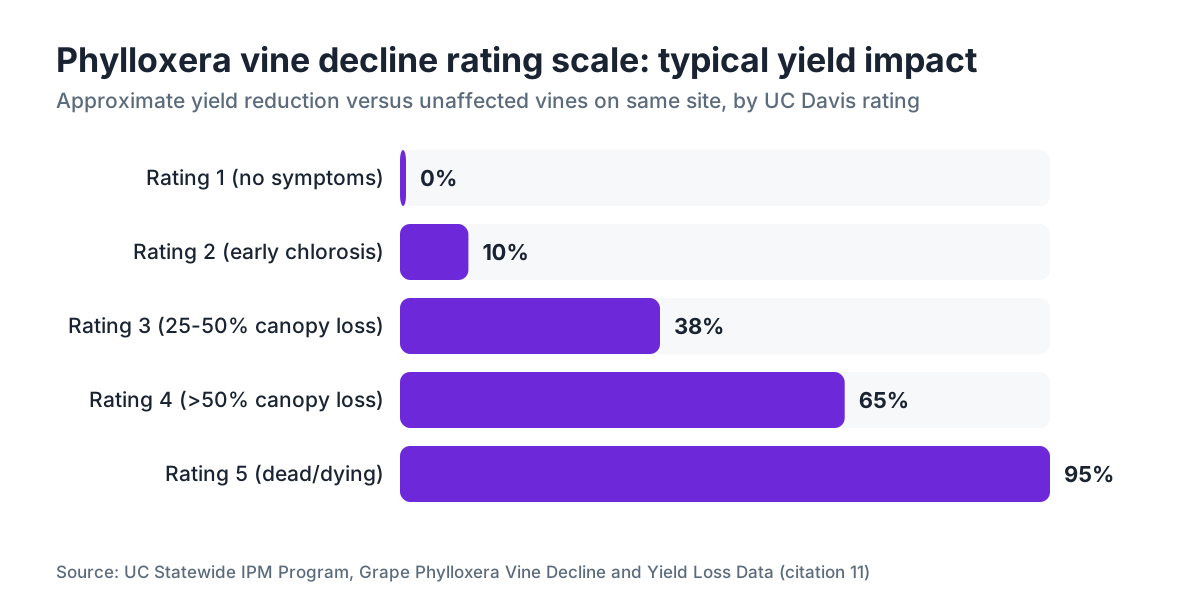
There's no single agreed conversion, but UC Cooperative Extension has published data suggesting vines at rating 3 on the Davis scale may show 25-50% yield reduction versus unaffected vines on the same site. At rating 4, yield loss typically tops 60%. These are rough ranges from older California research and shift with variety, irrigation, and soil depth. A block average of 2.5 across a full block likely means meaningful but not catastrophic yield impact this season, with accelerating decline projected.
Can I use a drone to map phylloxera distribution in a block instead of walking rows?
Drone-based NDVI or multispectral imagery helps identify zones of canopy stress consistent with phylloxera, and it's a useful tool for deciding where to walk and assess in large blocks. It can't replace vine-level ground-truth, because canopy stress has many causes. Use the imagery to build your assessment map and direct your ground survey, then document both: the imagery date, platform, and band used, plus the ground-truth vine ratings taken to confirm the remote-sensing read. NDVI alone is not a recognized severity rating.
What's a reasonable threshold for deciding to replant a block versus continuing to manage it in place?
UC Cooperative Extension guidance, backed by economic analysis from the early 2000s, suggests replant becomes economically justified when block average severity passes roughly 2.5 to 3.0 on the Davis scale, or when the affected zone covers more than 30 to 40% of the block, or when the rate of progression means the block will hit a rating 4+ average within two to three seasons. There's no hard regulatory threshold. It's an economic decision. Write your threshold into your management decision record so future reviewers see it was set ahead of time.
Should my phylloxera records be stored separately from my spray and fertilizer records?
Keep them linked but organized. The cleanest approach is a dedicated phylloxera block file holding assessment records, maps, photos, and management decision documents, with cross-references to your spray record binder for any pesticide applications. Spray records are legally required under EPA WPS and have their own retention and format rules, so they need to stand alone. A note in each file pointing to the other makes it easy to hand an auditor or reviewer a complete picture.
Sources
- UC Cooperative Extension, Grape Phylloxera Management Guidelines: UC Davis 1-5 vine decline rating scale for phylloxera; root damage precedes above-ground symptoms by multiple years; assessment timing recommendations around post-bloom through veraison
- California Department of Food and Agriculture, Specialty Crop Block Grant Program: CDFA requires documented pest management decisions as part of Specialty Crop Block Grant compliance; county agricultural commissioners track pest management requirements
- UC Davis, Cost Studies for Grape Production and Vineyard Establishment: Replanting a vineyard block costs approximately $25,000 to $60,000 per acre including vine removal, fumigation, new plant material, and lost production
- Cornell Cooperative Extension, Phylloxera Management in New York Vineyards: Cornell references UC Davis-equivalent vine decline rating scales; biotype B phylloxera documented in eastern US in the late 1990s affecting certain rootstocks
- Washington State University Extension, Grape Phylloxera: WSU recommends annual assessment; states that delaying replant of severely infested blocks results in accelerating spread and compounding rehabilitation costs; references vigor index assessment
- US EPA, Agricultural Worker Protection Standard: EPA WPS requires agricultural employers to retain pesticide application records for two years from date of application, including EPA registration number, active ingredient, rate, date, and applicator identity
- California Department of Pesticide Regulation, Pesticide Use Reporting: California requires pesticide applications to be reported to the county agricultural commissioner; licensed PCA recommendation forms are legally required for pesticide use recommendations
- USDA Risk Management Agency: Vineyard specialty crop insurance policies may use documented yield decline history from pest damage in yield adjustments and some replant cost coverage provisions
- UC Statewide Integrated Pest Management Program, Grape Phylloxera Vine Decline and Yield Loss Data: Vines at rating 3 on the Davis scale may show 25-50% yield reduction; at rating 4, yield loss typically exceeds 60%
Last updated 2026-07-10