How to document kaolin clay applications for leafhopper management

TL;DR
- Kaolin clay (sold as Surround WP) carries a full EPA pesticide registration under FIFRA, so it needs a complete spray record under most state rules even though it has no re-entry or pre-harvest interval.
- Every application record needs the date, product name and EPA Reg.
- No., application rate, target pest, applicator name, and field location at minimum.
Does kaolin clay require a spray record even though it's a mineral product?
Yes. Kaolin clay products used for pest control, including Surround WP (EPA Reg. No. 61842-18), carry a full EPA pesticide registration under FIFRA, so state pesticide use reporting laws apply to them the same way they apply to any synthetic insecticide. [1] A lot of growers assume that because kaolin is a naturally occurring clay mineral with no re-entry interval and no pre-harvest interval for most grape uses, they can skip the paperwork. That assumption gets people fined.
California's Department of Pesticide Regulation (CDPR) requires a Pesticide Use Report (PUR) for every FIFRA-registered product applied commercially, full stop. [2] Oregon, Washington, and New York have their own commercial applicator record-keeping statutes. Even in a state with lighter rules, your crop insurance policy, your GAP audit, and any organic certification you're chasing will all expect documentation.
The short version: the physical nature of kaolin (a white powder that washes off) does not change its regulatory class. Document it.
What information must go on a kaolin clay application record?
Most state regulations and the EPA Worker Protection Standard (WPS) together define a core set of fields a compliant spray record has to contain. [3] Here's what you need for every application:
| Field | What to record | Notes |
|---|---|---|
| Date and time | Exact calendar date; time optional but recommended | Helpful if weather records are ever cross-checked |
| Product name and formulation | "Surround WP Crop Protectant" | Use the label name exactly |
| EPA Registration Number | 61842-18 | Found on front panel of bag |
| Active ingredient | Kaolin (calcined) | Percent listed on label |
| Application rate | lbs per acre or gallons per acre of diluted mix | Surround label allows 25-50 lbs/acre per application |
| Target pest | Grape leafhopper (Erythroneura spp.) | Be specific; more than "insects" |
| Crop and growth stage | Vinifera or hybrid, BBCH or Eichhorn-Lorenz stage | Helps with retrospective IPM review |
| Location | Block name/number, GPS coordinates or legal description | Match your field map |
| Total acres treated | Acreage treated in that pass | |
| Application equipment | Sprayer type, nozzle configuration | |
| Applicator name and license number | Licensed applicator or supervised worker | Required under WPS and most state statutes |
| Operator/owner name | Business entity operating the equipment | |
| Weather conditions | Temperature, wind speed and direction, humidity | Critical for drift documentation |
| Adjuvants and tank additives | Name, EPA reg. no. if applicable, rate | Surround is sometimes tank-mixed with spreader-sticker |
That looks like a lot, but a good field form fits it all on one line per application. The weather fields are the ones growers most often skip, and they're exactly what a CDPR inspector asks for first when a neighbor complains about drift.
For kaolin specifically, record how many bags you opened and whether you applied in multiple overlapping passes, which is common for the film-building applications extension programs recommend during egg hatch. [5] That detail matters when you reconcile purchased inventory against recorded usage at season's end.
What does the EPA Worker Protection Standard require for kaolin clay records?
The revised WPS (effective 2017) requires agricultural employers to keep certain pesticide application information posted at a central location workers can reach without a supervisor present, and to retain records for at least two years. [3] Kaolin clay products with a full FIFRA registration fall under WPS coverage.
The posting requirement means the Safety Data Sheet (SDS) and a copy of the product label must be accessible. For kaolin this is low-stakes on paper, because the SDS classifies the product as minimally hazardous (no PPE beyond eye protection for most applications), but you still have to post it.
The WPS also requires you to record the specific location treated, the product applied, and the application dates so workers know where a treated area is. Surround WP lists no restricted-entry interval (REI) for most field tasks, but your application record still needs to note that no REI applies. [6] Auditors read the absence of a recorded REI decision as a gap, not as proof of compliance.
One practical tip: keep a laminated "No REI" notation card with your standard spray log forms, so the field gets checked and documented instead of forgotten.
How does leafhopper timing affect what you record, and when?
Grape leafhopper management with kaolin is timing-sensitive in a way that creates a documentation headache. UC IPM guidelines call for starting applications at or just before first-instar nymph emergence in spring, correlated with degree-day accumulation after budbreak, then reapplying every 7-14 days or after rain to maintain the particle film. [7] That can mean 4-8 individual application events per season on a single block, each needing its own record.
Every re-application is a separate pesticide use event in the eyes of regulators. You can't write one record for "multiple applications throughout summer." The date, rate, and weather data have to be distinct for each pass.
A few things to record that are specific to the kaolin-leafhopper timing context:
First, note the phenological trigger. Was this application tied to a degree-day threshold, a scouting observation (record the nymph count if you have it), or just a calendar date? Tying the spray decision to a scouting observation strengthens your IPM documentation and is often required if you're in a sustainability certification program.
Second, note post-application rain events that forced an unplanned re-application. Insurance adjusters and organic certifiers appreciate the explanation. A line like "reapplication required after 0.8" rain event on [date], film visibly removed" takes 30 seconds to write and saves a longer conversation later.
UC IPM materials describe the kaolin leafhopper program as a multi-pass system, and good records reflect the cumulative seasonal rate so you can confirm you've stayed inside label limits. [11]
How long do you have to keep kaolin application records, and in what format?
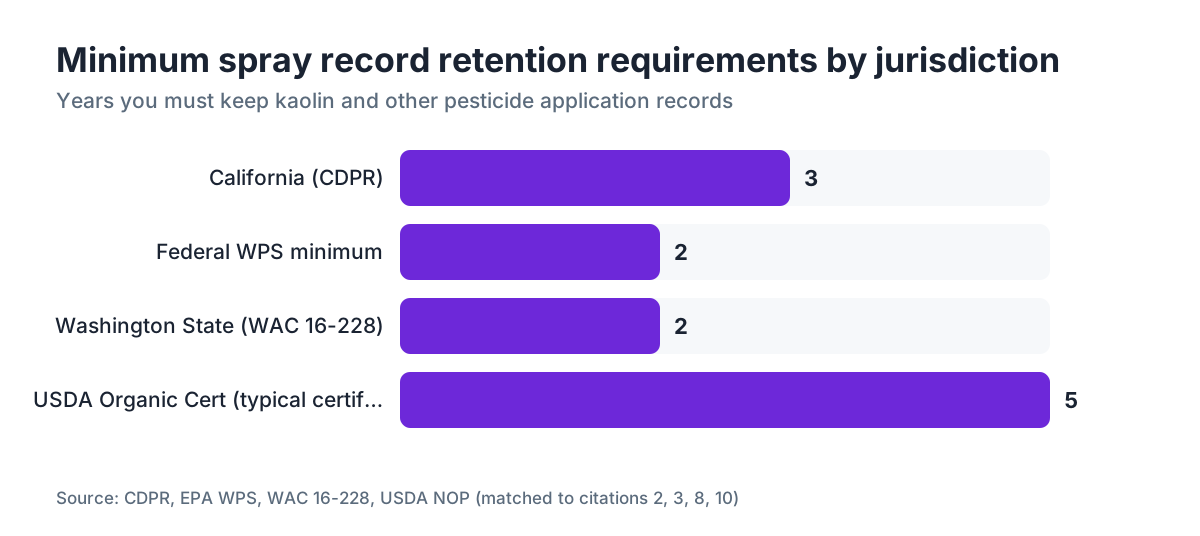
Federal minimum retention under WPS is two years. [3] California requires three years for PUR-submitted records. [2] New York requires two years. Washington requires two years for commercial applicators under WAC 16-228. [10] Most organic certifiers (CCOF, Oregon Tilth, OTCO) want five years of farm plan records, including pesticide-equivalent inputs.
Format is where a lot of operations get lazy. Paper logs in a field binder are legally valid in every state I'm aware of, but they cause real problems: illegible handwriting, water damage, lost binders, and no way to quickly generate a report sorted by product or block. A digital log, whether a spreadsheet or purpose-built software, makes audits faster and errors easier to spot.
If you want a software-based approach, VitiScribe is built for vineyard spray records and includes a kaolin/particle film category, so you're not jamming it into a synthetic pesticide template. The fields and prompts differ slightly for FIFRA-registered mineral products, and that difference is where mistakes hide.
Whatever the format, back up your records. One drive failure or one barn fire can put you in violation of retention rules. Cloud sync or a printed-and-scanned annual archive both work.
Does kaolin clay need to be reported to state regulators under pesticide use reporting laws?
In California, yes, without exception. The CDPR PUR system captures every application of a registered pesticide by licensed operators, and Surround WP is registered. [2] You submit the PUR to your county agricultural commissioner, usually monthly. The commissioner aggregates the data and forwards it to CDPR.
In other states the requirement varies. Oregon requires pesticide use reports from commercial applicators. Washington requires record-keeping but reports to the state only in specific categories (restricted-use, or upon request). [10] New York requires records but not routine reporting for general-use pesticides. Check with your county extension office or state department of agriculture to confirm what your state wants. The rules change periodically and the differences matter.
One thing that catches people off guard: if you hire a licensed pest control adviser (PCA) or custom applicator to apply kaolin, they carry their own reporting obligations, but that doesn't relieve you as the agricultural operator from keeping your own records. You're both on the hook. Get a copy of their application record and attach it to yours.
What's the right application rate to record, and where does that number come from?
The Surround WP label specifies 25-50 pounds of product per acre for fruit and vine crops, with the higher end for heavy pest pressure. [6] The label also says the film should cover all surfaces, which in dense grapevine canopies usually means applying to both sides of the canopy in a single pass.
Record the rate as pounds of product per acre treated, not per acre of vineyard. If you're treating a block with 9-foot row spacing and making a single-side pass, your effective treated acres differ from the land area. Pick a definition, document your methodology, and use the same one all season.
UC IPM and extension guidance recommend recording the tank concentration (a typical mix is 3 lbs Surround per gallon of water) and total gallons applied, which lets you back-calculate the pounds-per-acre figure from tank records if a question ever comes up. [11] That cross-check has saved growers in CDPR audits.
The Surround label does not state an explicit seasonal maximum in pounds. Cumulative applications that exceed 50 lbs/acre in a single application should be documented with a clear rationale. Growers running a full-season program (4-6 applications at 25 lbs/acre) log the running seasonal total on the same sheet as the individual records, so the number stays visible.
How do you document kaolin use under organic certification requirements?
Kaolin clay is allowed under USDA National Organic Program (NOP) standards as an inert substance for pest management, though the rules have a wrinkle. Under 7 CFR 205.601(e), inert ingredients in pesticide formulations must be on EPA List 4 (minimal concern) to be allowed in organic production. [8] Kaolin itself is NOP-compliant; some adjuvants you might tank-mix with Surround are not. Check your certifier.
For organic cert records, you need everything in the standard spray record plus confirmation that the product is OMRI-listed or has been reviewed and approved by your certification agency. Surround WP is on the OMRI Products List. [9] Keep a copy of the current OMRI listing in your farm plan file, because certifiers reverify it periodically.
Your organic system plan (OSP) should describe kaolin as a pest management tool, name leafhoppers as the target pest, and explain why non-chemical practices alone aren't enough (biological controls, habitat management, vine monitoring). This context isn't bureaucratic filler. It's the documentation that shows you're using kaolin inside an IPM framework rather than as a reflexive spray.
Document any scouting data that drove the decision to spray. A sticky trap count or a leaf-turn nymph count from the week before application is the best possible companion record to the spray log entry.
What's a practical spray log template for kaolin clay applications?
A good field form for kaolin doesn't need to be elaborate. Here's the minimum viable structure, which you can print on a single sheet or drop into a spreadsheet:
Block / Field ID: _______________
Application date: _______________
Start time / End time: _______________
Product name: Surround WP Crop Protectant
EPA Reg. No.: 61842-18
Active ingredient: Kaolin (calcined), 95%
Application rate: ___ lbs/acre
Dilution rate: ___ lbs per 100 gal water
Total product used: ___ lbs
Total acres treated: ___
Total gallons applied: ___
Cumulative seasonal total (this block): ___ lbs/acre
Target pest: Grape leafhopper (Erythroneura spp.)
Crop: _______________ Growth stage: _______________
Spray trigger / Scouting basis: _______________
Adjuvants added: _______________
Equipment: _______________
Applicator name: _______________ License No.: _______________
Weather at application: Temp: ___ Wind: ___ mph from ___ Humidity: ___%
Post-application notes: _______________
Supervisor signature: _______________
A few notes on this template. The "spray trigger" line is optional for most state regulators but expected by organic certifiers and GAP auditors. The cumulative seasonal total is the line most growers leave blank and then regret in December. Fill it in at the time of application.
For operations running VitiScribe or a similar digital platform, these fields map straight to a form that auto-generates the PUR data California requires and exports to CSV for your files. Either way, the content is the same.
Can you use a single record for multiple blocks treated in one day?
No, and this is a common shortcut that creates compliance problems. Each block is a legally distinct treated area. CDPR and most other state record requirements expect a separate location entry for each field or block, because the records track geographic pesticide load by township-range-section or by assessor parcel number. [2]
If you treat five blocks in sequence on the same day with the same product and the same equipment settings, you can use a single form page with multiple rows, one per block. But the block ID, acreage, and GPS or legal description must be distinct for each row. The date, product, and applicator fields can repeat or be marked "same as above."
The practical trap: on a long spray day it's tempting to fill in the paperwork that evening from memory. Weather, start times, and rates shift block to block. Fill in each block's row as you finish it, or at least jot field notes on a tablet or phone so the evening entry runs off real data, not a guess.
How do you handle record-keeping when kaolin is tank-mixed with another product?
Tank mixes need a separate record entry for each product in the mix, or a single record with every product listed in clearly separated rows or fields. Some growers mix Surround WP with a spreader-sticker like Nu-Film P or with a copper fungicide when timing overlaps. Each product in the tank needs its own name, EPA Reg. No., rate, and any applicable REI or PHI.
Here's where it gets complicated. If one of your tank-mix partners has an REI and kaolin does not, your posted WPS information has to reflect the most restrictive REI in the mix. The combined application record should note the REI that governs worker re-entry for that treated block.
For organic records, verify every tank-mix partner independently. A compliant kaolin application can be knocked out of organic compliance by an adjuvant that isn't on the approved materials list.
Extension guidance notes that many growers apply Surround as a standalone spray at the start of a spray interval, then come back with a separate fungicide pass, specifically to avoid tank-mix documentation complexity and to set nozzles right for each product. [5] That's a reasonable operational call, and it simplifies your records a lot.
What are the most common documentation mistakes vineyards make with kaolin applications?
Based on what state ag commissioners and organic certifiers flag most often, here's what actually trips people up:
Missing or vague location data. "North block" is not a compliant location description in California. You need a legal description or GPS coordinates that tie to a map.
No weather data. Temperature and wind speed at application time are required fields under most state statutes, and they're the first thing asked about if there's a drift complaint.
Skipping re-applications. Growers document the initial film-building sprays and then treat the maintenance re-applications as too minor to log. Every application is a separate event.
Wrong product name. "Kaolin" or "white clay" on the record is not compliant. The label product name and EPA Reg. No. must appear.
No REI documentation. Because kaolin has no REI, some growers leave that field blank. A blank REI field looks like an oversight, not a decision. Write "No REI, see label page [X]" or something similar.
Late entries. California PURs are due monthly. If you're entering spray records two months late from memory, data quality drops and the timestamp metadata often flags the delay. Record at the time of application.
Frequently asked questions
Is Surround WP considered a pesticide for record-keeping purposes?
Yes. Surround WP (EPA Reg. No. 61842-18) holds a full FIFRA registration, which classifies it as a pesticide under federal law regardless of its mineral origin. California, Oregon, Washington, and most other states require the same application records for Surround WP that they require for synthetic insecticides. There are no exceptions based on the product's physical or chemical nature.
What is the re-entry interval for kaolin clay in vineyards?
The Surround WP label does not establish a restricted-entry interval (REI) for vineyard uses, so workers can re-enter treated areas immediately after application concludes. You should still document this on your record by noting that no REI applies and referencing the label. Leaving the REI field blank without explanation can look like an incomplete record to an auditor.
Do I need to report kaolin applications to the county agricultural commissioner in California?
Yes. CDPR requires a Pesticide Use Report (PUR) for every commercially applied FIFRA-registered product, and Surround WP is registered. Reports go to your county agricultural commissioner, usually monthly. The obligation applies whether you apply the product yourself or hire a custom applicator, though in that case the applicator also has its own independent reporting obligation.
How many kaolin applications per season do I need to record for grape leafhopper control?
Every application is a separate record entry. UC IPM and extension guidelines for leafhopper management recommend starting at first-instar nymph emergence and reapplying every 7-14 days or after significant rain. A full-season program on a single block can easily require 4-8 separate applications, each needing its own date, rate, weather data, and applicator information.
Can kaolin clay applications count toward my organic certification?
Yes, if the product is OMRI-listed and your organic system plan addresses its use. Surround WP is on the OMRI Products List. Kaolin qualifies as an inert substance under USDA NOP rules (7 CFR 205.601), but you must verify that any tank-mix adjuvants are also NOP-compliant. Keep the current OMRI listing in your farm plan file and document the IPM justification for each application.
What degree-day threshold should I use to time kaolin applications for leafhoppers?
UC IPM guidelines suggest monitoring for grape leafhopper egg hatch using degree-day accumulation after budbreak. First-generation nymphs typically emerge around 100-150 degree-days (base 50 degrees F) after budbreak, though this varies by region and species. Record the degree-day value or the scouting observation that triggered each application alongside the spray record, especially under organic certification.
How long must I keep kaolin application records?
Federal WPS requires two-year retention. California requires three years. Organic certification bodies typically require five years of farm plan records including all inputs. Use the longest applicable period for your operation, which in most certified-organic California vineyards is five years. Digital records backed up to a second location (cloud or off-site drive) are the most reliable way to meet long retention periods.
Does applying kaolin in multiple passes on the same day count as one application or multiple?
It depends on intent. If you make two spray passes through the same block on the same day as part of one film-building event (one pass each side of the row), most regulators treat that as a single application event. Record the total product used and note the double-pass method. If you make a second application later that day after rain washes the first off, that is a second application event and needs its own record.
What weather conditions make a kaolin application inadvisable, and should I document why I postponed?
Wind above 10-15 mph increases drift risk and cuts deposition efficiency. Rain within 24-48 hours after application washes the film off before it dries. If you postpone for weather, a brief field-log note documenting the conditions and the decision creates a useful IPM narrative. It's not legally required in most states, but it strengthens organic and GAP audit trails.
What's the maximum seasonal rate for Surround WP in vineyards?
The Surround WP label specifies 25-50 pounds per acre per application for fruit and vine crops. The label does not state an explicit seasonal maximum in pounds per acre, but growers making 4-6 applications per season at 25 lbs/acre accumulate 100-150 lbs/acre over the season. Track the running seasonal total on your spray records and keep a copy of the product label to show your compliance basis if questioned.
Do custom applicators or PCAs have independent record-keeping obligations separate from the grower?
Yes. Licensed pest control advisers and commercial pesticide applicators have their own record-keeping and, in California, their own PUR submission obligations. Their records do not substitute for yours. Always request a copy of the applicator's records after any contracted application and attach it to your own spray log. Both parties are subject to audit.
How should I record kaolin applications in a vineyard block that straddles two assessor parcels?
Record the acreage treated in each parcel separately, with each parcel's legal description or APN noted. California PUR submissions are tied to the site identification section, which uses township-range-section or APN. If your block maps don't clearly show the parcel boundary, contact your county assessor for a boundary map and keep a copy in your farm files alongside your spray records.
Is there a difference in record-keeping requirements between kaolin and a conventional insecticide for leafhoppers?
The core fields are the same: date, product, rate, location, applicator, target pest, weather. The practical difference is that kaolin has no REI and no PHI, so those fields get noted as non-applicable rather than left blank. Kaolin is also not a restricted-use pesticide, so you don't need a private applicator license to apply it yourself, but whoever applies it commercially still needs to be documented on the record.
Sources
- EPA, Summary of the Federal Insecticide, Fungicide, and Rodenticide Act: FIFRA registration applies to all pesticide products sold or distributed in the US, including mineral-based products such as kaolin clay formulations
- California Department of Pesticide Regulation, Pesticide Use Reporting program: California requires a Pesticide Use Report for every commercially applied FIFRA-registered pesticide, with records retained for three years
- EPA, Agricultural Worker Protection Standard (WPS): WPS requires application information to be posted at a central location and records to be retained for at least two years; pesticide application and hazard information must be accessible to workers and handlers
- Cornell College of Agriculture and Life Sciences, viticulture and enology program: Cornell extension guidance describes kaolin application for leafhoppers as a multi-pass system requiring cumulative seasonal rate documentation
- Washington State University Extension: WSU extension recommends recording tank concentration (lbs per gallon) and total gallons applied to allow cross-calculation of per-acre rate; also recommends standalone Surround applications to simplify records and optimize nozzle settings
- EPA, Pesticide Product and Label System, Surround WP Crop Protectant (EPA Reg. No. 61842-18): Surround WP label specifies 25-50 lbs per acre per application for fruit and vine crops; no restricted-entry interval is established for most field tasks
- UC Statewide IPM Program, grape pest management guidelines: UC IPM guidelines recommend initiating kaolin applications at or just before first-instar nymph emergence, correlated with degree-day accumulation after budbreak, with reapplication every 7-14 days or after rain events
- USDA AMS, National Organic Program, 7 CFR 205.601 (eCFR): 7 CFR 205.601(e) specifies that inert ingredients in pesticide formulations used in organic production must be on EPA List 4 (minimal concern); kaolin qualifies as an allowed inert substance
- OMRI, OMRI Products List: Surround WP is listed on the OMRI Products List as allowed for use in organic production
- Washington State Legislature, WAC 16-228 (pesticide records): Washington State requires commercial applicators to keep pesticide application records for two years under WAC 16-228
- UC Statewide IPM Program, kaolin particle film guidance for grapes: UC IPM research and extension publications describe the timing, rates, and multi-application structure for kaolin particle film programs targeting grape leafhoppers
Last updated 2026-07-09