How to document a tank wash and nozzle rinse in pesticide records
TL;DR
- Federal law requires pesticide application records within 30 days of application, and most states want them faster.
- Document a tank wash and nozzle rinse with the date, location, product name, EPA registration number, rinse water disposal method, and the applicator's name.
- Miss those entries and you open the door to a cross-contamination allegation and state ag department penalties.
Why does a tank wash need its own record entry?
A lot of growers treat the tank wash as cleanup, not chemistry. That framing gets people in trouble. Under FIFRA and EPA's pesticide record-keeping rules, any time a registered pesticide contacts a surface and you rinse that surface, you generate pesticide-contaminated rinse water that has to be managed as a pesticide [1]. The wash itself doesn't require a separate application record. The rinse water disposal does, and most states fold that documentation right into the spray record for the application you just finished.
Here's the practical problem. State department of agriculture inspectors cross-check spray records against field observation logs and equipment wash logs. Say your spray record shows a fungicide applied June 14th, and there's no note about how the tank was cleaned before the next application on June 16th. That's a gap. It can suggest you applied a mix that wasn't on your label, or that you misidentified the previous product. Neither reads well during an audit.
The requirement protects you. If someone files a drift or contamination complaint, a clean, timestamped tank wash record shows exactly when you flushed, how you got rid of the rinse water, and which nozzles were in service. That documentation is the difference between a corrective order and a fine.
What federal regulations actually require for pesticide application records?
The federal baseline comes from FIFRA and 40 CFR Part 171, with the Worker Protection Standard (40 CFR Part 170) layered on top for anyone whose applications affect farm workers [2]. Under 40 CFR 171.103, certified applicators have to keep records of each pesticide application for at least 2 years. Those records must include:
- Date of application
- Product name and EPA registration number
- Total amount applied
- Location (field or block name and acreage)
- Applicator name and certification number
- Target pest
The WPS adds central posting. Employers have to post application information where workers can see it within 24 hours of any application, and keep it up for 30 days or until the restricted-entry interval expires [3].
No federal rule demands a standalone tank-wash form. What the code demands is that your records accurately reflect what happened. When your spray record shows a switch from one product class to another (say a copper fungicide on June 5th to sulfur on June 9th), documented evidence of a thorough tank wash between those two events protects you from a cross-contamination claim. The recordkeeping rule under 40 CFR 171.103 states that records must contain the required data elements to "be maintained for 2 years" [2].
Some states go well past the floor. California requires pesticide use reports (PURs) submitted to the county agricultural commissioner within 7 days of the end of each month, and those reports have to account for every application with no gaps in product sequencing [4]. Washington requires records kept on-site and available for inspection for 2 years [5]. Check your own state's ag department, because the federal number is genuinely just a floor.
What information belongs in a tank wash and nozzle rinse log entry?
Treat the tank wash entry as a short addendum to the spray record it closes out. You don't need a new form. You need these fields, either added to the bottom of your spray record or kept as a linked log:
| Field | Why it matters | Example |
|---|---|---|
| Date and time of wash | Establishes sequence before next application | 2025-06-15, 07:30 |
| Previous product(s) in tank | Documents contamination risk and label requirements | Mancozeb 75 DF, EPA Reg 70506-9 |
| Wash method (triple rinse, power wash, recirculating) | Shows label-required procedures were followed | Triple rinse, 10% tank volume each |
| Rinse water volume generated | Required for disposal records in many states | 30 gallons |
| Disposal method | Specifies where the water went | Applied to treated block at normal rate |
| Nozzle removal and rinse (Y/N) | Specific to WPS and label language | Yes, nozzles soaked 5 min in clean water |
| Detergent or cleaning agent used (if any) | Some tank cleaners are registered products | Tank Kleener, 8 oz per 30 gal water |
| Applicator name and signature | Chain of custody | J. Ramirez |
The rinse water disposal line is where most growers fall short. Your options, in EPA's order of preference, are: apply the rinse water to a labeled use site at or below the label rate, take it to a licensed waste handler, or hold it on an approved rinse water containment pad for approved disposal. Dumping it in a ditch or onto bare ground outside a treated block is an illegal discharge under FIFRA and can be a Clean Water Act violation too [6].
Nozzle records matter more than most growers realize. The WPS requires that equipment used to apply pesticides be cleaned before reuse in areas where workers may enter during a restricted-entry interval [3]. A written nozzle rinse note is your proof that you did it.
How do you document triple rinse specifically, and does it satisfy label requirements?
Triple rinse is EPA's recommended procedure for emptying pesticide containers, and the same logic carries to spray tanks [6]. Fill the tank to 10% capacity with clean water, agitate for 30 seconds, drain completely, and repeat three times. Apply each rinse volume to a treated site consistent with the label.
Log it like this: "Triple rinse performed 06/15/2025, 07:45. Three rinse cycles, 30 gallons each (10% of 300-gal tank). All rinse water applied to Block 7 (mancozeb-treated vines) below labeled application volume. Agitation time: 30 sec per cycle."
Does triple rinse satisfy every label's tank-cleaning requirement? No. Some herbicide labels, especially those with glyphosate or growth regulators like 2,4-D, call for extra steps: ammonia-based cleaning agents, detergent washes, or long soak times. Read the label of the product you're removing from the tank, more than the one you're about to apply. If the outgoing label says clean thoroughly with activated charcoal or an ammonia solution, triple rinse alone is not documented compliance [7].
WSU Extension's pest management guidance recommends keeping the label pages for each product physically or digitally attached to the spray record, so an inspector can verify your cleaning procedure matched the product's requirements [5]. That practice adds almost no time and buys real protection.
How should rinse water disposal be recorded to stay legal?
Rinse water disposal carries the most liability in this whole process. EPA classifies pesticide rinse water as pesticide waste, and improper disposal is a FIFRA violation [1]. Your record should name the exact disposal method, volume, and location.
The cleanest language is specific and verifiable: "30 gallons triple-rinse water applied to Block 7, Rows 1-20, at 1.5 gal/acre equivalent. Block 7 currently under active mancozeb REI (48 hours). No workers present. Application rate below labeled maximum."
Use a containment pad or a licensed disposal facility? Note the facility name and manifest number. Some states want a copy of the waste manifest attached to the spray record for that application cycle.
The things that cause problems: logging "dumped on gravel road" (that's a discharge to a non-target site), leaving the disposal field blank, or noting disposal to a block where the product you just rinsed isn't labeled for use. That last one deserves careful thought. If you rinsed a tank that held an insecticide registered only for vines and you applied the rinse water to your equipment yard, you just made an off-label application [6].
Cornell's Pesticide Safety Education Program notes that the applicator carries the burden of demonstrating compliance, more than asserting it [8]. A specific, timestamped disposal record is that proof.
What's the difference between a spray record and a tank wash log, and do you need both?
You probably don't need two separate physical forms. You do need two distinct entries, even if they sit on the same document.
The spray record documents what went onto the crop: product, rate, block, date, target pest, REI, PHI, weather conditions, equipment settings. That entry closes when the application ends.
The tank wash entry documents what happened to the equipment afterward. It's a transitional record that bridges the end of one application and the start of the next. Think of it as the comma between two spray events.
A single-page format that combines both works fine, as long as the fields stay clearly separated. Some growers use a two-column footer on their spray record: "Post-application equipment cleaning" on the left, with fields for wash method, rinse volume, and disposal, and "Pre-application equipment check" on the right, confirming nozzles were inspected before the next use.
Running multiple applicators or multiple pieces of equipment? A standalone tank wash log makes the sequence easier to audit. If your 200-gallon sprayer and your 100-gallon trailer sprayer both show up in your spray records but there's only one tank wash entry, that's a flag. Each piece of equipment needs its own wash documentation.
Digital tools like VitiScribe let you attach tank wash entries directly to the preceding application record, so they're searchable by block, product, or date without a separate folder to lose.
How long do you have to complete the record entry after a tank wash?
Federal law sets the baseline at 30 days from the date of application under 40 CFR 171.103 [2]. That 30-day window covers the application record itself, not specifically the wash log. In practice, because the wash log counts as part of the overall application record, inspectors in most states apply the same deadline to it.
Here's the honest problem with waiting. Memory degrades fast. Do two or three applications a week across multiple blocks, and a tank wash that happened on a Tuesday three weeks ago is nearly impossible to reconstruct accurately. You won't remember how many rinse cycles you ran, or which block got the rinse water, or whether you pulled the nozzles. The 30-day federal window is a legal maximum, not a good practice.
California's PUR system effectively forces same-day or next-day completion, since the PUR for any application is due within 7 days of month-end and auditors cross-check field scouting notes against application dates [4]. In Washington, records must be "kept current" per WAC 16-228-1310, which state inspectors read as contemporaneous, or within 24 to 48 hours [5].
The practical recommendation from UC Davis IPM: finish your spray record and tank wash entry the same day, ideally while you're washing equipment and the details are fresh [9]. It takes less time than reconstructing it later, and it's more accurate.
What happens if your tank wash records are missing or incomplete during an inspection?
State ag department inspectors have broad authority under FIFRA to inspect records with reasonable notice, and sometimes without notice if there's a complaint. Missing or incomplete records can bring:
- Written warnings or notices of violation
- Civil penalties up to $5,500 per day per violation for commercial applicators under FIFRA Section 14 [1]
- Loss of pesticide applicator certification
- Referral to the state attorney general if contamination is suspected
The penalty math is worth understanding. EPA's civil penalty policy under FIFRA rates record-keeping violations on a matrix built from culpability, effect, and history. A first-time incomplete record with no evidence of actual contamination might draw a $250 to $1,000 penalty. A pattern of incomplete records, or missing records for a product tied to a worker illness complaint, can hit the statutory maximum fast [11].
Regulatory penalties aren't the whole cost. Incomplete wash records complicate insurance claims. If a contamination event reaches a neighboring block or triggers a worker exposure complaint, your insurer will ask for documentation of your cleaning procedures. "I did it but I didn't write it down" is not a position you want to defend.
Missing records cause trouble at the sale too. Many winery contracts now require pesticide records going back at least one full growing season as a condition of acceptance [8]. A gap in your tank wash documentation can hold up payment on a good lot.
How do state requirements differ from the federal baseline?
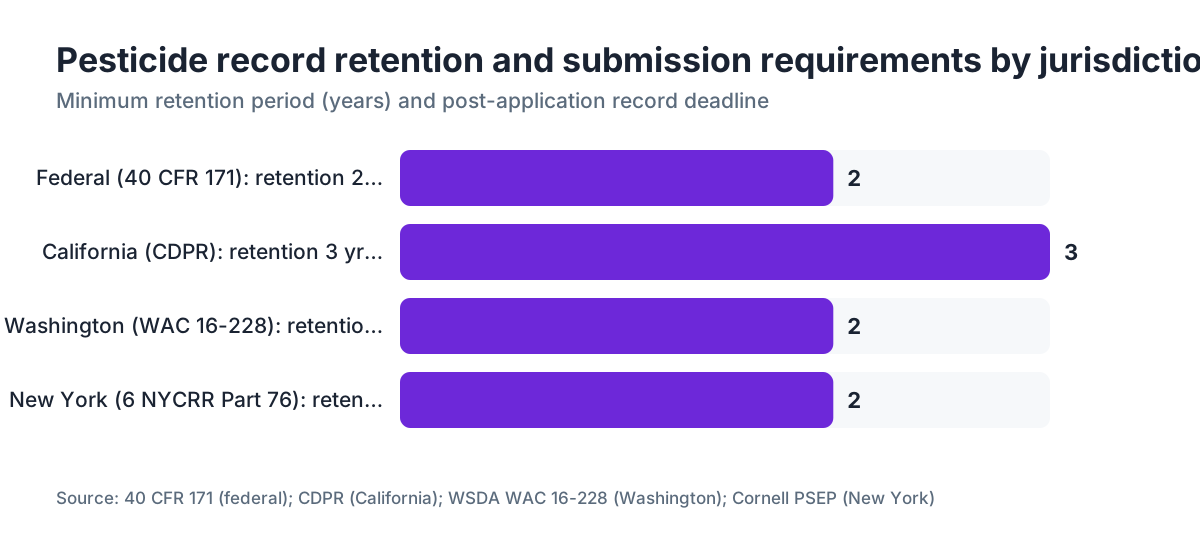
The federal record-keeping rules are a floor, and states build above it by very different amounts. Here's how key state requirements stack against the federal baseline:
| Requirement | Federal (40 CFR 171) | California (CDPR) | Washington (WAC 16-228) | New York (6 NYCRR Part 76) |
|---|---|---|---|---|
| Record completion deadline | 30 days | 7 days (month-end PUR) | "Keep current" (24-48 hrs in practice) | 30 days |
| Minimum retention period | 2 years | 3 years | 2 years | 2 years |
| Wash/disposal documentation required | Implicit (records must be complete) | Yes, rinse water disposal required in PUR | Yes, equipment cleaning log required for restricted-use pesticides | Recommended, not mandated |
| Submission to agency | No | Yes (monthly PUR) | No (kept on-site) | No (kept on-site) |
California is the strictest, by a wide margin. The California Department of Pesticide Regulation (CDPR) requires that all use of restricted-use and many general-use pesticides be reported through the county agricultural commissioner, and the PUR form's application method fields effectively force you to document your equipment configuration [4]. Swap nozzle types between applications, and CDPR expects that noted.
New York sits on the lenient end but still requires records available to the DEC on request. Cornell's Pesticide Safety Education Program recommends including tank cleaning notes because state inspectors use them to verify product sequencing [8].
Work in multiple states? Set your documentation standard to the strictest state you operate in and apply it everywhere. Maintaining different record formats for different properties is how gaps happen.
What records do you need for a mid-season nozzle replacement or tip change?
Most growers don't think about this one until an inspector asks. Swapping nozzle tips mid-season isn't an application event, but it does change your spray record accuracy. Your records should reflect the nozzle configuration in use during each application, because nozzle type and size drive application rate, droplet size, and drift potential.
The minimum documentation for a nozzle change:
- Date of change
- Equipment identifier (Sprayer #1, 300-gal trailer)
- Old nozzle type and size (e.g., TeeJet TP8004 flat fan, worn)
- New nozzle type and size (e.g., TeeJet TTJ60-11004, new)
- Reason for change
- Calibration check performed (yes/no, with new output rate)
- Technician name
Changed nozzles because tips were worn and flow rates had drifted? Note the calibration results before and after. That documents that your previous applications were within spec, or shows you caught the drift and corrected it, which is the honest and legally protective move.
For the nozzle rinse at end-of-season or before storage, document it like any other tank wash: product last applied, rinse method, rinse water volume and disposal, nozzle removal, and inspection for wear or clogging. UC Davis pest management guidelines flag clogged nozzles as a common source of unintentional over-application in vineyard blocks [9].
Are there record-keeping templates or software tools that cover tank wash documentation?
Yes, and using a template matters more than you'd guess. A blank sheet of paper invites you to record whatever comes to mind. A form with labeled fields makes you address every required element.
Free templates from extension programs:
- UC Davis IPM offers downloadable pesticide use record forms built for California compliance, including equipment cleaning fields [9].
- WSU Extension's pest management resources include spray record forms aligned with Washington WAC requirements [5].
- Cornell's Pesticide Safety Education Program includes templates for commercial applicator record-keeping in the northeastern states [8].
Run multiple blocks or multiple sprayers across a season, and paper forms get unwieldy fast. Misfiling, illegible handwriting, and lost pages are real problems, not hypothetical ones. Digital record-keeping platforms built for vineyard operations, like VitiScribe, link spray records to block maps and flag REI and PHI windows automatically, which cuts the risk of a gap forming between your application records and your tank wash entries.
Whatever system you run, the test is simple. Can an inspector sit down with your records and reconstruct exactly what product was in your tank, when you washed it out, where the rinse water went, and which nozzles ran during each application? If yes, you're compliant. If they'd have to guess at any of that, your record-keeping needs work.
How do you handle tank wash documentation when you're custom-spraying or using contract applicators?
This is where record-keeping gets genuinely complicated. Under FIFRA, the responsibility for maintaining application records sits with the certified applicator. Hire a licensed custom applicator or pest control adviser to spray your vineyard, and you need a written agreement that spells out who keeps the records and who gets copies.
Federal regulations require that when a certified commercial applicator applies pesticides for hire, they provide the agricultural employer (you) a copy of the application record within 30 days [2]. That record has to carry all the standard fields. But no federal rule specifically says the custom applicator must document their own tank wash, and none says you'll automatically receive that information.
The smart move: add a tank wash documentation requirement to your contract language. Something like: "Applicator agrees to provide, within 24 hours of each application, a completed spray record including post-application equipment cleaning notes, rinse water disposal location, and nozzle configuration used."
If your custom applicator sprays for other clients (which is typical), you also want them documenting tank condition before they arrive at your property. Cross-contamination from a previous client's application is a real liability. Ask for the pre-application tank history as part of their record.
Some state laws make this cleaner. California's CDPR requires the pest control operator's license number on the PUR, which creates a shared documentation chain between the custom applicator and the grower [4]. In other states, the grower is the ultimate record-holder and faces liability if the records aren't there, regardless of who actually sprayed.
Frequently asked questions
Do I need a separate form just for tank washes, or can it go on the spray record?
A separate form isn't required by federal law. Most growers add a clearly labeled "equipment cleaning" section to the bottom of their standard spray record. What matters is that the tank wash fields are present and completed, not which physical document they're on. If you run multiple sprayers, some operations find a standalone wash log easier to audit across equipment.
What counts as an acceptable rinse water disposal method in my records?
The three legally defensible options are: applying the rinse water to a crop site where the product is labeled at or below the label rate, sending it to a licensed hazardous waste handler with a manifest, or holding it in an approved on-site containment system for approved disposal. Your record should specify which method you used, the volume disposed of, and the exact location or facility name.
How many rinse cycles do I need to document for a triple rinse to be considered compliant?
Three complete cycles, each using roughly 10% of the tank's total capacity, filling, agitating for at least 30 seconds, and fully draining. Document each cycle individually if the label specifies triple rinse. Some labels for herbicides or growth regulators require additional cleaning steps beyond triple rinse, so always check the label of the product you just removed from the tank.
Does the EPA Worker Protection Standard require documented tank cleaning records specifically?
The WPS (40 CFR Part 170) requires that equipment used to apply pesticides be inspected and cleaned before reuse in areas where workers may enter during an REI. It doesn't create a standalone tank wash form requirement, but written evidence of cleaning supports your WPS compliance. If a worker exposure complaint is filed, the first thing an inspector asks for is documentation showing the equipment was properly decontaminated.
What's the minimum number of years I need to keep pesticide application records including tank wash notes?
Federal law requires 2 years under 40 CFR 171.103. California requires 3 years under CDPR regulations. A few states have different rules, so check your state ag department. In practice, keeping records for 3 years across the board is the simplest approach if you're not sure which state's rules are stricter, and storage costs for digital records are negligible.
Do I need to document tank washes for organic-approved materials like sulfur or copper?
Yes. Organic certification doesn't eliminate record-keeping requirements. USDA National Organic Program regulations require certified organic operations to maintain records for 5 years showing all inputs applied to crops. If you're washing a tank after sulfur and preparing to apply copper, a documented wash also protects against cross-contamination claims between those two reactive materials, which can cause phytotoxicity at certain ratios.
What do I write if I realize I forgot to log a tank wash from two weeks ago?
Write the entry dated today with a notation that it's a late entry reconstructed from field notes or memory, and specify what you do and don't recall precisely. Something like: "Late entry, reconstructed 07/02/2025. Tank wash performed approximately 06/18/2025 after mancozeb application. Method: triple rinse. Exact volume uncertain, estimated 30 gallons. Rinse water applied to Block 7." An honest late entry beats a fabricated one or no entry at all.
If I'm using a tank cleaner product between incompatible pesticides, does that product need its own spray record entry?
If the tank cleaner is a registered pesticide with an EPA registration number, yes, it needs to appear in your records. Some tank cleaners are cleaning agents only, not pesticides, and don't require a pesticide application record. Check the product's EPA status. If it has a registration number on the label, treat it like any other pesticide and document the rate, volume mixed, and disposal method.
Can I use photos on my phone as part of my tank wash documentation?
Photos are excellent supplementary evidence but they're not a substitute for written records in most states. A timestamped photo of a clean tank can support your written log if records are challenged, and some digital platforms let you attach images directly to application records. The written record is still the primary document regulators check. Use photos to supplement, not replace.
What fields does California's pesticide use report require related to equipment cleaning?
California's PUR form, filed with the county agricultural commissioner, requires application method, equipment type, and total product applied. It doesn't have a dedicated tank wash field, but CDPR expects the records taken together (the PUR plus your on-farm spray records) to account for all product use and disposal. County ag commissioners in high-scrutiny counties like Napa and Sonoma routinely ask for supplementary records during compliance audits.
Do I need to document tank wash records for pre-emergent herbicide applications in vineyard row middles?
Yes, especially if you're switching to a foliar product afterward. Pre-emergents and foliar fungicides or insecticides are often incompatible, and cross-contamination from an improperly cleaned tank is a phytotoxicity risk. Your tank wash record after an herbicide application matters even more because herbicide labels often carry specific cleaning requirements beyond triple rinse, including ammonia-based cleaners or activated charcoal.
How do I record a mid-season nozzle tip replacement in my spray records?
Add a dated equipment maintenance note to your spray log specifying the equipment identifier, old nozzle type and size, new nozzle type and size, reason for replacement, and a calibration check result. This note links the nozzle configuration to the spray records immediately before and after the change, which protects you if an application rate question comes up. Keep the worn nozzles in a labeled bag for at least one season if inspection is a concern.
What happens to my grape sale contracts if my pesticide records have gaps?
Most winery purchase contracts now include a pesticide compliance clause requiring clean records back one to three seasons. A documented gap, particularly in tank wash records that could suggest an unlabeled product was used, gives the buyer grounds to reject a lot or withhold payment pending investigation. Many disputes settle with a written explanation, but you need records to negotiate from. No records means no standing.
Sources
- EPA, Federal Insecticide Fungicide and Rodenticide Act (FIFRA) overview: FIFRA Section 14 civil penalties up to $5,500 per day per violation for commercial applicators; FIFRA classifies pesticide rinse water as pesticide waste subject to disposal requirements
- Electronic Code of Federal Regulations, 40 CFR Part 171, Certification of Pesticide Applicators: 40 CFR 171.103 requires certified applicators to maintain records of each pesticide application for at least 2 years, including date, product name, EPA reg number, amount applied, location, applicator name and certification number, and target pest
- EPA, Agricultural Worker Protection Standard (WPS), 40 CFR Part 170: WPS requires employers to post application information within 24 hours of any application and maintain it for 30 days or until REI expires; equipment used to apply pesticides must be inspected and cleaned before reuse in areas where workers may enter during REI
- California Department of Pesticide Regulation, Pesticide Use Reporting: California requires pesticide use reports submitted to the county agricultural commissioner within 7 days of the end of each month; CDPR requires records retained for 3 years
- Washington State Department of Agriculture, Pesticides, Fertilizers, and Safety: WAC 16-228-1310 requires pesticide application records to be kept current and available for inspection for 2 years; WSU Extension recommends attaching label pages to spray records
- EPA, Pesticide Worker Safety and container disposal, Triple Rinse guidance: EPA recommends triple rinse procedure: fill to 10% capacity, agitate 30 seconds, drain completely, repeat three times; rinse water must be applied to a labeled use site or disposed of via licensed handler; dumping on non-target sites is an illegal discharge under FIFRA and potentially CWA
- EPA, Label Review Manual: Labels may specify cleaning requirements beyond triple rinse for herbicides and growth regulators, including ammonia-based solutions or activated charcoal; applicators must follow label requirements for tank cleaning
- Cornell Cooperative Extension, Pesticide Safety Education Program: Cornell PSEP notes that the applicator bears the burden of demonstrating compliance; guidelines for commercial applicators recommend including tank cleaning notes to verify product sequencing; many winery purchase contracts require clean pesticide records back at least one full growing season
- UC Statewide Integrated Pest Management Program, Pesticide Use Records: UC IPM recommends completing spray records and tank wash entries the same day while details are fresh; clogged or worn nozzles are flagged as a common source of unintentional over-application in vineyard blocks; downloadable pesticide use record forms include equipment cleaning fields
- USDA Agricultural Marketing Service, National Organic Program: NOP regulations require certified organic operations to maintain records for 5 years showing all inputs applied to crops, including organic-approved materials such as sulfur and copper
- EPA, Enforcement: EPA's civil penalty matrix under FIFRA treats record-keeping violations based on culpability, effect, and history; first-time incomplete records with no contamination may draw $250-$1,000; patterns of missing records or records tied to worker illness complaints can reach statutory maximum
Last updated 2026-07-10