How to document tank mix pesticide applications in spray records

TL;DR
- Each product in a tank mix needs its own line in your spray record: product name, EPA registration number, rate per acre, total volume mixed, and target pest.
- EPA's Worker Protection Standard plus California, Washington, and Oregon rules all demand that level of detail.
- Miss one field on one application and an inspector can hand you a violation notice.
What information is legally required in a pesticide spray record?
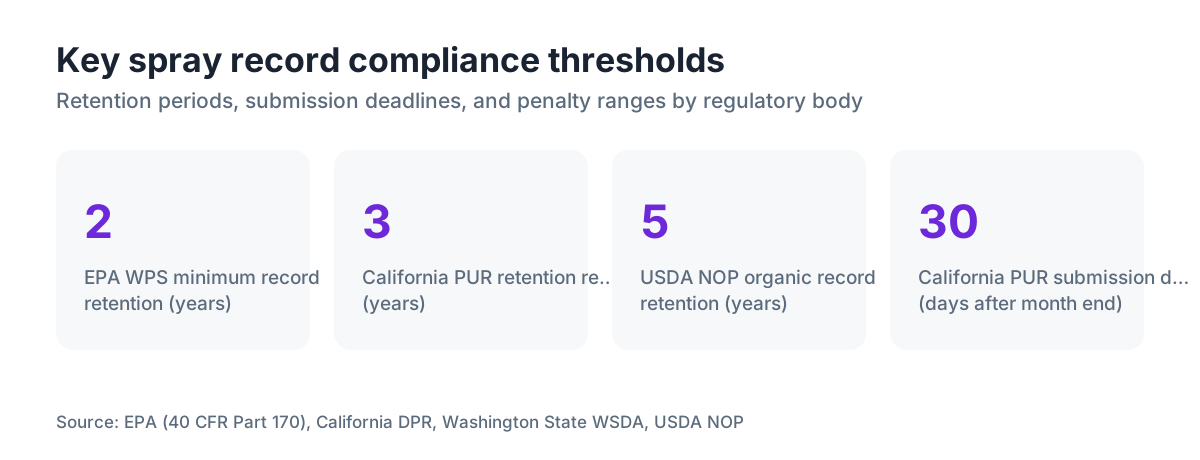
Federal law is the floor, not the ceiling. The EPA Worker Protection Standard (40 CFR Part 170) requires application records kept for at least two years that include the product name and EPA registration number, the active ingredient, the crop and location treated, the date and time, the size of the area treated, and the certified applicator's name [1]. State rules stack on top. California's Department of Pesticide Regulation requires the pesticide use report (PUR) to carry the county site ID, the product's registration number, the pounds of active ingredient applied, the application method, and the equipment used [2]. Washington requires similar data under RCW 17.21 and WAC 16-228 [3].
Here's the part that trips people up. "Tank mix" is not a recordable unit. Every product in the mix counts as a separate pesticide application on paper. Mix a fungicide, an insecticide, and a spreader-sticker into one tank and your record needs at least two product entries. (A spreader-sticker with no pesticidal claim may not need a PUR entry in some states. Check your state's rules.)
The UC Davis IPM program says it flat out: records must be product-specific, not mixture-specific [4]. That difference matters the moment an inspector opens your logbook and sees "tank mix" written as one line. In any state that requires a PUR, that is not an acceptable entry.
How do you record each product in a tank mix separately?
One row per product, per application event. That's the whole method. Spray three products on the same day, same block, same equipment, same start-to-finish window, and you still write three rows. Each row shares the date, block ID, applicator name, equipment ID, water volume, and weather. What changes row to row: product name, EPA Reg. No., formulation, rate per unit area, and total quantity used.
Here's what a minimal compliant tank mix entry looks like for a two-product mix in one block:
| Field | Product 1 Entry | Product 2 Entry |
|---|---|---|
| Date | 2024-05-14 | 2024-05-14 |
| Block / Site ID | Block 3A, 4.2 ac | Block 3A, 4.2 ac |
| Product Name | Pristine WG | Lorsban Advanced |
| EPA Reg. No. | 7969-138 | 62719-220 |
| Active Ingredient(s) | Boscalid 25.2%, Pyraclostrobin 12.8% | Chlorpyrifos 41.96% |
| Formulation | WG | EC |
| Rate (per acre) | 14.5 oz | 2 pts |
| Total Applied | 60.9 oz | 8.4 pts |
| Target Pest | Botrytis, Powdery Mildew | Leafhoppers |
| Water Volume | 75 gal/ac | 75 gal/ac |
| Application Method | Airblast sprayer | Airblast sprayer |
| Applicator (cert. no.) | J. Torres, CA-12345 | J. Torres, CA-12345 |
| Wind / Temp / RH | 5 mph NW / 68°F / 52% | 5 mph NW / 68°F / 52% |
Yes, you're duplicating a lot of data. The redundancy is the point. Every row has to stand alone as a complete, auditable record, because inspectors often pull records product by product, not block by block.
If your paper logbook physically can't fit that many rows, use a continuation sheet or note in the block entry that the application continues on the next page. Never cram two products onto one line to save space. That single shortcut is where most vineyard records fail inspection.
Where do you find the EPA registration number for tank mix products?
It's on the label. Every product registered under FIFRA carries an EPA Registration Number on the front panel or near the Directions for Use, written as two numbers split by a hyphen (62719-220, for example). The first segment is the registrant's company number. The second is the product number [5].
Working from a Safety Data Sheet instead of the label? The EPA Reg. No. sits in Section 1 or Section 15 of the SDS. You can verify any number through EPA's pesticide product search at epa.gov [5].
Generic products throw people off. The EPA Reg. No. on a generic differs from the brand-name original even when the active ingredient is identical. Record the number exactly as it reads on the label you actually used. Don't borrow a number from a different label because the product "seemed equivalent."
One edge case bites small operations. Sticker-spreaders and crop oils sold without a pesticidal claim carry no EPA Reg. No. because they aren't registered pesticides. Add one to a tank and you still note it in your record as an adjuvant with the product name and amount used. You just won't have a registration number to write down.
What weather data do you need to record for each spray application?
Temperature, wind speed, and wind direction at the time of application. The EPA WPS and most state rules require all three [1]. California DPR also wants relative humidity, and plenty of county agricultural commissioner offices want it either way [2]. WSU Extension suggests logging conditions at both the start and end of long spray days, because a vineyard block can shift enough in two hours to matter if a drift complaint lands on you [6].
Record it at the site. Not from a weather station five miles up the road. A $30 Kestrel pocket meter reads temperature, wind speed, and RH right where you're standing. Buy one.
Restricted-use pesticide (RUP) applications carry stricter weather documentation. California requires RUP records to show the start time, end time, and weather at application for each field or block treated [2]. A tank mix with even one RUP product means the whole application event inherits RUP documentation rules.
If conditions change hard mid-application, stop. Note the time and the changed conditions, then start a fresh set of entries for the rest of the block. That's the cleanest way to handle it, and it's exactly what the county ag commissioner expects to see.
How do you calculate and record the total amount of each tank mix product used?
Rate per acre times acres treated equals total product applied. Write both numbers. Some state PUR forms ask only for total pounds of active ingredient, not total formulated product, so you'll run that math too.
For a wettable granule (WG) or water-dispersible granule (WDG): multiply the label rate in ounces per acre by acres treated, then convert to pounds using the label's declared active ingredient percentage.
Example: Pristine WG at 14.5 oz/ac over 4.2 acres = 60.9 oz formulated product. The label states boscalid at 25.2% and pyraclostrobin at 12.8%. Total active ingredient = (60.9 / 16) pounds × 38% combined = 1.44 lbs a.i. applied.
For emulsifiable concentrates and other liquids, note whether your rate is in fluid ounces or pints and stay consistent all the way through. Plenty of California PUR submissions fail because the applicator entered fluid ounces when pounds were required, or dropped the rate-per-acre figure into the total-applied column.
Cornell Cooperative Extension's applicator training materials include a calculation worksheet built for PUR submissions that walks through the unit conversions [7]. Print it. Keep it in the logbook.
One more thing. If you tank-topped mid-block because you ran out of mix, document it. Note the volume left when you stopped, calculate the area the first load actually covered, and start a new entry for the reload. Logging it as one continuous entry when the tank was refilled and possibly remixed is inaccurate and warps your total-applied figures.
What are the pre-harvest interval and REI rules for tank mixes, and how do they affect your records?
Tank mix two or more products and the most restrictive restricted entry interval (REI) and pre-harvest interval (PHI) govern the whole application. Your record has to show which product in the mix drives the REI and PHI, so field workers and your own crew know the controlling limit [1].
The EPA WPS requires the REI to be posted on the treated area's warning sign at the start of the restricted entry period, and its duration has to match the longest REI among all products in the mix. Mix a 4-hour REI product with a 24-hour REI product and you post 24 hours [1].
For your record, write the controlling REI and the product that sets it. Write the controlling PHI and the product that sets it. Don't just write the numbers. "24-hr REI (Lorsban)" and "PHI 21 days (Lorsban)" means someone reading the record six months later can verify it without hunting through four label PDFs.
The WPS at 40 CFR 170.401(c) requires the handler employer to ensure the pesticide is applied consistent with the labeling and that restricted-entry interval information reaches workers. That obligation starts with accurate spray records.
Organic operations feed REI and PHI documentation straight into the organic system plan audit trail. OMRI-listed and NOP-compliant products still carry entry intervals, and your certifier will review spray records for PHI compliance at renewal.
How long do you have to submit pesticide use reports and keep spray records on file?
Federal WPS sets a two-year minimum for handler activity records [1]. California's PUR rule means you submit the previous month's pesticide use data to your county agricultural commissioner by the last day of the following month. May applications are due by June 30 [2]. California also requires copies kept for three years.
Washington requires pesticide application records retained for two years and available to the Department of Agriculture within 24 hours of a request [3]. Oregon's ODA runs a similar two-year retention rule under OAR 603-057.
For restricted-use pesticides, many states require the certified applicator's copy be held separate from the general farm record and producible on-site within one business day. If a third-party PCA (pest control adviser) or CCA is involved, put in writing who holds the primary record obligation.
Cloud-based vineyard management software, tools like VitiScribe included, lets you produce a dated, timestamped record fast for any inspection request. Paper logbooks are completely legal and perfectly fine, but they get wet, they burn, and they don't stamp their own timestamps. Whatever system you run, back it up.
What records do you need to keep for restricted-use pesticide tank mixes?
Restricted-use pesticides (RUPs) are their own category with documentation beyond the standard PUR. FIFRA Section 11(a) and EPA regulations at 40 CFR 171 require RUP application records to include the product name and EPA registration number, the amount applied, the location and date, the certified applicator's name and certification number, and the name of any non-certified applicator working under supervision [9].
In practice, one RUP plus two general-use products in a tank means RUP-level recordkeeping applies to the entire event. All products get documented at the RUP standard, not only the restricted one.
California layers on more for certain RUPs, especially organophosphates and carbamates, including pre-application notices to the county and, in some cases, to adjacent landowners. Got chlorpyrifos or something like it in your tank? Check your county's current use requirements before you spray. Some California counties add restrictions or notification steps beyond the state baseline [2].
RUP records usually have to live at the certified applicator's business location, not only at the farm. Hire a licensed pest control operator to make the application and you should get a copy of their record for your own files, then match it against your field notes.
What mistakes most commonly trigger spray record violations during inspections?
These are the failure modes California county agricultural commissioners and Washington inspection reports flag over and over:
Missing EPA registration numbers. A product name alone isn't compliant. Inspectors can't verify the product without the Reg. No., and "Pristine" tells them nothing about the formulation or registrant.
Tank mix entered as one line. "Tank mix: Pristine + Lorsban, 14.5 oz + 2 pts" as a single entry is wrong. Two products, two rows.
Rate-per-acre recorded, total applied blank. The PUR requires total applied. Rate alone doesn't satisfy it.
Weather data from a remote station. Numbers from a nearby CIMIS station or airport ASOS aren't enough. Conditions have to reflect the treatment site.
Target pest not specified. "Disease" or "insects" is too vague. Write the name: Botrytis cinerea, Erythroneura elegantula.
No certified applicator number. If the application needed a licensed applicator, the record has to carry the license or certificate number, not only the name.
Missed submission deadline. A California PUR filed late to the county ag commissioner draws a Notice of Violation even when the underlying record is perfect.
WSU Extension's record-keeping guide lists these same categories as the top inspection deficiencies in Washington audits [6].
How should you handle corrections and amendments to spray records?
Spray records are legal documents. Correct them the way you'd correct any legal document: draw a single line through the wrong entry, write the correction, date it, and initial it. Never white out, erase, or overwrite. An obliterated entry reads like a cover-up even when it's an honest slip.
Digital systems should handle the correction trail on their own. A compliant electronic record keeps the original entry and logs the correction as a separate timestamped event. If your software overwrites the original with no audit trail, that's a compliance problem sitting in plain sight.
Find a systematic error, say the wrong EPA Reg. No. across 15 entries because you had an old label, and you correct every entry, then write a short explanatory note at the top of that section. Contact your county ag commissioner on your own if the error touches submitted PURs. Self-reporting and filing a corrected PUR beats having an inspector find it, every time.
California DPR's guidance on PUR amendments requires a corrected report within 30 days of discovering the error. The corrected report replaces the original on file, and both stay retained [10].
Are there digital tools or apps that can simplify tank mix record-keeping?
Yes, and a few are worth your time. Features to demand: automatic EPA Reg. No. lookup by product name, multi-product entry for one application event, automatic calculation of total active ingredient applied, weather capture, and a PUR-formatted export that matches your state's submission format.
California operations can use DPR's free online PUR submission portal, but it's manual entry only and won't auto-populate from your field records. You're still copying data from paper to screen.
VitiScribe is built for vineyard operations and handles tank mix entries as separate product rows that share application event data, which strips out most of the manual duplication described above. Any tool you test should produce a state-formatted export without manual reformatting.
WSU Extension's spreadsheet template, free through their pesticide management program, works for smaller operations that don't need a full software subscription [6]. Cornell's IPM program offers similar templates tuned to New York's DEC requirements [7].
Whatever you pick, the test is simple. Can you produce a compliant, auditable record for a three-product tank mix in under five minutes? If it takes longer, the system isn't beating paper.
How do tank mix records interact with organic certification requirements?
Organic certification under the USDA National Organic Program (NOP) requires an Organic System Plan (OSP), and your records have to support it. Every input applied to a certified organic vineyard needs to trace back to an approved material, and your spray records are the primary evidence [8].
For tank mixes in an organic system, each product in the mix has to be individually approved under 7 CFR Part 205. Your certifier reviews your spray records and cross-checks every EPA Reg. No. or product name against the OMRI list or your approved materials list. A single unapproved product in a tank can put certification at risk for that block or that season.
Organic spray records should also note the lot number or purchase date of each material. Certifiers sometimes ask to confirm the product you used matches the formulation on the OMRI list, because formulations change and a previously approved product can be reformulated with a non-compliant ingredient.
Keep certificates of compliance and purchase invoices for every product. The invoice ties the product to a lot, the lot ties to the label, the label ties to the OMRI approval. That chain is what carries you through a contested renewal.
NOP record-keeping rules require producers to keep records for five years, longer than most state pesticide retention requirements [8].
Frequently asked questions
Do I need to record adjuvants and spray oils in my pesticide spray records?
If the adjuvant or oil carries an EPA registration number, record it like any other product. If it's sold purely as an inert carrier with no pesticidal claim, no EPA Reg. No. is required, but note the product name and amount used anyway for liability and drift investigation purposes. California DPR doesn't require PUR entries for non-pesticidal adjuvants, but noting them is good practice.
Can I group multiple blocks into one spray record entry if I sprayed them in the same pass?
You can list multiple blocks on one entry if the application was truly continuous with the same equipment, same mix, and same applicator, no stopping and reformulating. List each block ID and its acreage separately. The total area treated is the sum of those blocks. For California PURs, each legal land description (township/range/section) may need its own entry depending on county requirements, so check with your local ag commissioner.
What happens if I forget to record a spray application the same day?
Record it the moment you catch the gap. Many states require same-day recording for restricted-use pesticides; California requires RUP records completed by the end of the day of application. For general-use products, recording within 24 hours is standard practice. Don't backdate. Write the actual application date and the date the record was completed as two separate fields. Inspect your records weekly to catch gaps early.
How do I record a tank mix where I didn't use the full tank on one block?
Calculate the area actually treated with each load and record it block by block. Mix a 200-gallon tank, spray Block A with 120 gallons, then finish Block B with the remaining 80 gallons, and you record two separate entries with proportional area treated and proportional product applied for each. The total product across both entries should equal what went in the tank, minus any leftover you disposed of or returned.
What is the penalty for missing or incomplete spray records in California?
California county agricultural commissioners can issue civil penalties under Food and Agricultural Code Section 12999 for incomplete or missing pesticide use records. First-offense penalties commonly run from a warning notice to several hundred dollars per violation. Repeated violations or missing RUP records can reach $5,000 per violation. Falsified records can trigger criminal referral. The risk from a single inspection usually dwarfs the cost of keeping proper records.
Does my certified crop adviser or PCA need a copy of my spray records?
A PCA who makes written pesticide recommendations in California must keep copies of those recommendations for two years under California Food and Agricultural Code Section 11732. Your spray record as the operator is separate from the PCA's recommendation record. Give your PCA access to your spray records for follow-up scouting, but the legal duty to keep the use record sits with the operator or the licensed applicator, not the PCA.
How do I calculate pounds of active ingredient applied for a tank mix with multiple products?
Calculate each product separately. For each one: multiply rate applied per acre by acres treated to get total formulated product, then multiply by the active ingredient percentage on the label. Sum the results per active ingredient. If two products share an active ingredient (rare, but possible with generic premixes), add them together. California PUR forms have separate rows per active ingredient, so a multi-AI product like Pristine needs two AI rows per application.
What records do I need to provide to field workers about tank mix applications under WPS?
Under the EPA Worker Protection Standard (40 CFR Part 170), you must display a WPS safety poster and the product safety data sheet in a central location workers can reach. For each application, post the details (product, treated area, REI) on the field warning sign before application begins. Workers re-entering after the REI must be able to access application information including product name and REI on request. Records must stay available for 30 days after the REI expires.
Can I use a phone app for spray records or do they need to be on paper?
Electronic records are legal in all major wine-producing states as long as they can be printed or exported on demand and are stored for the required retention period. California DPR accepts electronic records provided they contain all required data fields and are retrievable during an inspection. The record must be producible within one business day for most state inspections. Back up electronic records offsite or in cloud storage to survive device failure.
Do tank mix spray records need a signature from the certified applicator?
California and Washington both require the certified applicator's name and certificate or license number on each RUP application record. A physical signature isn't universally required by statute, but many county ag commissioners expect one on paper records, and it's good practice. For digital records, a login audit trail tied to the certified applicator's credentials does the same job. Check your county's specific inspection checklist for their expectation.
How do I handle spray records for a vineyard I manage for an absentee owner?
The legal record duty generally falls on whoever made the application: the certified applicator and the operator of the land. If you're a contracted vineyard manager, your contract should spell out who keeps the primary records and who handles state submissions. Keep your own copy of every spray record you generate regardless of the contract. In California, both the certified applicator and the property operator can be held responsible for incomplete records.
What's the difference between a spray log and a pesticide use report (PUR)?
A spray log is your internal field record, created at the time of application. A PUR is the formal submission to the county agricultural commissioner required in California. The spray log usually holds more operational detail (equipment settings, tank volume, block conditions). The PUR is a standardized form with set data fields. Your spray log should contain everything needed to complete the PUR, but the PUR is a summary derived from your log, not a replacement for it.
How do I find the current label for a product in my tank mix if I've lost the original?
EPA's pesticide label database at epa.gov lets you search by product name or EPA registration number to find the current registered label PDF. CDMS and Greenbook are industry alternatives that aggregate current labels. Always use the currently registered version, never an old copy. Labels are amended periodically, and using an outdated label for a rate or use site that's no longer approved is an off-label application, even if the physical container predates the amendment.
Sources
- EPA, Worker Protection Standard (40 CFR Part 170): WPS requires application records kept for two years, including product name, EPA Reg. No., active ingredient, crop, location, date, area treated, and certified applicator name; REI must reflect the longest interval among all mixed products.
- California Department of Pesticide Regulation, Pesticide Use Reporting: California requires monthly PUR submissions to county ag commissioner by last day of following month, three-year record retention, and RUP records completed by end of day of application including weather conditions.
- Washington State Department of Agriculture, Pesticide Recordkeeping (RCW 17.21, WAC 16-228): Washington requires pesticide application records retained for two years and available to the Department of Agriculture within 24 hours of a request.
- UC Statewide Integrated Pest Management Program, Pesticide Record Keeping: UC IPM states records must be product-specific, not mixture-specific, meaning each product in a tank mix requires its own entry.
- EPA, Pesticide Registration and Labeling: EPA registration numbers are required on all FIFRA-registered product labels and must be recorded for every RUP application under 40 CFR 171; numbers can be verified through EPA's pesticide product search.
- Washington State University Extension, Pesticide Record Keeping Guide: WSU Extension recommends recording weather conditions at start and end of long spray days at the treatment site, and identifies missing EPA Reg. Nos. and single-line tank mix entries as top inspection deficiencies.
- Cornell Cooperative Extension, Pesticide Applicator Training and Record Keeping: Cornell Cooperative Extension provides calculation worksheets for PUR submissions including unit conversion guidance for active ingredient reporting.
- USDA National Organic Program, Record Keeping Requirements (7 CFR Part 205): NOP requires organic producers to maintain records for five years; every input in a tank mix must be individually traceable to an approved material under 7 CFR Part 205.
- EPA, Federal Insecticide Fungicide and Rodenticide Act (FIFRA) Section 11: FIFRA Section 11(a) and 40 CFR 171 require RUP records to include product name, EPA Reg. No., amount applied, location, date, certified applicator name and certificate number, and names of non-certified applicators under supervision.
- California Department of Pesticide Regulation, PUR Amendment Policy: California DPR requires corrected PUR submissions within 30 days of discovering an error; both original and corrected reports are retained on file.
- California Food and Agricultural Code Section 12999: Civil penalties for incomplete or missing pesticide use records in California can reach $5,000 per violation for repeated or RUP-related offenses under Food and Agricultural Code Section 12999.
Last updated 2026-07-10