How to document a vineyard EQIP payment schedule and practice completion

TL;DR
- To get paid under EQIP, you document each conservation practice with NRCS-approved forms, dated field notes, receipts, and a signed certification of completion before any payment releases.
- Payments follow a practice-by-practice schedule tied to the payment schedule table in your contract, and NRCS can audit your records for three years after the contract ends.
What is an EQIP payment schedule and why does documentation control it?
EQIP, the Environmental Quality Incentives Program run by USDA's Natural Resources Conservation Service, pays producers for putting specific conservation practices on working farmland, vineyards included. Congress funded it at roughly $8.45 billion over the 2018 Farm Bill's five-year window, and the 2022 Inflation Reduction Act added billions more targeted at climate practices. Vineyard operations compete for that money through state-level ranking [1].
The payment schedule is the table baked into your EQIP contract. It lists every practice code, the cost-share percentage NRCS will pay, the payment limit, and the window in which you must finish and certify the practice. Treat it like a milestone chart. You finish Practice 442 (sprinkler irrigation system installation), you document it, NRCS inspects and approves, then a payment releases. Nothing moves until the documentation lands first.
This is not a grant with money arriving upfront. Payments are cost-share reimbursements. You spend, then you get paid back a percentage. The documentation package is what turns your out-of-pocket spending into a reimbursable claim.
Miss a documentation step or blow the completion deadline and the payment can be reduced, withheld, or cancelled outright under 7 CFR Part 1466 [2].
For vineyard operators, the common practices are microirrigation conversion (Practice Code 441), cover crop establishment (340), residue and tillage management (329), integrated pest management (595), and hedgerow planting (422). Each code has its own technical standard and its own required evidence of completion.
What does NRCS actually require you to document for each practice?
The core documentation set for any EQIP practice completion has five parts. Every one matters, and the order matters too.
First, the conservation plan or practice design. Before you start work, NRCS prepares or approves a plan showing the specs: dimensions, materials, installation methods, application rates. Keep it on file because your completion documentation has to match it. Install a drip system at a different emitter spacing than the plan calls for and you have a problem at certification time.
Second, dated photographs. Field offices vary in how formal they get about photos, but shooting before, during, and after installation is the standard expectation. For a trellis system, that means posts in the ground, wires strung, and the finished row. Name your photo files with the date, or shoot on a device that embeds GPS and timestamp metadata. NRCS state conservation program guidance treats photographic evidence as part of the practice review process [3].
Third, receipts and invoices. Every expenditure you want reimbursed needs a paper trail. Contractor invoices, nursery receipts for cover crop seed, drip tape purchase records, irrigation labor bills. Keep originals. Auditors sometimes call the vendor to verify amounts.
Fourth, the practice certification form. This is usually the NRCS-CPA-1245 or a state equivalent. Your local office provides the form, or you request it through the USDA eAuthentication portal. You sign it. Your District Conservationist or a designated Technical Service Provider (TSP) countersigns after field verification. No countersignature, no payment.
Fifth, a practice completion report or implementation record. Some states use an internal worksheet that logs GPS coordinates of the installed practice, acreage treated, and materials used. Ask your local office for their exact form set at the contract signing meeting. Not six months later when you're trying to submit a claim.
How does the EQIP payment schedule work step by step?
The payment schedule table lists each practice code in a row, with columns for the contract year, the payment rate per unit (per acre, per linear foot, per system), and the total payment cap. Practices completed in Year 1 must be submitted for payment inside that fiscal year window, which usually closes September 30 because NRCS runs on the federal fiscal year.
Here is the standard sequence for a single practice payment:
- You finish the practice in the field according to the approved design.
- You tell your NRCS service center the practice is ready for review.
- An NRCS employee or a certified TSP visits to verify it.
- If it complies, they sign the CPA-1245 certification form.
- You submit the certification form, your invoices, and any required supporting documents to the service center.
- NRCS processes the claim and issues payment, usually within 30 to 60 days of a complete submission, though busy enrollment periods stretch that.
If a practice spans two contract years, you may get a partial payment at an interim milestone and a final payment at full completion. The schedule table spells this out when it applies.
Here is what practitioners get wrong: they assume NRCS will chase them. It won't. Finish a practice and fail to submit documentation by the deadline, and the payment opportunity often just closes. Set your own calendar reminders well ahead of the September 30 cutoff.
What records do you need to keep and for how long?
Federal rules at 7 CFR Part 1466 require producers to keep records supporting EQIP claims for three years after the final payment under the contract [2]. On multi-year contracts, that clock starts at the end of the whole contract, not each individual payment. So a five-year EQIP contract signed in 2024 with a final payment in 2029 means you hold records through at least 2032.
The minimum record set to keep:
- A copy of the signed EQIP contract and all amendments
- The approved conservation plan and any practice designs
- All practice certification forms (CPA-1245 or state equivalent)
- Invoices and receipts for every cost-share eligible expenditure
- Photographs organized by practice code and date
- Any correspondence with your NRCS office about compliance concerns or approved modifications
- Irrigation scheduling records if your contract includes an irrigation water management practice
For a vineyard-specific practice like cover crop establishment under Code 340, WSU viticulture extension resources describe stand establishment documentation, including seeding rates, seed mix composition, and a post-establishment photo survey, as part of the practice record [5].
Store everything in two places. A physical folder in a fireproof cabinet plus a cloud-synced digital folder is the floor, not the ceiling. NRCS can request records within days of an audit notice, and reconstructing three-year-old invoices under that kind of deadline is a bad place to be.
What EQIP payment limits and rates apply to vineyards specifically?
EQIP has a statutory payment cap. Under the 2018 Farm Bill, one person or legal entity cannot receive more than $450,000 in EQIP payments over any six-year period [1]. That limit covers all their EQIP contracts combined, not one per operation.
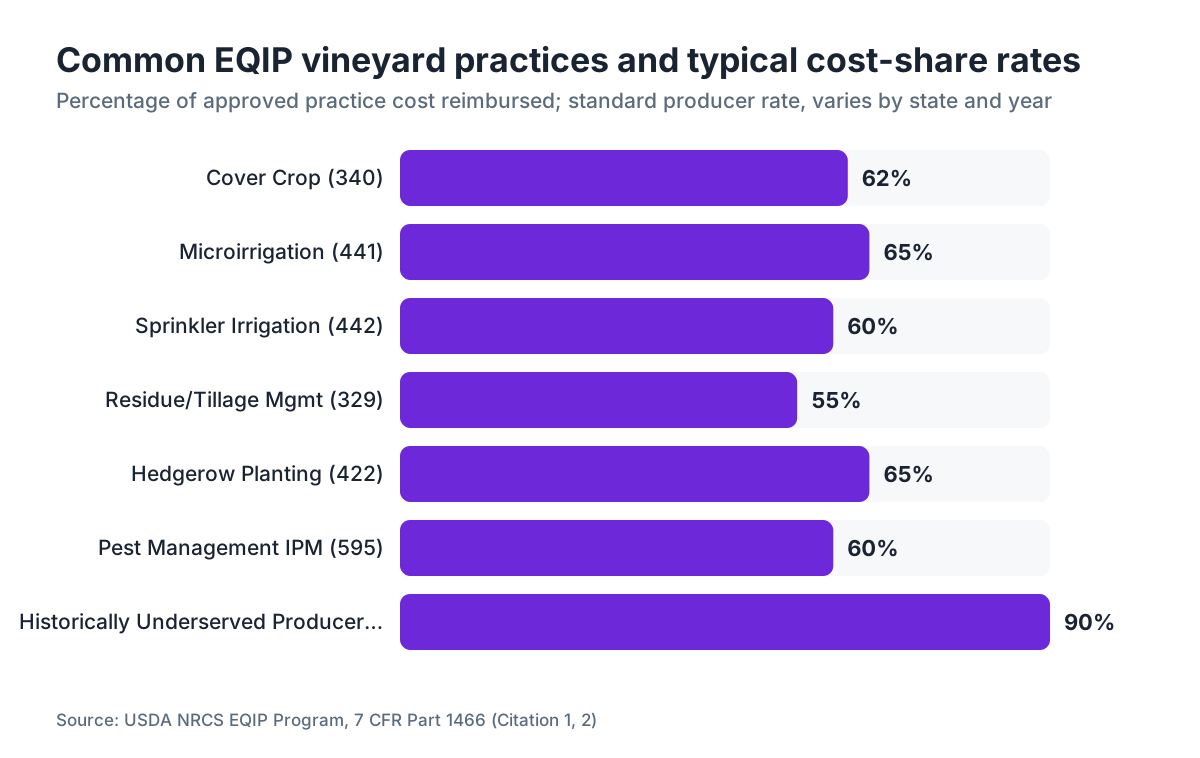
The cost-share rate, meaning the slice of practice cost NRCS pays, changes by practice, state, and producer status. Standard rates usually run 50 to 75 percent of the practice's approved cost schedule. Historically underserved producers (beginning farmers, limited resource farmers, and others defined in 7 CFR Part 1466) can receive up to 90 percent cost-share [2].
Vineyard payment rates come from NRCS state-level cost lists that set the approved cost per unit for each practice code. Those lists update every year. A drip system under Code 441 might carry an approved cost of $1,200 to $2,500 per acre depending on state and system type, and NRCS reimburses the agreed percentage of that approved cost, not your actual invoice if the invoice runs higher. Check your state's current cost list through your local NRCS office before you finalize a budget.
Beginning farmers should document their status at enrollment. That qualifying status sets your cost-share rate for the whole contract, and if NRCS later finds it was recorded wrong, they can recalculate payments.
| Practice Code | Practice Name | Typical Payment Unit | Common Cost-Share Range |
|---|---|---|---|
| 340 | Cover Crop | Per acre | 50-75% |
| 441 | Irrigation System, Microirrigation | Per acre | 50-75% |
| 442 | Irrigation System, Sprinkler | Per system | 50-75% |
| 329 | Residue and Tillage Mgmt | Per acre | 50-75% |
| 422 | Hedgerow Planting | Per linear foot | 50-75% |
| 595 | Pest Management | Per acre | 50-75% |
| 472 | Access Road | Per linear foot | 50-75% |
Note: Exact rates are set annually at the state level and differ by county ranking. Always confirm current rates with your NRCS service center.
How do you handle a mid-contract modification or practice that wasn't completed on time?
Contracts change. Equipment delays, weather, labor shortages, a replant that reshuffles your priorities. NRCS has a formal process for all of it.
If you know a practice won't be done by its scheduled deadline, contact your service center before the deadline, not after. Ask for a contract modification. NRCS can approve extensions, swap practice codes within your conservation plan, or shift payment years. They document it with a signed amendment to your contract. Keep that amendment with your records.
Miss a completion deadline without an approved modification and NRCS may issue a notice of non-compliance. Under 7 CFR Part 1466, producers who fail to meet contract terms can be required to refund payments already received, plus interest [2]. The interest is the standard Treasury rate that applied at the time of the original payment. It adds up fast.
For a practice you only partially finished, document what got done and put the status in writing to your NRCS contact. Email works. It creates a time-stamped record. A verbal conversation does not.
The single thing that derails more vineyard EQIP contracts than anything else is the irrigation timeline. Installing a new drip system takes longer than most growers plan for once supply chains and permitting enter the picture. Build a buffer into your schedule, or talk phased implementation through with your NRCS conservationist before you sign.
How do NRCS audits work and what triggers them?
NRCS calls its audits payment verification reviews. Some are random, pulled statistically from the pool of paid practices. Others come from complaints, unusual payment amounts, or gaps between what your plan says and what satellite or aerial imagery shows on the ground.
During a review, an NRCS employee or Office of Inspector General staff contacts you and asks for your documentation set. They compare your invoices to NRCS payment records, check your certification forms against each practice code's technical standard, and often run a field visit to confirm installed practices still exist and still function as designed.
For vineyards, verification usually zeroes in on irrigation systems (are they running, are they the type specified) and cover crops (is there evidence of establishment in the rotation years specified). Hedgerow plantings get checked for survival, which some practice standards define as a minimum percentage of plants still alive at a set point after planting.
The best defense in an audit is contemporaneous records. Documents you created the day of installation carry far more weight than anything reconstructed later. Date your photos the day you shoot them. Send email check-ins to your NRCS contact summarizing what you finished and when. That email trail is your contemporaneous record.
If NRCS finds a discrepancy, you get a written notice and a chance to respond. Respond in writing, attach your supporting documentation, and beat the stated deadline. Missing the response deadline gets treated as conceding the finding.
What tools and software help vineyard operators manage EQIP documentation?
Most operators running an EQIP contract hit the same wall: the records live in three places. The paper binder from the NRCS office, the phone photos from field visits, and the email inbox where contractor invoices landed. When a payment deadline or an audit notice shows up, pulling that into one clean package eats hours you don't have.
A purpose-built field records system earns its keep here. At a minimum you want something that ties dated photos to specific field blocks or practice codes, stores document scans next to field notes, and sends deadline reminders. Vineyard record platforms like VitiScribe are built around practice-to-block documentation, so your EQIP completion records sit in the same place as your spray records and irrigation logs. That helps when an auditor wants proof your irrigation management practice actually ran through the growing season.
Prefer something simpler? A shared Google Drive folder with a consistent naming convention (EQIP_PracticeCode_Date_Description) works fine. Consistency is the whole game. Pick your system before you start completing practices, not while you're scrambling to compile a claim.
UC Davis agricultural economics resources include farm management decision tools for record-keeping structure that carry over reasonably well to EQIP compliance, even though nobody wrote them specifically for EQIP [6]. WSU's viticulture extension similarly offers vineyard record management guidance that applies here [5].
How does EQIP documentation interact with worker protection standard records?
If your EQIP contract includes an IPM practice (Code 595) or any pesticide management component, your documentation overlaps with records you already have to keep under the EPA Worker Protection Standard (WPS) [7].
The WPS requires pesticide application records for agricultural establishments to be kept at least two years and made accessible to employees and their designated representatives. EQIP IPM practices often ask you to document scouting records, threshold-based decisions, and reduced-risk product substitutions as proof you're running real integrated pest management, not spraying the same old calendar with a new label.
So build one record that satisfies both. A spray record that captures the scouting observations behind the treatment decision, the product applied, the WPS reentry interval posted, and the application date covers your WPS obligation and documents your IPM practice for EQIP in a single entry. Cornell's viticulture and enology extension program publishes guidance on combined spray and scouting record formats that speak to both compliance contexts [8].
For WPS-specific requirements, EPA's Agricultural Worker Protection Standard page is the authoritative source [7]. Don't run on a paraphrase. Read the actual standard for your operation size and employee count.
What are the most common documentation mistakes vineyard operators make with EQIP?
Watch how growers handle EQIP paperwork across a few contract cycles and the same failure points show up again and again.
The first is waiting until the practice is 100 percent done to shoot any photos. NRCS needs to see the installation in progress, not only the finished product. A drip system photo taken after the lines are buried tells an inspector almost nothing.
The second is not keeping a copy of everything you send NRCS. Field offices are stretched thin and documents get misplaced. If you submitted a certification form and your office has no record of it, your own timestamped copy (fax confirmation, email with attachment, certified mail receipt) is your proof.
The third is informal contractor agreements. Hire a neighbor to install your cover crop or a friend with equipment to build a road, and the missing formal invoice becomes a real problem at payment time. NRCS needs documentation of actual expenditure. A handwritten receipt on dated paper with the contractor's name, address, and description of work beats nothing, but a real invoice is what's required.
The fourth is misreading the cost list. Your actual spending can exceed the NRCS approved cost per unit. NRCS reimburses on the lower of your actual cost or the approved cost schedule. Knowing that before you hire a contractor lets you negotiate or trim scope instead of finding a shortfall after the work is done.
The fifth, and usually the most expensive, is missing the fiscal year payment window. Finish the practice, request NRCS certification, and submit payment documentation well before September 30. 'Well before' means August, not September 28.
Where do you start if you're setting up EQIP documentation for the first time?
Start at your local NRCS service center. Bring your signed EQIP contract and ask two specific questions. What forms do you use for practice certification in this county? What is the documentation checklist for each practice code in my contract?
Write the answers down. NRCS field staff vary in how thorough they are at signing time. Some hand you a detailed packet, others give a general overview. Either way, you need the specific forms, not a description of them.
Then build a physical folder with one tab per practice code. Behind each tab: a printout of the practice design, the blank certification form, and a dated log sheet where you record each action as you take it. Install a drip zone and you log the date, the block, the contractor, the emitter spacing, the meter readings, and the photo filenames. Five minutes now saves five hours later.
For digital records, VitiScribe's vineyard compliance tools include practice completion tracking that ties field actions to specific contract line items, which cuts the assembly work when payment time comes. Any consistent system works.
Last, schedule a mid-contract check-in with your NRCS contact each year, somewhere around March or April, to review where you stand against the payment schedule and flag any practices that might need modifications. That conversation costs you an hour. The alternative can cost you a payment.
Learn more about how modern vineyard operations manage compliance records at vineyard.
Frequently asked questions
Can I get EQIP payments before I complete the practice?
No. EQIP is a cost-share reimbursement program, not a grant. You complete the practice at your own expense, document it, get it certified by NRCS or a Technical Service Provider, then submit for reimbursement. Advance payments are not available under standard EQIP contracts. Some beginning farmer provisions allow higher cost-share rates but not advance payment.
What form do I use to certify an EQIP practice is complete?
The primary federal form is NRCS-CPA-1245, the Practice Certification form. Some states add a supplemental state-specific form alongside it. Your NRCS district conservationist or a Technical Service Provider signs it after verifying the practice in the field. Request blank CPA-1245 forms from your local NRCS service center or through the USDA eAuthentication portal.
How long does NRCS take to pay after I submit a complete claim?
After a complete, certified documentation package is submitted, payment usually processes in 30 to 60 days. During peak periods, especially near the September 30 fiscal year close, processing runs longer. Submit well ahead of deadlines. Incomplete submissions restart the clock, so confirm with your service center that your package is complete before you leave the office.
What happens if my actual project cost exceeds the NRCS approved cost schedule?
NRCS pays the cost-share percentage of the lower of your actual cost or the state-approved cost schedule for that practice, never the higher figure. Pay $2,800 per acre for drip irrigation when the approved schedule is $2,000 per acre, and your reimbursement is based on $2,000. Review your state's current cost list before hiring contractors so you can budget the gap.
Can I modify my EQIP contract if my vineyard plans change?
Yes. Contact your NRCS service center before a practice deadline, not after. NRCS can approve modifications that swap practice codes, extend completion deadlines, or shift payment years. The modification must be documented and signed before the original deadline passes. Unauthorized changes to installed practices can trigger payment denial and refund demands.
How do I document cover crop establishment for EQIP Practice Code 340?
For Code 340, document the seeding date, the seed mix composition and seeding rate (pounds per acre), the seeding method (drill, broadcast), post-emergence stand photos taken 30 to 60 days after seeding, and the seed purchase receipt. Some states also require a certified seed tag or seed test report. WSU Extension's cover crop guidance for vineyards describes expected establishment standards.
What is the EQIP payment limit for a vineyard operation?
Under the 2018 Farm Bill, EQIP carries a statutory payment limit of $450,000 per person or legal entity over any six-year period, across all EQIP contracts combined. Historically underserved producers can receive cost-share rates up to 90 percent of the approved practice cost. Payment limits are defined in 7 CFR Part 1466 and confirmed at contract enrollment.
Do I need to keep EQIP records after my contract ends?
Yes. Under 7 CFR Part 1466, you must keep all records supporting EQIP claims for three years after the final payment under the contract. For a five-year contract with the last payment in 2029, you hold records through at least 2032. NRCS can audit any payment inside that window. Store originals in two locations, physical and digital.
What triggers an NRCS audit of my EQIP contract?
Payment verification reviews run both randomly and on triggers such as unusually high payment amounts, complaints, gaps between planned and installed practices, or satellite and aerial imagery showing inconsistencies. If selected, you receive written notice requesting your documentation package and usually a field visit to confirm installed practices are in place and functioning.
Can a Technical Service Provider certify my EQIP practice instead of NRCS staff?
Yes. USDA-certified Technical Service Providers can conduct practice certification visits and sign the CPA-1245 form in place of NRCS field staff. A TSP must be certified for the specific practice code they're certifying. Find USDA-certified TSPs through the USDA TSP registry. Using a TSP can speed up the certification timeline when NRCS offices are short-staffed.
How do I document a drip irrigation conversion for EQIP Practice Code 441?
Document the pre-installation system (type, age, photos), the approved system design from NRCS or a licensed irrigation engineer, installation photos (trench, mainline, emitters before burial), post-installation photos, system performance test results, contractor invoices, and the completed CPA-1245 certification. Some states also require a GPS map of the mainline route and emitter layout.
What if NRCS disputes that I completed a practice correctly?
NRCS issues a written notice of non-compliance naming the deficiency. You have the right to respond in writing within the timeframe in the notice, typically 30 days. Submit your response with all supporting documentation. If the dispute isn't resolved, you can request a formal review through USDA's National Appeals Division. Always respond in writing and inside the deadline.
Are EQIP payments taxable income?
Generally yes. EQIP cost-share payments are typically includable in gross income unless a specific IRS exclusion applies. Under IRS Section 126, some conservation cost-share payments may be excludable if USDA certifies the program meets Section 126 criteria. Check IRS Publication 225 (Farmer's Tax Guide) and consult a tax advisor familiar with agricultural programs for your specific contract.
Sources
- Code of Federal Regulations, 7 CFR Part 1466, EQIP regulations: Record retention requirement of three years after final payment; refund with interest for non-compliance; cost-share rates up to 90% for underserved producers
- USDA, Farmers.gov (getting assistance with conservation programs): State NRCS offices require standard implementation records for each practice code submitted under an EQIP contract
- Washington State University Extension: WSU Extension viticulture resources include guidance on cover crop establishment documentation and vineyard record management
- UC Davis Agricultural and Resource Economics: UC Davis farm management resources include decision tools for record-keeping structure applicable to compliance contexts
- EPA, Agricultural Worker Protection Standard (WPS): WPS requires pesticide application records be kept at least two years and accessible to employees; applies to operations with agricultural workers
- Cornell University College of Agriculture and Life Sciences, Viticulture and Enology: Cornell extension viticulture program has published guidance on combined spray and scouting record formats covering both WPS and IPM documentation
- USDA, Farmers.gov (Technical Service Providers): USDA-certified Technical Service Providers can certify EQIP practices and sign the CPA-1245 form in place of NRCS field staff
- IRS Publication 225, Farmer's Tax Guide: EQIP cost-share payments are generally includable in gross income; IRS Section 126 provides potential exclusion for qualifying USDA-certified programs
Last updated 2026-07-11