How to document a water quality best management practice in vineyard records

TL;DR
- For each water quality BMP, write down four things: what the practice is (name and NRCS code if it has one), where it sits (block ID or GPS coordinate), when you installed or performed it, and what maintenance or outcome followed.
- One dated, signed page per BMP satisfies most state and federal programs and protects you when an inspector calls.
What exactly is a water quality BMP in a vineyard context?
A best management practice, or BMP, is any action that prevents or reduces the movement of sediment, nutrients, pesticides, or other pollutants from your vineyard into surface water or groundwater. The term comes straight from Section 319 of the Clean Water Act, which directs states to build and fund nonpoint source pollution control programs around BMPs [1].
In a vineyard, the common ones are cover crops in row middles, vegetated filter strips at field edges, sediment basins, riparian buffers, tailwater recovery ponds, and agrichemical mixing and loading pads. Some are structural (you build them once). Some are management practices (you repeat them every season). Some are both. The USDA Natural Resources Conservation Service keeps a Practice Standards database that gives each recognized practice a three- or four-digit code. 393 is a filter strip. 638 is a water and sediment control basin [2].
Those codes carry weight. In an NRCS Environmental Quality Incentives Program (EQIP) contract, the code is basically the contract line item. And even if you're not in a cost-share program, putting the NRCS code in your records tells an auditor you know the language they speak.
Why do vineyard records for BMPs get audited?
Three things pull your BMP records into the open, and none of them give you much warning.
In California, the State Water Resources Control Board's Irrigated Lands Regulatory Program (ILRP) requires growers enrolled through a Third-Party Group or holding an individual permit to keep records showing which BMPs are in place, when they went in, and what monitoring or maintenance has happened [3]. The ILRP covers most commercial vineyards in the state. Oregon runs a parallel system through the Agricultural Water Quality Management Area Plans under the Oregon Department of Agriculture, and Washington runs one through the Voluntary Stewardship Program [4].
Cost-share audits are the second trigger. Take EQIP, RCPP, or state cost-share money for a water quality practice, and the funding agency can ask you to prove it was installed to standard and is still maintained. A missing installation date, or a maintenance log with a two-year hole in it, has forced growers to repay money they already spent.
Liability is the third reason. If a neighbor or an environmental group claims your vineyard fed a water quality event, dated records proving your BMP worked before the event are your first line of defense. After-the-fact notes are worth almost nothing.
What fields belong in a water quality BMP record?
Treat each BMP record as a mini-file. Seven fields cover you in nearly every program.
| Field | What to write | Why it matters |
|---|---|---|
| BMP name and NRCS code | e.g. "Vegetated Filter Strip, Practice 393" | Links to federal/state standard |
| Location | Block name, parcel APN, GPS coordinate | Pins the practice to a specific piece of ground |
| Installation or implementation date | MM/DD/YYYY | Sets the timeline for audits and cost-share |
| Design specification | Width, length, species mix, slope, capacity | Shows you met the practice standard |
| Responsible party | Name and role of who installed or performed it | Creates an accountable chain |
| Inspection/maintenance log | Date, finding, action taken | Shows the practice still works |
| Photo or map reference | File name or attachment ID | Visual proof for auditors who weren't there |
If you're in an EQIP contract, add the contract number and practice payment schedule to the same file. Then you never have to hunt for it when the district conservationist calls.
The inspection log is the field most people leave out. A record showing installation in 2019 and nothing since 2019 reads as abandoned. Aim for one documented inspection per season, and more for high-traffic spots like headlands or drain outlets.
How do you document structural BMPs like sediment basins or tailwater ponds?
A structural practice needs a paper trail that runs from design, through installation, into maintenance. Miss any of the three and the record has a hole in it.
Start with the design document. For an NRCS-funded structure, that's the Job Sheet from your local service center, which spells out dimensions, materials, and installation requirements. Keep a copy in your own farm file, more than the contractor's folder. If you designed it yourself or paid a private engineer, a signed and dated sketch with dimensions does the same job.
The installation record captures who built it, when they finished, and any deviation from the design. Deviations don't automatically sink you. Undocumented deviations do. If the sediment basin came out four feet shorter than spec because of a buried irrigation line, write that down, note it still cleared the minimum effective volume, and get your NRCS contact to sign off.
After installation, set a recurring reminder to inspect after every significant storm (most western state guidance puts that at 0.5 inches or more in 24 hours) and once mid-season no matter the weather [5]. Each inspection gets a line: date, sediment accumulation, whether the outlet is clear, any erosion on the embankment, action taken. When the basin fills to roughly half capacity, that's your cleanout point in most NRCS standards. Log the cleanout date and the volume you pulled.
Photos carry a lot of weight for structures. One shot at installation and one a year from the same spot give you a fast visual record of whether the thing is holding its shape.
How do you document management-based BMPs like cover crops or reduced tillage?
Management BMPs don't have a single installation date. They come back every season, so the documentation looks different.
For a cover crop program, your record shows the practice decision (species blend, seeding rate, which row middles), the implementation date each year, and an assessment note at season's end. UC Cooperative Extension recommends tracking percent canopy cover at key growth stages as a simple effectiveness check for erosion-control cover crops [6]. You don't need a soil scientist for this. A visual estimate of greater-than-70-percent cover in mid-February is enough of a data point.
For reduced or no-till, record the tillage passes you made (or skipped), what equipment, and why you departed from your standard approach if you did. That helps your BMP file and your pesticide records both, since tillage timing changes how pre-emergent herbicides get incorporated.
Pesticide management BMPs (buffer zones, closed mixing systems, designated mixing pads) overlap with the pesticide application records you already keep under California Food and Agriculture Code Section 12977 or your state's equivalent [7]. Cross-reference instead of duplicating. A line in your BMP file that reads "Pesticide mixing conducted at designated concrete pad per Application Record Block dated X" is clean and does the job.
What does a complete BMP record look like for a filter strip?
Here's a worked example you can copy.
BMP Name: Vegetated Filter Strip, NRCS Practice 393
Location: East edge of Block 7 (APN 123-456-789), running 320 feet along the northern creek setback. GPS: 38.7241 N, 122.4891 W (approximate center).
Installation Date: March 14, 2022
Design: 18 feet wide (measured from vineyard edge to top of creek bank), seeded with a mix of tall fescue and soft brome at 15 lbs PLS per acre. Slope averaged 3 percent toward the creek.
Installed by: Owner, assisted by vineyard crew. Seed sourced from Central Valley Seed Co., invoice retained in Farm File > 2022 Purchases.
Photos: Taken at seeding, 60 days post-seeding (establishment verification), and annually each March. Files named FiltStrip7_2022-03, FiltStrip7_2022-05, etc., stored in Farm Records > Block 7 > Water Quality.
Inspection Log:
- 04/15/2022: Establishment check, 65% cover, adequate for slope. No action.
- 01/22/2023: Post-storm inspection (1.1 inches overnight). No rilling, cover intact. No action.
- 03/10/2023: Annual inspection. Cover 80%, no woody encroachment. No action.
- 02/08/2024: Post-storm (0.7 in). Minor rill along tractor path, backfilled and reseeded 0.5 lb fescue. Noted.
- 03/15/2025: Annual inspection. Cover 85%, rill from 2024 fully recovered. No action.
Related Records: EQIP Contract #CA-2022-XXXXX, Practice Line 393.
That's everything an ILRP inspector or an NRCS district conservationist wants to see. Nothing fancy. No special software. Every field is there.
How long do you need to keep water quality BMP records?
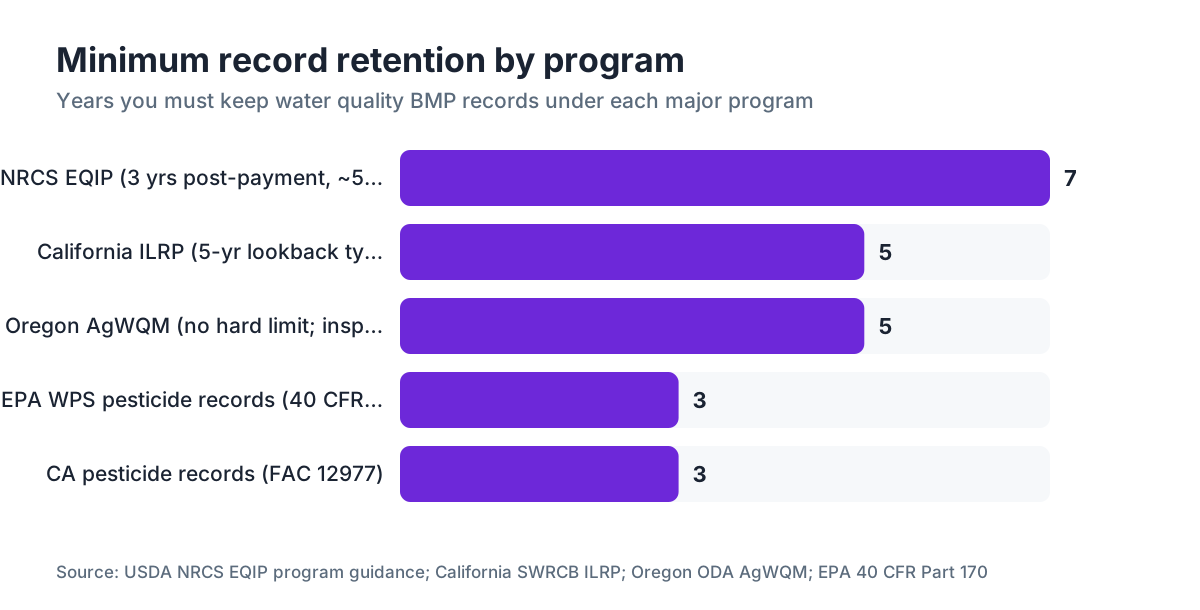
Retention rules move around by program and state, but the safe default is ten years from the most recent entry in a file.
California's ILRP doesn't name a single retention period in its standard permit language, but the program's annual reports and third-party group rules line up with the five-year lookback that's common in water quality enforcement [3]. NRCS cost-share contracts usually require records for three years after the final payment, which puts you at five to seven years total counting from installation [11]. Oregon's AgWQM Area Plans require records to be available for inspection but set no hard number, leaving it to the local watershed plan [4].
California pesticide application records run three years under the Food and Agriculture Code, and those often double as support for pesticide-management BMPs [7]. Holding BMP records past the legal minimum costs you almost nothing in digital storage, and it saves you if a dispute lands years later.
Keep one backup offsite or in the cloud. A shop fire or a flood that eats your paper files has wrecked EQIP compliance reviews for growers who kept only one copy.
How should you organize BMP records across multiple blocks or parcels?
Organization is where most small operations come apart, not the quality of the documentation itself.
The system that holds up ties your BMP files to your block structure, the same block IDs you already use on spray records and harvest reports. Each block folder (physical or digital) gets a subfolder called Water Quality or BMPs. Inside it, each practice gets its own file named with the NRCS code, block ID, and install year: 393_Block7_2022.pdf, for example.
When one BMP spans several blocks or covers a whole-farm drainage area, build a Farm-Level BMPs folder next to the block folders. Tailwater recovery ponds, wellhead protection plans, and riparian buffer programs usually live here.
A master BMP summary sheet at the farm level is worth an hour of your winter. One row per practice, with columns for code, location, install date, last inspection, and next inspection due. Print it during your slow stretch, update it, and pin it where you plan the season. WSU Extension recommends this kind of summary-level approach in its water quality farm planning guidance as a way to make compliance visible instead of buried in folders [8].
Once you're managing more than 50 acres across multiple parcels, a spreadsheet gets clumsy fast. That's where purpose-built vineyard record-keeping software earns its keep. VitiScribe (vitiscribe.com), for instance, lets you attach BMP records directly to block maps and flags inspection due dates on its own, which keeps an expired maintenance log from slipping past you.
For how this fits your broader field operations records, see our guide to vineyard operations records.
What do NRCS and extension programs say about BMP documentation standards?
The NRCS National Handbook of Conservation Practices defines the documentation requirements for each funded practice, and it's the authoritative source, publicly available through the NRCS website [2]. For most practices it wants a Job Sheet (the design document), a certification of installation signed by both the implementing agency and the landowner, and a maintenance record.
Cornell Cooperative Extension's work in the Finger Lakes and Hudson Valley has produced detailed guidance on BMP documentation for New York vineyards under the state's Agricultural Environmental Management (AEM) program. Their framework asks growers to document both that a BMP exists and that it's effective, which is a higher bar than most federal programs set, and it's good practice anyway [9].
UC Cooperative Extension advisors in Sonoma and Napa have published similar guidance under California's Irrigated Lands program. Their recommendation is to keep a running maintenance log rather than a static installation record, because the log is what shows ongoing compliance instead of one-time installation [6].
WSU Extension's guidance for Washington vineyards under the Voluntary Stewardship Program treats mapping as part of documentation. A simple field map showing BMP locations, even one drawn by hand, makes your records far more useful to an auditor or a cost-share administrator trying to verify spatial coverage [8].
All three extension systems agree on one point. The records have to be in a form you can actually find and hand over within 24 to 48 hours of a request. A box of loose notes does not clear that bar.
What triggers an inspection and what should you have ready?
Inspections come from three directions: scheduled program audits, complaint-driven investigations, and cost-share compliance checks.
Scheduled audits under California's ILRP run through your Third-Party Group. The group submits annual reports to the SWRCB with aggregated BMP implementation data from its members, and the board can pull individual grower records to verify the aggregate [3]. If you get selected, you typically have 30 days to produce records.
Complaint-driven inspections move faster. If a downstream neighbor or a regulatory agency gets a complaint about turbid water or a pesticide detection in a ditch after a rain event on your property, an investigator may ask for records within days. "The burden is on the discharger to demonstrate compliance," the SWRCB states in its ILRP guidance, which means your records need to exist before the event, not after it [3].
For a cost-share compliance check, have ready the original contract, the Job Sheet for each practice, the installation certification, and your maintenance log. The district conservationist usually walks the property and compares what they see to what's on paper, so the records have to match physical reality.
Keep a compliance packet, a physical folder or a digital one you can email, holding your master BMP summary sheet, the most recent inspection logs for every active practice, and your enrollment documents for any active programs. Updating that packet once a year takes under two hours and means you never scramble.
Are there free templates or tools to help you build these records?
Good free resources exist, and you should start there before paying for anything.
The USDA's NRCS eDirectives system has downloadable Job Sheet templates for every practice code [2]. These are fillable PDFs built to serve as both design documents and installation records. If your practice matches an NRCS code, use the official template.
California's ILRP third-party groups, including the Sacramento Valley Water Quality Coalition and the Central Valley regional group, publish BMP tracking worksheets and implementation logs tailored to California rules. Check your group's website or ask your coordinator.
Cornell's AEM program offers a Tier 2 planning workbook that walks through BMP identification and documentation field by field, with example records. It's built for New York, but the logic transfers to any state [9].
WSU Extension's Water Quality Program has a Pacific Northwest agricultural BMP guide with documentation examples specific to Washington's VSP requirements [8].
For growers who want this tied to their spray records, harvest data, and block maps, VitiScribe offers a trial so you can test BMP record management alongside the rest of your field documentation before you commit.
If you farm the Paso Robles area or coastal California, your county farm bureau or local Resource Conservation District often has staff who'll sit with you for an hour and review your record system at no charge. That beats trying to decode regulatory language on your own.
How do water quality BMP records connect to your pesticide application records?
Get this connection right, because it's where growers most often open a gap without noticing.
California requires pesticide application records under Food and Agriculture Code Section 12977 to include the product, application rate, target pest, application method, and the applicator's name [7]. Those records don't force you to document your pesticide-risk BMPs, but the ILRP does. The two systems are meant to work together.
Say one of your water quality BMPs is a buffer zone between a spray block and a waterway. Your spray records should show the application boundaries and that the sprayer shut off at the buffer edge. If you have a dedicated mixing and rinsate pad, your spray records should name the mixing location. If your BMP is a closed transfer system that stops spills during filling, a note in your equipment maintenance log backs up the BMP record.
The EPA Worker Protection Standard touches this too. Under 40 CFR Part 170, application exclusion zones and re-entry intervals create records establishing where and when applications happened, and those line up with the spatial documentation your BMP records need [10]. Keep both sets so you can cross-reference them without an afternoon of searching.
A short cross-reference note in each BMP file ("See Spray Records > 2024 > Block 7 for application boundary compliance") is enough. You don't duplicate the records.
Frequently asked questions
Do I need a separate BMP record for every vineyard block?
Not necessarily. If a single BMP covers multiple blocks (a whole-farm riparian buffer, or a tailwater pond serving the whole property), one record with a map showing the covered area is fine. Block-level records make sense for practices implemented differently by block, like cover crop species mixes or tillage decisions that change across the vineyard.
Can I keep BMP records in a spreadsheet instead of a paper binder?
Yes. Regulators and cost-share programs care about content, not format. A spreadsheet works fine as long as it's backed up, dated, and you can print or export it quickly on request. Cloud storage with version history beats a local file because it preserves the edit timeline, which helps if anyone questions when an entry was made.
What NRCS practice code should I use for a vineyard cover crop in row middles?
NRCS Practice Code 340 is Cover Crop. Code 327 is Conservation Cover, which applies to permanent vegetative covers rather than annually reseeded crops. For typical vineyard row-middle covers that get mowed or disced part of the year, 340 is the right code. Check with your local NRCS service center if your practice has unusual characteristics.
How detailed does the GPS location need to be in my BMP records?
A single GPS coordinate marking the approximate center or inlet point of the practice is enough for most programs. Polygon boundaries are better for large structures and are required in some EQIP contracts. A smartphone with a mapping app gives you enough accuracy; you don't need survey-grade equipment unless your NRCS Job Sheet specifically requires it.
What happens if a BMP fails or stops functioning between inspections?
Document the failure the moment you find it: date, what failed, probable cause, and your corrective action plan. Do not delete or alter earlier inspection records. Regulators know BMPs fail; what they look for is whether you caught it and responded. An honest record of a failed BMP that got repaired looks far better than a suspiciously clean record with no issues ever noted.
Do I need to document BMPs I installed before joining an EQIP contract or ILRP group?
Yes, and this trips up a lot of growers. Pre-existing BMPs often qualify as matching credit or baseline documentation in cost-share applications, but only if you have records showing they existed before enrollment. Documentation built after the fact is risky. If a practice has been in place for years with no records, start the log now and note the estimated installation date with whatever evidence you have, like aerial imagery or old invoices.
Are water quality BMP records the same as my nutrient management plan records?
They overlap but aren't the same. A nutrient management plan (NRCS Practice 590) is its own documented practice with its own record requirements, including soil and tissue test results, fertilizer application records, and application timing relative to rain events. Your BMP file for Practice 590 should reference the plan document rather than reproduce all of it. Keep the plan itself in a separate, easy-to-find file.
What if my state doesn't have a formal BMP program for vineyards?
Document your practices the same way regardless. If you accept any federal cost-share (EQIP, RCPP, CSP), federal documentation standards apply no matter your state's program status. And if a water quality enforcement action ever targets your operation, documented BMPs are your primary evidence of good-faith efforts to prevent pollution. No state program does not mean no risk.
Do I need to document water quality BMPs if my vineyard is under 10 acres?
Most state ILRP-style programs include small farms, though some set acreage thresholds. California's ILRP covers irrigated commercial agriculture broadly, and the threshold for individual permit requirements versus Third-Party Group enrollment depends on operation size and discharge potential more than raw acres. Check with your local Regional Water Quality Control Board office for the threshold that applies to your parcel.
How do I document a BMP that I removed or stopped using?
Write a closure entry in the record: the date you discontinued the practice, the reason, and what (if anything) replaced it. For EQIP practices, dropping a funded practice before the contract term ends triggers a repayment obligation, so contact your NRCS district office before removing any funded structure. For non-funded practices, the closure note just keeps your master summary accurate.
What's the best way to document a riparian buffer in vineyard records?
NRCS Practice Code 391 covers Riparian Forest Buffers. Your record needs a map showing buffer width at multiple transects (NRCS standards specify minimum widths that vary by resource concern and slope), species composition, planting date, and annual maintenance notes. Riparian buffers often carry state setback requirements on top of NRCS standards; include the applicable regulation citation so it's obvious you knew what you were meeting.
Can I use the same BMP record template for California, Oregon, and Washington if I farm in multiple states?
A common template works for the core fields (name, code, location, installation date, maintenance log), but you'll need a state-specific section for each operation noting which program the practice is enrolled in and which regulatory authority oversees it. California's ILRP, Oregon's AgWQM, and Washington's VSP have different reporting periods and submission formats, so a single monolithic record gets confusing fast for multi-state operations.
Should photos be part of the official BMP record?
Yes, strongly. Photos aren't legally required in most programs, but they're the fastest way to prove a practice was installed and maintained. File them with a consistent naming convention that includes the NRCS code, block, and date (e.g., 393_Block7_2024-03-15.jpg). An auditor who can see a dated photo of your filter strip is much less likely to question your written description of its width and condition.
Sources
- EPA, Clean Water Act Section 319 Nonpoint Source Program: Section 319 of the Clean Water Act directs states to develop nonpoint source pollution control programs built around BMPs.
- California State Water Resources Control Board, Irrigated Lands Regulatory Program: California's ILRP requires growers to maintain records of which BMPs are in place, when implemented, and what monitoring or maintenance has occurred; the burden is on the discharger to demonstrate compliance.
- Oregon Department of Agriculture, Agricultural Water Quality Management Program: Oregon's AgWQM Area Plans require BMP records to be available for inspection under the state's agricultural water quality program.
- UC Agriculture and Natural Resources (UC Cooperative Extension), Cover Cropping in Vineyards: UC Cooperative Extension recommends documenting percent canopy cover at key growth stages as a simple effectiveness indicator for erosion-control cover crops in vineyards.
- California Department of Pesticide Regulation, Pesticide Use Reporting and Records (Food and Agriculture Code Section 12977): California Food and Agriculture Code Section 12977 requires pesticide application records to include product, rate, target pest, application method, and applicator name, with records kept for three years.
- Washington State University Extension: WSU Extension recommends a summary-level BMP tracking approach and field mapping as components of documentation under Washington's Voluntary Stewardship Program.
- Cornell Cooperative Extension, Agricultural Environmental Management Program: Cornell's AEM Tier 2 framework asks growers to document both the existence of a BMP and evidence of its effectiveness, and provides a planning workbook with example records for New York vineyards.
- EPA, Agricultural Worker Protection Standard (40 CFR Part 170): Under 40 CFR Part 170, application exclusion zones and re-entry intervals create records establishing where and when pesticide applications occurred, consistent with the spatial documentation needs of water quality BMP records.
Last updated 2026-07-11