How to create a long-term replanting plan document for aging vineyard blocks
TL;DR
- A vineyard replanting plan document covers block-by-block condition assessments, rootstock and variety decisions, a phased pull-and-replant timeline (usually 10-20 years for a full property), cash-flow projections, and the compliance hooks that affect when you can act.
- Start with a written block inventory.
- Then layer in economics and logistics.
- Update it every two years.
Why does an aging vineyard need a written replanting plan at all?
Most vineyard managers already know which blocks are on borrowed time. The vines are gappy, yields keep sliding, trunk disease has hollowed out the cordons, and the variety stopped fitting the market three vintages ago. But a hunch in your head is not a plan. A written document forces you to confront the full scope, set a sequence that fits your cash flow, and leave a record that lenders, partners, and the next owner can actually read.
There's a money reason too. If your operation carries a USDA Farm Service Agency farm loan, or you're chasing cost-share through the Environmental Quality Incentives Program (EQIP), a documented conservation plan is a condition of funding, not optional paperwork [1]. Some state viticulture assistance programs work the same way. California's Sustainable Groundwater Management Act affects replanting across many Central Valley and coastal basins, because new planting activity now runs into water use documentation in critically overdrafted areas [2].
The plan also gives you something to revise. Markets shift, a rootstock trial at UC Davis turns up disease resistance you hadn't planned around, a frost rewrites your timeline. A living document you update every two or three years beats an informal mental model every single time.
What should a vineyard block assessment look like before you write anything?
The plan is only as good as the data under it. Before you write a word, build a block-level inventory that captures the condition of every block worth analyzing. That means walking rows, not eyeballing from the truck.
Here's what to record for each block:
| Field | What to record |
|---|---|
| Block ID / map reference | Internal code tied to your vineyard map |
| Variety and clone | Including any field mix you suspect |
| Rootstock | If known; many older plantings have poor records |
| Year planted | Verify against original permits if possible |
| Acres / row count | Measured, not estimated |
| Vine spacing and trellis system | Row x vine spacing, wire configuration |
| Missing vine percentage | Count empties, calculate as % of row |
| Trunk disease rating | Use a simple 1-5 scale, note crown gall, esca, Botryosphaeria |
| Yield last 3 seasons (tons/acre) | Pull from harvest records |
| Fruit quality notes | Brix at harvest, phenolic concerns, color issues |
| Irrigation infrastructure condition | Drip lines, emitters, pressure readings |
| Soil health data | pH, organic matter, nematode pressure if tested |
| Current lease or contract status | Does a winery contract tie this block? |
Collect at least three consecutive years of yield data before you make a pull decision. One bad year from frost or a disease spike doesn't mean the block is finished, and extension viticulture programs at Washington State University and elsewhere lean hard on multi-year yield trends rather than single-season numbers [3]. UC extension viticulture teams publish block assessment worksheets for California growers that walk through trunk disease scoring, which is often the factor that settles the argument in older plantings [4].
For nematode pressure, sample soil to 3 feet if the block is headed for replanting. Rootstock choice changes a lot depending on whether you have heavy Meloidogyne incognita populations. Skip the soil test, then plant AXR1, and you repeat one of the most expensive mistakes in California vineyard history.
How do you decide which blocks to replant first?
Prioritization is where the plan gets real. You can't pull everything at once, and you probably can't afford to. The usual framework weighs three things: block condition (how bad is it now), economic productivity (what this acre actually earns), and strategic fit (does the variety and location still make sense for your business in ten years).
A simple scoring matrix works. Score each block 1-5 on condition severity, revenue per acre, and variety/market fit. A block scoring high on severity and low on revenue is your first candidate. A block that's aging but tied to a variety with strong contract demand stays in the queue longer.
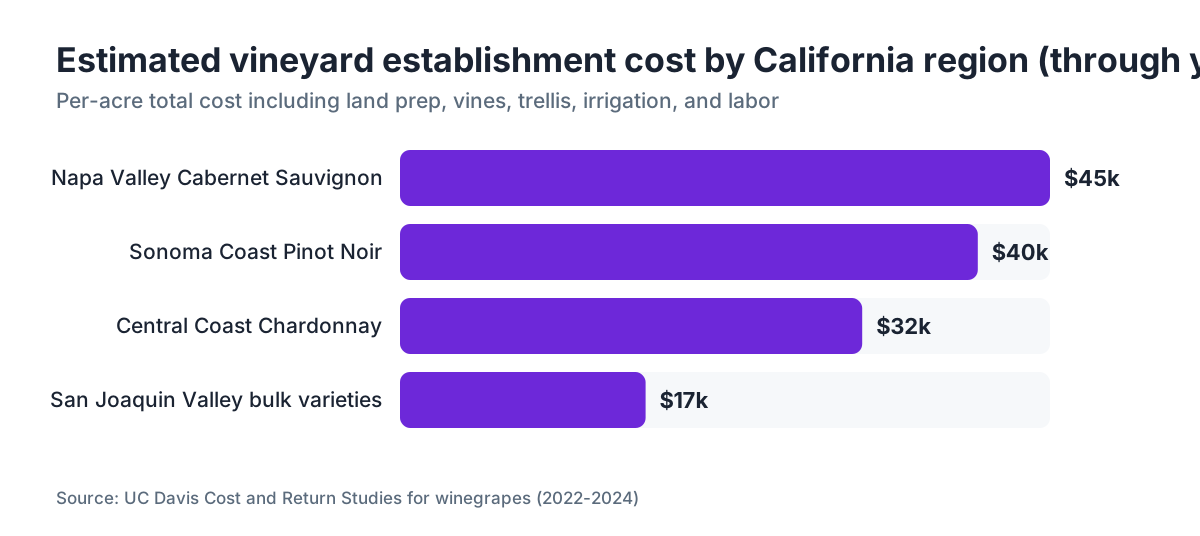
Here's an honest caveat. Nobody has clean industry-wide data on the average age at which California or Pacific Northwest blocks hit economic breakeven for replanting. The 25-to-35-year vine lifespan you hear quoted comes from regional conversations and lender guidelines, not peer-reviewed studies. The closest formal work is UC Cooperative Extension's cost-of-production studies, which model establishment costs by variety and region and let you back-calculate payback periods [5]. For Napa Cabernet, establishment through year three runs roughly $30,000 to $50,000 per acre in current cost studies depending on land prep, rootstock, and labor. Central Valley varieties cost far less. Use those numbers, not rules of thumb.
Phylloxera history changes the whole sequence. Blocks on their own roots or on AXR1 with phylloxera pressure present aren't just aging, they're dying on a clock. They jump the line regardless of variety or revenue, because waiting costs you the soil too.
How do you choose rootstock and variety for the replant?
This is the longest-lasting decision in the document. A rootstock planted in 2026 is likely still in the ground in 2055. Get it wrong and the whole investment underperforms for three decades.
Rootstock selection turns on soil type (sand vs. clay vs. loam), phylloxera pressure, the nematode species present, the vigor you want, and drought tolerance if you're short on water. Cornell's grape and wine program publishes rootstock comparison data for cool-climate Eastern varieties that applies well to New York and similar climates [6]. On the West Coast, UC Davis Foundation Plant Services and the public rootstock trial data are the best resources going [4].
A few notes on rootstocks that come up constantly:
110R and 140Ru are strong on low-vigor, shallow, dry soils, especially in Paso Robles and similar Mediterranean sites. They struggle on heavy clay or high-pH soils where micronutrient uptake suffers. 3309C is popular in the Pacific Northwest and parts of New York for moderate vigor and phylloxera resistance on lower-fertility ground. SO4 and 5C Teleki stay reliable on heavier soils but can over-vigor in fertile blocks, which costs you fruit quality.
Variety decisions loop back to three things: your winery's market direction, your climate trajectory (mean growing-season temperature across much of California has warmed by roughly 1-2 degrees F over 30 years in NOAA climate normals), and any existing purchase contracts. Don't replant 50 acres of Chardonnay because that's what you've always grown, if your winery has spent five years buying all-in on Rhone varieties.
Write down the rootstock and variety rationale in the plan itself. Five years out, when a new manager asks why this block sits on 110R and not 1103P, the answer should be on paper.
What does a phased replanting timeline actually look like in the document?
Most properties can only pull and replant 5-15% of total acreage in a given year, because you're losing revenue on the pulled block while carrying establishment costs on it. A 100-acre property with 40 acres needing replanting over a decade is looking at 4-6 acres a year, sometimes less.
The timeline section should carry, for each block:
- A pull year (the calendar year you plan to remove the old vines)
- A replant year (often the same year or the following spring)
- First leaf year (year 1 of the new planting)
- First commercial harvest target (usually year 3-4 depending on variety and training)
- Full production target (year 5-7 for most varieties on drip with proper establishment)
Build in slack. A late frost hits a year-2 block and your timeline shifts. A purchase contract lapses and the priority order changes. Write the timeline in a spreadsheet, not a PDF, so it's actually editable.
A Gantt-style table by year works well:
| Year | Block(s) pulled | Block(s) replanted | Revenue impact (est.) |
|---|---|---|---|
| 2026 | Block 7 (4.2 ac) | Block 7 (4.2 ac, new rootstock) | -$18,000 est. |
| 2027 | Block 12 (3.8 ac) | Block 12 (3.8 ac) | -$16,500 est. |
| 2028 | None | Block 7 year 2 maintenance | +$0 (still non-bearing) |
| 2029 | Block 3 (5.0 ac) | Block 3 (5.0 ac) | -$21,000 est.; Block 7 first light harvest |
The revenue impact column is where most informal plans fall apart. People underestimate how long four acres out of production drags on total cash flow, especially for a small estate. That number has to be real, built from your actual price per ton or per-bottle equivalent, not a placeholder.
What budget and cash-flow information belongs in the plan?
The financial section is what makes the plan fundable and defensible. It has to show two things: the cost to replant (establishment budget per acre, by block) and the revenue gap during the non-bearing years.
Establishment costs swing widely by region and system. UC Cooperative Extension publishes cost studies by region and variety [5]. As rough orientation (not a substitute for local contractor quotes), California North Coast Chardonnay or Pinot Noir establishment runs $25,000 to $45,000 per acre through year three in current studies, covering land prep, vines, rootstock, trellis, irrigation, and labor. Central Valley costs are lower, typically $12,000 to $22,000 per acre. Washington and Oregon land in a range close to California coastal, depending on labor markets.
Break the establishment budget into four buckets:
- Pre-plant (land prep, fumigation or biofumigation if needed, soil amendment, cover crop)
- Plant year (vines, planting labor, drip install if replacing, deer and rabbit protection, training stakes)
- Year 2 (irrigation, training, shoot positioning, pest and disease management)
- Year 3 (same as year 2, plus first trellis wire establishment)
Fumigation is a real cost and a real regulatory item. Methyl bromide alternatives under current EPA registration require a licensed pest control adviser and pre-plant soil fumigant permits in California [7]. Budget 45 to 60 days minimum of regulatory lead time on pre-plant fumigation.
For the revenue gap, take the tons per acre you're losing off the pulled block times your per-ton price (or a per-case equivalent if you're estate-only). A 4-acre block producing 4 tons per acre at $2,500 a ton was generating $40,000 in crop value a year. Over four non-bearing years that's $160,000 in foregone revenue, and it has to come from somewhere else in the operation or from financing.
Many community lenders and Farm Credit offices will finance vineyard establishment when the plan is strong. The document you're writing is partly a loan application, whether you intended it that way or not.
What compliance and regulatory items need to be in the plan?
Requirements vary by state, county, and sometimes AVA, but several federal rules apply broadly, and your plan should name each one.
EPA Worker Protection Standard (WPS). Any replanting work with restricted-use pesticides during soil prep or early establishment triggers WPS-compliant training, posting, and record-keeping for all agricultural workers and handlers [8]. The WPS was revised in 2015 with expanded protections, including the Application Exclusion Zone rules that apply during soil fumigation. Bring in contract labor for land prep and the WPS obligations follow you as the agricultural employer.
Pesticide records. Replanting often means pre-plant soil fumigation (chloropicrin, 1,3-dichloropropene, or metam sodium, depending on what's still registered where you are). These are restricted-use pesticides. California requires fumigation records be kept for at least three years; federal FIFRA requires two years for restricted-use records [9]. Your plan should state the fumigation approach you intend to use and flag the records requirement.
State planting permits and water rights. California requires a notice of intent or permit for new vineyard development in some counties, particularly those under CEQA review or in SGMA-designated basins [2]. Oregon requires registration of new vineyard acreage with the Oregon Department of Agriculture if you're pursuing state certification programs. Call your county agricultural commissioner before assuming replanting an existing block is permit-free. In some California counties it isn't.
AVA labeling continuity. Changing varieties on a block that feeds a labeled AVA wine? Note in the plan how the transition hits your label compliance timeline. You can't label a wine with an AVA if the grapes came from outside it, and if you buy bridge fruit elsewhere during the transition years, that sourcing decision affects your TTB certificate of label approval [10]. TTB rules require that a wine carrying an AVA name meet the minimum percentage of grapes from that area.
Tools like VitiScribe can hold your spray records, worker training logs, and replanting documents in one place, which matters when a compliance audit lands mid-season and you need three years of fumigation records fast.
How do you format and organize the actual plan document?
The document doesn't need to be fancy. It needs to be findable, updatable, and readable by someone who wasn't in the room when you made the calls.
A working structure:
- Cover page: property name, total acres, document date, author, next scheduled review date
- Executive summary (1 page): total blocks assessed, total acres flagged, overall timeline, total estimated cost, top-line rationale
- Block inventory (one page or spreadsheet tab per block): the assessment data from the section above
- Prioritization matrix: your scored ranking, with the scoring criteria spelled out
- Rootstock and variety selections: by block, with documented rationale
- Phased timeline: the Gantt-style table by year, with pull, replant, and first-harvest milestones
- Budget and cash-flow projections: establishment cost by block and year, revenue gap by year, financing assumptions
- Regulatory and compliance checklist: permits needed, fumigation approach, WPS obligations, water rights
- Appendices: soil tests, nematode reports, current lease or purchase contracts, county or state correspondence
Keep the narrative short. The value lives in the tables and the data. Lenders and investors scan. They don't read cover to cover.
Update the document at least every two years, or after any material change: a frost that damages a young block, a shift in your winery's purchase contracts, new nematode pressure from a soil test, or a regulatory change that reshapes your fumigation options. Date every revision at the top.
How do you handle blocks under existing grape purchase contracts?
This is often the hardest constraint in the whole timeline. A block under a multi-year purchase agreement may not be yours to pull without penalty clauses kicking in. Read every contract before you set a pull date.
The typical winery purchase contract carries a 1-to-3-year notice-of-intent clause for grower-initiated vine removal. Some Napa and Sonoma contracts run longer, especially for estate-designated or named vineyard programs. Miss the notice window and you're exposed to breach of contract claims.
For each affected block, your plan should list:
- Contract party (the buying winery)
- Contract expiration date
- Required notice period for vine removal
- Price per ton or per acre, so you can weigh early termination against waiting for natural expiration
- Any replanting approval clauses (some contracts lock in rootstock or variety)
One clean approach: schedule the pull in the contract year before expiration, give proper notice, and take the final contract harvest as your last crop off that block before removal. You keep the revenue, meet the contract, and hold the relationship for whatever you might source later.
What resources and extension programs can help with replanting decisions?
You don't have to work this out from scratch. Several extension programs publish replanting frameworks and cost tools worth pulling straight into your process.
UC Cooperative Extension publishes Costs and Returns Studies by region (Napa, Sonoma, San Joaquin Valley, Central Coast) and by variety. These are the most reliable public numbers for California establishment budgets [5]. Free to download, refreshed roughly every 2-3 years.
Cornell's grape and wine program covers Eastern US and Great Lakes replanting decisions, including trunk disease management and rootstock trial data for cool-climate conditions [6]. Their grapevine trunk disease material speaks directly to replanting timing.
Washington State University extension covers Washington and Oregon and publishes replanting guidance for Concord, wine grape, and juice grape systems in the Pacific Northwest [3]. Their irrigation and canopy management resources apply to establishment-year protocols.
ATTRA, the National Sustainable Agriculture Information Service, has a vineyard establishment guide covering organic and low-input pre-plant soil prep, useful if you're weighing alternatives to conventional fumigation [11].
Applying for USDA EQIP cost-share on replanting? Payments have reached $3,000 to $5,000 per acre for qualifying practices in some states, though rates shift by fiscal year and state office. Your local NRCS office has a technical specialist who can line up your plan with EQIP payment schedules [1].
On the record-keeping side, VitiScribe gives you a central home for block-level spray records, worker protection logs, and document storage that stays organized across a multi-year replanting cycle. It doesn't make the planting decisions for you. It keeps the compliance paper trail clean.
What are the most common mistakes in vineyard replanting plans?
A handful of failures show up again and again.
Underestimating the non-bearing revenue gap. A grower pulls a block, replants, and finds out in year two that the cash shortfall runs deeper than projected, because they forgot lost custom crush revenue, a change in winery buying, or a cool vintage that pushed first harvest back a season.
Ignoring soil health before replanting. Pull old vines, replant the same soil, and skip the nematode count, the pH fix, and the organic matter deficit, and you've made one of the most expensive mistakes in the book. The new vines underperform for their entire productive life because the foundation was wrong. Pre-plant fumigation or biofumigation, cover cropping for a year or two between pull and replant, and targeted amendments before planting are not the place to save money.
Selecting rootstock on availability instead of site data. In tight supply years, certain rootstocks go on allocation and growers take what's left. Planting 110R on deep alluvial soil because that's what the nursery had is a 30-year mistake. Order rootstock 12 to 18 months out and document a second choice in the plan.
Leaving out trellis replacement. Old trellises in a block being replanted are usually at the end of their life too. New posts and wire add $3,000 to $8,000 per acre depending on system and material prices. Plans that omit trellis replacement understate establishment costs by a wide margin.
Never scheduling a review. A plan written once and filed away goes stale fast. Build the review date into the document. Every two years is reasonable for most operations.
Frequently asked questions
How often should I update a vineyard replanting plan?
At least every two years, and immediately after any material change: a contract termination, a disease event that speeds a block's decline, a soil test showing elevated nematode pressure, or a regulatory change affecting fumigation options. Date every revision on the cover page so you always know which version is current and can defend it to a lender.
At what vine age should I start planning to replant a block?
Most replanting decisions are driven by productivity decline and trunk disease, not a specific age. That said, conventional analysis and lender guidelines point to formal assessment starting around year 20-25. UC Cooperative Extension cost studies model economic payback from first commercial harvest, which helps you back-calculate when a block has paid for itself and sits on the downslope of its return curve.
Can I get USDA funding to help pay for vineyard replanting?
Yes. USDA's EQIP program has funded vineyard establishment and replanting practices in some states at rates of $3,000 to $5,000 per acre for qualifying practices, though rates vary by state office and fiscal year. You need a written conservation plan aligned with NRCS technical standards as a condition of funding. Contact your local NRCS office for current payment schedules [1].
What soil tests should I run before replanting a vineyard block?
At minimum: a standard fertility panel (pH, organic matter, macro and micronutrients), a nematode bioassay to 3 feet to identify species and population density (which drives rootstock choice), and a texture profile if you don't have one. In known phylloxera areas, a root visual inspection adds useful data. Run tests 12 to 18 months before planned replanting so you have time to act on results.
How long does it take a replanted vineyard block to reach full production?
Most varieties on drip with strong establishment reach first commercial harvest in year 3-4 from planting. Full production, meaning yields comparable to a mature block, typically takes 5-7 years. Spur-pruned systems can reach full production faster than cane-pruned systems in some conditions. Cool-climate varieties and dry-farmed blocks trend toward the longer end of that range.
What is the EPA Worker Protection Standard requirement for vineyard replanting work?
The WPS requires that agricultural workers and pesticide handlers involved in replanting activities, including pre-plant soil fumigation, get WPS training, have access to pesticide application information, and are protected by application exclusion zones during fumigation. The 2015 revised WPS expanded those protections. Records must be kept two years under federal FIFRA, or three years in California [8][9].
Should I fumigate soil before replanting, and what are my options?
Pre-plant fumigation is worth doing when nematode populations are high or when replanting follows a block with documented phylloxera or soil-borne disease. Registered options include chloropicrin, 1,3-D (Telone), and metam sodium, all restricted-use and requiring a licensed PCA plus state permits. Biofumigation with high-glucosinolate mustard cover crops is a lower-regulation alternative, but efficacy against heavy nematode pressure is less consistent [7].
How do purchase contracts affect when I can pull and replant a block?
Most winery purchase contracts require 1 to 3 years' written notice before vine removal. Some estate-designated or named vineyard contracts run longer. Missing the notice window can trigger breach of contract penalties. Your plan should list every block's contract expiration date, notice requirement, and price per ton so you can schedule pulls that line up with expirations and keep the winery relationship intact.
How do I choose between replanting a block and continuing to manage declining vines?
Compare the per-acre revenue from the declining block (current yield times price per ton) against the annualized establishment cost of a new planting over its productive life. UC Cooperative Extension cost-of-production studies give establishment benchmarks by region and variety [5]. If the declining block earns less per acre than the debt service on a new planting would cost in years 1-4, the economics favor pulling sooner.
What rootstock should I use when replanting in a phylloxera-affected vineyard?
Avoid AXR1, which broke down under California biotype B phylloxera. Strong current choices include 110R for low-vigor dry soils, 1103 Paulsen for deep fertile soils needing drought tolerance, and 3309C for lower-fertility Pacific Northwest sites. UC and WSU extension programs both publish rootstock trial data as new resistance information emerges. Always pair the rootstock choice with a current nematode soil test [3][4].
Do I need a permit to replant an existing vineyard block in California?
Often replanting an existing block does not require a new development permit, but there are exceptions. Blocks in SGMA-designated basins may require water use documentation. Some counties require a grading permit for land prep with significant earthwork. Pre-plant restricted-use fumigation always requires a licensed PCA and state permit. Check with your county agricultural commissioner and planning department before assuming replanting is permit-free [2][7].
How should I account for climate change when choosing varieties for replanting?
Mean growing-season temperatures across much of California have warmed by roughly 1-2 degrees F over 30 years in NOAA climate normals. That matters for replanting because the variety you plant in 2026 produces fruit in 2055 under a warmer regime. Weigh heat tolerance, earlier ripening, and water use efficiency alongside current market demand. University extension climate adaptation guides for viticulture are available through UC and WSU programs.
What financial information do lenders want to see in a vineyard replanting plan?
Farm Credit and community ag lenders typically want establishment cost by block and year, the revenue gap during non-bearing years, a timeline to first commercial harvest and full production, current property debt structure, and evidence of a purchase contract or market outlet for the replanted variety. UC Cooperative Extension cost studies are frequently cited in loan applications as the basis for establishment cost projections [5].
Can I replant with a different variety than what's in my existing winery purchase contract?
Only if the contract permits it or after it expires. Many winery purchase contracts specify variety, and some also lock in rootstock or training system. Changing variety without agreement exposes you to breach of contract claims. If your winery agrees, get it in writing as a contract amendment before you pull the old vines. Your plan should document that conversation and any written confirmation.
Sources
- California State Water Resources Control Board, Sustainable Groundwater Management Act program: SGMA-designated basins in California require water use documentation for new or replanted agricultural acreage in critically overdrafted areas.
- Washington State University Extension, Viticulture and Enology program: WSU Extension advises collecting at least three consecutive years of yield data before making a vine removal decision.
- University of California Agriculture and Natural Resources, Viticulture resources: UC extension publishes block assessment worksheets and rootstock trial data including phylloxera resistance evaluations.
- UC Davis Department of Agricultural and Resource Economics, Cost and Return Studies for winegrapes: UC cost studies show California North Coast Chardonnay and Pinot Noir establishment costs of approximately $25,000-$45,000 per acre through year three.
- Cornell University, Grapes and Wine program (Cornell CALS): Cornell publishes rootstock comparison data and trunk disease management protocols applicable to cool-climate Eastern US viticulture.
- California Department of Pesticide Regulation: Pre-plant soil fumigation in California with chloropicrin, 1,3-D, or metam sodium requires a licensed PCA and state fumigation permit, with 45-60 day lead times.
- EPA, Agricultural Worker Protection Standard (WPS): The revised 2015 WPS requires training, application information access, and application exclusion zones for workers and handlers during pesticide applications including pre-plant fumigation.
- EPA, Summary of the Federal Insecticide, Fungicide, and Rodenticide Act (FIFRA): FIFRA requires restricted-use pesticide records be kept for a minimum of two years; California state law extends this to three years.
- Alcohol and Tobacco Tax and Trade Bureau (TTB), American Viticultural Areas: A wine labeled with an AVA designation must contain grapes from that AVA at the required percentage; sourcing bridge fruit from outside the AVA affects label compliance.
- ATTRA, National Sustainable Agriculture Information Service (NCAT), vineyard establishment guide: ATTRA's vineyard establishment guide covers organic and low-input pre-plant soil prep alternatives to conventional fumigation including biofumigation with glucosinolate-producing cover crops.
Last updated 2026-07-10