How to conduct and document a vineyard pesticide safety training session

TL;DR
- Under EPA's Worker Protection Standard (40 CFR Part 170), vineyard employers must train agricultural workers before they enter treated areas and again at least once every 12 months.
- Training has to cover 23 specific topics, come from a qualified presenter, and get documented in records kept for two years.
- A signed attendance log, the trainer's credentials, and the materials used are your minimum paper trail.
What does the law actually require for pesticide safety training in vineyards?
The EPA's Worker Protection Standard (WPS), at 40 CFR Part 170, is the federal rule that governs pesticide safety training for agricultural workers and pesticide handlers. It applies to any vineyard that uses pesticides and where workers enter treated areas. That's nearly every commercial operation. Five acres or five hundred, the rule is the same. [1]
Here's the core of it. Workers must be trained before they enter a pesticide-treated area, including an area still inside a restricted-entry interval (REI) for a WPS product. After that first training, they need a refresher at least once every 12 months. Handlers, the people who mix, load, or apply pesticides, face that same annual requirement plus task-specific training tied to the products they touch. [1]
The 2015 WPS revision, in effect for most provisions by January 2017, expanded the training content a lot. The rule now requires 23 specific topics, up from a much shorter old list. Those topics run from how pesticides get into the body to your workers' right to request safety data sheets to anti-retaliation protections. The full list lives in 40 CFR §170.401(c)(3). [9][11]
State lead agencies can layer their own requirements on top of the federal floor, and some do. California requires pesticide safety information under Cal/OSHA and the Department of Pesticide Regulation's worker safety rules on top of WPS. Washington's Department of Agriculture enforces WPS with state-level additions of its own. Call your state department of agriculture before you assume federal compliance covers you. [2][3]
Who is qualified to deliver the training?
The WPS names three types of trainers who can legally run the session: an appropriately licensed or certified pesticide applicator, a person who has completed an EPA-approved train-the-trainer program, or someone designated by an agency that runs an EPA-approved training program. That's the whole list. [1]
In plain terms, your usual options are a certified applicator on staff (many vineyard managers already hold this), a UC Cooperative Extension farm advisor, a county farm advisor, or a private consultant who has finished train-the-trainer coursework. Small operation with no certified applicator? Your county agricultural commissioner's office can usually point you to a group training or an approved trainer nearby.
WSU Extension and UC ANR both publish WPS train-the-trainer resources. Cornell's Pesticide Management Education Program and NPIC also maintain EPA-approved materials used across the country. [8][5] The point is simple. Whoever delivers the training has to be verifiably qualified. If your state ag department audits you, "the foreman did it" is not a defense unless that foreman holds the right credential.
Use a labor contractor and the responsibility splits. The agricultural employer and the labor contractor each carry their own WPS obligations. Get that spelled out in writing with your contractor before the season starts.
What 23 topics must the training cover?
40 CFR §170.401(c)(3) sets the required content for worker training. The table below maps each item to the regulatory language in condensed form. Every one has to be addressed in your session, and your materials should show that they were. [11]
| # | Required Topic |
|---|---|
| 1 | Where and in what form pesticides may be encountered |
| 2 | Hazards of pesticides from toxicity and exposure |
| 3 | Routes by which pesticides can enter the body |
| 4 | Signs and symptoms of common types of pesticide poisoning |
| 5 | Emergency first aid for pesticide injuries or poisonings |
| 6 | How to obtain emergency medical care |
| 7 | Routine and emergency decontamination procedures |
| 8 | Right to PPE provided by the employer |
| 9 | Warnings about taking pesticides or used PPE home |
| 10 | Keeping workers out of treated areas during applications and REIs |
| 11 | How to recognize treated areas and application equipment |
| 12 | Safety data sheets (SDS) and pesticide product labels |
| 13 | Right to access pesticide application information and SDS |
| 14 | Right to have a designated representative access records |
| 15 | Location of pesticide safety information (central posting) |
| 16 | Responsibilities of the employer |
| 17 | Anti-retaliation provisions |
| 18 | Name, address, and phone of nearest emergency medical facility |
| 19 | Transportation to emergency medical care |
| 20 | Decontamination supplies location |
| 21 | Right to request SDS from the employer |
| 22 | Requirements for handlers and early-entry workers |
| 23 | How workers can be affected by pesticides applied by others |
You don't have to deliver these in any set order, and the WPS sets no minimum number of training hours. It mandates content, not clock time. That said, most experienced trainers find 60 to 90 minutes is what it actually takes to work through all 23 topics with enough depth that people retain them, especially through a Spanish-language interpreter. Rushing it is legal and usually a waste of the whole session.
How should you structure the actual training session?
Lead with what workers need on day one: how to recognize treated areas, what REI signs look like, where decontamination supplies sit, and who to call in an emergency. The regulatory list is not a teaching sequence. Put the survival information first.
For a typical crew of 10 to 20 people, a structured 90-minute session works well. Roughly: 20 minutes on what pesticides are and how exposure happens, 20 minutes on symptoms, first aid, and emergency procedures, 20 minutes on rights and employer responsibilities, 15 minutes on reading a label and where the SDS documents are posted, and 15 minutes for questions and sign-in. Spanish-speaking crew? Plan for simultaneous interpretation or add 30 minutes for sequential translation. The WPS requires training in a manner the worker can understand. [1]
EPA-approved materials come in Spanish and several other languages through NPIC and state extension programs. UC ANR publishes bilingual WPS training materials made for California ag workers. [10][4] Published, language-matched materials are much stronger documentation than a homegrown slide deck, because the approval notation travels with them.
Hands-on beats slides for retention. Show workers a real REI sign posted in the vineyard. Walk them to the decontamination station and open it. Hold up a pesticide label and point to the REI section. Five extra minutes. It makes the training real instead of theoretical.
What records do you need to keep, and for how long?
The WPS requires training records to be kept for two years from the date of training. [1] Your minimum record set: the date, the location, the trainer's name and credential, the topics covered (or a reference to the specific approved materials used), and the name of each worker trained.
A signed attendance sheet is not explicitly named in the federal WPS, but it's the only credible way to document that a specific worker showed up and sat through it. Every compliance attorney and extension specialist who writes on this recommends one. Face an enforcement action or a workers' compensation claim, and an unsigned record is worth almost nothing.
For handlers, also document any product-specific training required by the label.
Keep the records accessible at the establishment where the workers are employed. Run multiple vineyards under one operation and you can centralize, but inspectors may want to see records on-site during a visit. Paper binders work. A shared drive works. A field operations platform like VitiScribe lets you attach training documentation straight to your spray calendar and compliance records, so everything sits in one place and stays audit-ready. That matters when the inspector shows up without warning.
Some states demand longer retention. California requires pesticide use records for two years, but some associated safety records run longer under Cal/OSHA. Confirm your state's number with your county ag commissioner.
What goes on a compliant pesticide training sign-in sheet?
Your attendance sheet needs, at minimum: the date, the physical location (vineyard block name, address, or APN is fine), the trainer's name and credential, the materials used (title and version, or EPA approval number), and each worker's printed name plus signature. A column for the worker's primary language helps but isn't required.
Add a check-box for the 23 topics, or a single line stating that the approved program covers all 23 topics in 40 CFR §170.401(c)(3), and the document stands on its own. An auditor reads one sheet and confirms compliance without hunting through a separate binder.
Here's a template structure that works:
PESTICIDE SAFETY TRAINING RECORD
Date: ___________ Location: ___________
Trainer: ___________ Credential: ___________
Materials used: ___________ (title, date, EPA approval # if applicable)
All 23 topics in 40 CFR §170.401(c)(3) were covered: YES / NO
| Worker Name (print) | Signature | Language |
|---|
Trainer signature: ___________ Date: ___________
Store the original. Take a photo backup. Scan it into your records system the same day. Paper gets wet, gets lost, gets eaten by the one filing cabinet nobody opens until an audit.
What are the central posting requirements that go with training?
Training is only part of your WPS obligations. The rule also requires a central posting location at the establishment where workers can reach specific information at all times during the growing season and for 30 days after the last REI expires. [1]
That posting must include the EPA WPS safety poster (or equivalent information), the name and address of the nearest emergency medical facility, and pesticide application and hazard information for any product applied within the last 30 days. That last item trips up more small vineyards than any other. Every spray event has to feed fresh label and SDS information to the central location.
The location has to be somewhere workers can reach without asking a supervisor, during normal working hours. A break room, the equipment shed door, or a weather-protected kiosk near the vineyard entrance all qualify. A locked office does not.
How do early-entry workers change the training requirements?
Early-entry workers enter a treated area during a restricted-entry interval, for tasks the product label specifically permits. The WPS allows early entry for certain activities (irrigation, some hand labor, scouting) under defined conditions. [1]
Those workers need standard worker training, and they need additional early-entry training before they go in during an REI. That extra training covers the REI and what it means, the specific pesticides involved, the PPE required, and decontamination procedures. It has to happen before every early-entry assignment, more than once a year.
In vineyards this comes up more than people expect. Someone has to check drip emitters, or hand-thin during a post-spray REI the label allows entry for. Your trainer (or you, if you hold the applicator certification) briefs that worker specifically before they step into the block. Document it apart from the annual record. Date, product, REI end time, PPE provided, worker signature.
What happens if you don't comply, and how often do inspections happen?
WPS enforcement runs through state lead agencies, usually the state department of agriculture, sometimes shared with the state environmental or labor agency. Penalties vary by state. Federal civil penalties under FIFRA (the Federal Insecticide, Fungicide, and Rodenticide Act) can reach $19,162 per violation as of the 2023 inflation adjustment, though first-time violations at small farms often end in a warning letter and required corrective action instead of a maximum fine. [6]
California enforces more actively than most states, with county agricultural commissioners running routine inspections. Washington's Department of Agriculture runs a compliance assistance program with both announced and unannounced farm visits. [3]
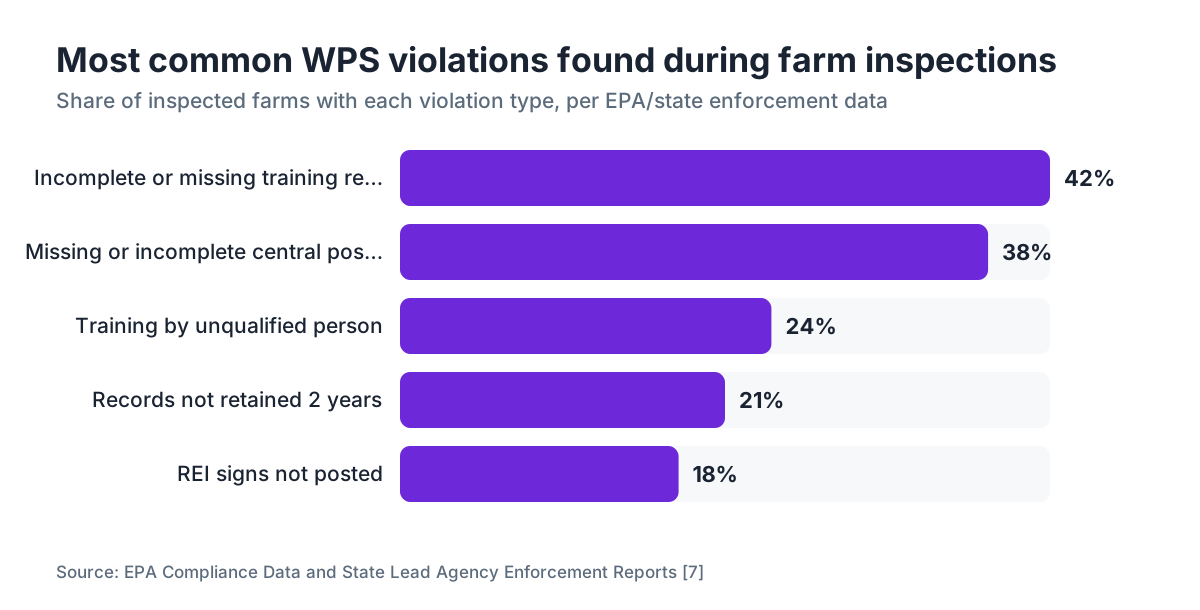
The most common WPS violations found during inspections, per EPA and state enforcement data, are missing or incomplete central postings, no signed training records, records not kept for two years, and training run by someone without the right credential. [7] Every one is a paperwork failure, not a safety failure. A vineyard that knows the material cold but never wrote it down gets penalized right alongside one that skipped training entirely.
One pattern worth knowing: research on WPS compliance finds that smaller farms (under 10 full-time workers) have substantially lower compliance rates than larger operations, mostly from record-keeping gaps rather than unsafe practices.
Are there language and literacy requirements for training?
Yes. The WPS states training must be provided in a manner the workers can understand. [1] If your crew speaks mostly Spanish, Mixtec, or another language, English-only training does not satisfy the standard.
EPA and OSHA both hold formal interpretations on this. Using a bilingual interpreter during training is accepted practice, and it's what most vineyards with mixed-language crews already do. Better still, get your materials in the workers' primary language. NPIC and UC ANR both publish Spanish-language WPS training materials that carry the right approvals. [10][4]
Literacy is a separate problem. Some workers read with difficulty in any language. For them, verbal delivery with visual aids, hands-on demonstrations, and pictogram-based materials do the job. The WPS does not require a written comprehension test, but if you think a worker didn't understand the training, deal with it directly before they enter treated areas.
Document the language accommodation in the record. Note the primary language of instruction and whether an interpreter was used. That protects you if a worker later claims they were never informed.
How do training requirements apply to labor contractors and custom operators?
This is one of the biggest sources of confusion in vineyard compliance. The WPS assigns responsibility jointly. The agricultural employer (the vineyard owner or farm manager) has to make sure workers are trained before they do covered work on the establishment. The labor contractor, if they employ the workers, carries its own independent WPS obligations too. [1]
So hire a contractor and you cannot assume they've handled training. You need documented proof, from the contractor, that each worker entering your treated areas got WPS training within the past 12 months. Get those records before the season. Keep copies. If the contractor can't produce them, you're the one exposed.
For custom pesticide applicators on your property, their training obligations under the handler provisions are mostly theirs to meet. But as the agricultural employer of record for the establishment, you still have to make sure they can reach the central posting, the application records, and the SDS materials the rule requires.
A written agreement with any contractor, spelling out who owns which WPS obligation, is worth the 15 minutes it takes to draft. Cornell's Pesticide Management Education Program has a contractor-agreement template available. [5]
What's the best way to manage training records across multiple blocks or properties?
For a single-vineyard operation, a physical binder with a tab for each training year is plenty. For multi-property operations, or any vineyard where the compliance paperwork is already tangled, a digital system earns its keep. Not because paper fails in theory, but because the human who updates the binder is reliable right up until they aren't.
Whatever system you run, the workflow that matters is this: training happens, the record gets created the same day, it lands somewhere that survives a vehicle fire or a flooded barn, and you can produce it in under 10 minutes when an inspector calls. That last part is real. Inspectors make unannounced visits. You want to hand them a folder, not spend an hour on the phone with a field supervisor trying to remember where the binder went.
For vineyards juggling multiple blocks and overlapping spray schedules, VitiScribe links training records to the spray calendar directly, so the connection between "who was trained" and "who entered which block after which spray" sits in one place. That's the audit trail that matters when questions surface months later.
Pair the digital records with a physical backup at the central posting location. The regulations were written assuming paper. An inspector who wants to see a record during a field visit should be able to see one on the spot.
Frequently asked questions
Does the EPA Worker Protection Standard apply to family members working on the vineyard?
The WPS exempts certain immediate family members of agricultural employers from worker protections, so the employer's spouse, parents, and children are not covered workers under the rule. The exemption is narrow. Employ any non-family member and all WPS obligations apply to that employee, training included. Most compliance specialists recommend training family members anyway, since the exemption does nothing about the real risk of pesticide exposure.
How do I know if my state requires more than the federal WPS minimum?
Contact your state department of agriculture or the county agricultural commissioner's office. California, Washington, Oregon, and New York all add state-level pesticide safety requirements to the federal WPS. Many extension offices publish state-specific compliance guides: UC ANR, WSU Extension, and Cornell's PMEP all keep current resources. Your county ag commissioner can tell you exactly which extra forms, postings, or training content your state requires.
Can I use an online or video-based pesticide safety training to meet WPS requirements?
Yes, with conditions. The WPS allows video or electronic delivery as long as a qualified trainer is present to answer questions and the content covers all 23 required topics. A video played with no qualified trainer in the room does not satisfy the rule. EPA is clear that the qualified trainer must be available during the training, more than before or after. Document the trainer's presence in your attendance record along with the video title and version.
How soon before working in the vineyard must a new worker complete pesticide safety training?
Before they enter any area where a WPS-covered pesticide has been applied, and before they enter during or after a restricted-entry interval. The rule is explicit: training happens before the worker does covered tasks. No grace period. A new hire you haven't trained cannot legally enter treated blocks. Plan a training session on or before the first day of work every season.
What records do I need to keep for pesticide handler training specifically?
Handlers need the same documentation as workers: date, location, trainer credential, materials used, topics covered, and signed attendance. On top of that, for handlers using products with specific PPE demands or unusual handling hazards, document the product-specific training separately with the product name and EPA registration number noted. Handler training records also have to be kept for two years under the WPS.
Do I need to provide training every year even if nothing has changed?
Yes. The WPS requires training at least once every 12 months, no matter whether the products or the practices on your operation changed. The 12-month clock runs from each worker's last training date, not from a calendar year. A worker trained October 15 has to be trained again by October 15 the next year. Running annual group sessions at the start of each growing season is the simplest way to keep everyone current.
What is the penalty for failing to keep WPS training records?
Federal civil penalties under FIFRA can reach $19,162 per violation (the 2023 inflation-adjusted figure). In practice, a first violation at a small farm usually draws a warning letter and required corrective action. Repeat violations, or violations tied to a worker injury, escalate fast. State penalties vary: California leans toward higher fines with active enforcement through county agricultural commissioners. Fixing a record-keeping gap costs nothing. Getting caught without records is expensive.
Can a vineyard foreman without a pesticide applicator license deliver the training?
Only if they've completed an EPA-approved train-the-trainer program. A supervisory title isn't enough. The WPS says trainers must be a certified pesticide applicator, someone who finished an approved train-the-trainer course, or someone designated by an agency with an EPA-approved program. If your foreman holds none of those, have a certified applicator or an extension-approved trainer run the session, even when the foreman coordinates the logistics.
What should be posted at the central location, and where can that location be?
The central location needs the EPA WPS safety poster (or equivalent information), the name and contact for the nearest emergency medical facility, and pesticide application and hazard information for any product applied in the last 30 days. Workers must be able to reach it without supervisor permission during working hours. Common spots: the break room, equipment shed entrance, or a weatherproof kiosk near the vineyard entry. A locked office does not qualify.
Does the WPS require a written test or comprehension check after training?
No. The WPS does not require a formal comprehension test. But it does require training delivered in a manner the worker can understand, which creates an implicit duty to address language and literacy barriers. If a trainer has reason to think a worker didn't understand the material, leaning on a signed form is legally thin. Document your language accommodations and follow up with any worker who seemed confused before they enter treated areas.
How do restricted-entry interval (REI) postings relate to training requirements?
REI postings are a separate WPS obligation from training, but they reinforce it. After any WPS-covered pesticide application, you must post warning signs at all usual points of entry to treated areas until the REI expires. Workers trained to recognize those signs are better protected, and inspectors look for exactly that link. Keep both training records and posting logs current, and cross-reference them in your compliance file.
What extension resources are available to help me build a compliant training program?
UC ANR publishes bilingual WPS worker training materials and handler training guides updated for the 2015 revision. WSU Extension's Pesticide Safety Education Program offers training curricula and train-the-trainer resources built for Pacific Northwest conditions. Cornell's Pesticide Management Education Program (PMEP) covers Northeast requirements and has contractor-agreement templates. Your county agricultural commissioner often runs low-cost or free group training sessions at the start of the growing season.
If I hire a new worker mid-season, do I have to run a full training session just for them?
Yes. Training has to happen before they enter any treated area, whether or not a full crew session is scheduled soon. Many vineyard managers keep training materials and a blank attendance sheet ready for exactly this: a short one-on-one session with the new hire, documented the same way as a group session. With a qualified trainer on staff, this takes about 90 minutes. It cannot be skipped because the timing is inconvenient.
Sources
- EPA, Worker Protection Standard (40 CFR Part 170): WPS requires annual training covering 23 specific topics, training by a qualified trainer, and two-year record retention under 40 CFR Part 170.
- California Department of Pesticide Regulation, Worker Health and Safety: California layers additional pesticide safety requirements on top of the federal WPS baseline for agricultural workers.
- Washington State Department of Agriculture, Pesticides and Fertilizers: WSDA enforces WPS with state-level additions and runs a compliance assistance program with announced and unannounced farm visits.
- UC Agriculture and Natural Resources: UC ANR publishes bilingual WPS worker training and handler training materials updated for the 2015 WPS revision.
- Cornell University Pesticide Management Education Program (PMEP): Cornell PMEP covers Northeast WPS requirements and provides contractor-agreement templates and train-the-trainer resources.
- EPA, Enforcement Penalty Policies: Federal civil penalties under FIFRA can reach $19,162 per violation as of the 2023 inflation adjustment.
- EPA, Agriculture Compliance: Most common WPS violations found during inspections include missing central postings, incomplete training records, and training by unqualified individuals.
- WSU Extension, Pesticide Education: WSU Extension offers WPS training curricula and train-the-trainer resources for Pacific Northwest agricultural operations.
- EPA, Revised Worker Protection Standard for Agricultural Pesticides: The 2015 WPS revision expanded required training content to 23 topics and most provisions took effect in January 2017.
- National Pesticide Information Center (NPIC): NPIC provides pesticide safety information and training resources in Spanish and other languages for agricultural workers.
- EPA, Worker Protection Standard Training Requirements (40 CFR §170.401): 40 CFR §170.401(c)(3) lists all 23 mandatory topics for WPS worker training.
Last updated 2026-07-10