How to document buffer zones around apiaries in vineyard spray records
TL;DR
- Federal law requires applicators to follow label-mandated bee buffer distances, and your spray record has to prove you did.
- Log the apiary location, the label's pollinator protection language, the measured distance from your application block, wind speed and direction, and application timing against bee foraging hours.
- Add the date you checked the beekeeper registry.
- That check date is the line inspectors push on.
Why do vineyard spray records need apiary buffer documentation at all?
A missing apiary notation turns a routine compliance audit into a real problem. Most vineyard managers know they have to keep spray records. Fewer know that the buffer field is the one an inspector reads first when a hive dies nearby.
The EPA's Worker Protection Standard and the labeling requirements under FIFRA (Federal Insecticide, Fungicide, and Rodenticide Act) both create paper trails that inspectors cross-reference. If a neighbor's hive dies after your sulfur or insecticide application and you have no record showing you documented the nearby apiary and took precautions, you're in a bad spot regardless of whether you actually caused the loss. [1]
State departments of agriculture keep raising enforcement here. California's DPR requires that any pesticide application resulting in bee mortality be reported within 24 hours, and incomplete spray records count as a separate violation from the kill event itself. [2] That double exposure is the whole reason documentation matters even when nothing goes wrong.
Here's the practical reality. Beekeeper registration databases exist in most states so growers can look up nearby hives before spraying. Not checking those databases, and not recording that you checked, is the gap that causes the most trouble.
What federal rules govern bee buffer zones and how do they apply to spray records?
FIFRA makes the pesticide label a legal document, not a suggestion. When a label says "do not apply within 25 feet of a known bee yard" or carries an EPA Pollinator Protection Box (the Bee Advisory Box), those words are enforceable law. You must follow them, and you must be able to prove you followed them. [1]
The EPA introduced the standardized Bee Advisory Box language in 2013 and has been adding it to labels for products with active ingredients rated highly toxic to bees ever since. [3] The box usually gives a buffer distance in feet from the application block edge to any active bee yard, plus a timing restriction. Many prohibit sprays during bloom or while bees are foraging, generally daylight hours above roughly 50 degrees F.
Your spray record has to capture at least these elements when a Bee Advisory Box is on the label:
- Product name and EPA registration number
- Label-specified buffer distance
- Location of the nearest registered apiary (address, GPS coordinates, or mapped block ID)
- Actual measured or estimated distance from application block to that apiary
- Wind speed and direction at time of application
- Application start and end time
- Applicator name and license number
The EPA does not prescribe a specific form. Federal law sets the minimum data elements. Your state may add more. [1]
How do you find registered apiaries near your vineyard before you spray?
Start with your state's beekeeper registry, then record which one you checked and when. Most states run a voluntary or mandatory registry growers can query before applications. The quality varies a lot from state to state.
California's DPR maintains a bee hive registration system where beekeepers register locations with county agricultural commissioners. Call your local ag commissioner's office to get the list for your area. [2] Washington runs a similar program through the Washington State Department of Agriculture. [4]
Two private networks are worth knowing. BeeInformed (beeinformed.org) is a USDA-supported project tracking hive health, and Beescape, from Penn State, maps pollinator habitat. Neither is a regulatory registry, but both help you understand apiary density near your blocks.
USDA's AMS runs Digi-Bee, a voluntary national registry that lets beekeepers post GPS coordinates and alert nearby growers. [5] Participation is patchy. It's still the closest thing to a national database.
For your record, document the registry or contact method you used, the date you checked, and the result. Write it plainly: "No registered apiaries within 1 mile" or "One registered apiary at [coordinates], approximately 400 feet from Block 7 east boundary." That check date matters. If a new apiary was registered after your check but before your spray, you generally aren't liable if you checked in good faith and documented it. State rules vary on how current the check must be, so run a fresh check before high-risk applications.
What information belongs in the actual spray record entry for a buffered block?
A compliant entry near a known apiary needs everything required for any pesticide record, plus the buffer-specific fields. Here's the field-by-field breakdown.
| Field | Standard spray record | Add when apiary is within label buffer distance |
|---|---|---|
| Application date and time | Required | Note start/end time vs. bee foraging hours |
| Product name and EPA reg. no. | Required | Confirm Bee Advisory Box language from label |
| Target pest and crop | Required | No change |
| Rate and volume | Required | No change |
| Block ID and acreage | Required | Add GPS boundary or map reference |
| Applicator name and license | Required | No change |
| Equipment used | Required | Note nozzle type if drift-reducing |
| Wind speed and direction | Recommended | Required when buffer applies |
| Temperature | Recommended | Required (ties to bee foraging risk) |
| Apiary location | Not standard | GPS coords or address, registry source |
| Distance to apiary | Not standard | Measured distance in feet or meters |
| Pre-notification of beekeeper | Not standard | Date, method, person contacted |
| Buffer compliance statement | Not standard | "Label buffer observed: 300 ft buffer, nearest hive 480 ft" |
The last two rows are where most growers leave gaps. Pre-notification isn't federally required under FIFRA for every product, but several states require it for specific active ingredients, and documenting it proactively is strong evidence of good faith if a dispute arises. [6]
WSU Extension recommends keeping a signed record of any communication with a beekeeper before applying products rated highly toxic to bees. [6] That one extra line in your spray record can make the difference if you ever defend against a bee kill complaint.
How do you measure and record the actual buffer distance in the field?
GPS measurement is the simplest defensible method, and vagueness is exactly what an inspector pushes on. Walk or drive the perimeter of the application block, record the boundary in your field mapping app or GPS unit, then record the coordinates of the nearest apiary (from the registry or a site visit). Most mapping apps (Google Maps, CalTopo, or dedicated ag apps) calculate straight-line distance between two points. Record that distance, the measurement date, and the tool you used.
No field mapping system? A measured estimate off your known row spacing is the next best thing. You know your row spacing, you know how many rows sit between the spray block and the fence line, and you can do the arithmetic. Write the math into the record. "Rows 1 to 48 of Block 7, row spacing 6 feet, 48 rows x 6 feet = 288 feet from spray block eastern edge to vineyard fence. Apiary is approximately 75 feet beyond fence. Estimated total buffer: 363 feet. Label requires 150 feet." That's a record an inspector can follow.
Some operations now document buffer compliance with drone imagery and GIS layers, which is excellent if you have the infrastructure. A screenshot from a GIS platform showing the apiary pin, the block boundary, and a measured line is a very clean record. [7]
Aerial or satellite measurement works if your state doesn't require on-the-ground verification, so check the state rules. California's DPR doesn't mandate a specific measurement method, but it does require the measurement be documentable and reproducible. [2]
Does California have stricter apiary buffer documentation rules than federal law?
Yes. California has the most explicit apiary-adjacent pesticide documentation requirements in the country, and grape growers there need to know what goes beyond FIFRA.
California Food and Agricultural Code Section 29094 requires that whenever a pesticide application poses a significant risk to bees, the applicator notify the county agricultural commissioner. County-level bee notification rules stack on top of that, and they vary. Some counties require 48-hour advance notice to beekeepers when you apply within a set distance of registered hives. [2]
California's pesticide use report (PUR) system is the most detailed mandatory pesticide reporting program in the U.S. Every commercial application gets reported to the county ag commissioner monthly, with full records open to state inspection. The PUR has no dedicated apiary buffer field, but the supporting spray records you must retain have to document label compliance, including Bee Advisory Box buffers. [2]
So California vineyard managers keep two layers: the PUR data submitted monthly, and the supporting spray records that back up label compliance. The spray records are what an inspector actually reads during an audit.
Spray a product with a Bee Advisory Box in California and your records should be bulletproof. That means the buffer check, the distance measurement, the beekeeper notification where county rules require it, and a note confirming the application ran outside bee foraging hours.
What does Washington State require for documenting bee buffers in vineyard records?
Washington runs one of the stronger state-level pollinator programs among the wine country states. WSU Extension's pest management guides for wine grapes include specific guidance on protecting managed bees, and the Washington State Department of Agriculture enforces label compliance under its own pesticide program. [4][6]
WSDA requires applicators to retain spray records for two years and to include the information required by the product label. [4] For products with Bee Advisory Boxes, the buffer data is required in the records by implication, even though WSDA's standard record form has no dedicated apiary field.
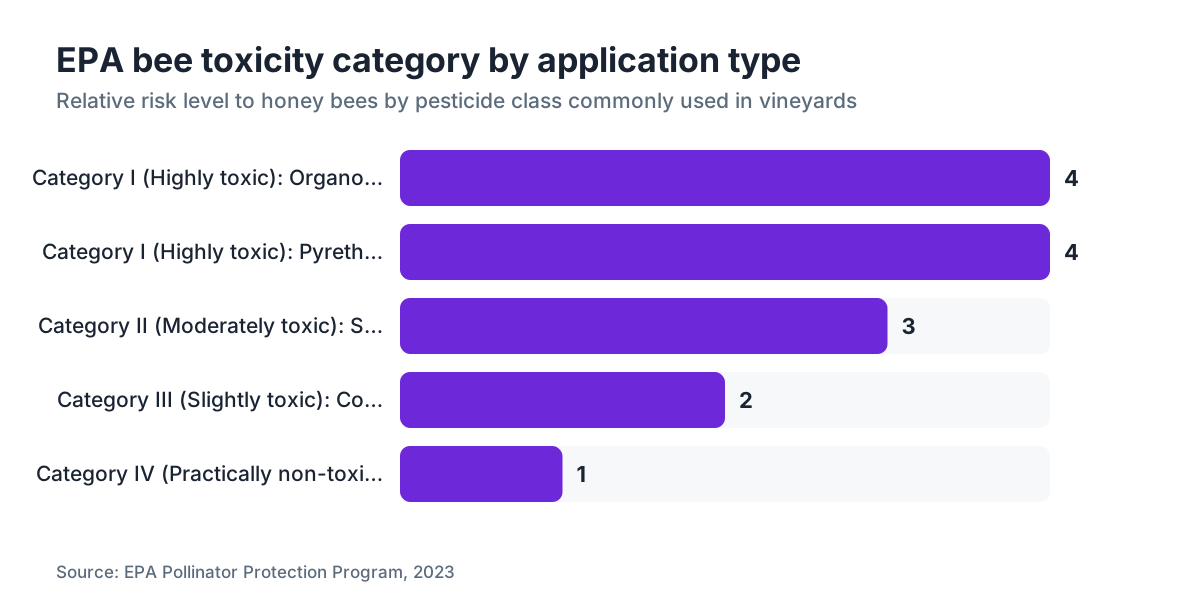
WSU Extension's publication "Protecting Honey Bees in Agricultural Settings" recommends that growers contact registered beekeepers before applying systemic insecticides or products rated highly toxic to bees, and document that contact. [6] It also notes that EPA bee toxicity ratings (categories I through IV, most to least toxic) should drive which applications get the most careful documentation.
For Yakima Valley or Columbia Valley vineyards, where commercial honey operations often share ground with grapes, buffer documentation carries extra weight. Hive density in those corridors makes a nearby registered apiary more likely than in isolated growing regions.
How should you handle pre-notification to beekeepers and record it?
Pre-notification is the step most vineyard managers skip, partly because it isn't always required and partly because finding the beekeeper's contact takes time. It's still good practice, and where it's required, failing to document it counts as a separate violation.
Where to find the contact: state beekeeper registries usually list a name and phone or email alongside the hive location. If you call the county ag commissioner for apiary locations, ask for the beekeeper contact at the same time.
What to record: the beekeeper's name, the date and time you made contact, the method (phone, email, text), the products you named, the intended application date, and whether you reached the beekeeper directly or left a message. Emailed? Keep a copy of the email in your file.
Couldn't reach anyone? Document the attempts. "Called [name] at [number] on [date] at [time]. Left voicemail. Sent follow-up email to [address] on [date]." A record of attempted notification is meaningful evidence you acted in good faith.
Some states have formalized this. California's DPR offers a sample pre-notification form through county commissioners, and some counties run online systems. [2] Using the official form, even when not strictly required, gives you a standardized paper trail.
What's the best system for keeping these records organized over a full spray season?
Paper records fail in one predictable way. Fields get left blank in the field and never filled in back at the office. The apiary buffer fields are exactly the detail that gets skipped under time pressure.
The most reliable setup for small to mid-sized operations is a template with the apiary buffer fields built in and required, not optional. If your template has a line reading "Nearest apiary: ___ ft (buffer required: ___ ft)," the applicator fills it in before leaving the block. Blank fields on a printed form jump out at an inspector in a way that missing digital fields don't.
For operations on digital record-keeping, platforms like VitiScribe include label-required fields and flag missing data before a record saves, which helps here since it's easy to forget the buffer notation while you're focused on getting the spray done.
Whatever you use, archive the product labels that were in force at the time of each application, more than the current label version. EPA label revisions happen. If a label's buffer language changes between your application date and an audit, you want the version that applied when you sprayed. A scanned PDF of each label keyed to the application date is the cleanest solution. [3]
Cornell's pest management guidelines for wine grapes recommend reviewing all product labels at the start of each season for updated Bee Advisory Box language, since the EPA keeps adding pollinator requirements to existing registrations on a rolling basis. [7]
What do inspectors actually look for in an apiary buffer audit?
Most vineyard pesticide inspections start with a complaint, usually a beekeeper reporting unusual hive mortality. The inspector's job is to figure out whether a pesticide application caused the loss and whether the applicator followed the law.
On the record side, inspectors check:
- Whether the product applied has a Bee Advisory Box or other pollinator language on the label.
- Whether the applicator knew or should have known about a nearby apiary (did they check the registry?).
- Whether the label buffer distance was met.
- Whether the application happened during restricted hours.
- Whether the records are complete, legible, and internally consistent. Application times that don't square with block acreage and equipment are a red flag.
Inconsistency is the most common problem. If your record shows application from 8 AM to 10 AM but your tractor GPS log shows 5 hours of runtime, that generates questions. List wind speed as "calm" while the weather station two miles away logged 12 mph gusts, and the inspector notes it.
The EPA's enforcement guidance requires that pesticide records be "accurate and complete," and treats falsification of records as a FIFRA violation separate from any underlying application violation. [1] That's a higher penalty tier.
One honest note. Inspectors in most states aren't pesticide chemists. They read paperwork and ask whether you did what the label required. A complete, clear, internally consistent record set is your best defense, even if the cause of a bee kill turns out to be something else entirely.
Are there record-keeping differences for organic vineyards using copper or sulfur near apiaries?
Copper fungicides and sulfur are the backbone of organic disease management in vineyards, and many growers assume they're mostly exempt from pollinator concerns because they're OMRI-listed and not systemic insecticides. That's partly right, not entirely.
Sulfur at high temperatures can stress or kill bees through contact, especially high-concentration wettable sulfur applied during warm daytime hours. EPA-registered sulfur products carry labels, and some include bee exposure cautions even without a formal Bee Advisory Box. If the label has any bee-related language at all, document it the way you would for a conventional product.
For copper and sulfur products with no bee advisory language, your records don't need apiary buffer fields. Still note that you reviewed the label for pollinator language and found none. That single line protects you.
Organic certification records and pesticide spray records are separate documents with separate rules. The USDA's National Organic Program requires documentation of all materials used on certified organic ground, including application rates and dates, but NOP does not require apiary buffer documentation specifically. [8] State and federal pesticide requirements apply regardless of organic status.
How does VitiScribe and similar software help with this documentation?
Manual spray logs leave too much room for gaps, especially inside a tight spray window. Software built for vineyard compliance closes that gap by making buffer documentation a required step instead of an afterthought.
VitiScribe lets you attach block GPS boundaries to spray records and flag applications where a saved apiary location falls inside a label-required buffer, so you can't submit a record with a blank buffer field. It also archives label PDFs alongside application records, which handles the version-in-force problem described above.
Record architecture matters beyond the single entry. A well-designed system pulls a report of every application near a registered apiary for a given season, which is exactly what you'd hand an inspector. That report takes minutes to generate digitally. Producing it from a binder of handwritten records takes days, if you can do it at all.
The honest caveat: no software fixes a grower who doesn't check the beekeeper registry before spraying. The workflow only works if the apiary location data lives in the system. Querying your state's registry at the start of each season and entering those locations is the human step nothing replaces.
What's a practical template for a single spray record entry near an apiary?
Below is a field-by-field example of a complete entry when an application block sits near a registered apiary. It isn't a legally required form, just a model of the information that should be present.
Application Record: Block 12, Cabernet Sauvignon
Date: [date] | Time start: 7:30 AM | Time end: 9:15 AM
Applicator: [name], CA License No. [number]
Product: [product name], EPA Reg. No. [number]
Target pest: Botrytis cinerea
Rate: [oz/acre], Volume: [gal/acre], Total volume: [gallons]
Equipment: [tractor-mounted airblast, nozzle type]
Wind speed and direction: 3 mph NW (Kestrel reading at 7:25 AM)
Temperature: 58 degrees F at application start
Pollinator/Apiary Section:
Bee Advisory Box present on label: Yes
Label buffer requirement: 150 feet from active bee yard
Registry checked: [State] County Ag Commissioner, [date of check]
Nearest registered apiary: [beekeeper name], GPS [coordinates], approximately 0.4 miles from Block 12 eastern boundary (measured via [app/tool] on [date])
Buffer compliance: Yes, 2,112 feet exceeds 150-foot label requirement
Application timing: Completed before 9:30 AM. Temperature at start 58F. Application finished before full foraging activity per label guidance.
Beekeeper pre-notification: Contacted [name] by phone on [date] at [time], spoke directly, informed of product and application date.
Label archived: Yes, PDF dated [date of print] attached.
That's a complete record. It tells a full story an inspector can follow without a single follow-up question. Every field has a specific, documentable answer.
Frequently asked questions
How far does a vineyard spray buffer need to be from a beehive?
The distance comes from the specific product label, not one universal rule. Products carrying an EPA Bee Advisory Box typically specify buffers from 25 feet to several hundred feet depending on the active ingredient and application method. Check the label's Bee Advisory Box for the exact figure. That language is legally binding under FIFRA, and your spray record must document that the required distance was met.
Do I have to notify a beekeeper before spraying near their hives?
Federal law doesn't universally require pre-notification, but several states do, and some county rules in California require it for certain products or distances. Even where it isn't required, documenting that you notified the beekeeper (or tried to) is strong evidence of good faith if a hive kill complaint is filed. WSU Extension recommends documenting beekeeper contact before applying insecticides rated highly toxic to bees.
How do I find registered beehive locations near my vineyard?
Contact your county agricultural commissioner, who holds registration records in California and many other states. Washington growers can query the WSDA. USDA's Digi-Bee is a voluntary national registry. Document which registry you checked, the date, and the result. Checking once at the start of the season may not be enough if new apiaries register mid-season, so a fresh check before high-risk applications is better practice.
What happens if I forget to document the apiary buffer and there's a bee kill complaint?
Missing documentation doesn't prove you broke the buffer, but it removes your main defense. State ag departments treat incomplete spray records as a separate violation from any underlying application violation. In California, failing to keep required pesticide records can bring fines and license suspension independent of whether a bee kill occurred. Complete records are your primary protection.
What is the EPA Bee Advisory Box and which products require it?
The EPA's Bee Advisory Box is standardized label language for products with active ingredients rated highly toxic to bees. It specifies buffer distances and application timing restrictions. The EPA began requiring it in 2013 and keeps adding it to existing registrations on a rolling basis. Check the current label for any product you plan to apply, since the language may have been added to registrations you've used for years without it.
Can I use GPS coordinates in spray records for apiary locations?
Yes. GPS coordinates are the cleanest, most defensible way to document apiary locations and measure buffer distances. Record the coordinates of the nearest registered apiary, the GPS boundary of your application block, the calculated distance between them, the measurement date, and the tool used. A screenshot from a mapping app showing the measured distance is an excellent supporting document to keep with the spray record.
How long do I need to keep vineyard spray records that include apiary buffer documentation?
Federal law under FIFRA requires pesticide application records be kept for two years. California requires two years as well, though PUR data submitted to the county is held permanently in the state system. Washington requires two years. Some states require longer retention for restricted-use pesticides. Keep the records, and keep the product labels that were in force at the time of each application alongside them.
Do sulfur and copper applications in organic vineyards require apiary buffer documentation?
Only if the product label carries bee advisory language. Many sulfur and copper products used in organic production have no Bee Advisory Box, so no buffer documentation is technically required. Sulfur applied at high temperatures can still harm bees on contact. A good practice is noting on the spray record that you reviewed the label for pollinator language and found none, which protects you if questions come up later.
What's the difference between a restricted-use pesticide record and a general-use pesticide record for apiary purposes?
Restricted-use pesticides require a licensed applicator and carry separate record-keeping requirements, including license number and certification category. For apiary purposes, the Bee Advisory Box requirement rides on the product's toxicity to bees, which doesn't map cleanly onto restricted-use versus general-use classification. Some general-use products have Bee Advisory Boxes. Check every label regardless of classification.
What information should I record about wind conditions when spraying near an apiary?
Record wind speed and direction right before the application starts, using a measured reading rather than a guess. Note the tool (weather station, handheld anemometer, phone app). Direction relative to the apiary matters, because drift toward a bee yard is a bigger concern than drift away. Some labels set a maximum wind speed near pollinator habitat. Calm conditions with the apiary downwind of the spray block are the highest-risk combination.
Are there university extension resources for vineyard apiary buffer compliance?
Yes. WSU Extension has published guidance on protecting honey bees in agricultural settings, including documentation recommendations. UC Davis and UC Cooperative Extension publish integrated pest management guides for wine grapes with pollinator protection sections. Cornell's pest management guidelines for wine grapes cover bee toxicity ratings and label compliance. All three are practical, peer-reviewed resources that line up with state and federal requirements.
Does the Worker Protection Standard overlap with apiary buffer requirements?
The EPA's Worker Protection Standard mainly covers human worker protections: restricted-entry intervals, personal protective equipment, and training. It doesn't govern apiary buffers directly. Bee buffer requirements come from the product label under FIFRA. But WPS records and pesticide application records often live together, so the same recordkeeping setup covers both. A complete, organized spray record system satisfies requirements from both frameworks.
How do I document a situation where I couldn't maintain the full buffer distance?
If your block layout makes the label-required buffer impossible on all sides, you have options: apply only in sections that meet the buffer, apply when bees aren't foraging (early morning, late evening, or below 50 degrees F), or switch to a product with a shorter buffer requirement. Document whatever you choose, including the constraints you faced and the decision you made. Never just leave the buffer issue out of the record.
Sources
- EPA, Federal Insecticide, Fungicide, and Rodenticide Act (FIFRA): FIFRA requires pesticide labels to be legally binding instructions; applicators must follow label requirements including Bee Advisory Box buffer distances; records must be accurate and complete and falsification is a separate violation
- California Department of Pesticide Regulation, Pesticide Use Reporting: California requires monthly pesticide use reporting to county agricultural commissioners and requires that spray records document label compliance including pollinator protections; bee mortality must be reported within 24 hours
- EPA, Pollinator Protection: Bee Advisory Box: EPA introduced the standardized Bee Advisory Box label language in 2013 for products with active ingredients rated highly toxic to bees, specifying buffer distances and application timing restrictions
- Washington State Department of Agriculture, Pesticide Program: WSDA requires pesticide applicators to retain spray records for two years and to include the information required by the product label; runs a beekeeper registration program
- USDA Agricultural Marketing Service, Digi-Bee Program: USDA AMS operates Digi-Bee, a voluntary national registry that allows beekeepers to register GPS coordinates and alert nearby growers before pesticide applications
- WSU Extension, Protecting Honey Bees in Agricultural Settings: WSU Extension recommends that growers document beekeeper contact before applying systemic insecticides or products rated highly toxic to bees, using EPA bee toxicity categories I through IV
- Cornell University, Pest Management Guidelines for Wine Grapes: Cornell's wine grape pest management guidelines recommend reviewing all product labels at the start of each season for updated Bee Advisory Box language
- USDA National Organic Program, Record-Keeping Requirements: USDA NOP requires documentation of all materials used on certified organic ground including application rates and dates, but does not specifically require apiary buffer documentation
- UC Davis, UC Integrated Pest Management Program: UC Cooperative Extension IPM guidelines for wine grapes include pollinator protection sections covering bee toxicity ratings and label compliance
- EPA, Worker Protection Standard for Agricultural Pesticides: EPA Worker Protection Standard covers restricted-entry intervals, personal protective equipment, and training; WPS and pesticide application records are commonly kept together
Last updated 2026-07-10