How to document mow timing decisions relative to beneficial insect habitat

TL;DR
- Document mow timing by recording the date, cover crop bloom percentage, beneficial insect species or functional groups you saw before the pass, weather, and your rationale in a dated field log.
- That creates an audit trail showing you weighed pollinator and natural enemy habitat before you dropped the deck.
- It matters for GAP audits, SIP certification, and USDA conservation program reviews.
Why does mow timing documentation matter for beneficial insects?
Mowing is one of the highest-impact decisions you make on the vineyard floor, and it's one of the least documented. You log every spray. You note every irrigation set. But the mow? Most managers scratch a date on a whiteboard and move on. That gap is a real problem.
Beneficial insects, including parasitic wasps, lady beetles, lacewings, ground beetles, and native bees, depend on floor vegetation for food, shelter, and reproduction. A cover crop in full bloom can support dozens of species at once. Mow at the wrong moment, say when buckwheat or phacelia is at peak flower, and you wipe out that resource in an afternoon [1].
The documentation side matters for three reasons. First, audit programs like Sustainability in Practice (SIP) and California Certified Sustainable Winegrowing (CCSW) ask how you manage habitat for natural enemies and pollinators. Saying "we think about it" does not satisfy a third-party auditor. A dated field log with bloom observations does. Second, if you're in USDA EQIP or RCPP conservation programs, your practice standards may require evidence that your cover crop management protects pollinators. Third, if a neighbor or a regulator ever questions your pesticide use or land management, documented mow decisions show due diligence.
The record has one job. On the day you mowed, what did you see, what did you decide, and why?
What information should every mow timing record include?
A good mow record is not a novel. It's a form you can fill out in five minutes at the tractor before the key turns. Here's what belongs in every entry.
Date and time. Sounds obvious, but the time carries weight. Early morning mows (before 10 a.m.) are consistently better for pollinators because most bee species forage heaviest from mid-morning through early afternoon [2]. Mow at 7 a.m. and write it down, and you've shown awareness backed by action.
Block or row section. Be specific. "East hillside, rows 40 to 80, Cabernet block" is useful. "Vineyard" is not.
Cover crop species present. List what's growing, even broadly. "Annual ryegrass, crimson clover, wild mustard" takes ten seconds and tells an auditor you looked.
Bloom stage. This is the observation that carries the record. UC Davis and WSU extension both flag bloom percentage as the single most predictive variable for insect activity in cover crops [1][3]. Estimate the share of plants in flower. A crop at 5% bloom is a different world from one at 70%.
Beneficial insects observed. No entomology degree required. Write what you see: "bees present, several species," "lacewing adults on mustard," "no insect activity noted." Functional groups are fine. The point is that you looked.
Weather conditions. Temperature, wind, and cloud cover all shape both insect activity and your decision to mow. A logged note that "temps below 55°F, no bee flight observed" is exactly the kind of line that backs up a cold-morning mow.
Mow height and equipment. This sets how fast the habitat recovers. A high cut at 6 to 8 inches leaves residue and some floral structure. A scalp cut at 2 inches does not. Write down which you ran and why.
Decision rationale. One or two sentences. "Clover at 60% bloom, bee activity observed, delayed mow to next week" or "mustard past peak, mostly seed set, mowed at 8 a.m., low bee activity." That's your paper trail.
What bloom stage thresholds should trigger a mow delay?
There's no single federal standard for bloom thresholds and mow delays. But extension guidance and integrated pest management (IPM) programs give you real numbers to work from.
UC Davis Cooperative Extension recommends against mowing when cover crops are in active bloom and foragers are present, and it flags the window from 10 a.m. to 4 p.m. as highest risk for pollinator disturbance [1]. WSU Extension's cover crop management guidance for Pacific Northwest vineyards likewise recommends scouting for bloom and insect activity before you schedule any mechanical floor work [3].
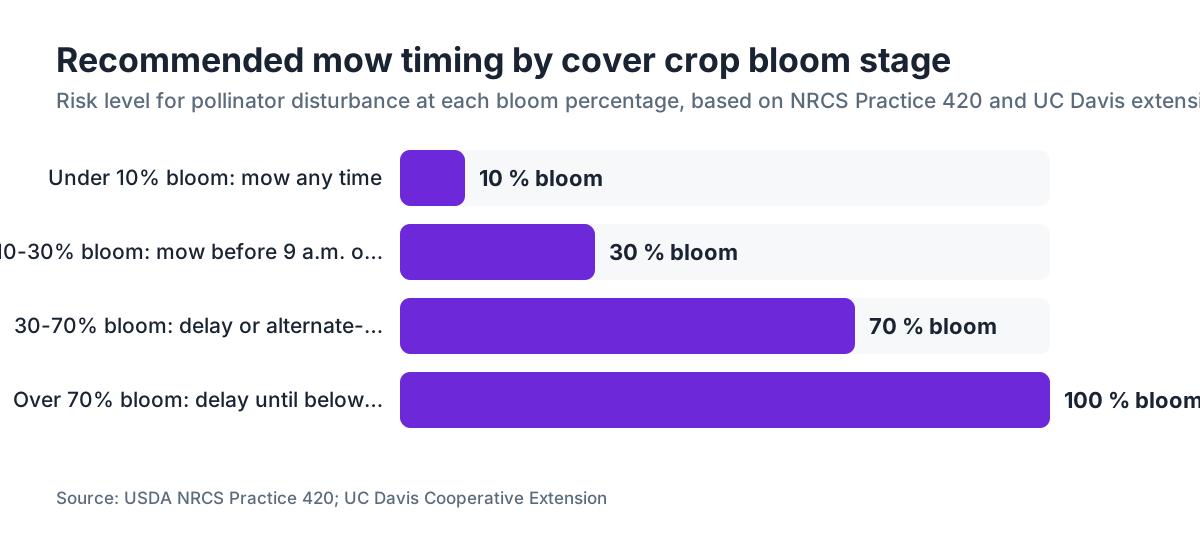
For working thresholds, the USDA Natural Resources Conservation Service (NRCS) pollinator habitat practice standard (Practice 420) says vegetation management should avoid the primary bloom period when pollinators are present [4]. In practice, most experienced managers I've watched use something close to this:
| Bloom stage | Bee/beneficial activity | Recommended action |
|---|---|---|
| Less than 10% bloom | Low activity | Mow any time of day |
| 10-30% bloom | Moderate | Mow before 9 a.m. or after 5 p.m. |
| 30-70% bloom | High | Delay mow or mow alternate rows only |
| Over 70% bloom | Peak | Delay mow until bloom drops below 30% |
| Post-bloom, seed set | Low | Mow any time, high cut preferred |
These thresholds are not law. They're working guidelines pulled from extension recommendations and NRCS practice standards. Your real decision hangs on your crop mix, your region, and what you observe. But write these thresholds into your farm plan, document whether you followed them, and you have a system that holds together.
Alternate-row mowing earns its own line in the log. Cornell Extension recommends it as a way to keep continuous habitat while still managing floor vigor, and it's a practice auditors recognize [5]. If you alternate rows, note which got mowed, which got left, and why.
How do you connect mow records to your spray program documentation?
This is where mow documentation pays double. Under the EPA Worker Protection Standard (WPS) and most state pesticide rules, you're already keeping spray records with dates, products, restricted entry intervals (REIs), and field locations [6]. Your mow records should live in the same system, or at least cross-reference it.
Here's the practical payoff. If you sprayed a broad-spectrum insecticide and then mowed a blooming cover crop two days later, an auditor reading both records sees the sequence. That's fine if the spray went on per label and the REI was respected. But if you're claiming a pollinator-friendly program and the records show a pyrethroid application followed straight away by a peak-bloom mow, you've got a credibility gap.
The reverse helps you too. Delay a mow because bloom was at 60% while an insecticide application was pending, document both, and you've shown integrated thinking. "Delayed mow 10/4 due to buckwheat at peak bloom. Mow rescheduled 10/8 pending bloom drop. Sulfur application 10/5 completed per label, REI 24 hours" is a record that holds up.
For managers on digital field platforms, tools like VitiScribe let you log mow events and spray records in one block-level timeline, so the cross-referencing is automatic instead of a scramble at audit time.
The EPA WPS itself doesn't require mow timing documentation. But the Agricultural Worker Protection Standard (40 CFR Part 170) does require records that show protection of agricultural workers and, by extension, compliance with label restrictions [6]. If a label says "do not apply when bees are actively foraging" and your field records show you mowed a blooming cover crop the morning of a spray, you want your paperwork to reflect the thinking behind it.
What format works best for a mow timing field log?
Paper, app, or spreadsheet all work. What matters is that you use it every time and fill it out completely. The medium is a distant second.
A paper field log is fine if your team actually uses it. The failure mode is selective documentation: people fill it out when they remember and skip it when they're in a hurry. Build the form into your pre-mow checklist so it's a required step, not an optional one. UC Davis Cooperative Extension's integrated vineyard management resources include sample field scouting forms you can adapt [1].
A spreadsheet works well if you're already keeping records digitally. Make a dedicated tab for floor management with the fields from the section above. The upside is easy sorting by date, block, or bloom stage when you pull records for an audit.
A dedicated field app is the most reliable option if your crew is comfortable with mobile tools. Records get time-stamped automatically, location can be GPS-tagged, and photos of bloom stage or observed insects become part of the record. Cornell Cooperative Extension has noted that photo documentation of insect presence strengthens habitat management claims in third-party audits [5].
Whatever format you pick, the record has to sit somewhere you can find it in three years. The California Sustainable Winegrowing Alliance recommends retaining field management records long enough to cover standard audit lookback periods, generally three years. USDA NRCS conservation program records typically require five-year retention [4].
One practical tip. Name one person per crew to complete the mow log for each event. Shared responsibility usually means no responsibility.
How do you identify and record beneficial insects without being an entomologist?
You don't need species-level ID. Functional groups are enough for most documentation, and they're what extension programs teach.
For the field log, four categories cover the beneficials that count:
- Bees (any bee, honey or native, foraging on flowers)
- Parasitoid wasps (small, dark wasps, often hovering over or walking on plants)
- Predatory beetles and bugs (lady beetles, ground beetles, lacewings)
- Hoverflies (bee-like flies, often hovering near flowers)
See any of these? Note the category, a rough count ("several," "abundant," "one or two"), and the plant they were on. That's enough.
WSU Extension's vineyard insect management publication includes quick visual ID guides for the most common beneficial groups in Pacific Northwest vineyards, and UC Davis IPM resources have the equivalent for California [3][7]. Print the right one-pager and laminate it for the tractor cab.
For a deeper look when you find something unfamiliar, the UC Statewide IPM Program's online pest management guidelines carry photo galleries that cover most vineyard-relevant beneficials [7]. Cornell's New York State IPM Program has parallel resources for eastern states [5].
Some managers run a three-minute sweep-net sample before mowing, especially at peak bloom. That gives you a real count instead of an eyeball estimate. It's not required. But if you're in a certification program that rewards documented habitat management, it adds weight.
How does this documentation fit into SIP, CCOF, and other certification programs?
Each program has its own rules, but they all reward the same thing: showing that you made deliberate, documented decisions about habitat management.
Sustainability in Practice (SIP) certification, run by the SIP Certified program in California, evaluates vineyard floor management under its biodiversity criteria. Auditors look for evidence that you assessed cover crop bloom and insect activity before mechanical management. A dated mow log with bloom observations answers that directly.
California Certified Organic Farmers (CCOF) and USDA organic certification don't specifically require mow timing logs, but an organic system plan must describe how you manage beneficial habitat. If your plan says you time floor management to protect beneficials, your records have to prove you actually do it.
The USDA NRCS Pollinator Habitat practice standard (Practice 420) states that management of pollinator plantings should be timed to reduce impacts on foraging and nesting pollinators [4]. If you're taking EQIP payments for cover crop establishment or pollinator habitat, your conservation plan should carry a management schedule, and your field records should document that you kept to it.
Lodi Rules for Sustainable Winegrowing, one of the more detailed third-party programs in California wine country, includes scored criteria for beneficial insect habitat management. Per the Lodi Winegrape Commission's grower workbook, documentation of management decisions affecting habitat feeds into your score [10]. A mow log with bloom and insect observations is exactly the evidence that moves you from "aware" to "practicing" on their rubric.
What does a completed mow timing record actually look like?
Here's a realistic example that would hold up in an audit. It's a constructed illustration, not a real farm's data, but every element is grounded in the documentation practices described by UC Davis, WSU, and Cornell extension.
Date: May 14, 2025, 7:45 a.m.
Block: Chardonnay Block C, rows 1 to 45 (odd rows only)
Cover crop species: Annual ryegrass, crimson clover, volunteer mustard
Bloom stage: Crimson clover about 55% bloom; mustard past bloom, seed set; ryegrass headed out
Beneficial insects observed: Several honey bees and at least two native bee species (small, dark, solitary) foraging on clover. One lady beetle adult on mustard. No lacewing or parasitoid wasp activity noted.
Weather: 52°F, overcast, light wind from northwest. Low bee flight consistent with cool temperatures.
Mow height: 6 inches
Equipment: Kubota M7-172, flail mower
Decision: Mowed odd rows only due to clover at 55% bloom. Even rows held for two weeks. Cool morning temperatures and overcast skies reduced bee flight; low activity observed during the walk-through before mowing. Will reassess even rows May 28.
Logged by: J. Morales
That record takes about four minutes to write. It shows the manager scouted the block before mowing, read the bloom stage and insect activity, made a habitat-protective call (alternate-row mowing), and noted the conditions that backed a 7:45 a.m. start. Any auditor reading it can follow the reasoning.
How often should you be scouting and documenting before mowing?
Scout every time you plan to mow during the window when cover crops could be in bloom. In most California wine regions, that's roughly February through June for winter annuals and spring-seeded species. In cooler regions like Washington's Columbia Valley or New York's Finger Lakes, the window shifts later, but the principle holds.
Outside the bloom window, a short note that bloom wasn't a factor ("cover crop dormant," "post-harvest, no bloom present") is enough. You're not making busy work. You're building a record that shows you thought about the question every time you mowed.
WSU Extension recommends scouting vineyard floors at least weekly during peak bloom to track shifts in floral resources and insect activity [12]. That cadence lines up neatly with mow scheduling. Scout weekly, and you'll know when bloom is peaking and when it's dropping, so you can time the mow and log the decision while the observation is fresh.
Run a big operation with multiple blocks mowing on different schedules? Keep a simple master log at the farm office in addition to block-level records. The master log gives you a bird's-eye view of your mow schedule against bloom timing across the farm, which helps at annual reviews and when you're justifying your approach to certifiers.
Are there any legal or regulatory requirements specifically about mowing near pollinators?
No federal law directly requires mow timing documentation for pollinator protection. But several regulatory threads touch it, and ignoring them is a mistake.
The EPA's pesticide label system is the closest thing to a hard legal hook. Some insecticide labels carry specific pollinator language. EPA's 2014 pollinator protection label improvements added advisory language to many neonicotinoid and pyrethroid labels, including restrictions on application when bees are foraging or when blooming weeds are present [6]. If your cover crop is blooming and you spray against those instructions, whether you mowed is a separate but related problem. The label is law under FIFRA (7 U.S.C. § 136 et seq.), and violations can carry fines [8].
The EPA WPS (40 CFR Part 170) is about worker protection, not pollinator protection, but it requires you to keep pesticide application records and pass hazard information to workers [6]. Mow timing records don't fall under WPS directly. They do sit in the same documentation ecosystem and back up a coherent farm records system.
State rules vary. California's Department of Pesticide Regulation (CDPR) has mandatory pollinator protection regulations for certain pesticides applied when bees are present (Title 3 CCR, Division 6) [11]. Oregon and Washington run similar provisions. In a state with active pollinator regulations, your mow timing documentation adds context to your whole compliance posture.
For growers in USDA conservation programs, the NRCS Practice 420 standard is effectively a contractual requirement [4]. If you're paid to establish and manage pollinator habitat and your records don't show habitat-protective timing, you're at risk of losing those payments.
How can you use mow timing records to improve your beneficial insect program over time?
The records do more than feed auditors. They feed you.
After two or three seasons of consistent documentation, you'll have real data on bloom timing by block and species mix, which months carry the most insect activity, and how fast habitat recovers after mowing at different heights. You can't pull that from an extension bulletin, because it's specific to your site, your microclimate, and your cover crop mix.
Review your mow logs each winter. Hunt for patterns. If your west-facing blocks hit peak bloom two weeks ahead of your east-facing blocks, build that into next year's mow schedule. If your phacelia mix draws far more beneficial activity than your ryegrass sections, that's a seeding decision for next fall.
Cornell Extension's work on vineyard ecosystem services suggests that vineyards with documented, consistent beneficial insect habitat management show better natural enemy populations over time, which cuts the need for insecticidal inputs [5]. Nobody has great long-term controlled data from commercial vineyards specifically, but the direction of the evidence is consistent.
Share annual summaries of your mow records with your viticulture consultant or IPM advisor. Three years of bloom observations and mow decisions give them context a single farm visit can't.
If you want one place to keep all of it, vineyard field management software like VitiScribe lets you attach bloom-stage notes and insect observations straight to scheduled mow events, so the documentation structure is already built in and you're not running a separate paper system.
Frequently asked questions
Do I need to document mow timing if I'm not in any certification program?
You don't legally have to, but it's still worth doing. If you ever apply for USDA conservation funding, pursue SIP or Lodi Rules certification, or face a pesticide use complaint, documented mow decisions are evidence of good-faith management. They also sharpen your cover crop program over time by showing which decisions worked and which didn't.
What's the simplest mow timing log I can actually get my crew to use?
A laminated one-page form on a clipboard in the tractor cab with five fields: date, block, bloom percentage (rough estimate), beneficial insects seen (yes/no plus a brief note), and mow decision (proceeded or delayed, with a one-line reason). The operator fills it out before starting the engine, then hands it in after mowing. That's the whole system.
How do I estimate bloom percentage quickly in the field?
Walk a 50-foot transect through the section you're about to mow and count plants with open flowers against total plants in a rough visual sweep. You're not counting individual flowers, just whether each plant has active bloom. The walk takes two minutes and gives you a defensible estimate. Write it down right away; memory of percentages fades fast.
Can I use photos instead of written observations for beneficial insect records?
Photos are a strong supplement but shouldn't replace written records. A time-stamped photo of bees on clover confirms your observation, but a written entry shows your decision-making: what you saw, what you decided, and why. Use both. Many digital field apps let you attach photos to a written log entry, which is the most complete record.
What time of day is safest to mow when cover crops are in bloom?
UC Davis extension guidance points to early morning, before 9 or 10 a.m., as lowest risk because most bee species forage most actively from mid-morning through early afternoon. Cold or overcast mornings below about 55°F cut bee flight further. Document the time and weather in your record so the rationale for morning mowing is clear.
Does alternate-row mowing actually help, and how do I document it?
Yes. Cornell Extension recommends alternate-row mowing specifically to keep continuous floral and habitat resources while still managing floor growth. In your log, note which rows were mowed (odd or even, or specific row numbers) and which were left, plus the bloom percentage that drove the call. Record the planned date for mowing the remaining rows.
How long do I need to keep mow timing records?
For USDA NRCS conservation programs, five years is standard. The California Sustainable Winegrowing Alliance recommends three years for audit lookback. Keep whichever is longer for your situation. If you're in multiple programs, default to the most stringent retention period. Store records somewhere secure and backed up, more than a paper folder in the barn.
What cover crop species are most important to document bloom timing for?
Focus on species that draw the most beneficial insect activity: phacelia, buckwheat, crimson clover, sweet clover, mustards, and California poppy. Annual ryegrass and fescue produce far less floral resource and lower insect activity. Knowing your species mix lets you calibrate how carefully to scout before each mow.
Does the EPA Worker Protection Standard require mow timing records?
Not directly. The WPS (40 CFR Part 170) covers pesticide application records and worker safety communication, not mow timing. But some pesticide labels restrict application when blooming plants are present, and your mow and spray records together show whether you managed both in line with label requirements. The label is enforceable under FIFRA.
Can mow timing documentation help reduce my pesticide use?
Indirectly, yes. Vineyards with healthy beneficial insect populations, supported by habitat-protective management, tend to have better biological control of mites, leafhoppers, and some moth pests over time. Cornell Extension research suggests consistent habitat management improves natural enemy populations in commercial vineyards. Your records let you track whether your habitat work is actually shifting insect populations and inputs across seasons.
How do I handle mow timing documentation for a very large vineyard with multiple crews?
Name one person per crew as the designated record-keeper for each mow event. Use a standardized form or digital entry so records stay consistent across crews. Keep a master mow log at the farm office that aggregates all block-level entries by date. Review it weekly during bloom season to catch any blocks where documentation was missed before memory fades.
Do I need to identify bee species, or is 'bees present' enough?
For most certification audits and conservation program records, 'bees present' with a rough activity level (few, several, abundant) is enough. Species-level ID is not required. If you want to go deeper, WSU and UC Davis extension publish quick visual guides to the most common beneficial groups in wine country vineyards that let you tell honey bees, bumble bees, and small native bees apart without specialized training.
Sources
- UC Davis Cooperative Extension, Integrated Vineyard Management: UC Davis extension recommends avoiding mowing when cover crops are in active bloom and insect foragers are present, and flags 10 a.m. to 4 p.m. as highest risk for pollinator disturbance.
- UC Davis Agriculture and Natural Resources, Bee-Safe Gardening and Farming: Most bee species forage heaviest mid-morning through early afternoon, making early morning mowing lower risk for pollinator disturbance.
- Washington State University Extension, Cover Crop Management in Pacific Northwest Vineyards: WSU Extension recommends scouting for bloom and insect activity before scheduling mechanical floor management, and flags bloom percentage as a key variable for insect activity.
- Cornell Cooperative Extension, New York State IPM Program, Vineyard Ecosystem Management: Cornell Extension recommends alternate-row mowing to maintain continuous habitat resources and notes that consistent habitat management improves natural enemy populations in commercial vineyards over time.
- U.S. EPA, Agricultural Worker Protection Standard, 40 CFR Part 170: The EPA WPS requires pesticide application records and worker safety communication; EPA's 2014 pollinator protection label improvements added restrictions on application when bees are foraging or blooming weeds are present.
- UC Statewide IPM Program, Pest Management Guidelines for Vineyards: UC IPM online resources include photo galleries and quick identification guides for beneficial insect groups in California vineyards.
- U.S. EPA, FIFRA (Federal Insecticide, Fungicide, and Rodenticide Act), 7 U.S.C. § 136: The pesticide label is law under FIFRA; violations of label restrictions, including those related to bee presence and blooming weeds, can result in fines.
- Lodi Winegrape Commission, Lodi Rules for Sustainable Winegrowing Workbook: Lodi Rules certification includes scored criteria for beneficial insect habitat management, and documentation of management decisions affecting habitat is factored into the grower's score.
- California Department of Pesticide Regulation, Pollinator Protection Regulations, Title 3 CCR Division 6: California DPR has mandatory pollinator protection regulations for certain pesticides applied when bees are present, making mow timing documentation relevant to overall compliance posture.
- WSU Extension, Vineyard Insect Management, Pacific Northwest: WSU Extension recommends scouting vineyard floors at least weekly during peak bloom periods to track changes in floral resources and insect activity for mow scheduling.
Last updated 2026-07-10