How to document restricted entry intervals in vineyard spray logs

TL;DR
- Every pesticide application in a vineyard needs a spray log entry with the REI end date and time, the product name and EPA registration number, the treated area, and who got notified.
- Under the EPA Worker Protection Standard (40 CFR Part 170), you keep records at least two years and make them available to workers within 15 minutes of a request.
What is a restricted entry interval and why does it go in your spray log?
A restricted entry interval (REI) is the stretch of time after a pesticide application when workers can't enter the treated area without specific personal protective equipment. The pesticide label sets the length, and that label is a legally binding document. In vineyards, REIs run from 4 hours on the short end to 5 days for some systemic fungicides and insecticides. [1]
The spray log is how you prove you knew the REI, communicated it, and enforced it. No written record, no defense during a Cal/OSHA inspection, a state department of agriculture audit, or a pesticide illness investigation. The EPA Worker Protection Standard, revised in 2015 and effective January 2017, requires both agricultural employers and handlers to keep records of each application. [2]
The practical reason matters too. Vineyard crews rotate. The person who sprays on Tuesday morning may not be the crew leader on Thursday afternoon when the REI has expired. A clear log entry, posted at the block and referenced in the field office record, is what keeps someone from walking into a block 24 hours early because they misremembered.
What fields does a legally compliant REI spray log entry require?
The EPA Worker Protection Standard (40 CFR Part 170.309) sets the minimum records an agricultural employer keeps for each application. Here is every required field, in plain language.
| Field | What to Record | Notes |
|---|---|---|
| Product name | As printed on the label | Include brand name and any formulation suffix |
| EPA Registration Number | On the label, e.g. EPA Reg. No. 62719-519 | Required for positive ID |
| Active ingredient(s) | List all from the label | |
| Application date | Date application started | Use MM/DD/YYYY |
| Application time | Time application started | 24-hr or AM/PM, be consistent |
| REI (hours) | From the label | |
| REI end date and time | Calculated from start time + REI | This is the field inspectors check hardest |
| Location | Block name, block ID, or GPS reference | Tie to your vineyard map |
| Acres treated | Actual treated acres | Not total block acreage if partial |
| Application method | Airblast sprayer, backpack, drone, etc. | |
| Rate applied | Per the label (oz/acre, fl oz/100 gal, etc.) | |
| Total amount mixed/applied | Gallons of mix, or lbs of product | |
| Applicator name | Person who applied | Printed name |
| Applicator license number | If applicable in your state | CA requires it for RUPs [3] |
| Handler PPE used | As required by label during application | |
| Notification method | Posted sign, verbal, or both | WPS requires both in most cases |
| Supervisor/manager signature | Varies by state | Good practice regardless |
Some states pile requirements on top of the federal baseline. California requires pesticide use reports (PURs) submitted to the county agricultural commissioner within one month of application, and those PURs carry extra fields including the site ID from the county database. [3] Washington State requires records of all restricted-use pesticide applications kept for a minimum of seven years. [4] Check your state's department of agriculture rules. The federal floor is not always the ceiling.
The REI end date and time is the field inspectors focus on because it's the only one that directly tells a worker when the block is safe to enter. Record it explicitly. Don't make someone calculate it from start time plus REI hours.
How do you calculate and record the REI end date and time correctly?
The label sets the REI in hours. Your job is to turn that into a wall-clock end time and write it down.
The formula is simple: REI end time = application start time + REI hours. Start spraying at 7:00 AM on June 14 with a 48-hour label REI, and the REI expires at 7:00 AM on June 16. Write "June 16, 07:00" on the log. Don't write "48 hours after application" and walk away. That forces someone else to do the math, and people get it wrong.
A few edge cases trip up vineyard managers.
- Multi-day applications. Spray a 40-acre block over two consecutive mornings and the REI clock starts when the last area was treated, not when you started day one. Log the completion time of each block section separately if they're done on different days. [1]
- Tank mixes. Mix two products, each with its own REI, and the longer REI governs. Log both products and both REIs, then circle or bold the controlling one so the right end time is obvious. [2]
- Early entry exceptions. The WPS lets workers enter during an REI for specific limited tasks (irrigation, hand-thinning in some situations) if they wear label-required PPE, get task-specific training, and have no other unequipped workers present. Use an early entry exception and you document it right there in the same log entry: who entered, when, what PPE, and why. [2]
Set your applicator's phone calendar or sprayer controller to log start time automatically where you can. A fuzzy start time is the number one source of REI calculation errors.
What WPS posting requirements connect to your spray log?
Under the 2015 revised WPS (effective 2017), you post a warning sign at each treated area before any application begins and keep it posted until the REI expires. [2] The sign must show the product name, the REI end date and time, the location treated, and the required PPE for early entry if early entry is possible.
Your spray log and your posted sign have to agree. If the sign says the REI ends June 16 at 7:00 AM and your log says June 15, that contradiction is the first thing an inspector circles. Keep a copy of the posted sign information in the spray log file. A timestamped phone photo of the posted sign is solid documentation and takes 10 seconds.
Central posting is an option under WPS for multi-block operations. You can post at a central location (a shop, a tractor shed bulletin board) instead of at every block, as long as workers know where it is and can check it freely before entering any field. [2] The information required is the same no matter where it lives. If you use central posting, note in the log that you did and where it was located.
UC ANR Statewide Integrated Pest Management materials note that posted signs must be legible and durable enough to survive field conditions like rain and morning dew. [5] A laminated sheet in a post-mounted sleeve is the standard setup for California vineyards.
What are the WPS worker notification requirements and how do you log them?
Posting alone isn't enough. The WPS requires that workers be told by word of mouth, in a language they understand, about ongoing or recent applications. [2] That notification has to happen before workers enter any area where pesticides were applied in the past 30 days.
For the spray log, that means a column or note field covering: who was notified, when, in what language, and by whom. If your crew speaks Spanish and the crew leader relayed the information, write it down. "Verbal notification given to crew by [name], in Spanish, at 6:30 AM on 6/14" is a complete record. "Crew notified" is not.
The WPS also requires that workers and handlers get access to application information within 15 minutes of a request. [2] Your spray log, or a summary of it, has to be reachable in the field, not locked in a filing cabinet at a house you never visit during harvest. Many operations keep a binder in the shop or a laminated quick-reference card in each tractor cab. Digital systems with mobile access solve this directly. A tool like VitiScribe lets any crew leader pull the current spray record on a phone, which meets the 15-minute access requirement without a paper chase.
One honest caveat: the 30-day notification window gets misunderstood constantly. It applies to any application in the prior 30 days, not only the most recent spray. Apply a fungicide 25 days ago and hire a new crew member today, and you owe them notification about that application too. Log your notifications with the date they happen, not the date of the application.
How long do you have to keep vineyard REI spray records?
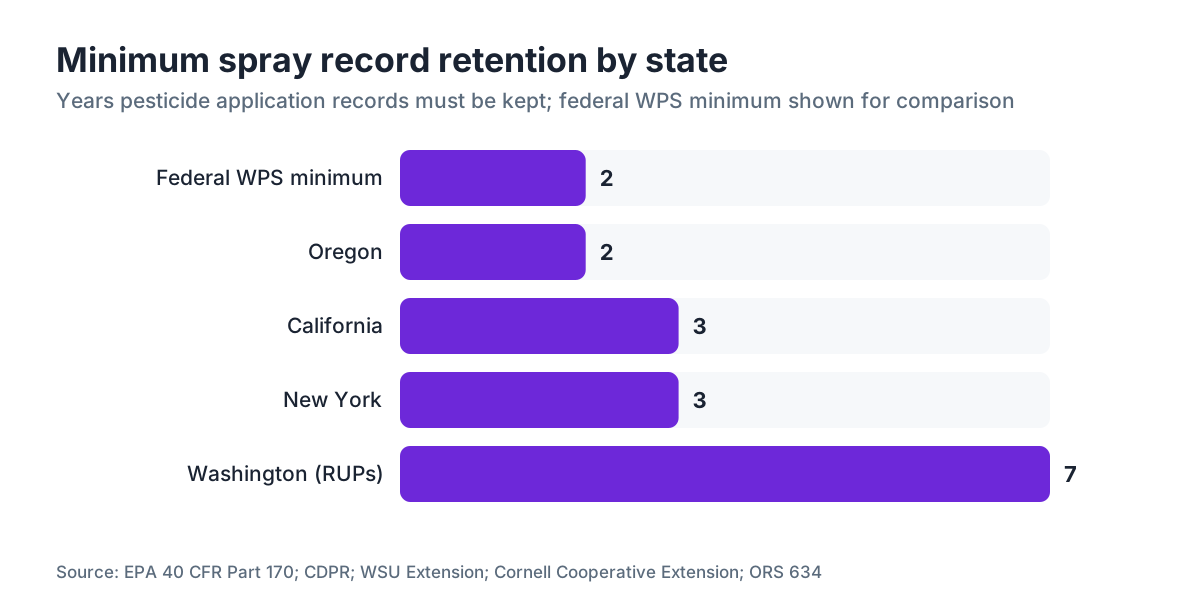
Federal WPS requires records for at least two years from the date of application. [2] That's a minimum. State requirements vary, and several states with active wine grape industries set longer windows.
| State | Minimum Record Retention | Authority |
|---|---|---|
| California | 3 years | CA Food & Ag Code sec. 12980 [3] |
| Washington | 7 years (RUPs) | WSU Extension, WAC 16-228 [4] |
| Oregon | 2 years | ORS 634 |
| New York | 3 years (pesticide records) | Cornell Cooperative Extension [6] |
| Federal WPS | 2 years | 40 CFR Part 170 [2] |
Apply the longer of the federal and state windows. In California, keep records three years. In Washington with a restricted-use pesticide, seven.
Inspectors generally accept digital records as long as they're legible, tamper-evident (a timestamp or audit log showing the record wasn't edited after the fact), and printable on request. A scanned PDF of a handwritten log qualifies. A spreadsheet with no version history is harder to defend if the date on an entry ever gets challenged. The WSU pesticide education program recommends that digital records include an audit trail showing who entered or changed each record and when. [4]
What are the most common REI documentation errors that lead to violations?
State department of agriculture inspectors and Cal/OSHA investigators flag the same handful of problems over and over. These aren't hypothetical. They're what shows up in inspection reports.
Missing REI end time. The log has the start time and the REI in hours, but nobody calculated or wrote down the end time. You can reconstruct it, sure, but now the inspector has to do math, which annoys them and signals a sloppy operation.
Tank mixes logged with only one product. Mix mancozeb and a phosphonate in the same tank and both need their own line. Logging only the primary fungicide means the REI that actually controls the mix may not be the one you wrote down.
Vague block location. "South vineyard" means nothing to an inspector who doesn't know your property. Use block IDs from your map, GPS coordinates, or both.
Absent notification records. The application is logged but there's no record that workers were told. This is the most commonly cited WPS violation. The EPA's 2017 WPS rule requires notification records be kept as part of the application record. [2]
Missing applicator license number for restricted-use pesticides. In California, any RUP application must be made by or under the direct supervision of a licensed pesticide applicator, and the license number has to appear on the record. [3] Its absence is a citation.
Retroactive record-keeping. Filling in logs Friday afternoon from memory. Courts and inspectors can usually tell. Inconsistent handwriting, uniform ink, rounded start times, and entries that don't match the day's weather all signal back-filling. Log at the time of application.
How should you structure a vineyard spray log binder or digital record for REI compliance?
How you organize the records matters almost as much as what's in them. An inspector who has to dig through a disorganized binder to find one application is an inspector in a bad mood, and that mood rarely helps you.
For paper systems, the setup that works best is chronological within each block, with a separate section per block or a clear block-ID index up front. Put each entry on a single page or a consistent two-page spread so nothing gets separated. Keep your label printouts (or a label URL reference) in a separate tabbed section, indexed by EPA registration number. Log a tank mix and cite the label tab numbers in the entry.
Digital systems follow the same logic. Each application is a record linked to a block ID, a product record (with label), and a crew record. Good vineyard software auto-calculates the REI end time the moment you enter the start time and product, which kills the arithmetic error. VitiScribe does this, and so do several other vineyard compliance tools. The payoff is that the REI end time is a system-generated field, not a hand-calculated one, so it holds up.
Paper or digital, keep a running index of every REI currently active. One clean sheet (or a dashboard view) showing all open REIs by block is what belongs posted in the shop. Your crew leader should glance at it each morning before assigning field tasks. Cornell Cooperative Extension recommends a "pre-entry check" as a standard operating procedure before any crew moves into a treated block. [6]
See also our coverage of vineyard operations for how REI tracking fits into broader field management.
Does restricted-use pesticide (RUP) documentation require anything extra in your log?
Yes, and it matters. Restricted-use pesticides carry requirements beyond the standard WPS baseline.
At the federal level, 40 CFR Part 171 requires RUP applications be made by or under the direct supervision of a certified applicator. Your spray log has to include the certified applicator's name and certification number for every RUP application. [11]
In California, every RUP application must be preceded by a Notice of Intent (NOI) filed with the county agricultural commissioner at least 24 hours before application (48 hours in some counties, so check locally). [3] Record the NOI number in your spray log alongside the application. After application, the Pesticide Use Report (PUR) submitted to the county has to match the log entry. A mismatch between PURs and on-farm spray records is one of the main triggers for follow-up inspections.
Washington State requires certified applicator records for RUPs kept seven years, as noted above. [4] The Washington State University pesticide education program has templates for RUP records you can adapt, and it's a reliable free resource for Pacific Northwest operators. [4]
The takeaway is plain. Apply any RUP in your vineyard and the log entry needs to be fuller than for a general-use product. The REI fields stay the same, but the applicator credentials, the pre-application notice, and the post-application reporting all tie back to that single entry.
What do early entry exceptions mean for your spray log documentation?
The WPS lets workers enter a treated area during the REI under limited circumstances, mainly irrigation equipment adjustment, pest scouting, and a handful of other tasks. [9] The rule at 40 CFR Part 170.603 requires that early entry workers get prior notice of the restrictions, the required PPE, and a reasonable chance to wash.
Authorize an early entry exception and the log entry for that application grows. Add: the name of each worker who entered during the REI, the date and time they entered, the specific task, the PPE they wore (verified by whom), and the fact that they got task-specific training before entry. If a supervisor verified the PPE, log their name.
This isn't paperwork for its own sake. If a worker reports a pesticide-related illness after entering a block during an REI under an exception, your documentation showing proper PPE, training, and notification is your main protection against liability. Absent that documentation, the presumption tends to run against the employer.
Early entry exceptions should be genuinely exceptional. In vineyards the most common legitimate use is irrigation system work that can't wait. Routinely authorizing early entry for harvest or pruning is a scheduling and operational problem worth solving, not a documentation problem to manage around.
How do you train vineyard staff to keep accurate REI records in the field?
The best-designed log form on earth fails if the applicator fills it out wrong or forgets to fill it out at all. Training is where compliance actually lives.
Start with the form itself. Every field gets a label, a format example (say, "REI End: 06/16/2025 07:00"), and a short note on why it matters. A form that explains itself cuts errors without adding training time.
For new applicators, a 30-minute walkthrough of one complete sample entry covers most of it. UC ANR's Statewide Integrated Pest Management program has training materials built for California pesticide applicators that you can reference or adapt. [5] Cover these points: where to find the REI on the label (it's in the Directions for Use section, under "Agricultural Use Requirements" or a similar heading), how to calculate end time for multi-day or multi-block applications, and what "notification" actually requires.
WSU Extension's pesticide safety education program, one of the most thorough in the Pacific Northwest, recommends role-specific training. Handlers get detailed instruction on label interpretation and PPE, while other agricultural workers get training focused on recognizing pesticide hazards and reading posted signs. [4] Match the training to the person's role.
Refresher training at the start of each season pays off. The label for a product you've used five years may have changed. EPA registration renewals sometimes alter REIs, add crops, or modify PPE requirements. Check labels every season, not only when you buy a new product. Keep a log of training sessions, who attended, and what was covered. That log is itself a compliance record.
What happens if your spray log REI documentation fails an inspection?
Consequences scale with severity and history. A first-time paperwork deficiency (a missing field, an imprecise block ID) usually draws a warning or a notice of violation with a correction deadline, not an immediate fine. A pattern of incomplete records, or missing records paired with an actual worker exposure, is a different animal.
In California, civil penalties under the Food and Agricultural Code can reach $5,000 per violation for willful or repeat pesticide law violations. [10] Violations tied to a pesticide illness can trigger Cal/OSHA enforcement separately, with penalties up to $25,000 per serious violation. [7] Federal WPS violations carry penalties up to $16,131 per serious violation under current OSHA penalty adjustments. [8]
Beyond fines, a pesticide illness incident with absent or inconsistent spray logs can complicate workers' compensation claims, trigger mandatory reporting to state health departments, and, in serious cases, support criminal referrals. The spray log isn't only a compliance form. It's contemporaneous evidence.
In California the inspection starts with the county agricultural commissioner, not a state agency. The commissioner reviews your spray logs, compares them to filed PURs, and may ask for label copies for any product applied. A gap between your on-farm records and your PURs is the fastest way to turn a routine check into a formal investigation. Keep them identical.
For vineyard operators in areas with active county CAC programs (Napa, Sonoma, San Luis Obispo), annual or biennial farm visits are normal. Treat every log entry as if the CAC is reading it next week.
Frequently asked questions
What is the minimum information required on a vineyard spray log for WPS compliance?
Under 40 CFR Part 170, your log needs the product name, EPA registration number, active ingredients, application date and time, REI in hours, calculated REI end date and time, treated location, acres treated, application method, rate and total applied, applicator name, PPE used, and how workers were notified. States like California and Washington add requirements including applicator license numbers and longer retention.
How long must I keep pesticide spray records for my vineyard?
Federal WPS sets a two-year minimum. California requires three years under the Food and Agricultural Code. Washington requires seven years for restricted-use pesticide records. Apply whichever is longer for your state. Digital records are fine if they're legible, printable, and include a clear audit trail showing who created or changed each entry.
Do I need to record the REI end time or is just logging the REI hours enough?
Log the explicit end date and time. Writing "48-hour REI" forces anyone reading the log later to calculate when entry is safe, and people miscalculate. Write out the actual end time: "REI expires June 16, 2025, 07:00 AM." That's what inspectors look for, and it's the only format that unambiguously protects workers who weren't present during the application.
What happens if I apply two products in a tank mix with different REIs?
The longer REI controls. Log both products with their individual REIs, then clearly mark which one governs the entry restriction. Many inspectors appreciate a note like "Controlling REI: Product B, 5 days, expires [date/time]." Never log only the shorter REI and assume a crew member will work out that the longer one applies.
Can I keep my vineyard spray logs digitally instead of on paper?
Yes. Digital records satisfy WPS and most state requirements as long as they can be printed on request and include a verifiable record of when entries were created. An audit trail (timestamps, user IDs, edit logs) strengthens a digital record against any challenge. Workers also have the right to access application information within 15 minutes, so digital records must be genuinely reachable, not theoretically available on a laptop at the house.
Does every vineyard spray log entry need a California county PUR filing?
In California, yes. Every pesticide application by a licensed applicator or anyone required to report must file a Pesticide Use Report with the county agricultural commissioner within one month of application. The PUR must match your on-farm spray log. A gap between the two is a primary trigger for follow-up inspections by the county CAC office.
How do I document a worker entering a treated block during the REI?
Any entry during an REI (early entry exception) needs added documentation in the same log entry: the worker's name, entry date and time, the task, the PPE worn and by whom it was verified, and confirmation that task-specific WPS training happened before entry. Early entry exceptions are allowed under 40 CFR Part 170.603 but must be documented in full, or the exception gives you no liability protection.
What do I need on the WPS field posting sign, and how does it relate to my spray log?
The sign must display the product name, REI end date and time, treated location, and any PPE required for early entry. It goes up before application and stays posted until the REI expires. The sign has to match your spray log. Any discrepancy, and inspectors treat the field sign as the less reliable document and flag the inconsistency.
Where exactly on the pesticide label do I find the REI?
Look in the section headed "Agricultural Use Requirements" or "Directions for Use" near the top of the label. The WPS box, required on all labels for agricultural use, holds the REI, the PPE requirements for handlers, and any early entry restrictions. It's usually a bordered box to make it easy to spot. If you can't find it, the EPA label database at labels.cdms.net has searchable label scans.
Do REI rules apply to all vineyard workers, including family members or the vineyard owner?
Yes, with one narrow exception. WPS protections apply to all agricultural workers and handlers on an agricultural establishment. An immediate family member of the agricultural employer is exempt, but that exemption is narrow and covers only spouses, parents, and children. Every hired worker, regardless of employment status or tenure, is a covered worker under the WPS.
What should I do if I realize I made an error in a spray log entry after the fact?
Correct errors with a single strikethrough of the wrong information, write the correction next to or above it, and initial and date the correction. Never erase, white out, or overwrite an original entry. For digital records, add a correction note rather than editing the original. A transparent correction shows good faith. An overwritten or erased record looks like tampering.
Is verbal notification of the REI enough, or do I have to post signs and notify workers in writing?
WPS requires both posting and verbal notification in most cases. Verbal alone doesn't satisfy the posting requirement, and posting alone doesn't satisfy the requirement to inform workers in a language they understand. Log both: what was posted, where, when it went up, plus who gave verbal notification, in what language, to whom, and at what time.
Does spraying a cover crop or non-grapevine area within the vineyard trigger REI documentation requirements?
Yes, if the product is applied on or near the commercial agricultural plant. Any pesticide applied on an agricultural establishment where workers are present is subject to WPS documentation. If your cover crop spray drifts onto the vine rows, or if workers regularly move through the cover crop area, treat the whole area as subject to the REI and log accordingly.
Sources
- EPA, Pesticide Labels: REIs are set on the pesticide label, which is a legally enforceable document, and range from 4 hours to several days depending on the product and crop.
- EPA, Agricultural Worker Protection Standard (40 CFR Part 170): WPS requires spray records be kept at least two years, workers notified in a language they understand, application information available within 15 minutes of request, and signs posted at treated areas until REI expires.
- California Department of Pesticide Regulation, Pesticide Use Reporting: California requires Pesticide Use Reports filed with the county agricultural commissioner within one month of application, records kept for three years, and applicator license numbers on all restricted-use pesticide records.
- Washington State University, Pesticide Education Program: Washington State requires restricted-use pesticide records be kept for seven years and recommends digital records include an audit trail of who entered or changed each record.
- UC ANR Statewide Integrated Pest Management Program: UC ANR extension materials note that posted signs must be legible and durable enough to survive field conditions including rain and dew, and provide training materials for California pesticide applicators.
- Cornell Cooperative Extension, Pesticide Management Education Program: Cornell Cooperative Extension recommends a pre-entry check as a standard operating procedure before any field crew enters a treated block, and notes New York requires pesticide records be kept three years.
- California Department of Industrial Relations, Cal/OSHA: Cal/OSHA can impose penalties up to $25,000 per serious violation when pesticide exposure incidents are linked to inadequate recordkeeping or failure to follow label requirements.
- OSHA, Penalties: Federal WPS violations can carry civil penalties up to roughly $16,131 per serious violation under current OSHA civil penalty adjustment schedules under the Federal Civil Penalties Inflation Adjustment Act.
- EPA, Agricultural Worker Protection Standard (early entry, 40 CFR Part 170.603): The WPS allows early entry exceptions during the REI for specific tasks, requiring prior notice of restrictions, PPE, and a reasonable opportunity to wash; all conditions must be documented.
- California Food and Agricultural Code Section 12980: California Food and Agricultural Code sec. 12980 establishes civil penalties up to $5,000 per violation for willful or repeat pesticide law violations, including recordkeeping failures.
- EPA, Pesticide Applicator Certification (40 CFR Part 171): 40 CFR Part 171 requires that restricted-use pesticide applications be made by or under the direct supervision of a certified applicator, and the certified applicator's name and certification number must appear in the application record.
Last updated 2026-07-11