How to document a spray application on leased vineyard land

TL;DR
- On leased vineyard land, both the applicator and the landowner may have legal obligations to keep pesticide records.
- At minimum you need: the product name and EPA registration number, rate, date and time, target pest, acreage treated, and applicator license number.
- Records must be kept at least two years under federal law, and many states require three.
- Get the split-records question settled in writing before you spray.
Why leased vineyards create a documentation problem that owned land doesn't
On land you own, the chain of responsibility is simple. You apply the spray, you keep the record, done. On leased land you've got two parties with potential legal exposure, and the standard boilerplate lease agreement almost never spells out who holds the required pesticide records or what happens if an inspector shows up.
The landowner can be liable under state law for pesticide violations on their property even if they weren't present. The applicator (usually the vineyard manager or a licensed PCA directing a licensed applicator) carries their own license risk. And if there's a crop injury claim, a worker exposure complaint, or a state Department of Agriculture audit, both parties are going to need documentation fast. Gaps between what the applicator recorded and what the landowner can produce are exactly where enforcement actions start.
This isn't a hypothetical. The EPA's Worker Protection Standard at 40 CFR Part 170 requires that certain application information be posted or available to agricultural workers and handlers, and the duty runs with whoever is the "agricultural employer" on the site at the time of application [1]. On leased land, that can be the lessee, the landowner, or both, depending on how the operation is structured.
So before you pick up a spray nozzle, get the record-keeping responsibilities written into the lease or a separate side agreement. One page. Who creates the record, who gets a copy, how fast the copy is delivered, and where both copies are stored.
What information does a pesticide application record legally have to contain?
Federal law sets the floor. Under FIFRA Section 8(a) and the EPA's implementing regulations, commercial applicators applying restricted-use pesticides (RUPs) must record [2]:
- Brand name and formulation of the product
- EPA registration number
- Total amount applied
- Location and size of the area treated
- Date of application
- Name and certification number of the certified applicator responsible for the application
That's the federal minimum. Your state almost certainly adds requirements on top. California's DPR, for example, requires the grower to submit a Notice of Intent before certain applications and then a Pesticide Use Report (PUR) within one month of application [3]. Washington State requires pesticide application records to include the target pest and the pesticide's restricted entry interval (REI) [4]. Cornell Cooperative Extension notes that New York applicators must also record the crop treated and the method of application [5].
For general-use pesticides applied by a private applicator on their own land, the federal record-keeping requirement doesn't technically apply, but most states impose their own rules regardless, and your lease may impose them too. Don't assume that because it's not an RUP you can skip the paperwork.
Here's a practical field record that covers every major state's requirements plus the EPA floor:
| Field | What to write |
|---|---|
| Property name / APN | The legal parcel, more than a field nickname |
| Applicator name and license # | From the license card, not from memory |
| Date and start/end time | Both, for REI calculation |
| Product name + EPA reg. # | Copy it off the label |
| Formulation (e.g., EC, WP, SC) | From the label |
| Application rate (per acre and per tank) | Both units |
| Total acres treated | GPS-confirmed if possible |
| Total product used | Reconcile against tank mix log |
| Application method / equipment | Airblast, boom, handgun, drone |
| Target pest | Specific: "Botrytis cinerea", more than "fungal disease" |
| REI and PPE required | Straight off the label |
| Weather at application (temp, RH, wind speed/direction) | Log it from a weather station, not a guess |
| Tank mix partners | Every product in the tank |
| Field worker notification method | Posting, oral, or electronic |
| Landowner copy delivered | Date and method |
How long do you have to keep spray records on leased land?
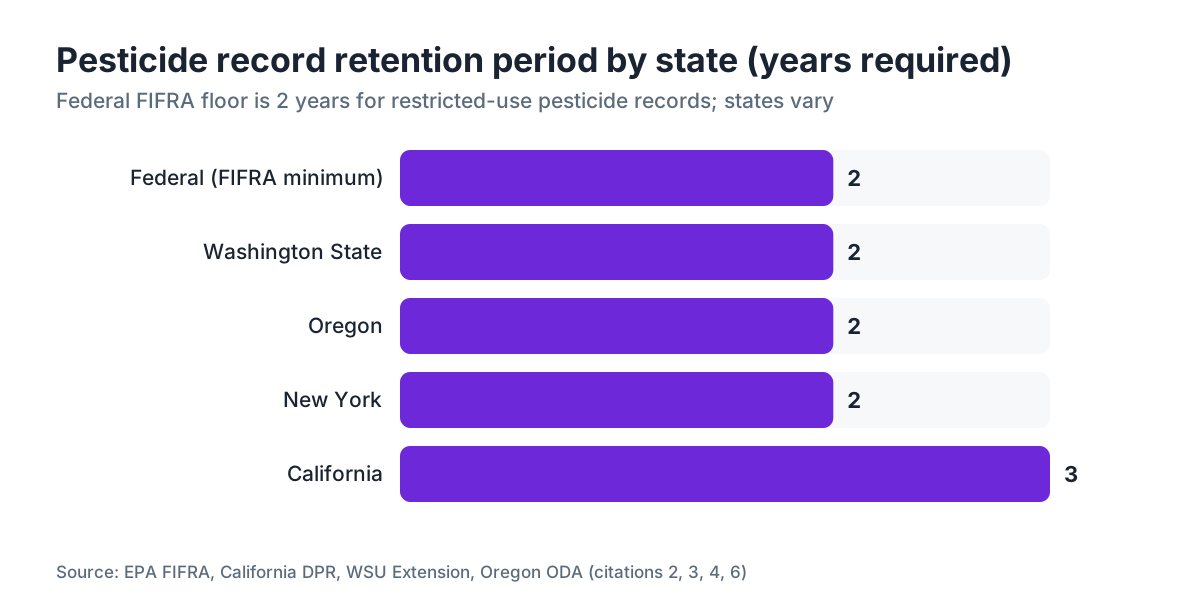
Federal law under FIFRA requires certified applicators to keep records of RUP applications for two years [2]. Two years is a floor, and most states have already raised it.
California requires pesticide use records to be kept for three years [3]. Washington requires two years, though many growers keep three because DPR audit windows sometimes stretch [4]. Oregon requires two years for the applicator and requires landowners to provide records to the department on request, with no formal separate retention period stated in OAR 603-057, though the practical standard is also two years [6].
The EPA Worker Protection Standard requires that central posting information, including the product name, EPA registration number, REI, and the location and description of the treated area, be kept at a central location for 30 days after the REI expires, or for the full WPS posting period, whichever is longer [1].
On leased land the safe move is three years for both parties, kept separately, with a digital copy in a cloud system neither party can accidentally delete.
One more thing: if you apply a pesticide under a Supplemental Label (Section 24(c)) or an experimental use permit, keep those labels and permits with the records for the full retention period. An inspector who finds an application of a 24(c) product with no label copy on file will assume non-compliance.
Who is responsible for records when a PCA directs the application but doesn't do the spraying?
This is a real gray area and it trips up a lot of California operations. In California, the licensed Pest Control Adviser (PCA) who writes the written recommendation is required to retain a copy of that recommendation for two years [3]. The licensed Pest Control Operator (PCO) or Qualified Applicator who actually sprays is required to file the Pesticide Use Report with the county agricultural commissioner. The grower (who may be the lessee) is also required to maintain their own records.
So on a typical custom-spray job in California, you have three separate parties each holding legally required paperwork: the PCA, the PCO, and the grower/lessee. The landowner is not off the hook. If the landowner is an agricultural employer under WPS and a worker is exposed during the REI, the landowner's inability to produce the REI and posting information is their problem, not the applicator's.
Outside California, the PCA role doesn't exist as a license category, but the same logic applies: whoever directed the application, whoever physically applied it, and whoever controls access to the land each have some documentation obligation. Get it sorted in writing with your custom applicator before the season starts, not after something goes wrong.
WSU Extension has published guidance on pesticide record-keeping for Washington growers that lays out the applicator vs. landowner distinction clearly [4].
What should the lease agreement actually say about spray records?
Most vineyard leases say nothing useful about pesticide records. Here's what a well-drafted lease clause covers:
First, it names which party is responsible for creating the primary application record. Usually that's the lessee (the operator).
Second, it sets a delivery deadline for a copy to the landowner. Seven calendar days from the date of application is a reasonable number. Longer than that and the landowner starts the following month not knowing what happened on their land.
Third, it specifies the format. A legible PDF or a shared cloud folder works. A handwritten note stuffed in the mailbox three weeks later does not.
Fourth, it addresses what happens if the lessee fails to deliver records. This is a lease compliance issue, more than a paperwork nicety. If the landowner faces a regulatory action because the lessee didn't provide records, there needs to be a remedy in the lease.
Fifth, it specifies which party maintains WPS central posting on the premises. The Worker Protection Standard says the "agricultural employer" does it, but when two parties share a property, you need one of them to own that duty explicitly [1].
Finally, a good lease clause restricts the use of pesticide products to those permitted under the applicable organic certification (if relevant), the GAP program requirements, or any premium winery contract the lessee has signed. Landowners get surprised when their estate vineyard label suddenly can't use a fruit because the lessee applied a product the winery prohibits.
How do the EPA Worker Protection Standard requirements apply on leased land?
The WPS at 40 CFR Part 170 applies to any agricultural establishment where pesticides are applied in the production of agricultural plants, and it applies to any "agricultural employer," defined as any person who hires or contracts for the services of workers [1]. On leased vineyard land where the lessee employs the workers and the landowner doesn't, the lessee is the agricultural employer and carries WPS duties.
But if the landowner retains any employees who work the vineyard, even seasonally, the landowner may also be an agricultural employer. Two agricultural employers on the same property are both responsible for WPS compliance.
The specific WPS documentation duties that generate paper records include:
- Central posting of pesticide application information (product, EPA reg. #, location, REI) at a location accessible to workers and handlers before the application begins and for 30 days after the REI expires
- Safety data sheet (SDS) access for every product used
- Application exclusion zone (AEZ) recordkeeping for the duration of the application
- Notification to workers (posting or oral communication) before they enter a treated area
As the EPA itself states in the WPS guidance, "Agricultural employers must provide workers with safety information... including information about any pesticide applications" in the work area [1]. On leased land, document in writing which party is providing that notification. A simple email or text to workers linking to the posted information counts, as long as you keep the record.
UC Davis has a detailed WPS compliance guide for California growers that walks through what to post, where to post it, and what the posting must say [7].
What does a good spray record look like in practice? A filled example
Abstract lists of fields are hard to act on. Here's what a completed record looks like for a sulfur application on a leased Paso Robles block:
APPLICATION RECORD
Property: Estrella River Road Vineyard, APN 027-181-020
Lessee operator: [Your LLC name]
Date: 2024-06-14 | Start: 6:15 AM | End: 9:40 AM
Product 1: Microthiol Disperss 80 WG
EPA Reg. #: 70506-187
Rate: 5 lb/acre | Total used: 125 lb (25 acres treated)
Formulation: Wettable granule
Target pest: Erysiphe necator (powdery mildew)
Application method: Airblast sprayer, 150-gallon tank
Equipment ID: JD 4066R + Gregoire G95
Applicator: [Name], CA QAL #[XXXXX]
PCA recommendation: [PCA name], CA PCA #[XXXXX], dated 2024-06-12
Weather: Temp 58°F, RH 72%, wind 2 mph NW at application start
REI: 24 hours (sulfur, closed cab exemption confirmed)
PPE required: Coveralls, chemical-resistant gloves, eye protection
Worker notification: Central posting completed 2024-06-13 at 5:00 PM
AEZ: N/A (non-enclosed space, wind <10 mph, standard use)
Tank mix partners: None
Total water per acre: 75 gallons
Landowner copy delivered: 2024-06-16 via email to [landowner email]
PUR filed with county: 2024-07-08 (within 30-day window)
That level of detail takes about 12 minutes to fill in after the spray run. It's also the difference between a clean inspection and a costly one.
For operators managing multiple leased blocks, a digital field-record system is genuinely useful. VitiScribe was built for exactly this workflow: you log the application once and it generates both the applicator's copy and the landowner's copy automatically, with timestamps.
How do you handle record-keeping when the same block has multiple spray passes by different applicators?
Custom spray work on leased blocks creates a record fragmentation problem. You hire one contractor for mildew sprays early in the season, another for bunch moth treatments in summer, and you do your own herbicide work. Three applicators, three record-keeping obligations, one property.
The lessee is still on the hook for having access to all of them. Your WPS duties require you to know what's been applied and when, because you're the one deciding whether to send workers into treated blocks. If your custom applicator didn't give you the REI from last Tuesday's spray, that's your compliance problem even though you didn't hold the spray nozzle.
Practically speaking, build it into your custom spray contract: the applicator must deliver a completed application record to you within 48 hours of the application, in a format you specify. Make this a payment-release condition if you need the pressure to get compliance.
For the landowner's copy, consolidate all records from all applicators into one monthly summary delivery. Landowners don't need to wade through 14 separate contractor PDFs. One clean summary per month, with all original records attached, is more useful and more likely to actually be retained.
Cornell Cooperative Extension recommends that growers maintain a master field history log that captures all spray events chronologically by block, regardless of who made the application [5]. That master log becomes your first line of defense if you ever face a pesticide drift complaint or a pre-harvest interval audit.
What are the pre-harvest interval rules and how do they show up in spray records on leased blocks?
The pre-harvest interval (PHI) is the minimum number of days between the last application of a pesticide and harvest. It's printed on the label, it's legally binding, and violating it is a federal pesticide law violation under FIFRA Section 12 [10].
On leased land, PHI violations are particularly risky because harvest timing decisions are sometimes made by people who don't know what was sprayed and when. A landowner who takes over harvest operations from a lessee, or a custom crush client who sets the harvest date, can inadvertently violate a PHI if the application records aren't in front of them.
Your spray record needs to compute and display the earliest legal harvest date for each block, updated after every application. Not the PHI number. The actual calendar date.
Example: Captan 50 WP has a 7-day PHI on grapes (per label). If you spray June 14, the earliest harvest date is June 21. Write "Earliest legal harvest: 2024-06-21" on the record. Put it in the header of the block's spray summary sheet. Text your winery contact after every late-season application.
Some lease agreements give the landowner the right to harvest at any time for their own use (backyard fruit, family harvest events). Make sure your lease carves out a process for the landowner to check the current PHI status before they send anyone into the vineyard during the growing season.
What records does an organic or transitional vineyard on leased land have to keep separately?
If the leased vineyard is certified organic or in transition, the record-keeping burden roughly doubles. In addition to the standard pesticide application records, you need to maintain:
- A materials log showing that every input used is on the National Organic Program (NOP) approved materials list or reviewed by your certifier
- Purchase receipts for every input, because your certifier will want to verify you bought what you say you used
- Field activity records showing that no prohibited substances were applied in the three years prior to certification (7 CFR Part 205) [8]
- An Organic System Plan (OSP), updated annually, that covers your pest and disease management approach
On leased land, the certifier relationship gets complicated. The certificate usually follows the operator (the lessee), not the land. But if the land has received prohibited substances from a previous tenant or the landowner's own activity during the current certification period, those applications must be disclosed and may reset the transition clock.
Get a written representation from the landowner in the lease that no prohibited substances have been applied to the parcel in the past three years, with an obligation to notify you immediately if they become aware of any past applications they didn't disclose. Your certifier should see that clause.
USDA's Agricultural Marketing Service maintains the NOP regulations and the list of approved and prohibited substances for organic production [8].
What happens during an inspection, and what should you have ready?
State department of agriculture inspectors can arrive with or without notice in most states. California DPR inspectors can conduct routine inspections of any pesticide use site [3]. What they want to see, roughly in order:
- The pesticide label for any product currently in use or recently applied
- The applicator's license (or proof the applicator is licensed)
- The application record for the current or most recent application
- The PCA written recommendation if one was required
- Evidence of WPS central posting
- Safety data sheets for products in use
For leased vineyards, the inspector will ask who the operator is and who the landowner is. Have that clearly documented. If the landowner is present and the lessee is not, the landowner should be able to produce the most recent spray record (which is exactly why you send the copy within seven days).
The most common violations found in vineyards, according to California DPR's annual enforcement reports, are: failure to have a written recommendation before applying an RUP, failure to post WPS information, and application records missing required fields [3]. None of those are technical pesticide chemistry failures. They're all paperwork failures, and they're all preventable.
Keep a "ready bag" in the spray tractor: laminated license card, current label copies for the products in your rotation, blank application records, and the current WPS posting template. Inspectors notice when an operation is prepared. It matters.
For multi-block operations, VitiScribe lets you pull up every block's spray history and current posting status from a phone, which is genuinely useful when an inspector is standing in your vineyard and your records are in an office 20 miles away.
Should spray records be stored digitally or on paper, and who controls the archive?
Paper records are legally acceptable in every U.S. state. Digital records are also accepted, and most state agencies now accept electronic submissions for PURs and similar reports. The practical question is reliability over the retention period.
Paper records stored in a barn office routinely get destroyed by moisture, rodents, or a building fire. Digital records stored only on a local hard drive fail when the hard drive fails. The only approach that reliably survives a three-year audit window is digital records backed up to at least two locations, at least one of which is off-site or cloud-based.
For leased vineyard operations specifically, the archive control question matters. When a lease ends, who owns the spray records? The applicator's license records are the applicator's. The landowner's copy is the landowner's. But the master block history, the tank mix logs, the equipment calibration records, these belong to whoever created them and whoever needs them.
Write into the lease that upon termination, the lessee will provide the landowner with a complete spray record archive covering the entire lease period, in PDF format, within 30 days of lease termination. This protects the landowner if the incoming operator asks about residual PHIs or restricted materials. It also protects the departing lessee from claims that they failed to document their practices.
For field operations across a vineyard portfolio, the most efficient system is a digital log where each application entry auto-populates the landowner copy and the compliance report format at the same time. Manual double-entry is where errors creep in.
Frequently asked questions
Does the landowner have to keep pesticide records if the lessee does all the spraying?
It depends on the state. In California, the landowner who is an agricultural employer under WPS has independent obligations to maintain central posting information, even if the lessee applied the product. In most states, the licensed applicator holds the primary record-keeping duty, but the landowner can face liability for violations on their property. The safest approach is for both parties to keep copies, settled in the lease.
What happens if a custom applicator refuses to give me a spray record?
Your contract with that applicator should require record delivery as a condition of payment. If the contract doesn't say that, you're in a weak negotiating position. Practically, you can file a complaint with your state department of agriculture. Licensed applicators are required to provide records to the property owner and operator on request in most states. A refusal is itself a potential license violation and gives you grounds to pursue the contractor.
How do I document a spray on a leased block that crosses county lines?
Each county may have a separate agricultural commissioner and separate PUR filing requirements. In California, you file a PUR with each county's commissioner for the acreage located in that county. Use the legal parcel number (APN) to identify which portion of the block falls in each county. Your spray record should note the acreage treated per county. Get this clarified with both county commissioners before your first spray of the season, not after.
Does the EPA Worker Protection Standard apply to family-owned leased vineyards with no hired workers?
The WPS applies to agricultural establishments that employ workers or handlers, including family members other than the immediate family of the agricultural employer. If you only use your own immediate family to work the vineyard, WPS requirements don't apply. Add one paid seasonal worker and they do. The EPA defines 'worker' and 'handler' precisely at 40 CFR 170.305, and the thresholds matter for small operations on leased land.
Can I use a phone app to satisfy pesticide record-keeping requirements?
Yes, in most states, as long as the record contains all required fields and can be printed or exported in a readable format on request by an inspector. California DPR, Washington State, and New York all accept electronic records. The record still needs to be retained for the legally required period and accessible without specialized software that might become unavailable. A PDF export function is a minimum requirement for any app you use for compliance records.
What do I put on the spray record for the 'location' if the leased block doesn't have a formal name?
Use the Assessor's Parcel Number (APN), legal description, or GPS coordinates for the block boundary. A field nickname ('North Block' or 'Creek Field') is fine as supplemental identification, but it's not sufficient on its own for a regulatory record. The APN is the most defensible identifier because it ties directly to the legal property record and can't be confused with another block on a different property.
How do spray records work if the lessee has an organic certification but the landowner previously applied non-organic inputs?
The three-year transition period under NOP (7 CFR Part 205) starts from the last date a prohibited substance was applied to the land, not from when your lease started. You need written documentation from the landowner of any prior applications. Your certifier will require this history as part of your Organic System Plan. If the landowner can't document the prior input history, your certifier may require soil or plant tissue testing, or may restart the transition clock from your lease start date.
What is the restricted entry interval (REI) and how do I document it on a leased block?
The REI is the minimum time after a pesticide application before workers without full personal protective equipment can enter the treated area. It's stated on the product label and is legally enforceable under both FIFRA and the WPS. On your spray record, write the REI in hours and the actual calendar date and time the REI expires. Post this at the block entrance before the application begins. On leased blocks where the landowner or other parties may access the land, make sure they know the REI expiration before any personnel enter.
Do I need a written PCA recommendation for every spray on leased vineyard land?
In California, a written recommendation from a licensed PCA is required before applying any restricted-use pesticide, and many general-use pesticides on the DPR's 'written recommendation required' list also need one. Other states have different thresholds. Outside California, most states require a certified applicator to supervise RUP applications but don't mandate a separate adviser recommendation. Check your state's department of agriculture rules and your county commissioner's requirements specifically.
What records do I need for a drone spray application on leased vineyard land?
Drone applications require all standard pesticide application records, plus the drone operator's FAA Part 107 remote pilot certificate number and the drone's FAA registration number. Many states are also requiring GPS flight logs as part of the application record for drone spray. Check whether the pesticide label specifically permits aerial or drone application, because 'aerial' language on labels varies. Some labels permit fixed-wing and helicopter but not multi-rotor drones, and applying outside label directions is a FIFRA violation regardless of who owns the land.
How far back do spray records need to go when I take over a leased block mid-lease?
You're responsible for your own applications from your first day of operation. You're not liable for violations by a prior tenant, but you do need the prior spray history for operational reasons: PHI compliance, organic transition documentation, worker notification for any applications with unexpired REIs when you take possession. Require the outgoing lessee to provide a complete spray history as a condition of the lease transfer. If they can't or won't, document your request in writing and notify your certifier or winery buyer immediately.
Does my winery contract add record-keeping requirements beyond what state law requires?
Often yes. Premium winery contracts, especially for estate or single-vineyard programs, frequently restrict which pesticide products can be applied and require the grower to submit spray records to the winery on a defined schedule. Some contracts require third-party audits. These contractual obligations don't replace regulatory requirements, they layer on top. Read your winery contract's viticulture addendum before the season starts and flag any conflicts with your standard spray program.
Sources
- EPA, Worker Protection Standard for Agricultural Pesticides (40 CFR Part 170): WPS requires agricultural employers to post pesticide application information and provide worker notification; the duty applies to any party who is an 'agricultural employer' on the site.
- EPA, FIFRA Section 8 and Restricted-Use Pesticide Record-Keeping Requirements: Under FIFRA, certified applicators applying restricted-use pesticides must record product name, EPA registration number, amount applied, location, date, and applicator certification number, and retain records for two years.
- California Department of Pesticide Regulation, Pesticide Use Reporting: California requires growers and licensed applicators to file Pesticide Use Reports within one month of application and retain records for three years; DPR conducts routine inspection of pesticide use sites.
- Washington State University Extension, Pesticide Recordkeeping Guidance: Washington requires pesticide application records to include the target pest and the REI, retained for two years, and distinguishes applicator from landowner recordkeeping duties.
- Cornell Cooperative Extension, Pesticide Recordkeeping Program: Cornell Cooperative Extension recommends growers maintain a master field history log capturing all spray events chronologically by block, and notes New York requires records to include the crop treated and method of application.
- Oregon Department of Agriculture, Pesticides Program (OAR 603-057): Oregon requires applicators to keep pesticide application records for two years and requires landowners to provide records to the department on request.
- University of California Agriculture and Natural Resources, Worker Protection Standard Guidance: UC provides a WPS compliance guide for California growers detailing central posting content, placement, and required application information.
- USDA Agricultural Marketing Service, National Organic Program (7 CFR Part 205): Under NOP regulations, organic operators must document all inputs used, maintain purchase records, and demonstrate that no prohibited substances were applied in the three years prior to certification.
- California Department of Food and Agriculture, County Agricultural Commissioners: In California, pesticide use reports for blocks crossing county lines must be filed separately with each county agricultural commissioner for the acreage in that county.
- EPA, FIFRA Section 12, Unlawful Acts: Applying a pesticide in a manner inconsistent with its labeling, including within the pre-harvest interval, is a federal violation under FIFRA Section 12.
- FAA, Part 107 Small Unmanned Aircraft Systems Rules: Drone spray operators must hold an FAA Part 107 Remote Pilot Certificate; the FAA registration number of the drone and the pilot certificate number are required documentation for commercial UAS operations.
Last updated 2026-07-09