How to maintain a hazard communication binder for vineyard employees
TL;DR
- A vineyard hazard communication binder must contain your written HazCom program, a Safety Data Sheet for every chemical on the property, a complete chemical inventory list, employee training records, and container labeling procedures.
- OSHA 29 CFR 1910.1200 requires it for any employer with hazardous chemicals present.
- Keep it where every worker can reach it during every shift.
What is a hazard communication binder and do vineyards really need one?
Yes. Full stop. If you store or use any pesticide, fertilizer, cleaning agent, sulfur dust, copper fungicide, or a commercial herbicide on your property, OSHA's Hazard Communication Standard (HCS), codified at 29 CFR 1910.1200, applies to you [1]. That covers virtually every working vineyard in the United States.
The HazCom binder is the physical (or digital) home for all the documentation your written hazard communication program requires. Think of it as the central file your crew can grab at 6 a.m. before a spray run, or the file a Cal/OSHA inspector asks to see within the first ten minutes of a site visit. Nothing says it has to be a three-ring binder. It can be a folder, a locked shared drive, or a labeled section of your spray records cabinet. What matters is that it's organized, complete, and reachable by every worker on every shift.
Small operators sometimes assume that because they're agricultural, they sit outside OSHA's general industry rules. That's partly true for some federal provisions. But EPA's Worker Protection Standard (WPS) and state-plan OSHA programs (California, Washington, Oregon, Michigan, and others) stack their own chemical information requirements on top of whatever federal baseline applies [2]. Even if one rule seems to let you off the hook, another one is almost certainly filling the gap. Keep the binder as if the full HCS applies, because for most vineyard work, it does.
What are the required contents of a HazCom binder?
OSHA 29 CFR 1910.1200 requires five core elements in any written hazard communication program. Give each one its own tab [1].
1. The written hazard communication program itself. This is a narrative that explains your approach: how you identify hazardous chemicals, how you label containers, how you manage SDSs, and how you train workers. It doesn't need to be long. Two to four pages is normal for a small vineyard. OSHA publishes a model program you can adapt rather than write from scratch [8].
2. A chemical inventory list. Every hazardous chemical used or stored on the property gets a line. Each entry names the product exactly as it reads on the label and SDS, the area where it lives or gets used, and a cross-reference to its SDS. Vineyards often run 20 to 50 products across a season. Don't undercount. Tank cleaners, adjuvants, pH adjusters, and whatever's on the equipment shed shelf all count.
3. Safety Data Sheets for every chemical on the inventory. One SDS per product, current version (post-GHS revision from the 2012 HCS update), in the 16-section format. File them in the same order as your inventory list so a worker can find one fast [1].
4. Container labeling procedures. A written description of how you label secondary containers, spray tank contents, and anything decanted into a smaller vessel. This section also states what you require on the primary labels you receive from manufacturers.
5. Training documentation. Records showing which employees got HazCom training, when, and what it covered. Dates and signatures matter. New hires get trained before they work with or around hazardous chemicals, not at the end of their first week [1].
Add a sixth item OSHA doesn't require: emergency contact numbers and first-aid reference sheets for the chemicals you use most. The Poison Control hotline (1-800-222-1222) and your county agricultural commissioner's office number belong on the inside front cover.
What goes on the chemical inventory list and how often should you update it?
Your chemical inventory list is the spine of the binder. Get the inventory wrong and nothing else saves you during an inspection, because you'll have SDSs missing for products in use and SDSs present for products you retired years ago.
Each row should capture the product name, manufacturer, product ID or EPA registration number (for pesticides), primary location of use or storage ("spray shed, shelf 2" or "winery sanitation closet"), and the SDS file number or page range in the binder. A printed spreadsheet inserted as the first working tab does the job.
Update the inventory every time a new chemical arrives, which on a working vineyard usually means at the start of every spray season and again mid-season when products change. Many managers run a formal review twice a year: once in February before the season ramps, once in October after harvest cleanup. Pull retired products off the active list, but keep an archived list with each product's last-use date in a separate section. OSHA compliance officers have been known to ask about chemicals employees may have handled in prior years.
The Washington State Department of Agriculture and WSU Extension both recommend keeping pesticide purchase records next to your HazCom inventory so you can check that every product you bought has an SDS on file [3]. It's a simple habit: if you bought it, you need its SDS.
| Inventory Column | What to Include | Why It Matters |
|---|---|---|
| Product name | Exact label name | Matches the SDS file |
| Manufacturer | Company name | For SDS sourcing if lost |
| EPA Reg. No. | From pesticide label | Required for WPS compliance |
| Location | Building/shelf | Helps workers find the SDS fast |
| SDS on file? | Yes / date obtained | Confirms binder is complete |
| Last use date | Season or month/year | Supports archival decisions |
How do you get and organize Safety Data Sheets for all your vineyard chemicals?
Manufacturers have to provide an SDS with the first shipment of any hazardous chemical, and again with any later shipment if the SDS has changed [1]. In practice you get SDSs three ways: with the product delivery, from your ag chem distributor's rep, or off the manufacturer's website. Nearly every major ag chemical company keeps an SDS library online, and the PDFs cost nothing to download.
For products you've used for years but never filed, go pull the current SDS now. Don't file an old pre-GHS sheet that predates the standardized 16-section format; inspectors notice, and manufacturers were required to complete the format change by June 2015 [1].
Organize the SDS section alphabetically by product name or numbered to match your inventory list. Alphabetical is usually easier for a worker to use alone without checking the index first. Put a table of contents up front. Past about 30 SDSs, divider tabs by category (fungicides, herbicides, insecticides, adjuvants, sanitizers) speed things up a lot.
OSHA allows digital SDS management as long as workers can reach the system without barriers during their shift, the system doesn't need a password they don't have, and retrieval isn't delayed in an emergency [10]. A tablet mounted in the spray shed works. A system that requires logging into the main office computer does not, if the office is locked after hours. Keep a printed backup of your 10 or 15 most-used products.
UC ANR (University of California Agriculture and Natural Resources) and UC Davis publish guidance on pesticide safety training and SDS management for California farm operations, which helps you benchmark what a complete SDS file looks like for a typical wine grape operation [4].
What does the written HazCom program document actually need to say?
The written program isn't a form you fill out. It's a policy statement that documents your specific approach. OSHA says it must describe how you meet each element of the standard for your workplace [1].
For a vineyard, a working program usually covers four things.
How you receive and review SDSs for new chemicals before they arrive. State whether the vineyard manager centralizes that review or whether crew leads can accept new products.
How you label secondary containers. Spray tanks, transfer containers, and anything refilled from bulk product need labels. The program states the minimum on each label: product name, hazard warning, and who to contact in an emergency.
How you make SDSs available. Binder location, digital access method, language considerations. OSHA doesn't require SDSs in multiple languages, but many California, Washington, and Oregon vineyards with Spanish-speaking crews provide Spanish-language SDSs as a safety and liability measure. Most manufacturers send Spanish sheets on request, and some state programs have translated versions [5].
How and when you train employees. Initial training before exposure. Refresher timing. Who delivers it.
OSHA publishes a model written program you can download and adapt [8]. Name your binder location in the document itself: "The Safety Data Sheets for Ramos Family Vineyard are maintained in the red three-ring binder in the spray shed, lower shelf, and are available to all employees during all work shifts."
How do you document HazCom training for vineyard workers?
Training records are where small operators fall short. The training happened. Nobody wrote it down. That's a problem.
OSHA doesn't dictate a training record format, but every record should capture the employee's name, the date, the topics covered, and the trainer's name. Add a signature line for the employee to acknowledge participation. It's standard practice and it protects you if a worker later claims they were never trained.
HazCom training for a vineyard should cover the physical and health hazards of the chemicals your crew actually touches, not a generic overview. If your crew applies sulfur, copper, and a systemic fungicide, walk through those SDSs by name. Show workers where the binder lives. Show them how to read the signal words and the first-aid section.
EPA's Worker Protection Standard requires agricultural workers who may be exposed to pesticides to receive safety training. The training, per EPA's WPS materials, must cover "how to protect yourself and your family from pesticide exposures" [2]. The WPS training requirement is separate from HazCom training but compatible with it; many operations run both in a single session and document them on one combined record.
Train new hires before they work around chemicals, not after their first week. Keep training records in the binder for at least three years, which covers the standard OSHA retention period. Some state-plan states require longer; check your state's specific requirement.
WSU Extension publishes Spanish-English bilingual pesticide safety training materials for farm workers that cover much of what both HazCom and WPS require [3]. They're free and genuinely useful where English isn't a worker's first language.
Where should the HazCom binder be located in the vineyard or winery?
OSHA requires that employees can reach SDSs immediately during their work shift. "Immediately" isn't a throwaway word in an enforcement context.
The standard spot for a vineyard is the spray shed or chemical storage building. That's where exposure risk runs highest and where workers most need the information. If you have crews in multiple locations, you have two options: duplicate binders at each site, or a reliable digital system that loads at every worksite.
Run a winery alongside the vineyard and you've got a second chemical profile to handle. SO2, cleaning agents, CIP chemicals, CO2 off fermentation, boiler chemicals. That may need its own binder or a supplemental section. Many compliance programs treat the winery and the vineyard as separate OSHA worksites with their own location-specific SDS files.
Label the binder so a worker who's never seen it can find it without asking. A laminated sign reading "Safety Data Sheets / Hojas de Datos de Seguridad" posted near the binder costs about $5 and kills any ambiguity.
If you're keeping records digitally, platforms like VitiScribe are built to store and retrieve SDS records, spray logs, and training documentation in one place. The requirement stays the same on any platform: workers reach the records without a barrier during their shift.
How often should you review and update the HazCom binder?
There's no OSHA-mandated annual review for the binder as a whole, but four triggers should prompt an immediate update.
New chemical on the property: add it to the inventory and file the SDS before it's used. No exceptions. Old chemical no longer in use: move it to the archived section and note the last-use date. SDS revised by the manufacturer: swap the old one for the current version. Roster change: add training records for new staff, archive records for departed employees (and keep them the full three years).
Beyond those event-driven updates, a calendar review makes sense twice a year. Pre-season (January or February in most wine regions) is the natural time to audit the inventory against what you've ordered and what's in storage. Post-harvest (October or November) is the time to archive chemicals you're retiring and confirm training records are complete for the season's temporary and seasonal workers.
Cornell's agricultural safety program and Penn State Extension both recommend folding the pre-season binder audit into your pesticide applicator certification renewal, since most state applicator licenses require continuing education credits covering chemical safety [6]. Stack these tasks and you'll actually do them.
Calendar reminders, recurring events in your operations software, or a note taped inside the binder cover all work. The system you'll actually use is the right one.
What happens if an OSHA inspector finds problems with your HazCom binder?
Citations under 29 CFR 1910.1200 are common. They range from other-than-serious for administrative gaps (one missing SDS, an unsigned training record) to serious for systemic failures (no written program, workers with no training at all).
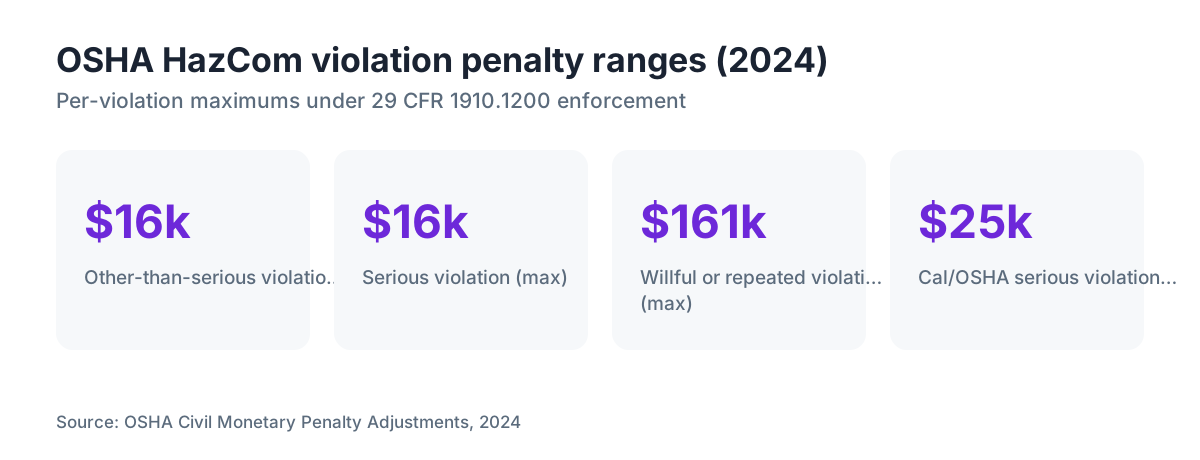
Penalty amounts as of 2024: other-than-serious violations carry maximums up to $16,131 per violation; serious violations also max at $16,131; willful or repeated violations can reach $161,323 per violation [7]. Those numbers adjust annually for inflation. A single inspection that turns up 10 missing SDSs, no written program, and no training records could realistically generate $50,000 or more in proposed penalties for a small operation.
State-plan states (California, Washington, Oregon, and others) set their own penalty amounts and must run programs "at least as effective as" federal OSHA [5]. In California, Cal/OSHA penalties for serious violations can reach $25,000 per violation.
Beyond fines, there's the liability angle. If a worker is hurt because they couldn't reach the first-aid information on an SDS they'd never seen, that documentation gap becomes part of the negligence record in any claim.
Most inspection findings are correctable on the spot or within a negotiated abatement period. Inspectors generally want compliance, not revenue. A binder that's 90 percent complete with a clear system and honest gaps documented gets treated very differently than a binder that doesn't exist.
How does the EPA Worker Protection Standard interact with HazCom requirements?
The Worker Protection Standard (WPS), run by EPA under FIFRA, is a separate framework from OSHA HazCom, but the two overlap heavily for vineyards that apply pesticides [2].
WPS requires agricultural employers to provide pesticide safety training to workers and handlers before they perform covered tasks, to maintain a pesticide application and hazard information display at a central location on the establishment, and to make pesticide labeling (the product label, not the SDS) and safety data available during and after applications [2].
The central posting requirement means that on top of your HazCom binder, you need a designated central location where application information is posted during and for 30 days after each pesticide application. That posting includes the product name, EPA registration number, active ingredients, first-aid instructions, applicator contact information, and the location of treated areas. Some operations put this posting next to their HazCom binder. Others keep them separate. Either works as long as both stay accessible.
The 2015 WPS revision strengthened several provisions, including minimum age (18 for handlers), expanded no-entry requirements during applications, and decontamination supply rules [9]. UC ANR and UC Davis have published updated WPS compliance guides for California wine grape growers [4].
The takeaway: your HazCom binder and your WPS documentation are neighbors. Keep them close. Cross-reference the WPS posting requirement in your written HazCom program so anyone following one thread finds the other.
What are common mistakes vineyard operators make with HazCom binders?
Review enough state inspection records and compliance guidance and the same handful of problems keep surfacing.
Missing SDSs for obvious products. People file the fungicides and herbicides, then forget the tank cleaner, the adjuvant, the fertilizer running through the drip system, or the brake fluid in the spray rig. If it's a hazardous chemical under HCS, it needs an SDS. The test is whether the product has a GHS-format label with pictograms or hazard statements.
Outdated SDS format. Sheets printed before the 2012 GHS harmonization (OSHA's manufacturer deadline was June 2015) use a different layout. Pre-GHS Material Safety Data Sheets (MSDSs) had variable formats, often 8 sections instead of 16. Replace any MSDS in your binder with the current 16-section SDS.
Training records that don't match the roster. Twelve workers, training records for eight. That's a gap regardless of how good the training was.
Binder locked in the office. It has to be accessible to workers. Not accessible to the manager on behalf of workers. If your crew starts at 5:30 a.m. and the office opens at 8:00, locking the binder in the office is a violation.
No Spanish-language SDSs when the crew is primarily Spanish-speaking. OSHA doesn't technically require translated SDSs, but if workers can't read the hazard information, that raises real questions about whether training was effective and whether the employer met its duty to communicate hazards.
Not updating after adding a product mid-season. That Reg. 3 fungicide you switched to in July because of resistance pressure needs to be on the inventory and its SDS in the binder before it's mixed or applied.
Can one HazCom binder cover both vineyard and winery operations?
It can, but only if every chemical from both operations is included and the binder sits where workers in both areas can reach it. In practice, most operations of any real size find one binder in one location doesn't serve both the vineyard and the winery, especially when they run at the same time.
The cleaner approach is a vineyard binder in the spray shed or equipment area and a winery binder (or winery section) in the production facility. The winery has its own chemical profile: sodium hydroxide and other caustic CIP chemicals, sulfur dioxide from SO2 additions and fermentation, peracetic acid sanitizers, CO2 (which OSHA treats as an asphyxiation hazard in enclosed spaces), and various enological additions. Those deserve their own organized section with SDSs for the winery workers who handle them.
Manage a destination property where hospitality and vineyard operations overlap and the chemical picture gets busier. Restaurant cleaning chemicals, pool chemicals, and HVAC refrigerants can all fall under HazCom. Larger resort-style vineyard properties should run a formal chemical inventory audit across every department rather than assume the vineyard binder covers it all.
For anyone keeping records across multiple operational areas, VitiScribe's record-keeping tools let you tag chemicals and SDSs by location, so your vineyard records and winery records stay organized without duplicating paperwork by hand.
Frequently asked questions
Is a physical binder required, or can I keep HazCom records digitally?
OSHA allows electronic SDS management under 29 CFR 1910.1200 as long as workers can reach the system without barriers during their shift. That means no locked computers, no passwords workers don't have, and no meaningful delay in an emergency. A tablet in the spray shed qualifies. A main office computer that's off-limits to field crews does not. Keep a small printed backup of your most-used SDSs as insurance.
Do I need SDSs for pesticides with signal word 'Caution' or only for more hazardous products?
You need SDSs for any product that qualifies as a hazardous chemical under HCS, which includes most pesticides regardless of signal word. Signal words (Caution, Warning, Danger) indicate acute toxicity categories, but many Caution-labeled products still carry classifications for skin or eye irritation, environmental toxicity, or other hazards that bring them under HCS. When in doubt, get the SDS.
How long do I need to keep training records in the HazCom binder?
OSHA's general retention period for HazCom training records is three years. Some state-plan states (California in particular) may require longer under their own regulations. Keep departed employees' records for the full retention period even after they leave; that's what protects you if a claim surfaces later. Date every record at the time of training, not retroactively.
Does the HazCom binder need to be in Spanish if my crew speaks Spanish?
OSHA doesn't technically require SDSs in languages other than English. But the underlying requirement is that employees understand the hazard information. If training is delivered in English to workers who don't speak English, that likely fails the training effectiveness requirement. Most manufacturers provide Spanish SDSs on request. Many state extension programs publish bilingual pesticide safety materials. Getting Spanish SDSs is cheap and the right call for a Spanish-speaking crew.
What's the difference between an MSDS and an SDS, and do old MSDSs still count?
An MSDS (Material Safety Data Sheet) is the pre-2012 format with variable section organization and no standardized layout. After OSHA harmonized with the Globally Harmonized System in 2012, manufacturers had to transition to the standardized 16-section SDS format by June 2015. Old MSDSs are out of compliance. Replace any MSDS in your binder with the current 16-section SDS from the manufacturer's website or your distributor.
Does the EPA Worker Protection Standard replace the need for a HazCom binder?
No. WPS and OSHA HazCom are separate requirements run by different agencies. WPS covers pesticide-specific hazard communication and training for agricultural workers and handlers. OSHA HazCom covers hazardous chemicals broadly, including sanitizers, fertilizers, and non-pesticide products. Most vineyards are subject to both. A WPS-compliant pesticide application record does not substitute for an OSHA-compliant written HazCom program.
Do seasonal or temporary vineyard workers need to be included in HazCom training records?
Yes. HazCom training applies to all employees who may be exposed to hazardous chemicals, including seasonal and temporary workers. Under EPA's WPS, agricultural workers must receive pesticide safety training before they work in treated areas or handle pesticides. Train seasonal workers before they start chemical-related tasks, document it with dates and signatures, and keep those records for three years even after the season ends.
What if I can't find the SDS for a product I've been using for years?
Go to the manufacturer's website first; nearly all major ag chemical companies keep SDS libraries. Your ag chem distributor can usually provide them. If the product has an EPA registration number, EPA's pesticide registration database can help you identify the manufacturer. As a last resort, contact your county agricultural commissioner's office. Never substitute a different product's SDS, even a similar formulation. Get the exact one.
How do I handle a chemical on the inventory whose SDS has been updated by the manufacturer?
Pull the old SDS and replace it with the new one. Write the date you obtained the new version on the cover page or in your inventory log. Manufacturers are required to send updated SDSs with subsequent shipments after a revision. You can also subscribe to SDS update notifications through most major ag chemical distributors. Updated sheets sometimes reflect new toxicological data, so this isn't just paperwork.
Does my written HazCom program need to be reviewed and re-signed every year?
OSHA doesn't require annual re-signing, but the written program must reflect your current practices. If your chemical inventory, labeling procedures, training approach, or binder location changes, update the program to match. Most vineyard operations do a quick review at the start of each season. Note the review date in the document so an inspector can see the program is actively maintained rather than sitting untouched since it was first written.
What OSHA penalty could I face if my HazCom binder is incomplete?
As of 2024, OSHA serious violation penalties max at $16,131 per violation, and willful or repeated violations can reach $161,323 per violation. Missing SDSs, no written program, and absent training records can each count as separate violations. State-plan states like California set their own amounts; Cal/OSHA serious violations can reach $25,000 per violation. Penalty exposure for a poorly maintained HazCom program on a small vineyard can realistically top $50,000 from a single inspection.
Should I include a first-aid reference sheet or emergency contacts in the binder even if OSHA doesn't require it?
Yes. The national Poison Control number (1-800-222-1222) and your local emergency services number should be on the inside front cover. Your county agricultural commissioner and nearest 24-hour emergency room are worth adding too. In a real exposure event, workers shouldn't have to hunt for these. Some county ag commissioner offices provide laminated emergency contact cards for pesticide incidents that slip right into the front pocket.
Are fertilizers and soil amendments included in the HazCom chemical inventory?
Some are, some aren't. Fertilizers exempt from FIFRA (consumer-use, small quantities) may be excluded, but commercial fertilizers applied at agricultural rates, especially nitrogen solutions, ammonium compounds, or products with physical hazards like flammability, generally qualify as hazardous chemicals under HCS. Check whether the product has a GHS-formatted SDS from the manufacturer. If it does, add it to your inventory. Blended granular fertilizers with no significant hazard classification often aren't required, but getting the SDS costs nothing.
Sources
- OSHA, Hazard Communication Standard 29 CFR 1910.1200: HazCom standard requires written program, SDS for each hazardous chemical, container labeling, and employee training before exposure
- EPA, Agricultural Worker Protection Standard (WPS): WPS requires pesticide safety training, central location hazard posting, and pesticide labeling/safety data access for agricultural workers and handlers
- WSU Extension: WSU Extension recommends cross-referencing pesticide purchase records with the HazCom chemical inventory and publishes bilingual pesticide safety training materials
- University of California Agriculture and Natural Resources (UC ANR): UC ANR publishes WPS compliance guides and pesticide SDS management guidance specific to California wine grape operations
- California Division of Occupational Safety and Health (Cal/OSHA), DIR: California state-plan OSHA maintains a program at least as effective as federal OSHA; serious violations can reach $25,000 per violation
- Cornell University, Agricultural Health and Safety Program: Cornell recommends integrating pre-season HazCom binder audits with pesticide applicator certification renewal continuing education
- OSHA, Penalties: As of 2024, OSHA serious violation penalties max at $16,131 per violation; willful or repeated violations can reach $161,323 per violation
- EPA, Agricultural Worker Protection Standard (2015 revision): 2015 WPS revision strengthened minimum age requirements, no-entry provisions during applications, and decontamination supply requirements
Last updated 2026-07-10