How to maintain a vineyard employee health and safety training binder

TL;DR
- A vineyard safety training binder holds OSHA Hazard Communication records, EPA Worker Protection Standard pesticide training certificates, emergency action plans, and equipment sign-offs for every worker.
- Federal law requires keeping most training records at least three years; OSHA injury logs run five.
- Organize by regulatory category, date every document, and audit the binder before each spray season and after any personnel change.
What exactly has to go in a vineyard safety training binder?
Anything a federal or state inspector could ask to see on the spot. That breaks into four regulatory buckets.
First is OSHA Hazard Communication (HazCom, 29 CFR 1910.1200 for general industry, 29 CFR 1928.21 for agriculture). Every worker who handles pesticides, fertilizers, sulfur dust, or other hazardous chemicals gets training before first assignment and again whenever a new hazard shows up. Your binder needs a training log with each worker's name, date of training, topics covered, and a signature. [1]
Second is the EPA Worker Protection Standard (WPS), which covers agricultural pesticide handlers and early-entry workers. Under 40 CFR Part 170, effective January 2, 2017, pesticide safety training has to come from a certified applicator or a trainer who finished an EPA-approved Train-the-Trainer program. The binder holds a copy of the training record for each worker, showing the trainer's certification number, the date, and the worker's signature (or, for a worker who can't sign, a note of the method used to verify training). [2]
Third is emergency preparedness. OSHA's Emergency Action Plan standard (29 CFR 1910.38, applied to ag through 1928.21) requires that workers know evacuation routes, muster points, and how to report fires or chemical spills. Your binder holds the written plan itself plus a sign-off sheet showing who reviewed it and when. [12]
Fourth is equipment-specific training: tractor roll-over protective structure (ROPS) awareness, ATV safety, forklift certification if you run a warehouse, respirator fit-test records if workers wear half-face respirators during spray, and any heat illness prevention acknowledgments your state requires. California's heat illness regulation (8 CCR 3395) requires documented training before the first day of outdoor work when temperatures can reach 80 degrees Fahrenheit. [3]
Beyond those four buckets, you may need sexual harassment prevention training records (California SB 1343, New York Labor Law 201-g), I-9 employment eligibility forms (those live in a separate binder, but document the training that explains how to handle them), and any state agricultural labor camp safety records if housing sits on-site.
How long do you have to keep vineyard training records?
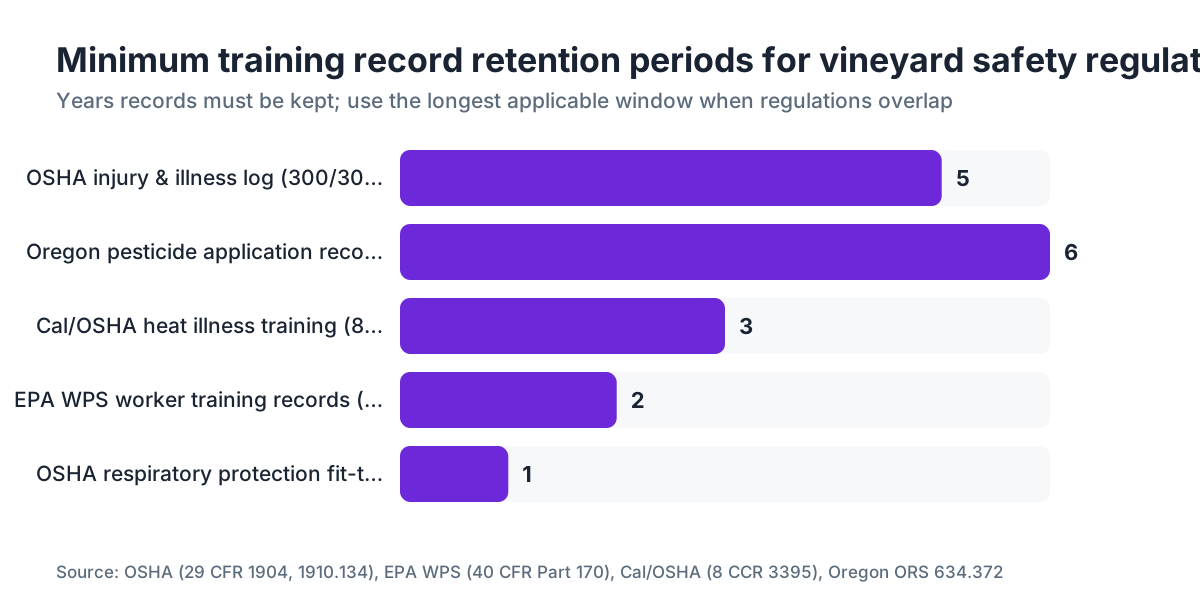
Retention periods change with the underlying regulation, and mixing them up is the most common audit mistake. Two years for WPS worker training. Five years for OSHA injury logs. Six years for Oregon pesticide records.
| Regulation | Minimum retention period | What to keep |
|---|---|---|
| OSHA HazCom (29 CFR 1910.1200) | 30 years for exposure records; training logs not explicitly timed, 3 years is best practice | Signed training logs, SDS access records |
| EPA WPS (40 CFR Part 170) | 2 years | Worker training records, application records |
| OSHA Respiratory Protection (29 CFR 1910.134) | Until replaced or 1 year after last exposure | Fit-test records, medical clearance |
| OSHA Injury & Illness (300 log) | 5 years | 300, 300A, 301 forms |
| Cal/OSHA Heat Illness (8 CCR 3395) | 3 years | Training acknowledgments |
| Pesticide application records (many states) | 2-3 years (varies by state) | Mix records, field logs |
Pick the longest applicable window and apply it to everything. Three years covers most federal agriculture standards, and five years covers OSHA injury logs. If your state runs longer, state law wins. Oregon requires pesticide application records for six years under ORS 634.372. [4]
Keep original signed documents in the physical binder. Then scan everything. A barn fire should not erase your compliance record.
What is the EPA Worker Protection Standard, and what training does it require?
The WPS is a federal regulation the EPA administers under the Federal Insecticide, Fungicide, and Rodenticide Act (FIFRA). The 2015 revision, which took full effect in January 2017, tightened training rules for agricultural workers and pesticide handlers on farms. [2]
Every worker who enters a treated field during a restricted-entry interval (REI), or who handles pesticides, gets trained before doing those tasks. The training covers specific topics defined in 40 CFR 170.401, including how to recognize pesticide poisoning symptoms, how to use personal protective equipment, how to reach the pesticide safety information posted at a central location, and where to find emergency medical care. [2]
The EPA's plain-language guidance puts the timing bluntly: "Workers and handlers must be trained before they are permitted to perform tasks covered by the WPS, except during an emergency." A new hire on their first day cannot enter a field post-application before training is done. Period.
Your WPS binder section should hold a copy of the training curriculum used (the EPA's WPS Training for Agricultural Workers module or a state-approved equivalent), a signed training record for each worker with the trainer's name and certification number, the training date, and a record of the central posting location. WSU Extension publishes a free WPS training record template that meets federal requirements. [5]
Workers trained within the last 12 months don't need retraining, but you still keep the prior record in the binder to prove it.
How should you physically organize the binder?
Organization sounds obvious until you're standing in a vineyard row in August, hunting for a spray training record while an inspector waits. Structure is the whole game.
Use a heavy-duty 3-inch three-ring binder, not a 1-inch. Vineyard binders fill up fast, especially with seasonal crews. Tabbed dividers, numbered sections, and a table of contents on page one are non-negotiable.
A section structure that holds up in the field:
Section 1: Table of contents with a last-updated date on the cover.
Section 2: OSHA HazCom and SDS index. The actual Safety Data Sheets can live in a separate SDS binder (that's fine), but the training logs and an index of every chemical on site belong here.
Section 3: EPA WPS records. Training certificates, trainer credentials, and the location map for the central posting site.
Section 4: Emergency action plan. One page with the site address (GPS coordinates help first responders in rural areas), nearest hospital, evacuation routes, and supervisor contacts.
Section 5: Equipment training. ROPS acknowledgments, forklift certifications, respirator fit-test records.
Section 6: State-specific records. Heat illness training, sexual harassment prevention, pesticide applicator license copies.
Section 7: Injury and illness log (OSHA 300 or equivalent). Some operations keep this apart; either way, cross-reference its location.
Section 8: Roster of current employees with training completion dates. Update it every time someone is hired, terminated, or changes duties.
Date-stamp every document as it enters the binder. A self-inking date stamp costs a few dollars and saves you at audit time.
Run one binder per vineyard block or location if your parcels have different chemical programs. A binder riding in the Block 12 truck does you no good when an inspector shows up at Block 4.
Who is responsible for keeping the binder current?
The employer. Full stop. Under OSHA and WPS, the duty to train workers and keep records lands on the agricultural employer, not the workers, not the labor contractor (though farm labor contractors carry their own parallel obligations), and not the spray applicator you hire. [1][2]
You can hand the day-to-day paperwork to a vineyard manager or crew supervisor, but someone with authority has to own the binder. That person needs a calendar reminder at least four times a year: before the first spray of the season, after any new hire or role change, after any pesticide incident or near-miss, and before year-end to archive that year's OSHA 300A summary.
Farm labor contractors (FLCs) complicate this. Under the WPS, if an FLC brings workers to your vineyard, you and the FLC share training obligations, but you as the agricultural employer must confirm WPS training happened and must retain records. A signed agreement with the FLC should name who delivers WPS training and require copies of the records within 48 hours of worker arrival. [2]
UC Davis's Western Center for Agricultural Health and Safety publishes practical guidance on splitting these duties in contracts with labor contractors. Read it if you rely on FLC crews. [6]
What do you do when a new employee starts mid-season?
Train before they touch anything. That's the law and the practical reality.
For WPS, the rule is training before first entry into a treated field or before handling pesticides. For OSHA HazCom, training happens before the worker works with or near hazardous chemicals. "We'll get to it next week" is not defensible. [1][2]
A one-page new-hire training checklist stapled to each new employee's paperwork keeps this manageable. Walk through it on day one, get the signature, drop it into Section 8 that afternoon. The checklist confirms: HazCom overview done, WPS training done (or prior training verified with documentation), emergency action plan reviewed, PPE issued and fit confirmed, equipment safety briefing done.
For workers trained on WPS at another operation within the past 12 months, accept their prior training record instead of retraining. Get a copy, put it in your binder with a note. Don't rely on a verbal assurance. You need the paper.
Seasonal re-entry at the start of a new season counts as continued employment for WPS purposes if the prior training is less than 12 months old and covers the same topics. But if your chemical program changed, or the worker's duties now include pesticide handling for the first time, retrain anyway.
How do you handle training records for workers who speak limited English?
This is where a lot of small operations fall short, and where inspectors look hard.
WPS requires training delivered in a manner the worker can understand. If a worker's primary language is Spanish, Mixtec, or anything else, the training comes in that language from someone fluent, or through a qualified interpreter. A bilingual supervisor reading from an English handout is not enough if the crew can't follow it. [2]
The EPA has approved WPS safety training materials in Spanish. Several land-grant extension programs, including Cornell Cooperative Extension and WSU Extension, publish WPS training videos and handouts in Spanish. [5][7]
The training record form itself can stay in English, but note the language of instruction used. If an interpreter was present, record their name. If a worker can't write their name, note the method used to verify participation (verbal acknowledgment witnessed by a supervisor, thumbprint, and so on).
California's Division of Occupational Safety and Health (Cal/OSHA) and Oregon OSHA both audit for language-appropriate training in agriculture. Documentation that names the training language protects you.
What does an actual OSHA or WPS audit look like, and what will an inspector ask for?
Agricultural inspections usually come from one of two directions: a state OSHA office following up on a reported injury, or a state agriculture department running a WPS compliance check. In California, the county agricultural commissioner runs WPS inspections. In Washington, it's the state Department of Agriculture. In New York, both the Department of Agriculture and Markets and the Department of Labor.
An inspector typically asks for five things right away: your pesticide application records for the past 30 days, proof that workers were trained before entering post-application fields, training records for any handlers who mixed or loaded pesticides, your central posting information (label, safety data sheet, and treated-area map posted where workers can reach it), and your emergency decontamination supplies.
Find a treated field with no posted information, workers who can't show WPS training, or training records dated before the 2017 rule revision, and you're looking at a Notice of Violation. Civil penalties under FIFRA (which enforces WPS) reach $23,988 per violation as adjusted for inflation under the Federal Civil Penalties Inflation Adjustment Act. [8]
OSHA penalties for willful or repeated violations in agriculture can reach $165,514 per violation in 2025. [9]
Keeping the binder in a known, accessible spot matters. "I have it somewhere" during an inspection is the same as not having it. Many operations keep the primary binder in the office or ranch manager's vehicle and a laminated one-page quick-reference (emergency contacts, central posting location, SDS binder location) in each work truck.
How often should you review and update the binder?
Four scheduled reviews a year, minimum. Here's what each one covers.
Pre-season review (February or March for most wine regions): Confirm all worker training is current (WPS within 12 months, HazCom current for any new chemicals). Add the season's pesticide product list and pull fresh SDS sheets for new products. Update the emergency contact list with current supervisor numbers.
First-spray review: Verify the central WPS posting is up and holds the required information for each application (product name, EPA registration number, active ingredient, REI, treated area, date and time of application, SDS location). Confirm everyone entering the field has been trained.
Mid-season review (July or August): Check that new hires and seasonal workers added since spring have complete records. Review the OSHA 300 log for incidents that need recording. Audit equipment training records if you added machinery.
End-of-season and annual review (November or December): Archive the year's training records and open a new section for the coming year. Post the OSHA 300A annual summary (February 1 through April 30 per 29 CFR 1904.32). Confirm retention going back the required number of years and purge anything past the window.
Outside those reviews, the binder needs attention any time someone is hired, fired, or changes duties; any time a new pesticide joins the program; and any time an incident, injury, or near-miss happens.
Record-keeping software can trigger the reminders for you. VitiScribe lets you attach scanned training records to employee profiles and set expiration alerts for WPS training, so the system flags a worker's 12-month window before spray season starts. Automation doesn't replace the physical binder, but it cuts the chance of a gap slipping through.
What training resources actually exist for small vineyards?
Most of the content you need is free from extension programs.
UC Davis Western Center for Agricultural Health and Safety publishes pesticide safety training curricula in English and Spanish, heat illness prevention materials, and tractor safety resources, all free for agricultural employers. [6]
Cornell Cooperative Extension runs a farm safety program with WPS-compliant pesticide training for workers and handlers, emergency preparedness templates, and a farm safety training guide updated to current OSHA standards. [7]
WSU Extension's pesticide education program publishes WPS training materials and Washington State applicator continuing education resources, useful even outside Washington because the underlying federal WPS content is identical. [5]
The EPA maintains a WPS webpage with downloadable training materials, including the "How to Comply" manual for agricultural employers, the clearest plain-language explanation of what you owe. [2]
For heat illness, California's Department of Industrial Relations publishes a Cal/OSHA heat illness prevention e-tool that generates site-specific written plans you can drop straight into your binder. [3]
The National Agricultural Safety Database (nasd.cdc.gov), maintained through NIOSH, is a searchable archive of safety training materials for every agricultural task. Vineyard operators underuse it. Bookmark it.
One honest caveat: extension materials vary in how current they are. Check the publication date against the current regulation text. The 2015 WPS revision voided a lot of older training curricula published under the 1995 rule. Any WPS material dated before 2017 needs a second look.
What are the most common mistakes vineyard operators make with safety binders?
Missing signatures are the single biggest audit failure. A training log without the worker's signature isn't a training record. It's a piece of paper. Get signatures the same day as training, not a week later.
Outdated SDS sheets cause trouble too. Manufacturers revise SDS documents when formulations change. If your SDS for a sulfur product is from 2014 and the inspector asks for the current version, you have a problem. A workable rule: replace SDS sheets whenever you open a new container with a different lot number or when the manufacturer sends a notice.
Confusing the application record with the training record happens constantly. The pesticide application record (who sprayed, what, where, when, at what rate) is a separate document from the WPS training record (who was trained, by whom, on what date). Inspectors see these two conflated all the time.
Skipping re-training after a new product comes in. HazCom requires re-training when workers meet a hazard that is "new or different from what was covered in previous training." Adding a fungicide with a different active ingredient triggers this. [1]
Keeping the binder somewhere workers can't reach it. Both OSHA and WPS give workers the right to review certain records. The WPS central posting must stay accessible during the workday. Your SDS binder must be reachable on each shift. A binder locked in the owner's car 40 miles away fails this.
For operations running across multiple appellations or properties, the paperwork multiplies fast. Tracking compliance records across vineyard sites spread over many parcels is one of the clearest cases where a purpose-built record-keeping system pays for itself in audit confidence alone.
Does vineyard size or number of employees change what you're required to keep?
Yes, but not the way most small operators assume.
OSHA's injury and illness recording rules under 29 CFR Part 1904 exempt employers with 10 or fewer employees from keeping the OSHA 300 log, but that exemption doesn't touch WPS, HazCom, or state safety training requirements. A two-person family vineyard where both people apply pesticides still complies with WPS training and recordkeeping. [11]
The WPS has no small-farm exemption. Use any pesticide with a WPS label on a farm, ranch, nursery, or greenhouse, and WPS applies, whatever your size. The only true exemption covers employers who employ only immediate family members. [2]
State rules can set extra thresholds. California's heat illness regulation (8 CCR 3395) applies to every outdoor employer with at least one employee, farms of any size included. [3]
For OSHA's respiratory protection standard, if even one worker wears a tight-fitting respirator (a half-face or full-face unit, not a simple dust mask) during pesticide application, you need a written respiratory protection program plus medical evaluations and fit tests for those workers, regardless of farm size. [10]
The honest summary: size trims some OSHA reporting obligations but not the training and recordkeeping duties under the standards that matter most for vineyard work.
Frequently asked questions
Can I keep vineyard safety training records digitally instead of in a paper binder?
Yes, with conditions. Both OSHA and EPA WPS allow electronic recordkeeping as long as records stay readily accessible for inspection, print on request, and carry the original signatures or equivalent authentication. A scanned PDF of a signed training form in a cloud system meets this standard in most states. Keep a printed backup on-site for field inspections, because not every inspector will wait for you to pull up a phone.
How do I document WPS training if the trainer is an outside certified applicator?
Get a copy of the trainer's pesticide applicator license or Train-the-Trainer certification, the training date, the topics covered, and a signature page for each worker trained. The outside applicator should hand these over; if they won't, that's a red flag about their compliance. File everything in your WPS binder section within 24 hours. You, as the agricultural employer, are the one the inspector holds responsible for the records.
What happens if an employee refuses to sign the training record?
Document the refusal in writing. Note the date, the employee's name, the training content covered, and the fact that they declined to sign. Have a witness (another supervisor) co-sign the note. Federal and state agencies accept this as evidence that training happened. The refusal itself is not a violation on your part; the absence of any documentation is. Keep the refused-signature record in the binder the same as a signed one.
Does heat illness prevention training need to be in the safety binder?
If you operate in California or any state with a mandatory heat illness prevention regulation, yes. California's 8 CCR 3395 requires training before an employee's first outdoor shift and requires you to retain records for three years. Oregon and Washington have similar rules. The training covers symptoms of heat illness, the importance of hydration, how to access shade, and how to report symptoms. A signed acknowledgment for each employee goes in the state-specific section.
Do I need to keep a copy of every pesticide label in the binder?
Not necessarily in the training binder, but you must have the label accessible at the central WPS posting location during and after each application, and the Safety Data Sheet for each product must be reachable by workers. Many operations keep a separate pesticide product binder with the current label and SDS for every product in the program, then cross-reference it in the training binder's table of contents. That setup satisfies both WPS central posting and OSHA HazCom SDS access.
What OSHA forms does a vineyard actually need to post or keep?
Vineyards with more than 10 employees maintain the OSHA 300 log (injury and illness log), the OSHA 300A annual summary (posted February 1 through April 30 each year), and the OSHA 301 incident report for each recordable injury. Farms with 10 or fewer employees are exempt from the 300 log but must still report any fatality within 8 hours and any hospitalization, amputation, or eye loss within 24 hours to OSHA, regardless of size.
How do I handle safety training records for farm labor contractor workers who come to my vineyard?
Under WPS, you and the farm labor contractor share responsibility, but you must verify training happened and retain evidence. Before FLC workers enter any treated area, get written confirmation from the FLC that WPS training was completed, plus the trainer's credentials and the training date for each worker. A signed letter or form from the FLC kept in your binder is the minimum. If the FLC can't provide this, you must train the workers yourself before they enter treated fields.
Is there a required format for the WPS central posting information, and where should it be posted?
The EPA WPS doesn't mandate a specific form, but the posting must include the product name, EPA registration number, active ingredient, REI, application start date and time, treated area location, and Safety Data Sheet location. Post it at a central location accessible to workers before they enter treated areas, and keep it there for 30 days after the REI expires. A weatherproof sleeve in the crew break area or equipment shed is a common solution.
Do vineyard owners who personally apply pesticides need to keep the same records as employers?
If you are an agricultural employer with workers (including family members who are not immediate family), yes, WPS applies and records are required. If you are a solo owner with no employees and apply pesticides yourself under your own applicator license, you follow state pesticide application recordkeeping rules (which vary but usually require a log of what, where, when, and how much) but you're not subject to the WPS employer recordkeeping requirements for worker training.
What respirator records does a vineyard need if workers spray sulfur?
If workers wear dust or mist masks (N95 disposable filtering facepieces) for sulfur, and those masks are voluntary rather than required by you, OSHA's respiratory protection standard requires only that you give workers Appendix D of 29 CFR 1910.134 (a one-page information sheet) and keep a record that you did. If you require tight-fitting respirators, you need a full written respiratory protection program, medical evaluations, and annual fit tests for each worker. Keep all of these in the equipment training section.
How often does WPS training need to be repeated?
Every 12 months. If a worker received WPS training at another operation within the past 12 months, you can accept it without retraining, but you must have documentation of the prior training. There's no grace period for expired training. If a worker's 12-month mark passes while they are still employed, they must be retrained before they can legally re-enter any field subject to WPS.
What is the penalty for not having WPS training records during an inspection?
Civil penalties under FIFRA, which enforces WPS, reach $23,988 per violation as adjusted for inflation under the Federal Civil Penalties Inflation Adjustment Act. State agencies with WPS enforcement authority can add state-level penalties. A missing training record for one worker on one application date is technically one violation, but an inspector finding systemic non-compliance across multiple workers or seasons can issue separate violations for each instance, and those stack fast.
Can I use a shared Google Drive or farm management software to maintain these records?
Yes, with one condition: you must produce records for inspection quickly, on-screen or printed, at the site where work happens. A cloud system that needs cellular service in a vineyard with no signal isn't adequate. Systems like VitiScribe sync records offline and print them on demand, which addresses this. Whatever system you use, verify that original signatures are preserved and the system creates an audit trail showing who entered each record and when.
Sources
- OSHA, Hazard Communication Standard 29 CFR 1910.1200: Employers must train employees on hazardous chemicals before first assignment and whenever a new hazard is introduced; training logs must document name, date, topics, and signature.
- EPA, Agricultural Worker Protection Standard (40 CFR Part 170): WPS requires pesticide safety training for all agricultural workers and handlers before performing covered tasks; employers must retain training records for two years.
- California Department of Industrial Relations, Cal/OSHA Heat Illness Prevention 8 CCR 3395: California requires documented heat illness prevention training before an employee's first outdoor shift when temperatures can reach 80 degrees Fahrenheit; records must be retained for three years.
- Oregon Department of Agriculture, Pesticide Program (ORS 634.372): Oregon requires pesticide application records to be kept for six years under ORS 634.372.
- Washington State University, Urban IPM and Pesticide Safety Education Program: WSU Extension publishes WPS-compliant training record templates and pesticide safety training materials for workers and handlers.
- UC Davis Western Center for Agricultural Health and Safety: UC Davis Western Center publishes pesticide safety training curricula in English and Spanish, heat illness prevention materials, and guidance on dividing WPS training responsibilities with farm labor contractors.
- Cornell Cooperative Extension, Agriculture and Food Systems: Cornell Cooperative Extension publishes WPS-compliant pesticide training for workers and handlers and emergency preparedness templates for agricultural employers.
- EPA, Enforcement (FIFRA civil penalty inflation adjustments): Civil penalties under FIFRA, which enforces the WPS, reach $23,988 per violation as adjusted under the Federal Civil Penalties Inflation Adjustment Act.
- OSHA, Penalties: OSHA willful or repeated violation penalties can reach $165,514 per violation in 2025.
- OSHA, Respiratory Protection Standard 29 CFR 1910.134: Employers who require tight-fitting respirators must maintain a written respiratory protection program, medical evaluations, and annual fit-test records for each worker, regardless of farm size.
- OSHA, Recordkeeping (29 CFR Part 1904): OSHA requires injury and illness logs (300, 300A, 301) to be retained for five years; employers with 10 or fewer employees are exempt from maintaining the 300 log but must still report fatalities within 8 hours.
- OSHA, Emergency Preparedness and Response (29 CFR 1910.38): OSHA requires employers to maintain a written emergency action plan covering evacuation routes, muster points, and procedures for reporting fires or chemical spills.
Last updated 2026-07-10