How to manage a vineyard: a practical guide for growers
TL;DR
- Managing a vineyard means running soil prep, variety selection, trellising, canopy work, irrigation, pest and disease control, spray records, and harvest timing across a full 52-week calendar.
- Most quality operations target 3 to 5 tons per acre.
- EPA Worker Protection Standard compliance is mandatory.
- Plan on 2 to 4 years before a new planting gives you a real commercial crop.
What does managing a vineyard actually involve day to day?
Vineyard management is not one job. It's soil science, carpentry, chemistry, labor scheduling, weather watching, and bookkeeping all running at once. On any given Tuesday in June you might adjust drip emitters in the morning, scout for powdery mildew at noon, train a new shoot to a catch wire at 2 p.m., and log a fungicide application before dinner. That's the real shape of it.
The year breaks into rough phases. Dormant-season pruning and trellis repair run December through March in most Northern Hemisphere regions. Bud break and early canopy work land in April and May. Fruit set and berry development bring heavy spray and irrigation management from June through August. Harvest hits August through October depending on variety and region. Post-harvest soil amendment and cover crop establishment close out October and November. Cornell's viticulture extension program publishes a season-by-season calendar that most East Coast growers use as a base and adapt to their site [1].
Scale changes everything. Small operations run 1 to 5 acres with an owner-operator plus seasonal help. Mid-size operations of 20 to 100 acres usually employ a full-time vineyard manager, 1 to 3 year-round crew, and a crew of 8 to 20 during pruning and harvest. Labor is usually 40 to 60 percent of total production cost, which is exactly why every efficiency in trellis design and mechanization pays you back for years.
Here's the honest part. The first two or three years of a new block are the hardest, because you're spending money with no return. Most commercial plantings don't produce a meaningful crop until year three or four, and you won't hit peak yield until year seven or eight [2].
How do you choose the right site and variety for your vineyard?
Site selection sets the ceiling on everything you'll ever do. You can improve soil, add irrigation, and adjust your canopy. You cannot move a vineyard after planting.
The factors that matter most, roughly in order: climate (heat accumulation measured in growing degree days, frost dates, humidity), soil drainage, slope and aspect, water access, and proximity to markets or a winery. UC Davis's viticulture program uses the Winkler Scale of heat summation, which sorts California wine regions into five zones based on degree days above 50°F accumulated from April 1 through October 31 [3]. Region I (under 2,500 degree days) favors cool-climate varieties like Pinot Noir and Chardonnay. Region V (over 4,000 degree days) suits heat-tolerant varieties like Grenache and Zinfandel. Outside California, WSU Extension has similar heat-zone work specific to Washington and the broader Pacific Northwest [4].
Soil drainage is non-negotiable. Vitis vinifera does not tolerate saturated roots. A percolation test before you plant is worth more than any soil amendment you can buy afterward. You want well-drained loam to sandy loam with a pH of 5.5 to 6.5, though plenty of great vineyards grow in clay-heavy soils that drain well at depth.
Variety choice follows site, never the other way around. Don't plant Pinot Noir at 2,800 degree days because you love Burgundy. Plant what your heat units, disease pressure, and frost window support. Your local extension viticulture advisor can tell you which varieties have the strongest track record in your county, and that conversation costs you nothing.
What trellis system should you install?
Trellis choice comes down to three things: your variety's vigor, your mechanization goals, and your budget. The three most common systems in the U.S. are Vertical Shoot Positioning (VSP), Scott Henry, and the Geneva Double Curtain (GDC).
VSP is the default for most Vitis vinifera plantings. Shoots grow vertically between two pairs of catch wires. It works well for moderate-vigor varieties in cooler climates, it takes mechanical harvest, and it's the picture most wine drinkers hold in their heads when they think of a vineyard. Typical post spacing is 8 to 10 feet in-row, with rows 9 to 12 feet apart.
Scott Henry splits the canopy into two curtains, one trained up and one down. It handles high-vigor sites better than VSP because it spreads more leaf area without shading the fruit zone. The tradeoff is more training labor.
GDC runs two parallel cordon arms on a wider row, good for very high-vigor varieties or soils that push hard growth. Cornell developed it specifically for hybrid varieties common in the Northeast [1].
Post and wire costs run roughly $3,000 to $6,000 per acre for an installed VSP system, depending on post material, wire tiers, and local labor rates. Treated wood posts are cheapest upfront but need replacement in 20 to 30 years. Metal T-posts with wooden end posts are the common compromise. You can see working examples of different trellis approaches at established destinations like Gervasi Vineyard in Ohio and Ponte Winery in Temecula, both of which run public vineyard tours where the trellis choices are easy to study up close.
Get your row orientation right before you pound the first post. North-south rows catch the most light in most Northern Hemisphere sites. On a slope, running rows up-and-down aids air drainage and cuts frost risk, even when it costs you the ideal sun angle. That's a fair trade in a frost-prone valley.
How do you manage pruning and canopy through the season?
Pruning is the most labor-intensive recurring task in a vineyard, and it largely sets yield and quality for the entire season. You make decisions in February that show up in the glass in October.
Most VSP vineyards use either cane pruning or cordon (spur) pruning. Cane pruning keeps one or two canes of last year's wood with 10 to 15 nodes each. Spur pruning keeps spurs of 2 to 3 buds along a permanent cordon. Spur pruning is faster and friendlier to mechanization. Cane pruning gives you more flexibility on varieties with poor basal bud fruitfulness, like Riesling or Grenache.
A common rule of thumb from UC Davis is the balanced pruning formula: leave 30 nodes for the first pound of pruning weight, then add 10 nodes for each additional pound [3]. This ties your bud load directly to the vine's demonstrated capacity from last year. It isn't perfect, but it beats arbitrary count-based pruning by a wide margin.
In the growing season, canopy management splits into shoot thinning, shoot positioning, leaf removal, and hedging. Shoot thinning happens at 3 to 6 inches of shoot growth, pulling weak or misplaced shoots to cut crowding. Shoot positioning tucks shoots between catch wires as they lengthen. Leaf removal opens the fruit zone to air and light, which is your main tool against Botrytis cinerea in humid regions. Cornell studies show that leaf removal at fruit set, especially on the morning (east) side of the canopy in the northeastern U.S., reduces Botrytis incidence with little yield loss [1].
Hedging cuts the tops of shoots to stop upward growth, usually once or twice in July and August. Don't hedge too hard too early. Strip too much leaf area during berry development and you starve sugar accumulation.
What irrigation strategy works best for wine grapes?
Deficit irrigation is the standard in most western U.S. wine regions. The goal is not maximum growth. It's managing vine water status to control vigor and concentrate berry flavor. You aren't trying to eliminate stress. You're applying mild, controlled stress at the right phenological windows.
Drip is almost universal in commercial wine grape production in California and Washington. A single-lateral drip system with 1 to 2 emitters per vine, delivering 0.5 to 1.0 gallon per hour, is the baseline design. Total seasonal water use in a California coastal vineyard typically runs 8 to 18 acre-inches depending on evapotranspiration and how much stress you want [3].
The key measurement tool is the pressure chamber (pressure bomb), which reads leaf water potential in bars (or MPa). At midday, a well-watered vine reads around -8 to -10 bars. Moderate stress for quality wine production usually sits at -12 to -15 bars midday stem water potential, measured on covered (bagged) leaves. WSU Extension has published thresholds specific to Washington Riesling and Cabernet Sauvignon that differ from California norms [4].
In the humid eastern U.S., irrigation is less common but still used in drought years. There the problem is usually too much water in the soil profile in June, not too little.
If you're dry-farming, you need deep soils with good water-holding capacity and a climate where winter rain recharges the profile. Dry farming without those two things just stresses vines into low yields with none of the quality payoff. It's a romantic idea that fails hard on the wrong site.
How do you control pests and diseases in a vineyard?
Disease management is where most new growers underestimate the workload. In a wet year in a humid region, you might apply 12 to 18 fungicide sprays. In a dry California summer, 6 to 8 will often do. The calendar matters less than the weather.
The big four disease threats in most U.S. wine regions are powdery mildew (Erysiphe necator), downy mildew (Plasmopara viticola), Botrytis bunch rot (Botrytis cinerea), and Phomopsis cane and leaf spot. Powdery mildew pressure begins at bud break and runs through veraison. It's the one you cannot skip. A single unprotected window of 4 to 5 days at 65 to 85°F with any leaf wetness can produce 20 to 40 percent cluster infection [5].
Insect pests vary by region. Grape leafhopper, grape berry moth, and vine mealybug do the most economic damage in the eastern U.S. Glassy-winged sharpshooter, the vector for Pierce's Disease, is the existential threat in coastal Southern California. Western grape leaf skeletonizer defoliates vines in warmer western regions. Spotted lanternfly is now established across much of the Northeast, and extension programs are still working out its management [1].
Integrated Pest Management (IPM) is the framework every major extension program recommends. Scout first. Apply thresholds before you spray. Rotate chemistries to manage resistance. Prefer selective materials over broad-spectrum ones. You don't spray because the calendar says so. You spray because scouting and a weather model tell you pressure is building.
For organic operations, copper and sulfur carry the disease program. Sulfur works well on powdery mildew but must not go on within 2 weeks of certain spray adjuvants or when temperatures top 90°F, or you'll burn tissue. Copper builds up in the soil under continuous use, so watch your cumulative load.
WSU Extension's Viticulture and Enology program keeps an online spray guide updated every year covering thresholds, efficacy ratings, and resistance management by chemistry class [4].
What spray recordkeeping and compliance do you need to stay legal?
This is the part most growers underestimate until a notice of violation lands in the mailbox.
Federal law under the Federal Insecticide, Fungicide, and Rodenticide Act (FIFRA) requires any pesticide used in commercial agriculture to be applied in strict accordance with label directions. The label is the law. Applying a product at a rate, interval, or use not listed on the label is a federal violation, full stop.
The EPA's Worker Protection Standard (WPS), at 40 CFR Part 170, requires agricultural employers to provide pesticide safety training to workers and handlers, post pesticide application information at a central location, and keep records of all applications for at least two years [6]. The WPS was revised in 2015, tightening training, personal protective equipment, and restricted-entry intervals (REIs). The rule states that "agricultural employers must keep records of each pesticide application for a period of 2 years," covering the product name, EPA registration number, total amount applied, location and description of the treated area, date, start and end times, and the name of the certified applicator [6].
State requirements often go further. California's Department of Pesticide Regulation requires licensed pest control operators and PCAs (pest control advisers) to file use reports monthly with their County Agricultural Commissioner. California growers must keep pesticide application records for 3 years under California Food and Agriculture Code Section 12981 [7]. Washington and New York layer their own recordkeeping rules on top of the federal ones.
In practice, your spray log needs the product name, EPA registration number, target pest, application date and time, block or field ID, acres treated, application rate, equipment used, and applicator name and license number. If you're still keeping this in paper notebooks, you're one audit away from a scramble. Tools like VitiScribe are built to capture this data in the field and generate compliant reports on demand, which saves hours when an inspector calls.
Re-entry intervals matter every single time. Chlorothalonil has a 12-hour REI. Many systemic insecticides carry 24 to 48-hour REIs. Send a worker into a treated block before the REI expires and you expose that person to harm and yourself to WPS liability.
| Pesticide Class | Typical REI | Common Example |
|---|---|---|
| Sulfur (fungicide) | 24 hours | Microthiol Disperss |
| Chlorothalonil | 12 hours | Bravo WeatherStik |
| Mancozeb | 24 hours | Dithane M-45 |
| Organophosphate insecticide | 24-48 hours | Various |
| Pyrethroid insecticide | 12 hours | Warrior II |
| Systemic insecticide (neonicotinoid) | 12 hours | Admire Pro |
How do you manage soil health and nutrition in a vineyard?
Vine nutrition starts with a soil test. Take samples before planting and every 3 to 5 years after. Petiole (leaf stem) sampling is your in-season diagnostic: sample at bloom and again at veraison, send to a lab, and compare against published sufficiency ranges [2].
Nitrogen is the element growers most often over-apply. High nitrogen pushes excessive vegetative growth, shades the fruit zone, and raises Botrytis risk. Most established vineyards need very little added nitrogen, 20 to 40 pounds per acre per year at most, and some need none at all [3]. A simple petiole nitrate reading at bloom tells you more than any guess.
Cover crops are your main tool for managing soil organic matter, water infiltration, and beneficial insect habitat. Most established vineyards run resident vegetation (mowed or flailed) or seeded cover crops in alternate rows or all rows depending on vigor goals. Resident vegetation competes with vines for water and nitrogen, which is often the whole point on a high-vigor site. In drought-prone regions, you might terminate the cover crop early or run clean cultivation under the vine row.
Potassium deficiency is common in sandy soils and shows up as marginal leaf scorch. Boron deficiency causes poor fruit set. Both are straightforward to correct once you have tissue test data in hand.
Soil pH below 5.5 can limit nutrient availability and harm beneficial microbial populations. Lime applications to raise pH are common in the acid soils of the eastern U.S. Apply based on a soil test, never a hunch.
How do you know when grapes are ready to harvest?
Harvest timing is part chemistry, part sensory judgment, and part logistics. No single number tells you to pick. You're weighing several signals at once.
Brix (percent dissolved sugars by refractometer) is the most commonly tracked metric. Most red wine grapes come in between 23 and 26 Brix. White wine grapes often target 21 to 24 Brix depending on style. Each degree Brix converts to roughly 0.55 to 0.64 percent alcohol by volume after fermentation [8].
But Brix alone will fool you. A berry can hit 25 Brix while still tasting green, because the seeds haven't browned, the tannins are unripe, and the flavors are still herbaceous. Titratable acidity (TA) and pH are the other two lab numbers you check at every sample. For most red wines, you want a harvest pH of 3.3 to 3.6 and TA of 5 to 7 grams per liter. White wines typically target lower pH (3.1 to 3.4) and higher TA (6 to 9 g/L).
The tasting evaluation is what separates good winemakers from people who just chase numbers. Chew the seeds to judge tannin ripeness. Taste the skins for flavor. Check how easily berries pull from the stem.
Sample weekly starting 4 to 5 weeks before your anticipated pick. Grab a random 100 to 200 berries from throughout the block (more than the easy clusters at the row ends), crush them in a bag, and test the juice. If your sampling isn't random and representative, your numbers are worthless.
Harvest at night or in the early morning when fruit temperatures are below 65°F. Warm fruit respires fast, oxidizes faster, and makes the winery's job harder before the grapes even hit the crush pad.
How much does it cost to establish and run a vineyard per acre?
The numbers vary enough by region that any single figure misleads, but here's the honest range.
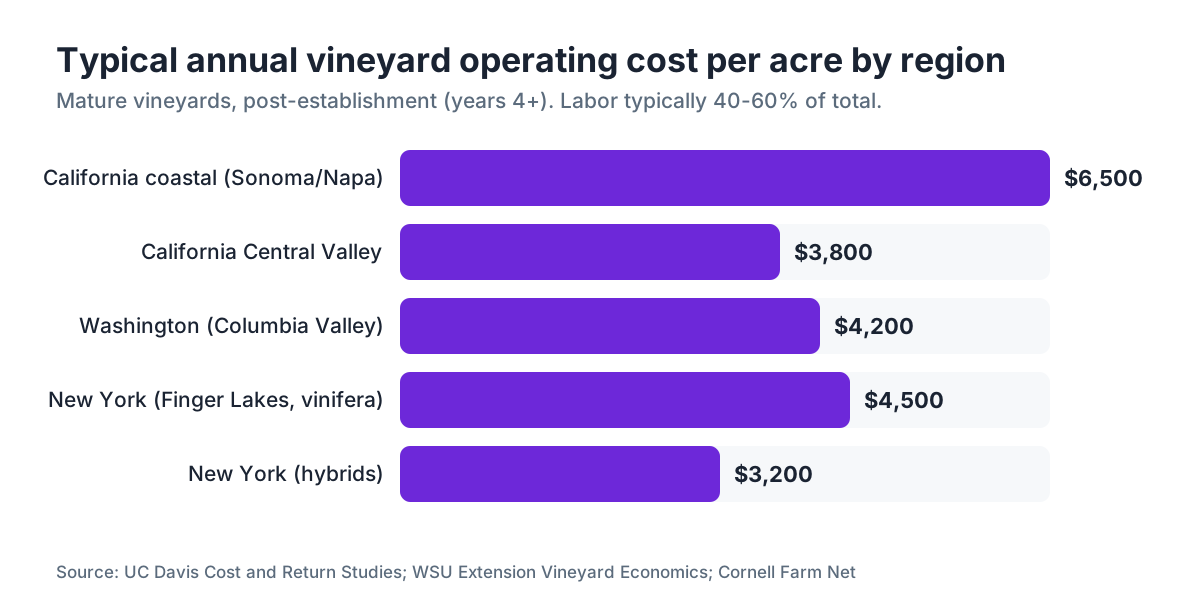
New vineyard establishment in California coastal regions runs $15,000 to $35,000 per acre across years one through three, including land clearing, soil prep, rootstock and grafted vines, trellis, irrigation, and labor [3]. In Washington, WSU Extension puts establishment at $10,000 to $20,000 per acre [4]. In New York, Cornell's Farm Net data pegs full establishment (through the non-productive years) at $8,000 to $15,000 per acre for hybrid varieties, and somewhat more for vinifera on marginal sites [2].
Annual operating costs once the vineyard is mature (year 4 and beyond) typically run $2,500 to $6,500 per acre per year in California wine regions, with labor as the dominant line item [3]. Spray materials alone can run $400 to $1,200 per acre per year depending on disease pressure and chemistry choices.
The payback math only works if you have a market for your fruit or a winery to process it yourself. Custom crush rates in California run roughly $400 to $900 per ton. Grape prices span from under $500 per ton for bulk commodity varieties to over $3,000 per ton for premium Napa Cabernet. Know your exit before you plant a single vine.
You can see operations of different scales at destinations like South Coast Winery in Temecula and the Paso Robles wineries cluster for a feel for how established estate vineyards tie production and hospitality economics together.
How do you build and manage a vineyard crew?
Most vineyard work in the U.S. leans on H-2A agricultural guestworkers alongside a core of year-round employees. The H-2A program, run by the Department of Labor, lets agricultural employers bring in temporary foreign workers when they can document that domestic workers aren't available. The Adverse Effect Wage Rate varies by state and year. In 2024 it ranged from $14.68 per hour in some southeastern states to over $19 per hour in California and Washington [9]. Those are minimums for H-2A workers. You can always pay more, and in a tight labor market you probably will.
Year-round employees usually include a vineyard foreman or assistant manager, an equipment operator, and sometimes an irrigation technician. These people need to read vine growth, spot disease and pest problems early, and ideally hold or be working toward a pesticide applicator's license.
Safety training is not optional. Under the WPS, every worker who handles pesticides or enters treated fields must get safety training annually, and you must keep records of it [6]. Beyond WPS, OSHA's agricultural safety standards cover heat illness prevention, equipment guarding, and PPE. California's Heat Illness Prevention regulation (Title 8 CCR Section 3395) is among the strictest in the country and has been the model for several other states [10].
Here's the one thing I'd tell any new vineyard manager. Invest in your foreman. A good, experienced foreman who knows your vines and your ground is worth more than any piece of equipment you'll ever buy.
What records do you need to keep to run a compliant vineyard operation?
Compliance recordkeeping falls into a few buckets that overlap but are not the same thing.
Pesticide application records: required by FIFRA and WPS at the federal level, often extended by state ag department rules. Keep them at least 2 years federal, 3 years in California, and check your own state's requirement [6][7].
Worker training records: WPS requires you to document annual pesticide safety training for every worker and handler. Name, date, and what was covered. Keep for 2 years [6].
Irrigation and water use records: California growers increasingly need these for water rights compliance and drought reporting. Washington water rights permits require annual water use reporting to the Department of Ecology.
Harvest records: required by the TTB (Alcohol and Tobacco Tax and Trade Bureau) if you're a bonded winery. Even selling fruit, good harvest records protect you in buyer disputes.
Equipment calibration logs: your sprayer needs calibration before the season and whenever you change nozzles. A calibration log is your best defense if an over-application complaint ever comes in.
Holding all of this together across a busy season is where most small operations struggle. Paper works, but only with real discipline. Digital field-record systems, including purpose-built ones like VitiScribe, capture application data at the point of use and link it to the right block, date, and applicator automatically, which cuts transcription errors and makes audit responses painless.
My honest advice: whatever system you pick, use the same one every time. Inconsistency is what gets people in trouble, not the paper versus software question.
Frequently asked questions
How long does it take a newly planted vineyard to produce a commercial crop?
Most Vitis vinifera vineyards produce a partial commercial crop in year 3 and reach near-full yield by year 5 to 7. Hybrid varieties in the eastern U.S. sometimes crop lightly in year 2. The first two years are pure establishment cost with no meaningful fruit return. UC Davis recommends removing any clusters in year 1 to push vine energy into root development.
How many tons per acre should a vineyard produce?
Target yield depends on your quality goal and variety. Premium California wine grape vineyards often aim for 2 to 4 tons per acre. High-production table wine vineyards can top 10 tons per acre. Cornell extension data shows New York hybrid variety yields of 4 to 8 tons per acre under normal conditions. Higher yield usually means lower berry concentration, so match your target to your price point and contract terms.
Do I need a pesticide applicator license to spray my own vineyard?
It depends on your state and the products you use. Applying Restricted Use Pesticides always requires a licensed applicator present. General Use Pesticides can be applied by an unlicensed owner-operator on their own property in most states, but many state departments of agriculture require a private applicator license for any commercial agricultural pesticide use. Check with your state department of agriculture before you buy your first jug.
What is the EPA Worker Protection Standard and does it apply to my vineyard?
The WPS (40 CFR Part 170) applies to any agricultural establishment that uses pesticides and employs workers or handlers, including family farms with non-family employees. It requires annual pesticide safety training, access to application records, personal protective equipment, and notice before workers enter treated areas. The EPA revised the WPS in 2015. Even small vineyards with seasonal harvest crews must comply.
How often should I be scouting my vineyard for pests and disease?
Weekly scouting from bud break through harvest is the baseline recommendation from every major extension program. During high-risk windows, like warm, wet weather after fruit set when Botrytis pressure spikes, step up to twice-weekly. Scouting means walking the rows, examining leaves and clusters, recording what you find, and comparing it to established action thresholds before you decide to spray.
What is balanced pruning and should I use it?
Balanced pruning ties the number of buds you leave at dormant pruning to the vine's prior-year growth, measured by weighing pruning brush. The UC Davis formula: leave 30 nodes for the first pound of cane weight, plus 10 nodes per additional pound. It isn't perfect for every variety, but it's a better starting point than fixed bud counts, and it adjusts automatically for low-vigor and high-vigor vines within the same block.
How do I prevent powdery mildew in my vineyard?
Start a sulfur or DMI fungicide program at bud break and don't let more than 10 to 14 days pass between applications during high-risk periods (65 to 85°F, any leaf wetness). Rotate chemistry classes to manage resistance. Open the canopy with leaf removal to improve air circulation and cut surface wetness. Powdery mildew is the one disease where a single missed spray window can cause season-defining damage.
What cover crops are best for vineyards?
It depends on your vigor and erosion goals. On high-vigor sites, competitive covers like annual ryegrass or fescue in every row help moderate growth. On low-vigor or dry-farmed sites, use covers in alternate rows only, or terminate them early in spring. Legume mixes (bell bean, vetch, peas) fix nitrogen but can push too much vine vigor. UC Davis recommends a site-specific approach rather than a universal cover crop prescription.
How do I measure vine water stress and know when to irrigate?
The pressure chamber (pressure bomb) is the most direct tool. Measure midday stem water potential on covered (bagged) leaves. A well-watered vine reads around -8 to -10 bars. Mild deficit irrigation targets -12 to -15 bars at midday. Values beyond -18 to -20 bars signal severe stress and call for immediate irrigation. WSU Extension publishes variety-specific threshold tables for Washington wine grapes.
How do I hire workers for pruning and harvest legally?
The H-2A agricultural guestworker program is the most common legal pathway for seasonal vineyard labor when domestic workers are unavailable. You must document recruitment efforts, pay at least the Adverse Effect Wage Rate (varies by state, $14.68 to $19+ per hour in 2024), and provide housing and transportation. The Department of Labor's Foreign Labor Certification program processes H-2A applications and typically requires a 45- to 60-day lead time before your workers' start date.
What is Brix and what Brix should I harvest at?
Brix measures the percentage of dissolved sugars in grape juice, read with a refractometer or hydrometer. Most red wine grapes are harvested between 23 and 26 Brix. Most white wine grapes target 21 to 24 Brix. Each degree Brix converts to roughly 0.55 to 0.64 percent potential alcohol. Brix alone is not a harvest trigger: also check pH, titratable acidity, and berry flavor and seed maturity before making a pick decision.
How much does it cost per acre to run a vineyard annually?
Annual operating costs for a mature wine grape vineyard (post-establishment) typically run $2,500 to $6,500 per acre in California wine regions, with labor making up 40 to 60 percent of that total. Washington and New York operations generally run somewhat lower, in the $2,000 to $4,500 range. Spray material costs alone are $400 to $1,200 per acre per year depending on disease pressure. Source: UC Davis Cost and Return Studies.
What is the difference between cane pruning and spur pruning?
Cane pruning keeps one to two long canes of last season's wood (10 to 15 nodes each) attached to the head of the vine each year. Spur pruning keeps short spurs of 2 to 3 buds along a permanent cordon arm. Spur pruning is faster, friendlier to mechanization, and easier for inexperienced crews. Cane pruning suits varieties with poor basal bud fruitfulness, like Riesling or Grenache, where the best fruit buds sit further from the base.
Do I need to keep spray records even if I'm an organic vineyard?
Yes. Organic certified vineyards still apply pesticides (OMRI-listed materials), and those applications fall under the same WPS recordkeeping requirements as conventional operations. Your USDA-accredited certifier also requires detailed input records as part of the organic system plan. Failing to keep accurate records is a common reason organic certifications get suspended.
Sources
- Cornell University Cooperative Extension, Viticulture Program: Season-by-season vineyard management calendar, GDC trellis development for northeast hybrids, and leaf removal research for Botrytis management in northeastern U.S. vineyards.
- Cornell University, Cornell Cooperative Extension Farm Net, Vineyard enterprise budgets: Establishment cost estimates of $8,000 to $15,000 per acre for New York hybrid varieties, and vine maturity timelines showing commercial production starting in years 3 to 5.
- UC Davis Department of Viticulture and Enology: Winkler Scale heat summation zones, balanced pruning formula (30 nodes per first pound plus 10 per additional pound), irrigation water use ranges of 8 to 18 acre-inches, nitrogen management recommendations, and California vineyard establishment cost ranges of $15,000 to $35,000 per acre.
- Washington State University Viticulture and Enology: Heat-zone work for Washington and the Pacific Northwest, variety-specific vine water potential thresholds for Riesling and Cabernet Sauvignon, an annually updated spray guide, and vineyard establishment cost estimates of $10,000 to $20,000 per acre.
- University of California Statewide Integrated Pest Management Program (UC IPM): Powdery mildew (Erysiphe necator) infection risk during unprotected windows at 65 to 85°F with leaf wetness, and IPM thresholds and monitoring guidance for grape pests and diseases.
- U.S. Environmental Protection Agency, Worker Protection Standard, 40 CFR Part 170: WPS requirement that agricultural employers maintain pesticide application records for at least 2 years, and that all agricultural workers and handlers receive annual pesticide safety training. Quoted text: 'agricultural employers must keep records of each pesticide application for a period of 2 years.'
- California Department of Pesticide Regulation: California Food and Agriculture Code Section 12981 requires pesticide use records be maintained for 3 years, and monthly use reporting to County Agricultural Commissioner.
- UC Davis Department of Viticulture and Enology, Harvest and Ripeness: Brix-to-alcohol conversion factor of approximately 0.55 to 0.64 percent alcohol per degree Brix, and target harvest Brix ranges by wine style.
- U.S. Department of Labor, Foreign Labor Certification, H-2A Adverse Effect Wage Rates: 2024 H-2A Adverse Effect Wage Rates ranging from $14.68 per hour in some southeastern states to over $19 per hour in California and Washington.
- California Department of Industrial Relations, Heat Illness Prevention, Title 8 CCR Section 3395: California's Heat Illness Prevention regulation requirements for outdoor agricultural workers, including shade, water, and rest requirements.
Last updated 2026-07-10