3 point hitch vineyard sprayer: how to choose and use one right

TL;DR
- A 3-point hitch vineyard sprayer mounts on a tractor's Category I or II hitch and uses the PTO to drive an airblast or boom that pushes pesticide into vine canopies.
- Tank sizes run 50 to 500 gallons.
- Calibration, nozzle matching, and EPA Worker Protection Standard recordkeeping are the three things that decide whether a small operation stays covered and compliant.
What is a 3-point hitch vineyard sprayer and how does it work?
A 3-point hitch vineyard sprayer bolts straight to a tractor's three-point hitch (the two lower lift arms and the upper top link), draws power from the power take-off (PTO) shaft, and delivers pesticide to the canopy through an airblast fan, a tower boom, or both. Pull-behind sprayers have their own axle. A 3-point mount doesn't. The tractor carries the whole thing, which keeps the footprint tight and the turning radius short. That matters at every row end in a vineyard.
The PTO spins the pump at a rate set by gear selection and engine RPM. Most vineyard-scale pumps run at 540 RPM PTO, though some larger diaphragm units call for 1,000 RPM. The pump forces liquid from the tank through a pressure regulator, then out to nozzles or the airblast tower. Air from the fan wraps droplets in a moving stream so they push into the leaf canopy instead of glancing off the outside foliage. A flat boom on a trellis row misses interior leaves almost completely. That's exactly where botrytis and powdery mildew start, down in the shaded middle of the canopy.
The three-point hitch itself is standardized by ASABE (formerly ASAE) into categories tied to tractor horsepower and hitch pin dimensions [1]. Category I fits tractors from roughly 20 to 45 PTO horsepower, with a 7/8 inch (22 mm) pin diameter. Category II covers 40 to 100 PTO hp with 1-1/8 inch (28 mm) pins. Most small-vineyard tractors (40 to 60 hp) sit in a gray zone where either category works depending on the model, so check your tractor's manual before you order a sprayer frame.
Tank capacity runs 50 to 500 gallons on 3-point units. The 100 to 200-gallon range is the common pick for vineyards under about 50 acres. At a typical 50 gallons per acre for an airblast unit, a 200-gallon tank covers 4 acres before a refill. Plan on 20 to 30 minutes per refill including travel back to water. Tank size drives your daily throughput more than almost anything else.
What size 3-point vineyard sprayer do I need for my acreage?
Tank size and pump output have to match the operation, and the math is short. Start with your target gallons per acre, multiply by the acres you want to spray in a day, and add 10 to 15 percent for tank residual and mixing losses. That number tells you how much liquid moves through the machine daily.
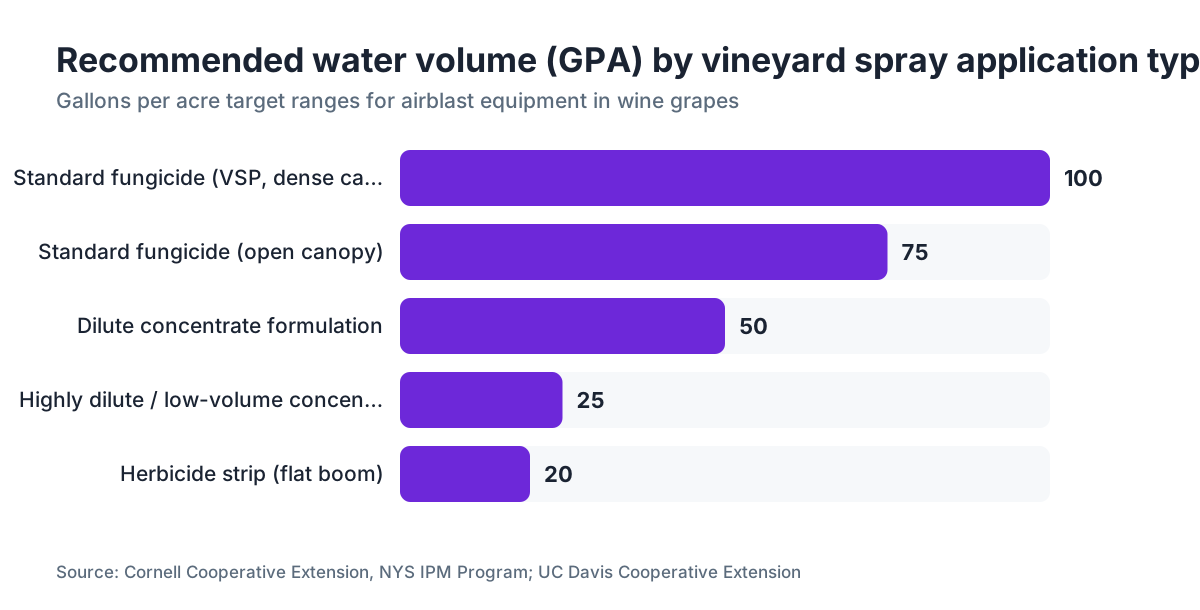
For airblast sprayers in wine grapes, Cornell Cooperative Extension guidelines suggest 50 to 100 gallons per acre (GPA) for most fungicide programs, dropping as low as 20 GPA for highly dilute concentrate materials [2]. A 10-acre-per-day job at 75 GPA needs 750 gallons of finished spray, which a 200-gallon tank handles in four fills. A 300-gallon tank cuts that to three.
Pump output is the second constraint. A typical diaphragm or centrifugal pump for this class delivers 10 to 30 GPM at working pressure (100 to 250 psi for diaphragm pumps, 25 to 80 psi for centrifugal units). At 15 GPM and 3 mph in a 6-foot row spacing, you're putting out roughly 74 GPA, right on the Cornell range. Speed up to 4.5 mph and that same flow drops to about 49 GPA. The UC Davis Cooperative Extension calibration formula runs on exactly this relationship: GPA = (GPM x 5,940) / (mph x row spacing in inches) [3].
Tractor horsepower caps how big a fan and pump you can drive. Rough rule: a mid-sized airblast tower (20 to 24 inch fan) needs 25 to 40 PTO hp to run right. Undersize the tractor and the fan never reaches rated RPM, airblast coverage falls off, and you get uneven penetration on dense training systems like VSP carrying heavy shoot growth.
| Operation size | Suggested tank (gal) | Typical PTO hp needed | Refills per 10-acre day at 75 GPA |
|---|---|---|---|
| 5 to 15 acres | 100 to 150 | 25 to 35 | 5 to 8 |
| 15 to 40 acres | 200 to 300 | 35 to 50 | 3 to 4 |
| 40 to 80 acres | 300 to 500 | 50 to 75 | 2 to 3 |
| 80+ acres | 500+ or pull-behind | 75+ | Consider pull-behind |
Airblast vs. tower boom: which design works better in vineyards?
Two designs dominate 3-point vineyard sprayers: the traditional radial airblast (also called axial-fan or turbine) and the tower or cannon boom. Both chase the same goal, canopy penetration, by different routes. Pick the wrong one for your trellis and you pay in coverage.
A radial airblast sprayer sits a high-volume fan at the rear of the unit. Air blows outward through deflector stacks, carrying atomized droplets from nozzles on the stack. This design forgives canopy variation and does well on gobelet-trained or high-cordon systems where the canopy is wide and irregular. The catch is drift. Run the fan with half-full stacks or let the wind pick up and it throws spray a long way. Washington State University Extension research on airblast drift found that under adverse conditions (winds above 10 mph, temperature inversions), detectable deposits landed 100 meters or more from the treated area [4].
Tower boom sprayers stack nozzles vertically on a rigid frame on each side. Many use a smaller fan to help droplets in rather than to carry them the whole way. They put spray where the nozzles aim, which cuts drift and evens out distribution in VSP (vertical shoot positioning), Lyre, and GDC systems where the canopy holds a predictable shape. The tradeoff: they're weaker on irregular or tall canopies and harder to tune as shoot growth thickens the canopy through the season.
Some makers now sell combination units with a centered fan and adjustable nozzle arcs, giving you a bit of both. They cost more, usually $4,000 to $8,000 above a basic airblast unit of the same tank size, and every added part is another maintenance point. For most operations under 30 acres in VSP wine grapes, a tower boom with a 15 to 18-inch assist fan is the better buy. For mixed plantings or older head-trained blocks, the radial airblast adapts better.
How do I calibrate a 3-point hitch sprayer for accurate application rates?
Calibration is the step that separates real vineyard management from guessing, and it takes under an hour once the process is routine. The UC Davis Cooperative Extension calibration procedure is the standard reference for California [3]. Skip it and every number in your spray program is a hope, not a fact.
Start with ground speed. Measure it in your own vineyard, at the gear and throttle you'll actually spray with. Don't trust the tractor's speedometer. Mark off 100 feet in the row, time the pass, run it three times, and average. Convert feet per minute to mph: mph = (feet per minute x 60) / 5,280.
Next, catch nozzle output. With the sprayer at operating pressure (set the pressure before you go to the field), collect output from each nozzle for 30 seconds into a graduated container. Record GPM per nozzle and average them. More than 10 percent spread between nozzles means a clogged, worn, or wrong-sized tip is hiding in there.
Then run the numbers: GPA = (GPM per nozzle x 5,940) / (mph x row spacing in inches). If the label says 50 GPA and you're hitting 80, slow the pump if it's variable, drop to a smaller orifice tip, or pick up ground speed. Never go over label rate. That's more than agronomy, it's law under FIFRA [5].
Calibrate at least three times a season: before the first spray, mid-season once wear sets in, and after any nozzle swap. Output climbs as tips wear. A tip pushing 15 percent over rated flow means you're overapplying every product, burning input money, and setting up a possible residue violation.
Log calibration data next to each application record in a system like VitiScribe and you've got a defensible paper trail if a drift complaint or residue question shows up later. That link between field data and compliance documents is what a state ag department audit tends to hammer on.
What nozzle types work best for vineyard sprayers?
Nozzle selection sets droplet size, and droplet size sets both coverage and drift. It's one of the most consequential calls in a spray program and one of the most ignored. Get it wrong and no amount of tractor horsepower saves the pass.
For vineyard fungicide work, hollow-cone nozzles (Teejet TX or D series, for example) make small to medium droplets (100 to 250 microns VMD) that wrap leaf surfaces and push into dense canopies. They're the classic choice for powdery mildew and botrytis programs where you have to hit leaf undersides. Small droplets drift further, though, so they need calm-wind windows.
Flat-fan nozzles don't do canopy penetration well in most vineyard cases. They lean on boom height and pressure to build a flat pattern, not on canopy-wrapping airflow. You'll see them on the vineyard floor for herbicide strips, rarely on foliar disease work.
Air-induction (twin-fluid or venturi) nozzles throw much larger droplets (300 to 600 microns) that resist drift hard. Some California counties with airblast drift concerns near sensitive sites are starting to push for them. UC Cooperative Extension research found air-induction tips cut drift by 50 to 90 percent versus standard hollow-cone tips at equal application rates, though penetration in dense VSP canopies slipped somewhat [6]. Fine for herbicide and late-season work when the canopy is open. Be careful using them for early-season fungicide when the canopy is thick and small-droplet coverage is what you actually need.
Material matters too. Stainless steel tips last longest and cost $5 to $15 each. Ceramic runs nearly as durable at $4 to $10 each. Plastic is cheap ($0.50 to $2 each) and wears out in a single heavy season. On a 16-nozzle tower boom, replacing plastic tips mid-season quietly eats the upfront savings.
Check output against manufacturer ratings every 10 to 15 hours of use. Teejet publishes wear tables for their nozzle lines showing hours of use against percent output increase [7].
What are the PTO safety requirements for a 3-point sprayer?
The PTO shaft between tractor and pump is the most dangerous part on the machine. The OSHA agricultural standard at 29 CFR 1928.57 requires all PTO drive components to have an integral master shield and any PTO-driven implement to be properly guarded [8]. On the worker side, EPA's Worker Protection Standard at 40 CFR Part 170 keeps workers out of the treated area during application and requires handlers to wear the PPE named on the pesticide label [9].
Every 3-point sprayer ships with a PTO guard. Guards come off for maintenance and sometimes never go back on. That's a citation waiting to happen, and worse, an entanglement waiting to happen. A bare shaft at 540 RPM wraps loose clothing in under one turn. Check the guard before every day of spraying.
Coupling and uncoupling the PTO: engine off, PTO disengaged, wait for the shaft to stop dead. Obvious, sure. It goes wrong when someone's rushing at the end of a long spray day. Post a laminated reminder on the tractor.
Shaft length is the other one people miss. When the hydraulics raise the 3-point hitch, the shaft angle changes. Too short and it can pull apart under extension. Too long and it can jam into the tractor body under compression. ASABE standard S203 covers driveline compatibility, and most sprayer makers publish minimum and maximum lift arm heights for their units [1]. Match those before you buy, not after the shaft grenades.
What does a 3-point hitch vineyard sprayer cost, new and used?
Prices swing wide, driven by tank size, pump type, and whether it's an airblast unit or a tower boom. Here's the honest lay of the land.
New entry-level 3-point airblast units with 100 to 150-gallon tanks start around $3,500 to $6,000 from makers like Rears and smaller fabricators. Mid-range tower boom units with 200 to 300-gallon tanks and diaphragm pumps run $8,000 to $18,000. High-end precision units with variable nozzle control, electronic pressure regulation, and GPS compatibility reach $25,000 to $45,000 and up.
Used pricing is harder to pin. A 10-year-old 200-gallon airblast unit in working shape might go for $2,000 to $5,000 at auction or through a dealer. The risks on used are nozzle wear, pump diaphragm condition, and tank integrity. A single blown diaphragm on a Bertolini or AR pump runs $150 to $400 to replace, which is fine. A cracked fiberglass tank on an old unit is often a write-off.
Annual maintenance on a new unit runs $300 to $800 a year in a typical vineyard: nozzle sets ($80 to $200), pump oil changes ($20 to $40), diaphragm inspection or replacement ($100 to $300), plus hose checks and filter cleaning. Budget separately for pressure gauges ($15 to $50 each), because vibration kills them fast.
One honest opinion. Don't buy the cheapest new unit if you're spraying more than 20 acres. The $3,500 machines use centrifugal pumps that can't hold pressure on hillside terrain and cheap agitation that lets product settle over a long spray day. A diaphragm pump unit at $10,000 to $12,000 outlasts two of the cheap ones and calibrates more reliably. You pay once instead of twice.
How does a 3-point sprayer affect EPA Worker Protection Standard compliance?
The EPA Worker Protection Standard (WPS), revised heavily in 2015 and codified at 40 CFR Part 170, applies to any agricultural establishment that produces agricultural plants and uses pesticides [9]. Hire workers or handlers and WPS compliance stops being optional.
For sprayer operators, the core WPS duties are three. The handler needs WPS safety training for their role. The handler must have and use every piece of PPE the label lists. And the employer has to supply decontamination supplies (water, soap, towels) at or next to the treated area. EPA's WPS guidance states that "handlers must follow all pesticide label directions, including required personal protective equipment" [9].
Application exclusion zones (AEZ), added in the 2015 revision, keep workers and other non-handlers out of a zone 25 to 100 feet from the point of discharge, depending on application method and whether it's outdoors. For airblast in a vineyard row, the AEZ runs laterally from the equipment. That's a real operational limit: you can't run a crew doing canopy work in an adjacent row while the sprayer is going.
Spray records under WPS have to carry product name, EPA registration number, active ingredient, total amount applied, application site, date, and the name of the certified applicator or licensed handler. Keep them two years and have them ready for inspection [9]. Washington State's pesticide rules (WAC 16-228) stack more recordkeeping on top for commercial applicators in that state [10].
A vineyard running 20-plus applications a season throws off hundreds of data points that all have to be retrievable. Paper binders work until they get soaked or lost. Software built for vineyard compliance like VitiScribe keeps the records searchable and audit-ready, which is the whole game when an inspector shows up.
What tractor horsepower and hitch category do I need?
Matching tractor to sprayer is two problems: hitch category (does it physically fit) and PTO horsepower (can it actually drive the thing). Get either wrong and the sprayer either won't mount or won't perform.
Hitch categories follow ASABE S217 [1]. Category I (7/8-inch lower pins, 7/8-inch top link pin) is rated for implements up to about 2,000 lbs and tractors 20 to 45 PTO hp. Category II (1-1/8-inch lower pins, 1-inch top link) handles implements to about 3,500 lbs and tractors 40 to 100 PTO hp. A full 300-gallon tank of water weighs about 2,500 lbs before you add the frame, pump, and fan, so a 100-gallon-plus unit on a Category I hitch is at or past the rated limit. Check the sprayer maker's published weight and the tractor's three-point lift capacity at the hitch points, more than the category rating.
Required PTO horsepower tracks the fan size and pump combination. A rough breakdown:
| Sprayer type | Minimum PTO hp | Recommended PTO hp |
|---|---|---|
| 50-gal airblast, 16" fan | 15 | 20 to 25 |
| 100-150 gal airblast, 20" fan | 25 | 35 |
| 200-300 gal tower boom | 30 | 40 to 50 |
| 300-500 gal airblast, 26" fan | 50 | 65 to 75 |
An undersized tractor doesn't just cost coverage. It strains the transmission and hydraulics, wears the PTO clutch faster, and can make the tractor lug dangerously uphill in hillside blocks. If your tractor sits right at the minimum PTO rating for a sprayer, drop one size in tank capacity and make up the difference with more refill trips. Cheaper than a new transmission.
How do I reduce drift when using a 3-point vineyard sprayer?
Drift is an agronomic problem and a legal one at the same time. Pesticide drift onto a neighbor's property or a non-target crop is a FIFRA violation [5], and in California, Oregon, and Washington a drift complaint pulls in the state ag department with real money on the line.
The WSU Extension work on airblast drift names five factors you can control: nozzle type, operating pressure, air volume and direction, ground speed, and timing relative to wind [4]. Timing is the biggest lever most operations can pull without spending a dollar.
Spray early morning (before 8 a.m.) or in the evening once winds drop below 5 mph. Most regulatory guidance treats 10 mph as the hard ceiling for outdoor airblast application, but above 7 mph you're already losing meaningful spray off-target with standard hollow-cone nozzles. Nighttime temperature inversions can trap a spray plume and move it in odd directions, so late-night passes carry their own risk.
Shielded hoods or wrap-around deflectors that push airblast into the row instead of straight out the back cut off-row drift by 40 to 70 percent in WSU comparisons, at some cost to penetration on the outer rows [4]. Next to organic farms, schools, or houses, that coverage tradeoff is worth it.
For every block, note wind speed and direction in the application record. If a drift complaint lands 30 days later, a log showing 3 mph NW wind at 7 a.m. is your best defense. No log, no defense. It's that simple.
What maintenance schedule keeps a 3-point vineyard sprayer reliable?
A vineyard sprayer sits idle 8 to 10 months, then gets run hard through a 6 to 10-week season. That on-off cycle is rough on seals, filters, and agitation lines. A simple seasonal routine heads off most failures before they cost you a spray window.
Before the season: flush the tank with clean water, then run a tank cleaner (sodium carbonate solution or a proprietary cleaner) matched to last year's residue chemistry. Inspect the pump diaphragms and seals and replace anything cracked or hardened. Swap the inline strainer screen (usually 50 to 100 mesh for nozzle protection). Check every hose clamp and fitting for corrosion. Run the sprayer 20 minutes on clean water, then calibrate all nozzles against spec.
During the season: after every spray day, flush with clean water until it runs clear. For products with real residue concerns (certain EBDC fungicides, organophosphates), add an ammonia or detergent rinse per label. Check nozzle output every 10 hours. Watch for weeping fittings, pressure drop, or a change in agitation noise, all early signs of pump wear.
End of season: drain and rinse the tank fully. Fill with a 10 percent antifreeze solution if the unit will see freezing temperatures. Pull the nozzles and store them indoors. Fog the pump internals with light oil if the pump maker recommends it. Store the PTO shaft disconnected and lubricated.
Do not skip the end-of-season flush because you're tired and harvest is on. Dried pesticide residue in a tank can contaminate the first spray of the next season, and after several months it's close to impossible to get back out.
What records do I need to keep for vineyard pesticide applications?
Federal and state law both demand specific pesticide records, and California, Washington, Oregon, and New York each stack extra requirements on the federal baseline. Know which layers apply to you before an inspector explains them for you.
Under FIFRA and the WPS, every restricted-use pesticide (RUP) application must be recorded and kept two years [5]. Required data: product name, EPA registration number, total amount applied, crop treated, application date and location, and certified applicator information. General-use pesticides carry no federal record mandate on their own, but where WPS applies, a two-year record is required regardless of the pesticide's status.
California's pesticide use reporting (PUR) system, run by CDPR and county agricultural commissioners, requires monthly electronic reporting of every application, whatever the use classification [11]. California is the most demanding state here. The nearest comparable is Washington's commercial applicator reporting under WAC 16-228 [10].
A record that satisfies both federal WPS and California PUR should carry: date, start and end time, field or block ID, crop and growth stage, product name, EPA registration number, active ingredient(s) and percent, rate per acre and total used, total acres treated, application method and equipment, carrier volume (GPA), applicator name and certification number, wind speed and direction, temperature, and any calibration notes.
That's 15 to 18 fields per application. A 30-acre vineyard running 15 passes a season generates 450 to 540 entries. Paper works, but retrieval during an audit is the real test. Whatever system you run, the records have to be findable by date, by product name, and by field block.
For how a vineyard's spray records tie into wider compliance systems, the Cornell Cooperative Extension viticulture program publishes recordkeeping guides written for New York wine grape producers [2].
Frequently asked questions
Can I use a 3-point hitch sprayer on a compact utility tractor under 40 hp?
Yes, with limits. Compact tractors in the 25 to 40 PTO hp range handle Category I 3-point sprayers with tanks up to 100 to 150 gallons and fans up to 18 inches. Past those specs, the tractor won't drive the fan to rated RPM and coverage suffers. Check the sprayer maker's minimum PTO hp rating and the tractor's 3-point rated lift capacity before you buy.
How often should I replace nozzle tips on a vineyard sprayer?
Replace tips when output runs 10 percent or more over rated flow. That usually hits after 75 to 150 hours for plastic tips, 150 to 250 hours for stainless steel, and 200 to 350 hours for ceramic. Test output every 10 to 15 hours during the season by catching 30-second samples in a graduated container and comparing to the manufacturer's rated GPM at your operating pressure.
What's the difference between a diaphragm pump and a centrifugal pump on a vineyard sprayer?
Diaphragm pumps (piston-diaphragm or roller) hold consistent pressure across terrain changes and handle thick tank mixes better. They run at 100 to 300 psi and cost more ($400 to $1,200 for the pump alone) but apply more accurately. Centrifugal pumps are cheaper and simpler, but pressure drops noticeably on hillside passes. For any vineyard with slope, a diaphragm pump is the better investment.
Do I need a pesticide applicator license to spray my own vineyard?
For restricted-use pesticides (RUPs), yes. You need a private applicator certification from your state's department of agriculture even on land you own or lease. California's DPR, Washington's WSDA, and most other states run online or in-person testing. General-use pesticides don't require certification for the landowner, but WPS training is still required for any hired handlers. Check your state ag department for current rules.
What wind speed is too high to spray with an airblast vineyard sprayer?
Most extension guidance and many labels set 10 mph as the ceiling for outdoor airblast application. WSU Extension research found meaningful off-target drift above 7 mph with standard hollow-cone nozzles. Spray early morning when winds are calmest. Above 10 mph, stop and wait for better conditions. Any application in high wind risks a drift complaint and a possible FIFRA violation.
How do I clean a vineyard sprayer between products to avoid tank contamination?
Triple-rinse the tank, pump, and lines with clean water. Switching from herbicides to fungicides, add a detergent or activated charcoal rinse if the previous product was a hormone-type herbicide (2,4-D, dicamba). Run the rinse solution through all nozzles to flush the lines. Most cross-contamination comes from residue in the pump head and boom lines, not the tank, so never skip the flush-through step.
What is the application exclusion zone under the EPA Worker Protection Standard for a vineyard sprayer?
Under the 2015 WPS revision (40 CFR Part 170), outdoor airblast applications require a 100-foot application exclusion zone. Outdoor applications using equipment other than airblast require a 25-foot AEZ. No workers or non-handler persons may be in the AEZ while the sprayer runs. The AEZ applies in all directions from the point of discharge, including into adjacent rows and row ends.
How many gallons per acre should I apply with a vineyard sprayer?
Cornell Cooperative Extension recommends 50 to 100 gallons per acre (GPA) for most wine grape fungicide applications with airblast equipment, with lower rates (20 to 50 GPA) acceptable for highly dilute concentrate formulations. California often runs lower water volumes because drier conditions speed evaporation. Always check the label for minimum and maximum carrier volume, which overrides any general guideline.
Can a 3-point vineyard sprayer be used for herbicide applications between rows?
Yes, with strict care. Use a dedicated boom with shielded nozzles for herbicide to avoid contaminating the next fungicide pass. Many managers keep a separate low-volume boom for herbicides and reserve the main tower for foliar work. Triple-rinse after herbicide use, especially with any hormone-type product. Herbicide residue in an airblast sprayer later used for foliar work can cause severe vine damage.
What's the best spray timing in the growing season for disease control in vineyards?
The top windows are pre-bloom (shoots 3 to 6 inches), bloom to fruit set (the most important stretch for botrytis and powdery mildew), and berry touch (before the canopy closes around the cluster zone). UC Davis and Cornell both rank the bloom-to-fruit-set window as the single most important timing for Botrytis cinerea prevention. Miss it and no amount of later spraying fully makes up the difference.
How do I winterize a 3-point sprayer to prevent freeze damage?
Drain all water from the tank, pump, lines, and nozzle bodies. Run the pump briefly after draining to clear the pump head. Fill the tank with a 10 percent propylene glycol (food-grade antifreeze) solution and run it through the whole system, booms and nozzles included, then drain again. Store nozzle tips indoors. In an unheated building in a freeze-prone climate, leave drain valves open so trapped water can't crack fittings.
Are there GPS or precision application options for 3-point vineyard sprayers?
Yes, more common on newer tower-boom units than on traditional airblast designs. Section control systems (auto shutoff by GPS block) come as aftermarket retrofits starting around $2,500 to $5,000 plus installation. Full variable-rate systems tied to canopy sensors or NDVI maps run on high-end units ($15,000 to $25,000 add-on). For most operations under 50 acres, the return on precision electronics is thin compared to proper manual calibration.
What's the typical lifespan of a 3-point vineyard sprayer with proper maintenance?
A mid-grade unit with a diaphragm pump, stainless fittings, and a polyethylene tank, maintained and stored right, lasts 15 to 25 years. The pump is the main wear component; a rebuilt or replaced pump ($500 to $1,500 installed) buys a good frame another decade. Fiberglass tanks are more prone to UV breakdown and impact cracking than polyethylene. Frame and PTO components rarely fail if the sprayer stays dry in storage and the shaft is greased yearly.
Sources
- ASABE (American Society of Agricultural and Biological Engineers), Standards S217 and S203: Three-point hitch categories I and II are defined by ASABE standards based on pin dimensions and rated tractor horsepower ranges; PTO shaft driveline compatibility is addressed in ASABE S203
- Cornell Cooperative Extension, New York State IPM Program, Vineyard Spray Management: Cornell Cooperative Extension recommends 50 to 100 gallons per acre water volume for airblast fungicide applications in wine grapes
- UC Davis Cooperative Extension, Sprayer Calibration for Vineyard Applications: UC Davis publishes the calibration formula GPA = (GPM x 5,940) / (mph x row spacing in inches) for vineyard sprayer calibration
- Washington State University Extension, Airblast Sprayer Drift Management in Vineyards: WSU Extension research found detectable spray deposits 100 meters or more from treated areas under adverse conditions; shielded deflectors reduced off-row drift by 40 to 70 percent
- U.S. EPA, Federal Insecticide, Fungicide, and Rodenticide Act (FIFRA), 7 U.S.C. §136 et seq.: FIFRA requires pesticide applications not to exceed label rate; pesticide drift onto non-target areas is a federal violation under FIFRA
- UC Cooperative Extension, Air-Induction Nozzle Performance in Vineyard Applications: UC Cooperative Extension research found air-induction tips reduced drift by 50 to 90 percent compared to standard hollow-cone tips at equivalent application rates
- TeeJet Technologies, Nozzle Catalog and Wear Data: TeeJet publishes wear tables showing the relationship between hours of use and percent output increase for their nozzle product lines
- OSHA, 29 CFR 1928.57, Guarding of Farm Field Equipment, Farmstead Equipment, and Cotton Gins: OSHA 29 CFR 1928.57 requires PTO drive components to have integral master shields and PTO-driven implements to be properly guarded
- U.S. EPA, Worker Protection Standard (WPS), 40 CFR Part 170: EPA WPS at 40 CFR Part 170 requires handler PPE per label, application exclusion zones (25 to 100 feet outdoors), and two-year retention of application records; EPA states handlers must follow all pesticide label directions including required PPE
- Washington State Department of Agriculture, WAC 16-228, Pesticide Application and Recordkeeping Rules: Washington State WAC 16-228 adds recordkeeping requirements for commercial applicators beyond the federal baseline
- California Department of Pesticide Regulation (CDPR), Pesticide Use Reporting (PUR) Program: California's PUR system requires monthly electronic reporting of all pesticide applications to county agricultural commissioners regardless of pesticide classification
Last updated 2026-07-10