How to reconcile conflicting spray restrictions from different certification programs

TL;DR
- When certification programs conflict on spray restrictions, apply the most restrictive requirement across every program you carry.
- Map each active material against each program, find the strictest PHI, re-entry interval, and allowed-materials status, then write down your reasoning.
- Most conflicts resolve by elimination.
- The ones that don't usually mean dropping a material or changing your certification mix.
Why do certification programs conflict on spray restrictions at all?
Each certification body writes its own standards for its own audience. USDA National Organic Program (NOP) rules are federal law, written for a broad range of crop types and rooted in the Organic Foods Production Act of 1990 [1]. CCOF, Demeter, SIP (Sustainability in Practice), Lodi Rules, and Fish Friendly Farming all layer their own materials lists, timing restrictions, and documentation requirements on top of that federal baseline, or sometimes independent of it entirely.
The conflicts come in three forms. A material allowed under one program is prohibited under another. Copper sulfate is the classic case: NOP permits it with restrictions, but some Fish Friendly Farming watershed plans cap application rates below what NOP would technically allow, and some Demeter biodynamic standards restrict it further still. Second, pre-harvest intervals (PHIs) and restricted-entry intervals (REIs) differ. The EPA sets minimum PHIs and REIs under the Federal Insecticide, Fungicide, and Rodenticide Act (FIFRA) and the Worker Protection Standard (WPS) [2], but a certification program can legally impose a longer interval than the label, and some do. Third, record-keeping and notification rules vary. What counts as adequate documentation under NOP is not automatically enough for a retailer audit under a private sustainability program.
Small operators carrying two or three certifications at once, which is common in California's Central Coast and Washington's Columbia Valley, hit all three conflict types together. Nobody hands you a reconciled master list. You build it yourself.
What is the 'most restrictive requirement' rule and does it always apply?
The working principle in multi-certification compliance is simple: apply the most restrictive requirement across every program you carry. This is not a federal statute. It's practical logic backed by how certification contracts are written. Every agreement you sign says you'll meet that program's standards. If Program A allows a 7-day PHI and Program B requires 14 days for the same material, you observe 14 days to stay compliant with both.
Where it gets messier is when the conflict is binary rather than a matter of degree. If Program A permits a synthetic adjuvant and Program B prohibits all synthetics outright, there's no middle ground. You either drop the material or you accept that you can't hold both certifications on that operation. That's a business decision, not a paperwork fix.
One honest caveat. Some certification bodies allow deviation requests or variance processes. NOP's National Organic Standards Board (NOSB) reviews petitions for new materials [3], and some private programs have a similar waiver path. These processes are slow, sometimes taking years, and they won't help you with this season's spray program. Don't count on a variance to solve an active conflict.
How do you actually build a reconciled spray restrictions matrix?
Build a side-by-side matrix: one row per active material or material category you use or are considering, one column per certification you hold or want. For each cell, fill in (1) allowed or prohibited, (2) maximum application rate if restricted, (3) PHI, (4) REI, and (5) any specific conditions like buffer zones or notification requirements. Then add a final column for the EPA label requirement, because the label is the legal floor and you can never go below it no matter what any certification says [2].
Here's a simplified example for four common materials across three programs:
| Material | NOP status | SIP status | Lodi Rules status | EPA label PHI | Reconciled PHI |
|---|---|---|---|---|---|
| Copper hydroxide | Allowed, rate-restricted | Allowed, rate-restricted | Allowed, rate-restricted | 0 days | Use lowest rate allowed by any program |
| Sulfur | Allowed | Allowed | Allowed | 0 days | No conflict |
| Synthetic pyrethroid | Prohibited | Some allowed | Allowed with restrictions | Varies | Prohibited (NOP governs) |
| Kaolin clay | Allowed | Allowed | Allowed | 0 days | No conflict |
Build this matrix once at the start of each season, then update it whenever a program issues a materials list revision. That single habit prevents more mid-season compliance failures than anything else you can do. UC Davis Cooperative Extension publishes guidance on California-specific spray materials and their organic compliance status that helps you fill in the NOP column accurately [4].
For operations tracking multiple blocks under different certifications, vineyard record systems matter a lot, because the matrix has to be block-specific rather than farm-wide.
Which programs tend to conflict most often in practice?
NOP and Fish Friendly Farming conflict most often on copper. Fish Friendly Farming's watershed-level restrictions on copper runoff can cap your seasonal copper budget well below what NOP's material-by-material rules would allow. The North Coast Regional Water Quality Control Board has issued guidance affecting growers in the Napa and Sonoma watersheds specifically [5]. If you hold both certifications and farm near a watercourse, this is your highest-probability conflict point.
NOP and Demeter conflict on timing and materials for fermentation inputs, which matters less for spray programs but is relevant if you're certifying the winery side too. For field spray programs, the biggest Demeter-specific restriction is the prohibition on many mined minerals in forms NOP would allow, plus the requirement that biodynamic preparations be used, which adds application events you have to log.
SIP and Lodi Rules are both California sustainability programs, largely harmonized with each other by design, but their materials lists aren't identical and their audit triggers differ. Lodi Rules uses a point-based system across multiple categories [6], so a spray decision that costs you points in one category might be fine overall or might push you below a threshold. SIP runs on pass/fail criteria for specific practices. These two conflict less on what you can spray and more on what you have to document about why.
WSU Extension publishes side-by-side comparisons of Pacific Northwest sustainability certification requirements that show where programs diverge on spray materials [7].
How does the EPA Worker Protection Standard interact with certification program REIs?
The EPA's Agricultural Worker Protection Standard (WPS), revised with rules taking effect in 2017, sets minimum REIs for every registered pesticide and governs worker notification, training, and early-entry protections [2]. The WPS REI is a legal floor. No certification program can tell you it's acceptable to go below it.
Certification programs can set REIs longer than the WPS minimum, and sometimes do. When they do, you follow the longer interval. If a material has a 4-hour WPS REI but your organic program requires no re-entry until the next day for that material class, you observe the next-day requirement and document it as such.
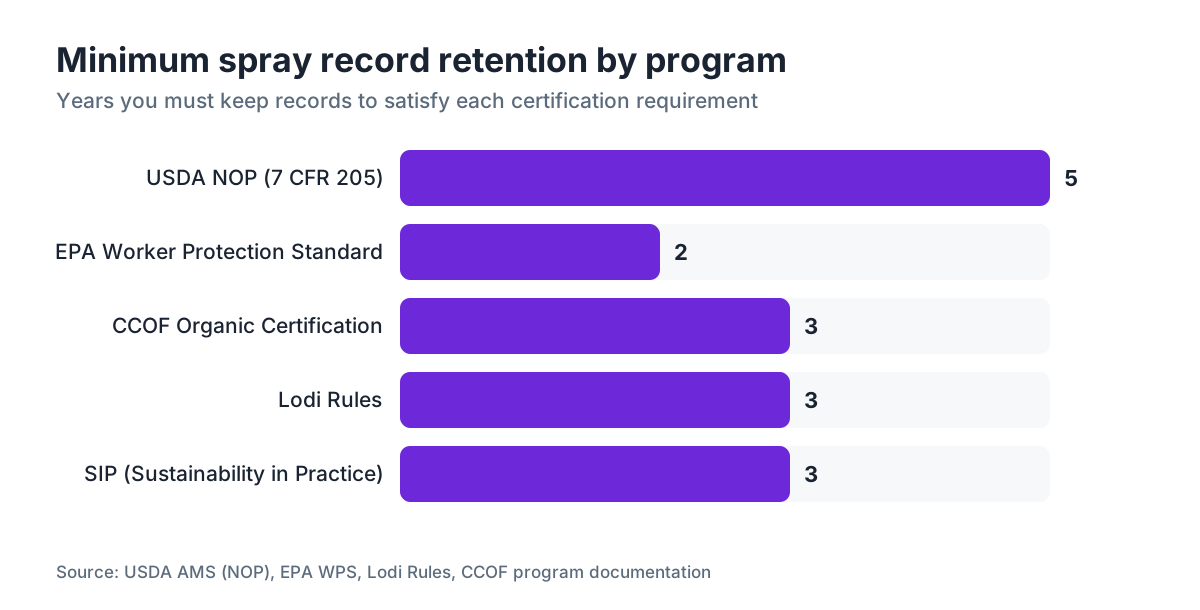
The WPS also requires you to post pesticide application information at a central location accessible to workers within 30 minutes of the start of application, and to keep records for two years [2]. Some certification auditors use WPS records as a proxy for spray record quality. A well-kept WPS notification log partially satisfies the spray-event documentation requirement for several programs at once. Cornell Cooperative Extension's pesticide safety resources cover what a legally sufficient WPS record looks like [8].
What do you do when the material you need is prohibited by one program but nothing else works?
This is the hardest case, and it shows up most with disease pressure spikes. Botrytis in a wet harvest season is the classic example. You have a material that's effective and legal under most of your certifications but prohibited by one.
Your options, ranked by how often they actually solve the problem:
First, verify the prohibition is real and current. Materials lists change. Call the certification body directly instead of trusting last year's list. A 10-minute phone call has saved plenty of growers from a false conflict.
Second, check whether the prohibition applies to your specific situation. Some programs prohibit a material generally but allow it for specific use cases with prior approval. Document that you asked.
Third, honestly weigh the cost of a one-season certification suspension. Some certification bodies allow a temporary suspension for a specific block if you notify them in advance, document the necessity, and agree to a re-certification inspection. This isn't universal and it has business consequences, especially if the certification affects your grape contract price. But it's a real option.
Fourth, accept the yield or quality consequence of not spraying. That's often less catastrophic than it feels in the moment, and with block-level records you can at least quantify the tradeoff for next time.
What you should never do is spray a prohibited material and leave it off your records. Auditors request purchase invoices, applicator logs, and spray records going back two to three years. The inconsistencies surface.
How should you document your reconciliation decisions to survive a certification audit?
A reconciled matrix in a spreadsheet is fine for planning, but it isn't sufficient audit documentation on its own. What auditors want to see is a record that connects each spray event to a decision, more than proof that an application happened.
For each application, your spray record should show date and time, material and formulation, EPA registration number, application rate, total volume applied, block or unit treated, operator, equipment calibration date, reason for the application (pest or disease target, threshold trigger if you use an IPM threshold), and which certification program's materials list governs that block. That last field is easy to skip, and it's the one that makes a multi-certification spray record defensible.
If you chose a material specifically because of a cross-program conflict, a one-line note explaining the constraint is worth its weight in audit outcomes. Something as plain as "kaolin chosen over [alternative] because [alternative] is prohibited under CCOF certification for this block" tells the auditor you understand the rules and applied them on purpose.
VitiScribe's record-keeping tools are built around exactly this kind of block-level, program-tagged spray documentation, so you can generate audit-ready reports without rebuilding records from field notes at the last minute.
The NOP requires organic operation records to be kept for five years [1]. Some private programs require only two or three. Keep everything for five years and you cover the most demanding standard by default.
Do PHIs from certification programs override the EPA label PHI?
No, and the direction matters. The EPA label PHI is the legal minimum and you can never go below it, period. Under FIFRA, the label is the law [2]. Certification programs can only impose longer PHIs, never shorter ones.
In practice, most materials used in winegrape production carry a 0-day or very short EPA label PHI, so this conflict is less common than the materials-allowed conflict. Sulfur, copper, and most biologically based materials have short or zero PHIs. The cases where a certification program's longer PHI creates a real operational constraint tend to involve late-season applications for harvest diseases, where timing is already tight.
One place PHI confusion runs high: some growers conflate the PHI with the WPS REI. They measure different risks. The PHI is about residue on the harvested grape. The REI is about worker safety in the treated area. A material can have a 0-day PHI and a 24-hour REI at the same time. Both apply independently.
Can you hold USDA Organic and a private sustainability certification at the same time?
Yes, and many California and Pacific Northwest vineyards do exactly this. NOP certification is federal and its prohibited materials list is non-negotiable under the Organic Foods Production Act [1]. Any private sustainability program running alongside NOP has to be satisfied with materials NOP already allows, or it has to restrict you further.
SIP and Lodi Rules were both designed with NOP compatibility in mind, so the overlap works reasonably well. The friction points are the documentation load (more programs mean more record sets) and the rare cases where a private program allows something NOP prohibits, which creates a temptation you have to actively manage.
Demeter biodynamic certification alongside NOP is common in premium wine regions. Demeter's Biodynamic Farm Standard requires NOP organic certification as a baseline, so there's no fundamental conflict, but Demeter adds its own material restrictions and practice requirements that go further than NOP in some areas [9].
Carrying three or more certifications at once is where audit fatigue becomes a real operational cost. The administrative burden scales with the number of certifications, not the area farmed. That cost is real, and worth weighing against the premium the certifications command in your market.
What's the fastest way to identify a conflict before spray season starts?
Pull each certification's current materials list or approved inputs list in January or February, before you finalize your spray program. Most bodies publish these annually. NOP's National List of Allowed and Prohibited Substances is codified at 7 CFR Part 205 [1] and updated through NOSB petitions. CCOF publishes a materials database. Lodi Rules publishes its approved practices workbook [6]. Fish Friendly Farming and SIP both have grower handbooks with spray guidance.
Set them next to your planned spray program and go material by material. It takes two or three hours the first time, maybe 45 minutes in later years once you have a baseline matrix. That's cheap compared to discovering a conflict after you've already ordered product.
If you're doing this for the first time or adding a new certification, ask the certifying agent for a pre-certification inspection or a pre-season materials review. Most agents will do this, and it's one of the more useful services they provide. Cornell's extension viticulture resources include guidance on preparing for organic certification that applies broadly to this kind of pre-season prep [8].
Are there resources that already reconcile common certification conflicts for vineyards?
A few, though none covers everything. UC Davis Cooperative Extension's Statewide Integrated Pest Management Program publishes pest management guidelines for wine grapes that note NOP compatibility for listed materials [4]. They're updated periodically and free online. They don't cover every private certification, but the NOP column is reliable.
WSU Extension's organic viticulture resources cover Pacific Northwest-specific programs and offer practical guidance on materials decisions under multiple certification scenarios [7]. Cornell Cooperative Extension covers the Northeast and has resources on organic grape production that hold up even outside their region for the underlying compliance logic [8].
For California sustainability programs specifically, the Lodi Winegrape Commission publishes its workbook and technical notes for Lodi Rules, the most thoroughly documented of the private programs [6]. CCOF maintains a searchable materials database members can use to check status before purchasing [11].
The USDA's Agricultural Marketing Service, which oversees NOP, publishes the full regulatory text and an FAQ covering common operator questions about the National List [3]. These are the primary sources. Third-party summaries are convenient, but they can lag behind updates to the underlying rules, so verify against the primary source when you're making a real decision.
What should you do when a certifier and a PCO or County Ag Commissioner disagree?
This is a different kind of conflict, and it needs a different framework. County Agricultural Commissioners enforce state pesticide use requirements and California Department of Pesticide Regulation (CDPR) rules in California, or their state equivalents elsewhere. Those are regulatory requirements with legal enforcement behind them. Certification body requirements are contractual. When they conflict, the government regulatory requirement governs, full stop.
If a County Ag Commissioner's pest control requirements in a quarantine situation, like a glassy-winged sharpshooter treatment program, call for a material your certification prohibits, you apply the material. Regulatory compliance isn't optional. What you do immediately is notify your certification body in writing, document the regulatory requirement that compelled the application, and ask about your options for keeping certification status. Some certifiers have emergency protocols for exactly this.
VitiScribe's documentation tools generate the timestamped, program-tagged records that help you show a certifier a non-compliant application was the result of a regulatory mandate, not a voluntary choice. That distinction matters in certification appeals.
The California Department of Food and Agriculture's organic program office is the state-level NOP authority and has handled these situations before. Contact them if you're in California and facing a regulatory-versus-certification conflict [10].
Frequently asked questions
If NOP prohibits a material that my sustainability certification allows, which one wins?
NOP wins. It's federal law under the Organic Foods Production Act of 1990. If you hold USDA Organic certification, you cannot use a prohibited material regardless of what any private program says. Private sustainability certifications can be more restrictive than NOP but cannot override it. If the private program allows something NOP prohibits, your choice is to not use the material or to give up one of the certifications.
How often do certification bodies update their allowed materials lists?
NOP updates its National List through NOSB petition cycles, which run continuously but produce regulatory changes on a multi-year timeline. CCOF, Lodi Rules, and SIP typically publish annual updates to their materials guidance, usually in late fall or early winter before the next spray season. Fish Friendly Farming guidance can change when watershed-level regulations shift. Pull current lists at the start of each season rather than relying on prior-year documents.
Can a certifier suspend a block's certification for a single season without affecting the whole farm?
Some can, but it depends entirely on the certification body's rules and your agreement with them. NOP allows split operations, meaning certified and non-certified land can coexist on one farm with proper record-keeping and buffer management. Private certifiers vary. You must notify the certifier before the application, not after, and document the necessity. Applying a prohibited material without notification is a different situation and typically triggers a full certification review.
What does a defensible multi-program spray record look like?
It should show date, material, EPA registration number, rate, total volume, block ID, operator name, equipment used, pest or disease target, and a field for which certification program governs that block. If you chose a material to satisfy a specific program's restriction, note that reason explicitly. NOP requires five-year retention of records. Keep everything for five years to satisfy the most demanding program you carry.
Does the EPA Worker Protection Standard REI always override the certification program REI?
No, the WPS REI is the floor, not the ceiling. Certification programs can require longer re-entry intervals than the EPA label specifies, and when they do, you follow the longer one. You can never go below the WPS REI regardless of what any certification says. A material with a 4-hour WPS REI might require next-day re-entry under a specific certification program; both requirements coexist and you follow whichever is more restrictive.
Are buffer zone requirements from certification programs enforceable the same way CDPR requirements are?
No. Certification program buffer zones are contractual requirements enforced through audit and certification status. CDPR and county agricultural commissioner buffer requirements are regulatory and carry legal penalties. When they differ, follow the regulatory requirement and document any gap relative to your certification standard. Then notify your certifier. In most cases, complying with the more restrictive regulatory buffer also satisfies the certification requirement.
How do I handle a conflict if my PCO requires a treatment the certification prohibits?
Apply the treatment. Regulatory requirements from a Pest Control Officer or county commissioner take precedence over contractual certification requirements. Immediately document the regulatory mandate in writing, notify your certification body before or as soon as possible after the application, and ask about emergency or variance procedures. Keep copies of all government correspondence. Many certifiers have seen this situation and have a defined path for maintaining certification through a compelled non-compliant application.
Is kaolin clay compatible with USDA Organic and most sustainability programs?
Yes, kaolin clay (commercially known as Surround) is allowed under NOP's National List and is generally compatible with SIP, Lodi Rules, CCOF, and most other sustainability programs. It has a 0-day PHI on the EPA label. Always verify against the current materials list for each program you hold, since program rules can change, but kaolin is one of the lower-conflict materials in the vineyard spray toolkit.
What's the best way to handle copper use when holding multiple certifications with different rate caps?
Apply the lowest maximum rate imposed by any program you hold and document the reason. NOP restricts copper to avoid soil accumulation and requires a plan, but doesn't set a single numerical cap at the federal level. Watershed-level programs like Fish Friendly Farming may impose site-specific seasonal caps. Sum your copper applications across the season against every program's limit and track the running total. UC Davis IPM guidelines offer baseline rates for disease management that are useful starting points.
Does Demeter biodynamic certification conflict often with NOP?
Not as a direct conflict, because Demeter requires NOP organic certification as a prerequisite. Demeter layers on top of NOP. The friction comes from Demeter's additional material restrictions and its requirements for biodynamic preparations, which add application events. Some materials allowed under NOP are restricted by Demeter's Farm Standard. Review the current Demeter Biodynamic Farm Standard alongside your NOP materials list annually to find where Demeter is the binding constraint.
How does Lodi Rules' point-based scoring interact with materials restrictions from other programs?
Lodi Rules uses a points-based workbook across categories including pest management, so a spray decision that costs you points doesn't automatically fail your certification. It depends on your total score across all categories. However, if a material is also prohibited by NOP and you hold that certification, the NOP prohibition overrides any scoring flexibility Lodi Rules might allow. The two programs evaluate compliance differently; always apply the binding prohibition from the more restrictive program.
Can a certification body require records beyond what WPS or NOP already require?
Yes. Private certification programs can require more documentation than federal or state minimums. SIP and Fish Friendly Farming, for example, may require documentation of decision-making processes, IPM threshold observations, or equipment calibration records that go beyond what WPS or NOP mandate. The practical response is to design your record-keeping system around the most demanding program you carry, which usually means capturing more fields per spray event than any single program requires.
Where can I find an up-to-date list of NOP-allowed materials for winegrapes?
The primary source is 7 CFR Part 205, Subpart G, the National List of Allowed and Prohibited Substances, published by USDA AMS. UC Davis Cooperative Extension's Statewide IPM Program publishes pest management guidelines for wine grapes that note NOP compatibility for listed materials and are updated periodically. CCOF also maintains a searchable materials database for its members. Always cross-reference the UC Davis guidelines against the current NOP regulatory text for anything borderline.
Sources
- USDA AMS, National Organic Program, 7 CFR Part 205: NOP rules are federal law under the Organic Foods Production Act of 1990; the National List of Allowed and Prohibited Substances is codified at 7 CFR Part 205; records must be maintained for five years
- EPA, Agricultural Worker Protection Standard (WPS): WPS sets minimum REIs for every registered pesticide; the label is the law under FIFRA; records must be posted within 30 minutes of application and maintained for two years
- USDA AMS, National Organic Standards Board (NOSB): NOSB reviews petitions for new materials to the National List through a formal petition process
- UC Davis Statewide IPM Program, Grape Pest Management Guidelines: UC Davis Cooperative Extension publishes pest management guidelines for wine grapes noting NOP compatibility for listed materials
- California State Water Resources Control Board, Regional Water Quality Control Boards: The North Coast Regional Water Quality Control Board has issued guidance affecting copper use for growers in the Napa and Sonoma watersheds
- Lodi Winegrape Commission, Lodi Rules Certified Sustainable Winegrowing: Lodi Rules uses a point-based scoring system across multiple categories including pest management; its approved practices workbook is published annually
- Cornell Cooperative Extension, Pesticide Safety Education Program: Cornell Cooperative Extension covers legally sufficient WPS record-keeping and organic grape production compliance
- Demeter USA, Biodynamic Farm Standard: Demeter biodynamic certification requires USDA NOP organic certification as a baseline and adds its own material restrictions and biodynamic preparation requirements
- California Department of Food and Agriculture, Organic Program: CDFA's organic program office is the state-level NOP authority in California and handles regulatory-versus-certification conflict situations
- CCOF, Organic Certification and Materials Database: CCOF maintains a searchable materials database for members to verify NOP compatibility before purchasing inputs
Last updated 2026-07-10