How to document a delayed spray due to bee activity restrictions

TL;DR
- When you delay a pesticide application because bees are foraging or a beekeeper notified you, write it down the same day: record the original application date, the reason for delay, who made the call, and the new application window.
- That entry protects you under FIFRA label law, EPA Worker Protection Standard, and most state pesticide registration acts.
Why does documenting a bee-related spray delay matter legally?
A pesticide label is a federal legal document. Under FIFRA Section 12(a)(2)(G), using a pesticide in a manner inconsistent with its labeling is a federal violation [1]. Most insecticides and many fungicides now carry bee precautionary language, and that language often includes timing restrictions tied to active foraging. Skip the application because bees are working the block and fail to write it down, and you have no paper trail showing you complied with the label rather than just forgot.
State pesticide enforcement agencies can audit your records at any time, and the audit window varies by state. California requires pesticide use reports for agricultural operations to be filed with the county agricultural commissioner within seven days of application, or of a scheduled treatment that didn't happen [2]. Other western states follow similar monthly or weekly reporting cycles. A documented delay with a clear reason is almost always viewed more favorably than a gap in the record with no explanation.
There's a real liability angle too. If a neighboring beekeeper loses a colony and points to your operation, a contemporaneous log entry showing that you held the application until bees had cleared is hard evidence. An absence of any record is an open invitation to dispute. Write it down.
What information must a bee-activity delay entry actually contain?
There's no single federal template for a bee-delay entry, but you can reverse-engineer the requirements from the documents that reference them. The EPA's Agricultural Worker Protection Standard (WPS), 40 CFR Part 170, requires that pesticide application records include the product name, EPA registration number, active ingredient(s), application date, location, and rate applied [3]. When the application doesn't happen on schedule, you capture the same information plus the reason it didn't.
At minimum, a bee-activity delay entry should include:
- Planned application date and time window
- Block or field identifier (GPS coordinates or your internal block numbering)
- Product name and EPA registration number
- Application method you planned to use (airblast, boom, backpack)
- Reason for delay (observed bee foraging, beekeeper notification, pre-application scouting result, or label timing restriction)
- Name of the person who made the delay decision
- Actual rescheduled date and time
- Conditions at the time the decision was made (temperature, bloom stage, time of day)
If a registered beekeeper contacted you in advance under a state apiary notification program, note the beekeeper's name, hive registration number if available, and the date and method of communication. That detail matters if a colony-damage claim ever gets filed against you.
Bloom stage is worth capturing even if your label doesn't require it. Cornell's Integrated Pest Management program notes that bee exposure risk during bloom is dramatically higher than at other growth stages, and documenting phenological stage contextualizes your decision for anyone reviewing the record later [4].
What do common pesticide label bee precautions actually require?
Label language varies by product but follows a few standard EPA-required formats. The most common tier you'll see on vineyard materials is the "Bee Caution" box, which reads something like: "This product is toxic to bees exposed to direct treatment or to residues on blooming crops. Do not apply this product while bees are actively foraging. Do not apply this product to plants that are in bloom if bees are visiting the treatment area" [5].
The EPA has published a standardized set of bee precautionary language for pesticide labels. Products that meet the threshold for acute bee toxicity (either contact LC50 or oral LD50 thresholds) must carry language from one of three tiers: prohibit application when bees are foraging, prohibit application to plants in bloom when bees are visiting, or broader notification requirements. Your label tells you which tier applies to the specific product.
Some products, particularly certain systemic fungicides and sulfur materials common in winegrape programs, carry no bee restriction at all. Others, particularly carbamates, organophosphates, and many neonicotinoids, carry the strictest language. Knowing which tier governs your product before you write the delay entry lets you cite the exact label language in your record rather than a generic "bee concern."
| Pesticide class | Typical label bee restriction tier | Delay trigger |
|---|---|---|
| Neonicotinoids (imidacloprid, thiamethoxam) | Tier 1: prohibit when bees foraging | Any observed bee activity at time of application |
| Organophosphates (chlorpyrifos, now largely banned on grapes) | Tier 1 or Tier 2 | Foraging bees present |
| Carbamates (carbaryl) | Tier 1 | Foraging bees present |
| Pyrethroids | Tier 2 | Bees actively visiting blooming plants |
| Most sulfur fungicides | No bee restriction | N/A |
| Some SDHI fungicides | Tier 2 or none | Check individual label |
This table reflects general patterns, not specific product approvals. Always read the actual label.
How do state apiary notification programs affect your records?
Roughly 20 states now operate formal apiary notification programs that require pesticide applicators to contact registered beekeepers before applying certain products near hives [6]. California's program, administered through county agricultural commissioners, requires applicators to contact beekeepers within a set radius (typically one to two miles depending on county) before applying Tier 1 pesticides during bloom. Washington State runs a similar program through the state Department of Agriculture.
When you receive a notification from a beekeeper, or when the beekeeper's notification triggers a timing adjustment, that communication becomes part of your compliance record. Log the date you received the notification, how it came in (phone, email, FieldWatch or DriftWatch alert), and what the beekeeper requested. If their hive registration is listed on the notification, include it.
FieldWatch (fieldwatch.com) is the major third-party registry used in many states where beekeepers and specialty crop growers register locations and receive alerts. If you're opted into FieldWatch and a notification comes through that platform, download and attach the alert email or screenshot to your field record for that block. A digital timestamp on a FieldWatch notification is stronger documentation than a handwritten note that you spoke with someone.
WSU Extension has published guidance noting that beekeepers and applicators who communicate proactively before bloom have significantly fewer colony-damage disputes than those who don't [7]. The documentation habit and the communication habit reinforce each other.
What does a completed bee-delay record entry look like in practice?
Here's a concrete example of what a well-written entry looks like in a paper spray log or digital record:
Date of planned application: June 14, 2025
Block: North Block, Rows 1-42 (Block ID: NB-01)
Product: [Product Name], EPA Reg. No. [XXXXX-XXX]
Active ingredient: [AI name]
Planned rate: [X oz/100 gal]
Application method: Airblast sprayer
Application status: DELAYED
Reason: Active bee foraging observed at 7:15 AM during pre-application scouting. Honeybee and native bee activity present on cover crop in bloom between rows. Label (see attached) requires no application while bees are actively foraging.
Decision made by: [Your name], [title]
Bloom stage at time of decision: BBCH 65 (full bloom, >50% caps fallen)
Rescheduled application window: Evening of June 15, after 8:00 PM, with confirmation that cover crop will be mowed before application.
Beekeeper notification: Received FieldWatch alert June 12, 2025 from [Beekeeper Name], Hive Reg. [XXXXX]. Alert acknowledged and foraging schedule confirmed via phone June 13.
This entry is complete, internally consistent, and references the label rather than a vague rule. Notice that it also documents what you're going to do to address the bee risk before the rescheduled application, which shows a good-faith compliance posture.
For anyone managing multiple blocks and products across a season, keeping all of this in one place is the hard part. A purpose-built vineyard compliance platform like VitiScribe lets you attach label PDFs, log delay reasons against a specific application event, and export the record in a format county ag commissioners can actually read. That said, a well-organized paper log works fine too. The content matters more than the format.
When should the entry be written, and how long do you keep it?
Write the entry the same day you make the decision. Memory fades fast and the regulatory standard in most states is a contemporaneous record. California specifically requires pesticide use reports to be submitted to the county agricultural commissioner no later than the seventh day after the week in which the application (or delayed application decision) occurred [2].
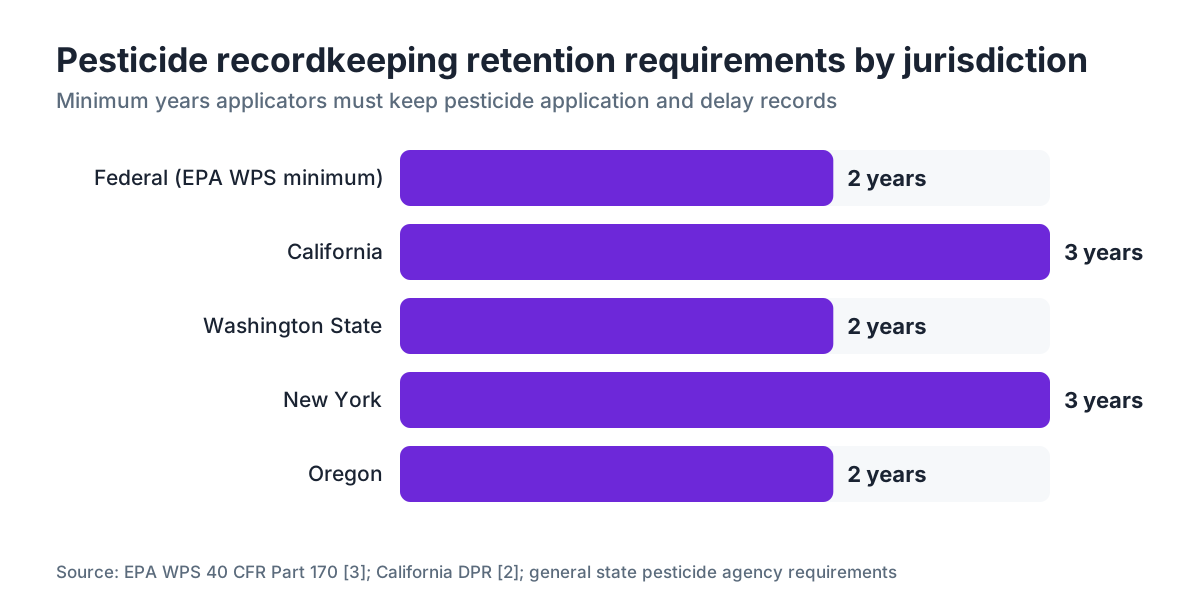
Federal retention requirements under FIFRA and the WPS require pesticide application records to be kept for at least two years [3]. Several states require longer. California requires pesticide use records to be kept for three years. New York and Washington follow similar two-to-three-year windows depending on the operation type. Keep the longest applicable period to be safe, which in practice means three years for most commercial vineyard operations.
If you're a certified pesticide applicator, your state licensing board may have its own retention requirement separate from the state ag department's pesticide reporting rule. In California, those requirements overlap rather than conflict, but check your state's rules explicitly. UC Davis Extension has a summary of California pesticide recordkeeping requirements that's worth bookmarking [8].
What if the delay was caused by a neighbor's beekeeper or pollinator service, not your own?
This is common in wine regions where managed hive services move colonies in for pollination of neighboring orchards or cover crops. You still have the same documentation obligation, because the label doesn't distinguish between your bees and someone else's. If foraging bees are present at your planned application site, the Tier 1 label restriction applies.
The documentation in this case should note that the bees are not under your direct management and that you observed them on your property. Note the approximate hive location if you can see it, the direction bees were coming from, and whether you attempted to contact the beekeeper. You're not required to track down the hive owner to comply with the label, but a record that shows you tried, or that you simply observed foraging and held the application, demonstrates good-faith compliance.
In some states, if a non-registered beekeeper has moved hives near your operation without any notice and you delay an application as a result, that information can be relevant to enforcement discussions if there's a later dispute about economic damage to your crop from the delay. Document the economic impact too, if it's meaningful: the date, the crop stage, the pest or disease pressure that made the timing important, and what monitoring you did during the delay period.
How should you handle the rescheduled application record?
The rescheduled application needs its own complete record entry, more than a reference back to the delayed entry. Write it as a full application record: date, time, product, rate, block, applicator, weather conditions, and equipment used. Reference the original delay entry by date so the two records are linked.
One thing most applicators miss: if you changed your application timing or method to reduce bee exposure (evening application instead of morning, lowered rate to reduce residue persistence, mowed cover crop first), note those adjustments and the reason for them. That creates a picture of active risk management rather than passive compliance.
Under the EPA's WPS [3], the application record must also note the specific entry-restricted areas established by the application and the duration of any restricted-entry interval. If your product's restricted-entry interval changed because you switched from a daytime to a nighttime application (some labels have different REI provisions by formulation or method), capture that.
Pest monitoring data from the delay period belongs in the record too. If you were watching for Botrytis, powdery mildew, or leafhopper counts while you waited for bee activity to drop, note the monitoring dates and results. That data supports the agronomic decision you made about timing and shows inspectors that you didn't just delay indefinitely.
Are there specific rules for organic vineyard operations?
Organic operations under the USDA National Organic Program (NOP) are already restricted to materials on the National List [9]. Most NOP-compliant materials have low acute bee toxicity, but that doesn't erase the documentation requirement. The label still governs, and the NOP's own record-keeping rules under 7 CFR 205.103 require organic producers to maintain records that "fully disclose" all activities and transactions relating to their operation [9].
A bee-activity spray delay on an organic block should be documented identically to a conventional block. The reason to be even more careful on organic blocks is that any hint of a non-compliant application can trigger a certification review. A clean record of thoughtful, label-consistent decisions helps your certifier as much as it helps you with the county ag commissioner.
Some organic growers use copper hydroxide or copper sulfate fungicides, which do appear on restricted lists in certain bee toxicity databases. Check your specific material's label and any relevant organic certifier guidance before assuming that "organic" equals "no bee concern."
What are the penalties for not keeping these records?
Penalties vary by state and by whether there's an accompanying application violation, but the numbers are real enough to take seriously. In California, a first violation of pesticide use reporting requirements can result in fines up to $5,000 per violation under Food and Agricultural Code Section 12999 [10]. Repeat violations or violations that accompany a bee kill can reach $10,000 per incident plus civil liability for damages.
Federal FIFRA penalties for label violations are assessed at up to $19,162 per violation per day as of 2024, and EPA adjusts these annually for inflation [1]. In practice, EPA tends to pursue the most serious cases, but state ag departments routinely issue smaller fines for recordkeeping failures discovered during routine audits.
The bigger financial risk is often the civil side. A documented bee kill attributed to your operation, where you lack records showing you complied with label timing restrictions, puts you in a weak position in any settlement or litigation. Beekeepers have recovered damages in the range of several hundred dollars per colony in civil actions. A commercial apiary with 50 hives on your fence line is real exposure if your records can't tell a clean story.
For vineyard managers handling records across multiple blocks and products, a tool like VitiScribe that builds the delay-reason field directly into the spray log workflow is worth considering, simply because it makes the right thing to do the easy thing to do.
How do you train your crew to recognize bee activity thresholds and report them?
Your documentation is only as good as what gets observed and reported before the sprayer gets loaded. Crew training on bee activity recognition is the front end of a solid compliance system.
WSU Extension's bee protection resources suggest a simple field protocol: before any bloom-period application, the person doing pre-spray scouting should look specifically for bee activity for at least five minutes in the block to be treated [7]. The threshold isn't a precise count. Most labels use the qualitative standard of "bees actively foraging" or "bees visiting the treatment area." Train your scouts to read that phrase this way: if you see bees working flowers or cover crop in or near the block, hold the application and report it.
The report needs to reach whoever has authority to delay the application, and it needs to happen before equipment moves. A verbal report that doesn't get written down is not a record. Give your scouts a simple field card or form (paper or app-based) that captures time, block, what they saw, and their recommendation. Even a timestamped text message to the vineyard manager with a description qualifies as contemporaneous documentation if you save it.
The California DPR's pesticide safety education program includes bilingual training materials for agricultural workers on pesticide label compliance, including bee protection language [11]. If your crew does any pre-application scouting or makes field observations that feed into your application decisions, they should go through that training or an equivalent.
Frequently asked questions
Do I have to file a separate report for a delayed application, or is a note in my spray log enough?
For most states, a note in your spray log with the delay reason, date, and rescheduled date satisfies the recordkeeping requirement. California's pesticide use reporting system requires reporting actual applications to the county ag commissioner, not planned ones, but your internal records must document why a scheduled application didn't happen as planned. Check your state's specific rules; requirements vary significantly.
What counts as 'bees actively foraging' under a Tier 1 label restriction?
No federal regulation defines this with a specific count per minute or per plant, and that ambiguity is intentional. The practical standard used by most extension programs is: if you observe honeybees or native bees working flowers or blooming cover crop in or adjacent to the treatment area during your pre-application scout, bees are actively foraging. WSU Extension recommends a five-minute observation at multiple points in the block before making the call.
How long do I have to keep bee-delay records?
Federal FIFRA and WPS rules require pesticide application records to be kept for two years. California requires three years for commercial agricultural operations. Several other states match California's three-year standard. Keep the longest applicable period, which for most commercial vineyard operations means three years. If you're a licensed pest control adviser or commercial applicator, your state licensing board may have separate retention rules.
Can a beekeeper sue me if I don't have documentation of a delay I actually made?
Yes, and the absence of records hurts you more than almost anything else in that situation. Without a contemporaneous log entry, you can't prove the decision was made before the application, when it was made, or who made it. Beekeepers have recovered civil damages for colony losses attributed to pesticide exposure. A complete delay record is your primary evidence that you followed the label.
Does the EPA Worker Protection Standard require bee-delay documentation specifically?
The WPS (40 CFR Part 170) requires records of all pesticide applications including date, product, location, and rate, but it doesn't create a standalone bee-delay documentation requirement. The obligation to document a delay flows from FIFRA label compliance and state pesticide use reporting rules. WPS inspectors do review application records, though, and any unexplained gaps in a spray schedule can trigger questions.
What if I use a commercial pesticide applicator instead of applying myself?
Commercial applicators maintain their own records under state licensing requirements, but as the grower you may still have reporting obligations to your county ag commissioner depending on your state. Get a copy of the applicator's spray record, including any delay notation, and keep it with your own farm records. Don't assume the applicator's records are your records; they're not.
Do I need to document bee delays for fungicide applications, more than insecticides?
Check the specific label. Most sulfur and copper fungicides carry no bee restriction. Some SDHI fungicides and a few systemic fungicides do carry Tier 2 bee precautionary language. If the label has any bee precautionary statement and you delayed the application because of bee activity, document it. The product class matters less than what the label actually says.
What is FieldWatch and how does it connect to my spray records?
FieldWatch is a third-party registry where beekeepers register hive locations and pesticide applicators register specialty crops. Applicators who opt in receive automated alerts when registered hives are within a set radius of their fields. If a FieldWatch alert influenced your timing decision, save the alert notification and reference it in your delay record. It gives you independent, timestamped documentation of why you held the application.
How should I document a delay caused by a beekeeper notification program, not by my own scouting?
Log the date and method of the beekeeper's notification, the beekeeper's name and hive registration number if available, what they requested, and how you responded. Note the rescheduled application window and any conditions the beekeeper communicated about when it would be safe to apply. Keep the original notification (email, text, or FieldWatch alert) attached to or cross-referenced in your spray record.
Are there different documentation requirements for organic versus conventional vineyards?
The label compliance and state pesticide reporting obligations apply equally. Organic operations have an added layer: USDA NOP rules under 7 CFR 205.103 require records that 'fully disclose' all activities, so any application decision including a delay must be traceable in your organic system plan records. Your certifier may also want to see evidence of timing decisions that protect bee populations if your certification program addresses pollinator protection.
What does a county agricultural commissioner look for when auditing spray records that include delays?
They want to see that the delay reason is specific and contemporaneous, that the rescheduled application is documented as a complete record, and that the delay is internally consistent with the label's bee precautionary language. A delay that says only 'weather' when the label restriction is specifically about bees doesn't align. Be precise: name the observation, cite the label language, and show the rescheduled date.
Does documenting a bee delay protect me from EPA enforcement if a colony loss is later reported?
Documentation alone doesn't guarantee you won't face scrutiny, but it is the primary evidence of good-faith label compliance. EPA and state agencies evaluate whether an applicator followed label restrictions. A complete, contemporaneous delay record showing you observed bee activity, held the application per label requirements, and rescheduled for a lower-risk window is the strongest available defense. It won't protect you if the later application also violated the label.
Can I use a smartphone app or digital log instead of paper records?
Yes. California, Washington, and most other states accept electronic pesticide records as long as they're retrievable, printable, and maintained for the required retention period. The content requirements are the same regardless of format. Timestamped digital entries are often stronger evidence than handwritten paper records because the timestamp is harder to dispute. Make sure your system can export records in a readable format for county ag commissioner review.
What bloom stages carry the highest bee exposure risk in winegrapes?
BBCH stages 60 through 69, which cover first flower open through full bloom and petal fall, carry the highest risk. Cornell IPM guidance identifies this window as the period when both honeybees and native bees are most attracted to grape flowers and any blooming cover crop in the vineyard floor. Any Tier 1 or Tier 2 label restriction is most likely to be triggered during this stage. Document bloom stage alongside any delay decision made during this window.
Sources
- California Department of Pesticide Regulation, pesticide use reporting program: California requires pesticide use reports to be filed with the county agricultural commissioner within seven days of the week in which the application occurred; records must be kept three years.
- EPA, Agricultural Worker Protection Standard 40 CFR Part 170: WPS requires pesticide application records to include product name, EPA registration number, active ingredient, application date, location, and rate; records must be kept at least two years.
- Cornell University Integrated Pest Management, pollinator protection in vineyards: Bee exposure risk during bloom is dramatically higher than at other growth stages; bloom stage documentation contextualizes application timing decisions.
- FieldWatch, bee and specialty crop registry overview: Approximately 20 states operate formal apiary notification programs; FieldWatch is the primary third-party registry used by beekeepers and applicators to exchange proximity alerts.
- Washington State University Extension, protecting bees from pesticides in agriculture: WSU Extension recommends a five-minute pre-application observation for bee activity; beekeepers and applicators who communicate proactively before bloom have significantly fewer colony-damage disputes.
- UC Davis Extension, California pesticide recordkeeping requirements for agricultural operations: UC Davis Extension publishes a summary of California pesticide recordkeeping requirements for commercial agricultural operations including retention periods.
- USDA National Organic Program, 7 CFR 205.103 recordkeeping requirements: NOP rules under 7 CFR 205.103 require organic producers to maintain records that 'fully disclose' all activities and transactions relating to their operation.
- California Food and Agricultural Code Section 12999, pesticide violation penalties: California FAC Section 12999 allows fines up to $5,000 per violation for first-offense pesticide use reporting violations; repeat violations or those accompanying a bee kill can reach $10,000 per incident.
- California Department of Pesticide Regulation, pesticide safety education program bilingual materials: California DPR provides bilingual training materials for agricultural workers on pesticide label compliance including bee protection language.
- EPA, Guidance for Assessing Pesticide Risks to Bees (2014): EPA defines three tiers of bee precautionary label language based on acute contact and oral toxicity thresholds; Tier 1 prohibits application when bees are foraging.
Last updated 2026-07-10