Oregon Tilth vineyard certification spray record documentation requirements

TL;DR
- Oregon Tilth Certified Organic (OTCO) requires vineyard operators to document every pesticide and allowed-material application with the product name, EPA registration number or OMRI listing, application date, field/block ID, rate, applicator name, and reason for application.
- Records must be kept for at least five years and made available for inspection during announced or unannounced audits.
What is Oregon Tilth certification and why do spray records matter so much?
Oregon Tilth Certified Organic (OTCO) is an accredited certifier operating under the USDA National Organic Program (NOP). When you certify your vineyard through OTCO, you're agreeing to be audited against federal organic regulations codified at 7 CFR Part 205 [1]. The NOP sets the floor. OTCO enforces it. Your spray records are the paper trail that proves your operation did or didn't use a prohibited substance.
This is not a soft documentation suggestion. The NOP regulation at 7 CFR § 205.103 requires that you "maintain records sufficient to demonstrate compliance with the regulations in this part" [1]. Auditors are trained to hunt for gaps in spray logs, mismatches between purchase invoices and application totals, and blocks where pest pressure got documented but no approved response ever shows up in the record.
For a small vineyard, the spray record is often the single document that makes or breaks a certification renewal. Miss a field block. Forget to note why you applied sulfur. Fail to attach a product label copy. Any one of those can trigger a corrective action request (CAR) that delays your certificate. Get three CARs in a cycle and you're looking at a possible suspension.
What specific information must appear on every spray record entry?
Every spray record entry needs eleven things: application date, block ID, full product name, EPA registration or OMRI number, active ingredients, rate, total area treated, application method, applicator name, the reason for the application, and the restricted entry interval. Miss any one and an auditor can mark the entry incomplete.
The NOP at 7 CFR § 205.103(b) lists required record categories broadly, but OTCO's Organic System Plan (OSP) templates and NOP guidance spell out what a complete pesticide or material application record looks like [1][2]. Here is the full checklist:
| Field | Why it's required |
|---|---|
| Application date | Ties the record to weather logs and pest scouting notes |
| Crop/block/field ID | Must match your farm map submitted with the OSP |
| Product name (full label name) | Auditor cross-references to approved list |
| EPA registration number OR OMRI listing | Proves the product is allowed; unlisted products are a red flag |
| Active ingredient(s) | Required for NOP compliance review |
| Application rate (per acre or per gallon) | Must be at or below label rate |
| Total area treated (acres) | Auditor checks this against invoice quantities |
| Application method (airblast, hand-spray, etc.) | Relevant to Worker Protection Standard records too |
| Applicator name | Individual accountability; also required by EPA WPS [3] |
| Reason for application / pest or disease target | Justification showing preventive or responsive basis |
| REI (Restricted Entry Interval) | Required under EPA WPS 40 CFR Part 170 [3] |
A common shortcut that causes problems: writing "per label" in the rate column instead of the actual number. Auditors count that as incomplete. Write "3 lbs/acre" or "0.5 oz/gal," not a reference.
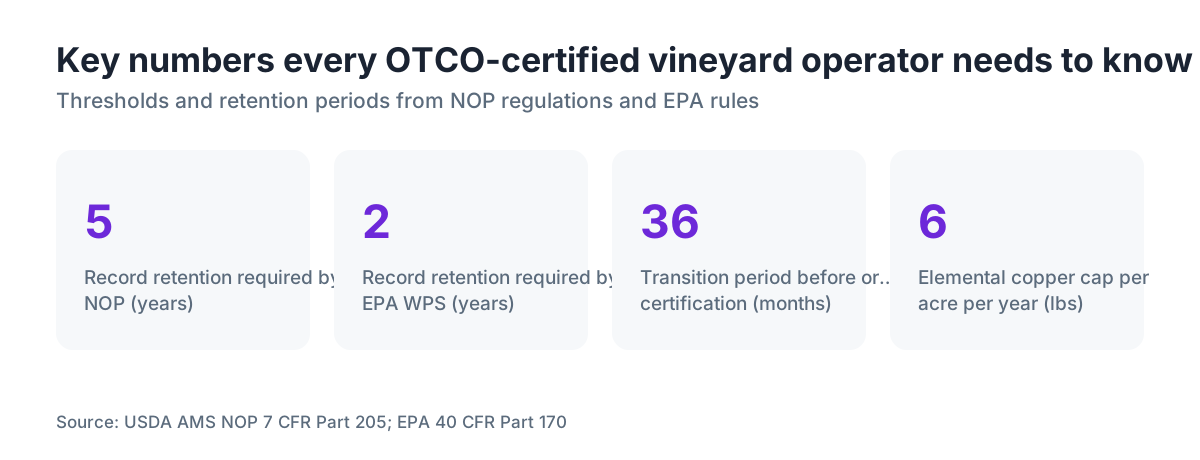
For copper and sulfur, OTCO also expects you to track cumulative annual application totals, because the NOP caps elemental copper at 6 pounds per acre per year [1]. If your spray records don't tally running totals, build that into your log format now, not at audit time.
How long do you have to keep spray records for OTCO certification?
Five years, minimum. The NOP regulation at 7 CFR § 205.103(c) sets a retention period of five years, and OTCO follows that floor [1]. Keep records for at least five years from the date of the last entry in a given season's log.
Five years is longer than it sounds for a vineyard. Spray records from the 2021 growing season need to stay accessible through at least the end of 2026. If you're in transition (the 36-month period before certification), records from the entire transition window have to be retained, because an auditor may want to verify that no prohibited substance was applied before your certificate start date.
Store records in a format you can actually retrieve fast. An auditor arriving for an unannounced inspection is not going to wait while you dig through a filing cabinet. OTCO accepts electronic records, but you need a backup, because a crashed hard drive during audit week is not a recognized excuse under the NOP. Washington State University Extension's organic farming guidance recommends keeping a working copy on-site and a backup offsite or in cloud storage [4].
What products are allowed in an OTCO-certified vineyard, and how do you document them?
Allowed materials fall into a few categories under the NOP National List (7 CFR § 205.601 for crop production) [1]. For vineyards, here are the materials you'll reach for most and exactly what you need to record.
Sulfur (elemental, dust or wettable): Allowed without restriction beyond label rate. Document product name, formulation, and rate per acre. No OMRI listing required because it's directly listed on the NOP National List, but keep the product label on file.
Copper-based materials (copper hydroxide, copper sulfate, Bordeaux mix): Allowed, but the cumulative 6 lb/acre/year elemental copper cap applies [1]. Your spray records have to track the elemental copper equivalent, more than the product volume. Read the label: a 77% copper hydroxide product at 4 lbs/acre delivers about 3 lbs of elemental copper. Running-total tracking is not optional.
OMRI-listed products (insecticidal soaps, kaolin clay, Bacillus thuringiensis formulations, spinosad for some uses): Document the OMRI listing number alongside the EPA registration number. Print and file the current OMRI certificate for any OMRI-listed product you use. OMRI delists products, and if yours gets delisted mid-season, you need the certificate proving it was listed on the date of application.
Oils (petroleum-based narrow-range oils, plant-based oils): Allowed at certain rates. The label must say "for use in organic production" or the product must carry NOP compliance verification. Document this explicitly.
For any product you're unsure about, submit a materials review request to OTCO before you buy. This is a free service and it protects you. Using a product that turns out to be non-compliant, even in good faith, can cost you the certificate. Cornell's organic viticulture resources include material guidance on adjuvants and tank-mix partners, which are a frequent source of compliance problems [5].
Adjuvants are a real trap. A spreader-sticker that isn't NOP-compliant voids the whole application record, even if the primary fungicide was allowed. Document every material in the tank, more than the active ingredient product.
What does the Oregon Tilth audit process actually look like for spray records?
OTCO conducts at least one inspection a year, usually announced with reasonable notice, but the NOP allows unannounced inspections at any time [2]. Roughly 5% of certified operations get an unannounced inspection in a given year, according to USDA AMS program integrity reporting, though the exact share shifts year to year [10].
The inspector will ask to see:
- Your Organic System Plan (OSP), which lists every material you're approved to use
- All spray records for the current certification year and sometimes the prior year
- Purchase invoices and delivery records for every material in your spray log
- Storage inventory (what's in your spray shed right now)
- Worker Protection Standard records, since those overlap with spray records [3]
Reconciliation is where people get caught. If your spray records show 10 applications of a copper fungicide at 3 lbs/acre over 8 acres, the auditor expects purchase invoices totaling roughly 240 lbs of product. If you bought 100 lbs, something doesn't add up. Either the rates were wrong, records are missing, or you borrowed product, which creates its own paper trail problem.
When a discrepancy appears, the auditor issues a Notice of Noncompliance or a Corrective Action Request depending on severity. A CAR for a minor gap, like a missing applicator name on two entries, usually gets resolved by filling in the records and submitting a written explanation. A Notice of Noncompliance for possible prohibited-substance use triggers a more serious review and can suspend your certificate while the investigation runs.
Good records are your best defense. An auditor who finds a complete, well-organized spray log with reconciled invoices is far more likely to read a small gap as honest error than an auditor staring at a disorganized pile of handwritten notes.
How do OTCO spray record requirements overlap with the EPA Worker Protection Standard?
They overlap almost completely, but the retention periods differ. The EPA Worker Protection Standard (WPS), codified at 40 CFR Part 170, requires agricultural employers to keep records of pesticide applications for a minimum of two years [3]. NOP requires five. Default to five years and you satisfy both.
WPS requires you to document the product name, EPA registration number, active ingredient, application date, location, application rate, and restricted entry interval (REI) for every application [3]. Sound familiar? Those fields are on the OTCO list too. A single spray record that captures all required fields can satisfy both agencies at once.
Where the two systems diverge: WPS adds posting requirements (a Central Information Display, safe-handling information at the worksite) that aren't spray record items per se. And NOP doesn't require REI posting for unlabeled materials like some exempt minimum-risk products. For any pesticide with an EPA registration number, satisfy WPS posting and you're good.
UC Davis's viticulture and enology extension resources note that growers often miss the requirement to keep a central file of product labels and SDS sheets [6]. Those aren't technically spray records, but auditors expect them in the records package. Staple or digitally link each product's label to its application entries.
What format should you use for spray records, and can you use digital records?
OTCO accepts both paper and electronic spray records. The NOP at 7 CFR § 205.103(a) says records must be "adapted to the nature and scale of the certified operation" [1], which has been read to allow electronic formats as long as they're durable, retrievable, and not easily altered without a trace.
In practice, a simple spreadsheet works. A dedicated software system with an audit trail works better. Paper notebooks work too, but they're harder to reconcile against invoices and slower to search during an audit.
If you use spreadsheets, use separate tabs per block or a single log with clear block-ID columns. Version control matters. If you update a past entry, note why and when. Auditors aren't looking for perfection. They're looking for honesty. A crossed-out entry on a paper log with initials and a date reads as a legitimate correction. A backdated spreadsheet entry with no timestamp reads as possible falsification.
Tools like VitiScribe are built specifically for vineyard spray logging with NOP-relevant fields already in place, which cuts the odds of missing a required data point when you're filling out records after a long spray day. The core principle holds no matter what: any format that captures all required fields and gets stored for five years.
WSU Extension's organic systems handbook recommends testing your record system by walking through a mock audit before your first real inspection [4]. Pull your own records, cross-reference them against your invoices, and see where the gaps show up.
What are the most common spray record mistakes that lead to OTCO corrective action requests?
The same handful of mistakes generate most CARs: missing block IDs, no application justification, unlisted adjuvants, untracked copper totals, gaps between scouting and spray logs, and outdated OSP materials lists. Fix those six and you've cleared the majority of what auditors flag on organic vineyards.
Here's what each one looks like in the field, drawn from the issues NOP program integrity reporting describes and that certifiers raise in grower guidance [10].
Missing block identification. You applied sulfur but the record says "vineyard," not "Block 3, North" or whatever your OSP-defined field units are. If your OSP identifies five distinct management blocks, every record needs a block ID.
No justification for application. Sulfur applied "as needed" or "routine" fails the test. Write "botrytis pressure following 0.4 inches rain, 5-day forecast humid" or "powdery mildew scouting showed 2% shoot infection rate in Block 2." Pest scouting notes should cross-reference your spray log.
Adjuvants not listed. Every tank-mix component needs its own line, or at minimum a parenthetical note. Auditors know applicators use spreaders and stickers, and they'll ask about them.
Copper totals not tracked. The 6 lb/acre/year elemental copper cap [1] is one of the most common overages found in organic vineyard audits, and it's almost always a record-keeping problem as much as an application problem. Track the running total.
Gap between scouting records and spray records. If you document disease pressure in your scouting log but there's no matching application record, auditors wonder if you used something and didn't log it. The inverse is also suspicious: applications with no scouting justification suggest routine spraying that should at least be documented as preventive with a rationale.
Outdated materials list in the OSP. Add a new product mid-season without filing an OSP amendment with OTCO and that product's records will flag as unauthorized. Always update your OSP before first use of a new material.
How does the 36-month transition period affect spray record requirements?
Before OTCO can certify a vineyard as organic, the land has to go through a 36-month transition period during which no prohibited substances are applied [1]. This is a federal NOP requirement, not something OTCO invented.
Spray records during transition matter just as much as post-certification records, maybe more. When you apply for certification at the end of the transition window, you'll need complete spray records covering the entire 36 months to prove the land was clean. If records for part of that period are missing or incomplete, OTCO can't certify the operation until they're satisfied the land qualifies.
For vineyards previously managed conventionally, the transition records also need to capture what was applied before transition began, to the extent that information exists. Prior-owner records, custom applicator invoices, or county pesticide use reports (public record in Oregon and most western states) can fill gaps if your own records don't reach back far enough.
If you bought a vineyard and want to claim it's in or completing transition, the burden of proof rests with you. OTCO will want documentation from the prior operator or, in some cases, a soil or plant tissue residue test. This is a legitimate certification pathway, but the record requirements are heavier, not lighter.
How do Oregon's state-level pesticide use reporting requirements interact with OTCO records?
Oregon has no mandatory pesticide use reporting system like California's, but Oregon Revised Statutes and Oregon Department of Agriculture (ODA) rules still require applicators holding a commercial or public applicator license to keep records of pesticide applications [7]. For vineyard operations where the owner applies pesticides personally, private applicator rules apply under ODA.
The ODA records requirement overlaps with NOP requirements on the fields captured but has a shorter retention window (typically two years under Oregon administrative rules) [7]. As with WPS, default to the NOP's five-year retention and you're covered.
One Oregon-specific item that trips up small vineyard operators: if you hire a custom pest control applicator (a licensed PCO) to do spray applications, that applicator keeps their own records under Oregon law, but you as the grower still need a copy of the application record for your NOP file. Verbal reports aren't enough. Get a written application record from every contractor within 24 hours of the application, or build it into your service contract.
ODA can run its own pesticide compliance inspections independent of OTCO certification audits. Records that satisfy NOP requirements will satisfy ODA requirements too, so there's no reason to maintain separate systems.
What resources and templates can help you build a compliant spray record system?
Several universities and extension programs publish free templates and guidance that are genuinely useful for building an OTCO-compliant spray log.
WSU Extension's organic farming resources include field record templates designed for tree fruit and vineyard operations in the Pacific Northwest, adaptable to Oregon conditions [4]. Cornell's viticulture and enology extension program publishes organic pest management guides for wine grapes, including material selection decision trees [5]. UC Davis's Department of Viticulture and Enology has extension resources on organic and sustainable viticulture that cover materials documentation [6].
OTCO itself publishes an Organic System Plan template and crop production materials guidance on its website [2]. These are the documents your records need to match, so start there before you adapt any template from another source.
For day-to-day logging, a good physical spray record book works if you commit to filling it out right after every application. The biggest enemy of complete records isn't bad intentions. It's memory. A spray applied Monday afternoon gets logged Friday morning with approximate rates and vague block descriptions. Fill in the log before you wash out the tank.
For operations managing more than a handful of blocks or running multiple spray crews, digital logging is worth the setup cost. VitiScribe offers a free trial for vineyard operators who want to test a purpose-built spray record system before committing. Whatever tool you use, run a mock audit against it once a year.
See also the broader vineyard compliance landscape for how spray records fit into your overall field operations documentation.
Frequently asked questions
Does Oregon Tilth require scouting records in addition to spray records?
OTCO doesn't mandate scouting records as a separate document category, but spray records showing applications with no documented pest or disease justification will draw scrutiny. Auditors expect a rational basis for every application. Keeping a scouting log and cross-referencing it with your spray records is the clearest way to show your pest management is responsive and preventive, not routine calendar spraying.
Can I use a simple paper notebook for OTCO spray records?
Yes. OTCO and the NOP accept paper records as long as they're legible, contain all required fields, and are stored for five years. The catch with paper is that invoice reconciliation and copper-total tracking require manual math. If you're managing multiple blocks with 15 or more spray events per season, a spreadsheet saves real audit-prep time. Paper notebooks work fine for simple single-block operations.
What happens if I accidentally use a non-OMRI-listed adjuvant in an organic vineyard?
Report it to OTCO immediately. The NOP and OTCO treat voluntary disclosure very differently from noncompliance discovered during audit. A single inadvertent use of a non-allowed adjuvant, self-reported, typically results in a corrective action request and an updated OSP. The same incident found during audit without prior disclosure gets treated as a willful violation, which carries much higher consequences including possible certificate suspension.
How does OTCO verify that the copper cap of 6 lbs per acre per year hasn't been exceeded?
Auditors calculate elemental copper totals from your spray records using the copper content percentage on each product label, then cross-check against purchase invoices. If your records show 4 applications of a product with 25% copper hydroxide at 4 lbs/acre on 5 acres, the auditor does the math on total elemental copper applied. Keep your own running tally per block so you can answer this instantly during any inspection.
Are pre-plant or soil amendment applications covered by OTCO spray record requirements?
Yes. Any material applied to the field, including soil amendments, compost, biological inoculants, or pre-plant herbicides (none of which would be allowed in organic production anyway), has to be documented. Soil amendment records use a slightly different format than spray records but still require product name, source, application date, rate, and block ID. OTCO reviews these alongside spray records during annual inspection.
Do I need to document water-only or plain water applications?
No. Water applications for frost protection or dust suppression don't require spray record entries under NOP or OTCO rules. But if you add anything to the water, even a food-grade material, it becomes an application that needs documentation. When in doubt, log it. A brief entry for a material that turns out to be exempt causes no problem; a missing entry for a material that required documentation causes a CAR.
What is an Organic System Plan and how does it relate to my spray records?
Your Organic System Plan (OSP) is the master document you submit to OTCO describing how you manage your vineyard: fields, practices, materials, and pest management strategies. Your spray records are the real-time evidence that you're actually doing what the OSP describes. Every product in your spray log must appear in your approved OSP materials list. To add a new product mid-season, file an OSP amendment with OTCO and get approval before applying.
How far back can an OTCO auditor request to see spray records?
The NOP's five-year retention requirement is both the minimum you must keep and the window an auditor can reasonably request. In practice, annual inspections focus on the current certification year and sometimes the prior year. Transition-period applications, however, can be reviewed going back the full 36 months of transition. For operations with a history of noncompliance concerns, OTCO has latitude to request records from any period within the five-year window.
If I hire a vineyard management company to apply sprays, who is responsible for the records?
You are, as the certificate holder. A vineyard management company can generate and maintain the application records, but you're legally responsible for making sure those records meet NOP standards and that you retain copies for five years. Build a record-delivery requirement into any vineyard management contract. OTCO holds the certificate holder accountable for missing or noncompliant records regardless of who physically did the spraying.
Does OTCO require spray records to be submitted annually, or just kept on file?
You keep them on file. You don't submit spray records with your annual certification renewal application unless OTCO specifically requests them. Your renewal application (the OSP update) summarizes your materials and practices, but the underlying spray log stays at your operation and gets reviewed during the physical inspection. OTCO may request records electronically before or after an inspection if something in your renewal raises a question.
Can a family member or vineyard employee fill out spray records, or does the applicator have to do it?
Anyone with direct knowledge of the application can fill in the record, but the applicator's name must appear as a distinct field, and ideally the applicator should sign or initial the entry. If a manager fills in records based on verbal reports from crew members, that's a weaker paper trail and can look problematic during audit. Best practice is for the applicator to fill in the log immediately, or complete a standard form and hand it to the manager the same work day.
What's the difference between an OMRI listing and an NOP review for organic materials?
OMRI (Organic Materials Review Institute) is a private nonprofit that reviews products against NOP standards and lists compliant ones. An OMRI listing is strong evidence of compliance but not the only path. Products can also be reviewed and approved by other NOP-accredited review organizations, or you can submit a material to OTCO directly for review against the National List. For spray records, document whichever compliance verification applies to each product: an OMRI number, another review organization's approval, or OTCO's own materials review.
Is Bordeaux mixture treated differently from other copper products in spray records?
Bordeaux mixture (copper sulfate plus hydrated lime) is allowed under the NOP but requires the same elemental copper tracking as any other copper product. Because growers often mix Bordeaux on-site rather than buying a pre-formulated product, the record needs to show the quantities of copper sulfate and hydrated lime separately, with the resulting elemental copper calculated. A common error is logging only the lime or only the total mix volume without specifying copper content.
Sources
- USDA AMS, National Organic Program Regulations, 7 CFR Part 205: NOP requires records maintained for 5 years (§ 205.103), prohibits prohibited substances during 36-month transition, caps elemental copper at 6 lbs/acre/year on National List (§ 205.601), and requires records sufficient to demonstrate compliance
- Oregon Tilth Certified Organic (OTCO), Certification Program: OTCO is an NOP-accredited certifier; conducts annual inspections including review of Organic System Plans and spray records
- EPA, Agricultural Worker Protection Standard (40 CFR Part 170): WPS requires pesticide application records including product name, EPA reg number, active ingredient, date, location, rate, and REI to be retained for 2 years
- Washington State University Extension: WSU Extension recommends mock audit practice and dual-copy record storage (on-site and offsite backup) for organic operation compliance
- Cornell University, Grapes and Wine Extension Program: Cornell extension covers allowed organic materials in wine grape production including adjuvant compliance guidance
- UC Davis Department of Viticulture and Enology: UC Davis extension notes that growers frequently miss the requirement to maintain product labels and SDS sheets alongside spray records for organic certification review
- Oregon Department of Agriculture, Pesticides Program: Oregon ODA requires licensed pesticide applicators to maintain application records; private applicator rules govern vineyard owner-applicators in Oregon
- USDA AMS, The National List of Allowed and Prohibited Substances: The NOP National List specifies which crop production materials are allowed in certified organic systems, including elemental sulfur and copper-based materials
- OMRI (Organic Materials Review Institute), OMRI Lists: OMRI listing provides independent verification that a commercial product complies with NOP standards; listings can be revoked and growers should file dated certificate copies
- USDA AMS, Organic Integrity Learning Center and Program Handbook: NOP program integrity reports indicate that approximately 5% of certified operations receive unannounced inspections annually; record discrepancies are a leading cause of noncompliance findings
Last updated 2026-07-10