Demeter biodynamic certification spray and preparation records

TL;DR
- Demeter USA makes you record every application of a biodynamic preparation (BD 500 to 508), every approved spray, and any restricted material by date, rate, timing, block, and weather.
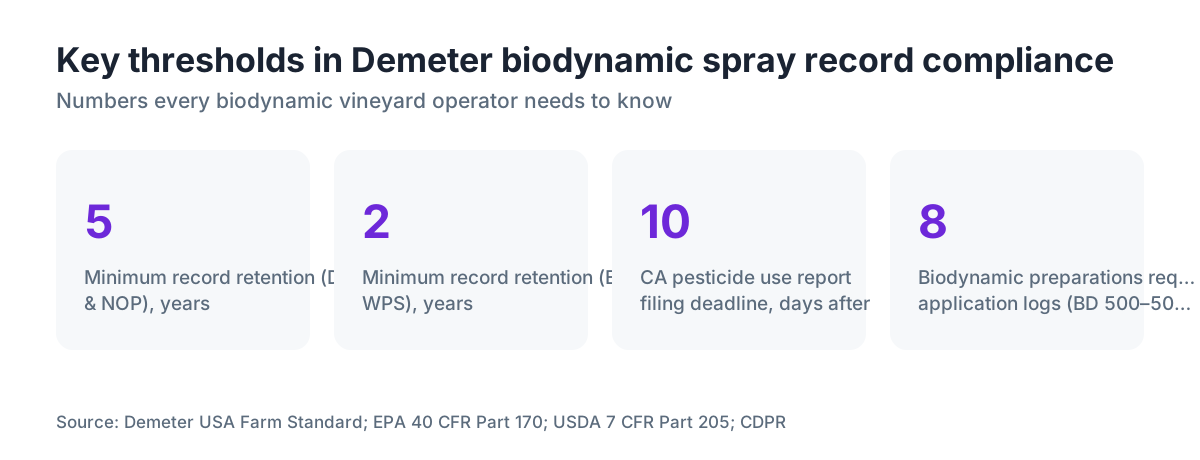
- Keep the records at least five years and hand them over at annual inspection.
- Missing or sloppy logs are the number one reason certificates get suspended.
What records does Demeter USA actually require for biodynamic certification?
Demeter USA wants a written record for every substance that touches a certified farm. That means all eight biodynamic preparations (BD 500 through BD 508), any Demeter-approved plant and mineral spray, and even conventional pesticides that are otherwise banned but might show up through drift or a neighbor's mistake. The governing document is the Biodynamic Farm Standard. [1]
At the preparation level you record the date and time of application, the specific preparation number, the source (who made it or which supplier sold it), the quantity used and the volume of water it was stirred into, the field or block ID, the application method (backpack sprayer, tractor rig, hand-flicking), and the weather at the time. That last one is not filler. BD 500 horn manure goes down in the evening when the soil is warm and a little moist. BD 501 horn silica goes on in the early morning. Inspectors know the difference and they check.
For any approved spray beyond the preparations, the same fields apply, plus the product name, the EPA or OMRI listing number, and the target pest or disease. For anything on Demeter's restricted list, you also need a written justification signed by the farm operator. [1]
The standard names no specific form. Some growers use a notebook, some use spreadsheets, some run field-operations software. What the standard demands is that records are legible, organized by field block, and easy to pull when an inspector asks.
Which biodynamic preparations require a log entry and what goes in it?
Eight preparations sit at the core of the biodynamic system, numbered BD 500 through BD 508. Each has its own application protocol, and each application needs its own line in the log. Here's the breakdown.
| Preparation | Common name | Typical timing | Typical target |
|---|---|---|---|
| BD 500 | Horn manure | Autumn/spring, evening | Soil, root stimulation |
| BD 501 | Horn silica | Summer, early morning | Foliar, fruit development |
| BD 502 | Yarrow | Compost addition | Compost pile |
| BD 503 | Chamomile | Compost addition | Compost pile |
| BD 504 | Stinging nettle | Compost addition | Compost pile |
| BD 505 | Oak bark | Compost addition | Compost pile |
| BD 506 | Dandelion | Compost addition | Compost pile |
| BD 507 | Valerian | Compost addition / foliar | Compost, frost protection |
| BD 508 | Horsetail | Foliar spray | Fungal pressure |
BD 500 and BD 501 are the field sprays most growers apply several times a season, so they generate the most log lines. In a typical northern California wine grape operation you might put BD 500 down twice and BD 501 down three to five times a season, which is five to seven separate records from those two preparations alone. [10]
Compost preparations BD 502 through BD 507 usually get logged against your compost lot documentation. You note which preparations went into which pile on which date. Inspectors cross-check those logs against your compost application records to trace the whole chain.
BD 508 horsetail deserves its own callout. It's the one growers reach for most against downy or powdery mildew, and in humid regions it comes out often. Every spray gets its own entry, repeats included.
How does the lunar calendar factor into your spray records?
Biodynamic timing ties preparation applications to the lunar calendar, specifically whether the moon sits in a root, flower, fruit, or leaf day as laid out in Maria Thun's planting calendar. [3] Demeter USA does not currently make you record which lunar day each application landed on. It does expect your BD 500 and BD 501 timing to follow the recommended windows, and an inspector can absolutely ask why you sprayed BD 501 at dusk during a leaf period.
Most experienced growers write the lunar period in the log anyway. It takes ten seconds to note "fruit day, descending moon" in the comments column, and it kills any inspector question about timing before it starts. If you missed the ideal window because of rain or a broken sprayer, write that down too. Inspectors are farmers. They understand weather.
Some growers use the Stella Natura calendar, published annually and distributed through biodynamic suppliers. Others use the Maria Thun Biodynamic Calendar. [3] Either works as a reference. Neither has to go in with your records, but keeping the relevant pages filed alongside your spray logs is smart come inspection day.
What format do spray records need to be in for a Demeter inspection?
Demeter USA's standard says records must be "maintained and available for review," and it says nothing about paper versus digital. [1] Inspectors working through the Demeter-accredited bodies (CCOF, Oregon Tilth, PCO, and others contract as inspectors in different regions) will take a well-organized binder, a printed spreadsheet, or a screen share of your digital system during the on-site visit.
Format isn't what sinks you. Gaps are. A missing date, a blank preparation quantity, a block ID that doesn't match your farm map: those are the things that generate corrective action requests. The Farm Standard leans hard on the phrase "verifiable records," and verifiable means an auditor can trace a specific application backward to a source and forward to a field result without guessing. [1]
Keep digital records? Print them for the visit or be ready to share a screen. Not every inspection site has good cell service, and making an inspector watch a page spin is a rough way to open the day.
Field software like VitiScribe can generate timestamped, block-level application logs that clear the verifiable bar without hand transcription. That matters, because transcription errors are the second most common finding after flat-out missing entries.
How long do you have to keep biodynamic spray and preparation records?
Five years, minimum. Demeter USA sets that floor. [1] It lines up with the USDA National Organic Program, which also requires a five-year retention minimum under 7 CFR Part 205. [4] If you're certified both biodynamic and organic, which is common, one set of records covers both.
Five years is a floor, not a ceiling. Keeping records longer costs you nothing and can save you plenty. If a neighbor's spray drifts onto your block, or a residue investigation ever names you, older records show a pattern of compliance. Some certification attorneys tell clients to keep application records forever if storage isn't a headache.
Digital storage makes retention almost a non-issue. The one real risk is format rot: a 2019 spreadsheet in some proprietary format may fight you in 2030. Plain CSV or PDF exports are the safer long-term bet than native software files.
What happens if your spray records are incomplete during a Demeter audit?
It depends on how bad the gap is. Demeter runs a tiered corrective action system. Small stuff, a missing weather note, an unsigned justification form, usually draws a written corrective action request (CAR) that you answer within 30 days with either the fixed record or a procedure change to stop it happening again. [1]
Bigger problems escalate. A pattern of missing entries for a regulated input, or a record that fights with your purchase invoices or tank-mix tickets, can trigger a certificate suspension while the investigation runs. Suspension means you can't sell product as Demeter Biodynamic certified during that window.
The worst finding is intentional falsification. That leads to revocation and a multi-year ban from reapplying. Demeter coordinates with USDA and, where it applies, state departments of agriculture when it suspects fraud. [1]
Here's the practical move. If you spot a gap before the inspector does, fix it with a dated amendment note that says what happened and what you did about it. Inspectors respond far better to a correction you brought forward than to a hole they had to find.
How do EPA Worker Protection Standard requirements interact with biodynamic spray records?
The EPA Worker Protection Standard (WPS), at 40 CFR Part 170, makes agricultural employers keep records of all pesticide applications for at least two years and make them available to workers and their reps. [5] It applies to certified organic and biodynamic operations too, any time an EPA-registered pesticide gets used. That includes copper fungicides and sulfur, both of which sit on Demeter's approved materials list.
EPA WPS guidance states that "the pesticide application and hazard information must be kept for 2 years," and it must include the product name, EPA registration number, active ingredient, the location and description of the treated area, and the application date. [5] That's a subset of what Demeter already asks for, so a thorough biodynamic log satisfies WPS at the same time.
Copper and sulfur are where growers trip. Both are EPA-registered pesticides. Both need WPS posting of the application info, restricted-entry interval compliance, and access to the safety data sheet. Biodynamic philosophy does not buy you an exemption from federal pesticide law. WSU Extension has a plain-language summary of WPS rules for organic and sustainable operations. [6]
UC Davis Cooperative Extension has published guidance noting that copper applications on California vineyards carry additional state reporting through the county agricultural commissioner system, separate from both Demeter and WPS. [7] In California you're keeping three overlapping record sets: Demeter, WPS, and the CAC pesticide use report.
What do California county agricultural commissioner pesticide records require on top of Demeter logs?
California piles on a layer of state pesticide reporting that most other states skip. The Department of Pesticide Regulation (CDPR) requires a Pesticide Use Report (PUR) filed with your county agricultural commissioner for every pesticide application, including any EPA-registered material used on a biodynamic farm. [8]
PURs are due monthly, by the 10th of the following month. Each one needs the operator name and site ID, the commodity and acreage treated, the product name and EPA registration number, the pounds of active ingredient applied, the application method, and the date. Copper and sulfur are the materials that most often trigger PUR filing on biodynamic wine grape farms.
Here's a distinction worth pinning down: biodynamic preparations BD 500 through BD 508 are not EPA-registered pesticides and do not trigger PUR filing. They still go in your Demeter logs. They just aren't reportable to the CAC.
So in California, a well-run biodynamic vineyard keeps at least three separate but overlapping record sets. One system that exports in multiple formats saves real administrative hours.
How should you log BD 500 horn manure applications step by step?
BD 500 is the preparation at the center of biodynamic soil work, and it's the one inspectors squint at hardest when they're deciding whether a farm actually practices biodynamics or just bought the label. Here's what a complete BD 500 log entry looks like.
Field or block ID: Use the same identifiers that appear on the farm map you submitted to Demeter. "Block 3A" is useless if your map says "South Slope Cab" with no matching code.
Date and time: Record both. BD 500 protocol calls for late afternoon to dusk. A 10 a.m. entry will draw a question.
Preparation source: Where did it come from? If you made it, note that. If you bought it, record the supplier and lot number. The Josephine Porter Institute is a common domestic supplier. Biodynamic Association member suppliers are another. [2]
Quantity of preparation: Typically 25 to 40 grams per acre, stirred into 8 to 13 gallons of water per acre. Record the grams and the final spray volume.
Stirring method and duration: Hand-stirring in a wooden or clay vessel for one hour is traditional. Larger operations sometimes use mechanical stirrers. Note which and how long.
Application equipment: Backpack sprayer, tractor sprayer, or a brush for hand-flicking. Write it down.
Weather at time of application: Temperature, humidity, wind speed and direction, cloud cover. No weather station needed. A reasonable field observation is fine.
Acres covered: Total area treated in this session.
Operator signature or initials: Who actually did it.
That's nine data points for one application. Sounds like a lot until you've done it a few times, at which point it takes about ninety seconds.
What's the difference between allowed, restricted, and prohibited inputs under Demeter standards?
Demeter USA sorts farm inputs into three buckets: allowed, restricted (permitted with conditions or documentation), and prohibited. [1] Which bucket a material lands in changes what your spray records have to carry.
Allowed inputs, like the biodynamic preparations, compost made to Demeter standards, and approved plant-based sprays, need the standard application log and nothing extra.
Restricted inputs need a written justification form, usually a one-page note explaining why the material was necessary, what alternatives you weighed, and what you'll do to reduce future need. Copper fungicides above a certain annual threshold may require this in some Demeter programs. That justification becomes part of your permanent record for the year.
Prohibited inputs, meaning synthetic pesticides, synthetic fertilizers, and genetically engineered material, are the things that should never appear in your logs at all. If a prohibited material turns up in a soil or product residue test, the burden falls on you to show it came from drift or contamination and not deliberate use. Your spray records are the first line of evidence.
Cornell's Department of Horticulture has published review materials on moving vineyards into biodynamic standards, with a useful breakdown of input categories and how they stack against NOP organic standards. [9]
How do you handle spray records during the three-year transition to Demeter certification?
Demeter requires a three-year transition before full certification. During those years the land has to be managed to biodynamic standards even though the certificate isn't granted yet. [1] Transition records matter just as much as certified-period records, because at the end of the three years inspectors review the full transition history to confirm you complied throughout.
Start your application logs on day one of transition. Use the exact format you'll use once certified. Any gap in the transition record is a gap in the evidence that the land was clean during conversion.
The transition usually overlaps the USDA NOP organic transition, since Demeter requires underlying organic certification for most operators. Under NOP, the three-year organic transition also runs from the last application of a prohibited substance. [4] If both clocks are running at once, your record system has to satisfy both from the start.
Plenty of growers find transition harder to administer than the ongoing certified phase, because they're building the record system from scratch while learning the practice protocols. Nailing your logging format in year one saves a mountain of retrofitting later.
What tools or systems work best for keeping biodynamic vineyard spray records?
Options run from a three-ring binder to purpose-built field software. The right pick comes down to farm size and how many people are making and logging applications.
On farms under 20 acres with one operator, a paper log book organized by block and date works fine. The Josephine Porter Institute and various biodynamic farm associations publish downloadable log templates. [2] Print a stack, keep them in a weatherproof sleeve in the field truck, and transcribe to a binder every week.
On larger operations, or any farm where several employees apply preparations and sprays, paper turns dangerous fast. Bad handwriting, lost pages, and days when nobody remembered to log are all real. A shared spreadsheet in cloud storage is a clear step up: timestamped, searchable, reachable from any device.
For operations juggling CAC PUR reporting, WPS record-keeping, and organic certification records at the same time, purpose-built field software earns its cost. VitiScribe is one option built for vineyards, with block-level application logging, preparation-specific fields, and export formats that feed multiple certification bodies.
Whatever you pick, the one habit that matters most is same-day entry. Studies of farm record-keeping consistently find that entries made more than 24 hours after an application carry much higher error rates than same-day entries. [6]
Frequently asked questions
Do biodynamic preparations BD 500 to 508 need to be logged as pesticide applications?
No. BD 500 through BD 508 are not EPA-registered pesticides, so they don't trigger EPA Worker Protection Standard records or state pesticide use reports. They still need full documentation in your Demeter spray and preparation logs. In California you file no PUR for preparation applications, but you do keep the Demeter record. Treat them as a separate category from regulated pesticides.
Can I use a digital app or spreadsheet for my Demeter spray records, or does it have to be paper?
Demeter USA doesn't require paper. The Farm Standard requires records to be maintained and available for review during inspections. Digital logs, spreadsheets, or software-generated records all qualify, as long as they're legible, organized by field block, and can be printed or displayed during the on-site visit. A cloud-only system with no offline access can cause problems if your farm has poor connectivity on inspection day.
How many years of biodynamic spray records do I need to keep?
Demeter USA requires five years, minimum. USDA NOP organic certification, which most Demeter operations also hold, also requires five years under 7 CFR Part 205. EPA Worker Protection Standard records for registered pesticide applications require two years, minimum. If you're certified both ways, the five-year Demeter requirement covers all three obligations.
What happens if I spray a prohibited material by mistake and it shows up in a residue test?
Self-report to your certification body before the test results land, if you know an error happened. Inspectors treat operators who come forward differently from those who don't. Your spray records are your main evidence that the application was accidental, from drift, or from contamination. A clean application log with no conflicting entries backs your account. Intentional use of prohibited materials can lead to revocation and a multi-year ban.
Does Demeter require me to record the lunar calendar day for each preparation application?
Demeter USA does not currently require you to log the specific lunar day. Preparation timing is expected to follow biodynamic recommendations (BD 500 in the evening, BD 501 in the morning, root days for soil preparations), and inspectors may ask about your timing choices. Most experienced growers note the lunar period in the comments field as a matter of routine. It takes seconds and answers inspector questions before they're asked.
Do I need to record who stirred the biodynamic preparation, more than who applied it?
Demeter USA doesn't separately require a stirring log, but the application record should carry the preparation source, the quantity stirred, the stirring duration and method, and the operator who applied it. If the same person stirred and applied, one signature covers both. On larger operations where one worker stirs and another applies, noting both names is good practice and helps trace any quality issue back to the batch.
What records are needed for BD 508 horsetail spray used for fungal disease management?
BD 508 is a plant-based biodynamic spray, not an EPA-registered pesticide, so it needs no pesticide use report or WPS record. Your Demeter log entry needs the date, time, block ID, quantity of dried horsetail used and water volume, application method, equipment, weather, and operator. If you're spraying it often during a wet season, each application gets its own line. There's no exemption for repeat applications of the same preparation.
How do Demeter spray records differ from USDA organic certification spray records?
USDA NOP requires documentation of all materials applied, inputs used, and sales sufficient to verify organic integrity, under 7 CFR Part 205. Demeter adds preparation-specific requirements: preparation source, stirring method, lunar timing context, and application technique aren't NOP fields but are Demeter fields. Demeter also requires records for compost preparation insertion (BD 502 to 506), which has no direct NOP equivalent. A well-designed Demeter log is a superset of the NOP record and satisfies both.
Are there specific requirements for recording copper fungicide applications on a biodynamic vineyard?
Yes, and they come from several directions. Copper is EPA-registered, so WPS records and, in California, PUR reporting apply. Demeter tracks cumulative copper use and may require written justification above certain annual thresholds. Your Demeter log needs the product name, EPA registration number, rate, block, and date. Your WPS file needs the product name, active ingredient, REI, and application location. California growers file a monthly PUR. Three overlapping record sets, same underlying data.
What does a Demeter inspector actually check when reviewing spray records?
Inspectors cross-reference your application logs against purchase invoices for preparations and materials, compost lot records, farm maps, and sometimes satellite imagery for timing plausibility. Common checks: do preparation quantities match supplier invoices? Do BD 500 and BD 501 application dates follow seasonal and timing protocols? Do compost preparation records line up with the dates preparations were bought or made? Are block IDs consistent with the farm map on file? Gaps and internal contradictions are the primary triggers.
Can a small vineyard share preparation application records with a neighboring biodynamic farm?
No. Each certified operation keeps its own records for its own land. If two operations run under a shared management arrangement, the certification structure (separate certificates versus a group certificate) sets how records are organized, but each farm's applications must be documented individually. Shared records that don't clearly identify which parcel got which application are a common audit finding in multi-parcel operations.
What is the best way to document a biodynamic compost preparation application to vineyard blocks?
Create two linked records: one for the compost lot (which preparations went in, on what dates, source of preparations, compost type, and maturity date) and one for each block application (date, compost lot ID, volume or weight applied per acre, application method, and operator). The lot ID links the field application back to the preparation documentation. Inspectors need to trace from the field backward to the preparation source, and a lot-numbering system makes that clean.
Sources
- Demeter USA, Biodynamic Farm Standard: Demeter USA requires written records for every substance applied to a certified farm, minimum five-year retention, and verifiable records available during inspections
- Josephine Porter Institute for Applied Biodynamics: JPI is a primary domestic supplier of BD 500 to 508 preparations and publishes application guidance including typical rates of 25-40 grams per acre for BD 500
- North American Biodynamic Calendar (Stella Natura), Camphill Village Trust: Stella Natura publishes the annual lunar planting calendar used by biodynamic growers to time root, flower, fruit, and leaf day applications
- USDA Agricultural Marketing Service, National Organic Program, 7 CFR Part 205: NOP requires certified organic operations to maintain records for five years and document all materials applied
- EPA, Worker Protection Standard, 40 CFR Part 170: WPS requires agricultural employers to maintain pesticide application records for two years and states that pesticide application and hazard information must be kept for 2 years
- Washington State University Extension, Worker Protection Standard compliance for organic and sustainable farms: WSU Extension provides plain-language WPS compliance guidance applicable to organic and biodynamic operations using EPA-registered materials such as copper and sulfur
- UC Davis Cooperative Extension, Pest Management Guidelines for Wine Grapes: UC Davis notes that copper applications in California vineyard operations require county agricultural commissioner pesticide use reports separate from organic or biodynamic certification records
- California Department of Pesticide Regulation, Pesticide Use Reporting: CDPR requires growers to submit Pesticide Use Reports to their county agricultural commissioner monthly by the 10th of the following month for all EPA-registered pesticide applications
- Cornell University, School of Integrative Plant Science (Horticulture): Cornell horticulture review materials on transitioning vineyards to biodynamic standards include a breakdown of input categories compared to NOP organic standards
- Biodynamic Association, About Biodynamic Preparations: The Biodynamic Association describes the eight field and compost preparations BD 500 to 508 and their recommended application contexts
Last updated 2026-07-10