How to record cane vs. spur pruning decisions across block history
TL;DR
- Record pruning method, bud count per vine, crew ID, date, and weather for every block each season.
- Store it by block-year so you can compare wood weight trends over time.
- Cane vs.
- spur decisions shift as vines age, so a multi-year log is the only honest way to spot when a block needs to change systems before yield collapses.
Why does recording pruning decisions matter beyond just knowing what you did?
Most vineyard managers remember what they pruned last winter. Almost none of them can tell you what they pruned five winters ago in Block 7 and whether dormant cane weights were trending up or down when they made the switch from spur to cane. That gap is where the expensive mistakes live.
Pruning method is not a static decision. A young Cabernet Sauvignon block on VSP may spur-prune beautifully at year three, push uneven shoots by year eight as spur arms lengthen and crowd, and genuinely need cane pruning by year twelve if the cordon is showing dead spurs and position loss. Without a written block history you are making that call on memory and gut. Gut does not hold up well when you are standing in the same block with a different crew chief or trying to brief a new vineyard manager.
There is also a compliance dimension. USDA NRCS cost-share programs and some state-level viticulture grants require documented cultural practice records to verify eligibility [1]. A pruning log is the foundation of that documentation.
When you get to replanting or trellising decisions, buyers of vineyard property and lenders financing vineyard development consistently ask for historical block records. A clean year-by-year pruning log with method, bud count, and dormant weight data is a tangible asset, not a formality.
What is the difference between cane and spur pruning, and why does the recording structure differ?
Spur pruning removes last year's cane back to a two-bud stub, leaving a permanent cordon arm that grows longer each year. Cane pruning removes everything except one or two long canes selected from near the head, replacing the fruiting wood every season. Spur-pruned vines accumulate permanent wood over time. Cane-pruned vines stay biologically younger in their fruiting zone. That agronomic split drives everything about how you record them.
What you capture differs by system. On a spur-pruned block you track bud count per spur, number of spurs per vine, cordon condition (dead zones, gaps, skipped positions), and any retraining notes. On a cane-pruned block you record cane count per vine (usually one or two canes for Geneva Double Curtain or a single cane for VSP), bud count per cane, dormant cane weight, and where the replacement cane was selected from relative to the head.
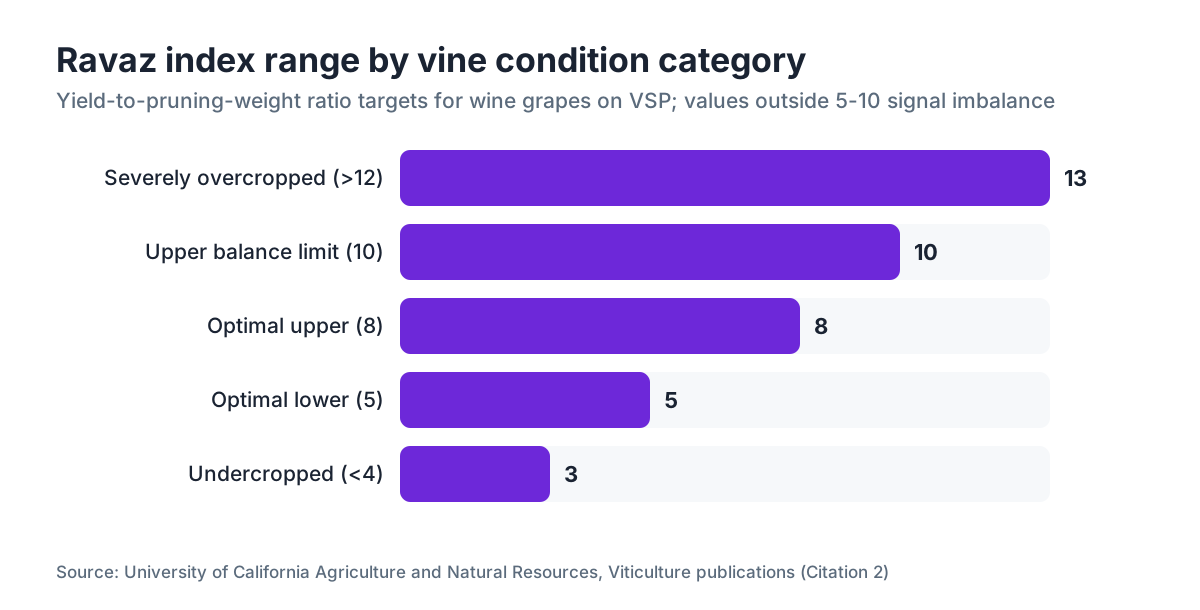
Cane weight per running foot of cordon, or per vine, is the data that pays off later. UC Davis Cooperative Extension guidance on balanced pruning frames it plainly: the Ravaz index, calculated as yield divided by pruning weight, is a direct measure of vine balance, and without pruning weight records you cannot compute it [2]. A Ravaz index between 5 and 10 is the general target range for wine grapes, though it shifts by variety and training system.
Build separate field form sections or database fields for spur-pruned blocks versus cane-pruned blocks. A generic "pruning done" checkbox captures nothing you can use next year.
What data fields should every block-level pruning record include?
There is no universal standard, but the fields below are what extension specialists and experienced vineyard managers treat as the minimum useful set.
Block identification layer (static, set once)
- Block ID and variety
- Rootstock
- Year planted
- Row and vine spacing
- Trellis system
- Training system
Seasonal pruning record layer (new entry each year)
- Season (crop year, usually the upcoming harvest year)
- Pruning date(s), start and finish
- Pruning method: cane or spur (or mixed, with percentage)
- Bud count target per vine
- Actual average bud count per vine, sampled
- Dormant pruning weight (grams per vine or pounds per acre), sampled
- Number of vines retraining was applied to, with reason
- Crew identifier or contractor name
- Supervisor who verified the count
- Temperature range on pruning days (relevant for disease risk and callus timing)
- Pruning wound treatment applied (if any), product name and rate
Condition flags (optional but high-value)
- Cordon die-back percentage (spur blocks)
- Dead spur positions as a percent of total positions
- Head condition for cane-pruned vines
- Notes on trunk disease symptoms observed
That last category is where a long-term block history earns its keep. Cornell's viticulture and enology program documents that Eutypa dieback and esca often show up in pruning-season observations years before they surface in yield data [3]. If your record has a field for it, your crew notes it. If not, it disappears.
| Data layer | Spur pruning | Cane pruning |
|---|---|---|
| Bud count per vine | Count per spur x spurs | Count per cane x canes |
| Wood removed | Cordon maintenance notes | Full cane weight |
| Key metric | Dead spur positions (%) | Dormant cane weight (g/vine) |
| Retraining note | Spur repositioning | Cane selection point |
| Balance index input | Pruning weight sample | Pruning weight (direct) |
How should you structure the block history so the data is actually useful across years?
The most common mistake is storing pruning records by season rather than by block. If your 2021, 2022, and 2023 records are three separate files organized by year, looking up the pruning trajectory of Block 4 means opening three files and manually pulling the Block 4 rows every time. That friction means people stop doing it.
Organize primarily by block, with season as a nested dimension. In a spreadsheet that means one tab per block (or one table filtered by block ID) where each row is a season. In a database it means a block table with a one-to-many relationship to a seasonal records table keyed by block ID and year. Either works. The structure is the thing.
Within that structure, calculate and store derived metrics alongside raw inputs every year:
- Ravaz index (yield kg/vine divided by pruning weight kg/vine)
- Year-over-year change in dormant pruning weight
- Dead spur position trend for spur-pruned blocks
Those derived columns make a block history readable at a glance. Open a block record and see that dormant pruning weight has climbed from 180 g/vine to 340 g/vine over six years on a spur-pruned block while dead spur positions have gone from 8% to 22%, and the case for switching to cane pruning writes itself. Without the trend column, you are doing math in your head every time.
Washington State University's viticulture extension work treats vine balance records as a multi-year dataset rather than a point-in-time snapshot, since single-year pruning weight has limited interpretive value without the surrounding context [4].
When should you switch a block from spur to cane pruning, and how do you document that decision?
There is no hard rule, but a few conditions tend to start the conversation: dead spur positions above roughly 15-20% of the total, cordon sections with three or more consecutive missing spurs, crowding from spur arm elongation, or trunk disease pressure that is making individual spurs non-productive.
The decision to switch systems is one of the biggest single-block calls a vineyard manager makes. It affects labor time per vine (cane pruning typically takes 25-40% longer per vine than spur pruning on mature vines, depending on system and crew experience), yield potential for at least two seasons while vines adjust, and trellis requirements if the current setup does not accommodate the cane system you are moving to.
Documentation for a system switch should include:
- The season of last spur pruning
- The trigger conditions that drove the decision (with the block history data behind them)
- Whether a phased transition was used (mixed block: some vines cane-pruned, some spur)
- The target cane system (single cane VSP, bilateral cane, GDC, etc.)
- Trellis modifications made
- Who authorized the change
That authorization note matters more than people expect. On properties with absentee owners or management turnover, a documented decision with the agronomic rationale stops the next person from reversing a sound change out of cost or habit.
Store the decision record as a permanent event in the block history, separate from the seasonal records. Treat it the way you would a replanting or trellising event. It is a milestone, not a routine data point.
What tools work best for tracking pruning records across multiple blocks and years?
Honest answer: the best tool is the one your team actually fills out. A well-designed paper form that gets scanned and filed beats a sophisticated app nobody opens in the field.
Here is a practical breakdown of the options.
Paper field forms. Fast in cold weather with gloves on, no connectivity needed, works for anyone. The failure mode is illegibility, loss, and the labor of transcribing into anything queryable. If you use paper, build a standard form with checkboxes and numeric fields so crew members fill in blanks rather than write prose. Scan and file by block right after each pruning session.
Spreadsheets. Google Sheets or Excel work fine for operations under roughly 50 blocks. The block-as-primary-tab structure above translates directly. The failure mode is version control: two people editing different copies is a real problem. Use one shared cloud spreadsheet with one owner.
Purpose-built vineyard software. Platforms built for vineyard record-keeping (including VitiScribe) allow block-level data entry with structured fields, automatic calculation of derived metrics like the Ravaz index, and filtered reporting by block across seasons. The real advantage is that the block history stays current and queryable without anyone babysitting a spreadsheet architecture. The cost is real, usually $500 to $2,000 per year for small to mid-size operations, plus a setup and training investment.
Farm management systems. Larger operations sometimes use platforms like AgriWebb or Granular, which cover more than viticulture but can be configured for block-level pruning records. The viticulture-specific fields often need customization.
For most operations under 20 blocks, a well-structured shared spreadsheet backed by a disciplined paper field form is the right starting point. Move to purpose-built software when spreadsheet maintenance turns painful or reporting requirements demand it.
How do you standardize data entry so records from different crew members are consistent?
Inconsistent records are nearly as bad as no records. If one crew chief records bud count as "target" and another records it as "actual average from a sample," you have two years of data that cannot be compared.
The fix is a written data entry protocol. One page, posted physically in the equipment shed and digitally in whatever system you use. It should define:
- Exactly what "bud count" means for your operation (target, actual counted, or sampled estimate)
- Sample size for dormant weight measurements (say, 10 vines per block, selected from three representative rows)
- How to classify a vine as retraining vs. normal pruning
- What qualifies as a dead spur position vs. a weak-but-alive position
- Who enters data (field crew, supervisor, or office staff) and when (same day, within 48 hours, etc.)
For pruning weight specifically, WSU Extension recommends sampling at least 10 to 15 representative vines per block and recording total weight in kilograms before applying any balance pruning adjustments [4]. Write that method into your protocol and you get data that is comparable year over year and comparable to extension research benchmarks.
If you run bilingual crews, which most California and Washington operations do, translate the field form. The EPA Worker Protection Standard requires that pesticide safety information be provided in a language workers understand [5], and the same logic applies to operational forms. Accuracy needs comprehension.
What pruning record data is required by compliance programs and certifications?
Requirements vary by program, but these are the most common drivers.
USDA NRCS EQIP (Environmental Quality Incentives Program). Cost-share payments for practices like cover cropping or irrigation efficiency require documentation of cultural practices including pruning. The specific records depend on the practice standard, but field operation logs by block and date are standard [1].
Organic certification (USDA NOP). Organic operations must maintain records showing that all production practices comply with NOP regulations for a minimum of five years [6]. Pruning records are part of the field operation documentation certifiers review during annual inspections.
Salmon-Safe and LIVE certification. Both programs require documented evidence of vineyard management decisions. Pruning records that include wound treatment product details tie into pesticide use documentation requirements.
State-level programs. California's CDFA and Washington's WSDA both administer voluntary certification programs that reference cultural practice documentation. The California Sustainable Winegrowing Alliance assessment tool includes pruning and canopy management as scored categories [7].
For any program requiring records, the five-year retention minimum under organic certification is a reasonable default for all pruning records, certified organic or not. It covers most audit lookback windows and most replanting decision cycles.
How do you use historical pruning records to make better replanting decisions?
A block history with consistent pruning data answers questions gut instinct cannot: Has this block always been vigorous, or did vigor creep up after we changed irrigation? Did bud count adjustments in years four through six actually move the Ravaz index, or did yield stay stubbornly high regardless?
The most useful single analysis is a plot of dormant pruning weight per vine over the block's life. In a healthy, well-managed spur-pruned block, pruning weight stabilizes as the vine matures. A sustained upward trend suggests excessive vigor, often correctable with rootstock changes at replant. A downward trend in an aging block, combined with rising dead spur positions, is a strong signal that vine health is declining and that the economics of replanting are getting better relative to the economics of managing what you have.
Cane-pruned blocks show different patterns. Because fruiting wood is replaced each year, declining cane weight from the head area signals trunk or root issues more directly than spur blocks do, where the permanent cordon masks some of those signals.
When you reach a replanting decision, a complete block history also lets you judge whether the previous variety, rootstock, and training system combination performed as expected for your site. USDA and land-grant viticulture extension resources frame rootstock selection as a site-specific decision that needs data on soil, water, and observed vine performance over time [8]. Without a pruning and yield history, that observed performance data does not exist.
What does a practical block history record look like, and can you show an example structure?
Below is an example block history for a single block over six seasons, showing the kind of data that makes year-over-year comparison possible. The numbers are illustrative of realistic ranges, not benchmarks.
| Season | Method | Bud/vine | Pruning wt (g/vine) | Yield (kg/vine) | Ravaz index | Dead spur pos. (%) | Notes |
|---|---|---|---|---|---|---|---|
| 2019 | Spur | 28 | 210 | 1.8 | 8.6 | 6 | Young block, season 3 |
| 2020 | Spur | 30 | 240 | 2.1 | 8.8 | 7 | Normal |
| 2021 | Spur | 32 | 295 | 2.6 | 8.8 | 9 | Irrigated more aggressively |
| 2022 | Spur | 32 | 340 | 2.5 | 7.4 | 14 | Crowding noted |
| 2023 | Mixed | 28 | 305 | 2.2 | 7.2 | 18 | Began cane transition 30% of vines |
| 2024 | Cane | 14/cane x2 | 280 | 2.0 | 7.1 | n/a | Full cane transition |
This table makes the 2022 to 2023 inflection point visible. Pruning weight peaked, dead spur positions crossed 14%, and the decision to begin transitioning makes sense in context. Without the prior four years, the 2023 entry looks like an unexplained change in practice.
The record does not need to be more complex than this. Start with these columns and add only what your operation will actually measure consistently. An incomplete record you maintain beats a complete record design you abandon in March.
Software like VitiScribe can automate the Ravaz index calculation and flag blocks where pruning weight or dead spur trends cross thresholds you set, so the pattern catches your attention without you reviewing every block by hand at the end of each season.
How should pruning records connect to spray records and other block history data?
Pruning records do not live alone. The most useful block history links pruning data to at least three other streams.
Spray records. Dormant season fungicide applications (copper, lime sulfur, or biologicals) for trunk disease management go on during and right after pruning. Those applications belong in the spray record by block and date, and the pruning record should cross-reference them. EPA Worker Protection Standard requirements for pesticide application records include application date, site, product, and applicator [5]. A linked structure means you can pull both the pruning context and the spray detail for any block-season combination without searching two separate systems.
Yield records. The Ravaz index needs both pruning weight and yield. If those two datasets sit in separate systems with no shared key, computing it means manual matching every year. Use the same block ID across all record types.
Canopy and shoot assessment records. Mid-season shoot counts and canopy density observations are the in-season read on whether the pruning decision was right. A block history that carries both the pruning call and the canopy outcome is far more useful than pruning records alone. Cornell's viticulture research group has published extensively on the relationship between pruning bud load, shoot density, and disease pressure, particularly for powdery mildew [3].
The integration does not need sophisticated software. A shared block ID across tabs in a spreadsheet or folders in a file system is enough to link the data mentally. The pruning record is most useful as part of a block biography, not as a standalone document.
Frequently asked questions
How far back should I keep pruning records for each block?
Keep records for the full life of the block, which usually means 20 to 30 years for wine grapes. The USDA NOP organic certification standard requires a minimum of five years of records for certified operations [6], but pruning data becomes most useful for replanting decisions once you have 8 to 12 years of trend data. Storage is cheap. The cost is creating the record in the first place.
Do I need to record pruning information for every vine or just a sample?
Full vine-by-vine records are impractical for most operations. The standard approach is a block-level record with sampled data for dormant weight (10 to 15 vines per block is the WSU Extension recommendation [4]) and aggregate counts for bud targets and any retraining done. Individual vine records make sense only for blocks with real vine-level variability you are actively managing, or for small high-value blocks under 2 acres.
What is the Ravaz index and why does it matter for pruning records?
The Ravaz index is yield divided by pruning weight, both per vine. It is the most widely used single-number measure of vine balance. A value between 5 and 10 is the general target for wine grapes, though the range shifts by variety and system [2]. You cannot calculate it without pruning weight data, which is the core reason dormant pruning weight should be a required field in every seasonal block record.
Can the same block have a mix of spur and cane pruning in the same season?
Yes, and this is common during a system transition. When recording a mixed season, note the percentage of vines under each method and which rows or zones were cane-pruned versus spur-pruned. Record bud counts and pruning weights separately for each method if you can, or flag the season as a transition year with a mixed-method note. Averaging the two methods into a single entry loses the information that makes the transition evaluable.
What should I do if I inherit a vineyard with no existing pruning records?
Start with a block condition assessment in the first pruning season: count dead spur positions, estimate cordon age and condition, measure dormant pruning weight on a 15-vine sample, and photograph representative vines. That assessment becomes Year 1 of your block history. You cannot recover the past, but you can create a clear baseline. Talk to the previous crew if you can. Experienced pruning crews often hold informal knowledge that partly substitutes for missing records.
Does cane pruning always take longer than spur pruning?
Generally yes, especially on mature vines. Industry estimates range from 25 to 40% more labor time per vine for cane pruning compared to spur pruning in established vineyards, depending on crew experience and the cane system used. Your own block records are the best source of site-specific labor data. Track pruning hours per block per season alongside the method, and you will build your own labor cost comparison over three to four seasons.
Are there specific bud count targets I should use for spur vs. cane pruning?
Bud count targets depend on variety, vigor, training system, and site, so there is no universal number. Balanced pruning formulas, like the one described in UC Davis extension resources [2], set bud count based on the previous year's pruning weight rather than a fixed number. A common starting point for moderate-vigor VSP spur-pruned blocks is 28 to 40 buds per vine, but calibrate against your dormant weight data rather than using a fixed target across blocks.
How do pruning records connect to worker safety documentation?
Pruning records should cross-reference any wound treatment products applied at pruning. Under the EPA Worker Protection Standard, pesticide application records must include date, site, product name, EPA registration number, amount applied, and applicator identity [5]. If you apply a copper or biological product at pruning, that application belongs in the spray record with the block ID and date matching your pruning record. Linking the two keeps compliance documentation complete.
What level of detail do certifiers actually look for in pruning records during an organic audit?
USDA NOP certifiers focus on whether cultural practice records are enough to show that prohibited materials were not used and that required practices were followed. For pruning, they want dates, blocks, any materials applied at pruning, and evidence the records are contemporaneous rather than reconstructed. They are not typically auditing bud counts or Ravaz index calculations. The agronomic detail is for your management benefit, not the certifier's.
Should I photograph vines as part of the pruning record?
Photos are genuinely useful for documenting cordon condition, trunk disease symptoms, and training decisions, and smartphone photos geotagged to the block cost almost nothing to capture. The failure mode is disorganization: photos in a camera roll with no block or date reference are worthless. If you take photos, name the file with block ID and date right away, or use an app that captures location metadata. A small photo library organized by block adds real diagnostic value over time.
How do I handle pruning records for leased blocks where the landowner wants copies?
Treat the record as yours and theirs at the same time. Build a structure that lets you export a clean block-level report by season without exposing other blocks or proprietary operational data. Most spreadsheet and software systems can do this with basic filtering. Define in the lease agreement who owns the records, what format they get, and how often. Pruning and yield records have real value at lease renewal or sale, so clarity upfront prevents disputes.
Is there a standard format for vineyard pruning records that extension services recommend?
No single universal format exists. UC Davis, Cornell, and WSU extension programs each publish vineyard record-keeping templates and guides [2][3][4], and they share the same core fields (block ID, date, method, bud count, pruning weight) but differ in secondary fields and layout. Download two or three, compare them to your operational needs, and build a hybrid that fits your blocks. The fields matter. The specific form layout does not.
How do I document a decision to permanently change training systems, more than pruning method?
This is a milestone event and should be recorded as such, separate from the seasonal pruning record. Create a block event log entry that captures the date, the previous system, the new system, the agronomic rationale with supporting data from the block history, any trellis modifications made, cost, and the person who authorized it. Attach photos of the block before and after. That event record becomes a permanent part of the block biography and is valuable documentation for property transactions, insurance, and future management handoffs.
Sources
- University of California Agriculture and Natural Resources, Viticulture publications: Balanced pruning and the Ravaz index (yield divided by pruning weight) are described as measures of vine balance; a Ravaz index of 5-10 is the general target for wine grapes
- Cornell University College of Agriculture and Life Sciences, Grapes and Wine program: Eutypa dieback and esca spread are often visible in pruning-season observations years before yield data reflects them; pruning bud load affects shoot density and disease pressure
- Washington State University Extension: WSU Extension recommends sampling 10-15 representative vines per block for dormant pruning weight, and maintaining vine balance records as a multi-year dataset rather than a point-in-time snapshot
- U.S. Environmental Protection Agency, Agricultural Worker Protection Standard: EPA WPS requires pesticide application records including date, site, product name, EPA registration number, amount applied, and applicator identity; safety information must be provided in a language workers understand
- USDA Agricultural Marketing Service, National Organic Program regulations: USDA NOP certified operations must maintain records demonstrating compliance with organic production practices for a minimum of five years
- California Sustainable Winegrowing Alliance, Sustainable Winegrowing Program: CSWA's sustainability assessment tool includes pruning and canopy management as scored categories in its vineyard evaluation
- University of California Agriculture and Natural Resources, rootstock selection guidance: UC viticulture extension frames rootstock selection as a site-specific decision requiring data on soil, water, and observed vine performance over time
- USDA National Agricultural Library: Federal agricultural library resources on grape production reference vine balance and pruning weight data as standard vineyard management metrics
- California Department of Food and Agriculture, State Organic Program: California CDFA administers organic certification including requirements for documented vineyard management practices
Last updated 2026-07-10