How to record worker protection standard compliance in vineyard operations

TL;DR
- The EPA Worker Protection Standard (40 CFR Part 170) requires agricultural employers to keep pesticide application records, safety training records, and posted field-reentry information for at least two years.
- Vineyards must document every restricted-entry interval, handler certification, and emergency medical contact.
- Gaps in any of these records are among the most common causes of WPS civil penalties, which can reach $19,520 per violation.
What is the Worker Protection Standard and why does it apply to vineyards?
The Worker Protection Standard (WPS) is an EPA regulation under 40 CFR Part 170 that covers agricultural workers and pesticide handlers on farms, forests, nurseries, and greenhouses. [1] Vineyards fall squarely under the farm category. Any operation that grows wine grapes, table grapes, or raisin grapes and uses pesticides must comply, regardless of size. There is no de minimis exemption based on acreage or revenue.
The 2015 revision of the WPS, which took effect in 2017, expanded the recordkeeping obligations for agricultural employers. The revised rule added requirements for written pesticide application records that are accessible to workers, annual safety training documentation, and records of the central posting location where field-reentry information is displayed. [8] EPA published a plain-language guide summarizing these changes that remains the most useful starting document for vineyard managers.
California, Washington, and Oregon each have state-level WPS plans approved by EPA, which means those states administer and enforce the federal minimum through their own departments of agriculture or pest management. [2] In practice, Cal/OSHA and the California Department of Pesticide Regulation (CDPR) run most vineyard inspections in California. The Washington State Department of Agriculture (WSDA) handles enforcement there. The federal minimums apply everywhere, but in states with approved plans you deal with state inspectors first.
Here's the rule for small family operations. If you're an agricultural employer who uses any pesticide, you must comply. The only exception in the entire regulation is a family farm where the only workers are the owner and immediate family members. [1] Hire even one outside worker and the full WPS applies.
What records does the WPS require vineyards to keep?
The WPS requires three main categories of records, and each has specific fields you cannot skip.
1. Pesticide application records
For every pesticide application, you must record: the product name, EPA registration number, active ingredient(s), location and description of the treated area, date and start and end times of the application, the restricted-entry interval (REI) for that product, and the name and certification number of the certified applicator (if one was required). [1] The 2015 revision added the requirement to include the applicator's contact information so workers know who to call.
Those records must be available to workers, handlers, and their designated representatives within 15 days of a request. [1] You don't post them in the field. You keep them accessible at a central location like the farm office or winery office.
2. Safety training records
Every agricultural worker and pesticide handler must receive WPS safety training before they work in treated areas or handle pesticides. [1] You must keep a record of: each person trained, the date training was completed, the trainer's name and credentials (or the name of the accredited training program used), and whether the person received worker or handler training. The 2015 revision requires training to occur annually. Records of that training must be kept for two years from the date the training was provided. [1]
WSU Extension has a practical WPS training documentation form that vineyard managers can adapt. [3] UC Davis also publishes training templates as part of its Integrated Pest Management (IPM) program. [4]
3. Central posting and REI notification records
You must maintain a central posting location where workers can see: the product name, EPA registration number, location of treated areas, date and time the application ended, and the REI expiration date and time. [1] Many vineyards use a whiteboard or a laminated sheet on the office door. That works, but you also need to prove to inspectors that the posting was current and accurate during every REI period. A log of what was posted, and when you posted and removed it, gives you that evidence.
All WPS records must be kept for at least two years. [1]
What goes in a pesticide application record for WPS purposes?
A lot of vineyards confuse their state pesticide use report (PUR) with a WPS application record. They overlap, but they are not the same document.
In California, a licensed pest control operator or a property owner must file a PUR with the county agricultural commissioner within 30 days of a restricted-use pesticide application. [2] That report satisfies some WPS data requirements, but it doesn't cover everything, and it doesn't replace your obligation to keep a WPS record on-site.
The fields that satisfy WPS application recordkeeping under 40 CFR 170.309 are:
| Field | Notes |
|---|---|
| Product name | Exactly as it appears on the label |
| EPA registration number | On the front panel of the label |
| Active ingredient(s) | Can copy from label |
| Location and description of treated area | Block name, row numbers, GPS coordinates, or map reference |
| Date of application | Calendar date |
| Time application started and ended | 24-hour format is fine |
| REI for the product | Found on the label; use the longest REI if multiple apply |
| Certified applicator name and certification number | Required if a certified applicator was involved |
For organically certified vineyards, your organic system plan and application records feed into both WPS compliance and USDA NOP requirements, so keeping one unified record that satisfies both is worth the effort.
EPA's pesticide worker safety website has the exact regulatory language for 40 CFR 170.309 if you want to check specific fields against the rule text. [1]
How long do you have to keep WPS records and who can access them?
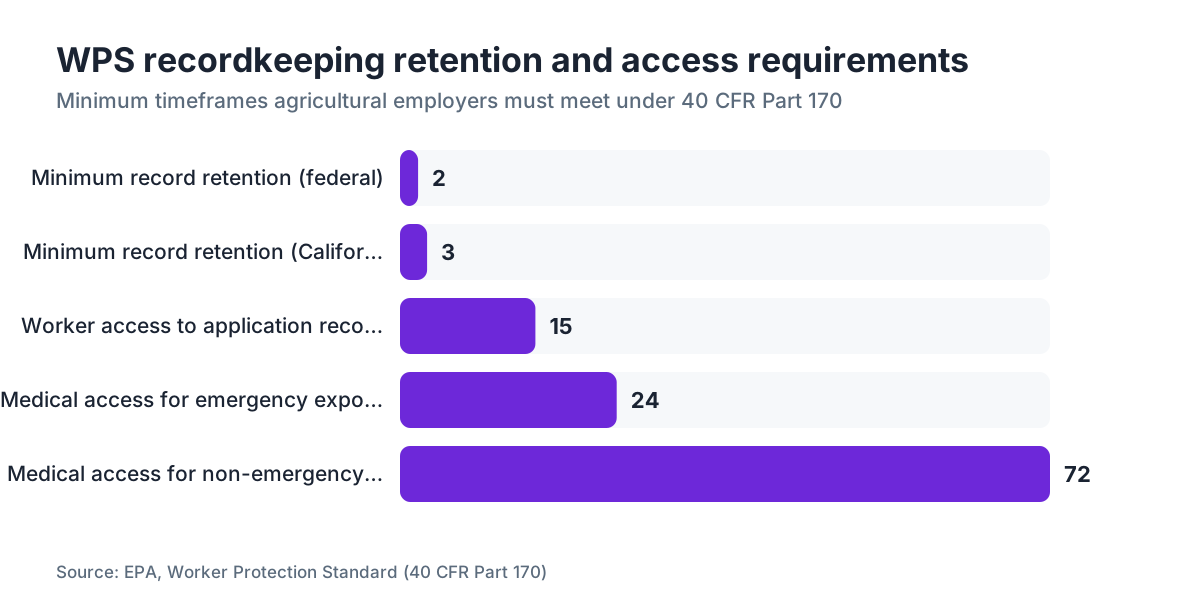
Two years. That's the federal minimum for all WPS records under 40 CFR 170.309. [1] Some states require longer. California CDPR requires pesticide use records to be kept for three years under California Food and Agricultural Code Section 12981. [2] When state law is stricter than the federal rule, the state standard governs in that state.
Access rules matter as much as retention rules. Any agricultural worker or handler, or a person they designate in writing, can request access to application records within 15 days of making the request. [1] You do not have to give them a copy (though providing one is good practice). You must allow them to see and review the records.
A treating physician also gets access if a worker is exposed to a pesticide and seeks treatment. The WPS requires you to make application records available to a medical professional within 24 hours of a request if it's for emergency treatment, and within 72 hours otherwise. [1] Having records that are actually findable at 2 a.m. is not a paperwork nicety. It's a health and safety obligation.
State enforcement agencies and EPA inspectors can access your records during normal business hours. In California, CDPR or county agricultural commissioner staff don't need a warrant to inspect pesticide records on a licensed or permitted operation.
What does WPS safety training documentation need to include?
Annual WPS safety training for workers must cover 23 specific topics listed in 40 CFR 170.301, including how to read a pesticide safety poster, how REIs work, symptoms of pesticide poisoning, and where to get emergency help. [9] Handler training covers additional topics tied to personal protective equipment (PPE) and application equipment.
Your training record for each person needs to show:
- The worker or handler's full name
- The date training was completed
- The trainer's name and, if they used an EPA-approved training program, the name of that program
- Whether the person received worker-level or handler-level training
You do not need a signature from the worker, but getting one is a reasonable practice because it creates evidence that training actually happened. Cornell Cooperative Extension recommends keeping a sign-in sheet alongside any written training materials or video logs used. [5]
Training can be delivered in person or through an EPA-approved online program. The trainer for in-person sessions must either be a certified pesticide applicator, a person with demonstrated knowledge of WPS requirements, or someone delivering a program from an accredited source. [1]
One practical note. If your workers speak Spanish, Mixtec, or another language as their primary language, EPA strongly recommends (and some state regulations require) that training be provided in a language the worker understands. UC Davis's IPM program has translated materials. [4] Training delivered in English to workers who don't understand English is not valid training under the WPS.
How should you handle restricted-entry interval records in a vineyard?
REIs in vineyards can range from 4 hours (some fungicides) to 48 hours or longer (some organophosphate insecticides). Getting the REI wrong, or failing to document that you observed it, is one of the most common WPS violations found in vineyard inspections.
The REI starts when the application ends, not when it starts. That distinction matters if you have a multi-hour spray operation across a large block. If you start spraying at 7 a.m. and finish at 1 p.m., the 24-hour REI expires at 1 p.m. the following day, not at 7 a.m. Start and end times in your application record are therefore not optional detail. They set the legal reentry time.
For your central posting, the REI expiration date and time must be posted before anyone can legally reenter the treated area after the application ends. [1] Say you apply at dusk on Monday and your crew is back in the vineyard at dawn on Tuesday. If you haven't confirmed the REI has expired, you have a recordkeeping problem and a potential worker exposure problem.
A lot of vineyard managers keep a running whiteboard or a printed weekly spray schedule that shows active REIs block by block. That is exactly what EPA and state inspectors want to see. Photograph it daily if you're managing multiple blocks with overlapping spray schedules. That photograph, timestamped by your phone, is contemporaneous evidence.
Operations running VitiScribe or similar field-record platforms can tie spray logs directly to REI timers and get push alerts when an interval expires, which takes the mental math out of a busy spray week. That kind of automation doesn't replace the underlying record. It generates it in real time.
What are the most common WPS recordkeeping violations inspectors find in vineyards?
EPA and state enforcement agencies don't publish detailed vineyard-specific violation data, but CDPR publishes annual enforcement statistics and the pattern holds steady across years. The most frequently cited WPS deficiencies in agricultural operations include:
- Missing or incomplete training records (workers trained but no documentation kept)
- Application records that lack the REI or the applicator's certification number
- Central posting not updated in time, or the posting missing required fields
- Records not made available within 15 days of a worker request
- Training not provided annually (for example, seasonal workers who weren't trained before entering treated areas)
CDPR data from 2022 showed pesticide recordkeeping violations were among the top five categories of agricultural violations statewide. [2] EPA's maximum civil penalty for a WPS violation is $19,520 per violation per day as of 2023, adjusted for inflation under the Federal Civil Penalties Inflation Adjustment Act. [6] Multiple violations from a single inspection can stack.
The real risk for most vineyards isn't a $19,520 fine on the first offense. EPA and state agencies use a penalty matrix that weighs gravity, good faith, and history of compliance. First-time violations with no worker harm and clear good-faith effort typically bring much lower penalties or a correctable warning. But "I couldn't find the records" is not a good-faith defense. It's evidence of the violation.
What's a practical recordkeeping system for a small vineyard operation?
The question I get asked most often is whether a paper system is good enough. Yes, paper is legally sufficient. EPA does not require electronic records. What it requires is that records be legible, complete, accurate, and accessible. Paper works if you actually maintain it.
For a vineyard with fewer than five blocks and one spray rig, a simple three-ring binder with tabbed sections works fine:
- Tab 1: Current year application records (one page per application, chronological)
- Tab 2: Training records (one page per worker, updated annually)
- Tab 3: Central posting log (dated entries showing what was posted and when)
- Tab 4: Prior year records (kept for the two-year retention period)
Date everything. Sign everything. Don't backfill records after the fact. Inspectors are good at spotting entries written in the same pen on the same day when they should span weeks.
For larger operations with multiple blocks, multiple applicators, and crews rotating through treated and untreated areas, paper gets unwieldy fast. A spreadsheet that auto-populates REI expiration times from the application end time and the label REI is one simple upgrade. A cloud-based field records platform gives you mobile entry from the cab of the spray rig and searchable records for inspector requests.
WSU Extension has a free WPS compliance workbook with fillable templates for training logs and application records. [3] Cornell's WPS training resources cover the same ground for eastern vineyards. [5] Those are genuinely good free resources. Use them.
See also: vineyard for broader field operations context.
Do you need separate WPS records if you hire a PCA or custom spray applicator?
Yes. This is a persistent point of confusion. If you hire a licensed pest control advisor (PCA) who designs your spray program, or a custom commercial applicator who physically applies the pesticide, you are still the agricultural employer. [1] The WPS places recordkeeping obligations on the agricultural employer, not on the service provider.
The custom applicator has their own licensing and record obligations under state law (in California, under Food and Agricultural Code Section 11732 and the licensing requirements administered by CDPR [2]). They'll typically give you a copy of the application record. Take it. File it. Don't assume their records substitute for yours.
Where the employer relationship ends and the independent contractor relationship begins can get murky, especially with labor contractors in vineyards. If you exercise control over when and how workers enter treated areas, EPA is likely to view you as the agricultural employer regardless of the contract structure.
Handlers employed by a custom application company are that company's responsibility for WPS training and PPE. But workers you employ who might reenter treated areas after the custom applicator finishes are your responsibility for reentry notification. [1] Keep those two categories clear in your recordkeeping.
How do you document WPS compliance for organic or IPM-certified vineyards?
Organic vineyards and those enrolled in IPM programs aren't exempt from WPS. If you use any pesticide (including OMRI-listed materials like copper sulfate or sulfur) in quantities or concentrations that require a pesticide license in your state, the WPS applies. [1]
Sulfur has a REI of 24 hours on most labels when applied above certain concentrations. Copper-based fungicides commonly carry REIs of 24 to 48 hours. Plenty of vineyard managers running organic programs are surprised to find they have WPS recordkeeping obligations for inputs they thought of as benign.
The good news is that organic system plan records and pesticide application logs required under USDA NOP (7 CFR Part 205) [7] overlap heavily with WPS application record requirements. A unified log that captures all required NOP and WPS fields satisfies both with one document. UC Davis's organic viticulture resources describe what a combined compliance record can look like. [4]
For IPM-certified operations, your IPM plan and spray decision records can also double as evidence of good faith in an enforcement context. An inspector who sees a documented decision not to spray, or documentation of threshold-based decisions, sees an operation paying genuine attention to pesticide stewardship.
What should you do if a worker reports a pesticide exposure?
Stop what you're doing and treat it as an emergency first. Get the worker to medical care. Then pull your records.
Under WPS, if a worker or handler is exposed to a pesticide and seeks medical treatment, you must give the treating physician the pesticide product name, EPA registration number, active ingredient(s), and application details within 24 hours if it's an emergency, and 72 hours otherwise. [1] This is where having your records organized and findable at any hour matters concretely.
You also must give the worker the name of the pesticide and the emergency contact information for the nearest poison control center. The national Poison Control number is 1-800-222-1222.
After the immediate health situation is handled, document everything about the exposure incident: date, time, location, what the worker was doing, which product they may have contacted, and the REI status at the time. This documentation protects the worker, informs medical treatment, and gives you an accurate account if a regulatory inquiry follows.
If a worker files a complaint with CDPR, WSDA, or EPA's Office of Pesticide Programs, inspectors will request all application records and training records tied to the incident. Complete, accurate, contemporaneous records are your best evidence that you followed the WPS. Missing or retroactively completed records are the opposite.
How do state-specific WPS rules differ from federal requirements?
The federal WPS sets the floor. States with EPA-approved state plans can add stricter requirements but cannot weaken federal protections. [1]
California is the most demanding. CDPR's pesticide regulations under the California Food and Agricultural Code require restricted-use pesticide applicators to file a Notice of Intent (NOI) before applying certain materials, and the PUR must be filed with the county agricultural commissioner within 30 days. [2] California also mandates heat illness prevention plans and specific worker-in-field safety requirements under Cal/OSHA that interact with WPS but are separate compliance obligations.
Washington requires employers to provide WPS training in a language the worker understands, and WSDA actively audits vineyard operations in the Yakima Valley and Columbia Valley. [10] WSU Extension has Washington-specific WPS guidance and a compliance checklist that maps state requirements onto the federal rule. [3]
Oregon, like California and Washington, has an approved state plan. The Oregon Department of Agriculture administers WPS enforcement there.
In states without approved plans (parts of the Southeast and Midwest), EPA itself enforces the WPS directly through its regional offices. The records requirements are identical. The inspection frequency and enforcement culture can vary.
So here's what matters. Know whether your state has an approved WPS plan, identify the primary enforcement agency, and check whether they publish an inspection checklist. Most do. That checklist tells you exactly what an inspector will look at.
Can digital or cloud-based records satisfy WPS requirements?
Yes. EPA has confirmed that electronic records satisfy WPS recordkeeping requirements as long as they are accessible, legible, and can be retrieved and printed within the required timeframes. [1] There is no requirement that records be kept on paper.
The 15-day access window for worker requests and the 24/72-hour window for medical access apply equally to digital records. If your records live in a cloud system that needs internet access and your vineyard office has poor connectivity, that's a real operational risk. A local backup or a printable PDF export function fixes it.
For vineyards building a digital record system, the minimum functional requirements are:
- Timestamped entries that cannot be retroactively edited without an audit trail
- Fields that capture every WPS-required data element for applications and training
- Access controls so authorized workers can view (but not modify) records
- Export capability to PDF or print for inspector access
A platform like VitiScribe is built around exactly these requirements and ties spray logs to block maps, REI timers, and training records in one searchable record. Whether you use a purpose-built platform, a spreadsheet, or a notebook, the underlying requirement is the same: accurate, accessible, retained for two years minimum.
Frequently asked questions
What is the minimum retention period for WPS records in a vineyard?
Federal WPS requires you to keep all application records, training records, and central posting logs for at least two years from the date of the activity. Some states require longer: California mandates three years for pesticide use records under the Food and Agricultural Code. Keep the stricter state standard in mind if you operate in California, Washington, or Oregon.
Does the WPS apply to vineyards that only use organic pesticides?
Yes. If a pesticide product (including OMRI-listed materials like sulfur or copper-based fungicides) carries a REI on the label, the WPS recordkeeping and reentry protections apply. The regulation covers pesticides as defined under FIFRA, which includes many inputs used in certified organic production. Check each product label for REI language to determine your WPS obligations.
Who is responsible for WPS training records if we use a labor contractor?
The agricultural employer, usually the vineyard owner or manager, is responsible for making sure all workers who enter treated areas get WPS safety training before they do so. If a labor contractor supplies workers, spell out in your written agreement who provides and documents the training. EPA and state enforcement agencies look to the agricultural employer if records are missing.
What happens if an inspector finds we have missing WPS training records?
Missing training records can bring civil penalties up to $19,520 per violation per day under EPA's penalty authority, though first-time violations with demonstrated good faith usually result in lower penalties or corrective notices. The more serious risk is that missing training records suggest workers may have entered treated areas without required safety information, which is a worker health issue as well as a compliance issue.
How do we document the central posting location requirement?
Keep a dated log showing what was posted at the central location, when it was posted, and when it was removed or updated. A photograph of the posting with a timestamp works as supporting evidence. EPA requires the posting to show the product name, EPA registration number, treated area description, application end date and time, and the REI expiration date and time.
Is a verbal record of WPS training sufficient?
No. WPS requires written documentation of training for each worker and handler. You need the worker's name, the training date, the trainer's name, and the level of training (worker or handler). A sign-in sheet paired with a description of the training content is the standard approach. Without written records, you have no evidence the training occurred if an inspector asks or a complaint is filed.
How does the restricted-entry interval affect daily vineyard work scheduling?
The REI starts at the end of the application, not the beginning. You must post the REI expiration time before workers reenter the treated block. Common REIs in vineyards range from 4 hours (some fungicides) to 48 hours (some organophosphates). Scheduling vine work, tying, or harvesting in blocks adjacent to a treated block requires knowing whether workers might inadvertently enter a treated zone during an active REI.
Can I use the California pesticide use report as my WPS application record?
Partially. The PUR satisfies some WPS field requirements but not all. The WPS requires the REI, the certified applicator's name and certification number, and the application start and end times to be documented on the on-site record. The PUR may not capture all of those fields, and it is filed with the county, not retained on the farm. Keep a separate WPS record on-site.
Do we have to provide WPS training in Spanish if our workers speak Spanish?
EPA requires training to be provided in a manner the worker can understand. Providing English-only training to Spanish-speaking workers does not satisfy the WPS requirement. Many state plans (including California and Washington) are explicit on this point. UC Davis and WSU Extension offer translated WPS training materials. Using an EPA-approved Spanish-language training program is the clearest way to document compliance.
What records do we need to give a doctor if a worker has a pesticide exposure?
You must give the treating physician the pesticide product name, EPA registration number, active ingredient(s), and application information within 24 hours for emergency treatment or within 72 hours for non-emergency requests. This is why application records need to be physically accessible at all times, not locked in a filing cabinet only one person can open.
How far in advance do we need to train new seasonal workers before they enter treated areas?
Workers must be trained before they enter any area where pesticides have been used or REIs are in effect during the current growing season. There is no grace period. If a new worker arrives on a Monday and an REI is active in a block, they cannot enter that block until trained. Training must be completed first, before any work in treated areas begins.
Are there free WPS record templates we can use?
Yes. WSU Extension publishes a WPS compliance workbook with fillable application record and training log templates. UC Davis's IPM program offers training documentation forms. EPA's WPS webpage has a compliance guide that includes sample recordkeeping formats. Cornell Cooperative Extension also publishes WPS training resources with documentation templates for eastern vineyard operations.
Sources
- EPA, Worker Protection Standard (40 CFR Part 170): WPS requires application records, safety training records, and central posting documentation to be kept for at least two years; medical access to records required within 24 hours for emergencies; worker access within 15 days.
- California Department of Pesticide Regulation, Pesticide Use Reporting: California requires pesticide use records to be kept for three years under Food and Agricultural Code Section 12981; CDPR administers WPS enforcement for California's EPA-approved state plan.
- Washington State University Extension, Worker Protection Standard Resources: WSU Extension publishes WPS compliance workbooks and Washington-specific WPS checklists for vineyard and agricultural operations.
- UC Davis Integrated Pest Management Program: UC Davis IPM publishes WPS training documentation templates and translated training materials for Spanish-speaking agricultural workers.
- Cornell Cooperative Extension, Pesticide Safety Education Program: Cornell Cooperative Extension recommends keeping WPS sign-in sheets alongside training materials or video logs as documentation that training occurred.
- EPA, Civil Monetary Penalty Inflation Adjustments: EPA's maximum civil penalty for a WPS violation is $19,520 per violation per day as of 2023, adjusted under the Federal Civil Penalties Inflation Adjustment Act.
- USDA Agricultural Marketing Service, National Organic Program (7 CFR Part 205): USDA NOP under 7 CFR Part 205 requires pesticide application records for certified organic operations, which overlap with WPS application record fields.
- EPA, WPS 2015 Final Rule Summary: The 2015 WPS revision, effective 2017, added requirements for written pesticide application records accessible to workers, annual safety training, and records of central posting location.
- EPA, WPS Key Requirements and Compliance Guide: The WPS requires 23 specific topics to be covered in agricultural worker safety training under 40 CFR 170.301, including REI information, symptoms of pesticide poisoning, and emergency contact information.
- Washington State Department of Agriculture, Pesticide Compliance: WSDA actively audits vineyard operations in the Yakima Valley and Columbia Valley for WPS compliance under Washington's EPA-approved state plan.
Last updated 2026-07-11