How to release Anagrus wasps for leafhopper biological control in vineyards
TL;DR
- Anagrus wasps attack grape leafhopper eggs, and in well-managed vineyards near prune hedgerows they parasitize 60 to 90% of those eggs.
- Success depends on three things: releasing in early spring as first-generation eggs appear, planting overwintering habitat within 40 meters of your rows, and keeping broad-spectrum insecticides away from the release window.
What are Anagrus wasps and why do they matter for leafhopper control?
Anagrus wasps are tiny egg parasitoids in the family Mymaridae, sometimes called fairyflies. The species most relevant to California vineyards is Anagrus erythroneurae (formerly lumped under A. epos), though A. epos in the strict sense also attacks grape leafhopper eggs in some regions. [1] Each adult female finds grape leafhopper eggs laid inside leaf tissue and lays her own egg inside. The leafhopper egg never hatches. A new wasp hatches instead.
The wasp is about 0.5 mm long. You will never see it working. That invisibility is part of why growers underestimate how much natural control is already happening before they ever buy a single release vial.
Grape leafhopper (Erythroneura elegantula) and variegated leafhopper (E. variabilis) are the two main targets in California, and their damage costs real money across the North Coast, Central Valley, and Sierra Foothills. [2] At high densities, leafhoppers stipple the leaves, cut photosynthesis, and drop honeydew and cast skins that dirty the fruit at harvest. The UC IPM threshold for wine grapes is 15 to 20 nymphs per leaf on a three-leaf sample. In table grapes it drops to 10. [2]
Here's the thing about Anagrus. It's already in your vineyard to some degree if you haven't hammered it with broad-spectrum sprays. The management question is how to get more of it.
Does releasing Anagrus wasps actually work? What does the research say?
Yes, but habitat matters more than releases. Understand that before you spend a dollar on purchased wasps.
UC research led by Kent Daane and colleagues documented Anagrus parasitism of grape leafhopper eggs reaching 60 to 90% in vineyards next to French prune (Prunus domestica) hedgerows or riparian woodland. [1] Prune trees carry overwintering eggs of prune leafhopper (Edwardsiana prunicola), which feed Anagrus through winter when the vineyard has no leafhopper eggs. Without that overwintering bridge, wasp populations crash between seasons and drift back into the vineyard slowly in spring, arriving too late to catch the first leafhopper generation. [1]
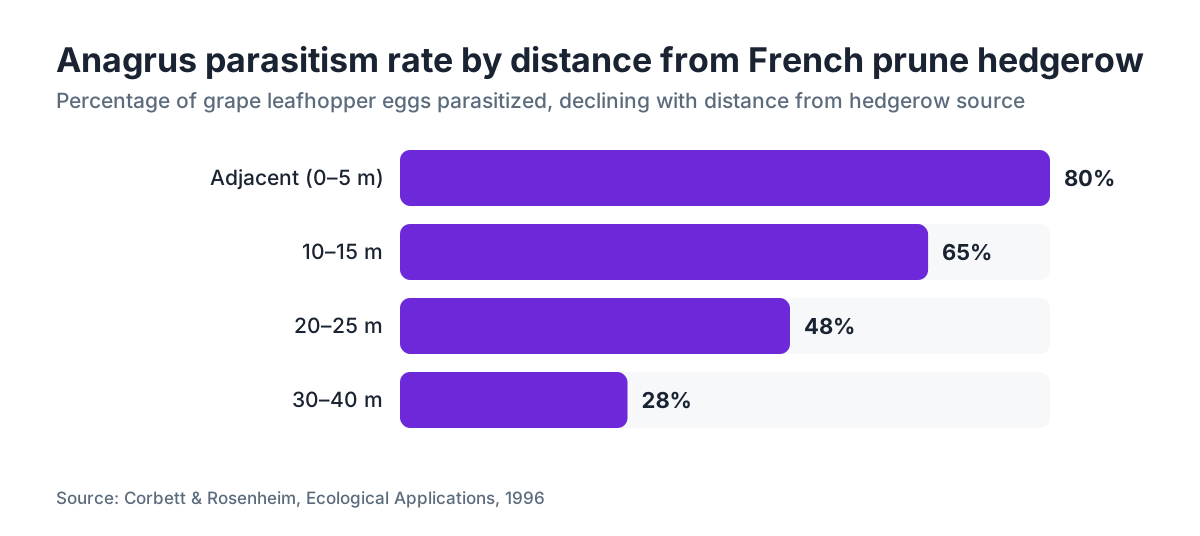
A 1996 study by Corbett and Rosenheim in Ecological Applications measured Anagrus dispersal from prune plantings and found parasitism fell with distance, from roughly 80% right at the hedgerow to under 30% at 30 to 40 meters out in some blocks. [3] That's a hard number worth remembering: if your nearest prune tree or elderberry sits more than 40 meters from the rows you care about, natural dispersal may not carry the wasp far enough.
Augmentative releases (buying and turning loose wasps) have fewer and more mixed published trials. The mechanism works. The open question is whether you can release enough wasps at the right moment to get ahead of the first leafhopper generation. UC Cooperative Extension trials in Napa and Sonoma found that timed releases in March to early April can add suppression, but the payoff was much stronger paired with hedgerow habitat than on its own. [2]
So the math is simple. No habitat and no plans to build any means purchased wasps are a temporary patch. Habitat plus an early-season gap to fill means purchased releases earn their keep.
What habitat do Anagrus wasps need, and how do you set it up?
French prune is the gold standard overwintering host in California. Prune leafhopper eggs in the bark and leaf petioles carry Anagrus through winter, and the wasps fly into the vineyard as grape leafhopper lays her first eggs in spring. Plant prune trees in hedgerows on the north or east edge of the vineyard, or in edge windbreaks, spaced 3 to 5 meters apart. Even a single row 30 to 50 meters long helps measurably. [1]
Where prune isn't practical, other options include:
- California blackberry (Rubus ursinus): hosts blackberry leafhopper, which is also an Anagrus host. It grows naturally along riparian corridors.
- Wild grape or elderberry: elderberry (Sambucus spp.) supports leafhopper species that Anagrus will parasitize as an overwintering bridge. [4]
- Cultivated elderberry hedgerows: planted at vineyard edges, these have shown promise in UC trials in Napa County. [4]
UC IPM recommends planting French prune at vineyard borders at a spacing of at least one tree per 15 to 20 linear meters of edge. [2] Don't plant them too close to the vines. You want a distinct edge habitat, not interplanting that fouls up your spray passes.
Ground covers and flowering plants in the alleyways (buckwheat, phacelia, sweet alyssum) feed Anagrus adults nectar and can nudge populations up. [4] This does less than the overwintering-host question, but it's cheap and it works alongside your other beneficial-insect goals.
One thing kills programs fast: tilling the hedgerow strip in late fall or early spring. Leave the ground undisturbed. Wasps pupate in leaf litter, and the overwintering hosts lose value if you strip out the structure around them.
When is the right time to release Anagrus wasps in spring?
Timing is the whole game. Release too early and there are no leafhopper eggs to parasitize, so the wasps disperse or die. Release too late and the first generation has already hatched, matured, and laid a second flush of eggs you'll chase all season.
Aim for the window when grape leafhopper adults are laying first-generation eggs in leaf tissue. On California's North Coast that usually starts when vines reach the 4 to 6 leaf stage, roughly late March to mid-April depending on location and variety. [2] In warmer Central Valley sites it can begin in mid-March. In cooler coastal Sonoma or Mendocino it may run to late April.
Track phenology to hit it. First-generation leafhopper adults emerge from overwintering sites around bud break and start laying eggs in expanding leaf tissue two to three weeks later. Time your release for that egg-laying stretch.
Degree-day models sharpen the call. UC IPM's degree-day calculator tracks leafhopper development on a 50°F (10°C) base. First-instar nymphs show up at roughly 200 to 300 degree-days (base 50°F) after January 1. [2] Releases timed just before nymph hatch give Anagrus the best shot at reaching eggs before they open.
In practice: if you're leaning on purchased wasps, ask for delivery 7 to 10 days before your local expected nymph-hatch date, and release the same day or the next morning.
How do you actually release Anagrus wasps, step by step?
Purchased Anagrus come as parasitized leafhopper eggs on small cards or in vials, usually from California insectaries. The wasps sit in the pupal or late-larval stage inside those eggs and emerge as adults within 1 to 5 days of delivery, depending on temperature.
Here's what to do on receipt and at release:
- Inspect on arrival. Open the package right away. Cards should show parasitized eggs (darker, with no active leafhopper larva visible). If you see live leafhopper nymphs hatching from many eggs, the material has aged past its use. Call the supplier.
- If you can't release the same day, hold vials or cards at 50 to 55°F (not below 45°F) for no more than 48 hours. Longer cold storage kills adults that have already emerged inside the vial. [12]
- Release in early morning or late afternoon. Skip midday heat above 90°F and skip rain. Wind below 10 mph is ideal.
- Placement: hang cards or open vials on vine shoots or tuck them into shoot-wire clips at about waist height, on the shaded side of the canopy. One release point per 4 to 6 row meters is common spacing, though it varies by supplier. [5]
- No insecticide within 72 hours before or after release, and that includes sulfur fungicides at high rates. Sulfur above 3 lb/acre in hot weather can kill Anagrus adults. [2]
- Make at least two releases, 10 to 14 days apart, to cover the full egg-laying window of the first leafhopper generation.
On rates: most commercial insectaries recommend 5,000 to 10,000 wasps per acre for augmentative releases when resident populations are weak. A vineyard with existing Anagrus activity (prior hedgerow work, no recent broad-spectrum sprays) may need only 2,000 to 5,000 per acre as a supplement. [5] These are supplier numbers. I'm not aware of an independent controlled trial that has cleanly validated a single universal release rate for California vineyards, so treat them as starting points, not gospel.
How do you know if the Anagrus release worked?
You measure it. Without monitoring, you're spending money and hoping.
Parasitism rate is the number that tells you the truth. To get it, collect 25 to 50 leafhopper eggs per block by taking whole leaf samples during first-generation egg-laying, usually mid-April through mid-May. Eggs are embedded in leaf tissue along the major veins, mostly on the undersides of young leaves. Take the leaves to a lab or look at them under a dissecting scope at 20 to 40x. Parasitized eggs are darker (yellowish-brown to tan) and hold a visible wasp larva or pupa. Unparasitized eggs are clear to cream and hold a developing leafhopper embryo. [2]
In a system that's working, first-generation parasitism should reach 50% or higher by the time first-instar nymphs appear. If you're seeing under 20% parasitism after a release and two weeks or more to work, then either the wasps didn't establish, the timing was off, or something (pesticides, no habitat, extreme heat) knocked them back.
Count nymphs per leaf too, starting at first instar. The UC IPM three-leaf method samples one young, one mid-canopy, and one old leaf per shoot, from 25 shoots per block, counting all nymphs. [2] Match your counts to the threshold: 15 to 20 nymphs per leaf (combined instars) for wine grapes, lower for table grapes with appearance standards.
If you're at or above threshold by second-generation nymph hatch (typically late May to June on the North Coast), Anagrus alone may not carry you and you'll need a selective insecticide. Make that call from actual counts, not from general anxiety.
What insecticides are compatible with Anagrus, and what should you avoid?
This is where a lot of programs fall apart. You do everything right with habitat and timing, then a fungal pressure event in May leads to a tank mix that wipes out your wasps for six weeks.
Broad-spectrum insecticides kill Anagrus adults and nymphs on contact. That group includes organophosphates (chlorpyrifos, now banned in California under CDPR's 2020 risk mitigation measures), pyrethroids (permethrin, lambda-cyhalothrin, bifenthrin), and carbamates. [6] These carry long residual activity and will flatten Anagrus populations for 4 to 8 weeks after application.
Selective options compatible with Anagrus include:
- Insecticidal soap: contact only, low residual, safe for Anagrus adults 24 hours after spray at label rates.
- Kaolin clay (Surround): physical barrier, no toxicity to Anagrus.
- Neem oil (azadirachtin products): moderate caution, some lab toxicity data, but field residual is short at 3 to 5 days.
- Spirotetramat (Movento): systemic, moves through the phloem; field data suggest low direct toxicity to Anagrus adults, though it does hit leafhopper populations systemically. [7]
- Petroleum oils: use with care and only when needed; direct contact is toxic but residual is short.
Sulfur fungicides deserve their own line. Elemental sulfur at standard rates in hot weather (above 85°F) is acutely toxic to Anagrus adults. Cornell's grape IPM program notes that sulfur applications during warm periods should be timed for cool morning windows to cut Anagrus exposure. [8]
Washington State University extension guidance recommends a pesticide-restricted buffer of at least 5 days around Anagrus release dates for any product with known toxicity to beneficials. [9]
For spray-record compliance, logging each application's estimated impact on beneficials is good practice and increasingly expected in sustainability audits. Tools like VitiScribe let you tag spray events with a beneficial-insect impact rating right in the spray log, which catches accidental overlap between release dates and spray windows before it costs you the wasps.
How much do Anagrus wasps cost, and where do you buy them?
California insectaries are the main source. Prices as of 2024 run roughly $20 to $50 per 1,000 wasps, depending on quantity and supplier. Most growers pay $80 to $200 per acre per release at a rate of 5,000 to 10,000 wasps per acre. Two releases a season means $160 to $400 per acre in wasp cost alone, before the labor to hang cards. [5]
For comparison, one application of a selective insecticide like spirotetramat costs $25 to $45 per acre in product at typical use rates, plus application cost. So full-rate augmentative Anagrus releases are not cheap. Strong habitat lets you cut both the release rate and the cost.
Suppliers include (list not exhaustive, no endorsement implied):
- Koppert Biological Systems (koppert.com): distributes Anagrus in California. [12]
- Rincon-Vitova Insectaries (rinconvitova.com): California-based, long history with Anagrus production. [5]
- Beneficial Insectary (now part of Koppert): historical supplier.
Order 4 to 6 weeks ahead of your target release date. Supply is seasonal and limited, and late orders get shorted on quantity or timing. Book early and most insectaries will build you a delivery schedule.
Most UC Cooperative Extension farm advisors treat purchased Anagrus as a supplement to habitat, not a replacement. The cost-benefit math shifts hard once established hedgerow habitat handles natural recolonization for you.
What worker safety rules apply to Anagrus releases under the EPA Worker Protection Standard?
Releasing biological control agents like Anagrus is not a pesticide application under FIFRA, so the EPA Worker Protection Standard (40 CFR Part 170) restricted-entry interval (REI) and PPE rules that govern insecticide applications do not directly govern the release itself. [10]
Several adjacent compliance points still matter.
First, if you're releasing wasps in a block that has an active REI from a prior spray, workers must observe that REI before entering, including to hang release cards. The wasp release does not cancel an REI already in force. [10]
Second, any spray scheduled around the release date has to meet standard WPS requirements: posting, notification, PPE, and central posting of pesticide safety information. [10]
Third, in California, CDPR's Pesticide Use Report (PUR) system does not require reporting of beneficial-insect releases, but any registered pesticide applied in the same timeframe still goes on your PUR. [6]
Fourth, biological control suppliers sometimes ship Anagrus on cards carrying a minimal sugar or protein medium. Check the label or SDS from your supplier for regulated ingredients, though in practice these are food-grade and not reportable under Prop 65 or OSHA HazCom.
If you're in an air-quality management district with spray notification requirements (several North Coast and Bay Area districts have them), the release itself is not covered, but concurrent spray events are. Keep the records straight.
How do Anagrus programs differ across California, Cornell, and WSU wine regions?
The biology and the tactics shift by region in ways that matter if you're not in California.
California (UC Davis, UC IPM) has the deepest research base. French prune hedgerows anchor the UC recommendation. The UC IPM grape guidelines carry specific Anagrus monitoring protocols and parasitism benchmarks. [2] North Coast wine country runs on established Anagrus populations in riparian corridors, and many Napa and Sonoma growers see 60 to 80% parasitism in well-managed blocks without buying a single wasp.
New York (Cornell) fights eastern grape leafhopper (Erythroneura comes) as the primary pest. Anagrus tretiakovae and related species are present but historically at lower background levels than in California. Cornell's viticulture program notes hedgerow habitat manipulation is promising but less tested in the Northeast, and that biological suppression is less consistent than in California's drier climate. [8] Cornell treats Anagrus augmentation as experimental in the New York context.
Pacific Northwest (WSU): Washington State University extension recognizes Anagrus as a natural enemy of leafhoppers in Washington vineyards, but the drier, more continental Columbia Basin presents different dispersal and overwintering conditions. WSU recommends conserving native beneficial populations through selective pesticide practices before attempting augmentative releases. [9]
Oregon tracks California's UC IPM framework more closely than WSU's, given climatic similarities in the Willamette Valley, though Anagrus research specific to Oregon is thin.
The table below lines up the regional differences.
| Region | Primary Leafhopper Species | Anagrus Species | Hedgerow Recommendation | Augmentative Releases |
|---|---|---|---|---|
| CA North Coast | E. elegantula, E. variabilis | A. erythroneurae | French prune (established best practice) | Supplement to habitat |
| CA Central Valley | E. elegantula | A. erythroneurae | French prune, elderberry | More common due to fewer natural sources |
| NY / Northeast | E. comes | A. tretiakovae | Experimental, less data | Experimental |
| WA / OR | E. elegantula | A. erythroneurae | Conservation-first approach | Limited commercial use |
What can go wrong with an Anagrus program, and how do you fix it?
Most failures trace back to one of four problems.
Timing mismatch. You release when no leafhopper eggs are present, the wasps disperse or die, and the money's gone. Fix it with degree-day tracking and direct leaf examination for eggs before you release.
Pesticide interference. A sulfur application in warm weather, a pyrethroid for another pest, or a fungicide tank mix with insecticidal activity flattens the wasp population. Fix it by auditing your spray calendar 3 to 4 weeks around planned release windows and flagging any application with known Anagrus toxicity. UC IPM's Natural Enemy Activity chart gives relative toxicity ratings for common products. [2]
No overwintering habitat. You buy wasps every year, see some effect in May, and by mid-season the population is thin again. The fix is habitat. Even 10 to 15 French prune trees along one vineyard edge makes a measurable difference by the second or third year after planting. [1]
Variegated leafhopper pressure too high. A. erythroneurae parasitizes E. variabilis less effectively than E. elegantula in some California studies, and variegated leafhopper populations tend to peak later. [2] If variegated is your dominant species, Anagrus alone may not carry you to threshold-safe levels and you may need a selective insecticide for the second generation.
One more: heat. Anagrus adults die under extended exposure above 100°F. In Central Valley blocks, releasing in late afternoon or early morning during heat events, and hanging cards in shaded canopy positions, matters more than in cooler Coast Range sites.
How do you record Anagrus releases for compliance and sustainability audits?
This is where field operations meet paperwork. More buyers and certifiers (SIP, Lodi Rules, CCOF organic, the California Sustainable Winegrowing Alliance) want documentation of biological control practices as part of their scoring. [11]
Record this for each release event: date, block ID, wasp species (Anagrus erythroneurae or A. epos, as the supplier states it), supplier name and lot number, release rate (wasps per acre), number of release points, weather at release (temperature, wind), and the name of the person who did the release.
For monitoring records: date, block ID, sample size (number of leaves), parasitism rate (%), nymph count per leaf, and any threshold comparison note.
These records don't have to be fancy, but they have to be retrievable. A paper field log works. A spreadsheet works. A dedicated field operations platform makes retrieval faster at audit time. VitiScribe's spray and field activity log lets you record biological control events alongside spray records in the same block-level timeline, which makes it easy to show that release dates and spray dates didn't collide, a question auditors ask more and more.
Under California DPR's Pesticide Use Reporting system, biological control releases need no PUR entry, but any pesticide applied in the same period must be reported within 7 days of the end of the application month. [6] Keeping your biological control records next to your spray records stops you from accidentally leaving a nearby spray event off the PUR.
See the vineyard operations overview for more on how block-level record-keeping fits into a full-season field operations system.
Frequently asked questions
Can I use Anagrus wasps in certified organic vineyards?
Yes. Biological control agents like Anagrus wasps are not pesticides under USDA National Organic Program rules and do not require an OMRI listing. Their release is fully compatible with certified organic production. You still have to make sure any concurrent pesticide applications use only NOP-allowed materials, since a non-allowed spray eliminates the wasps regardless of your certification status.
How far do Anagrus wasps disperse from a release point?
UC dispersal data shows Anagrus moving effectively within 20 to 30 meters of a release or hedgerow source, with parasitism dropping meaningfully past 40 meters. For blocks wider than 80 meters, space release points through the interior of the vineyard instead of only at the edges. Dispersal also depends on wind speed and canopy density.
Do Anagrus wasps sting humans?
No. Anagrus wasps are about 0.5 mm long and have no stinging apparatus that can pierce human skin. They are egg parasitoids that attack leafhopper eggs, not humans or other vertebrates. There are no worker safety concerns specific to the wasps themselves during release, though standard WPS requirements apply to any concurrent pesticide applications.
When should I give up on Anagrus and spray an insecticide instead?
If nymph counts in a block hit or pass 15 to 20 nymphs per leaf (three-leaf UC IPM sampling method) before second-generation parasitism has had time to act, a selective insecticide is justified. Spirotetramat (Movento) is one of the more Anagrus-compatible rescue options. Make the spray-or-don't call from actual field counts, not calendar dates.
How many French prune trees do I need to support Anagrus populations?
UC IPM recommends at least one prune tree per 15 to 20 linear meters of vineyard edge, in a hedgerow planting. Even a small planting of 10 to 20 trees along one block edge has shown measurable benefit in Napa and Sonoma trials. The trees need 2 to 3 years to establish before prune leafhopper populations build to levels useful for Anagrus overwintering.
Does Anagrus work on all leafhopper species in my vineyard?
Anagrus erythroneurae is effective against grape leafhopper (Erythroneura elegantula) and has some activity against variegated leafhopper (E. variabilis), though parasitism rates on variegated run lower. In the Northeast, Anagrus tretiakovae targets eastern grape leafhopper (E. comes). If your vineyard has mixed leafhopper species, identify the dominant one before deciding on a biological control strategy.
Can I collect and redistribute Anagrus wasps from one part of my vineyard to another?
In theory yes, but it isn't practical at scale. Collecting parasitized leafhopper eggs, identifying them correctly, and moving them in meaningful numbers takes a dissecting scope and careful handling. Most growers rely on natural dispersal across their blocks or buy commercial material. The one exception: saving parasitized egg-bearing pruned canes from a high-parasitism block and redistributing them during winter pruning, a technique used occasionally in research.
How soon after planting a French prune hedgerow do I see Anagrus benefits?
Usually 2 to 3 years. Prune leafhopper populations need time to build on the trees, and Anagrus in turn needs time to track that host. First-year trees rarely carry enough prune leafhopper egg load to hold meaningful Anagrus populations through winter. Supplemental purchased releases make more sense during the establishment years while the hedgerow matures.
What temperature range do Anagrus wasps need to be active and effective?
Anagrus adults are most active between 65°F and 90°F (18 to 32°C). Below 55°F they turn sluggish and don't search well. Above 100°F for extended periods, mortality climbs sharply. In the Central Valley, time releases and card placements for cooler parts of the day during heat events. In cooler coastal regions, cold spring temperatures can delay activity even after a well-timed release.
Is there a way to test whether my vineyard already has a resident Anagrus population before buying wasps?
Yes. In early spring (March, before first-generation eggs hatch), collect 25 to 50 leafhopper eggs from leaf tissue and examine them under a dissecting scope. Darkened eggs with an internal wasp larva or pupa show resident parasitism. If you're seeing 20 to 30% natural parasitism before any releases, you likely have a resident population worth supporting through habitat rather than augmentation.
Do I need a license or permit to purchase and release Anagrus wasps in California?
For intrastate purchase and release of commercially produced Anagrus wasps from a licensed California insectary, no special permit is required. CDPR regulates commercial insectaries under the Food and Agricultural Code but does not require the grower to hold a permit for releasing commercially produced beneficials. Check with your county agricultural commissioner if you plan any interstate shipment of biological control agents.
What's the difference between Anagrus epos and Anagrus erythroneurae?
These were long treated as one species under the name A. epos. Research in the 1990s and 2000s split the complex into multiple species. Anagrus erythroneurae is the primary leafhopper egg parasitoid in California vineyards; A. epos in the strict sense attacks a broader host range. California suppliers typically sell A. erythroneurae or a species complex from the California grape leafhopper system, though labeling varies. Ask your supplier which species they are rearing.
How does climate and drought stress affect Anagrus effectiveness?
Drought-stressed vines can shift leafhopper dynamics, often raising populations as leaves lose turgor and become easier to feed on. Anagrus effectiveness itself isn't directly impaired by vine drought stress, but if leafhopper pressure rises with drought, you may need higher release rates or a selective insecticide backup. Extreme heat above 105°F during the release window cuts wasp adult survival regardless of water stress.
Sources
- UC Division of Agriculture and Natural Resources, Daane et al., research on Anagrus and hedgerow habitat: French prune hedgerows host prune leafhopper, providing an overwintering bridge for Anagrus; parasitism rates of 60 to 90% documented in adjacent vineyard blocks
- UC IPM, Grape Pest Management Guidelines: Leafhoppers: UC IPM economic threshold of 15 to 20 nymphs per leaf for wine grapes; degree-day base 50°F for leafhopper development; Anagrus monitoring protocols and pesticide compatibility guidance
- Corbett, A. and Rosenheim, J.A. (1996). Impact of a natural enemy overwintering refuge and its interaction with the surrounding landscape. Ecological Applications 6(4): 1176 to 1188.: Anagrus parasitism declined from approximately 80% adjacent to hedgerow to under 30% at 30 to 40 meters distance
- UC IPM, Grape Pest Management Guidelines: cover crops and hedgerows for beneficial insects: Elderberry and flowering cover crops support Anagrus adults and can serve as alternative hedgerow habitat for overwintering Anagrus populations
- Rincon-Vitova Insectaries, Anagrus product information: Commercial release rate guidance of 5,000 to 10,000 Anagrus per acre and price range approximately $20 to $50 per 1,000 wasps
- California Department of Pesticide Regulation, Pesticide Use Reporting: Biological control agent releases do not require PUR entry; pesticide applications must be reported within 7 days of end of application month; chlorpyrifos risk mitigation measures enacted 2020
- Bayer CropScience, Movento (spirotetramat) product information: Spirotetramat field data indicate low direct toxicity to Anagrus adult wasps at recommended label rates
- Cornell University, New York State IPM Program, Grape IPM guidelines: Sulfur applications during warm periods are harmful to Anagrus; Cornell notes biological control by Anagrus is less consistent in New York than California
- Washington State University Extension, Pacific Northwest Pest Management Handbook: Grapes: WSU recommends conserving native Anagrus populations through selective pesticide practices; 5-day pesticide buffer around beneficial insect release dates recommended
- U.S. EPA, Worker Protection Standard for Agricultural Pesticides, 40 CFR Part 170: Biological control agent releases are not pesticide applications under FIFRA; active pesticide REIs in a block still apply to workers entering for any purpose
- California Sustainable Winegrowing Alliance, Sustainability in Practice (SIP) certification standards: SIP and Lodi Rules certification scoring includes documentation of biological control practices as part of vineyard sustainability criteria
- Koppert Biological Systems, Anagrus product sheet: Commercial supplier information for Anagrus wasps; storage temperature guidance of 50 to 55°F for short-term holding of shipments
Last updated 2026-07-11