Napa County erosion control plan documentation requirements for vineyards

TL;DR
- Napa County requires most vineyard operators to file an Erosion Control Plan (ECP) through the Watershed Information Center before any land disturbance over one acre, or any grading on slopes above 5%.
- Plans must include site maps, soil data, cover crop schedules, drainage design, and annual reporting.
- Non-compliance can trigger stop-work orders and fines under the Napa County Grading and Erosion Control Ordinance.
What is the Napa County Erosion Control Plan requirement for vineyards?
Napa County's erosion control requirements for vineyards come from two local instruments: the Napa County Grading Ordinance (Napa County Code Chapter 18.108) and the Napa County Erosion Control Program run through the Resource Conservation District (RCD) and the county's Watershed Information Center. [1] Together they require you to document, submit, and put in place an approved Erosion Control Plan before you disturb soil, grade, or install new vineyard infrastructure that crosses certain triggering thresholds.
The short version: plant on a slope over 5%, grade more than one acre, or disturb stream setback areas, and you almost certainly need a formal ECP on file before a shovel goes in the ground. Many operators are surprised that even replanting projects can trigger the requirement if they involve significant soil disturbance.
Napa County adopted these rules partly in response to the Statewide General Permit for Discharges of Storm Water Associated with Construction Activity (Construction General Permit, Order 2009-0009-DWQ, as amended), which the State Water Resources Control Board administers. [2] Local requirements can be stricter than state minimums. In Napa, they usually are.
Which vineyards and projects are required to file an erosion control plan?
The triggering conditions in Napa County are worth knowing precisely, because the thresholds sit lower than many growers expect.
You need a county-approved ECP if any of the following apply to your project [1]:
- Land disturbance (grading, excavation, clearing) exceeds one contiguous acre
- Any grading occurs on slopes steeper than 5%
- Work occurs within a required setback from a stream, creek, or drainage channel
- The project involves new vineyard development on land that was not previously farmed
- Terracing or deep-ripping is planned on slopes greater than 15%
Small replant projects confined to flat, already-farmed land under one acre may be exempt, but confirm that with the Napa County Planning, Building, and Environmental Services Department before you assume anything. Calling the Watershed Information Center at the county is the fastest path to a clear answer for your specific parcel.
The State's separate requirement, the Construction General Permit, kicks in at one acre of land disturbance regardless of slope. Cross that threshold and you'll need both a county ECP and a state-level Stormwater Pollution Prevention Plan (SWPPP) filed through California's Stormwater Multiple Application and Report Tracking System (SMARTS). [2] These are separate filings with separate fees. Many operators treat the SWPPP as the harder document and let the county ECP ride on it, but the county has its own content requirements that don't always line up with the state form.
What documents and information must an erosion control plan include?
Napa County's ECP content requirements go well past a standard grading permit application. The county's Watershed Information Center publishes a checklist, but the core required elements break down like this [1][3]:
Site description and maps
You need a project location map (USGS topographic base at minimum), a site map showing existing contours at two-foot intervals on slopes above 10%, property boundaries, all water features, existing drainage infrastructure, and any oak woodland or sensitive habitat areas. Digital submissions in PDF are standard now, but the county may ask for GIS-compatible files on larger projects.
Soil survey and erodibility data
The plan has to identify soil types using the USDA Web Soil Survey for Napa County. [4] State the erodibility factor (K-factor) for each mapped soil unit on the disturbed footprint. Some plans also require a Universal Soil Loss Equation (USLE) or Revised USLE (RUSLE2) calculation, particularly for projects on slopes above 15% or with drainage to a blue-line stream.
Grading and drainage design
A grading plan stamped by a licensed civil engineer or geologist is required for most projects involving slopes greater than 15% or cuts/fills exceeding five feet. Drainage calculations have to show that post-project peak runoff rates don't exceed pre-project rates for the 10-year, 24-hour storm event.
Cover crop and revegetation schedule
The plan has to specify species, seeding rates, and timing for temporary cover crops during construction and permanent vegetation for disturbed areas not occupied by vines. UC Davis extension research consistently shows that mustard, cereal rye, and oats hold soil well in Napa's winter rainfall. [5]
Best Management Practices (BMPs) schedule
Every ECP has to list the specific BMPs to be installed, with the installation date and responsible party named. Common required BMPs include straw wattles or fiber rolls at the downslope edge of disturbed areas, inlet protection on any storm drain inlets within 200 feet, and silt fencing along drainage channels.
Inspection and maintenance plan
Document who runs weekly inspections during the rainy season (October 1 through April 30 in Napa County) and within 48 hours after any storm producing 0.5 inches or more of rain. Inspection logs are part of the record and must stay on-site and available for county review.
Annual compliance report
An annual report summarizing BMP performance, any erosion events observed, and corrective actions taken has to be filed with the county. The due date is typically May 31 each year, covering the prior rainy season.
What are the slope and setback thresholds that affect plan complexity?
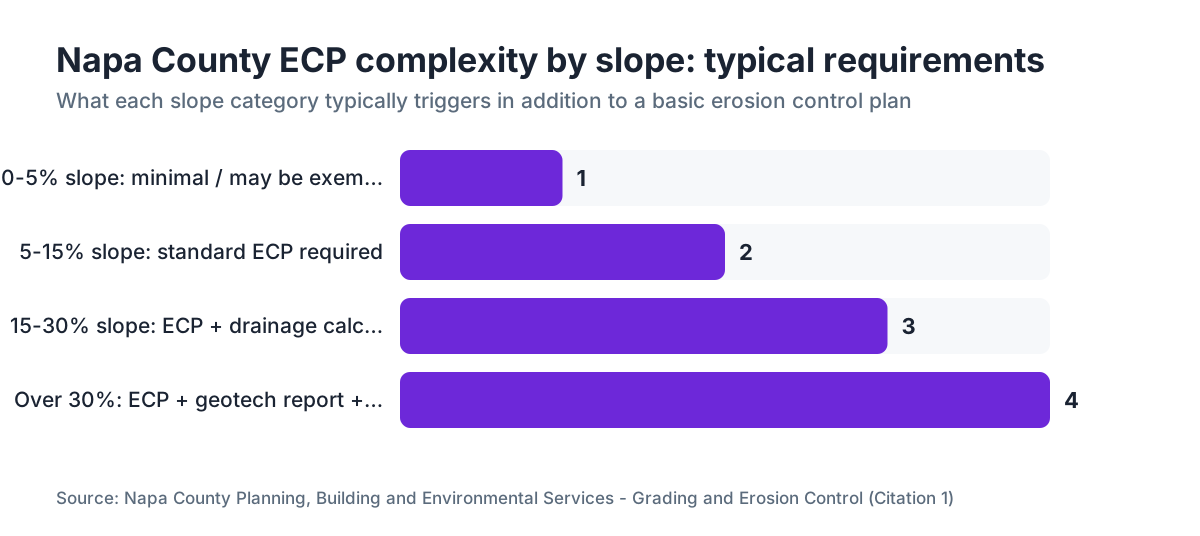
Slope is the variable that decides how complicated your ECP gets and whether you'll need engineering stamps.
| Slope Range | Typical ECP Complexity | Licensed Engineer Stamp Required? | RUSLE2 Calculation Required? |
|---|---|---|---|
| 0-5% | Minimal; may be exempt | No | No |
| 5-15% | Standard ECP | Usually no | Often no |
| 15-30% | Full ECP + drainage calcs | Often yes | Yes |
| Over 30% | Full ECP + geotech study | Yes | Yes |
Stream setbacks under the Napa County Code and the state Streambed Alteration Agreement process (Fish and Game Code Section 1602) add another layer. [6] The setback distance varies by stream type and width, but the county's default for most blue-line streams is 50 feet from the top of bank for any ground disturbance. Work inside that setback often triggers both county and California Department of Fish and Wildlife review, and the ECP has to address how riparian buffer vegetation will be protected or restored.
Steep hillside vineyards above 30% slope are the hardest cases. The Napa County Hillside Ordinance (County Code Chapter 18.108) got stronger after big flood events in the Milliken, Conn, and Tulucay creek watersheds, and planners now routinely require geotechnical reports as a condition of ECP approval on those slopes. Budget accordingly.
How do you submit an erosion control plan in Napa County?
Submissions go to the Napa County Planning, Building, and Environmental Services (PBES) Department, specifically the Land Use Division. [1] As of 2024, the county accepts electronic submissions through its online permit portal. The Watershed Information Center, a joint program between the county and the Napa County Resource Conservation District, gives technical help to applicants during plan preparation.
The basic submission package includes:
- Completed Erosion and Sediment Control Plan application form
- All technical documents described in the previous section
- Application fee (see fee schedule; erosion control plan review fees ran roughly $1,500 to $4,500 for most vineyard projects as of 2023, though fees change with annual county budget cycles)
- Grading permit application if applicable
- Copy of any state permit applications (SWPPP, 1602 Streambed Alteration Agreement)
Review timelines are not fast. The county's stated goal is to finish initial review within 30 business days, but complex hillside projects with multiple agency referrals commonly take 60 to 90 days for first comments. Plan on submitting well before your target construction window, ideally by July for fall grading work.
The Napa RCD offers a free pre-application meeting for vineyard operators new to the process. Take it. Staff there can flag issues with your site that would otherwise come back as plan deficiencies after weeks of review time.
What are the rainy season work restrictions for Napa vineyard operations?
Napa County prohibits most significant grading and soil disturbance between October 15 and April 15 unless the operator has an approved Wet Season Waiver or Rain Season Variance and all required BMPs are in place before work begins. [1] This window drives your whole development schedule.
A Wet Season Variance requires extra documentation beyond the standard ECP, including proof that all temporary erosion control measures are installed and working before work resumes after any rainfall event. Inspections during the rainy season come more often, typically weekly at a minimum plus the post-storm inspections mentioned above.
For ongoing farming (not new development), the county's Agricultural Erosion Control Program has separate provisions that recognize routine farming activities. Cover cropping, for example, is expected to be fully established by October 15 each year on all disturbed inter-row areas. The requirement for 70% ground cover in all disturbed areas by October 15 is a hard standard that shows up in many permit conditions. [3]
Most experienced Napa vineyard managers try to finish any real earthwork by September 30, leaving two weeks of buffer before the hard cutoff. Equipment on steep slopes after the first fall rains can do more damage in a single event than the cost of waiting until spring.
How does the county verify compliance with erosion control requirements?
Napa County uses several enforcement mechanisms. The PBES department runs field inspections, and the county also works with the Regional Water Quality Control Board (San Francisco Bay Region, Region 2, or North Coast Region 1 depending on watershed location) on compliance referrals. [7]
Inspectors look for:
- Whether approved BMPs are actually installed and working
- Whether inspection logs are current and on-site
- Whether disturbed areas have adequate temporary cover before the rainy season
- Whether any unauthorized grading or disturbance has happened outside the project boundary
The county's complaint-driven inspection process also means your neighbors matter. Sediment leaving your property during a rain event is both a violation of your ECP conditions and potentially a violation of the state's Porter-Cologne Water Quality Control Act. [8]
Fines for non-compliance can start at $1,000 per day per violation under the county's administrative penalty authority and climb from there. Stop-work orders get issued when inspectors find conditions that create imminent erosion risk. Getting a stop-work order lifted takes a re-inspection after corrections, which often means weeks of delay in a narrow construction window.
Keeping your inspection logs current and reachable is the cheapest insurance you have. Tools like VitiScribe can digitize those field logs so they're time-stamped and pull up on a phone when an inspector shows up unannounced.
What BMPs does Napa County specifically require for vineyard sites?
Napa County's ECP guidelines draw on the California Stormwater Quality Association's BMP Handbooks and the state's Construction General Permit BMP requirements, with vineyard-specific tweaks. [9] The most commonly required BMPs for vineyard projects include:
Hydroseeding or broadcast seeding with mulch
All cut-and-fill slopes get seeded right after grading, with mulch (straw crimp or hydromulch) applied to hit at least 70% cover before October 15 or within 14 days of final grading, whichever comes first.
Fiber rolls and straw wattles
Required at the downslope edge of all disturbed areas and along contours on slopes greater than 15%, typically at 50-foot vertical intervals maximum.
Erosion control blankets
Required on slopes greater than 2:1 (horizontal:vertical) that are seeded but not planted with vines, and in all drainage swales.
Check dams
Required in all constructed drainage channels where velocity calculations show erosive potential. Rock check dams beat straw because they last longer.
Vehicle tracking control
A rock construction entrance, minimum 50 feet long and 6 inches deep, is required wherever construction vehicles reach the site from a paved road.
Inlet protection
Straw wattles or filter fabric inserts are required around all storm drain inlets within 200 feet of the project boundary.
The Napa RCD's Vineyard Erosion and Sediment Control Ordinance (VESCO) program offers cost-share help for BMP installation on qualifying properties. That funding has historically covered 50% to 75% of BMP installation costs for participating landowners, though annual availability varies. [3]
How long does approval take and what does it cost to prepare a plan?
Honest answer: it varies a lot, and anyone who quotes you a fixed number without seeing your site is guessing.
For a straightforward replant project on a moderate slope (5 to 15%), where you're not in a stream setback and the disturbed area is under five acres, plan preparation by a qualified consultant typically runs $3,000 to $8,000 and takes four to six weeks. Add county review of 30 to 60 business days for a realistic total of three to four months from starting the consultant search to holding an approved plan.
For a new hillside vineyard on slopes above 15%, with stream setbacks involved and a geotechnical study required, plan preparation including the geotech report can reach $15,000 to $40,000, and the full approval process including county review and a possible 1602 Streambed Alteration Agreement from CDFW can take six to twelve months. [6]
There's no good shortcut on complex projects. The county won't expedite ECP review for a fee the way some jurisdictions do for building permits. A complete, well-organized package the first time is the most reliable way to cut total clock time.
The UC Cooperative Extension farm advisor network in Napa County can sometimes point you toward qualified consultants with local project experience. [5] That's a better starting point than a cold internet search.
How do annual reporting and record-keeping requirements work?
Once your ECP is approved and your project is built, the paperwork keeps going. Napa County requires ongoing documentation through the life of the project and, in some cases, for a period after final stabilization is reached.
Required ongoing records include [1][3]:
Rainy season inspection logs
Weekly inspection logs from October 1 through April 30, plus a log entry within 48 hours of any storm producing 0.5 inches or more. Each log entry has to record weather conditions, any evidence of erosion or BMP failure, and corrective actions taken.
Annual compliance report
Due May 31 each year. It has to summarize the rainy season's BMP performance, photograph key BMP installations before and after any significant storm events, and document any erosion incidents and how they were addressed.
Final stabilization determination
You can request a final stabilization determination from the county once at least 70% permanent vegetative cover is established across all disturbed areas and all temporary BMPs are removed. Once that determination is made, annual reporting requirements typically end.
Keeping all of this where you can find it fast matters more than people expect. Field notes scrawled on paper and filed in a binder in the winery office are technically compliant, but useless when you're standing in a muddy vineyard and a county inspector asks for last Tuesday's post-storm log. Digital record-keeping in a platform built for vineyard compliance, a spreadsheet system or something like VitiScribe, makes that retrieval real. The records have to be available on-site and on demand.
Are there any state or federal programs that overlap with the county requirements?
Yes, and the overlap is where operators most often trip up by assuming one approval covers everything.
State Construction General Permit (CGP)
For any project disturbing one or more acres, the State Water Resources Control Board's Construction General Permit requires a Stormwater Pollution Prevention Plan (SWPPP) prepared by a Qualified SWPPP Developer (QSD), filed through the state's SMARTS system. [2] The county ECP and the SWPPP are separate filings. Some consultants can prepare both at once, which saves time.
California Department of Fish and Wildlife, Section 1602
Any project that alters a streambed or riparian corridor requires a Streambed Alteration Agreement from CDFW before work begins. [6] Processing times have historically run 60 days from a complete application, though agency capacity swings. The county's ECP will often be conditioned on getting the 1602 agreement first.
Section 401 Water Quality Certification and Section 404 Permit
If the project involves filling or dredging in waters of the United States, a Section 404 permit from the Army Corps of Engineers and a Section 401 water quality certification from the State Water Board may be required. [10] Vineyard projects rarely trigger this unless they involve significant stream crossings or pond construction, but check with a wetlands consultant for any project near drainage features.
EPA Pesticide Worker Protection Standard
Separate from erosion control, but worth noting for vineyard compliance: the EPA's Worker Protection Standard (WPS) requires pesticide application records, safety training documentation, and posting requirements that stand entirely apart from erosion control paperwork. [11] The WPS doesn't overlap with ECP requirements, but many operators run both sets of compliance at once, and confusing which agency wants what is common.
UC Davis has published practical guides through its Agriculture and Natural Resources division on coordinating these multiple permit streams for vineyard development. [5] WSU Extension has comparable guidance for Pacific Northwest operators, which, while not Napa-specific, gives useful frameworks for understanding regulatory layering. [12]
What are the most common reasons erosion control plans get rejected or delayed in Napa County?
County planners see the same problems over and over. Knowing them ahead of time saves you a review cycle.
Incomplete soil data. Plans that cite soil series names without K-factor values, or that don't use current USDA Web Soil Survey data for the parcel, come back with comments every time. [4]
Missing drainage calculations. For any slope over 15%, submitting a narrative description of drainage without actual calculations is a red flag. The county wants numbers: peak flow rate before and after, calculated in cubic feet per second for the 10-year storm.
Generic BMP lists. Plans that just say "install straw wattles as needed" without specifying locations on a grading plan, installation timing, and spacing intervals count as incomplete. BMPs have to tie to the plan sheets.
No wet weather contingency. The plan has to address what happens if a storm hits while grading is in progress. Saying "work will stop if it rains" isn't enough. You need a documented protocol for stabilizing the site within 24 hours of a storm that interrupts grading.
Wrong engineer signature. Some grading plans in Napa require both a licensed civil engineer and a licensed engineering geologist signature, not one or the other. Check the specific requirements for your slope category before paying for stamps.
Late submission. Submitting in August for an October grading start doesn't work if the county needs 60 business days for review and your project requires a 1602 agreement. Work backward from your construction start date and add 30% buffer.
Frequently asked questions
Does a small vineyard replant under one acre need an erosion control plan in Napa County?
It depends on slope. If the replant area is on a slope greater than 5% or involves significant soil disturbance, a county ECP may still be required even if the area is under one acre. Flat, previously farmed land under one acre on slopes below 5% is more likely to be exempt, but confirm with Napa County PBES before assuming exemption. Call the Watershed Information Center directly.
Who can prepare an erosion control plan for a Napa vineyard project?
The county doesn't license specific ECP preparers, but for projects on slopes above 15% or involving significant grading, the plan has to be stamped by a licensed civil engineer or registered geologist. For less complex projects, a qualified agricultural consultant or vineyard planner with ECP experience may prepare the plan. The Napa RCD can provide a referral list. Always check what the county specifically requires for your slope category before hiring.
What is the deadline for having cover crops established before the Napa rainy season?
Napa County requires 70% ground cover in all disturbed inter-row and disturbed bare areas by October 15 each year. This is a firm standard that appears as a condition in most ECP approvals. Cover crop seeding typically needs to happen by early September to hit that threshold by October 15, depending on species and conditions.
How long do I have to keep erosion control inspection records in Napa County?
The county's standard permit conditions require records to be retained for at least three years after the project receives a final stabilization determination, and to stay available on-site for inspection during that period. If the project is also subject to the state's Construction General Permit, the SMARTS system imposes its own retention requirements, which are also three years from the filing of a Notice of Termination.
What happens if erosion from my vineyard enters a stream or neighboring property?
You're potentially in violation of your ECP permit conditions, the county's Grading Ordinance, and possibly the state's Porter-Cologne Water Quality Control Act, which prohibits discharges that cause or threaten to cause water quality degradation. The Regional Water Quality Control Board can issue cleanup and abatement orders and assess fines. The county can also issue stop-work orders and administrative penalties starting at $1,000 per day per violation.
Does a Napa vineyard erosion control plan expire?
ECP approvals are typically tied to the associated grading permit, which in California expires if work doesn't commence within one year of permit issuance. If you don't start work within that window, you'll need to renew the permit, and if conditions on the site or in county regulations have changed, you may need to revise the plan. Annual reporting requirements continue until the county issues a final stabilization determination.
What is the Napa VESCO program and how does it help with erosion control costs?
VESCO, the Vineyard Erosion and Sediment Control Ordinance program, is run by the Napa County Resource Conservation District. It provides technical assistance and historically has offered cost-share funding covering 50% to 75% of qualifying BMP installation costs for participating vineyard operators. Funding varies by year. Contact the Napa RCD directly to confirm current funding availability and eligibility requirements before budgeting a project.
Do I need a separate SWPPP in addition to the county erosion control plan?
Yes, if your project disturbs one acre or more of land. The California State Water Resources Control Board's Construction General Permit requires a Stormwater Pollution Prevention Plan prepared by a Qualified SWPPP Developer and filed through the state SMARTS system. This is separate from the county ECP, though the two documents should be consistent with each other. Some consultants prepare both documents at once to reduce costs.
Can I do grading work in Napa County during the October to April rainy season?
Generally no, without a Wet Season Variance from the county. The standard prohibition on significant grading runs from October 15 to April 15. A variance is possible but requires proof that all BMPs are installed and functional before any rain event and that inspection protocols are in place. Most experienced operators avoid this process entirely by finishing earthwork before October 1 to have a buffer.
What soil data does the Napa County ECP require and where do I get it?
Plans have to identify soil types and their erodibility (K-factor) values using the USDA Natural Resources Conservation Service Web Soil Survey, which provides detailed soil mapping for all Napa County parcels. For projects on slopes above 15% or near streams, a RUSLE2 (Revised Universal Soil Loss Equation) calculation using those K-factors is typically required. Your plan consultant should pull this data as part of standard plan preparation.
How does the Napa County hillside ordinance affect erosion control plan requirements?
Napa County Code Chapter 18.108 (the Hillside Ordinance) imposes extra requirements for vineyard development on slopes above 15% and prohibits most development on slopes above 30%. For projects in the 15% to 30% range, a geotechnical report from a licensed engineering geologist is typically required as part of the ECP package. These projects also face more intensive county and RWQCB scrutiny during review.
Are organic or biodynamic vineyards exempt from erosion control plan requirements in Napa County?
No. Certification status under USDA National Organic Program or Demeter biodynamic standards has no bearing on Napa County's erosion control permit requirements. The requirements are based on land disturbance, slope, and proximity to waterways, not farming philosophy. Organic operations that involve new vineyard development or significant grading must comply with the same ECP requirements as any other operation.
What role does the Napa RCD play in the erosion control plan process?
The Napa County Resource Conservation District gives technical assistance to vineyard operators working through the ECP process, including pre-application consultations, BMP selection guidance, and administration of the VESCO cost-share program. The RCD doesn't approve or deny permits (that's PBES), but they're often the most practical first call for a grower who isn't sure where to start or which requirements apply to a specific site.
Sources
- California State Water Resources Control Board - Construction General Permit Order 2009-0009-DWQ: State Construction General Permit requires SWPPP for projects disturbing one or more acres, filed through SMARTS
- Napa County Resource Conservation District - VESCO Program: VESCO cost-share program covers 50-75% of qualifying BMP installation costs; 70% ground cover required by October 15; annual reporting requirements
- USDA Natural Resources Conservation Service - Web Soil Survey: K-factor (erodibility) values for soil types required by Napa County ECP; source for soil mapping data by parcel
- UC Division of Agriculture and Natural Resources - Cooperative Extension Napa County: UC Cooperative Extension guidance on cover crop species (mustard, cereal rye, oats) for erosion suppression and vineyard development permit coordination
- California Department of Fish and Wildlife - Streambed Alteration Program (Fish and Game Code Section 1602): Section 1602 Streambed Alteration Agreement required before work altering a streambed or riparian corridor; processing historically 60 days from complete application
- San Francisco Bay Regional Water Quality Control Board - Region 2: Regional Water Quality Control Board enforcement role for erosion control violations in Napa County watersheds
- California State Water Resources Control Board - Porter-Cologne Water Quality Control Act: Porter-Cologne Act prohibits discharges that cause or threaten water quality degradation; basis for enforcement actions when vineyard sediment enters waterways
- California Stormwater Quality Association - BMP Handbooks: CASQA BMP Handbook standards referenced by Napa County ECP guidelines for vineyard-site BMP requirements
- US Army Corps of Engineers - Section 404 Permit Program: Section 404 permit required for fill or dredging in waters of the United States; applies to vineyard projects involving stream crossings or pond construction
- US EPA - Worker Protection Standard for Agricultural Pesticides: EPA Worker Protection Standard requires pesticide application records, safety training documentation, and posting requirements for vineyard operations
- Washington State University Extension - Vineyard Site Development and Erosion: WSU Extension frameworks for understanding regulatory layering in vineyard development permit processes
Last updated 2026-07-11