How to request a compliance assistance visit from your county ag commissioner

TL;DR
- A compliance assistance visit is a voluntary, usually free consultation where county agricultural commissioner staff walk your vineyard and review your pesticide records, worker safety practices, and permits before a formal inspection finds the gaps.
- You request it by calling or emailing your county ag commissioner's office and asking for a compliance assistance visit or pre-inspection consultation.
- Response times run from a few days to a few weeks.
What is a compliance assistance visit from the county ag commissioner?
A compliance assistance visit is a voluntary meeting where county agricultural commissioner (CAC) staff come to your vineyard or office and help you understand what the regulations actually require. Some counties call it a pre-inspection consultation or an outreach visit. It's not a surprise inspection. Nobody is hunting for violations to cite. The point is to find gaps before a formal inspection does.
County ag commissioners in California, and their counterparts in other states, wear two hats. They enforce ag laws, and they run outreach and education programs. For a lot of small vineyard operations those two jobs feel like a conflict, but the compliance assistance side really is separate. Staff assigned to outreach visits are usually not the same people writing up violations on enforcement inspections, though this varies by county.
The visit usually covers pesticide use records, restricted materials permits, Worker Protection Standard (WPS) compliance, and any commodity-specific rules that touch wine grapes. Some counties will also review your permit-to-operate status for spray equipment if you ask. You set the agenda. If you only want them to look at your spray records, say so and that's what they'll do.
Is a compliance assistance visit voluntary, and can anything you say be used against you?
Yes, it's voluntary. You request it, you schedule it, and you can cancel it. The county ag commissioner cannot make you have a compliance assistance visit as a condition of anything. It happens entirely at your initiative.
Confidentiality is the harder question, and the honest answer is that it depends on your state and county. Nobody should hand you a blanket guarantee. County records are subject to public records law, so if a later enforcement action turns up a violation, documentation from a prior outreach visit could in theory surface [1]. In practice that's rare. Most experienced compliance staff won't produce a detailed written report of an outreach visit unless you ask them to. Call your county office and ask directly what they write down and who gets to see it.
Here's what is clear. If you fix a problem after an outreach visit and there's no ongoing harm, that visit is not a trigger for enforcement. The purpose is correction, not prosecution. UC Cooperative Extension has long advised growers to use these visits precisely because finding and fixing problems early beats the slim risk of a paper trail [2].
Which county and state agencies actually offer compliance assistance visits?
In California, every county has an agricultural commissioner's office, and the CAC is the primary enforcement arm for pesticide rules at the county level, acting as a local agent of CDPR. The California Agricultural Commissioners and Sealers Association (CACASA) represents all 58 county offices, and most of them offer some form of grower outreach [3].
Outside California, the equivalent is usually the state department of agriculture or a county extension office working with state ag enforcement. In Washington, for example, WSU Extension works closely with the Washington State Department of Agriculture (WSDA) Pesticide Management Division on grower compliance [4]. Cornell Cooperative Extension runs similar outreach for New York vineyards through its county offices.
The EPA's Worker Protection Standard is federal. The agency that enforces it in your state may be your state department of agriculture, your state environmental agency, or an EPA Region office directly. For most wine grape states, WPS enforcement runs through the state ag department, which then works with county offices. So even though the rule is federal, the person who can walk your vineyard and tell you whether your WPS program is right is probably a county-level staffer [5].
Not sure who to call? Start with your county ag commissioner. They'll route you to the right program, or tell you honestly that their office doesn't do outreach visits and point you somewhere that does.
How do you actually request a compliance assistance visit?
The process is simple, and the only reason growers don't use it more is that nobody told them to ask.
Step one: find your county ag commissioner's contact information. CDPR keeps a directory of all California county ag commissioner offices at cdpr.ca.gov [1]. For other states, your state department of agriculture website carries county-level contacts. In a small county you may be dialing a two-person office where the commissioner picks up the phone.
Step two: call or email and use the words "compliance assistance visit" or "pre-inspection consultation." Staff know this language. You can also say you want an outreach visit to review your pesticide records and WPS program. Be specific about what you want reviewed. If you have a particular worry, say you're unsure whether your restricted materials permit covers a new active ingredient, put that on the table upfront.
Step three: pick a date that works for both sides. Most offices try to fit you in within a few weeks. During peak spray season or when the office is short-staffed, it can take longer.
Step four: prepare your records before the visit. The next section covers this in detail.
You don't need to file a formal written request in most counties. A phone call does it. Still, send a follow-up email confirming the date, the topics you want covered, and who will attend. That creates a record you control, and it's worth the two minutes.
What should you have ready before the visit?
Walking in unprepared is the single biggest mistake growers make with these visits. You learn less, and the visit drags longer than it should.
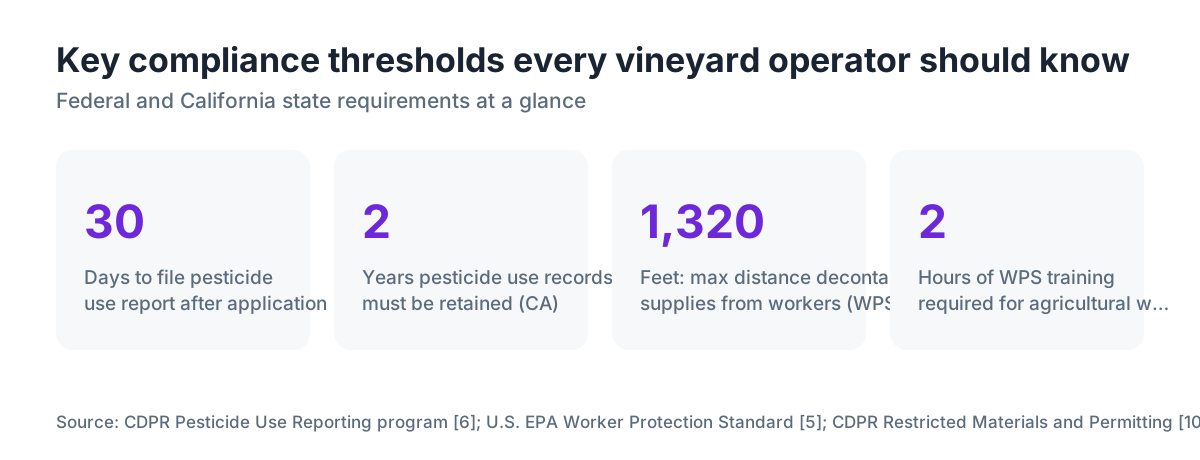
Start with pesticide use records. California requires pesticide use reports (PURs) to be filed with the county ag commissioner's office, and your records have to match what you filed [6]. Pull your spray records for the past 12 months at minimum. Some counties will look back two or three years if there's a specific question you've raised. Each record should carry the application date, field location (APN or block description), operator name, license number, product applied, EPA registration number, amount of product per acre, total acres treated, target pest, and application method. If any of those fields sit blank, fill them before the visit or flag them as questions.
WPS documentation comes next. Have your safety data sheets ready (the 2015 revised WPS requires SDSs, not the old MSDSs), proof of annual training for agricultural workers and early-entry workers, your central posting (the WPS safety poster at a spot all workers can reach), decontamination supplies, and records of any application-specific information you gave workers [5].
Restricted materials permits. If you use any California restricted-use pesticides, you need a valid permit from the county ag commissioner for each material. Bring the permits and check the expiration dates. If a permit lapsed and you kept spraying, that's a violation you want to surface now, on your terms.
Equipment calibration records. Some counties check these. Others won't unless you ask.
A site map helps more than people expect. A simple block map showing field boundaries, spray blocks, and worker facilities (toilets, handwash stations, the central posting location) lets the staffer understand your operation in about a minute and makes the whole visit run faster.
What does the county ag commissioner actually look at during the visit?
Expect the visit to hit three areas: records, physical compliance, and permits.
Records review is the heart of it. The staffer checks whether your pesticide use records are complete and consistent with your restricted materials permits. A common gap is an application recorded under a permit that didn't cover that specific field location. Another is a pesticide with a supplemental label restriction that never made it into the record. They want completeness, not a gotcha.
Physical compliance means walking the vineyard and your shop. WPS requires decontamination supplies within a quarter-mile of where workers are working, or at the start of the work period [5]. They'll check handwash stations, the central posting, and whether your SDSs are accessible to workers. If you run a closed system for mixing pesticides, they may look at that too.
Permit status review confirms that your restricted materials permits are current and that what you're permitted to use matches what you're actually spraying.
What they typically don't do on a compliance assistance visit: write violation notices, take samples, or call enforcement staff about what they found. A serious finding, say an ongoing acute hazard to workers, changes the picture. But for a garden-variety record gap or paperwork error, the expectation is that you fix it and they note you're working to correct it.
Before they leave, ask for a written summary of anything they flagged, even informal notes. That gives you a checklist and documents your good-faith effort to comply.
How long does a compliance assistance visit take, and does it cost anything?
Most visits run two to four hours for a typical small vineyard (under 100 acres, one farm labor employer). Bigger operations, or visits covering several topics, can eat a full day.
Cost is almost always zero for the grower. These visits are publicly funded as part of the county's outreach mission. A handful of California counties have tried fee-for-service consultation programs for more involved compliance work, but that's the exception. Standard outreach visits are free.
Travel time matters in rural counties with a lot of ground to cover. Some offices serve large areas with limited staff to send out. If your vineyard sits way out there, offer to bring your records to the county office for the paperwork review and schedule a separate site visit only if it's needed.
What's the difference between a compliance assistance visit and a formal inspection?
A formal inspection gets triggered by a complaint, a random pick under the county's annual inspection plan, or a tip from another agency. You generally get no advance notice (though California law does set notice requirements for some inspection types). The inspector is there to document what they find, not to coach you on fixes. Violations produce written notices, and serious ones can lead to civil or criminal penalties.
A compliance assistance visit is the mirror image. You initiate it. You set the scope. The staffer's job is to explain what's required and help you get there. No violation notices come out of it.
So here's the practical move. If you know your records or your WPS program have a problem, request a compliance assistance visit and start fixing things before a formal inspection finds them. Inspectors and commissioners absolutely notice the difference between a grower who fixed a gap on their own and one who got cited and then fixed it.
For California vineyards, the county ag commissioner conducts pesticide enforcement inspections as part of CDPR's mandated inspection program. Pesticide use records show up as one of the more frequently cited categories in CDPR's statewide enforcement reporting [6]. Getting your records reviewed ahead of that inspection cycle is plain common sense.
What happens after the visit? How do you track the follow-up items?
The visit hands you a list of things to fix. Some are quick: add a missing field to your spray record template, update an SDS binder, renew an expired restricted materials permit. Others take real time: redesigning your worker training program, installing a permanent handwash station in a remote block.
Write an action list the day of the visit. Date it. Put a name and a target date on every item. This matters because if you get inspected later and the inspector finds the same issue, your dated action list is evidence you were working in good faith.
For the record-keeping side, vineyard compliance software earns its keep. VitiScribe is built for vineyard operations and logs spray records in a format that mirrors the fields your county ag commissioner will look for during an inspection or outreach visit. A well-organized spreadsheet or paper binder works too. The tool matters less than the habit.
Once you've made your corrections, circle back to the county office. A short email saying "we fixed the items from our March visit" builds a paper trail of your compliance effort and a working relationship with the office. That relationship pays off. A commissioner who knows you take compliance seriously is not going to treat you like an adversary during a formal inspection.
What are common compliance gaps that these visits uncover in vineyards?
Based on what CDPR inspection data and extension outreach programs keep flagging, these are the problems that turn up most in wine grape operations:
Incomplete pesticide use records. Missing EPA registration numbers, a missing applicator license number, or an application logged at the wrong field location. These are the most common gaps [6].
WPS posting failures. The central posting has to display specific required documents, including the current pesticide safety information poster (the version revised under the 2015 rule). Old pre-2015 posters are still hanging in some operations [5].
Restricted entry interval (REI) recordkeeping. When workers enter a treated field during the REI, which California allows under specific conditions with the right PPE and training, the employer has to document the entry, the reason, and the protections provided. That paperwork goes missing more often than any other.
Expired restricted materials permits. Permits renew annually with the county ag commissioner. It's easy to let one lapse, especially for a material you don't use every year but keep on the permit just in case.
Missing or outdated safety data sheets. The 2015 revised WPS requires SDSs in the GHS 16-section format. Older MSDS documents don't count.
Applicator license status. If you use a pest control adviser (PCA) or a qualified applicator licensee (QAL), their licenses have to be current and appropriate for the materials being applied. Checking this before the visit saves an awkward moment.
How does this process work for vineyards in states other than California?
The mechanics change by state, but the approach holds: find the state or county agency that enforces pesticide rules for your operation, ask whether they offer compliance assistance or grower outreach visits, and request one.
In Washington, the WSDA Pesticide Management Division runs a grower assistance program. WSU Extension's Viticulture and Enology program coordinates with WSDA on compliance education for wine grape producers, and county extension offices are often the first point of contact [4].
In Oregon, the Oregon Department of Agriculture (ODA) Pesticides Division handles grower outreach. The state's wine grape industry centers on the Willamette Valley, and ODA has run vineyard-specific outreach in that region.
In New York, Cornell Cooperative Extension's county offices work alongside the NYS Department of Agriculture and Markets on compliance education. Cornell's viticulture team publishes guidance on pesticide record-keeping for New York winegrape growers [7].
Where the county structure is thin, you may deal directly with the state department of agriculture. Call the pesticides division, say you're a wine grape grower who wants a pre-inspection consultation, and ask who can help. Most state agencies have someone whose job includes this even when it isn't advertised.
The EPA's WPS compliance assistance resources are a solid starting point no matter the state. EPA Region offices each have a compliance assistance coordinator who can point you to the right state or local contact [9].
How do university extension programs fit into compliance assistance for vineyard operators?
Extension programs are not enforcement agencies. They can't write you a violation or issue a permit. But they're often the best first call before you contact the county ag commissioner, because they can explain what the regulations require in plain language before you're sitting across from someone whose agency does have enforcement power.
UC Cooperative Extension has a long record of vineyard-specific compliance education. Its farm advisor network covers most California wine grape counties and includes pest management specialists who know both the agronomic and regulatory sides of pesticide use [2]. WSU Extension in Washington runs similar programs for Columbia Valley and Puget Sound-area vineyards [4]. Cornell's Lake Erie and Finger Lakes offices cover the wine grape regions in New York [7].
Here's a practical sequence. Attend an extension workshop on pesticide compliance (most are free or cheap), use the farm advisor relationship to get your records reviewed informally, then walk into your county ag commissioner visit already knowing where your gaps are. In some counties an extension educator will even go with you to a commissioner meeting, which some growers find reassuring.
Extension programs also publish county-specific guides to permit requirements. They get updated more often than state agency websites and read like they were written for practitioners rather than lawyers. Worth bookmarking.
Frequently asked questions
Can a county ag commissioner fine me based on what they find during a compliance assistance visit?
Not from a compliance assistance visit alone. These visits are voluntary and educational. A staff member conducting an outreach visit is not there in an enforcement role and does not issue violation notices based on what they observe. The one exception is an ongoing immediate hazard to worker health, which could compel any agency official to act regardless of the visit's stated purpose. For ordinary record gaps and paperwork issues, the answer is no.
How often should a vineyard manager request a compliance assistance visit?
Once a year is a reasonable baseline. Request one any time you change your pest management program significantly, hire a new applicator, add a new block or farm worker housing, or start using a restricted material you haven't used before. New regulations also justify a fresh visit. The 2015 revised EPA Worker Protection Standard, for example, prompted many experienced growers to request outreach visits even after decades of farming.
What if I request a compliance assistance visit and then can't get my records organized in time?
Reschedule. Showing up with disorganized records helps nobody. Call the county ag commissioner's office a few days before your scheduled visit and ask to push it back two or three weeks. This is common and never held against the grower. The visit is far more useful when you're prepared, so the delay pays for itself.
Does having a compliance assistance visit reduce my chances of being selected for a formal inspection?
There's no formal mechanism for that, and you shouldn't count on it. California county ag commissioners conduct pesticide inspections under a workplan approved by CDPR, and random selection is part of the process. Some counties do track grower participation in outreach programs, and compliance officers know who's engaged. Whether that quietly lowers your inspection priority depends on the county. Don't request a visit to dodge inspection. Request it because it helps you comply.
What is a restricted materials permit and do I need one for wine grape sprays?
A restricted materials permit is an annual authorization from the county ag commissioner to use a California-classified restricted-use pesticide. You need a separate permit for each restricted material. Many conventional vineyard fungicides and insecticides are not restricted use, but some key materials (certain organophosphates, fumigants, restricted-use herbicides) require one. Check the CDPR restricted materials list before your spray season starts. Spraying without a required permit is a violation.
Can I request a compliance assistance visit if I hire a licensed pest control adviser to manage my spray program?
Yes, and it's a good idea even with a PCA. The county ag commissioner looks at your records as the grower and farm employer, more than at the PCA's recommendations. WPS compliance is your responsibility as the agricultural employer no matter who recommends the spray. A visit that includes both you and your PCA runs more smoothly than one that doesn't, so invite your PCA if they're available.
How far back do my pesticide use records need to go for a compliance assistance visit?
California requires pesticide use records to be kept for two years, and pesticide use reports filed with the county ag commissioner within one month of application [6]. For a compliance assistance visit, have at least 24 months of records on hand. If you're also reviewing WPS worker training documentation, those records should cover the current growing season plus prior years if you have workers returning annually.
What does the EPA Worker Protection Standard require me to post at a vineyard?
The revised WPS (effective January 2, 2017) requires a central posting that includes the current EPA WPS safety poster, the location of decontamination supplies, and application-specific information (product name, location, REI, and the time the REI ends) for any application with an REI over 30 minutes. The posting must sit in a location all workers can reach, and the information has to be in a language workers understand [5].
Is there a difference between a compliance assistance visit and a pest control district inspection?
Yes. Some California counties also run pest control districts or agricultural districts that inspect for specific commodity programs (phylloxera, Pierce's disease vectors, and the like). Those are separate from the county ag commissioner's pesticide compliance function. A compliance assistance visit usually covers pesticide records and WPS, not commodity pest control programs. You may need to contact different offices to discuss both.
Do small or part-time vineyard operations have the same compliance requirements as large ones?
For WPS, the test is whether you use pesticides with a re-entry interval greater than zero and whether you have agricultural workers or early-entry workers in treated areas. If yes, WPS applies regardless of size. Pesticide use reporting in California applies to any commercial pesticide application to a field crop, with no acreage or revenue exemption. Small vineyards sometimes assume the rules ease off at a certain scale. The ag commissioner's office will tell you the same thing no matter how many acres you farm.
What if my county ag commissioner's office says they don't offer compliance assistance visits?
Some smaller county offices genuinely lack the staff for outreach visits. If that's your situation, contact your nearest UC Cooperative Extension farm advisor, WSU Extension office, or Cornell Cooperative Extension office depending on your state. Your state department of agriculture pesticide division may also have a compliance assistance coordinator. EPA Region offices keep compliance assistance contacts too. You can often get most of the benefit of a county visit through an extension consultation.
Can I use VitiScribe or similar software records during a compliance assistance visit?
Yes. Bring printed reports or a laptop with the data accessible. County staff want to see that your records carry the required fields (application date, location, product, EPA registration number, rate, acres treated, target pest, operator license number). If your software exports a report covering all those fields, that's a fine format. Confirm in advance whether the county prefers paper or can work from a screen.
What should I do if I find a compliance problem before requesting the visit?
Document the problem in writing and start correcting it right away. Don't wait for the visit to begin the fix. When you meet with county staff, disclose the issue and show what corrective action you've taken or have underway. Proactive disclosure plus demonstrated correction is consistently treated more favorably than a problem discovered during an inspection with no corrective action in progress. The system's goal is compliance, not punishment.
Sources
- California Department of Pesticide Regulation, County Agricultural Commissioners directory: CDPR maintains a directory of all California county ag commissioner offices and oversees the county-level enforcement of pesticide regulations
- UC Cooperative Extension, UC Agriculture and Natural Resources: UC Cooperative Extension provides farm advisor networks in California wine grape counties covering pest management and regulatory compliance education
- California Agricultural Commissioners and Sealers Association (CACASA): CACASA represents all 58 California county agricultural commissioner and sealer offices, which carry out pesticide enforcement and grower outreach
- Washington State University Extension, Viticulture and Enology program: WSU Extension coordinates with WSDA on pesticide compliance education for Washington wine grape producers
- U.S. EPA, Agricultural Worker Protection Standard: The revised EPA Worker Protection Standard (effective January 2, 2017) requires central posting of safety information, decontamination supplies within a quarter-mile of workers, and annual training for agricultural and early-entry workers
- California Department of Pesticide Regulation, Pesticide Use Reporting program: California requires pesticide use reports to be filed with the county ag commissioner within one month of application and records retained for two years; pesticide use records are among the more frequently cited categories in CDPR enforcement reporting
- Cornell Cooperative Extension, Viticulture and Enology resources for New York: Cornell Cooperative Extension's county offices provide pesticide record-keeping guidance and compliance education for New York winegrape producers in coordination with NYS Department of Agriculture and Markets
- U.S. EPA, Compliance Assistance: EPA Region offices maintain compliance assistance coordinators who can direct agricultural employers to state or local contacts for WPS and pesticide compliance help
- California Department of Pesticide Regulation, Restricted Materials and Permitting: Restricted materials permits must be obtained from the county ag commissioner annually before using California-classified restricted-use pesticides, with a separate permit required for each material
Last updated 2026-07-11