Who is responsible for spray records on a custom farmed vineyard block

TL;DR
- On a custom farmed vineyard, the licensed applicator or PCA who directs the spray keeps the pesticide use record under state law.
- The landowner picks up secondary duties under the EPA Worker Protection Standard.
- Contract terms, more than statutes, decide who gets sued when records go missing.
- Read the contract first.
What does 'custom farming' actually mean for pesticide record obligations?
Custom farming means a third-party operator runs field operations on land somebody else owns. The landowner holds title to the crop or the grape contract. The custom operator brings labor, equipment, and the day-to-day decisions. That split raises one blunt question right away: whose name goes on the pesticide use record?
California covers the largest grape-growing region in the country, so start there. The short answer is that the person who directs or performs the application carries the primary record-keeping duty. California Food and Agricultural Code Section 12980 says any person who applies or causes a pesticide to be applied must keep records of that application and report them to the county agricultural commissioner [1]. 'Causes to apply' is the phrase that does the work, and regulators read it broadly.
Here is how that plays out in the field. If a licensed pest control operator (PCO) or a qualified applicator does the spraying under a Pest Control Adviser (PCA) recommendation, that PCO holds the record. If the custom manager employs the spray crew and directs the work, the custom operator is on the hook. The landowner who just cashes a check at harvest usually has no direct record-keeping duty under state pesticide law. That is not the end of the story, though.
Which specific laws govern spray records in a vineyard?
Three legal frameworks touch pesticide records on a custom farmed block, and they do not all name the same person.
California Pesticide Use Reporting (PUR). California runs the most detailed mandatory pesticide reporting system in the country. Under the California Department of Pesticide Regulation's (CDPR) reporting rules (3 CCR Section 6618), licensed pest control operators file monthly pesticide use reports with their county agricultural commissioner within seven days after each calendar month ends [2]. Each report lists the site by Township/Range/Section or GPS, crop, application date, product, EPA registration number, amount applied, and acres treated. Miss the deadline and civil penalties run up to $5,000 per violation [1].
Federal EPA Worker Protection Standard (WPS). The WPS (40 CFR Part 170) covers any agricultural establishment that employs workers or handlers who might be exposed to pesticides. EPA revised it in 2015, and it took full effect in 2017 [3]. The 'agricultural employer' has to provide safety information, keep application records accessible to workers and handlers, and post central display information. On a custom farmed block, the agricultural employer is whoever employs the field workers, which is usually the custom operator. If the landowner directly employs any harvest crew, the landowner becomes a co-employer under WPS and shares those duties.
Other state frameworks. Washington, Oregon, and New York all grow serious grape tonnage and all run their own reporting rules. Washington's Pesticide Management Division requires use records for agricultural applications under WAC 16-228 [4]. Cornell's pesticide safety education program notes that New York applicators keep records for three years under state law [5]. WSU Extension has published record-keeping guidance for Washington growers that tracks many of California's obligations [6].
The table below lays out the core requirements across three major grape states.
| State | Who must report | Deadline | Retention period | Penalty (max per violation) |
|---|---|---|---|---|
| California | Licensed PCO / commercial applicator | 7 days after month end | 3 years (5 for certain) | $5,000 civil |
| Washington | Certified applicator, commercial applicator | Annual report by Jan 31 | 3 years | Up to $7,500 civil |
| New York | Certified commercial applicator | On-site, available on request | 3 years | Up to $2,000 |
Sources: CDPR [2], WA Dept. of Agriculture [4], Cornell PSEP [5].
Does the custom farm contract change who is legally responsible?
Statutes set the floor. The contract stacks liability on top of it.
A good custom farming agreement spells out, in plain words, which party keeps the pesticide use records, who files the PUR reports, who holds copies, and for how long. It should also cover the ugly moments: what happens when a record is late or incomplete, who pays the fine, who defends the enforcement action, and whether the party promising to cover you actually carries the insurance to do it.
Without that language, disputes fall back on general agency principles. Where the custom operator is an independent contractor rather than an employee of the landowner, courts in California and most other states have held that the contractor carries its own statutory duties [7]. But if the landowner handed down specific spray instructions, picked the pesticide, or had the power to control how the work got done, a court can find the landowner co-responsible.
UC Davis has published guidance for landowners entering these arrangements, noting that 'the landowner retains ownership of the crop and therefore retains exposure to liability arising from how that crop was produced' [7]. That matters the day a buyer or retailer asks for a full pesticide use history during a food safety audit or a sustainability certification.
My honest advice: before a single spray rig rolls, get the agreement reviewed by an agricultural attorney who knows your state's pesticide code. Generic templates miss these details all the time.
What is a PCA's role in spray record responsibility?
A licensed Pest Control Adviser (PCA) in California has to issue a written recommendation before a restricted-use pesticide goes out [2]. That recommendation is itself a record, and PCAs keep copies of every recommendation for three years.
The PCA's record and the applicator's record are two separate duties. The PCA documents what was recommended and why. The applicator, the person or firm running the spray rig, documents what actually went on, how much, and where. These two sometimes disagree, and when they do, regulators read both.
On a custom farmed block, the custom operator usually hires the PCA, not the landowner. That matters, because the PCA's duty of care runs to whoever hired them. If the landowner has no relationship with the PCA, the landowner has no direct recourse against the PCA when records come up wrong. The landowner can still catch heat from the county ag commissioner if the block's records are thin.
Some operators tell their PCA to copy the landowner on every recommendation automatically. Good practice. Costs nothing.
Who is responsible for WPS records specifically?
The EPA Worker Protection Standard earns its own section because it trips people up constantly, and its penalties are federal, which tend to hit harder than state ones.
Under 40 CFR Part 170, the agricultural employer keeps pesticide application records accessible to workers and handlers. The 2015 revised WPS defines 'agricultural employer' as 'any person who hires or contracts for the services of workers or handlers' [3]. On a custom farmed block where the custom operator employs the spray crew, that operator is the agricultural employer for WPS purposes.
The WPS record has to carry the product name, EPA registration number, active ingredient, the location and description of the treated area, the date and time the application finished, and the restricted-entry interval. Keep those records two years for most applications, and hand them to workers, handlers, or designated representatives within 15 days of a request [3].
Here is the part that blindsides growers. If the landowner employs any workers at all, even seasonal harvest labor, who enter a treated block during a restricted-entry interval, the landowner becomes an agricultural employer under WPS and has to keep those records too. UC Davis Safety Services has detailed guidance on this point for California operations [8].
WPS violations carry civil penalties. EPA has fined growers for record-keeping failures with no worker exposure incident behind them at all.
How should landowners protect themselves when hiring a custom farm operator?
The landowner's best protection is documentation of documentation. It sounds circular. It works.
Start by requiring the operator to hand you copies of every pesticide use report filed with the county within 30 days of filing. Write that into the contract as a delivery obligation with a hard deadline.
Next, require the operator to hold its own pesticide applicator license and carry adequate liability insurance, and to name you as an additional insured. If the operator lets a license lapse and sprays anyway, your ground becomes the site of an unlicensed application.
Third, run an annual spot check. Request the county's PUR data for your block straight from the ag commissioner. In California, pesticide use reports are public records, and the county will print out what was reported for a specific parcel. Compare it against what the operator gave you. A discrepancy is worth a phone call before it turns into a fine.
Fourth, ask for proof of WPS training for any crew on your block. Under the revised WPS, handler training has to be done before handlers do handler tasks, and the training records have to be kept [3].
Tools like VitiScribe let landowners receive spray record syncs from their operators in real time, which kills the 30-day lag and makes the spot check automatic instead of a yearly scramble. That shared visibility is worth raising with any operator you hire.
What happens if spray records are missing or incomplete?
A missing record is a violation, not a paperwork hiccup.
In California, the county ag commissioner inspects pesticide use records. If a PCO fails to file a monthly PUR report, or files one missing required fields, the commissioner can issue a notice of violation and assess a civil fine up to $5,000 per violation per day [1]. CDPR tracks repeat offenders, and a pattern of failures can cost an operator its license.
The pain does not stop at the regulator. Missing records blow up deals with buyers. Certification programs like GLOBALG.A.P. and California's Leafy Green Marketing Agreement (LGMA) require complete pesticide use histories to pass audit. Grapes fall outside LGMA, but plenty of premium wineries now ask their growers for full spray records as a supply chain condition. A custom operator who cannot produce records puts the landowner's grape contract at risk.
Wine country has also seen personal injury plaintiffs subpoena pesticide use records. Gaps in those records do the defense no favors.
Here is the honest reality. Records almost never go missing because the application never happened. They go missing because nobody kept a paper trail, or the spray log rode around in a truck cab and never got transcribed. Digital systems have wiped out that excuse for anyone who bothers to use one.
Does it matter whether the vineyard produces wine grapes or table grapes?
For state pesticide record-keeping, not really. Both are agricultural crops under the same PUR rules.
For the federal food safety layer, the line matters more. Table grapes move into fresh produce supply chains covered by the FDA Food Safety Modernization Act (FSMA), including the Produce Safety Rule, which carries its own record requirements [9]. Wine grapes go through fermentation and are generally excluded from FSMA produce safety requirements, though FSMA's Preventive Controls for Human Food Rule can reach the winery side.
For most custom farmed wine grape blocks, the record framework is state pesticide law plus WPS, full stop. The winery buying the fruit may add contract terms (spray records as a condition of purchase), but those are private terms, not federal mandates.
How long do spray records have to be kept?
Retention depends on the record type and the jurisdiction.
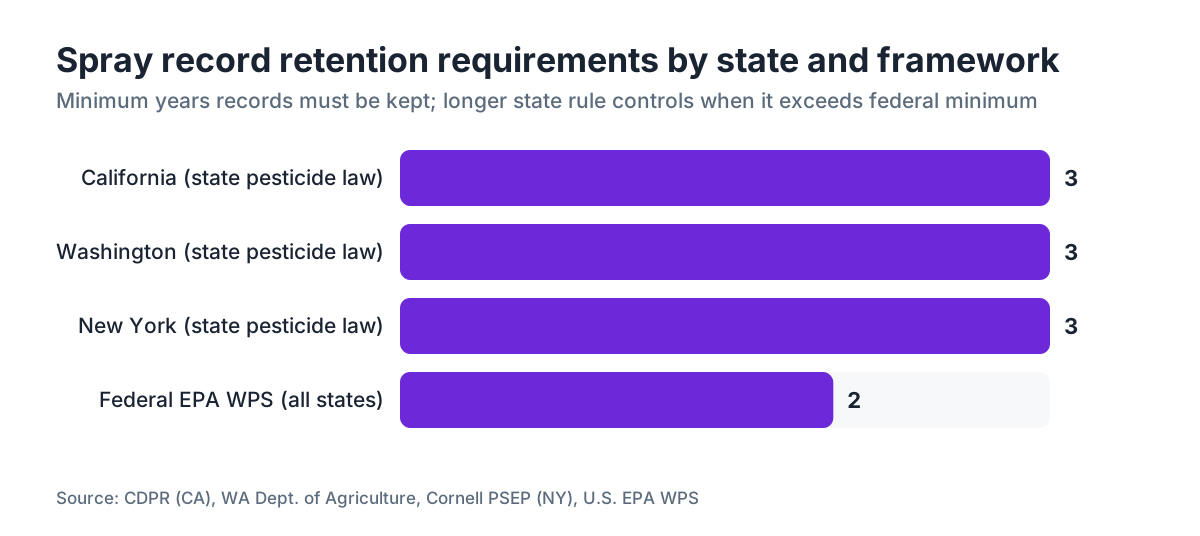
In California, pesticide use records have to be kept three years under 3 CCR Section 6618 [2]. PCA recommendations, three years. WPS application records run two years at the federal level, but state law can require longer, so the California three-year rule wins where it applies.
Washington also requires three years for most pesticide use records under WAC 16-228 [4].
WPS restricted-entry interval records get two years under EPA, and workers who ask for them have to receive them within 15 days [3].
My rule of thumb: keep everything five years, minimum. Three years is the legal floor in most states, but food safety audits, grape contract disputes, and personal injury claims all have limitations periods that can reach past three years in some cases. Five years costs almost nothing in a modern digital system and buys you real breathing room.
One specific trap. If a pesticide went out under a Section 18 emergency exemption or a 24(c) special local need registration, some states require longer retention because the exemption itself has to be documented.
What should a spray record actually include to be compliant?
A compliant California pesticide use record has to carry, at minimum: the property operator's name and address, county, location (section/township/range or GPS), commodity or crop, acres or units planted, the pest being controlled, product name and EPA registration number, amount applied per acre and total, application date and time, application method, and the applicator's name and license number [2].
The WPS adds the handler side: list the restricted-entry interval, and the time the application finished, more than the date.
Go past the legal minimum. Experienced vineyard managers log water volume per acre, application equipment, weather (wind speed, temperature, relative humidity), and the PCA recommendation number that authorized the spray. None of that is always required by law. All of it helps enormously when a drift complaint, an efficacy dispute, or a worker exposure claim shows up.
WSU Extension's record-keeping guidance for Washington growers recommends keeping a running spray log in the field and moving it to a permanent record within 24 hours [6]. That 24-hour habit is smart. Memory fades fast, and applicators who wait until Friday afternoon to log the week's sprays make mistakes.
Digital platforms that prompt for each required field at the moment of application have basically solved the completeness problem. Paper logs are not gone, but a paper log sitting in a truck cab for two weeks is a compliance risk no matter how good the applicator meant to be.
How is responsibility divided when multiple parties are involved in one spray event?
One spray event on a custom farmed block can pull in four or five parties with distinct but overlapping duties: the landowner, the custom operator, the PCO running the application, the PCA who wrote the recommendation, and sometimes a labor contractor supplying the crew.
Picture concentric rings. The innermost ring is the applicator, the person or firm on the equipment. Their duty is the most direct: keep the application record, file the PUR report if they are a licensed PCO, and follow the label. Label compliance is federal law under FIFRA, and 'the label is the law' is more than a slogan [10].
The second ring is the custom operator, who runs the operation and in most cases decides when and what to spray. If the operator holds the applicator license, ring two collapses into ring one. If they hired a subcontractor PCO, they carry management and contractual liability but a lighter direct statutory duty.
The third ring is the PCA. Issue a written recommendation, keep a copy, and take responsibility if the recommendation led to a misuse.
The outer ring is the landowner. Lightest direct record-keeping duty, most to lose on the crop contract and liability side.
CDPR compliance data shows most PUR violations land on PCOs and commercial applicators, not landowners [2]. That is no guarantee. If a county commissioner finds a landowner directing spray applications without a licensed PCO (a common shortcut on small blocks), the landowner becomes the applicator and carries the full statutory load.
Frequently asked questions
Can a landowner be fined for missing spray records if they hired a custom farm operator?
Possibly, yes. If the county ag commissioner finds applications were made on your property without proper records, you can be pulled into the enforcement action, especially if you directed the work or your operator used unlicensed applicators. Your best defense is a contract that clearly assigns record-keeping to the operator and proof you asked for copies. California civil penalties reach $5,000 per violation [1].
Does the custom farm operator need a pesticide applicator license to spray my vineyard?
In California, anyone applying a restricted-use pesticide for compensation must hold a licensed Pest Control Operator certificate from CDPR [2]. Employees who apply pesticides must be licensed or work under direct supervision of a licensed person. If your operator cannot show a current license, that is a serious red flag. Washington and New York run similar requirements [4][5].
What records does the EPA Worker Protection Standard specifically require for vineyard spray applications?
Under 40 CFR Part 170, the WPS requires the agricultural employer to keep records that include the product name, EPA registration number, active ingredient(s), the location and description of the treated area, date and time the application finished, and the restricted-entry interval. Records have to be kept two years and made available to workers or their representatives within 15 days of a request [3].
If my PCA writes the spray recommendation, does that mean they are responsible for the spray records?
Not for the application record. The PCA keeps copies of their written recommendations for three years in California, but the applicator, not the PCA, logs what actually went out and files the monthly pesticide use report with the county. The PCA's record and the applicator's record are separate documents doing separate compliance jobs [2].
How do I get my vineyard's pesticide use records from the county if my custom farm operator is not sharing them?
In California, pesticide use reports filed with the county ag commissioner are public records under the California Public Records Act. Submit a written request to your county ag commissioner's office for PUR data on your specific parcel or location. Most counties respond within 10 business days. The data shows what was reported, and any gaps in reporting show up as gaps in the printout.
What goes in a spray record to make it legally compliant in California?
California requires: property operator name and address, county, location by Township/Range/Section or GPS, crop, acres treated, pest targeted, product name and EPA registration number, amount applied per acre and total, application date and time, application method, and the applicator's license number. The WPS adds the restricted-entry interval. Weather conditions and the PCA recommendation number are not legally required but are strongly advisable [2][3].
How long must vineyard spray records be kept under state and federal law?
California requires three years for pesticide use records under 3 CCR Section 6618 [2]. Washington requires three years under WAC 16-228 [4]. Federal WPS requires two years, but the longer state rule controls where it applies. In practice, keeping five years is sensible because food safety audits, grape contract disputes, and personal injury claims can surface after the legal minimum runs out.
Are wine grapes subject to FSMA food safety record-keeping rules?
Generally no, on the vineyard side. Wine grapes go through fermentation and are excluded from FDA's Produce Safety Rule under FSMA [9]. Table grapes do fall under the Produce Safety Rule. For most custom farmed wine grape blocks, the record framework is state pesticide law plus the EPA Worker Protection Standard, not FSMA produce safety rules, though your winery buyer may add private contract requirements.
What should a custom farming contract say about spray records?
At minimum, the contract should name which party keeps the pesticide use records, who files monthly PUR reports, who holds copies and for how long, who pays regulatory fines for missed or incomplete records, how the operator shares copies with the landowner and on what timeline, and whether the operator has to prove a current pesticide applicator license and insurance coverage.
What are the penalties for failing to submit pesticide use reports in California?
California Food and Agricultural Code Section 12980 authorizes civil penalties up to $5,000 per violation per day for failing to file required pesticide use reports [1]. Repeat violations can be referred to CDPR for license suspension or revocation. The county ag commissioner is the primary enforcement agency for PUR compliance and runs periodic inspections of licensed PCOs and commercial applicators.
Does the landowner need to provide WPS training to spray workers on a custom farmed block?
Only if the landowner is an agricultural employer under the WPS definition, meaning the landowner directly hires or contracts for workers or handlers who might be exposed to pesticides. If the custom operator employs all field workers, the operator holds the WPS training duty. If the landowner employs any workers who enter treated areas, the landowner shares it [3]. The line is not always obvious, so pin it down in the contract.
Can spray records be kept digitally or do they need to be on paper?
California, Washington, and New York all accept digital records as long as they are accurate, complete, and available for inspection. CDPR has not mandated a specific format. The records have to be producible on request by the county ag commissioner. Systems that log at the time of application and capture required fields automatically cut transcription errors and are generally more reliable than handwritten logs reconstructed after the fact.
If I use multiple custom farm operators on different blocks, does each operator keep their own records?
Yes. Each licensed PCO or commercial applicator is responsible for its own pesticide use reports on the blocks it treated. As the landowner, collect copies from each operator and keep a consolidated file for the property. Discrepancies between what different operators report, or gaps where a block got treated but no report exists, are your first warning of a compliance problem.
Sources
- California Legislative Information, Food and Agricultural Code Section 12980: Any person who applies or causes to apply a pesticide must keep records; civil penalties up to $5,000 per violation per day for failure to file required reports.
- California Department of Pesticide Regulation, Pesticide Use Reporting: Licensed PCOs must submit monthly pesticide use reports within 7 days after each calendar month end; records must be kept for 3 years; required fields include location, crop, product EPA reg number, amount applied.
- U.S. EPA, Worker Protection Standard (40 CFR Part 170): Agricultural employers must maintain WPS application records for 2 years and make them available to workers within 15 days of request; the 2015 revision took full effect in 2017.
- Washington State Department of Agriculture, Pesticide Management Division, WAC 16-228: Washington certified applicators must keep pesticide use records for 3 years; annual reports due by January 31; maximum civil penalty up to $7,500.
- Cornell University Pesticide Safety Education Program: New York commercial pesticide applicators must keep records for 3 years, available on request; maximum civil penalty up to $2,000 per violation.
- Washington State University Extension, Pesticide Record-Keeping for Agricultural Producers: WSU Extension recommends keeping a running spray log in the field and transferring it to a permanent record within 24 hours of application.
- UC Davis Agricultural and Resource Economics, Custom Farming and Landowner Liability Guidance: The landowner retains ownership of the crop and therefore retains exposure to liability arising from how that crop was produced.
- UC Davis Safety Services, Worker Protection Standard Guidance: If a landowner employs any workers who enter treated areas during a restricted-entry interval, the landowner becomes an agricultural employer under WPS and must maintain WPS records.
- U.S. FDA, Food Safety Modernization Act Produce Safety Rule (21 CFR Part 112): Wine grapes that undergo fermentation are generally excluded from the FSMA Produce Safety Rule; table grapes are covered.
- U.S. EPA, Federal Insecticide, Fungicide, and Rodenticide Act (FIFRA): Under FIFRA, pesticide use inconsistent with label directions is a federal violation; the pesticide label is a legally enforceable document.
Last updated 2026-07-09