How to set up separate spray records for organic and conventional blocks

TL;DR
- Organic and conventional blocks need completely separate spray records because any pesticide application to an organic block, even a record-keeping error, can trigger a certification violation.
- Each record must capture the block ID, product name, EPA registration number, rate, acres treated, applicator name, and application date.
- Partition the two systems, on paper or digitally, from day one.
Why do organic and conventional blocks need separate spray records at all?
The short answer: your certifier requires it, your state department of agriculture expects it, and mixing the two is the fastest way to lose an organic certificate.
Under the USDA National Organic Program (NOP), certified organic operators must maintain records that "fully disclose all activities and transactions of the certified operation" for five years [1]. That language covers every input applied to every block. If your spray log lumps organic and conventional blocks together, an inspector can't quickly verify that a synthetic fungicide applied to Block 7-C never touched Block 7-A. Commingled records don't pass inspection, and inspectors know how to look for them.
On the conventional side, EPA's Worker Protection Standard (WPS) requires that employers post or provide pesticide application information, including the product, location treated, date of application, and restricted-entry interval, for each application [2]. WPS doesn't care whether a block is organic. It cares about the field location and the product. A combined log that doesn't clearly distinguish block identity by organic status creates unnecessary exposure if OSHA or your state ag department audits.
There's also a contamination-risk angle. Conventional drift, even minor drift from an adjacent row, is one of the most common reasons organic certification gets questioned. Separate records force you to think spatially about each application, which itself reduces the chance of accidental overlap.
For a small operation running both systems on the same ranch, the discipline of separate records has saved more than one grower from an expensive re-certification hearing. Build the wall early.
What fields are legally required on a vineyard spray record?
Requirements come from three overlapping sources: your state department of agriculture, the EPA WPS, and (for organic blocks) the NOP. The table below shows the core fields and which authority mandates each.
| Field | State ag (most states) | EPA WPS | USDA NOP |
|---|---|---|---|
| Application date | Yes | Yes | Yes |
| Field / block ID | Yes | Yes | Yes |
| Pesticide product name | Yes | Yes | Yes |
| EPA registration number | Yes | No | Yes |
| Active ingredient(s) | Yes | No | Yes |
| Amount applied (rate + volume) | Yes | No | Yes |
| Acres treated | Yes | No | Yes |
| Applicator name & license number | Yes | No | No |
| REI (restricted-entry interval) | No | Yes | N/A |
| PHI (pre-harvest interval) | Most states | No | No |
| Target pest | Some states | No | Yes |
| Allowed input confirmation (organic) | No | No | Yes |
California's Department of Pesticide Regulation (CDPR) is one of the most detailed, requiring a licensed pest control adviser signature for many applications [3]. Washington State requires records be kept for two years for conventional applications and matches the federal five-year retention for organic [4]. Cornell's extension program notes that New York growers must retain pesticide records for three years under state law [5].
For organic blocks, you also need documentation that the product you used appears on your certifier's approved materials list or has been cleared through the Organic Materials Review Institute (OMRI) [6]. That's an extra column or an attached document that conventional records never need.
Don't try to stuff all of this into one form. Use two forms.
How should you physically or digitally separate organic and conventional records?
Paper or digital, the principle is the same. One system cannot contain records from the other without a hard, visible barrier.
For paper-based growers, the simplest setup is two binders, one green (organic) and one red or gray (conventional), kept in different locations or clearly labeled sections of a fireproof cabinet. Each binder gets its own block map on the inside cover showing which rows fall under which certification status. Never file a spray ticket in the wrong binder. That sounds obvious, but at harvest when tickets are piling up is exactly when mistakes happen.
For digital growers, use a separate record set or folder per certification status, more than a separate tag or column in a shared spreadsheet. A shared spreadsheet with a column that says "Organic: Y/N" is one accidental cell edit away from an audit problem. If you're using farm management software, check whether it allows true block-level certification partitioning rather than just labeling. Some platforms handle this well. Others treat it as a filter, which is not the same thing. VitiScribe lets you assign each block a certification status at setup so organic and conventional applications write to separate record streams by default, which removes the manual-filing step that causes most errors.
Regardless of format, your block map is the anchor document. It should show GPS coordinates or a clear sketch of every block, its certification status, and the date that status was last verified or updated. Post a copy in the shop where spray equipment is prepped, more than in the office.
WSU Extension recommends that growers assign permanent block IDs early in the season and never reuse an ID for a different block in the same record year [4]. That keeps records unambiguous across spray events even when crews change.
How do you set up a block ID system that keeps organic and conventional straight?
A block ID system should make certification status obvious without needing to look anything up.
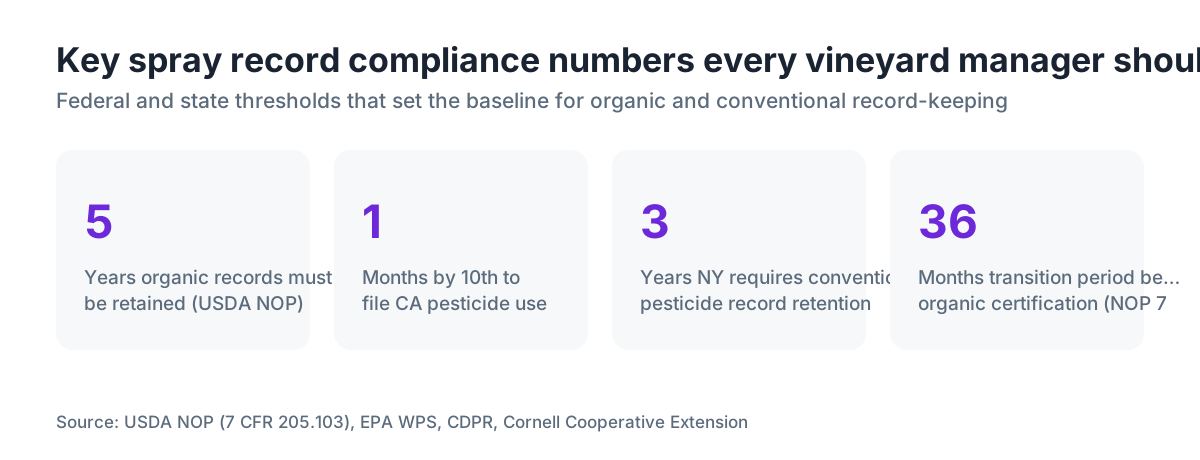
One clean approach: prefix all organic block IDs with the letter O and all conventional blocks with the letter C. So Block O-12 is organic, Block C-12 is the conventional block immediately adjacent to it. If a block transitions from conventional to organic (typically a three-year process under NOP rules), its ID changes the year it achieves full certification, not earlier [1].
Another approach uses a two-part ID: ranch abbreviation, block number, and year of current certification status. For example, HM-7-ORG or HM-8-CNV. It's more verbose, but it makes historical records self-explaining when you pull them years later for an audit.
Whatever system you choose, write it down in a single reference document and share it with every person who writes a spray ticket: your spray crew lead, your PCA, your assistant manager. If your PCA is filling out records and using a different ID for the same block, you'll spend hours reconciling at inspection time.
Transition blocks deserve special attention. A block in the three-year organic transition period under NOP cannot be sold as certified organic, but it still needs to follow organic input restrictions if you intend it to certify [1]. Keep transition blocks on a third record set, or at minimum flag them separately within your conventional records. Some certifiers want to see transition records going back to the start of the transition period, so create that paper trail from day one.
What does an audit-ready organic spray record actually look like?
Inspectors from accredited certifiers vary in their thoroughness, but the best ones cross-reference your spray records against your input invoices, your certifier's approved materials list, and your field map. An audit-ready record satisfies all three checks without requiring you to dig for anything.
For each organic application, the record should include: the block ID with a field map reference, the date, the product's full commercial name, its OMRI listing or your certifier's approval letter number, the EPA registration number, the active ingredient and its concentration, the rate applied per acre, total acres treated, total product used (and it should match your invoice), the applicator's name, and the target pest or disease.
The USDA's NOP Handbook, Guidance NOP 5020, lays out the operator record-keeping requirements and makes clear that records must be "adapted to the size, nature, and complexity of the certified operation" [8]. That's not permission to keep minimal records. It means a 200-acre organic vineyard is expected to have more detailed documentation than a 2-acre market garden.
A paper trail that ties each product purchase to each application separates a smooth inspection from a corrective action. Keep input invoices clipped to the monthly spray summary, or in a digital folder linked to the corresponding spray records. If you applied 10 gallons of copper hydroxide in June, your invoice from the distributor should show you bought at least that much.
UC Davis's viticulture extension materials recommend that growers review their records against their organic system plan at the start of each season to catch any drift in product use before an inspector does [7].
How do you handle spray records when one applicator works both organic and conventional blocks on the same day?
This is one of the most common real-world complications, and it's manageable if you build the habit.
The applicator fills out two separate tickets, one for each block type, on the same day. The tickets should look different enough that they can't be misfiled. Color-coded paper is the lowest-tech solution and it works. If you're using a digital form, the block ID prefix (O- vs C-) should appear at the top of the form and auto-route to the correct record set.
Equipment cleaning between organic and conventional applications on the same day matters for physical compliance, and it also shows up in records. Some growers add a "tank cleaned before this application" checkbox to their organic spray ticket. That's not strictly required by NOP, but inspectors notice the attention to detail and it creates a contemporaneous record if a contamination question ever comes up.
If the applicator sprays a synthetic product on conventional blocks and then needs to spray an allowed material in organic blocks, note the cleaning step and the time gap in the organic ticket. The NOP's contamination-prevention provisions in 7 CFR 205.272 require that certified operations prevent commingling and contamination [1]. A documented cleaning step is your evidence of compliance.
Never let one ticket cover applications to both an organic block and a conventional block, even if the product is the same and would be allowed on both. The records need to be separate because the authorization chains are separate.
How long do you need to keep organic and conventional spray records?
Federal law sets the floor. USDA NOP requires organic records be retained for five years [1]. EPA WPS requires employers to maintain records of pesticide applications for thirty days after the restricted-entry interval expires, but for the application information itself, most state-level ag pesticide laws set the minimum at two to three years [2].
In practice, keep everything for five years regardless of whether the block is organic or conventional. Here's why. If a wine lot is ever questioned for pesticide residue, you'll want spray records that go back to the full growing season, and potentially to dormant sprays from the prior winter. Residue investigations don't always happen quickly. A five-year retention policy covers both your organic certification requirements and the realistic window for any product-liability or residue dispute.
Store records in at least two locations. For paper, keep originals in your records cabinet and scanned copies on a cloud drive or external hard drive stored off-site. For digital records, make sure your backup is not on the same server as your primary records. A barn fire has ended more than one organic certification because spray records couldn't be reconstructed.
California growers should note that CDPR requires pesticide use reports to be filed with the county agricultural commissioner by the 10th of the month following application [3]. That reporting requirement is separate from your internal record-keeping, but your internal records are what you use to fill out those reports accurately. If your records are a mess, your reports will be wrong, and that's a separate compliance problem.
What mistakes most commonly cause organic certification problems related to spray records?
The mistakes that actually cause certification suspensions or corrective actions are almost never about deliberately using a prohibited material. They're about documentation failures that make inspectors question whether prohibited use happened.
The most common one is using a product name that doesn't match the certifier's approved materials list, even when the active ingredient is allowed. Certifiers approve specific formulations. "Copper hydroxide" may be approved but a specific commercial product with adjuvants may not be. Always record the full commercial product name and cross-reference it against your approved list, more than the active ingredient [6].
The second most common issue is gaps in records. A month with no spray records in a disease-pressure year looks suspicious to an inspector, even if you genuinely didn't spray. Some growers log a "no spray" entry for each block during periods when scouting indicated no action was needed. That's optional, but it preempts questions.
Misfiled tickets, where a conventional product's ticket ends up in the organic binder, are less common but more damaging. The fix is the color-coded binder system or digital partitioning described earlier.
UC Davis extension materials note that "incomplete records are the primary reason organic inspections result in corrective action requests rather than clean certifications" [7]. Corrective actions are not automatic decertification, but they require a written response and follow-up inspection, both of which cost time and money.
For conventional records, the most common WPS-related violation involves failure to post or communicate REI information to workers before they re-enter a treated field [2]. The spray record is your evidence that you knew the REI and communicated it. If your record doesn't include the REI, you lose that evidence.
Can you use one piece of software or one spreadsheet template for both block types?
Yes, with the right design. Organic and conventional records must be stored and retrievable as completely separate sets, not as a filtered view of a single dataset.
A well-designed spreadsheet can work if it uses separate worksheets (tabs) for organic and conventional blocks, with each tab locked against accidental data entry from the other. Don't use a single tab with a dropdown that filters by block type. That design fails under any meaningful scrutiny because the data lives together and filters can be changed.
Farm management platforms vary a lot. Before adopting any software for dual-system record keeping, ask the vendor two questions: (1) can organic and conventional blocks have completely separate application records that cannot be commingled in any report? and (2) can I export each block type's records separately in a format my certifier will accept?
WSU Extension's farm records program recommends that growers choosing any record-keeping system confirm it produces output that matches their state's pesticide use reporting format, because reformatting data for regulatory reports is where errors creep in [11]. If your software exports a report that doesn't match the CDPR use report format (for California growers), you'll be transcribing manually, which introduces errors.
VitiScribe was built for vineyard operations with mixed certification status, so if you want a purpose-built option rather than adapting a generic farm platform, it's worth a trial run during a low-spray window to see if the block partitioning works the way you need it to.
For growers managing ten or more blocks across both systems, software is almost always worth the subscription cost in time saved at reporting season. For two-block operations, a well-designed spreadsheet is fine.
How do state requirements differ from the federal NOP baseline for spray records?
Federal NOP sets the minimum for organic certification records. States layer on additional requirements, especially around pesticide use reporting and applicator licensing.
California is the most demanding. CDPR requires a licensed pest control adviser to make written recommendations for any restricted-use pesticide application, and those recommendations must be on file with the spray record [3]. California also mandates monthly pesticide use reports to the county ag commissioner. No other state currently matches that reporting frequency.
Washington requires spray records to be available for inspection by the Washington State Department of Agriculture for two years for conventional pesticides [4]. For organic operations, the five-year federal rule applies on top of that.
New York, as Cornell extension notes, requires three-year retention for pesticide records and mandates that certified applicators or their licensed supervisors sign off on certain pesticide applications [5]. For organic blocks, the NOP five-year rule extends that to five years.
Oregon follows federal WPS requirements closely and adds a requirement that spray records be available to workers upon request within fifteen days of application, which has practical implications for how you store them.
The safest approach is to meet the most stringent requirement that applies to any of your blocks and apply it uniformly. Keep everything for five years. Include EPA registration numbers on every record. Get applicator license numbers on every ticket. That way you don't have to track different retention rules for different records.
What's the best way to train your spray crew on maintaining separate records?
Training is where most dual-system record-keeping setups succeed or fail. The system can be perfectly designed and still produce wrong records if the person writing the ticket doesn't understand why it matters.
Start with a visual block map in the spray shop. Laminate it. Show exactly which rows are organic and which are conventional, with the corresponding record forms or folders for each. A crew member who can see the map and match it to a color-coded ticket is far less likely to make a filing error than one working from memory.
Run a fifteen-minute annual training before the first spray of the season. Cover: what "organic" means for input restrictions (more than a label, a legal restriction), what happens if a conventional product is logged against an organic block, how to fill out each field on the record, and what to do if they're not sure which form to use (answer: stop and ask, do not guess and file).
EPA WPS requires that workers and handlers receive pesticide safety training before handling pesticides or entering treated areas [2]. That training requirement is a good anchor point for the spray record discussion because it naturally covers REI documentation, which is part of what the record captures.
For seasonal crews who may have limited English proficiency, produce bilingual versions of the spray record forms with labeled diagrams. UC Davis extension has resources on worker safety communication in agricultural settings that are worth reviewing for this purpose [7]. The record is only as good as the person filling it out, and that person needs to understand what they're filling out.
Frequently asked questions
Do I need a separate spray record for each individual block, or can I group blocks by certification status?
Grouping by certification status on one log is acceptable if every block in that log genuinely shares the same certification status and received the same application. In practice, most vineyard blocks have different varieties, row spacings, or timing needs, so per-block records are cleaner and far easier to audit. If you group, list every block ID covered by that application explicitly on the record.
Can my organic spray records and conventional spray records be in the same binder if they're separated by a divider?
Technically yes, but it's a bad idea in practice. A divider can be misaligned, pages can be misfiled, and an inspector who opens one binder and sees records from both systems will spend extra time verifying nothing is mixed. Two separate binders eliminate that uncertainty entirely. The marginal cost of a second binder is zero compared to the risk of a corrective action request.
What happens if I accidentally apply a conventional pesticide to an organic block and it's in the spray records?
You must notify your certifier immediately. Under USDA NOP rules, applying a prohibited substance to a certified organic operation is a serious noncompliance. The outcome depends on whether it was intentional, how it happened, and whether you reported it proactively. Voluntary disclosure before an inspection is always treated more favorably than an inspector discovering it. The block may lose organic status for that season or trigger a full review.
Does EPA WPS apply to organic vineyard operations?
Yes. EPA's Worker Protection Standard applies to any agricultural employer who has workers or handlers entering areas treated with pesticides, including OMRI-listed materials classified as pesticides under FIFRA. Organic operations using copper, sulfur, or spinosad still trigger WPS requirements for REI posting, record-keeping, and worker training. The NOP doesn't exempt you from WPS.
How do I document a no-spray period in organic records so inspectors don't flag a gap?
Write a dated scouting note or field observation entry for the relevant period. It doesn't need to be a formal spray record, but it should be filed with your organic records and reference the block IDs and the reason no application was made, such as no disease pressure observed, weather-limited access, or block in dormancy. Some growers use a simple scouting log page for this purpose.
How do I handle a tank mix on an organic block? Does each product need its own record entry?
Most certifiers and state forms want all products in a tank mix listed on the same application record for that date and block, not as separate entries. List each product with its own name, EPA registration number, rate, and OMRI or approved status. Make sure the tank mix itself is approved by your certifier, because some allowed materials become non-compliant when combined.
What does USDA NOP actually say about how long organic records must be kept?
Under 7 CFR 205.103, the NOP requires certified operations to maintain records for no less than five years. The USDA National Organic Program Handbook, Guidance NOP 5020, confirms this and specifies that records must be available to the certifier and the USDA at any time during the certification period and for five years after.
Can a PCA (pest control adviser) sign one recommendation that covers both organic and conventional blocks in the same vineyard?
In California, no. CDPR requires a separate written recommendation for each pesticide product and each field or block where it will be applied. A PCA recommendation that doesn't specify block identity by name or ID is not adequate. For organic blocks, the recommended product must also be confirmed as allowed under your certification. One recommendation document can cover multiple organic blocks if it lists them all explicitly.
Do I need to report organic and conventional pesticide use separately to my county ag commissioner in California?
California pesticide use reports to the county agricultural commissioner do not require you to flag organic versus conventional status, but you do need to report each pesticide product by its EPA registration number and the specific site (block or field location) where it was applied. Since OMRI-listed materials still have EPA registration numbers if they're registered as pesticides under FIFRA, they get reported the same way as any other application.
What's the minimum a spray record needs for a USDA organic inspection to pass?
At minimum: application date, block ID that matches your field map, full commercial product name, EPA registration number, active ingredient, rate per acre, total acres treated, applicator name, and confirmation the product is on your certifier's approved list. Missing any one of these fields is enough to generate a corrective action request. The certifier will also want to cross-reference the quantity used against your purchase invoices.
How do you handle spray records for a block that's in organic transition but not yet certified?
Treat transition blocks as if they are certified organic for input restriction purposes, because you'll need to prove they were during your final certification inspection. Keep their records in a separate transition set or clearly labeled section. Use organic-approved inputs only, and document them with the same detail as a certified block. NOP transition under 7 CFR 205.202 requires a 36-month period free of prohibited substances before certification.
Is there a standard spray record form I can download, or do I have to create my own?
Several states provide templates. UC Cooperative Extension has spray record forms adapted for California growers, and WSU Extension has versions for Washington. CDPR's website has a pesticide use record format that satisfies California requirements. For organic records, your certifier may provide or require their own form. There's no single federal form for spray records; you can design your own as long as it captures all required fields.
If I sell my vineyard, do the new owners need my spray records for the organic blocks?
Yes, and transferring them is in the buyer's interest as much as yours. The new owner will need to apply for organic certification transfer, and the certifier will want to see the full five-year record history for organic blocks to verify continuous compliance. In California, pesticide use records may also be requested by regulators regardless of ownership change. Include record transfer explicitly in the sale agreement.
Sources
- USDA Agricultural Marketing Service, National Organic Program, 7 CFR Part 205: NOP requires certified operations to maintain records for five years and to prevent commingling and contamination of organic products under 7 CFR 205.103 and 205.272
- U.S. EPA, Worker Protection Standard for Agricultural Pesticides: EPA WPS requires employers to post or provide pesticide application information including product, location, date, and restricted-entry interval for each application
- California Department of Pesticide Regulation, Pesticide Use Reporting: CDPR requires pesticide use reports to be filed with the county agricultural commissioner by the 10th of the month following application, and requires licensed PCA written recommendations for restricted-use pesticide applications
- Washington State University Extension, Pesticide Record Keeping for Agriculture: WSU Extension notes Washington State requires spray records to be available for WSDA inspection for two years for conventional pesticides, and recommends assigning permanent block IDs early in the season
- Cornell Cooperative Extension, Pesticide Management Education Program: Cornell extension notes New York growers must retain pesticide records for three years and certified applicators or their licensed supervisors must sign off on certain applications
- Organic Materials Review Institute (OMRI), OMRI Listed Products: Organic certifiers require documentation that products used in certified operations appear on the certifier's approved materials list or have been reviewed and listed by OMRI
- UC Agriculture and Natural Resources, Cooperative Extension Viticulture Resources: UC extension recommends growers review spray records against their organic system plan at the start of each season, and notes incomplete records are a primary reason organic inspections result in corrective action requests
- USDA National Organic Program Handbook, Guidance NOP 5020, Recordkeeping: NOP Guidance NOP 5020 states that operator records must be adapted to the size, nature, and complexity of the certified operation and must be available to the certifier and USDA at any time during the certification period
- USDA National Organic Program, 7 CFR 205.202, Land Requirements for Organic Production: NOP requires a 36-month transition period free of prohibited substances before a field can achieve certified organic status under 7 CFR 205.202
- U.S. EPA, Summary of the Federal Insecticide, Fungicide, and Rodenticide Act (FIFRA): Pesticide products used in agriculture, including those listed as organic-approved by OMRI, must carry an EPA registration number if registered under FIFRA, and that number is required on pesticide use records
- WSU Extension, Farm Business Records for Washington Growers: WSU Extension recommends growers confirm any record-keeping system produces output matching their state's pesticide use reporting format to avoid transcription errors at reporting time
Last updated 2026-07-11