How to track rootstock and clone records for each vineyard block

TL;DR
- Track rootstock and clone identity for every vineyard block by recording variety, clone number, rootstock name, nursery source, planting year, row and vine spacing, and GPS block boundaries in a permanent file.
- Update it at every replant or graft-over.
- Link those records to your spray and yield logs so the data stays connected when ownership or management changes.
Why does tracking rootstock and clone records matter for each block?
It matters because both money and time compound badly when you lose this information.
A grower who knows they have 4.5 acres of Cabernet Sauvignon clone 337 on 110R can call a nursery and order exactly the right budwood and rootstock combination. A grower who doesn't know spends weeks calling neighboring operations, guessing from vine architecture and berry flavor, or paying a consultant to run tissue tests. UC Cooperative Extension farm advisors on the North Coast have long pointed to missing planting records as a common cause of replant mismatches, where the new block lands on the wrong rootstock for the site's nematode pressure or soil pH [1].
There's a disease angle too. Grape leafroll-associated viruses behave differently depending on the clone and rootstock combination. When a UC Davis plant pathology team tries to understand an outbreak pattern, the first thing they ask for is your block records [11]. No records, and the investigation stalls.
Selling fruit? Wineries increasingly want this data. Some Pinot Noir contracts specify clone by number (Dijon 115, 667, and 777 versus heritage Pommard 4 or Swan). If your block file doesn't have that, you may not qualify for a price tier you're entitled to.
What information should a vineyard block record include?
A working block record has two layers: identity data that never changes, and operational data you update every season.
Identity data (permanent):
| Field | Example entry |
|---|---|
| Block name/ID | Block 7 / "East Bench" |
| Variety | Cabernet Sauvignon |
| Clone number | FPS 337 (ENTAV-INRA 337) |
| Rootstock | 110 Richter |
| Planting year | 2009 |
| Vine source nursery | Sunridge Nurseries lot 08-CSx337-110R |
| Row orientation | N-S |
| Row spacing (ft) | 10 ft |
| Vine spacing (ft) | 5 ft |
| Training system | VSP, bilateral cordon |
| GPS block boundary | Shapefile or KMZ attached |
| Acres | 4.52 |
Operational data (updated seasonally or on change):
- Replant patches: date, rows affected, new clone/rootstock used
- Graft-over history: date, original variety, new variety, method
- Virus test results: date, lab, result by block or by sample point
- Yield history: tons/acre by harvest year
- Chemical application link: cross-reference to your spray record file by block ID
The planting stock lot number from your nursery is the one field people routinely skip and later regret. Nurseries keep those lot records for years. If a rootstock identity question ever comes up (mislabeled material does happen), that lot number is your chain of custody [3].
WSU Extension recommends growers also record the certification source of the budwood, meaning whether the scion came from a certified Foundation Plant Services block or a USDA Clean Plant Network block. That single note shapes your disease liability picture down the road [4].
What is the difference between a clone number and a selection, and why does it matter for records?
A clone carries an official number and a traceable pedigree. A selection is budwood from a block whose identity nobody verified. That distinction is where most record errors start.
A clone is a genetically identical propagation from a single mother vine, selected and tracked by an official program. In the U.S., Foundation Plant Services at UC Davis maintains the national repository and assigns the numeric designations [2]. ENTAV-INRA clones from France carry their own numbering. So Chardonnay FPS 04 and Dijon 76 are both Chardonnay clones, but from different programs, and they ripen at meaningfully different times.
A selection is informal. Budwood came from a vineyard block whose identity is untested. People call it "old block" material or "heat-treated" material. It can perform beautifully. It just has no traceable certification chain. Many Zinfandel blocks planted before 1990 came from selections, and their records say "Zin, old vine selection" or nothing at all.
For your records, the distinction drives two choices:
- If your material is a certified FPS clone, record the exact clone number and point to the public FPS catalog entry.
- If it's an uncertified selection, say so plainly ("Syrah, local selection from Bien Nacido block 3, 1994") rather than guessing a clone number. A wrong clone number is worse than an honest "unknown selection" note.
The FPS catalog at UC Davis lists every currently registered Vitis vinifera clone and its availability status [2].
How do you identify rootstock if you don't have the original planting records?
You have three options, in rough order of cost: ask the people who planted it, run a PCR test, or hire an ampelographer. This is a real situation for properties that changed hands or went in before anyone kept good records.
First, ask the original grower, the nursery, or the planting contractor. Nurseries like Sunridge, Novavine, and Duarte keep lot records going back decades in many cases. Give them a rough planting year and block size and they can sometimes reconstruct what went out.
Second, leaf petiole or vine tissue PCR testing. Several labs (Cornell Plant Disease Diagnostic Laboratory, CDFA-approved labs in California, and commercial diagnostic labs) run molecular marker panels that separate the major rootstock varieties [5]. It runs roughly $50 to $150 per sample depending on the panel, and you'd want multiple vines per block for confidence, but the answer is definitive.
Third, ampelography. A trained viticulture consultant reads leaf shape, shoot tip appearance, and root bark to make a probable ID. It works well for common rootstocks (3309C versus SO4 versus 110R) and less well for close relatives like 1103P versus 140Ru.
Once you've pinned it down, lock it into the record with a note on how you got there. "Identified as 110R by PCR, March 2023" is a permanent, auditable line. Don't just write "110R" as if you knew all along.
What file format should you use to store vineyard block records?
Almost any consistent format beats no format. Some choices just age better than others.
Paper binders in a fireproof cabinet work, and plenty of multi-generational vineyards still run this way. The trouble is search, duplication, and off-site backup. If your barn burns, the records go with it.
Spreadsheets (Excel, Google Sheets) are the most common upgrade. One workbook, one row per block, the field list above across the top. Google Sheets adds automatic cloud backup and easy sharing with a bookkeeper or agronomist. The risk is format drift: different people editing in different ways, columns added inconsistently, old data overwritten with no change log.
GIS-linked records earn their cost once you run more than about 15 blocks. ESRI ArcGIS, QGIS (free), or vineyard-specific platforms let you draw block polygons on an aerial map and attach the identity fields to each polygon. You see at a glance which rootstock is where, which matters when you're planning a phylloxera replant or deciding where a systemic treatment goes. Cornell Cooperative Extension's viticulture group has published guidance on setting up basic farm GIS that growers can adapt [6].
For operations that want spray records, block data, yield history, and compliance documents in one place, purpose-built vineyard record systems handle the relational links. VitiScribe, for one, keeps block identity records permanently attached to each spray event and yield entry, so the clone and rootstock context follows every record automatically.
Whatever you choose, one rule holds: designate a single master file. Reference copies are fine. There must be one authoritative version everyone knows to update.
How do you record a replant or graft-over without losing the history?
Never overwrite the original identity fields. Use a change log instead. This is exactly where most record systems break: a grower replants a patch, updates the block to the new clone and rootstock, and quietly erases what was there before.
The simplest version is a "change history" tab or section on each block record. Every entry gets a date, what changed (rows 1-8 replanted), the original material, the new material, and the nursery lot number for the new vines.
For a graft-over, record both the topworked variety and clone (what got cut off) and the new variety and clone (what got budded on). The rootstock is unchanged in a graft-over, and that's easy to forget when you're writing it down.
A practical entry reads like this:
"March 2021: Rows 14-18 replanted following phylloxera damage. Original: Merlot, FPS 6, 101-14 Mgt. Replaced with: Merlot, FPS 6, 1103 Paulsen. Nursery lot: Duarte 20-MxFPS6-1103P. 312 new vines installed."
That one line preserves the history, documents the rootstock change (which matters for future soil sampling), and gives you the nursery traceability you'd need if a disease question hits that material later.
How do pesticide records connect to rootstock and clone records under the EPA Worker Protection Standard?
They connect at the block level, and keeping them linked is both a compliance requirement and plain good practice.
The EPA Worker Protection Standard, codified at 40 CFR Part 170, requires agricultural employers to keep application records showing the crop, the location, and the product applied, and to make those records available to workers and handlers on request [7]. "Location" in a vineyard means the block.
If your spray records reference "Block 7" but your block map doesn't clearly define where Block 7 starts and ends, you have a gap in the compliance chain. State agencies, particularly the California Department of Pesticide Regulation and the Washington State Department of Agriculture, can ask you to show that restricted-entry intervals were properly posted for the specific blocks treated [8][9].
Here's the operational tie to clone identity: some fungicide decisions ride on clone susceptibility. Certain Pinot Noir clones carry meaningfully different Botrytis risk than others, driven by cluster architecture, which is clone-linked. When you look back at a spray year and ask why Block 12 needed three extra Botrytis sprays, having the clone identity in the same system answers the question. Without it, you're guessing.
California's CDPR electronic pesticide reporting system requires a site description, and linking that site description to your block ID keeps everything auditable [8].
How often should you audit your vineyard block records for accuracy?
Once a year, minimum, before dormant pruning when you're walking every row anyway.
The audit answers three questions. Does the record match what's actually in the ground? Has any patch been replanted or grafted over since the last update? Are the GPS boundaries still right (fences move, new rows get added)?
For the first question, spot-check 10 to 15% of vines per block, comparing shoot morphology, leaf shape, and cluster architecture to your recorded variety and clone. This won't catch every labeling error. It catches the obvious ones, like a block labeled Merlot that keeps throwing leaves shaped like Cabernet Franc.
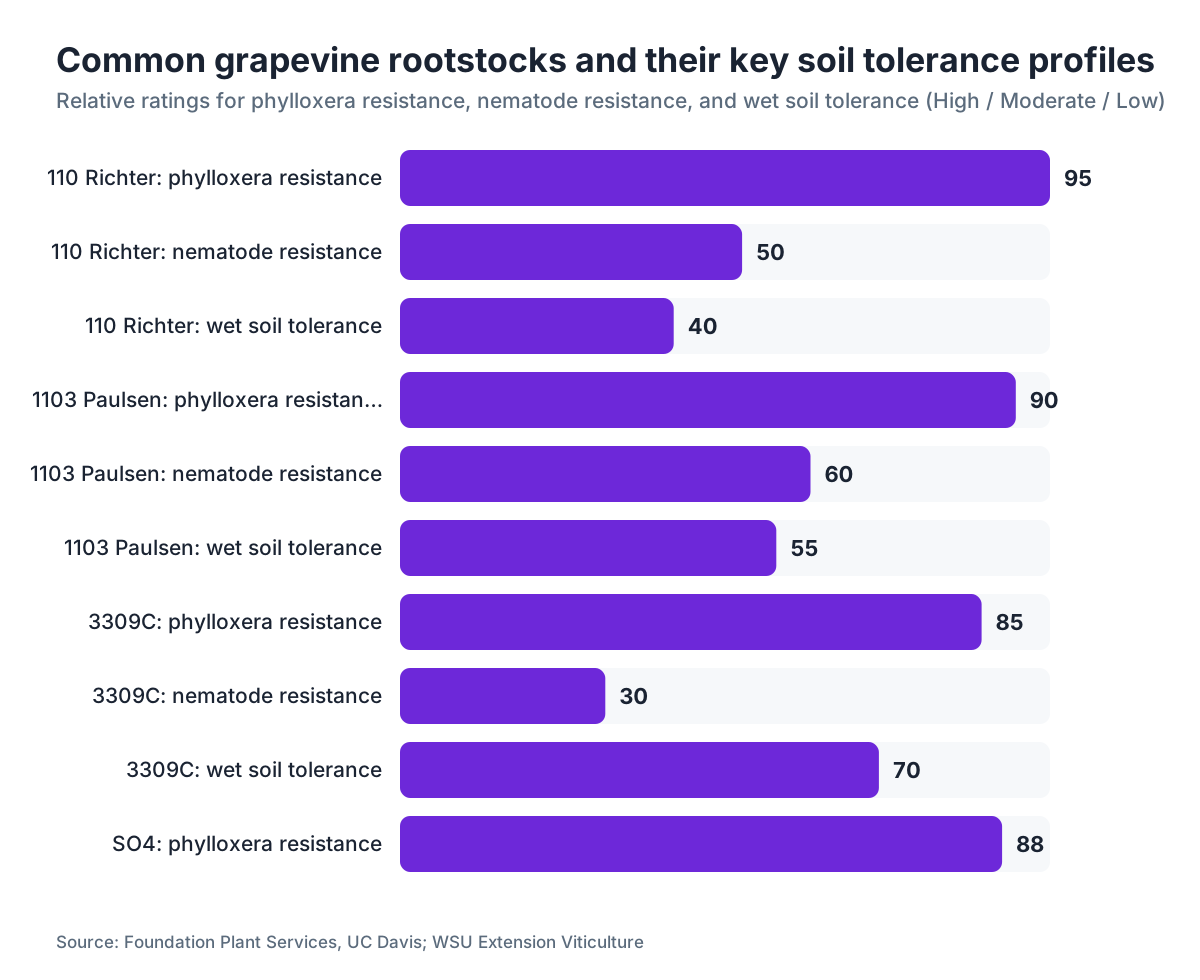
Properties that have dealt with nematode damage, phylloxera, or replant disease deserve a harder look every three to five years using PCR-based rootstock verification. A PCR panel runs roughly $100 to $200 per block. That's trivial next to discovering after a replant that half your 1103P block is actually SO4, which has a very different tolerance profile for wet soils.
WSU Extension's Viticulture and Enology program recommends growers review and update block records at every replant, graft-over, or lease or ownership transfer, treating those events as mandatory record triggers rather than optional reminders [4].
What records do you need when buying or selling a vineyard with existing blocks?
This is where incomplete records show their clearest dollar value.
A buyer running due diligence wants, at minimum: clone and rootstock identity for every block, planting year, nursery source if available, virus testing results from the past five years, and a replant history showing whether any blocks hold mixed material.
Missing clone records drag down the defensible appraised value, because the buyer has to budget for identification work or eat the risk on replant decisions. In premium Pinot Noir AVAs like the Willamette Valley or the Sonoma Coast, where clone identity is a marketing asset, buyers have negotiated price reductions when sellers couldn't document Dijon versus heritage clone blocks.
On the sell side, a clean, organized block record file is one of the highest-return things you can put together in the two years before a sale. It signals operational discipline and takes a negotiating lever out of the buyer's hand.
For lease transfers, include current block records as a signed exhibit in the lease agreement, so nobody disputes later what was planted when the lease started.
If you're assembling a full vineyard operations file for sale or transfer, a system like VitiScribe can export block records in a standard PDF or CSV that a due-diligence reviewer can actually read, instead of decoding someone's custom spreadsheet.
Are there university or government resources that provide standard templates for vineyard block records?
Yes, and they beat building from scratch.
UC Agriculture and Natural Resources publishes farm record-keeping guides through its ANR Publication series. UC Cooperative Extension viticulture farm advisors in Napa, Sonoma, and San Luis Obispo counties have developed county-specific block record templates you can request from the local farm advisor office [1].
Foundation Plant Services at UC Davis maintains a public database of every certified clone, its selection history, and its availability, which gives you the authoritative reference for clone numbering [2]. If your records say "Chardonnay, Wente clone," you can cross-reference FPS to confirm which designation that maps to.
WSU Extension's Viticulture and Enology program at Prosser publishes vineyard management guides with recommended record-keeping fields for Pacific Northwest conditions, where rootstock choices around replant disease and wet-foot tolerance differ from California [4].
Cornell Cooperative Extension's viticulture team covers the Northeast and publishes integrated pest management guides that include site record components [6]. Their guidance helps most with hybrid variety blocks, where clone and selection tracking is less standardized than for vinifera.
The USDA National Clean Plant Network keeps certification status records for foundation plant material and is the source for verifying whether a scion was certified at planting [10].
None of these hands you a single universal form, because block data legitimately varies by region and operation size. Between FPS, WSU, and UCCE, though, you have enough to build a solid standard operating procedure for your own place.
How do you handle blocks with mixed clones or unknown heritage vines?
Record them honestly and never invent a single clone designation for a mixed block. Mixed blocks are more common than most growers admit, especially in older plantings.
Write it as it is: "Block 3: Zinfandel, mixed heritage vines circa 1952 (head-trained, own-rooted), estimated 60% original vines, 40% replanted with FPS 03 on 110R beginning 1998-2004, replant areas shown on block map."
That entry is messy but accurate. A false-clean record calling the whole block "Zinfandel FPS 03" creates problems downstream.
For own-rooted blocks, common in old-vine Zinfandel and some old Carignan or Mourvedre plantings, record the rootstock field as "own-rooted" with a note on how you confirmed it. Don't leave it blank. A blank rootstock field reads as "unknown" in any database, which is not the same as "confirmed own-rooted."
Where you genuinely can't determine clone identity, document your attempts (nursery inquiry, tissue test, ampelography consult) and record the result as "identity unresolved as of [date], method tried: [method]." That's a professional record. It tells the next reader the question was asked, not ignored.
Mixed blocks also need a map showing where different material sits, more than a single-row list. A hand-drawn map with row numbers, scanned and attached to the digital file, is completely fine and often more useful than a complex GIS layer for a small mixed block.
Frequently asked questions
What is the minimum information I need in a vineyard block record?
At minimum, record the variety, clone number or selection description, rootstock name, planting year, nursery source (lot number if available), row and vine spacing, and acreage. Add a GPS boundary or hand-drawn map. That set of fields covers most replant decisions, sales due diligence, and disease investigation requests you'll ever face.
How do I find out what rootstock my vineyard was planted on if I have no records?
Start by contacting the original nursery with your planting year and approximate block size; many nurseries keep lot records for decades. If that fails, send vine root samples to a lab (Cornell PDDL or a CDFA-approved California lab) for PCR-based rootstock identification, which costs roughly $50 to $150 per sample and returns a definitive result.
What is Foundation Plant Services (FPS) and how does it relate to clone records?
FPS at UC Davis is the national repository for certified grapevine propagation material in the U.S. It assigns numeric clone designations and maintains certification status for each clone. If your planting material came from an FPS-certified source, your record should note the FPS clone number, which you can cross-check against the public FPS catalog.
Do I need to track rootstock and clone information to comply with EPA Worker Protection Standard requirements?
The WPS (40 CFR Part 170) requires application records linked to a specific location, which is your block. The block's rootstock and clone identity is not itself a WPS field, but if your block IDs on spray records don't match a clear block map and description, you have a compliance gap. Linking spray records to block identity records closes that gap.
How do Dijon clones differ from heritage Pinot Noir clones in a record-keeping context?
Dijon clones (115, 667, 777, 828, and others) are ENTAV-INRA numbered selections imported in the late 1980s and 1990s and certified through FPS. Heritage selections like Pommard 4 and Swan carry their own FPS designations. They ripen at different times with different cluster architectures, so recording the specific clone number rather than just 'Pinot Noir' matters for yield prediction and winery contract compliance.
How should I record a block that was grafted over from one variety to another?
Keep the original identity (variety and clone that was cut off) in a change-history log with the date of topworking. Record the new variety and clone under the current identity fields. Note that the rootstock is unchanged in a graft-over; if it suited the original variety but may be suboptimal for the new one, flag that for a future soil assessment.
Can I use Google Sheets or Excel for vineyard block records, or do I need special software?
A well-built spreadsheet works fine, especially under 20 blocks. Use one row per block, protect the header row and key identity fields from accidental editing, and keep it in cloud storage for off-site backup. The main limit is that spreadsheets don't automatically link to spray records or yield logs, so you rely on manual cross-referencing to keep everything consistent.
How do wineries use clone and rootstock information from grower records?
Wineries use it to verify fruit meets contract clone specifications, to understand ripening timeline variation across sources, to make blending decisions (some winemakers sort by clone before fermentation), and to document provenance for high-end bottlings. Some AVA regulations and certification programs require documented clone identity for estate or single-vineyard label claims.
How do I document own-rooted vines in a block record?
Record the rootstock field as 'own-rooted' and note how you confirmed it: visual inspection of root morphology, lack of a graft union, nursery records, or historical documentation. Do not leave the field blank, because blank reads as unknown in any database. Own-rooted status is significant information for phylloxera risk assessment and insurance purposes.
What should I include in block records when purchasing a vineyard property?
Request the full block file during due diligence: clone and rootstock identity per block, planting years, nursery lot numbers, virus test results from the past five years, replant history, and any spray records. Missing or inconsistent records are a legitimate negotiating point. Have a viticulture consultant review the file for gaps before close of escrow.
How often should vineyard block records be updated?
Review and update at least once a year, ideally during dormant pruning when you're walking every row. Update immediately after any replant, graft-over, or ownership or lease transfer. An annual audit should verify that physical block conditions match the records and flag any discrepancies for investigation before the next growing season.
Are there specific rootstock record requirements for certified organic vineyards?
USDA National Organic Program certification requires documentation that prohibited substances have not been applied to the land. While NOP does not specifically mandate rootstock records, your certifying agent may ask for evidence of plant material sourcing. Some certifiers want to confirm that fumigants (which carry organic restrictions) were not applied for replant disease management before the new planting.
What is the USDA Clean Plant Network and do I need to reference it in my block records?
The USDA National Clean Plant Network coordinates foundation plant material certification across crops including grapevines. If your scion or rootstock came from an NCPN-certified source, noting that in your records strengthens your disease liability documentation. FPS at UC Davis is the main NCPN grapevine center, and its certification records are publicly searchable.
Sources
- UC Agriculture and Natural Resources, UC Cooperative Extension: Missing planting records are a common cause of replant mismatches in North Coast California vineyards, according to UCCE viticulture farm advisors.
- Foundation Plant Services, UC Davis: FPS at UC Davis maintains the national repository of certified Vitis vinifera clones, assigns numeric clone designations, and publishes the authoritative catalog of registered clones and their availability.
- Sunridge Nurseries, plant traceability documentation: Commercial grapevine nurseries maintain lot-level records that allow growers to trace the rootstock and scion identity of vines by nursery lot number years after planting.
- Washington State University Extension, Viticulture and Enology: WSU Extension recommends growers document the certification source of scion material (FPS or USDA NCPN) and update block records at every replant, graft-over, or ownership transfer.
- Cornell University, Plant Disease Diagnostic Laboratory: PCR-based molecular marker panels can distinguish major grapevine rootstock varieties; Cornell's PDDL performs diagnostic testing on submitted vine material.
- Cornell Cooperative Extension, Viticulture Program: Cornell CCE publishes integrated pest management guides for Northeastern viticulture that include recommended site and block record components for hybrid and vinifera plantings.
- U.S. EPA, Worker Protection Standard, 40 CFR Part 170: The EPA Worker Protection Standard at 40 CFR Part 170 requires agricultural employers to keep pesticide application records showing crop, location, and product applied, available to workers and handlers on request.
- California Department of Pesticide Regulation (CDPR): California's CDPR electronic pesticide reporting system requires a site description for each application record, and records must be auditable by block or site.
- Washington State Department of Agriculture, Pesticide Management Division: Washington State's pesticide record-keeping requirements mandate that spray records identify the specific location treated, including block-level identification for multi-block vineyards.
- USDA National Clean Plant Network: The USDA National Clean Plant Network coordinates certification of foundation plant material for grapevines and other crops and is the source for verifying whether plant material was certified at planting.
- UC Davis Department of Plant Pathology, Grapevine Virus Research: UC Davis plant pathology researchers use block identity records (clone and rootstock) as a starting point when investigating leafroll virus outbreak patterns in California vineyards.
Last updated 2026-07-10