Nematode assay records for vineyard site assessment and rootstock selection

TL;DR
- A nematode assay counts and identifies plant-parasitic nematodes in soil and root samples before you plant or replant a vineyard.
- Results drive rootstock choice, because Meloidogyne and Xiphinema respond very differently to resistance genes.
- Labs return counts in 7 to 21 days.
- Keep every report at least three years and tie it to your field map for future replant calls.
What is a nematode assay and why does it matter before planting a vineyard?
A nematode assay is a soil or root extraction test that counts and identifies plant-parasitic nematodes in a sample. A lab runs one of a few extraction methods, usually the Baermann funnel or centrifugal-flotation technique, to separate nematodes from soil or root tissue. The count comes back as individuals per 100 grams of soil or per gram of root.
That number decides a lot. Plant-parasitic nematodes chew on vine roots directly, and dagger nematodes (Xiphinema index) go a step worse: they carry Grapevine Fanleaf Virus (GFLV) and inject it while feeding. UC Statewide IPM guidance documents yield losses running well past 30 percent in severely infested blocks, depending on species and soil type [1]. You won't see the damage until two or three seasons after planting, and by then a full replant runs $15,000 to $30,000 per acre depending on region and site prep.
An assay done before site prep buys you a decision window. Low populations, or species that host poorly on Vitis, and you can proceed on a susceptible rootstock. High counts with Meloidogyne incognita or Xiphinema index in the mix, and you need a resistant rootstock, a preplant fumigation plan, or both. None of those calls is cheap to reverse once vines go in the ground.
Small operations often skip the assay to save $100 to $250 per composite sample. That math never works out.
Which nematode species should you be testing for in a vineyard?
Test for the species that actually change your rootstock decision: Meloidogyne (with species ID), Xiphinema index, Pratylenchus, and Mesocriconema xenoplax. Labs report dozens of taxa, but that short list drives most planting calls [2].
Root-knot nematodes (Meloidogyne spp.) are the main worry in warm-climate vineyards: California's San Joaquin Valley, the Central Coast, and the desert Southwest. M. incognita and M. arenaria do the most damage to grapevines. M. hapla, the northern root-knot nematode, matters more in Oregon, Washington, and New York, where it does fine in cooler soils [3].
Dagger nematode (Xiphinema index) is the GFLV vector, and it changes the whole equation. Even a low count, say 50 per 100 grams of soil, is a red flag, because the virus rides on the nematode's stylet and stays in the soil for years after the population crashes. UC guidance treats any detectable X. index as a serious site risk [1].
Ring nematode (Mesocriconema xenoplax) suppresses root growth and ganging up with other soil pathogens. Lesion nematode (Pratylenchus vulnus) attacks fine roots directly. Citrus nematode (Tylenchulus semipenetrans) shows up on some California coastal sites that once grew citrus or olives.
A complete preplant panel should cover Meloidogyne spp. (with species ID), Xiphinema index, Pratylenchus spp., and Mesocriconema xenoplax at minimum. The broader panel adds Criconemella, Paratrichodorus, and a few others for maybe $50 to $100 more. On any site with a murky crop history, pay for it.
| Nematode species | Primary damage mechanism | Key host/region concern | Threshold (per 100g soil)* |
|---|---|---|---|
| Meloidogyne incognita | Root galling, yield loss | Warm CA, AZ, TX | 1 juvenile |
| Meloidogyne hapla | Root galling | OR, WA, NY, cool sites | 1 juvenile |
| Xiphinema index | GFLV vector, root tip feeding | Most wine regions | 1 nematode |
| Pratylenchus vulnus | Root lesions, dieback | CA coastal, PNW | 50-100 per 100g |
| Mesocriconema xenoplax | Root suppression | Southeast, some CA | 50 per 100g |
*Thresholds sourced from UC Statewide IPM; action thresholds vary by soil type, vine age, and host rootstock [1].
How do you collect soil and root samples for a reliable nematode assay?
Sample collection is where most results go wrong. Nematodes concentrate near roots, at certain depths, in a narrow moisture window. Collect haphazardly and the count means nothing.
On a bare preplant field, target the top 24 to 36 inches of the profile. Vineyard nematodes often sit in the 12-to-24-inch zone, especially on sandy or loamy soils. Pull 20 to 30 individual cores across a 5-acre sampling unit and combine them into one composite. If the block changes in soil texture, topography, or prior crop, split it into zones and submit a composite for each [2].
On an existing vineyard with suspect vines, collect soil within 12 to 18 inches of the trunk, down in the rootzone. Grab a root sample from a visibly sick vine too. Root samples run through a separate extraction (blender or mist chamber) and give you a population estimate right at the infection site.
Season matters as much as method. Populations peak when soil temperatures sit between 60 and 80 degrees F and moisture is moderate. In California that means fall or early spring. Skip dry, baked summer soils and waterlogged soils. Both push surface populations down and hand you an artificially low count [1].
Keep samples cool in transit. Seal each in a plastic bag with a damp paper towel and ship overnight if you can. Labs differ on how much delay they tolerate, but WSU extension guidance is to process samples within 24 to 48 hours of collection [4]. Label every bag with block ID, depth, date, GPS coordinates or map reference, and sampler name. That label is the foundation of a record you can actually use later.
What do nematode assay results actually tell you, and how do you read a lab report?
A standard report lists nematode taxa (identified to genus, sometimes species), a count per 100 grams of soil or per gram of root, and sometimes a life-stage breakdown of eggs, juveniles, and adults. Some labs add a short agronomic note. The count is the start of the story, not the end.
200 Pratylenchus per 100 grams in a sandy loam scares me more than the same count in a clay loam, because sandy soils let nematodes move fast and give roots less buffering. UC Statewide IPM nematology guidance says damage thresholds are not fixed numbers; they shift with soil texture, vine vigor, and species [1].
For Meloidogyne and Xiphinema, most extension specialists treat any detectable population as actionable on a preplant site. The logic is simple. You're about to sink $12,000 to $25,000 per acre into a permanent planting, and even a small starting population builds under a susceptible host. Cornell's viticulture extension materials describe preplant detection of X. index as a trigger for switching rootstocks, or running a one-year cover crop rotation to starve the population down before planting [3].
When you read a report, note three things: the extraction method (it affects how you compare labs or years), the sample weight processed, and whether root samples ran separately from soil. Compare a 2019 preplant sample to a 2024 post-plant sample without those notes and you're reading numbers that were never comparable.
Zero detections across all taxa is good news, but confirm the extraction efficiency held up. A competent lab includes a quality control note or recovery standard. Ask for it if it isn't there.
How do nematode assay results drive rootstock selection?
Match the resistant rootstock to the species your assay found. Rootstock resistance is well documented, but it's species-specific: a rootstock that shrugs off Meloidogyne incognita can be wide open to M. hapla. Ratings come from inoculation trials at UC Davis, Cornell, and USDA-ARS, published in variety trial reports and extension rootstock guides [1][3].
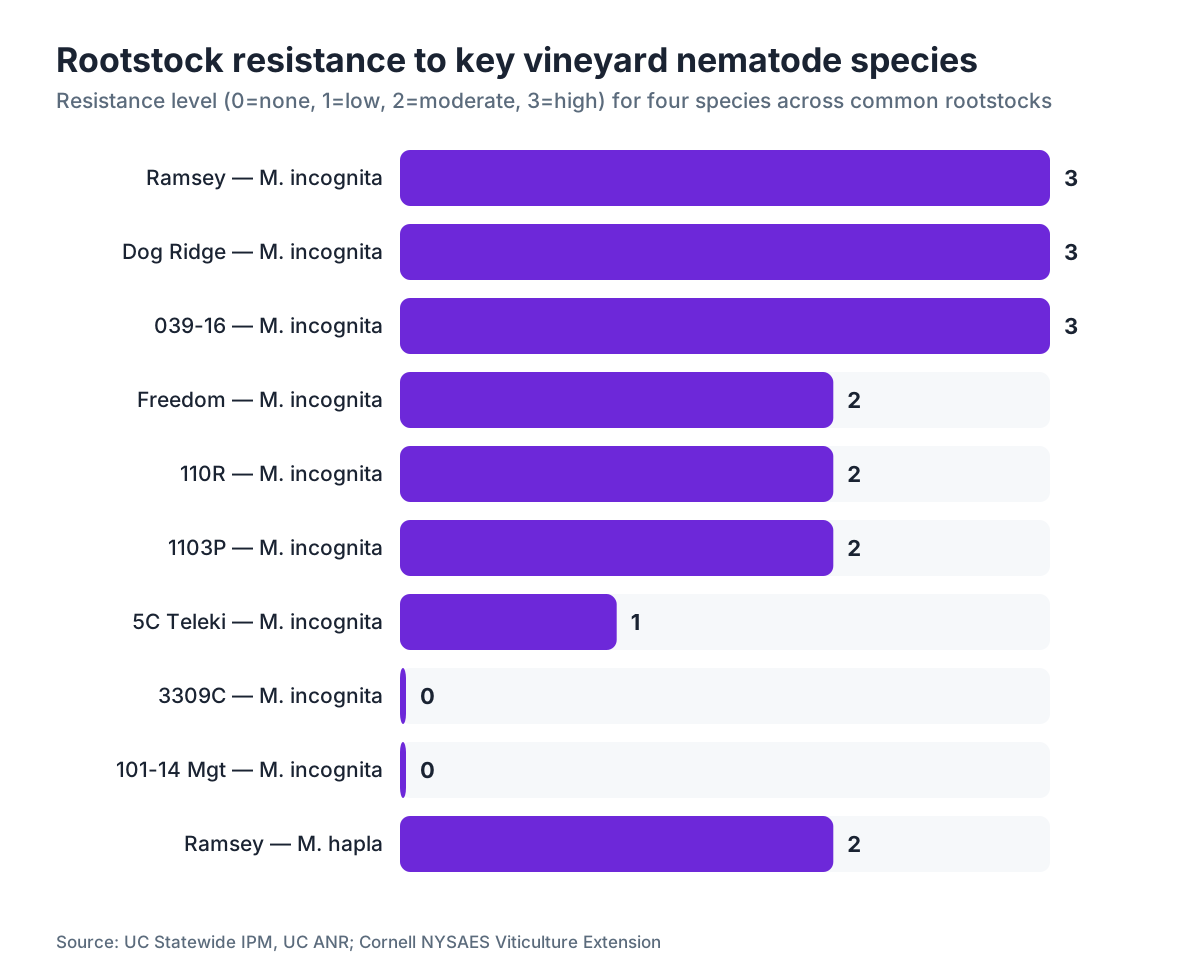
Here's how the spectrum plays out. Against M. incognita and M. arenaria, rootstocks with Vitis champinii parentage hold up best. Ramsey (Salt Creek) and Dog Ridge are highly resistant to M. incognita. Freedom and Harmony carry moderate resistance. For M. hapla the picture flips: 3309C, Riparia Gloire, and 101-14 Mgt, all common in cooler climates, run moderate to poor, which is exactly why M. hapla in an Oregon or New York block forces a careful rootstock conversation [3].
Xiphinema index is the hard one. No commercial rootstock reliably stops GFLV transmission. The nematode finishes a feeding cycle on resistant Vitis roots fast enough to pick up and inject the virus anyway. The practical answer from UC guidance: where X. index is present, fumigate the old vine row zone or fallow the site three to five years, then plant on a nematode-resistant rootstock to slow the population rebuild [1].
Pratylenchus vulnus is a different animal. Ramsey and Dog Ridge show tolerance, not resistance. AXR#1, once planted all over California, has no useful resistance to any major species and got flattened by phylloxera biotype B, which is why it's gone from new plantings in Napa and Sonoma.
One honest caveat. Resistance ratings come from controlled trials, and the field is messier. Soil type, population density, and vine stress all bend how a rated rootstock actually performs. The assay tells you what you're up against. The rating gives you a probability, not a promise.
For vineyard site evaluation beyond nematodes, the vineyard overview on VitiScribe covers the soil, drainage, and climate factors that tangle up with rootstock choice.
What records do you need to keep from a nematode assay, and how long do you keep them?
No federal rule specifically forces a vineyard operator to keep nematode assay records. Keep them anyway, treated as permanent site documentation, because three overlapping reasons make them worth more than the paper they print on.
First, fumigation. If you applied a preplant fumigant like Telone II (1,3-dichloropropene) or chloropicrin based on assay findings, you're in EPA Worker Protection Standard (WPS) territory [5]. WPS under 40 CFR Part 170 requires pesticide application records be kept two years from the application date. Most state ag departments push that to three years. The assay that triggered the application belongs in that same file.
Second, USDA and state programs. For an agricultural loan, grant, or certification tied to replanting, reviewers often ask for historical soil data, nematode surveys included. USDA Farm Service Agency's Noninsured Crop Disaster Assistance Program (NAP) can require documentation of pre-loss condition, and an assay helps establish it [6].
Third, a sale or lease. A buyer's due diligence will ask for nematode history. A clean file (survey dates, lab reports, species, counts, the rootstock you picked, the fumigation record if any) makes a deal credible. A gap in records on a block that looks stressed invites a price cut or a contingency.
Keep the original lab report (PDF or paper), the field map showing sample locations, the submission form with dates and depths, and any consultant correspondence interpreting the results. File it by block and year. Tools like VitiScribe let you attach lab PDFs straight to a block record with GPS coordinates, so the result and the map stay linked over the years.
EPA's WPS requirements sit at 40 CFR Part 170. The most recent revision took effect January 2, 2017, and updated recordkeeping provisions under Section 170.309 [5].
How do nematode assays interact with preplant fumigation decisions?
The assay is the trigger for the whole fumigation call, and it's an expensive call. Telone II runs roughly $400 to $700 per acre for materials alone, before application equipment, state permit costs, and the 14-to-30-day planting quarantine that stalls you after treatment [7].
In California, the Department of Pesticide Regulation (CDPR) requires a permit for restricted-use fumigants, and many county agricultural commissioners want a pest management justification, which is basically your assay result plus a recommendation from a licensed pest control adviser (PCA) [8]. No documented assay, no permit, or you're fumigating blind and spending several hundred dollars an acre on a problem that might not be there.
Where assay results show high Meloidogyne populations on a replant site (former vineyard soil), fumigation clearly reduces early vine decline. UC research comparing fumigated and unfumigated replant plots found fumigated vines gained 20 to 40 percent greater trunk circumference after three years on sites carrying preplant M. incognita above 50 per 100 grams [1]. Long-term yield recovery data is thin, but those early vigor numbers hold up.
Xiphinema index with GFLV is trickier. The virus lives in the soil alongside X. index individuals, and fumigation can knock the population back without clearing the pathogen reservoir. WSU extension notes GFLV can persist in infested soils 10 to 20 years after the nematode population drops [4]. On those sites the working combination is fumigation, a multi-year fallow, certified virus-free planting material, and a resistant rootstock.
Record the pre-fumigation counts and pull a post-fumigation follow-up sample 6 to 12 months out. That pair documents whether the treatment worked, and it protects you if a vine failure surfaces later and someone asks whether the site was ever treated right.
How do you build a nematode sampling and recordkeeping program for ongoing vineyard monitoring?
Sample every production block every 3 to 5 years under normal conditions, and sooner when something looks off. Preplant is the obvious moment, but monitoring can't stop there. Populations rebuild, new species arrive on irrigation water or dirty equipment, and rootstock resistance can crack under stress or a very high starting load.
Trigger an out-of-cycle sample when a block shows unexplained decline, weak bud break, or heavy spring foliar chlorosis, and take it the same season the symptoms appear. Sample any block where you've changed irrigation, cover crop species, or soil amendments, because all of those reshape nematode habitat.
Collect in fall, post-harvest and before soils drop below 50 degrees F, or in early spring after soils reach 55 degrees F and before shoot break. Use the same sampling points relative to vine rows and the same depth intervals every time, so you're comparing equivalent samples year over year.
File each result with block ID, GPS sample points, date, lab name, extraction method, and the count per 100 grams for each taxon. Build a simple table in your block records that tracks counts over time. A rising Pratylenchus count over three sampling periods on a rootstock rated only tolerant tells you something a stable low count never would.
Some labs offer longitudinal reporting if you stay with one facility, and they'll flag trends for you. UC Statewide IPM nematology publications hold that trends across two or three sampling dates are more actionable than any single count [1]. The single count tells you what's there. The trend tells you whether it's getting better or worse.
Run multiple blocks across multiple ranches and a structured record system beats memory every time. This is where digital field records earn their keep.
What does a nematode assay cost and how do you find an accredited lab?
A standard nematode assay runs $80 to $180 per composite soil sample, based on recent pricing from major California, Washington, and New York labs [2][4]. Species-level ID for Meloidogyne, needed to tell M. incognita from M. arenaria and M. hapla, which matters for rootstock choice, adds $30 to $75 per sample, usually via esterase electrophoresis or perineal pattern analysis.
Root tissue analysis adds another $50 to $100 per sample. If you're diagnosing an existing problem rather than assessing a bare site, the root sample is often more diagnostic than the soil.
In California, the UC Davis nematology lab and several CDFA-certified private labs process samples. In Washington and Oregon, WSU's Plant Pest Diagnostic Clinic handles nematology [4]. Cornell's Plant Disease Diagnostic Clinic covers New York [3]. Most state extension systems keep a list of accredited labs, and using a state-listed lab matters if you ever need the result to back a regulatory or insurance claim.
Turnaround runs 7 to 21 days. If you need results fast, say you're under contract on a vineyard land purchase with a short due diligence window, call the lab before submitting. Some run rush processing for an added fee.
For a consultant or PCA writing a pest management recommendation that includes a fumigation permit application, the lab that ran your sample has to be named in the paperwork. Keep the lab's name, address, and your sample ID number in your records right next to the results.
How do rootstock resistance ratings compare across major nematode species?
University extension programs publish rootstock resistance ratings, and they don't all agree on every variety, because trials ran at different sites, with different nematode isolates, in different soils. The table below pulls together ratings from UC Statewide IPM and Cornell/NYSAES publications where both exist [1][3].
| Rootstock | M. incognita | M. arenaria | M. hapla | Pratylenchus vulnus | Xiphinema index |
|---|---|---|---|---|---|
| Ramsey (Salt Creek) | High resistance | High resistance | Moderate | Tolerant | No resistance |
| Dog Ridge | High resistance | High resistance | Moderate | Tolerant | No resistance |
| Freedom | Moderate | Moderate | Low | Moderate | No resistance |
| Harmony | Moderate | Moderate | Low | Moderate | No resistance |
| 5C Teleki | Low | Low | Moderate | Low | No resistance |
| 3309C | Susceptible | Susceptible | Low | Susceptible | No resistance |
| 101-14 Mgt | Susceptible | Susceptible | Moderate | Susceptible | No resistance |
| 110R | Moderate | Moderate | Moderate | Moderate | No resistance |
| 1103P | Moderate | Moderate | Moderate | Moderate | No resistance |
| 039-16 | High resistance | High resistance | Low | Moderate | No resistance |
Note: No commercial rootstock carries resistance to X. index that prevents GFLV transmission. Ratings above reflect root-galling or population reproduction suppression, not virus transmission prevention [1].
A few things jump out. Ramsey and Dog Ridge are the standard answers for M. incognita, but they carry baggage: high vigor, a deep grafting requirement, weak performance on some cool sites. You're trading one problem for another. Freedom and Harmony were bred partly for nematode tolerance, but they've shown phylloxera vulnerability against certain California biotypes, so check current phylloxera biotype data for your region before you default to them.
In cool-climate regions where M. hapla dominates, the useful-resistance options thin out. Cornell's viticulture extension materials suggest that where M. hapla is the main concern, 101-14 Mgt's susceptibility may be partly offset by its vigor-moderating effect, which keeps roots healthier under moderate pressure. They still don't rank it a first choice where populations top 200 per 100 grams [3].
What are the compliance and documentation requirements for nematode management under the EPA Worker Protection Standard?
The EPA Worker Protection Standard (WPS), revised in 2015 and effective January 2, 2017, covers agricultural pesticides including soil fumigants used against nematodes [5]. Under 40 CFR Part 170, agricultural employers must keep records of pesticide applications: product name, EPA registration number, active ingredient, application date, and treated area. Hold those records two years from the application date and hand them to state or federal inspectors on request.
The WPS at 40 CFR 170.309(a) requires: "The agricultural employer must retain records of each pesticide application for 2 years following the end of the application." The nematode assay that justified the fumigation isn't explicitly required by WPS, but it's the one document that explains why a restricted-use fumigant went on a specific block, and any enforcement review or insurance claim will ask for it.
California goes further. CDPR's pesticide use reporting system requires all restricted-use pesticide applications be reported to the county agricultural commissioner within 30 days, feeding the state's Pesticide Use Reporting (PUR) database [8]. The pest management justification, assay findings included, sits in the permit application file at the county.
On worker safety, fumigation creates restricted-entry intervals (REIs) of 5 days for Telone II and chloropicrin under most use patterns, stretching to 30 days in some scenarios. Post those REIs at field entry points and pass them to workers. Your assay records, fumigation records, and REI documentation together make one coherent compliance file for any WPS or state inspection.
Unsure whether your fumigant application records are complete? EPA's WPS agricultural employer requirements are the place to start [5].
Frequently asked questions
How many soil samples do I need for a reliable nematode assay on a 10-acre vineyard block?
Take 20 to 30 individual cores per 5-acre sampling zone and combine them into one composite. For a 10-acre block with uniform soil history, two composites (one per 5 acres) is the minimum. If soil texture or previous crops vary within the block, create separate sampling zones and submit separate composites. More samples mean more representative data, especially on sites with patchy prior land use.
Can I use the same nematode assay results to choose both a rootstock and a cover crop?
Yes, with caveats. High Meloidogyne populations favor cover crops that are non-hosts or poor hosts for the specific species found, such as cereal rye or sudangrass for M. incognita management. But the assay identifies what's there, not how a cover crop will affect populations. UC Statewide IPM cover crop guides and nematology publications cover species-specific host status. Use both when making a decision.
What is the difference between a soil nematode sample and a root tissue sample, and when do I need both?
Soil samples capture free-living and soil-dwelling stages. Root samples capture species that spend most of their life cycle inside root tissue, particularly Pratylenchus and Meloidogyne females and eggs. For pre-plant assessment, soil samples are the standard. For diagnosing an existing vine problem, root samples are often more informative. Running both on a problem block gives a complete picture and is worth the added $50 to $100 lab cost.
Does fumigating a Xiphinema index-infested site actually eliminate the GFLV risk?
No, not reliably. GFLV persists in soil associated with X. index and can survive even after the nematode population is reduced by fumigation. WSU extension notes the virus can persist for 10 to 20 years on infested sites. Fumigation reduces nematode populations and slows virus spread, but does not eliminate it. Planting certified virus-free material on a resistant rootstock with an extended fallow period is the best combination currently available.
How often should I sample an established vineyard for nematodes?
Every 3 to 5 years under normal conditions. Sample more frequently, meaning annually, if you see unexplained decline, reduced vigor in a block on a susceptible rootstock, or after you've introduced new irrigation infrastructure or made significant soil management changes. Consistent sampling at the same time of year and same soil depths is more useful than more-frequent but inconsistently timed sampling.
Are there organic alternatives to chemical fumigation for nematode management before planting?
Yes, though none match the knock-down efficacy of Telone II on high-population sites. Options include biofumigation with brassica cover crops (especially varieties with high glucosinolate content), extended fallow periods (2 to 4 years), soil solarization in high-sun regions, and anaerobic soil disinfestation. Each approach reduces populations to varying degrees. UC Statewide IPM trial data shows 40 to 70 percent population reduction from solarization in California conditions, compared to 80 to 95 percent from Telone II.
What rootstock should I choose if my assay shows both Meloidogyne incognita and Pratylenchus vulnus?
Ramsey or Dog Ridge gives the strongest resistance to M. incognita combined with reasonable tolerance of Pratylenchus. Freedom and Harmony are moderate for both, a more balanced choice if vigor is a concern. Consult current UC Statewide IPM rootstock trial data for your specific grape variety and soil conditions, since vigor interactions between rootstock and scion vary by site.
Do I need a licensed pest control adviser to interpret nematode assay results in California?
A PCA is not required to interpret results, but you do need one to write a pest management recommendation that supports a permit application for a restricted-use fumigant in California. CDPR requires that any recommendation for a restricted-use pesticide, including Telone II, be written and signed by a licensed PCA. The assay result is the factual basis; the PCA provides the regulatory authorization for the fumigation plan.
How do I document nematode assay records properly if they're ever challenged by a regulator or buyer?
Keep the original lab report, the sample submission form with collection date, block ID, GPS coordinates or field map, sampler name, and sample depth. Attach any consultant correspondence interpreting results. If fumigation followed, attach the fumigation record and the PCA recommendation. Organize by block and year. Records should be accessible, meaning not buried in a file box, for at least three years from the date of any related pesticide application.
What sample depth is standard for pre-plant nematode testing in a vineyard?
The standard recommendation from UC Statewide IPM and WSU extension is 0 to 24 inches, collected as two depth intervals (0 to 12 inches and 12 to 24 inches) or as a single composite from 0 to 24 inches. Some labs prefer separate depth submissions to show where populations concentrate. On sandy soils or former orchards, some specialists recommend going to 36 inches, since populations can go deep on coarse-textured profiles.
Can nematode species from one vineyard spread to an adjacent new planting?
Yes. Nematodes move through soil water, attached soil on roots, and equipment carrying infested soil. Dagger nematodes move slowly on their own but can travel significant distances in irrigation runoff. Standard biosecurity for vineyard equipment, cleaning tractor tires and discs between blocks, reduces but doesn't eliminate transfer risk. If an adjacent block has a known Xiphinema index population, consider that a risk factor when assessing your new site.
Is there a nematode threshold below which I can safely plant a susceptible rootstock?
For Meloidogyne and Xiphinema index, most extension specialists treat any detectable population as a meaningful risk in a pre-plant context, given the long economic life of a vineyard planting. For Pratylenchus vulnus, UC Statewide IPM guidance suggests populations below 50 per 100 grams in a pre-plant soil sample may be low enough risk to proceed with a tolerant rootstock on a vigorous site, but that threshold is not fixed and depends on soil type.
Where can I find published rootstock resistance ratings I can cite in a pest management recommendation?
UC Statewide IPM publishes rootstock and nematode profiles through UC ANR (ipm.ucanr.edu). Cornell Cooperative Extension and the New York State Agricultural Experiment Station publish northeastern trial data through their viticulture extension pages. WSU Extension covers Pacific Northwest rootstock performance. USDA-ARS rootstock trials appear in the American Journal of Enology and Viticulture. For a permit application, cite the most recent version of your state's extension rootstock guide alongside your assay data.
What happens if I don't test for nematodes before planting and discover a problem two years in?
Your options shrink dramatically. You can't change the rootstock without killing the vines. You can try to suppress populations with soil amendments, cover crops, or in some cases a post-plant restricted-use nematicide (limited options; few products are labeled for established vineyards). You can tolerate the yield and quality losses while the block serves its economic life, then replant with better information. The pre-plant assay exists precisely to avoid this situation.
Sources
- UC Statewide IPM Program, UC ANR, Grape Pest Management Guidelines (Nematodes): Yield loss ranges, nematode thresholds not being fixed numbers, X. index as serious site risk, fumigation trunk-circumference gains, solarization vs Telone reduction percentages, and trend-based interpretation guidance
- UC Statewide IPM Program, UC ANR, Grape Nematode sampling guidance: Standard composite sample size (20-30 cores), sampling season guidance, lab cost ranges, and species panel recommendations for vineyard nematode assays
- Cornell Cooperative Extension, New York State Agricultural Experiment Station, Viticulture and Enology Extension: M. hapla dominance in cool-climate regions; 3309C and 101-14 Mgt susceptibility ratings; X. index as trigger for rootstock substitution; Cornell Plant Disease Diagnostic Clinic services
- Washington State University Extension, Plant Pest Diagnostic Clinic and Viticulture Extension: Sample processing within 24-48 hours of collection; GFLV persistence in X. index-infested soils of 10-20 years after nematode population reduction
- US EPA, Worker Protection Standard, 40 CFR Part 170: WPS recordkeeping requirement: retain pesticide application records for 2 years; revised WPS effective January 2, 2017; Section 170.309(a) quoted text
- USDA Farm Service Agency, Noninsured Crop Disaster Assistance Program (NAP): NAP documentation requirements that can include pre-loss soil condition records for vineyard eligibility
- California Department of Pesticide Regulation, Telone II (1,3-dichloropropene) Use Requirements: Telone II application cost range $400-700 per acre for materials; 14-30 day post-fumigation planting quarantine requirement; restricted-use permit requirement
- California Department of Pesticide Regulation, Pesticide Use Reporting: CDPR requires restricted-use pesticide applications to be reported to the county agricultural commissioner within 30 days; PCA requirement for restricted-use fumigant recommendations
- American Journal of Enology and Viticulture, ASEV, Rootstock trial publications: USDA-ARS and university rootstock trial data including nematode resistance evaluations published in peer-reviewed viticultural research
Last updated 2026-07-11