How to write a vineyard management agreement covering spray record responsibilities

TL;DR
- A vineyard management agreement should name who keeps the pesticide application records, specify the exact format required by your state and the EPA Worker Protection Standard, set retention periods (at least two years federally, three or more in most wine states), spell out who bears liability for recordkeeping failures, and include a notification clause if records are requested by an inspector.
Why spray record responsibilities belong in the contract, not in a handshake
Most vineyard management disputes that reach a courtroom or a state ag department start the same dumb way. The grower assumed the manager was keeping the spray records. The manager assumed the grower was. Nobody wrote it down. When an inspector shows up and the records are full of holes, both parties point at each other.
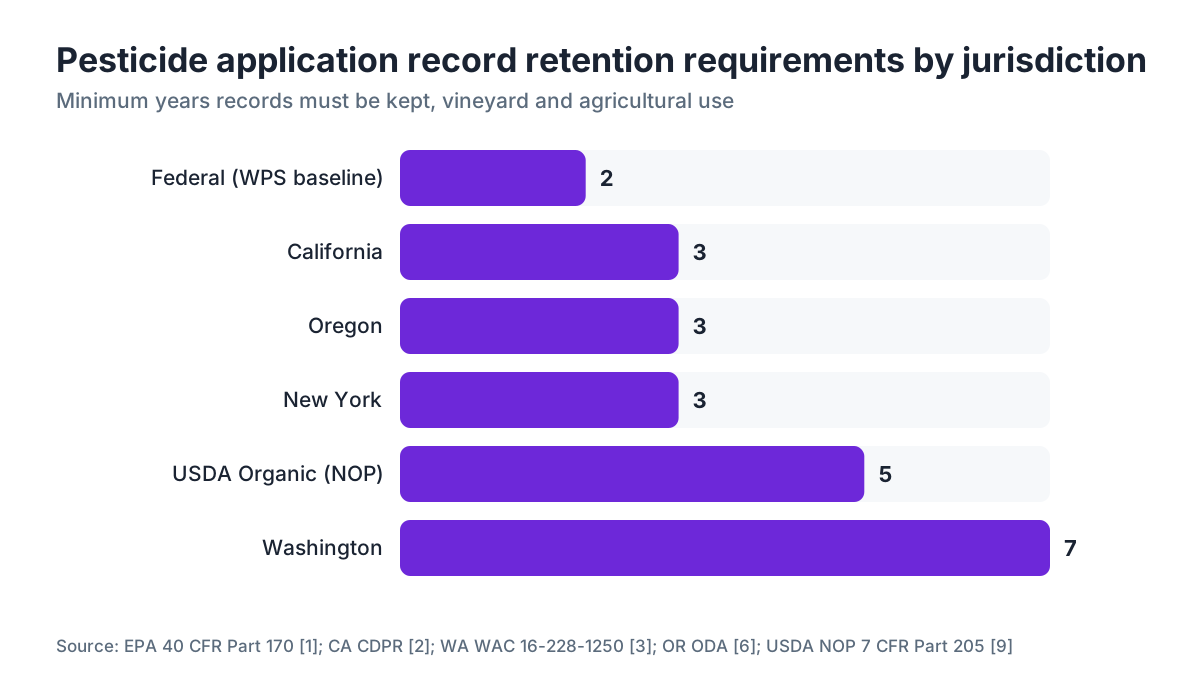
The federal Worker Protection Standard requires pesticide application and safety training records to be kept for at least two years from the date of the application, and the regulation is explicit that it applies to any agricultural employer or handler employer who uses or supervises the use of pesticides [1]. State rules layer on top of that. California requires licensed pesticide applicators to retain application records for three years under the California Food and Agricultural Code Section 12981 [2]. Washington State requires commercial pesticide applicators to keep records for seven years under WAC 16-228-1250 [3]. Oregon sits at three years. If your contract does not say which party carries those obligations, you are relying on inference the day an inspector hands you a notice.
The stakes are real. EPA civil penalties under FIFRA for recordkeeping violations can reach $20,000 or more per violation as of the most recent inflation adjustment, though first-time minor violations often settle far lower [4]. A well-drafted spray record clause costs you nothing but an afternoon of careful drafting. That is a good trade.
What is a vineyard management agreement and who typically signs one?
A vineyard management agreement (sometimes called a vineyard management contract or a custom farming agreement) is a written contract between a vineyard owner and a professional vineyard manager or management company. The manager agrees to handle day-to-day field operations. The owner agrees to pay a management fee, cover operating costs, or both.
The parties vary. In Napa and Sonoma you often see absentee landowners who own acreage but have no farming background contracting with established management firms. On the Central Coast, especially around Paso Robles wineries, you see more hybrid arrangements where a winery also owns or leases the vineyard and the manager is basically an employee with a contract. City-based wine businesses that source from a contract vineyard, including operations like city winery ventures that buy fruit under long-term supply agreements, sometimes wrap management responsibilities into the supply contract itself.
Structure aside, every version of this agreement needs to answer four questions: who makes spray decisions, who applies the pesticides, who documents them, and who keeps the records. Those questions are distinct. The answers can be four different people or entities, and that is exactly why the paperwork has to be precise.
Which laws actually govern pesticide recordkeeping in a vineyard?
Three layers of law sit on top of every spray record you keep. Understand all three before you write a single clause.
Federal layer: FIFRA and the Worker Protection Standard. The Federal Insecticide, Fungicide, and Rodenticide Act (FIFRA) and its implementing regulations at 40 CFR Part 170 (the Worker Protection Standard, or WPS) set baseline requirements for agricultural pesticide use. For farms that employ workers or handlers, the WPS requires the agricultural employer to keep specific application information posted during the re-entry interval and to keep certain safety data accessible for two years [1]. For restricted-use pesticides specifically, the certified applicator who purchases or uses them must keep records under 40 CFR Part 171 [10].
State layer. Every wine-producing state has its own pesticide control act administered by the state department of agriculture. California's is among the most detailed: the county agricultural commissioner system means applications must usually be reported to the county, more than held in a farm file [2]. Washington's Department of Agriculture administers its pesticide rules under RCW Chapter 15.58 [3]. Cornell Cooperative Extension publishes guidance comparing northeastern state recordkeeping requirements for growers in New York, Pennsylvania, and New Jersey [5].
Label layer. The pesticide label is a legal document. Under FIFRA, using a pesticide inconsistently with its labeling is a federal violation. Some labels impose their own recordkeeping or re-entry requirements beyond the WPS baseline. Your contract should say the manager is responsible for reading and complying with the label on every product used.
So your agreement should do three things: name which state's law governs, cite the retention period for that state, and add a catch-all that the manager must comply with all label requirements and any county-level reporting.
What exact information must a pesticide application record contain?
The WPS requires application information posted for workers to include the product name, EPA registration number, active ingredient(s), location and description of the treated area, date(s) of application, and re-entry interval [1]. California's requirements under FAC 12981 go further, adding the applicator's license number, acres treated, amount of product used, and the pest(s) targeted [2].
Here is a side-by-side of the fields required across key wine states:
| Field | Federal WPS | California | Washington | Oregon | New York |
|---|---|---|---|---|---|
| Product name + EPA reg. no. | Required | Required | Required | Required | Required |
| Active ingredient(s) | Required | Required | Required | Required | Required |
| Date of application | Required | Required | Required | Required | Required |
| Location / block identifier | Required | Required | Required | Required | Required |
| Re-entry interval | Required | Required | Required | Required | Required |
| Licensed applicator name + number | Not required | Required | Required | Required | Required |
| Amount of product used | Not required | Required | Required | Required | Required |
| Acres or units treated | Not required | Required | Required | Required | Required |
| Pest(s) targeted | Not required | Required | Not required | Required | Not required |
| Application method / equipment | Not required | Required | Not required | Not required | Not required |
| Weather conditions at time of application | Not required | Required | Not required | Not required | Not required |
Sources: [1][2][3][5][6]
List these fields explicitly in your contract clause so there is no ambiguity. Copy the most demanding state standard and you cover every other one at the same time.
How do you structure the spray record clause itself?
Break the clause into four numbered sub-sections. This is what I'd actually write.
1. Record creation. State that the manager must create a written pesticide application record within 24 hours of each application. Specify the format (paper log, electronic system, or both) and the fields it must contain. If you use a software platform that creates timestamped, field-level records, reference it here. VitiScribe and similar vineyard recordkeeping platforms generate records that export to California's county reporting format, which matters if you run multiple properties.
2. Record retention. State the retention period in plain numbers. Use the longest requirement that applies: in California, that is three years from the application date [2]. Add a litigation hold provision: if either party reasonably anticipates litigation or a regulatory inquiry, records stay put until the matter closes, no matter the standard retention period.
3. Record access. The owner should have the right to access, copy, and audit all spray records at any time with reasonable notice (48 hours is workable, 24 hours is fine if the operation is local). The manager should also hand over copies within five business days of the end of each calendar quarter, or immediately on request. This matters for organic certification audits, third-party sustainability certifications, and due diligence on a property sale.
4. Regulatory response. If a government inspector (county ag commissioner, EPA, state department of agriculture) requests records or issues a notice of inspection, the manager must notify the owner within 24 hours and provide copies of anything submitted to the agency within 48 hours. People forget this clause. It causes the most damage when it is missing.
Who should hold liability for incomplete or incorrect spray records?
Liability should follow control. That is the honest answer, and it is where most template contracts quit early: they say the manager will keep records, then go silent on what happens when the manager doesn't.
If the manager makes spray decisions and applies products, or supervises licensed applicators, the manager should carry primary liability for the completeness and accuracy of the records. The owner carries the cost of any fine that comes from the owner's own failure to make records available when legally required.
A workable structure: the manager indemnifies the owner for any regulatory penalties, third-party claims, or legal costs arising from the manager's failure to create, maintain, or produce records as required by the agreement or applicable law. The owner indemnifies the manager for penalties arising from the owner's failure to provide necessary information (for example, the owner made an application themselves and never told the manager).
You also need a cap. Unlimited indemnification clauses often make it impossible to get a management company to sign. A reasonable cap is the total management fees paid in the 12 months before the claim, or the limits of the manager's commercial general liability and pollution liability insurance, whichever is greater.
Require the manager to carry both commercial general liability and pesticide-specific pollution liability coverage. UC Davis Agricultural and Resource Economics extension publishes guidance on insurance and liability for custom farm operators in California that is worth reading before you set your minimums [7].
How do Worker Protection Standard notification and posting requirements fit into the agreement?
The WPS requires agricultural employers to post specific information at a central location before workers enter a treated area during the re-entry interval [1]. The posting must include the product name, EPA registration number, active ingredient(s), location and description of the treated area, date and start time of application, and re-entry interval.
In a management agreement, you have to name who is the "agricultural employer" for WPS purposes. EPA's position is that the agricultural employer is the person who employs or is responsible for the workers. If the management company employs the farmworkers, the management company is the agricultural employer and carries the WPS compliance obligations. If the vineyard owner employs the workers but the manager directs their work, the situation gets murky. Clarify it in the contract in plain words.
The agreement should also cover WPS safety training records. The WPS requires training to be documented, and those records must be available for inspection [1]. Assign that obligation clearly. If the manager trains field workers, the manager keeps the training records and provides copies to the owner annually and on request.
Washington State University Extension runs a pesticide education program with WPS compliance materials for Washington growers that is a good supplement to review alongside your contract drafting [8].
What should the spray program approval process look like in the contract?
Spray records document decisions, so the contract should say how those decisions get made. That is what determines who owns the record in the first place.
A standard approach: the manager prepares an annual spray program or integrated pest management (IPM) plan by a set date (often February 1 for a spring growing season). The owner reviews and approves. The manager executes within that approved program. Any application outside the plan needs written owner consent except in an emergency, and emergency applications get documented with a written explanation within 48 hours.
This structure earns its keep three ways. It protects the manager from being blamed for an application the owner mandated. It creates a paper trail showing a good-faith IPM approach, which matters for organic certification, sustainability audits, and any neighbor dispute over spray drift. And it makes the spray records a management tool instead of a compliance checkbox.
For vineyard operations that also make wine on-site, as you see at estate properties like Gervasi Vineyard, the approval process should loop in the winemaker, since pre-harvest intervals and residue limits affect winery operations directly. UC Davis extension publishes IPM planning and custom farming resources that help frame this section of the contract [11].
How should the agreement handle organic certification and third-party audits?
If the vineyard is certified organic or heading into transition, the spray record requirements jump. The USDA National Organic Program (NOP) requires organic system plans and compliance records to be maintained for at least five years [9]. That beats any state pesticide recordkeeping requirement.
Your contract should say that when the operation is NOP-certified, the five-year retention requirement governs over the state standard, and the manager must keep all records in a format the certifying agent will accept. The manager must also give records to the certifying agent on request and tell the owner immediately if any prohibited substance was used, even by accident.
For non-organic vineyards chasing third-party sustainability certifications (California Sustainable Winegrowing Alliance, LIVE, Salmon-Safe, and others), give the certification auditor the same access rights as the owner, and require the manager to finish any self-assessments or data submissions by set deadlines.
Nobody has good published data on how often certification audits fail specifically because of spray record gaps. The closest thing is anecdotal feedback from certifying agents, which points to incomplete applicator information and missing re-entry interval documentation as the most common deficiencies.
What happens to the spray records when the management agreement ends?
This is the clause people only regret skipping after the relationship ends badly.
When a management agreement terminates for any reason, including non-renewal, the manager should transfer all original records, or certified copies, to the owner within 30 days of the termination date. The manager can keep copies for their own regulatory compliance, but the originals belong to the vineyard owner. They follow the land and the crop history.
If records are electronic, specify the export format. A proprietary format only the manager's software can read is useless to the owner. CSV or PDF exports of each application record are reasonable minimums.
Add a survival clause: the manager's recordkeeping and records-transfer obligations continue after the agreement ends for the full length of any applicable retention period. If you are in Washington and records must be kept seven years, the manager's duty to retain and produce records on request runs seven years from the date of the last application under the agreement [3].
A platform like VitiScribe makes this handoff simpler because records live in the grower account, not the manager's login. The transition does not hinge on a cooperative ex-manager exporting files.
What are common mistakes in vineyard management agreements covering spray records?
A handful of failure patterns repeat across these contracts.
Vague language on format. "Manager shall keep adequate records" means nothing. Specify the fields, the timing of entry, and the storage medium.
No notification trigger for regulatory contact. The manager gets a notice of violation. They handle it quietly. The owner finds out six months later when the fine is final. A 24-hour notification requirement would have stopped that cold.
Ignoring county-level reporting. In California, pesticide use reports go to the county agricultural commissioner, more than into a farm file [2]. The contract should say who files those reports and when.
No backup requirement. Records sit on the manager's laptop. The laptop dies. Who eats that? Require records to be backed up to cloud storage or handed to the owner in a set format at set intervals.
Missing insurance requirements. A manager with no pollution liability coverage who causes a FIFRA violation is personally liable. If they cannot pay, your indemnification clause is worthless. Set minimum coverage amounts in the contract and require annual proof of insurance.
No provision for custom applicators. If the manager hires a licensed pest control operator to do the actual spraying, the contract should say the manager is still responsible for collecting and keeping that applicator's records. The licensed PCO's records do not flow into the farm file on their own.
What should the spray record section look like as a checklist before you sign?
Before you sign any vineyard management agreement, run this list and confirm each item is in writing.
- Record creation: who creates the record, what fields it must contain, and how soon after application (24 hours is the standard).
- Format: paper, electronic, or both. If electronic, name the platform or specify the export format.
- Retention period: state the number of years explicitly, using the longest applicable requirement.
- Owner access: owner can request and receive copies at any time, with a defined turnaround (48 hours is workable).
- Quarterly delivery: manager provides the full record set to the owner at the end of each quarter.
- County reporting: who files pesticide use reports with the county agricultural commissioner when state law requires it.
- WPS posting: who posts re-entry interval information and keeps worker safety records.
- Regulatory contact notification: manager notifies owner within 24 hours of any inspector contact.
- Approved spray program: annual IPM plan approval process defined, emergency application procedure defined.
- Certification audits: certifying agents and sustainability auditors get records access equal to the owner.
- Custom applicator records: manager collects and keeps records from any hired pest control operators.
- Termination transfer: originals transfer to the owner within 30 days, in a specified format.
- Survival clause: obligations continue for the full retention period after termination.
- Liability and indemnification: primary liability follows control, with defined caps.
- Insurance: minimum coverage types and amounts specified, annual proof required.
Frequently asked questions
How long does the law require you to keep vineyard spray records?
The federal minimum under FIFRA and the Worker Protection Standard is two years for most records. State requirements vary: California requires three years, Washington requires seven years for commercial applicators under WAC 16-228-1250, and Oregon requires three years. USDA organic certification requires five years. Your contract should use the longest period that applies to your operation.
Does the vineyard owner or the manager have to sign the EPA Worker Protection Standard pesticide application records?
The WPS does not require a signature on application records. It requires that the information be recorded and posted. But the agricultural employer, the entity that employs or supervises workers, is responsible for making sure the records are created and posted. Your management agreement should say explicitly whether the owner or manager is the agricultural employer for WPS purposes, since that determines who faces enforcement if records are missing.
What happens if a vineyard manager fails to keep required spray records?
EPA civil penalties for FIFRA recordkeeping violations can reach $20,000 or more per violation as of the most recent inflation adjustment. State penalties vary. In California, failure to submit required pesticide use reports to the county agricultural commissioner can lead to permit suspension. The vineyard owner may also lose organic certification or third-party sustainability certification if records are unavailable for an audit.
Can a verbal agreement cover spray record responsibilities in a vineyard?
Legally, maybe. Practically, no. A verbal agreement is impossible to enforce when an inspector shows up and records are missing. Any professional vineyard management relationship should have a written contract. Courts in California, Washington, and Oregon generally enforce written farm contracts under their respective statute of frauds provisions when the agreement covers more than a single growing season.
Who files the pesticide use report with the county agricultural commissioner in California?
California's pesticide use reporting system requires the licensed pest control operator or pest control adviser who directed the application to file the report with the county agricultural commissioner within one month of the application under the California Food and Agricultural Code. Your management agreement should confirm the manager handles this filing and gives the owner copies of all submitted reports.
What insurance should a vineyard manager carry related to pesticide applications?
At minimum, a vineyard manager should carry commercial general liability coverage and pesticide-specific pollution liability coverage. Pollution liability covers third-party bodily injury or property damage from pesticide drift or misapplication, which general liability policies often exclude. UC Davis extension recommends reviewing minimum thresholds with a farm insurance specialist, since standard amounts vary widely by operation size and geography.
Do spray records need to cover pesticide applications made by a hired pest control operator, not the manager?
Yes. The licensed pest control operator who makes the application has their own legal obligation to keep records, but those records do not automatically end up in your farm file. Your management agreement should require the manager to collect a copy of each application record from any hired applicator within 48 hours of the application and add it to the farm's master pesticide record.
How should electronic spray records be stored to satisfy a regulatory inspection?
Most state agriculture departments accept electronic records as long as they can be printed on demand and contain all required fields. California's county ag commissioner system accepts electronic submissions through certain approved platforms. Your contract should require records to be backed up off-site or in cloud storage, exportable to PDF or CSV, and accessible for printing within the window an inspector would reasonably allow, typically 24 to 72 hours.
What is the difference between a restricted-use pesticide record requirement and a general-use one?
Restricted-use pesticides (RUPs) require purchase and use records maintained by the certified applicator under 40 CFR Part 171, on top of the standard WPS application records. These records must be available for inspection by any authorized government employee for two years. General-use pesticides have no federal purchase record requirement, though state law may add its own. Your contract should confirm the manager tracks RUP use separately.
Can spray record responsibilities be split between the owner and the manager?
They can, but it is risky. Splitting responsibilities, where the manager records the application and the owner files the county report for example, creates gaps when communication breaks down. If you split, your contract must spell out each party's exact obligation with its own timeline and define who bears liability if the other party fails. Most experienced attorneys advise assigning primary responsibility to one party with the other holding audit rights.
What should a vineyard management agreement say about spray records when transitioning to organic?
The USDA NOP requires documentation of all inputs for the three-year transition period before certification and for five years after. Your contract should extend record retention to five years, require the manager to document any prohibited substance use immediately and in writing, and confirm the manager cooperates with the certifying agent's record requests. Transition period records are often the most scrutinized during initial certification.
How do spray record provisions differ for a lease agreement versus a management agreement?
In a management agreement, the manager acts as the owner's agent and the owner typically carries ultimate regulatory responsibility. In a lease, the lessee is an independent operator and generally carries their own regulatory obligations, including pesticide recordkeeping. If you are leasing your vineyard, your lease should require the lessee to give you copies of all application records annually and notify you of any regulatory contact, since the land's production history affects your property value and future certification eligibility.
Sources
- EPA, Agricultural Worker Protection Standard (40 CFR Part 170): The WPS requires pesticide application and safety training records to be kept for at least two years from the date of the application and specifies the information that must be posted for worker re-entry.
- California Department of Pesticide Regulation, Pesticide Use Reporting: California Food and Agricultural Code Section 12981 requires licensed pesticide applicators to retain application records for three years, with county agricultural commissioner reporting requirements.
- Washington State Legislature, WAC 16-228-1250 (pesticide recordkeeping): Washington requires commercial pesticide applicators to keep application records for seven years.
- EPA, Enforcement (FIFRA civil penalties and inflation adjustments): EPA civil penalties under FIFRA for recordkeeping violations can reach roughly $20,000 or more per violation as of the most recent annual inflation adjustment.
- Cornell Cooperative Extension, agriculture programs (pesticide recordkeeping guidance): Cornell Extension publishes guidance on pesticide recordkeeping requirements in northeastern states including New York, comparing field requirements to federal minimums.
- Oregon Department of Agriculture: Oregon requires pesticide application records to be kept for three years and include active ingredients, pest targeted, and amount of product used.
- UC Davis Agricultural and Resource Economics: UC Davis Agricultural and Resource Economics has published guidance on insurance and liability considerations for custom farm operators and vineyard managers in California.
- Washington State University Extension: WSU Extension runs a pesticide education program with WPS compliance materials for Washington vineyard operations.
- USDA Agricultural Marketing Service, National Organic Program (7 CFR Part 205): The NOP requires that organic system plans and records demonstrating compliance be maintained for at least five years.
- EPA, Pesticide Registration (FIFRA and restricted-use pesticides, 40 CFR Part 171): Under 40 CFR Part 171, certified applicators must maintain restricted-use pesticide purchase and use records available for inspection for two years.
- University of California Agriculture and Natural Resources (UC ANR): UC extension provides resources on vineyard management, IPM planning, and custom farming contract considerations.
- California Department of Food and Agriculture, Plant Health and Pest Prevention Services: California's county agricultural commissioner system requires pesticide use reports to be filed by licensed operators within one month of application.
Last updated 2026-07-10