Identifying early season Eutypa dieback symptoms on grapevines
TL;DR
- Eutypa dieback (caused by Eutypa lata) shows its first reliable field signs in spring, roughly 3 to 8 years after the fungus enters a pruning wound.
- Look for one or two arms producing stunted, chlorotic, cupped shoots while the rest of the vine looks fine.
- Infected wood shows a wedge-shaped, dark brown canker in cross-section.
- Early ID saves the arm.
- Late ID costs the whole vine.
What is Eutypa dieback and why does early detection matter?
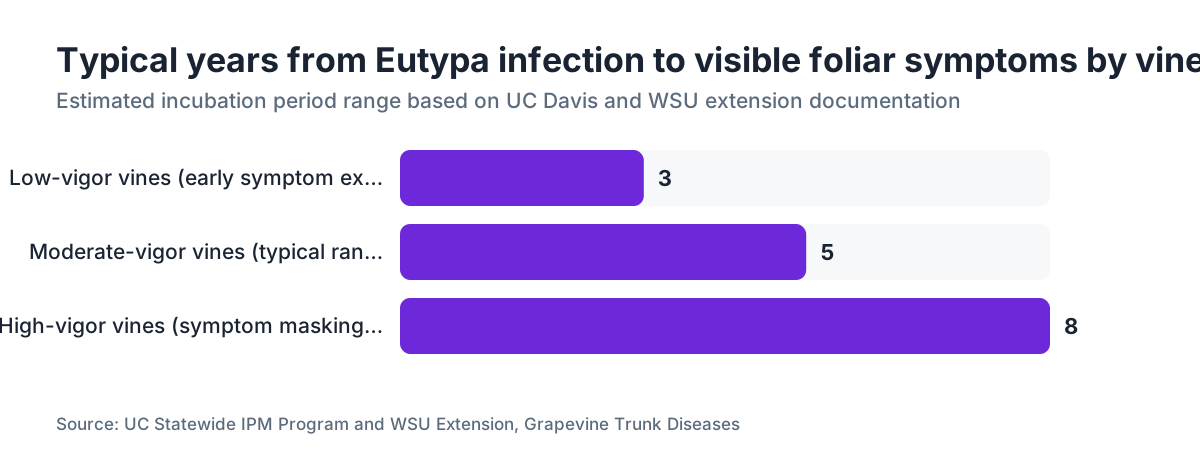
Eutypa dieback is a wood disease of grapevines caused by the fungus Eutypa lata. It gets in almost exclusively through fresh pruning wounds, travels down the vascular tissue, and kills the wood from the inside out over years. By the time most growers notice anything is wrong, the fungus has been colonizing that arm for three to eight years [1].
That long lag is the whole problem. A grower prunes casually during a wet February, leaves large wounds bare, and sees no visible trouble for several seasons. No feedback. No signal that anything went sideways. Then one spring, one arm of a vine leafs out slowly, the shoots look thin and yellow, and the grower blames nutrition or late frost. By the time a real diagnosis happens, the canker has often crept close enough to the cordon or trunk that removing the arm still leaves infected wood behind.
Early detection means catching the disease at the arm level before it reaches the trunk. That is the single most practical way to save a vine. UC Davis plant pathologists have documented that losses can reach 20 to 80 percent of vineyard production in heavily infected blocks over time [1]. Catch it early, before the trunk is compromised, and that statistic never applies to your block.
When in the season do Eutypa symptoms first appear?
Symptoms show up in spring, at or just after budbreak. That timing is your opening. It's the window to walk the rows and see the affected arms before the canopy fills in and hides them.
The textbook window runs from shoot emergence through about six to ten inches of growth. At that stage the contrast between sick and healthy tissue is sharpest. Shoots on an infected arm lag behind by days to a week or more, and when they finally push, they look plainly different from the healthy shoots on the same vine.
After flowering and into summer, the picture gets murkier. The vine compensates a little, and the stunted shoots blend into the canopy once leaves expand and the block fills out. You can still find it mid-season if you know what you're looking at, but the spring window is faster and cleaner [2].
Walk the block twice. Once at budbreak, again when shoots are six to twelve inches long. Flag anything suspicious on the first pass. Come back on the second pass with a pruning saw and make cross-section cuts on everything you flagged.
What do Eutypa dieback symptoms look like on shoots and leaves?
The shoot symptoms are distinctive enough that an experienced eye can call a provisional diagnosis from twenty feet away, at least on a vine with a clean canopy.
Affected shoots are short, sometimes stunted to a third or less of normal length, with compressed internodes. The leaves are small and chlorotic, a yellowish or pale green, and the margins cup or pucker inward. Some references describe the leaf edges as necrotic or scorched. UC Davis extension materials note that small, cupped leaves with necrotic margins are a hallmark sign [1].
The diagnostic clue that matters most: symptoms show up on some arms but not others on the same vine. A vine where every shoot looks stunted probably has a different problem, like a rootstock issue, waterlogging, or nutrient deficiency. A vine where one or two cordons push stunted, chlorotic, cupped shoots while the adjacent arms look perfectly normal is the classic Eutypa presentation. That localized, arm-specific decline is the clearest field indicator you get before you even touch a saw.
Flowers on affected shoots often abort or set clusters with severe shot berry. Poor fruit set concentrated on one arm of an otherwise productive vine? Add Eutypa to your list.
How do you confirm Eutypa dieback with a wood cross-section cut?
Shoot and leaf symptoms give you a strong working hypothesis. A cross-section of the wood confirms it.
Use a sharp pruning saw or chisel and cut across the suspect arm a foot or two below where the symptomatic shoots emerge. Read the cut face. Healthy wood is cream to light tan, clean and uniform. Eutypa-infected wood shows a wedge-shaped, dark brown to grayish-brown sector of dead tissue, usually in the outer sapwood [2]. The wedge almost always points inward toward the pith. It isn't a uniform ring. It's a pie-slice. That wedge is the canker.
See discoloration? Cut again lower on the arm, then again higher, working toward the clean zone. The goal is to find where the staining stops. That tells you how far the canker has traveled. If you cut all the way to the cordon junction and the wood is still stained, the infection has reached the trunk and your options narrow fast.
Washington State University extension recommends cross-section diagnosis in early spring specifically because the brown staining is clearest before the vine is in full growth [3]. Keep a saw in your scout kit during the spring walk. Each cut takes about forty-five seconds, and it's the most useful information you'll get in the field.
How is Eutypa dieback different from other grapevine trunk diseases with similar spring symptoms?
This is where growers get tripped up, and it matters, because the management response changes with the disease.
Botryosphaeria dieback (caused by a group of Botryosphaeriaceae species) also throws stunted spring shoots and dark wood discoloration in cross-section, so the two can look nearly identical in the field. The tells: Botryosphaeria cankers tend to be darker, often close to jet black, and the sector shape is often more irregular or less clearly wedge-shaped. Botryosphaeria species also release spores during dry weather, while Eutypa lata releases spores mostly during rain events from fall through early spring [1]. Trunk disease in a young block that hasn't had much large-wound exposure points more toward Botryosphaeria.
Esca is another common mix-up. Esca produces a different internal symptom: soft, white spongy decay in the heartwood, which you can usually see and smell. Its external foliar symptom, the interveinal chlorosis and necrosis known as "tiger stripe," also looks nothing like the small, cupped Eutypa leaves, though both diseases can stunt shoots.
Phomopsis dieback tends to hit younger wood and canes rather than running the multi-year march of Eutypa.
The table below lines up the key differentiators.
| Disease | Wood cross-section color | Symptom pattern | Spore timing |
|---|---|---|---|
| Eutypa dieback | Brown to gray-brown wedge | Arm-specific stunted shoots, cupped leaves | Wet weather, fall-spring |
| Botryosphaeria dieback | Dark brown to black sector | Similar stunted shoots, may recover mid-season | Dry or wet weather |
| Esca | White soft decay in heartwood | Tiger-stripe leaf pattern, vine apoplexy | Spring through summer |
| Phomopsis dieback | Dark streaking in canes | Cane-level dieback, basal lesions | Wet weather, early spring |
When you're stuck, send a wood sample to your state plant diagnostic lab. UC Davis offers identification services [4], and Cornell's Plant Disease Diagnostic Clinic at Cornell AgriTech handles samples from the northeast [5].
What conditions in the vineyard increase Eutypa infection risk?
Eutypa lata releases spores during rain, mostly between October and April in most California wine regions, and the window runs longer in cooler, wetter climates [9]. Any pruning wound that's fresh and wet during a rain event is exposed.
Big wounds carry more risk than small ones. Exposed surface area is what counts. Double Guyot or spur-pruned cordons with multiple large cuts from removing old wood hand Eutypa more entry points than minimally-pruned systems. Old vines with decades of pruning wounds on the trunk are more susceptible too, simply because infected wood has had more time to pile up.
Pruning timing is a real lever. Wounds made in mid-winter, deep in the wet season, face more spore pressure than wounds made late in the dormant season as the vine nears budbreak. Research from UC Cooperative Extension found that wounds made within two to four weeks of budbreak show significantly lower infection rates, because the vine's wound-healing response is more active [8]. In practice, most large operations can't prune a whole vineyard inside that narrow late-dormant window, so they lean on wound protectants for blocks pruned early.
Varietal susceptibility differs. Cabernet Sauvignon, Chardonnay, and Chenin Blanc are reported as more susceptible than some other varieties, though nobody has a clean ranking that holds across all environments. Cornell viticulture extension materials note that virtually all Vitis vinifera varieties can be infected under the right conditions [5].
How do you scout for Eutypa dieback systematically across a block?
Random walking doesn't cut it. Eutypa clusters in blocks where a past pruning practice or a specific rain event created a shared exposure window, so you'll find it in pockets, not scattered evenly.
Here's a scouting system that works: give each block a walk at budbreak and a second walk at six to twelve inches of shoot growth. Walk every row, not every other row. Your eyes hunt for vines where some arms lag and some are ahead, or where one cordon pushes visibly smaller, yellower shoots. Flag those vines with tape or drop a GPS waypoint. On the second pass, saw cross-section cuts on the flagged arms.
Record everything. Vine ID (row and plant number), which arm is symptomatic, whether the canker has reached the cordon or trunk junction, and the date. That record is what lets you track progression year over year and decide whether a block needs replanting or just arm-level surgery. Tools like VitiScribe let you attach field notes and GPS waypoints to individual vine records, which matters a lot when you're tracking disease history across several blocks over several seasons.
For larger operations, UC Davis extension recommends sampling at least 50 vines per block for a baseline disease incidence estimate [1]. For a small block, look at every vine. Eutypa spreads slowly at the vineyard scale but moves fast on the individual vine once the canker is established, so a thorough early census pays for itself.
Can Eutypa dieback be treated, or do you just remove the infected arm?
No systemic fungicide is currently registered in the US that will kill Eutypa lata once it's established inside the wood. The only real treatment is surgery: cut out the infected tissue, and cut far enough below the visible stain to reach clean wood.
That last part is the piece growers get wrong. They cut to where the staining stops and figure they're done. Eutypa lata mycelium can run several inches past the stained zone. Washington State University extension recommends cutting until you see completely white, clean wood in cross-section, rather than stopping when the obvious brown sector disappears [3]. That usually means taking off more wood than feels comfortable.
If the canker has already reached the trunk, you have a few paths. Trunk renewal using a sucker or a low bud shoot to train a fresh trunk works on younger vines. On an old vine where the canker has run deep into the trunk, full removal and replanting is often the cheaper answer. The math depends on vine age, varietal value, and how much productive capacity is already gone.
Wound protectants applied at pruning time (not as a cure for existing disease) are the main prevention tool. Registered products include thiophanate-methyl formulations and some Trichoderma-based biological products. Always check current label requirements and your state registration before you spray. The EPA Worker Protection Standard requires re-entry interval compliance for all pesticide applications in vineyards [6].
How do you record and track Eutypa observations for compliance and planning?
In most US states, if you apply a fungicide to manage Eutypa (a wound protectant at pruning time, or any other registered product), you need a pesticide application record. California, Washington, and Oregon all require written records within 24 hours of application, including the product name, EPA registration number, application rate, acres treated, and applicator information [7].
The compliance piece is the easy part. The harder, more valuable piece is the agronomic record: which vines showed symptoms, what year, which arm, what the cross-section showed, what you did about it. Skip that and you're flying blind every spring. You won't know if the disease is spreading, if your wound protectant program is doing anything, or whether a block has crossed the line where replanting beats another round of vine surgery.
A simple spreadsheet works if you're disciplined. A field record system like VitiScribe makes it easier to pin scout observations to vine locations and pull block-level disease maps at the start of each season. Either way, make the records, date them, and stash them somewhere you'll actually find them in three years.
Pesticide application records must typically be kept for two to three years depending on the state. California requires three years [7]. Field scout records carry no legal retention requirement, but keeping them for the life of the block is just practical.
What does a Eutypa-infected vine look like by mid-summer compared to spring?
By July or August, affected arms usually look worse than they did in spring. The stunted shoots may have died back partway. Leaves drop early or show progressive necrosis working inward from the margins. In a bad case, the whole arm can look dead by late summer while the neighboring cordon carries a full crop.
Here's the tricky part. Sometimes a mildly infected vine seems to partially recover mid-season. The shoots gain a little length, the leaves green up some, and a grower decides the problem sorted itself out. It didn't. The fungus is still in there, the canker is still growing, and next spring will likely look worse. If you flagged a vine in April and it looked better by August, go back in dormant season and make those cross-section cuts anyway.
By mid-summer, the "one arm versus the others" pattern also gets fuzzier. Drought stress, mite damage, and nutrient deficiencies can all cause generalized decline that buries the arm-specific signal that makes Eutypa easy to spot in spring. That's the whole case for the spring walk: you're reading the clearest possible signal before other stressors muddy it.
Are there resources for Eutypa identification training and laboratory confirmation?
Yes, and the good ones are free.
UC Davis Plant Pathology has published widely on trunk diseases including Eutypa dieback, and the UC Statewide IPM Program maintains pest management guidelines for grapes that cover identification, life cycle, and management [1]. This is probably the best free reference for California growers.
Cornell AgriTech (formerly the New York State Agricultural Experiment Station) has extension materials on trunk diseases relevant to northeastern viticulture, including Eutypa [5]. Its Plant Disease Diagnostic Clinic accepts physical samples.
Washington State University extension covers Eutypa in the context of Pacific Northwest wine grape production and has published on pruning wound susceptibility windows [3].
For lab confirmation, most land-grant university plant diagnostic labs can isolate Eutypa lata from a wood sample. The process usually takes one to three weeks and costs $40 to $100 per sample depending on the lab and level of service. Submit samples in spring, when symptom expression is strong. Cut a six to twelve inch section of the symptomatic arm, wrap it in damp paper towel, bag it, and ship same-day or overnight. Include the vine variety, approximate vine age, and the symptoms you saw. Sending a sample from an adjacent healthy arm as a reference is good practice.
None of these programs recommends attempting molecular identification in the field. Visual and cross-section diagnosis is enough for most management decisions.
Frequently asked questions
Can Eutypa dieback symptoms look like frost damage in spring?
Yes, and it's one of the most common misdiagnoses. Frost damage hits the whole vine or the most exposed parts of the canopy uniformly. Eutypa is arm-specific: one or two cordons look stunted and chlorotic while adjacent arms on the same vine look completely normal. A cross-section cut showing a wedge-shaped brown canker in the wood rules out frost. Frost doesn't produce that internal staining.
How many years after infection do Eutypa symptoms first show up?
UC Davis research puts the lag at roughly three to eight years from infection to visible foliar symptoms in most California conditions [1]. The range is wide because it depends on how much infected wood the vine holds, plus vine age, vigor, and environment. A highly vigorous vine masks symptoms longer. Cooler climates can stretch incubation further. That lag is exactly why early-season scouting has to be annual, not reactive.
Do you need to test soil or do a tissue analysis to diagnose Eutypa dieback?
No. Soil and tissue tests don't diagnose Eutypa. They help rule out nutrient deficiencies that mimic the chlorotic leaf symptoms, but the diagnosis comes from field observation (arm-specific stunted, cupped shoots) and a wood cross-section showing the wedge-shaped brown canker. If you're still uncertain after visual and cross-section inspection, submit a wood sample to a plant diagnostic lab.
What is the best time of year to prune to reduce Eutypa infection risk?
Late dormant season pruning, as close to budbreak as practical, cuts the exposure time for fresh wounds to wet, spore-releasing conditions. UC Cooperative Extension research found that wounds made within two to four weeks of budbreak show significantly lower infection rates [8]. The tradeoff is a compressed labor window. Large operations often combine late pruning on susceptible varieties with wound protectant applications on blocks pruned earlier.
Can biological fungicides actually prevent Eutypa infection in pruning wounds?
Some Trichoderma-based products registered for wound protection have shown efficacy in replicated trials, though results run more variable than with conventional fungicides like thiophanate-methyl. UC IPM guidelines list both options with efficacy ratings [1]. Biological products may be preferred where conventional options are restricted. Read the label: application timing matters, and these products need to be on the wound within a day or two of cutting.
Is Eutypa dieback the same as dead arm disease?
The term 'dead arm' is informal and has pointed to more than one pathogen over time, which causes real confusion. In older European literature, dead arm sometimes meant Phomopsis dieback. In current North American usage, 'dead arm' most often means Eutypa dieback. Because the term is ambiguous, plant pathologists and extension services prefer the names Eutypa dieback or Eutypa lata by pathogen name for clarity.
How do you know if a Eutypa canker has reached the trunk?
Make sequential cross-section cuts moving from the symptomatic arm down toward the trunk junction. If the wedge-shaped brown staining is still there when you reach the cordon or trunk, the infection has progressed that far. Clean, white wood in cross-section means you've found the healthy margin. When staining runs all the way to the trunk, options include trunk renewal from a low sucker or full vine replacement, depending on vine age and economics.
Does Eutypa dieback spread vine to vine through the soil or roots?
No. Eutypa lata doesn't spread through soil or root contact between vines. It spreads through airborne spores released during rain events that land on fresh pruning wounds. Infected wood left on the vineyard floor or on the vine can keep releasing spores. Hauling infected wood out of the vineyard instead of leaving it in the row reduces the local spore load, though the fungus also lives on many native and non-native woody plants outside the vineyard.
How do you scout for Eutypa in a large vineyard block efficiently?
Walk every row during the two best windows: budbreak and six to twelve inches of shoot growth. Scan for the arm-specific pattern, one or two cordons with stunted, chlorotic, cupped shoots on an otherwise normal-looking vine. Flag suspects with tape or a GPS note. On a second pass, make cross-section cuts on flagged vines. UC Davis recommends examining at least 50 vines per block for a baseline disease incidence estimate [1].
What records do I need to keep if I apply a wound protectant fungicide for Eutypa prevention?
In California, Washington, and Oregon you need a pesticide application record within 24 hours, including product name, EPA registration number, rate, acres treated, target pest, and applicator information [7]. California requires records be kept for three years. Under the EPA Worker Protection Standard, you also need to post re-entry interval information and train workers before they enter treated areas [6]. Check your state's rules, since they can exceed federal minimums.
Can you see Eutypa symptoms on the vine trunk or bark from the outside?
Generally no, not early on. The surface of infected wood usually looks normal. In advanced cases the bark over a severely infected area may shrink or crack slightly, and sometimes you'll see sunken spots on the trunk, but that's late-stage disease. External bark cankering isn't a reliable early indicator. The cross-section cut through the wood is the only reliable way to see how far the infection has gone.
Which grape varieties are most susceptible to Eutypa dieback?
Cabernet Sauvignon, Chardonnay, and Chenin Blanc are commonly listed as more susceptible in California studies. But all Vitis vinifera varieties can be infected under the right conditions [5]. Susceptibility data across all varieties and climates is incomplete, and no variety is immune. Pruning wound protection and timing matter more than varietal selection as a practical management tool.
If I remove an infected arm, how long before the replacement arm is at risk?
A replacement arm trained from a healthy shoot starts at zero infection risk, but it becomes susceptible as soon as it's big enough to need pruning cuts of meaningful size. That's usually after the second or third dormant season. Apply wound protectant to replacement cords from the first pruning cut forward, especially if you're pruning during the wet season. The cycle resets, but the risk comes back with every pruning.
Sources
- UC Statewide IPM Program, Grape Pest Management Guidelines: Eutypa Dieback: Eutypa lata infects via pruning wounds, symptoms appear 3-8 years post-infection, losses can reach 20-80% of production in heavily infected blocks
- UC Davis Department of Plant Pathology, Trunk Disease Identification (Cooperative Extension publications): Cross-section of Eutypa-infected wood shows a wedge-shaped brown to gray-brown canker in the outer sapwood; visible staining in spring before full leaf-out
- Washington State University Extension, Grapevine Trunk Diseases: WSU recommends cross-section diagnosis in early spring and cutting to completely white wood when removing cankers, noting mycelium extends beyond visible staining
- UC Davis Department of Plant Pathology, Diagnostic Services: UC Davis offers plant disease identification services including isolation of trunk disease pathogens from wood samples
- Cornell AgriTech Plant Disease Diagnostic Clinic, Grapevine Trunk Diseases: Cornell extension notes all Vitis vinifera varieties can be infected by Eutypa lata under appropriate conditions; clinic accepts physical wood samples for diagnosis
- US EPA, Worker Protection Standard for Agricultural Pesticides: EPA Worker Protection Standard requires re-entry interval compliance and worker training for pesticide applications in vineyards
- California Department of Pesticide Regulation, Pesticide Use Reporting: California requires pesticide application records within 24 hours of application, retained for three years, including product name, EPA registration number, rate, and acres treated
- UC Cooperative Extension, Pruning Wound Susceptibility and Eutypa lata Infection (Rolshausen et al.): Wounds made within 2-4 weeks of budbreak show significantly lower Eutypa infection rates than wounds made mid-dormant season
- Pacific Northwest Plant Disease Management Handbook: Grapes: Eutypa lata releases spores primarily during rain events from October through April in Pacific Northwest and California regions
- American Phytopathological Society, Compendium of Grape Diseases, Disorders, and Pests: Botryosphaeria species can produce similar stunted shoot symptoms and dark wood discoloration to Eutypa; differentiated by canker morphology and spore release conditions
Last updated 2026-07-11