How to document eutypa dieback pruning wound treatment applications
TL;DR
- To document eutypa dieback pruning wound treatments, record the product name and EPA registration number, application date and time, pruning wound target description, applicator name, rate applied, water volume, and weather conditions at application.
- Keep those records for at least two years under EPA Worker Protection Standard requirements, and three years if you're in California or another state with stricter rules.
Why does documentation of eutypa wound treatments matter legally?
Eutypa lata, the fungus behind eutypa dieback, gets into grapevines almost entirely through fresh pruning wounds. The infection window is short and real. That means applicators are out treating wounds in cold, wet weather right behind the pruning crew, and that's exactly when the paperwork gets skipped.
Skipping it is a compliance problem, not a paperwork inconvenience. Any pesticide applied as a wound treatment, including registered products like Topsin-M (thiophanate-methyl) or Rally 40WSP (myclobutanil), must be documented under the Federal Insecticide, Fungicide, and Rodenticide Act (FIFRA) and, for agricultural employers with workers, under EPA's Worker Protection Standard (WPS). The WPS, codified at 40 CFR Part 170, requires that pesticide application records be kept for at least two years and be available for inspection by authorized representatives of the EPA or the state lead agency [1].
State rules stack on top of that. California's Department of Pesticide Regulation (CDPR) requires a completed pesticide use report (PUR) within seven days of application and keeps those records for three years [2]. Washington requires commercial applicators to keep records for two years, and county agricultural officials can ask for them at any time [3]. Oregon runs similar retention rules through its Department of Agriculture.
Here's the practical stakes. If a block develops severe eutypa symptoms five years from now and you land in a lease or insurance dispute, zero documentation of preventive treatment leaves you exposed. Records that show consistent treatment back up your case that you followed current best practices, which UC extension research on wound protection explicitly recommends [4].
What information must every wound treatment record include?
There's a minimum floor set by FIFRA and WPS, and then there's what actually makes a record useful in a real audit or agronomic review. Know both.
Regulatory minimum (FIFRA/WPS) [1]:
- Product name (brand name exactly as on the label)
- EPA registration number (printed on the label, e.g., 70506-204 for Topsin-M WSB)
- Site of application (ranch name, APN, or GPS coordinates)
- Date and time of application
- Amount of product used
- Applicator name and certification number if a licensed applicator applied it
- Target pest or use pattern
What you should add beyond the minimum:
- Block ID or row range treated
- Total pruning wounds treated (or estimated linear feet of cordon treated)
- Pruning crew foreman name (proves synchronization of pruning and treatment)
- Temperature, relative humidity, and wind speed at application
- Application method (paint-on, backpack sprayer, or powered airblast)
- Adjuvant or sticker added and rate
- Re-entry interval (REI) posted and time it expires
- Whether pre-application notification was posted for workers
Weather data matters more than people think. Eutypa infection risk tracks with wet weather and mild temperatures after pruning [5]. If you ever have to explain why a block got treated twice, or why you treated in a certain sequence, temperature and rainfall records tied to your application log tell that story. A note reading "applied at 52°F, 85% RH, rain forecast within 24 hours" earns its keep.
For products with a restricted-entry interval, you also need to show the date and time the REI expires and how you notified workers. Under the 2015 WPS revision, that notification goes at a central location on the establishment [1].
What log format works best for eutypa wound treatment records?
There's no single mandated form at the federal level. States run their own: California uses the Pesticide Use Report (DPR-ENF-036 series), Washington uses the Commercial Pesticide Application Record [3], Oregon has its own. Start with your state's official form for the core data. It's already built to satisfy the inspector who reviews it.
Beyond the state form, a vineyard-specific field log that captures the block-level and agronomic data is what you actually want for internal use. The two coexist fine: state form for compliance, internal log for operations.
Here's what each layer captures:
| Data field | State PUR/record | Internal vineyard log |
|---|---|---|
| EPA Reg. number | Required | Optional (already on PUR) |
| Application date | Required | Required |
| Block ID / row range | Sometimes required | Required |
| Weather at application | Rarely required | Strongly recommended |
| Pruning crew sync date | Not required | Required for eutypa program |
| Application method | Required | Required |
| REI posted time | Required | Required |
| Wound count or linear feet | Not required | Recommended |
| Photo attachment | Not required | Recommended |
For paper-based operations, a dedicated spray record binder with pre-printed block maps is the floor. For digital operations, a field-records platform ties an application directly to a GPS-located block and timestamps it automatically. VitiScribe is one tool built for exactly this: linking spray records to block maps, exporting state-formatted reports, and keeping the audit trail in one place. Whatever system you run, the output has to survive a three-year archive and print on demand.
Which eutypa wound treatment products are registered and how do you record each one?
The registered options for pruning wound protection against eutypa are a short list. UC's Integrated Pest Management program and its Grape Pest Management Guidelines track this most reliably [5]. As of 2024, the commonly registered active ingredients for wound treatment include:
- Thiophanate-methyl (e.g., Topsin-M WSB, several generics)
- Myclobutanil (Rally 40WSP)
- Tebuconazole (Orbit, Elite)
- Boscalid + pyraclostrobin (Pristine, registered for some states)
- Trichoderma-based biofungicides (RootShield, Vintec in some regions)
- Wound sealants combined with fungicide (some proprietary formulations)
Each one carries a different EPA registration number. This matters because your record has to match the label of the product you actually used. A generic thiophanate-methyl has a different EPA reg number than the Topsin-M label. Record the wrong number and it's a technical violation even when the chemistry is identical.
Paint-on formulations and low-volume backpack or wand applications carry different maximum rates than broadcast applications. Record which method you used, because that's how an inspector confirms you stayed within label rate. If you used a colorant or marking dye (a smart way to confirm coverage by eye), note that too, even though it's usually exempt from reporting.
Some Trichoderma-based materials qualify as minimum-risk products exempt under FIFRA Section 25(b), but that exemption is product-specific [9]. Don't assume a biopesticide is exempt. Check the label. If it carries an EPA registration number, treat it like any other registered pesticide in your records [6].
How do you document the timing relationship between pruning and wound treatment?
This is the agronomic documentation that shows up on no regulatory form yet proves you ran a sound eutypa program. The whole point of wound treatment is to protect fresh cuts before Eutypa lata spores germinate and grow into the wood. UC and Cornell extension both put the treatment window at roughly 24 to 48 hours after cutting, with delay past that cutting efficacy hard [4][7].
Your records need to show the gap. The clean way: log the pruning date for each block next to the treatment date. Pruning crew finished Block 7 on January 14, you treated wounds on January 15, that's a 24-hour gap, inside the protective window. Pruning January 14 and treatment February 3? That's a problem agronomically, and it surfaces fast if you ever have to defend your management in an arbitration.
A shared field log where both the pruning foreman and the spray operator make entries gives you that paired record without extra work. Some vineyards run a simple block-progress board in the shop: pruning date in one column, treatment date in the next. Transcribe that board to a durable record at the end of each day.
If weather forced a delay, say so. "Block 7 pruning complete January 14. Treatment delayed to January 17 due to sustained winds above 15 mph on January 15-16. Rainfall 0.3 inches on January 16 may have increased infection risk; block flagged for monitoring." That annotation is honest recordkeeping. It reads as professional judgment, not negligence.
What are the EPA Worker Protection Standard requirements for wound treatment records?
The 2015 revision to the WPS (40 CFR Part 170) is the controlling federal regulation for agricultural pesticide applications where workers may be present [1]. Eutypa wound treatments sit squarely inside its scope because pruning crews and other workers re-enter treated areas.
Under WPS, before any pesticide application, the agricultural employer must:
- Display pesticide application information at a central location workers can reach. That includes the product name, EPA registration number, location being treated, application dates and times, and the REI.
- Keep that information posted for 30 days after the REI expires.
- Maintain application records for two years.
WPS also bars workers from entering a treated area during the REI. For most wound treatment fungicides, REIs run from 12 hours for thiophanate-methyl formulations up to 24 hours for tebuconazole products, though you always check the current label because REIs change with label amendments. The label is the law, as EPA states plainly [6].
EPA's Worker Protection Standard requires, in the agency's words, that "agricultural employers must keep pesticide application and hazard information accessible to workers and handlers." [1] That's not optional language.
One thing that catches small vineyards: if family members who aren't immediate family of the farm owner work in the vineyard, WPS applies to them. The 2015 rule narrowed the family member exemption. If you're unsure whether your workforce triggers WPS, assume it does. The record requirements are the same either way.
How do California's pesticide use report rules apply to eutypa treatments?
California runs the most rigorous pesticide recordkeeping system of any state. Every pesticide application made by or for a grower must be reported to the county agricultural commissioner within seven calendar days of the application [2]. That includes fungicide wound treatments on grapevines.
The Pesticide Use Report (PUR) requires:
- County, section, township, range, and section corner
- Commodity (wine grapes, table grapes, raisin grapes)
- Pesticide product name and EPA registration number
- Amount of pesticide applied
- Acres planted and acres treated
- Application date and time
- Application method code
- Operator and grower identification numbers
CDPR keeps all PUR data in a publicly searchable database going back to 1990, which is genuinely useful. You can confirm your reported data landed correctly, and you can pull historical application patterns on a parcel you're buying or leasing.
The seven-day reporting window is the one that trips people up during pruning season. Treating 40 blocks over six weeks means you need a system that captures each application right away and queues it for reporting inside the week. Waiting until the end of pruning season and filing retroactively is a violation.
If you use a licensed pest control adviser (PCA) in California, the PCA's written recommendation must accompany or precede the application, and a copy of that recommendation belongs in your records. The PCA name and license number go on the PUR [2].
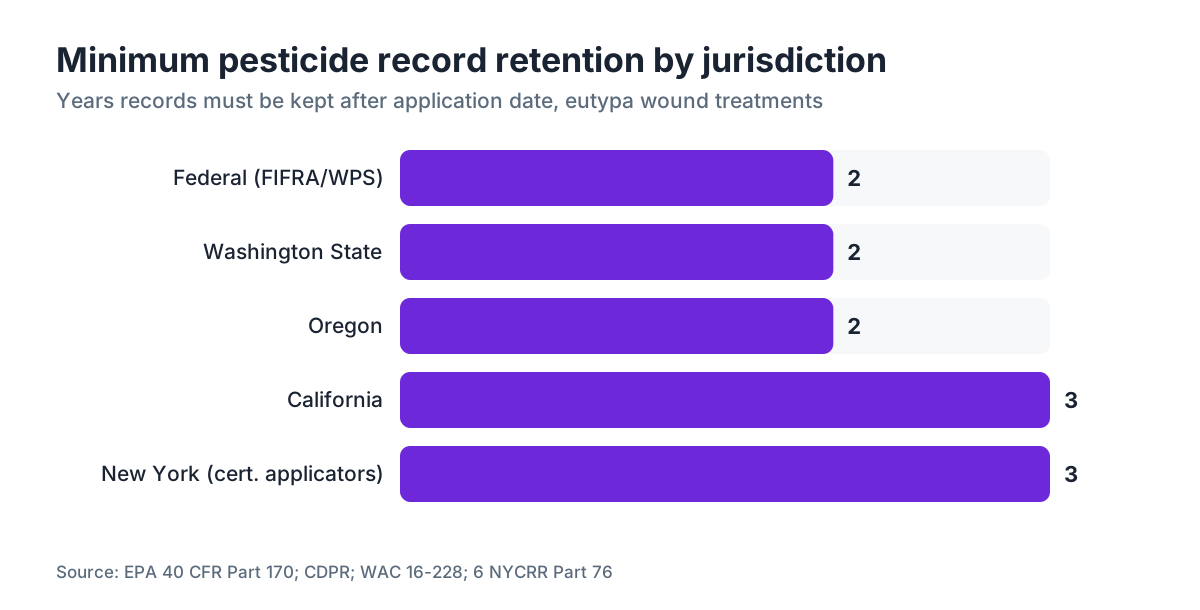
How long do you need to keep eutypa wound treatment records?
The federal floor under FIFRA and WPS is two years from the date of application [1]. Most states match that minimum. A few require longer.
| Jurisdiction | Minimum retention period | Authority |
|---|---|---|
| Federal (FIFRA/WPS) | 2 years | 40 CFR Part 170 |
| California | 3 years | CCR Title 3, Div. 6 |
| Washington | 2 years | WAC 16-228 |
| Oregon | 2 years | OAR 603-057 |
| New York | 3 years (certified applicators) | 6 NYCRR Part 76 |
Keep records longer than the minimum if you can. Eutypa dieback runs a long latency: symptoms often don't show until 3 to 10 years after infection, per UC extension research [4]. If a landlord or buyer claims you let a vineyard get infected on your watch, records showing a consistent wound treatment program from eight years back are your defense. Two years of records won't reach that far.
My recommendation: keep the full application records indefinitely in a compressed digital archive. A decade of spray records for a 50-acre vineyard is maybe 500MB. Storage is not the constraint.
What should a complete audit-ready eutypa treatment record look like?
An audit-ready record is one where an inspector from your county ag commissioner's office or the EPA can walk in, read one document per application, and answer every question without asking you a follow-up.
Here's what that looks like for a single wound treatment application:
Vineyard: River Ranch, APN 012-345-678
Block: Block 12, Rows 1-40, Cabernet Sauvignon
Application date: January 22, 2025
Application time: 8:30 AM start, 11:15 AM finish
Product name: Topsin-M WSB
EPA Reg. number: 70506-204
Rate applied: 2 lb/100 gal, applied at 1 gal/acre equivalent (paint-on)
Total product used: 1.5 lbs
Target pest: Eutypa lata (pruning wound protection)
Application method: Backpack pump sprayer, 4-inch brush applicator
Acres treated: 4.2 acres
Pruning completion date for this block: January 21, 2025
Weather: 49°F, wind 3-5 mph NW, relative humidity 78%, overcast
REI: 12 hours (expires January 22 at 8:30 PM)
REI posted at central location: Yes, posted January 22 at 7:00 AM
Applicator: [Name], Qualified Applicator License [number]
Pruning foreman: [Name]
Notes: Light rain forecast for January 23. Treatment timed to precede rain. Colorant (Blazer Blue, non-registered marking dye) used to confirm coverage.
That record takes about four minutes to fill out. The colorant note is optional but shows diligence. The pruning completion date is the agronomic link that ties the whole thing together.
If you're running a property like many small California or Washington operations, and you want a digital system that builds this output automatically from field-entered data, tools like VitiScribe are worth a look. The payoff is consistency: every record reads the same regardless of who was in the field that morning.
How do you handle documentation when a licensed pest control company or PCA applies the treatment?
When you hire a licensed pest control operator (PCO) or pest control adviser (PCA) to make the wound treatment application, the documentation burden shifts partly to them but never all the way off you.
The PCO is responsible for:
- Their own application record (a licensed commercial applicator keeps application records separate from yours)
- Reporting the application to the state if they hold the operator license in California
- Handing you a copy of the application record within a reasonable time
You, as the grower or agricultural employer, are responsible for:
- Keeping a copy of that application record for the full retention period
- Making sure the REI information was posted for your workers
- Holding the PCA recommendation on file (in California, required; elsewhere, best practice)
Get the record from the PCO in writing the same day if you can. Here's the common gap: the PCO emails a spray record summary two weeks later, and by then the REI expired long ago and nobody posted anything. That's a WPS violation on your property even though someone else applied the product.
If a PCA wrote the recommendation and a different licensed applicator made the application, your file should hold three documents: the PCA recommendation, the applicator's application record, and your internal block log tying it to the pruning date.
How do you organize multi-season eutypa wound treatment records for a large vineyard?
A vineyard with 20 or more blocks, pruned in sequence over six to eight weeks, can generate 40 or more individual wound treatment records in one dormant season. Across five years, that's 200 records. With no system, they turn into a pile.
The best structure I've seen: organize by year first, then by block within each year. A digital folder structure works:
/Spray Records
  /2025
    /Eutypa-Wound-Treatment
      Block-01_2025-01-10.pdf
      Block-02_2025-01-11.pdf
      ...
  /2024
    /Eutypa-Wound-Treatment
      ...
Each PDF is the complete record for one application. If you treated a block twice in a season (which happens when the first application slipped past the protective window), each treatment gets its own file.
For paper systems, a three-ring binder per year with tabbed dividers by block works and survives a shop environment better than a manila folder. Keep the binders in a fireproof cabinet or scan everything to cloud backup.
At the end of each dormant season, run a completeness check: every block that got pruned should have a matching wound treatment record. If a block got skipped for budget or scheduling, document that too. "Block 18 not treated, decision made by owner on [date] due to vine age and planned removal." That annotation shows the call was intentional, not overlooked.
WSU wine grape resources and Cornell viticulture extension materials both stress that disease management programs should be documented at the program level, more than application by application, so regulators and agronomists can judge whether the program made sense [7][8].
Frequently asked questions
Do I need to document eutypa wound treatments even if I'm using a biofungicide or organic product?
Yes. If the product carries an EPA registration number, it requires a pesticide application record under FIFRA and WPS regardless of organic status. Products exempt under FIFRA Section 25(b) (certain minimum-risk pesticides) don't require a federal record, but verify the exemption on the specific product label. California requires reporting all registered pesticide applications, including OMRI-listed products.
What is the re-entry interval for common eutypa wound treatment fungicides?
REIs vary by product and formulation. Thiophanate-methyl products (Topsin-M) typically carry a 12-hour REI. Tebuconazole products (Orbit, Elite) commonly run 12 to 24 hours. Myclobutanil (Rally) is typically 24 hours. Always read the current label because REIs change with label revisions. The label is the legal document; extension summaries and this article are not.
How do I record a eutypa wound treatment if my pruning crew and spray crew work separately?
Create a linked record: log the block, the date pruning finished (from the pruning crew foreman), and the date and time the wound treatment was applied. The gap between those two dates is your treatment timing record. If the gap exceeds 48 hours, annotate the reason. Some vineyards use a shared paper block log; others use a digital platform where both crews log in separately.
Can I use a single spray record for multiple blocks treated on the same day?
Regulatorily, yes in most states, as long as all blocks are clearly identified and the acres treated total correctly. Agronomically, separate records per block are better because each block has its own pruning completion date, which matters for evaluating treatment timing. A single record covering six blocks pruned on six different days makes the timing analysis impossible.
What happens if I miss the California seven-day PUR filing deadline?
Late filing is a violation subject to penalty under California Food and Agricultural Code Section 12999.4. Penalties vary based on whether it's a first offense and whether the commissioner considers it willful. First-time late filings are often handled with a warning and mandatory correction, but repeated violations can bring fines starting around $500 and escalating. File as soon as you catch the error and contact your county agricultural commissioner proactively.
Do I need a licensed pest control adviser recommendation to apply eutypa wound treatments?
In California, a written recommendation from a licensed PCA is required for any pesticide application on a commercial agricultural operation unless the grower or a grower-employee holds a valid pest control adviser license. In most other states, a PCA recommendation is best practice but not legally required for general-use pesticides applied by the grower. Check your state's specific rules with your state department of agriculture.
How do I document a wound treatment that was partially applied due to rain or equipment failure?
Record what was actually applied: how many rows or blocks were completed, the time you stopped, and the reason. Then create a second record for the completion application. Never record a partial application as complete. If the delay pushed the second application past the protective window (more than 48 hours after pruning), note that explicitly and flag the block for enhanced disease monitoring.
Are wound sealant products without a fungicide component subject to the same documentation rules?
If the sealant product has no EPA registration number and makes no pesticidal claim, it is not regulated as a pesticide and requires no FIFRA or WPS record. But if the product label claims to protect against Eutypa lata or other fungal pathogens, it is making a pesticidal claim and requires EPA registration. Check whether your sealant has an EPA registration number, and if it does, document it like any other registered product.
How should I document eutypa wound treatments on rented or custom-farmed vineyard land?
Both the operator of record (the entity applying the pesticide) and the property owner may need records depending on your state. Under California's PUR system, the grower of record and the operator are both identified. In a custom farm agreement, the contract should specify who holds the application records and who files the PUR. Get that in writing, and keep a copy of every application record yourself regardless of who files.
What is the best way to prove I treated wounds within the effective window if my records are challenged?
The strongest evidence is a paired record showing both the pruning completion date for the block and the wound treatment date, plus weather data from a nearby station (CIMIS, AgWeatherNet, or NEWA) confirming conditions were appropriate. If you used a colorant, dated photographs of treated wounds showing dye coverage add a visual layer. A dated record signed by both the pruning foreman and the spray operator is harder to dispute than a solo record.
Does Washington State have specific forms for vineyard pesticide application records?
Washington requires commercial pesticide applicators to keep records under WAC 16-228, but does not mandate a specific state form for private agricultural applicators applying general-use pesticides. The Washington State Department of Agriculture provides guidance documents and recommended record formats. WSU Extension wine grape resources include record-keeping templates adapted to Washington's regulatory requirements.
How do eutypa wound treatment records fit into a broader vineyard disease management audit?
Wound treatment records are one component. A complete audit trail for a eutypa program also includes dormant pruning timing decisions (dates, growth stage), spur or cordon removal records for symptomatic wood, tissue sample results if you sent samples to a diagnostic lab, and any replant or bridge-grafting records. Cornell and UC extension materials frame eutypa management as a multi-year program requiring documentation at each step, more than the spray application.
Sources
- EPA, Worker Protection Standard (40 CFR Part 170): WPS requires pesticide application records be kept for at least two years and be available for inspection; employer must post application information at a central location.
- California Department of Pesticide Regulation, Pesticide Use Reporting: California requires pesticide use reports filed with the county agricultural commissioner within seven calendar days of application, retained for three years.
- Washington State Department of Agriculture, Pesticides: Washington requires commercial applicators to retain pesticide application records for two years under WAC 16-228.
- University of California Agriculture and Natural Resources, Eutypa Dieback of Grapevine: Eutypa lata symptoms often appear 3 to 10 years after infection; wound treatment is most effective within 24 to 48 hours of pruning.
- UC IPM, Grape Pest Management Guidelines: Eutypa infection risk correlates with wet weather and mild temperatures following pruning; registered fungicides include thiophanate-methyl and myclobutanil.
- EPA, Pesticide Labels: The pesticide label is a legal document; the EPA registration number on the label must match what is recorded in application documentation.
- Cornell Cooperative Extension, Viticulture and Enology: Cornell extension emphasizes that disease management programs should be documented at the program level to allow agronomic evaluation of season-long decisions.
- Washington State University Extension: WSU Extension provides record-keeping templates and guidance adapted to Washington State pesticide regulatory requirements for commercial wine grape operations.
- EPA, Minimum Risk Pesticides Under FIFRA Section 25(b): Pesticides meeting Section 25(b) criteria are exempt from federal registration requirements; exemption is product-specific and must be verified on the label.
- California Department of Food and Agriculture, Plant Health and Pest Prevention: California Food and Agricultural Code authorizes penalties for late or missing pesticide use reports filed with county agricultural commissioners.
- University of California Agriculture and Natural Resources: UC research recommends synchronizing wound treatment with pruning completion and treating within 24 hours for optimal protection against Eutypa lata.
Last updated 2026-07-09