Interpreting tensiometer readings for vineyard irrigation decisions
TL;DR
- A tensiometer measures soil water tension in centibars (cb).
- For grapevines, most extension programs suggest irrigating at 40 to 60 cb in sandy loams and 50 to 80 cb in clay loams, depending on growth stage.
- Below 10 cb the soil is saturated.
- Above 80 cb the instrument loses accuracy.
- Placement depth and time of day matter as much as the number.
What does a tensiometer actually measure?
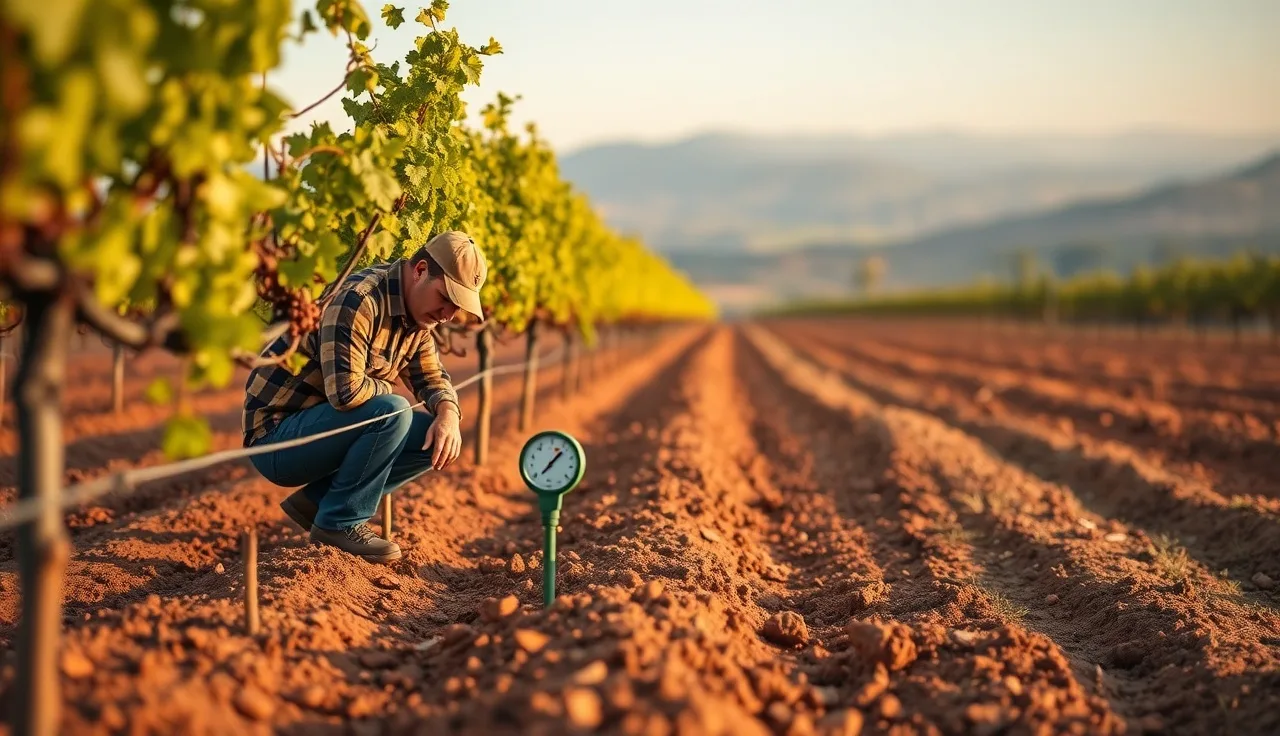
A tensiometer measures the suction force roots have to exert to pull water out of the soil pore spaces. That force is soil matric potential, and the gauge reports it in centibars (cb) or, in older literature, kilopascals (1 cb = 1 kPa). The scale runs from 0 cb (soil is saturated, no suction needed) up to roughly 85 to 100 cb, where the ceramic tip loses hydraulic contact with the soil and the reading flatlines or jumps around. [1]
It does not measure water content. Two soils can show the same tensiometer reading and hold very different amounts of water, because the pore geometry differs. A clay soil holds a lot more water at 50 cb than a sandy loam does at 50 cb. That gap matters when you decide how long to run the drip line once you've decided to water.
The instrument is a sealed water-filled tube with a porous ceramic cup at the bottom and a vacuum gauge on top. As the soil dries, water moves out through the ceramic into the soil, and the vacuum that builds is what the gauge reads. Irrigate or get rain, and water flows back in and the needle drops. Top off the reservoir every time you read it. A low water level gives you false-high numbers. [2]
What are the right tensiometer reading thresholds for grapevines?
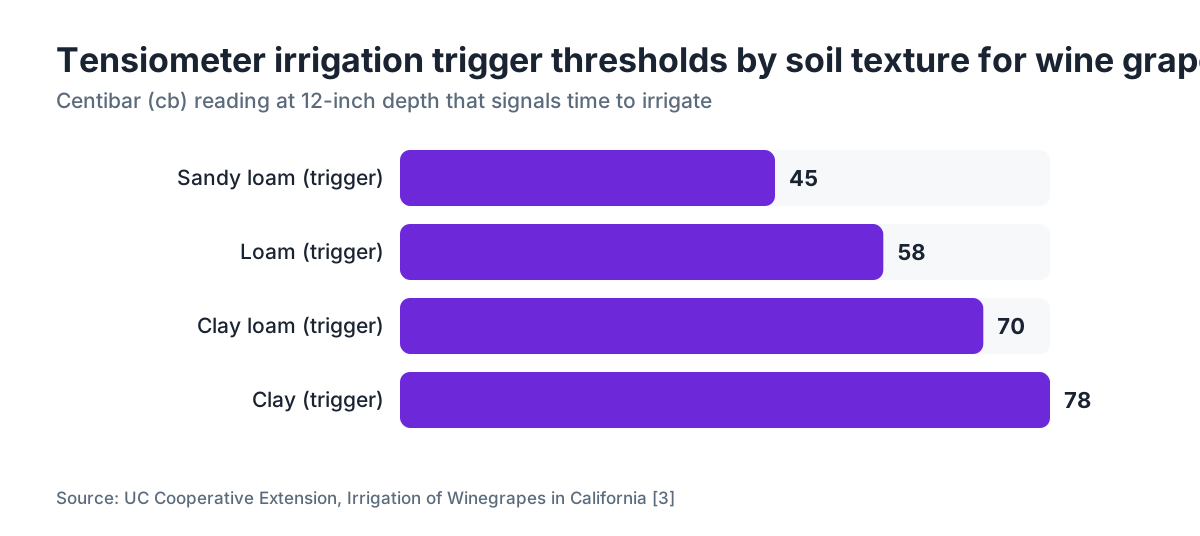
Thresholds shift with soil texture, growth stage, and how much deficit stress you want. UC Cooperative Extension publishes the most-used numbers for California wine grapes: in sandy loam, irrigate when the 12-inch sensor reads 40 to 50 cb; in loam, 50 to 65 cb; in clay loam, 60 to 80 cb. [3] Washington State University Extension gives similar ranges for the Columbia Valley but flags that fast-draining volcanic soils can warrant earlier triggers, around 30 to 40 cb, because the plant runs out of reachable water fast once tension climbs past that. [4]
Growth stage moves the target. Through bloom and set, most growers let tension run higher (more stress) to hold back shoot vigor and bunch size. After veraison the strategy splits. Some winemakers keep the deficit on to concentrate flavor. Others bring tension back to 50 cb to protect berry integrity and dodge shrivel before harvest. There's real disagreement here, and your own soil and climate beat any generic figure.
Here's the honest version: these thresholds are starting points, not laws. Nobody has clean controlled-trial data showing 65 cb beats 60 cb for Cabernet in a Paso Robles loam. Treat the numbers as guardrails, then adjust off vine response (leaf water potential, shoot tip behavior, berry size) across two or three seasons.
| Soil Texture | Irrigate Trigger (shallow, 12") | Deficit Stress Target (post-veraison) |
|---|---|---|
| Sandy loam | 40-50 cb | 50-65 cb |
| Loam | 50-65 cb | 65-75 cb |
| Clay loam | 60-80 cb | 70-85 cb |
| Clay | 70-85 cb | 80-90 cb (instrument limit approached) |
Source: UC Cooperative Extension Irrigation of Winegrapes in California [3]
How deep should you install tensiometers in a vineyard?
Install two sensors per station: one shallow, one deep. The shallow sensor sits at 12 inches (30 cm), where most active feeder roots live in a drip-irrigated vineyard. The deep sensor goes at 24 inches (60 cm) to watch for deep percolation or a wetting front that hasn't reached the lower root zone yet. [3]
The shallow sensor drives your call. If it reads 60 cb and the deep sensor reads 20 cb, the top of the root zone is drying out but you have moisture in reserve below. If both read 60 cb at once, the whole profile is drying and you act. If the deep sensor reads higher than the shallow one after you irrigate, you either undershot the run time or a subsurface barrier is slowing infiltration.
Where you put the sensor relative to the emitter matters. In drip systems, set it 12 to 18 inches out from the emitter, at the edge of the wet bulb instead of straight under the dripper. Directly under the emitter is always wetter than the average root zone. At the edge you read where roots actually compete for water. [10]
On steep slopes, put sensors on the uphill side of the row when you can. Water moves downslope through the soil, so the uphill side dries first.
When during the day should you read a tensiometer?
Read in the early morning, before the canopy heats up and transpiration pulls hard on the soil. Midday readings run systematically higher than predawn ones in the same soil, because the vine is actively pulling water and steepening the gradient around the sensor. You want to compare readings across days, and that only works if you read at the same time. [2]
Read before you irrigate, not after. Obvious, but field logs show it happens anyway. A post-irrigation number tells you almost nothing about whether you needed to water in the first place.
Frequency counts most during peak water use. Flowering through veraison in a warm climate can drop soil moisture fast, and daily readings beat weekly ones in that window. Outside those stretches, every two to three days is usually plenty.
How do you calibrate and maintain tensiometers so readings are accurate?
Calibration in the field means checking that the gauge reads near 0 cb when you submerge the ceramic tip in clean water. If it reads 5 to 8 cb in open water, the gauge has a zero-offset. Adjust every reading by that amount, or just note the offset in your log. Most Irrometer and Soilmoisture Equipment gauges hold factory calibration for several seasons. [5]
Maintenance matters more than calibration for most people. Fill the reservoir with clean, de-aerated water (boil it, let it cool) before each season and any time the level drops below halfway. Air bubbles in the tube create false-high readings that make moist soil look dry. Purge the air by pressing a vacuum pump on the top cap and holding it about 30 seconds.
Ceramic tips clog over time, worst in soils high in iron or manganese. Soak a clogged tip in 10% bleach for several hours, then rinse it well. Some growers swap tips every three to four years on principle. A clogged tip responds slowly and lags actual soil conditions by hours, so you think the soil is drier than it is.
In winter, pull the instruments if your area gets hard freezes. Water expands as it freezes and cracks the ceramic tip. Store them upright with the tip submerged in a bucket of water.
What do readings below 10 cb or above 80 cb mean?
Below 10 cb, the soil is essentially saturated. Grapevines shrug off brief saturation, but stretches above field capacity starve roots of oxygen and raise Phytophthora risk. If you keep seeing readings under 10 cb, your run times are too long, you have a drainage problem, or both. [3]
Above 80 cb, most tensiometers lose useful resolution. The ceramic tip can't pull enough water from the tightly bound soil films, hydraulic contact breaks, and the needle sticks or wanders. Cornell's grape production resources note that once you sit consistently above 80 cb, the vines are under serious water stress and you've probably already blown past the ideal irrigation trigger. [6] The instrument is telling you it's out of range, not that the soil sits at some exact higher tension.
If your readings routinely max out before you can water, look at whether the station is placed right, whether your irrigation frequency is off, or whether you need a supplemental sensor somewhere else in the field.
How many tensiometer stations do you need per vineyard block?
Start with one station per distinct soil type or management zone in a block. If your 20-acre block spans three soil series, put a station in each. If you're farming one uniform soil across 5 acres, a single station usually gives you enough confidence. [4]
For larger operations, WSU Extension suggests a minimum of one station per 5 to 10 acres in blocks with moderate soil variability, sited in representative spots rather than the best or worst corner. Running the whole farm off one station in the handiest location is how you over-irrigate one zone while stressing another.
Stations in the same block will often diverge 15 to 20 cb on a given morning. That's normal, and it tells you the block isn't uniform. Make the call off the drier station (higher reading) unless you can zone your irrigation separately.
How do tensiometers compare to other soil moisture monitoring methods?
Tensiometers give you energy status directly, which is what the plant responds to. That's their edge over volumetric sensors (capacitance or TDR probes), which report water content without telling you how available that water is to roots. In heavy clay, 25% volumetric water content might read dry for root extraction. In sandy loam, that same 25% might sit near saturation. Tensiometers cut through the ambiguity. [11]
The tradeoffs are real. Tensiometers need regular upkeep, fail above 85 to 100 cb, and can't work in freezing conditions. Capacitance sensors (Sentek EnviroSCAN, Decagon 5TM) work across a wider range, skip the reservoir refill, and log continuously to a data platform. Continuous logging catches overnight drainage and gives you early-morning numbers without walking the rows.
Pressure plate and neutron probe methods read more accurately for research but flunk the routine-farm-decision test. Leaf water potential (a pressure bomb) is a plant-based measurement many researchers call the gold standard for vine stress, but it costs real money, needs careful technique, and gives you a snapshot, not a trend.
| Method | Measures | Useful Range | Maintenance | Cost (approx.) |
|---|---|---|---|---|
| Tensiometer | Soil matric potential | 0-80 cb | High (weekly) | $40-80/unit |
| Capacitance probe | Volumetric water content | Full range | Low | $150-600/unit |
| Pressure bomb | Leaf water potential | N/A | Medium | $800-1,500 |
| TDR probe | Volumetric water content | Full range | Low | $200-800/unit |
Sources: UC Cooperative Extension [3], WSU Extension [4]
How do you use tensiometer readings to schedule irrigation run times, more than trigger points?
The trigger tells you when to start. Run time is a separate calculation. Once the shallow sensor hits your threshold, you want to add enough water to bring the profile back toward field capacity (roughly 10 to 15 cb on a tensiometer) without shooting past it. That calculation needs your emitter flow rate, emitter spacing, soil water-holding capacity, and how much of the root zone you're wetting. [3]
A practical shortcut: run the system until the deep sensor (24 inches) rises by 10 to 15 cb from where it started. That means the wetting front moved down through the full monitored root zone. On drip, give it time for lateral spread, which runs slower than vertical movement in most soils. In sand the wetting front is mostly vertical. In clay it spreads sideways. That changes where you place the deep sensor.
After you irrigate, read again 6 to 8 hours after shutoff. Estimate field capacity from that stabilized reading, not the number right after the system stops, because drainage keeps redistributing water in the first few hours. If that stabilized reading still sits above 40 cb in a sandy loam, your run time was short. Log run time against post-irrigation reading across a bunch of events, and you'll dial in your system's behavior over a season.
If you want to keep that log without spreadsheet chaos, tools like VitiScribe let you record sensor readings next to irrigation events in the same workflow where you already track field applications. That makes patterns across a full season easy to see, instead of reconstructing them from three separate notebooks.
What can go wrong when reading tensiometers and how do you catch mistakes?
The most common field error is air in the system. A tensiometer with an air bubble reads high (drier than reality) because the compressible air soaks up part of the vacuum instead of transmitting it through water to the soil. If a reading jumps from 35 cb one morning to 70 cb overnight with no rain or irrigation, check the reservoir and purge before you trust it. [5]
Gauge drift is real on older units. A gauge that read true in year one can drift mechanically by year four. If two side-by-side stations in soil you believe is uniform read a steady 20 cb apart, pull one, bench-test it in a bucket, and replace the gauge if it won't zero.
A sensor placed wrong relative to the emitter reads misleadingly. Too close and the soil looks wetter than the average root zone. Too far and you water earlier than needed.
Writing a 46 down as a 64 happens in the field. Use a consistent recording form. Cross-check against sense: a healthy vine in July in Sonoma shouldn't read 12 cb on the shallow sensor unless you just irrigated. If a number looks impossible, re-read it before you log it.
Are there regulatory or record-keeping requirements tied to irrigation monitoring?
Tensiometer readings aren't mandated by federal law. But growers under water rights restrictions in western states (California's State Water Board, Oregon Water Resources Department) may need to document irrigation amounts and timing to prove compliance with their water use permits. Keeping a sensor log next to your irrigation records is good practice and easy to defend if someone asks. [7]
If you're certified organic or chasing a sustainability certification (Certified California Sustainable Winegrowing, Lodi Rules), documented deficit irrigation and soil moisture monitoring can earn audit points. Read the specific standard's requirements.
The EPA Worker Protection Standard doesn't govern irrigation scheduling. But any pesticide application that specifies irrigation restrictions (a pre-irrigation requirement, or a limit on post-application irrigation) means you have to track when you watered relative to the spray. Knowing soil moisture before a spray also tells you whether a pre-irrigation is even needed. [8] A clean irrigation log with tensiometer readings lets you answer from records instead of memory.
For operations tracking spray applications and irrigation in one place, VitiScribe's field records module is one option. The more useful point: a handwritten daily sensor log, dated and kept by block, satisfies almost any auditor's reasonable request.
Frequently asked questions
What unit does a tensiometer use and how does it relate to kPa?
Tensiometers report soil water tension in centibars (cb). One centibar equals one kilopascal (kPa), so the numbers are interchangeable. Some sensor documentation uses kPa, some uses cb. A reading of 50 cb means the soil is exerting 50 kPa of suction on the soil water. Both units describe the same physical quantity.
At what tensiometer reading should I irrigate wine grapes?
UC Cooperative Extension recommends irrigating wine grapes when the 12-inch depth sensor reaches 40 to 50 cb in sandy loam, 50 to 65 cb in loam, and 60 to 80 cb in clay loam. These are starting points, not fixed rules. Adjust based on vine stress indicators like shoot tip behavior and your own season-to-season observations in your specific soil type.
Why does my tensiometer read differently in the morning versus afternoon?
Afternoon readings run higher than morning readings in the same soil because grapevines are actively pulling water through their roots during peak transpiration, creating a steeper water-potential gradient around the sensor. Always read at the same time, early morning before significant evapotranspiration starts, so you can compare readings meaningfully across days.
How deep should tensiometers be installed in a drip-irrigated vineyard?
Install one sensor at 12 inches (30 cm) and one at 24 inches (60 cm) per monitoring station. The shallow sensor drives irrigation decisions because that is where most active feeder roots concentrate under drip irrigation. The deep sensor shows whether the wetting front is reaching the lower root zone and guards against over-irrigation and percolation past the root zone.
Can a tensiometer read soil moisture accurately above 80 centibars?
No. Above roughly 80 to 85 cb, the ceramic tip loses hydraulic contact with the increasingly tightly bound soil water. The gauge reading becomes unreliable and may stick or jump around. If your tensiometers regularly max out, your vines are already under serious stress and you've missed your irrigation trigger window. Consider adjusting your monitoring frequency.
How many tensiometers do I need per vineyard block?
WSU Extension recommends at least one monitoring station per 5 to 10 acres in blocks with moderate soil variability, with each station carrying two sensors at different depths. A block with multiple distinct soil types needs one station per soil type. Running an entire block off one station in an unrepresentative location is a common source of under- or over-irrigation in one zone.
How often should I read tensiometers during the growing season?
During flowering through veraison, read daily or every other day because vines use water fastest in this window. Outside peak growth stages, readings every two to three days are usually enough. Always read before irrigating, not after. In hot, dry climates with sandy soils, even daily reading can miss rapid drying between morning checks during heat events.
What does it mean if my tensiometer reads below 10 cb?
Below 10 cb the soil is essentially saturated and the root zone holds more water than grapevines need. Prolonged saturation cuts oxygen availability around roots and raises the risk of Phytophthora and other soilborne pathogens. If readings stay this low, your irrigation run times are too long or you have a drainage limitation that needs addressing.
How do I maintain a tensiometer to get accurate readings all season?
Refill the reservoir with clean, de-aerated water whenever the level drops below halfway. Check for air bubbles by applying a hand vacuum pump to the cap and purge any you find. Inspect the ceramic tip for clogging, especially in iron-rich soils. At season's end, pull instruments from the ground before hard freezes to prevent ceramic cracking.
How do tensiometers compare to capacitance probes for vineyard irrigation decisions?
Tensiometers measure soil matric potential (energy status, which is what roots respond to) but top out at 80 to 85 cb and need regular maintenance. Capacitance probes measure volumetric water content across a full range and log data continuously with no reservoir to fill. The best systems combine both: a tensiometer for plant-available tension and a capacitance probe for trend data and continuous logging.
Should I change my tensiometer trigger thresholds after veraison?
Many growers and winemakers do intentionally allow higher tensions post-veraison (mild deficit stress) to concentrate berry solutes and control berry size. How high depends on your style target and variety. Some growers let tension rise to 70 to 80 cb in loam soils post-veraison; others hold at 60 cb to avoid shriveling. There is no universal answer; monitor vine and berry response and adjust by season.
Do I need to keep irrigation and tensiometer records for compliance purposes?
No federal rule mandates tensiometer logs specifically. But western-state water permit holders may need documented irrigation records to show compliance with use limits. Organic and sustainability certifications (CCSW, Lodi Rules) can award audit credit for documented soil moisture monitoring. Keeping a dated log by block also helps you explain irrigation decisions during a third-party audit or a dispute over water use.
Where exactly should I place a tensiometer relative to the drip emitter?
Install the sensor 12 to 18 inches horizontally from the drip emitter, at the edge of the wet bulb rather than directly beneath the emitter. Directly under the emitter stays consistently wetter than the average root zone, which makes the soil look moister than it really is for most of the roots. On sloped ground, place the sensor on the uphill side of the vine row, where soil dries first.
Sources
- Irrometer Company, Tensiometer Interpretation Guide: Tensiometers measure soil matric potential in centibars (1 cb = 1 kPa) and lose hydraulic contact above approximately 85-100 cb
- UC ANR, Irrigation Management for Winegrapes (publication 3447): Tensiometers should be read in early morning before peak transpiration; reservoir must be filled with de-aerated water to prevent false-high readings
- UC Cooperative Extension, Irrigation of Winegrapes in California: Irrigation trigger thresholds for wine grapes: 40-50 cb in sandy loam, 50-65 cb in loam, 60-80 cb in clay loam at 12-inch depth; dual-sensor installation at 12 and 24 inches recommended
- Washington State University Extension, Vineyard Irrigation Management: WSU recommends one monitoring station per 5-10 acres in variable-soil blocks; volcanic Columbia Valley soils may warrant earlier irrigation triggers of 30-40 cb due to rapid drainage
- Soilmoisture Equipment Corp, Operating Instructions for Tensiometers: Air bubbles in tensiometer tubing produce false-high readings; purging with a vacuum pump and using de-aerated water corrects the error; gauge zero-check performed by submerging ceramic in open water
- Cornell University, Viticulture and Enology Extension, Vineyard Water Management: Cornell notes that tensiometer readings consistently above 80 cb indicate serious vine water stress and the instrument has exceeded its reliable operating range
- California State Water Resources Control Board, Agricultural Water Use: California water permit holders may be required to document irrigation amounts and timing to demonstrate compliance with water right conditions
- EPA, Agricultural Worker Protection Standard (40 CFR Part 170): The EPA Worker Protection Standard governs pesticide application conditions including any irrigation restrictions specified on a pesticide label
- WSU Extension, Soil Moisture Monitoring for Irrigation Scheduling: Tensiometer placement 12-18 inches from drip emitter at the edge of the wet bulb gives a reading more representative of average root-zone conditions than placement directly beneath the emitter
- UC Cooperative Extension, Comparing Soil Moisture Monitoring Devices: Tensiometers measure energy status (matric potential) directly, while capacitance and TDR probes measure volumetric water content; energy status is more directly related to plant-available water across soil types
Last updated 2026-07-11