Iowa vineyard soils: what growers actually need to know
TL;DR
- Iowa vineyards sit on glacially derived loam and silt-loam soils with naturally high organic matter, moderate to high pH, and drainage that swings hard by landform.
- The best sites drain to at least 48 to 60 inches, sit on gentle slopes for cold-air drainage, and test between pH 5.8 and 6.5.
- Compaction and winter-wet root zones are the two problems that kill most Iowa vine plantings before year three.
What kinds of soils do Iowa vineyards actually grow on?
Iowa's soils are almost entirely glacial. The Des Moines Lobe in north-central Iowa is young glacial till, geologically speaking, deposited only about 14,000 years ago, and those soils are still poorly drained and high in carbonates. The Southern Iowa Drift Plain is older and more weathered. The rolling loess hills of western Iowa along the Missouri River bluffs hold some of the best-drained soils in the state, which is exactly why most of Iowa's serious vineyards cluster there.
The soil series you'll run into most in Iowa vineyard country are Shelby loam, Monona silt loam, Marshall silt loam, and Ida silt loam. Marshall and Monona are deep, well-drained, moderately permeable, and high in organic matter, often 4 to 7%. That sounds great until you realize high organic matter also drives high pH buffering capacity and can tie up micronutrients at the wrong end of the scale. [1]
Nearly all native Iowa soils test between pH 6.0 and 7.5 before amendment. Too high for vinifera. For the cold-hardy hybrids most Iowa growers plant, like Marquette, Frontenac, and La Crescent, a pH between 5.8 and 6.5 works well. The catch is that Iowa's calcareous parent material means pH can drift back up faster than you'd expect after acidification, sometimes within two to three seasons on poorly buffered sites. [2]
Tile drainage runs through the corn-belt soils of Iowa, and many vineyard sites are converted cropland tiled decades ago. That's both a blessing and a complication. Existing tile lines may intercept perched water and keep the root zone workably dry, or they may run at the wrong grade and create wet pockets you won't spot until vines die in year two. Pull the FSA aerial drainage maps and walk the site after a two-inch rain before you commit to a block.
How do I read the Iowa vineyard soil map for site selection?
The USDA Web Soil Survey (WSS) is where every Iowa vineyard site evaluation starts. Pull a detailed soil map for any parcel in Iowa, see the dominant soil series, and get tabular data on drainage class, depth to water table, available water capacity, and slope percent. The WSS also carries Farmland Classification data, which tells you whether a parcel is Prime Farmland, Farmland of Statewide Importance, or something else. That classification has regulatory teeth in some county zoning contexts. [3]
For Iowa specifically, Iowa State University Extension soil survey interpretation guides pair well with the WSS. ISU has mapped soil productivity indexes for a long time, and while those indexes were built for corn and soybeans, the underlying drainage and permeability data carries straight over to vineyard suitability. A soil that scores poorly on the CSR2 (Corn Suitability Rating 2) because of slope, shallow depth, or droughtiness may be ideal for vines. [4]
Here's the workflow I use. Pull your parcel on WSS, download the soil map units, and sort by drainage class first. You want soils rated "well drained" or "somewhat excessively drained" in the 0 to 30 inch profile. Then look at depth to seasonal high water table. Anything shallower than 24 inches is a problem for cold-hardy vines and outright hostile to any vinifera attempt. Slopes between 2% and 12% work well in Iowa: enough grade for cold-air drainage and surface runoff, not so steep that erosion management becomes your full-time job.
The map picture gets more interesting once you account for topographic position. Even within a single 20-acre parcel, the WSS may show two or three distinct map units. The sideslope loam that drains freely is your row location. The toe-slope silty clay loam with a 12-inch seasonal water table is your turn-row or grass buffer, not your vines. Spend $800 to $1,200 on a soil scientist to run a reconnaissance-level site investigation with a hand auger before you plant. It's the cheapest insurance you'll buy.
What soil drainage requirements do grapevines need in Iowa?
Grapevines are deep-rooted perennials. In loam soils under good conditions, Vitis roots reach 4 to 6 feet within three to four years of planting. That depth is what gives established vines their drought resilience and winter hardiness, because a root system stuck near the surface takes the full force of freeze-thaw cycles and temperature swings. [5]
Iowa's problem is that a big share of its farmland has a seasonal water table above 24 inches for at least part of the year. The Des Moines Lobe and the Iowan Surface in northeast Iowa are the worst offenders. The loess hills of Monona, Crawford, and Harrison counties are the exception: deep natural drainage, often to 6 feet or more, with little tile dependency.
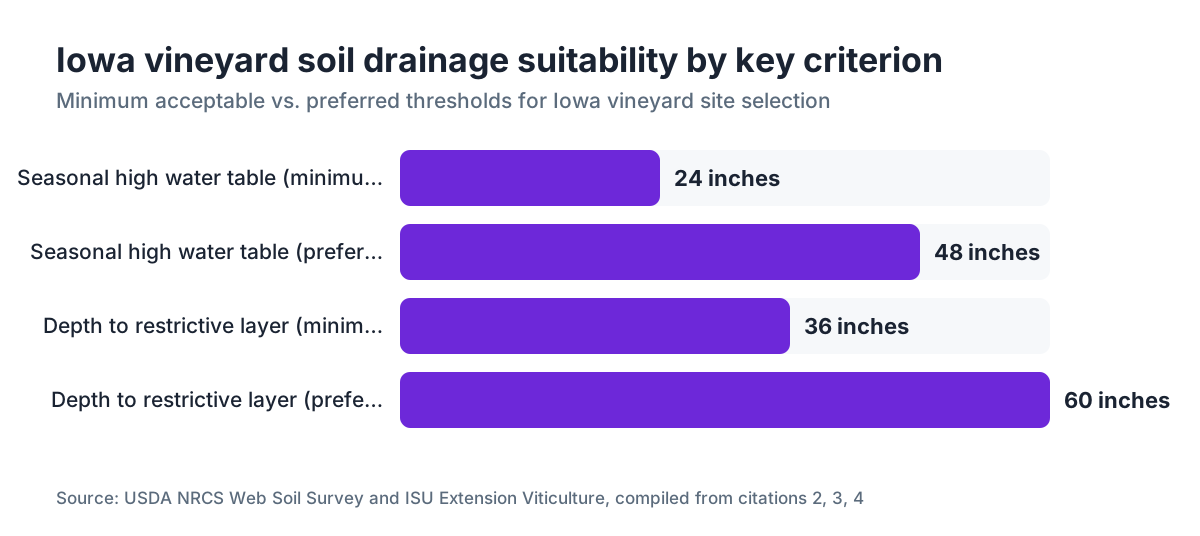
For a new vineyard site in Iowa, here's the minimum standard most experienced growers use:
| Criterion | Minimum acceptable | Preferred |
|---|---|---|
| Seasonal high water table | 24 inches | 48 inches or deeper |
| Internal drainage class | Somewhat poorly drained | Well drained |
| Slope | 1% | 3 to 8% |
| Depth to restrictive layer | 36 inches | 60 inches |
| Soil texture (0 to 24 in) | Sandy loam to silt loam | Loam to silt loam |
If your site is naturally poorly drained but you're set on it, surface grading and tile installation are both real options. Tile for a 5-acre vineyard block runs $4,000 to $10,000 per acre depending on existing infrastructure and spacing. That cost needs to pencil against the alternative of finding a better-drained parcel. [6]
What is the ideal soil pH for Iowa vineyards, and how do I adjust it?
The working target for cold-hardy hybrid grapes in Iowa is pH 5.8 to 6.5, with 6.0 to 6.2 the sweet spot most extension recommendations land on. Below pH 5.5, aluminum and manganese availability climbs to potentially phytotoxic levels. Above pH 7.0, iron and manganese lock up and you'll see interveinal chlorosis on young leaves, especially on any vinifera you're attempting. [2]
Native Iowa soils sit at or above pH 6.5 almost uniformly, and calcareous soils in the Des Moines Lobe can hold pH 7.5 to 8.0 even after years of cultivation. Acidification with elemental sulfur is the standard approach. Iowa State Extension recommends incorporating sulfur at 600 to 1,200 lbs per acre to drop pH by 1.0 unit in a silt loam, but those rates assume thorough incorporation to 8 inches and enough soil moisture for sulfur oxidation by Thiobacillus bacteria. On cold Iowa soils in spring, oxidation is slow, and you may wait 12 to 18 months for the full pH shift. [4]
Pre-plant is your best window for pH correction. Work the sulfur in two years before planting if you can. Post-plant correction is possible with surface applications, but it's slow and uneven, and you're never going to get pH right at the 18-inch root depth with surface sulfur alone. On a calcareous till soil, be honest with yourself: holding pH below 6.5 may take repeated applications every two to three years indefinitely, which is a real management cost.
Soil pH also changes how herbicides behave under the vines. Simazine, a pre-emergent used in Iowa vineyards, binds differently in high-pH, high-organic-matter soils, often needing higher rates for efficacy and persisting longer than the label predicts. Check your most recent soil test before any pre-emergent application.
How does Iowa's high organic matter affect vine nutrition management?
Iowa's prairie history left deep, dark topsoils with organic matter percentages that make a California viticulturist envious and an Iowa viticulturist nervous. Marshall silt loam, one of the most common vineyard soils in western Iowa, often tests at 4 to 6% organic matter in the top foot. That's genuinely unusual for growing grapes.
High organic matter is a nitrogen time-bomb for grapevines. As that organic matter mineralizes over the season, it releases nitrogen continuously, often 20 to 40 lbs of plant-available N per acre per year in Iowa soils with no fertilizer applied at all. Vines that get too much nitrogen throw excessively vigorous shoots, dense canopies, delayed fruit maturity, and heavier disease pressure from botrytis and powdery mildew. Cornell University's viticulture program has documented the tie between excess nitrogen and grape quality problems in detail. Their guidance puts the total plant-available N target for established vineyards at 20 to 30 lbs per acre per year, including soil mineralization. [7]
So here's the practical part. Most established Iowa vineyards on native prairie soils should get no additional nitrogen fertilizer at all unless a petiole analysis at bloom shows clear deficiency. New plantings in the first two years are the exception, because you want to push establishment, but even then, modest rates of 20 to 30 lbs actual N per acre in split applications is the ceiling most experienced Iowa growers work from.
Potassium is a different story. Iowa soils vary widely in K availability, and high organic matter doesn't guarantee enough K. Petiole analysis at bloom is the most reliable diagnostic tool. ISU extension recommends sampling petioles at full bloom (shoot tip and opposite leaf, petiole only) and targeting 1.2 to 2.0% K in petiole dry weight. Deficiency shows as marginal leaf scorch and can be confused with potassium toxicity at the opposite end. [4]
What cold-hardy grape varieties actually suit Iowa soils?
Variety selection in Iowa is a climate question first and a soil question second. Iowa's USDA hardiness zones run from 4b in the northeast to 6a in the southeast, and most commercial viticulture sits in zones 5a to 5b. That means University of Minnesota cold-hardy varieties dominate the commercial landscape: Marquette, Frontenac, Frontenac Gris, La Crescent, and Itasca are the names you hear at every Iowa Grape Growers Association meeting. [8]
Still, variety-soil interactions are real. Marquette on a well-drained loess bluff soil in Monona County will behave differently than Marquette on a heavy silt-clay loam in Johnson County with a 30-inch water table. Shallower, heavier soils constrain root depth, cut drought resilience, and can push early-season vigor because roots stay in the warmest, most biologically active soil layer. That early vigor means more shoot thinning labor and more disease management events.
Frontenac, arguably the most planted red variety in Iowa, tolerates heavier, less well-drained soils better than Marquette does. Iowa growers have reported acceptable Frontenac performance on sites where Marquette struggles with root zone saturation. That's not a controlled trial result, just observational consensus from the Iowa wine community, but it's consistent enough to weigh in your variety-by-block placement decisions.
La Crescent for whites is site-sensitive in a different way. It runs prone to potassium deficiency on lighter, sandier Iowa soils, so monitoring petiole K at bloom matters more with this one. Itasca, newer to Iowa, has shown promising performance across a range of soil types in University of Minnesota trials, with better acid balance than La Crescent on similar sites. [8]
How should I approach soil testing and sampling for a new Iowa vineyard?
Baseline soil sampling before you plant anything is non-negotiable. For a prospective vineyard block, sample by soil map unit, not by arbitrary grid. If the WSS shows three distinct map units on your 10-acre block, pull one composite sample per map unit, each composite made from at least 10 to 15 individual cores taken to 8 inches. Also pull subsoil samples to 24 inches at two locations per map unit to check pH, calcium-magnesium ratios, and any carbonate layers.
The standard Iowa State University soil test panel gives you pH, buffer pH (for lime requirement), P, K, Mg, Ca, Zn, Mn, and organic matter. For vineyards, add B (boron) and Fe if you're on calcareous soils. The ISU Soil and Plant Analysis Lab is the reference lab most Iowa growers use, and their interpretation guides are calibrated to Iowa soils. [4]
After planting, the sampling rhythm most agronomists recommend runs like this: soil pH and nutrients in the dormant season (October to November), then petiole analysis at full bloom (collect opposite the basal cluster, petiole only, 50 to 75 petioles per block). Soil and petiole together give you a picture that neither one alone provides.
If you're managing spray records and nutrient applications across multiple blocks with different soil types, a field operations platform makes the compliance side a lot easier. VitiScribe, for example, lets you attach soil test results and application records to individual block maps so your agronomist, your farm advisor, and your own records all live in one place.
One thing almost every first-time Iowa vineyard soil test turns up: boron deficiency. Iowa soils run notoriously low in plant-available boron, and boron drives fruit set. A foliar boron application at 10 to 50% bloom (0.1 to 0.2 lbs B per acre) is common practice in Iowa commercial vineyards and often pays back clearly in berry uniformity and cluster fill. [4]
What soil-related disease and pest pressures are specific to Iowa vineyards?
Phylloxera is present in Iowa. Because essentially all commercial Iowa vineyards are planted on their own roots (own-rooted cold-hardy hybrids), phylloxera pressure is a real long-term concern, especially as block age climbs. The University of Minnesota has documented phylloxera on Marquette and Frontenac in trial plantings, though the hybrid parentage in those varieties appears to limit economic damage compared to V. vinifera. Own-rooted hybrid vineyards in Iowa that are 10-plus years old should be scouted for unexplained decline. Pulling a soil sample or vine root wash from declining areas to check for phylloxera is straightforward. [8]
Nematodes are less consistently a problem in Iowa than in warmer grape regions, but sandy soils in the Des Moines River valley and other lighter-textured areas can harbor dagger nematode (Xiphinema americanum), which vectors tomato ringspot virus. Pre-plant nematode sampling is cheap and smart on a light-textured soil with a history of susceptible crops.
Crown gall (Agrobacterium vitis) is the soil-borne bacterial disease that causes the most actual economic damage in Iowa vineyards. It overwinters in soil and vine tissue and explodes after winter injury, which Iowa vineyards take in some measure every few years. Soil management can't prevent crown gall, but two practices cut its impact: avoid trunk wounds during cultivation, and mound soil over the crown in fall to protect it from freeze-thaw cycles. Crown gall on the trunk above the soil line in March is a demoralizing sight. Below-grade protection is your main tool. [9]
Erosion is the quiet soil threat in Iowa's loess hill vineyards. Monona and Ida silt loam rank among the most erodible soils in the United States under bare conditions. Cover crop management in row middles is not optional on slopes above 5%. Unprotected loess can lose measured tons per acre in a single intense rain. The USDA NRCS recommends continuous vegetative cover in middles on slopes above 3% in Iowa. [10]
What are the spray record and worker protection rules Iowa vineyard operators need to follow on pesticide applications near soil?
Iowa vineyard operators who apply restricted-use pesticides (RUPs) must be licensed applicators or hire a licensed commercial applicator. Iowa's pesticide regulations are administered by the Iowa Department of Agriculture and Land Stewardship (IDALS) under Iowa Code Chapter 206. Records of each RUP application must be kept for three years and must include the applicator license number, product name and EPA registration number, application rate, target pest, crop, date, and treated area. [11]
The EPA Worker Protection Standard (WPS), 40 CFR Part 170, applies to every Iowa vineyard that employs agricultural workers or pesticide handlers other than the owner-operator. The 2015 revision strengthened the rules: central posting of pesticide application information within 24 hours of application, a minimum 40-hour re-entry interval for certain fungicides applied under enclosed cab conditions, and mandatory annual training for all workers. The EPA's own summary states that the WPS "protects approximately 2.5 million agricultural workers and pesticide handlers from pesticide-related illness and injury." [12]
For soil-applied herbicides in Iowa vineyards (simazine, flumioxazin, pendimethalin), the restricted-entry interval on the label controls. Simazine carries a 12-hour REI. Flumioxazin carries a 12-hour REI as well. Read the current label every time, because these intervals can change between product registrations.
Pesticide records, application logs, and worker training documents are the paperwork state inspectors look at first. If your records are scattered across paper notebooks, spiral binders, and your phone's camera roll, a field operations platform closes that gap cleanly. VitiScribe's spray record module is built around WPS compliance fields so nothing gets missed mid-season.
To learn more about vineyard operations management in general, the vineyard overview on VitiScribe is a useful starting point.
How do Iowa vineyard soils compare to other Midwest and Appalachian wine regions?
Iowa's soils hold an unusual spot in the Midwest wine landscape. The loess hill soils of western Iowa are geologically and texturally close to parts of the Willamette Valley and the loess-derived soils of Washington State's Columbia Valley, though Iowa's climate demands run dramatically different. [13]
Compare Iowa to Missouri's Ozark Highland AVA, which sits on thin, cherty, acidic soils derived from dolomite and limestone. Iowa's deep loam and silt-loam soils are inherently more fertile and better buffered. That fertility advantage turns into a management challenge fast: Missouri vines on thin, rocky Ozark soils grow at naturally lower vigor, which many winemakers prefer for fruit concentration. Iowa growers on deep Marshall silt loam often have to work hard to hold vigor down through canopy management, cover crop competition, and deliberate under-fertilization.
Compare Iowa to the limestone-derived soils common in the Finger Lakes of New York, and Iowa's soils come out deeper, better drained in the loess hills, and much higher in organic matter. Cornell's viticulture program notes that Finger Lakes vineyards on well-drained Honeoye and Lima soils, both silt loams on glacial till, share some traits with Iowa's northern drift soils, but drainage class and growing-season heat accumulation differ enough that direct comparisons only go so far. [7]
One clear Iowa advantage: the loess hill soils of western Iowa carry natural micronutrient profiles that are generally adequate for grapevines without supplementation, unlike the heavily leached sandier terrain of the Upper Midwest or the iron-deficient calcareous soils of parts of Kansas and Nebraska.
What cover crops and soil health practices work in Iowa vineyards?
Cover crop selection in an Iowa vineyard row middle comes down to one goal: competition management. You want enough competition to limit vine nitrogen uptake and hold vigor down, but not so much that you're stealing water from vines during an August dry spell.
The most common approach in Iowa commercial vineyards is a permanent sod of fine fescues (creeping red fescue, hard fescue) in the middles, managed with two to four mowing passes per season. Fine fescues stay low, tolerate drought, and compete effectively for nitrogen without the bulk that tall fescue or orchardgrass would throw. They also harbor fewer voles than clover-dominant mixes, which matters in Iowa because vole girdling of vine trunks under snow cover has caused real losses in multiple Iowa vineyards.
Under-vine weed management is the counterpoint. Under the vine, minimize competition for the first three to four years, which means herbicide strips, cultivation, or organic mulches. Wood chip mulch at 3 to 4 inch depth suppresses weeds well and holds soil moisture, but it also builds ideal vole habitat. A 6 to 8 inch clear zone between the mulch edge and the trunk is the compromise most growers use.
Washington State University's viticulture extension program has done useful work on cover crop effects on vine nitrogen and berry quality, finding that perennial grass middles cut vine N status and improved fruit composition in several Inland Pacific Northwest trials. The principle carries to Iowa, though the specific variety and soil responses won't be identical. [14]
For new vineyard sites coming out of row crops, a two-year cover crop rotation before planting (winter rye, followed by a legume cover in year two, terminated before planting) can break compaction, build soil structure, and provide a nitrogen flush at termination that supports early vine establishment without supplemental fertilization.
Frequently asked questions
What is the best soil type for a vineyard in Iowa?
Deep, well-drained loam or silt loam with a seasonal water table below 48 inches and a slope of 3 to 8% is the ideal. The loess-derived Marshall silt loam and Monona silt loam in western Iowa's bluff counties (Monona, Crawford, Harrison) come closest. Avoid heavy clay soils and any map unit rated 'poorly drained' or 'somewhat poorly drained' without significant tile drainage infrastructure already in place.
What pH do I need for cold-hardy grapes in Iowa?
Target pH 5.8 to 6.5 for Marquette, Frontenac, La Crescent, and other University of Minnesota cold-hardy varieties. Most native Iowa soils test above 6.5 and need elemental sulfur incorporation before planting. On calcareous till soils in north-central Iowa, holding pH below 6.5 is difficult and may take repeated applications every two to three years. Iowa State Extension provides sulfur rate calculators calibrated to Iowa soil buffer pH values.
How do I use Web Soil Survey to pick a vineyard site in Iowa?
Go to websoilsurvey.sc.egov.usda.gov, draw your area of interest, and run the Soil Data Explorer. Sort soil map units by drainage class first, then look at depth to seasonal high water table and slope. Download tabular data for any map unit rated 'well drained' or 'somewhat excessively drained' and cross-reference with ISU extension soil interpretation guides. Follow up with on-site hand auger testing after a significant rain before you commit to a planting plan.
How deep do grapevine roots go in Iowa soils?
In well-drained Iowa loam soils, established grapevine roots reach 4 to 6 feet within three to four years of planting. Root depth is limited by seasonal water tables, hardpan layers, and compacted subsoil. On poorly drained sites with a water table above 24 inches, roots stay shallow, which cuts drought resilience and raises winter injury risk from freeze-thaw cycles in the top 12 inches of soil.
Is tile drainage necessary for an Iowa vineyard?
It depends entirely on the site. On loess hill soils with natural free drainage, tile is unnecessary. On former row-crop ground in central or northeast Iowa with a seasonal water table above 24 inches, tile drainage is essentially required for long-term vine health. Installing a new tile system for a 5-acre block typically costs $4,000 to $10,000 per acre depending on existing infrastructure, lateral spacing, and outlet availability. Weigh that cost against finding a naturally better-drained parcel.
What nutrients are commonly deficient in Iowa vineyard soils?
Boron is the most consistently deficient nutrient in Iowa vineyard soils. A foliar boron application at 10 to 50% bloom at 0.1 to 0.2 lbs B per acre is standard practice and often improves fruit set measurably. Iron can be deficient on calcareous soils above pH 7.0. Potassium varies widely and should be confirmed with petiole analysis at bloom, not estimated from soil tests alone. Nitrogen is almost never deficient on native Iowa prairie soils with organic matter above 4%.
Can I grow Marquette on Iowa soils?
Yes, and Marquette is one of Iowa's most commercially successful red varieties. It does best on well-drained loam to silt-loam soils with a seasonal water table below 36 inches. On heavier, wetter soils, Marquette shows more susceptibility to crown gall after winter injury and tends toward excessive vigor. Frontenac is a better pick on marginally drained sites. Both varieties suit the pH range typical of western Iowa loess hill soils after modest acidification.
How do I prevent erosion in a hillside Iowa vineyard?
Monona and Ida silt loam soils on Iowa loess hills rank among the most erodible soils in the U.S. under bare conditions. Permanent grass cover in all row middles is the primary tool. USDA NRCS recommends continuous vegetative cover on slopes above 3%. Grassed waterways should handle concentrated flow in and around the vineyard block. Avoid tillage on slopes above 8%, and establish cover immediately after any grading or earthwork tied to trellis installation.
What spray record requirements apply to Iowa vineyard pesticide applications?
Iowa Code Chapter 206 requires records of every restricted-use pesticide application to be kept for three years, including the applicator license number, product EPA registration number, application rate, pest target, crop, date, and treated acreage. The EPA Worker Protection Standard (40 CFR Part 170) also requires central posting of application information within 24 hours and annual worker training for vineyards with non-owner employees. IDALS is the state enforcement agency.
How often should I test soil in an established Iowa vineyard?
Test soil pH and macronutrients annually in the dormant season (October to November), and pair that with petiole analysis at full bloom each year. ISU Extension recommends at least every two years for established vineyards with stable pH and nutrient history, but Iowa's calcareous soils can shift pH meaningfully in a single season, so annual pH monitoring is prudent. Subsoil sampling to 24 inches every three to four years tracks any pH drift from repeated acidification treatments.
Are Iowa vineyard soils good enough for vinifera varieties?
A small number of Iowa growers attempt Vitis vinifera in especially protected microclimates, mostly in southeast Iowa and in sheltered valley positions. The soil quality is often adequate on well-drained loess soils, but Iowa's climate, specifically minimum temperatures of -20°F to -30°F in severe winters plus late spring frost risk, kills or badly injures vinifera most years without aggressive trunk protection. The soil is rarely the limiting factor. The climate is. Most commercial Iowa operations focus entirely on cold-hardy hybrids.
What is the Iowa Grape Growers Association's role in soil and variety guidance?
The Iowa Grape Growers Association (IGGA) is the state's primary grower organization and connects members with Iowa State University extension viticulture resources, field days, and variety trial data. They don't publish their own soil standards, but ISU extension materials distributed through the IGGA are the most Iowa-specific soil management guidance available. Annual meetings typically include soil health and nutrition sessions tailored to Iowa growing conditions.
Sources
- Iowa State University Extension and Outreach, Viticulture Publications: Target pH for cold-hardy hybrid grapes in Iowa is 5.8 to 6.5; native Iowa soils typically range from 6.5 to 7.5 before amendment.
- USDA Web Soil Survey, NRCS: Web Soil Survey provides drainage class, depth to seasonal water table, available water capacity, slope, and Farmland Classification for all Iowa parcels.
- Iowa State University Extension and Outreach, Soil Fertility publications: ISU recommends 600 to 1,200 lbs elemental sulfur per acre to drop pH by 1.0 unit in Iowa silt loam soils, with 12 to 18 months for full pH shift; boron deficiency is common statewide.
- UC Agriculture and Natural Resources, Grapevine Root System Biology: Under adequate soil conditions, grapevine roots reach 4 to 6 feet depth within three to four years of planting in loam soils.
- Cornell University College of Agriculture and Life Sciences, Viticulture and Enology Program: Cornell guidance targets total plant-available nitrogen for established vineyards at 20 to 30 lbs per acre per year including soil mineralization; excess nitrogen drives vigorous shoots, dense canopies, and delayed maturity.
- University of Minnesota Extension, Cold-Hardy Grape Variety Development Program: Marquette, Frontenac, Frontenac Gris, La Crescent, and Itasca are primary cold-hardy varieties recommended for USDA hardiness zones 4 to 6 including Iowa; phylloxera has been documented on Marquette and Frontenac in trial plantings.
- Cornell University College of Agriculture and Life Sciences, Crown Gall of Grapevines: Crown gall (Agrobacterium vitis) overwinters in soil and vine tissue and is triggered by winter injury; trunk protection and avoidance of crown wounds are the primary management tools.
- Iowa Department of Agriculture and Land Stewardship, Pesticide Bureau, Iowa Code Chapter 206: Iowa Code Chapter 206 requires restricted-use pesticide application records to be kept for three years, including applicator license number, EPA registration number, rate, pest, crop, date, and treated area.
- U.S. EPA, Worker Protection Standard, 40 CFR Part 170: The EPA WPS 'protects approximately 2.5 million agricultural workers and pesticide handlers from pesticide-related illness and injury'; the 2015 revision added central posting and mandatory annual training requirements.
- Washington State University Viticulture and Enology Program: The loess-derived soils of Washington's Columbia Valley are texturally comparable to western Iowa loess hill soils.
- Washington State University Extension, Cover Crops in Vineyards: WSU viticulture trials found perennial grass middles reduced vine nitrogen status and improved fruit composition; fine fescue species used as permanent sod limit nitrogen competition and reduce vigor without the water competition of tall-growing cover crops.
Last updated 2026-07-09