Understanding vineyard soils: what grape growers actually need to know
TL;DR
- Vineyard soils set root depth, water availability, nutrient balance, and fruit character.
- Most wine grapes do best in well-drained loam or sandy loam at pH 5.5 to 7.0.
- The four numbers worth knowing before you plant or amend anything are texture, organic matter, cation exchange capacity, and drainage class.
- Dig pits.
- Test at the same spots every time.
Why does soil matter so much for grapevines?
Soil drives vine water status, nutrient supply, and root architecture, and all three feed straight into canopy size, crop load, and berry chemistry. A vine in deep, fertile alluvial ground can grow three times the canopy it would on a shallow, rocky hillside. That difference shows up as lower sugar concentration, bigger yields, and often thinner-skinned fruit.
Researchers at UC Davis have documented for decades that soil depth and texture, working together with irrigation, determine vine vigor more than almost any other variable [1]. That is not an abstraction. Two blocks fifty meters apart, irrigated identically, can behave like different vineyards if one sits on a clay pan at 60 cm and the other has free-draining loam to 150 cm.
Know your soil before you install drip, set your RDI targets, or pick a trellis. Soil survey data gets you started. Block-level variability means you almost always need your own measurements on top of it.
What are the key soil properties vineyard managers should measure?
Six properties are worth tracking consistently: texture, structure, pH, organic matter, cation exchange capacity (CEC), and drainage class. Each one answers a different operational question, so none of them is optional.
Texture (the sand/silt/clay ratio) tells you how fast water moves through the profile and how much the soil holds at field capacity. Sandy soils drain fast, warm early, and stress vines quickly under deficit irrigation. Clay soils hold more water but compact easily and can stay waterlogged long enough to kill roots.
pH governs nutrient availability more than the raw nutrient numbers do. Below pH 5.5, aluminum and manganese turn soluble at concentrations toxic to roots. Above 7.5, iron, zinc, and boron lock up even when they are physically present. Most Vitis vinifera varieties do well between pH 5.5 and 6.8, and pH up to 7.0 is generally fine [2].
Organic matter stands in for biological activity, water retention, and slow-release nitrogen. Most vineyard soils in the western U.S. run 0.5 to 2.5 percent organic matter, which is low by farming standards. You cannot raise it fast. Two tons of compost per acre per year for five straight years might move it 0.3 to 0.5 percentage points in a warm climate where decomposition is quick [3].
CEC is the soil's capacity to hold and hand off positively charged nutrients (calcium, magnesium, potassium, ammonium). Sandy soils often sit below 10 meq/100g; clay soils can top 30. Low-CEC soils respond faster to fertilizer and leach it faster too.
Drainage class (the USDA scale from excessively drained to very poorly drained) predicts your risk of waterlogging and Phytophthora root rot. USDA NRCS soil surveys assign these classes, and they are a reasonable first filter when you evaluate new ground [4].
Available water capacity (AWC) is the water a soil holds between field capacity and the permanent wilting point. It sets how long vines can go between irrigation events. A soil with 0.10 inches of water per inch of depth and a 48-inch rooting depth holds 4.8 inches of plant-available water. That number belongs in your irrigation plan, not in a filing cabinet.
How do you read a soil survey and what are its limits?
The USDA Web Soil Survey gives you free, map-unit-level data for most of the continental U.S. You can pull texture, drainage class, AWC, pH ranges, and depth to a restrictive layer for any polygon on the map [4]. Good reconnaissance. Not a substitute for digging.
Soil map units are named for the dominant soil series, but they can carry 25 to 30 percent inclusions of different soils. In a 10-acre block you might have three drainage classes hiding under one map name. The survey will never show you that. Dig pits. Two or three per block minimum, more if the terrain changes or the surface soil changes color.
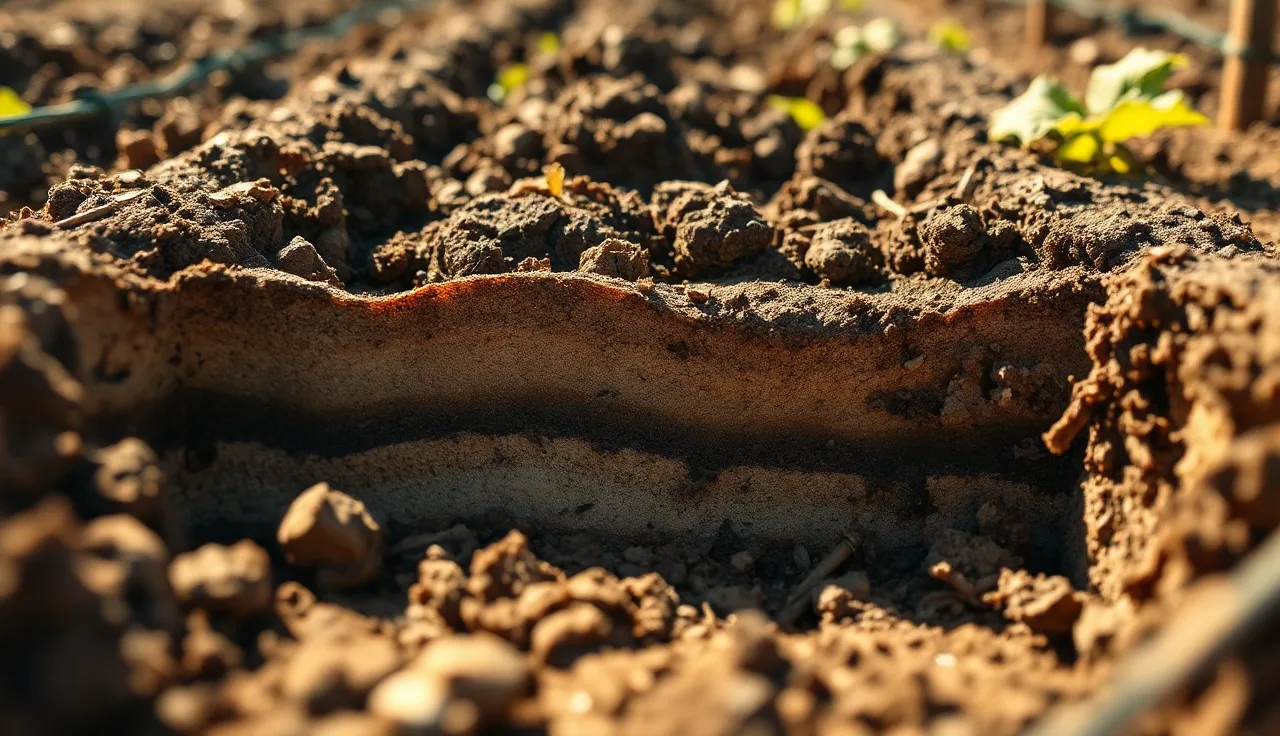
Pits should go to at least 120 cm (about four feet) or to the restrictive layer, whichever comes first. Look for color mottling, the gray or orange streaks that flag seasonal water saturation even when the surface looks bone dry. Feel the texture. Does it ribbon between your fingers, or fall apart? Is there a hard pan or a carbonate layer waiting for your roots? Each pit takes about 20 minutes and can save you from burying thousands of dollars of infrastructure in the wrong spot.
WSU Extension publishes a practical guide on reading vineyard soil pits that is worth keeping on the truck [5].
What does a vineyard soil test actually tell you, and how often should you test?
A standard agronomic soil test reports pH, buffer pH, organic matter, and extractable phosphorus, potassium, calcium, magnesium, and sometimes sulfur and micronutrients. Labs use different extractants (Mehlich-3 is common in the East, Olsen or Bray in the West), and the interpretation tables shift with the extractant. Do not compare numbers across labs without checking their methods first.
Test the top 12 inches (0 to 30 cm) for the general panel. If you are managing rootstocks or chasing potassium stratification, add a 30 to 60 cm sample. Test annually in young vineyards, then every two to three years once you have a baseline and the numbers hold steady. Same time of year, same spots, same depth, every time.
Tissue testing (petiole or blade samples at bloom or veraison) reads what the vine is actually taking up, which can differ sharply from what the soil test says is available. Cornell's viticulture program publishes petiole sufficiency ranges at bloom that most Northeast and Midwest growers use [6]. UC ANR Publication 3483 covers both soil and tissue interpretation for California conditions [1].
Here is a number that surprises growers: a soil test runs $20 to $50 per sample at a university lab, sometimes less, and a full micronutrient panel adds $10 to $30. There is no good reason to skip it.
How does soil drainage affect vine health and disease pressure?
Poor drainage is one of the most underrated yield killers in vineyards, and one of the hardest problems to fix once vines are in the ground. Waterlogged soil goes anaerobic and damages fine roots within 24 to 48 hours, depending on temperature. Even when the surface looks fine, a clay pan 50 cm down can perch a water table every wet winter and grind the root system down over years.
Phytophthora cinnamomi and P. megasperma, the oomycete pathogens most often tied to grapevine root rot, thrive in saturated soil. They are not fungi and shrug off most fungicides. Your real tools are drainage, resistant rootstocks, and not planting in the wet spots to begin with.
Tile drainage costs $1,500 to $4,000 per acre depending on depth, pipe spacing, and outlet options, per NRCS cost-share data [4]. French drains (perforated pipe backfilled with gravel) run toward the low end on a DIY basis. Neither works without a functioning outlet, and the outlet is the part growers forget. Know where the water goes before you design the system.
The opposite extreme bites too. Excessively drained, droughty soils with AWC below 0.05 inches per inch may need irrigation every three to five days at peak summer demand in a hot climate, and any pump failure hits hard and fast.
What soil pH range do grapevines actually prefer, and how do you adjust it?
The practical target for most Vitis vinifera is pH 5.8 to 6.8 in the top 30 cm. American hybrid varieties (Concord, Niagara, and their kin) tolerate lower pH, down to about 5.0, because their native parents evolved in acidic Eastern forest soils.
To raise pH you apply agricultural lime, and the rate rides entirely on your soil's buffer capacity. That is why labs report a buffer pH next to the water pH. A soil at buffer pH 6.5 and water pH 5.4 needs far less lime to reach 6.0 than a soil at buffer pH 5.8 with the same water pH. Do not guess. Use the lime rate the lab calculates for your buffer pH and target. Calcitic lime (calcium carbonate) raises pH without adding magnesium; dolomitic lime adds both. If your Mg:Ca ratio is already high, reach for calcitic.
Lime moves slowly. A surface application takes one to three years to shift pH at 15 to 30 cm. Incorporate it before planting if you possibly can.
To lower pH in alkaline soils, elemental sulfur is the standard amendment. Soil bacteria oxidize it into sulfuric acid. The process takes months, speeds up in warm moist soil, and needs repeat applications in high-carbonate soils because the carbonate keeps buffering the change back. UC ANR publishes rate tables, but in a calcareous soil with 5 to 10 percent calcium carbonate, acidification is a losing fight over the long haul [1].
How does soil type influence rootstock selection?
Rootstock choice and soil properties are one decision, not two. Some rootstocks handle wet feet reasonably well (Riparia Gloire, SO4 to a point); others collapse fast in saturated ground. Drought tolerance splits too: 110R and 140Ru root deep and take dry, rocky sites in stride, which is why they show up all over southern France and the California coast ranges.
Lime tolerance, meaning the ability to keep pulling iron in high-pH, high-carbonate soils, is the criterion that matters most where pH tops 7.5. 41B and Fercal are the most lime-tolerant rootstocks widely sold, rated to handle 40 percent and 60 percent active carbonate respectively. Verify availability with your nursery, since budwood supply shifts year to year.
Phylloxera resistance is still the baseline nearly everywhere, and every commercially grafted rootstock gives you that. Nematodes are the secondary filter in many California and southeastern soils. Ring, root-knot, and dagger nematodes carry different rootstock susceptibility profiles [9]. Get a nematode assay before you pick a rootstock on ground that has grown previous crops or vines.
WSU Extension's rootstock comparison tables are a useful starting point for Pacific Northwest growers working through this [5].
For how these calls play out across regions, the vineyard article covers site evaluation at a larger scale.
What role does soil organic matter play in a vineyard, and how do you manage it?
Organic matter (OM) does several jobs at once: it holds water, glues soil particles into aggregates, feeds soil biology, and releases nitrogen, sulfur, and phosphorus slowly as it breaks down. The catch is that vineyard OM is chronically low. You are growing a permanent perennial crop, tillage history has oxidized what was there, and warm dry summers burn through the rest.
The best tool most growers have is the cover crop. A perennial or annual cover in every row or every other row returns plant material to the surface and feeds the earthworms and microbes that build aggregate stability. UC Cooperative Extension work in Napa and Sonoma found cover-cropped vineyard floors take in water faster and shed less surface runoff than clean-cultivated floors, which matters for erosion and water retention both [3].
Compost at 2 to 4 tons per acre can add to this, but it is expensive per unit of OM. Finished compost runs $25 to $60 per ton delivered in most western markets, so 3 tons per acre costs $75 to $180 per acre a year. Reasonable if you also want pH buffering, trace minerals, and better soil biology, but do not expect a big OM jump from one application.
Chip bark mulch under the vine row cuts evaporation, evens out soil temperature, and adds carbon as it breaks down. Some growers swear by it. Others find it harbors Botrytis in the fruit zone if the material creeps up. Keep it six inches back from the trunk.
How do you interpret soil electrical conductivity and what does it tell you about salinity?
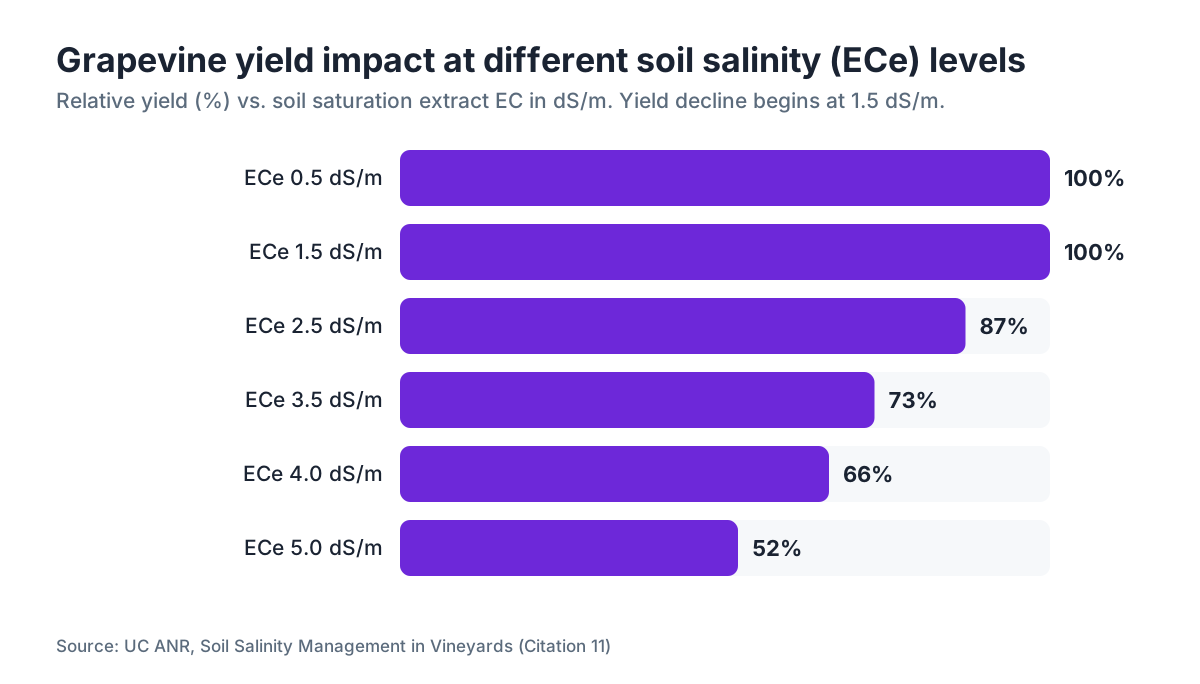
Soil electrical conductivity (EC) stands in for soluble salts. High EC suppresses germination, cuts water uptake (because concentrated salt lowers soil water potential), and drives specific ion toxicity from sodium, chloride, or boron. Grapevines are moderately salt-sensitive. Yield decline begins at a soil saturation extract EC (ECe) around 1.5 dS/m, and heavy losses set in above 4.0 dS/m, per research summarized by UC ANR [11].
EC also moves with texture and moisture. Wet clay reads higher than dry sand at the same salt load. That is why proximal soil sensors (EM38, Veris, and similar tools) that map apparent EC across a block are worth more for spotting spatial variability than for pinning down absolute salinity. Run once before planting, these surveys cost roughly $5 to $20 per acre depending on the provider and the job.
If your irrigation water EC tops 0.75 dS/m, track salt buildup every year. In arid regions with little rain to flush the profile, salinity climbs over years even when the water looks acceptable at the start. A leaching fraction of 10 to 20 percent above crop ET is the standard recommendation for keeping salt in balance in drip-irrigated vineyards in dry climates [10].
Tracking soil data next to irrigation records in one place is the exact problem VitiScribe is built for, keeping soil test history, block-level notes, and water use logs tied to the same block map so nothing goes missing at audit time.
What are the most common soil problems in established vineyards and how do you fix them?
Compaction is probably the most common problem in working vineyards and the most ignored. The same wheel tracks year after year compact the subsoil, cut macroporosity, and block root growth. Penetrometer readings above 300 psi (2,070 kPa) are generally considered limiting to roots, and plenty of vineyard midrows pass that after a decade of traffic [5].
Deep ripping (subsoiling) at 45 to 60 cm breaks the compacted layer, using a chisel or paraplow on a vineyard tractor. Timing is everything. Rip when the soil is dry enough to shatter, not smear. Wet ripping glazes the tine path and leaves you worse off than before.
Potassium stratification is real in no-till or minimal-till vineyards, where potassium piles up in the top few centimeters and runs short deeper down. Low petiole K plus high soil K at 0 to 30 cm usually points here. Tillage incorporation or injection can help, but there is no clean fix in a mature vineyard.
Boron toxicity shows up in irrigated blocks where the water carries even modest boron (above 0.5 to 1.0 mg/L) over many years. It reads as marginal leaf scorch that mimics potassium deficiency. Test your water first, ahead of your soil.
Nematode damage is easy to misread because the symptoms (poor growth, yellow leaves, low vigor) copy nutrient deficiency. If a block underperforms and your nutrient numbers look clean, pull roots and check for galls (root-knot nematodes) or send a soil sample to a nematology lab. In an established vineyard your options narrow to organic matter additions and cover crops of resistant species.
For Paso Robles and Central Coast growers, the paso-robles-wineries resource has region-specific context on calcareous soil management, which comes up constantly in that AVA.
How do you create a soil management plan that actually gets used?
A vineyard soil management plan does not need to run 40 pages. It needs to be a block-level reference that says what each block's constraints are and what you are doing about them.
At minimum, write down the soil series name from the USDA survey, your measured pH and OM at planting or last test, the rootstock, the drainage class, any known restrictive layers, and the year of the last lime or amendment. One page per block, updated when you test. That is the whole document.
The hard part is consistency. Soil tests mean nothing if you take them at different times, depths, or locations. Set permanent sampling stations, GPS-marked, and use them every time. Store photos of your soil pit logs beside the test results. When you sell the vineyard or hand it to a new manager, that record is the line between a clean handoff and starting over.
Under the EPA Worker Protection Standard and most state pesticide rules, spray records are mandatory but soil records carry no specific federal mandate. Many sustainability audits do require them, though. Lodi Rules, CCOF, and Fish Friendly Farming all want documented soil health practices. Know what your certification asks for before the audit lands [7].
VitiScribe has a block-level soil log and amendment history built into its field records module, which keeps this kind of documentation in a format an auditor can actually read without wading through spreadsheets.
What does soil variability mean for precision irrigation and harvest decisions?
Inside a single block you can easily see AWC swing from 0.06 to 0.14 inches per inch across different textures. Over a 48-inch root zone that is the gap between 2.9 and 6.7 inches of stored water, which means very different vine water status and ripening even under one irrigation schedule.
This is where proximal EC mapping and multiple soil moisture sensor locations pay for themselves. An EC map taken before planting or at establishment gives you a defensible basis for splitting a block into irrigation zones. Run one drip schedule across a variable block and you guarantee that part of it is over-watered and part is stressed, and walking the rows will not always tell you which is which.
For harvest, knowing your soil types sets your expectations for berry size and juice chemistry. Shallow, stony soils with low AWC lean toward smaller berries, higher skin-to-juice ratios, and earlier maturity. Deep, fertile soils give larger berries, more juice, and can push ripening later if you do not manage vigor. This is a tendency, not a law, and exceptions are everywhere. But it is a good prior when your brix curves diverge and you want to know why.
For properties like gervasi-vineyard or south-coast-winery, where several soil types share one map, the block-level tracking described here earns its keep.
Frequently asked questions
What is the ideal soil pH for growing wine grapes?
Most Vitis vinifera varieties do best between pH 5.8 and 6.8, with pH up to 7.0 generally acceptable. Below 5.5, aluminum and manganese can reach toxic concentrations. Above 7.5, iron and zinc availability drops sharply. American hybrids like Concord tolerate more acidity, down to around pH 5.0. Test your specific block rather than trusting regional averages.
How deep should grapevine roots go, and what limits them?
In ideal conditions with no restrictive layers, grapevine roots reach two to four meters deep. In practice, clay pans, carbonate layers, hardpan, high water tables, or compacted subsoil commonly limit effective rooting to 60 to 100 cm. Rooting depth sets drought tolerance and how much of the soil's nutrient reserve a vine can reach. Dig a pit to 120 cm before you assume your roots are going deep.
How often should I do soil testing in my vineyard?
Test annually for the first two to three years while you build a baseline and respond to amendments. Once the numbers hold steady, every two to three years is enough for most established vineyards. Sample at the same time of year, the same depth, and the same GPS locations every time. Pair soil tests with petiole tests at bloom or veraison to catch uptake problems the soil test alone misses.
What is cation exchange capacity and why does it matter in a vineyard?
Cation exchange capacity (CEC) is the soil's ability to hold positively charged nutrients like calcium, magnesium, potassium, and ammonium, measured in meq per 100 grams. Sandy vineyard soils often sit below 10; clay soils can top 30. Low-CEC soils respond faster to fertilizer but leach nutrients quicker, so split applications at lower per-event rates usually beat single large doses.
Can you grow good wine grapes in sandy soil?
Yes, and many famous regions do. Sandy soils drain fast, warm early in spring, and create moderate vine stress that often concentrates flavor. The tradeoff is lower water and nutrient holding capacity, which means more frequent irrigation and closer watch on potassium and magnesium. Deeper-rooting rootstocks (110R, 140Ru) help reach subsoil moisture. Nematode pressure runs higher in sandy profiles, so test before planting.
What is available water capacity and how does it affect irrigation scheduling?
Available water capacity (AWC) is the water a soil holds between field capacity and the permanent wilting point, usually in inches of water per inch of soil depth. A soil with AWC of 0.10 in/in and 48 inches of active rooting holds 4.8 inches of plant-available water. That figure sets how long vines can go between irrigations in hot weather. Multiply AWC by rooting depth and you have the reservoir you manage.
How do I know if my vineyard soil has a drainage problem?
Dig a pit to 120 cm and look for gray or orange mottling, which flags periodic waterlogging even in dry summer. A simpler field test: dig a hole 60 cm deep, fill it with water, and time the drop. Drainage slower than 1 inch per hour in that hole suggests restricted drainage. USDA Web Soil Survey drainage class data is a useful first check before you dig.
How much lime do I need to raise vineyard soil pH?
Lime rate depends on your soil's buffer pH more than its water pH. Your lab calculates a specific recommendation once you give them a target pH. As rough orientation, raising pH one unit in a medium-textured soil with moderate buffering usually takes one to two tons of agricultural lime per acre. Incorporate before planting if you can; surface lime moves slowly and may take two to three years to change pH at 30 cm.
What soil properties should I prioritize when evaluating a new vineyard site?
Start with drainage class and depth to any restrictive layer, since those are hardest to change after planting. Then check pH, because extreme values in either direction cause lasting nutrient problems. Look at texture for water-holding capacity and compaction risk. Then get a baseline nutrient panel and organic matter reading. A nematode assay matters if the ground has grown previous crops.
Does soil type affect wine quality or is that marketing?
There is real research behind the connection, though it is rarely direct. Soil type affects vine vigor, water availability, and root temperature, all of which shape canopy density, berry size, and juice chemistry. Shallow, low-fertility soils tend to give smaller berries with higher skin-to-juice ratios, which can mean more color and tannin. The terroir claim gets overstated in marketing, but the agronomic mechanisms are documented and legitimate.
What cover crops work best for improving vineyard soil health?
Perennial grasses like fescues or native bunchgrasses add organic matter, cut erosion, and compete with the vine for water in ways that moderate vigor on rich sites. Annual mixes of cereals and legumes add nitrogen and bulk organic matter when mowed or rolled under. In dry climates where water competition worries you, alternating cover-cropped and clean rows is common. UC Cooperative Extension has regional cover crop guides for California conditions.
Is soil compaction really a problem in established vineyards?
It is. Repeated tractor passes in the same wheel tracks compact subsoil to penetrometer readings above 300 psi within years, which physically limits root penetration. The symptoms get confused with nutrient deficiency or rootstock incompatibility, because the real effect is reduced fine root mass and impaired water and nutrient uptake. Deep ripping in dry conditions is the standard fix; ripping wet soil smears rather than shatters the compacted layer.
How do I manage salinity in my vineyard if my irrigation water has high EC?
Grapevine yield begins declining at a soil saturation extract EC around 1.5 dS/m. If your irrigation water EC tops 0.75 dS/m, apply a leaching fraction of 10 to 20 percent above crop ET to flush salts below the root zone. Test soil EC annually in the drip bulb zone. Drip concentrates salts at the wetting front perimeter, which matters less in season but can move toward roots during off-season rains if the system is poorly managed.
What is the USDA Web Soil Survey and how reliable is it for vineyard planning?
The USDA Web Soil Survey provides free map-unit-level soil data including texture, drainage class, available water capacity, and depth to restrictive layer for most U.S. land. It is a solid starting point for site evaluation but does not replace on-site pits. Map units typically allow 25 to 30 percent of other soil types within the named series, so block-level variability can be large even within one polygon. Screen with it, then dig to confirm.
Sources
- UC Agriculture and Natural Resources, Publication 3483: Soil and Plant Tissue Testing in California: Soil depth and texture interact with irrigation management to determine vine vigor; rootstock nematode susceptibility profiles; sulfur acidification rate guidance for calcareous soils
- Cornell Cooperative Extension, Viticulture and Enology Program, Soil pH for Vineyards: Most Vitis vinifera varieties perform well between pH 5.5 and 6.8; American hybrids tolerate down to pH 5.0
- UC Cooperative Extension, Cover Cropping in Vineyards, Napa-Sonoma: Cover-cropped vineyard floors have higher infiltration rates and less surface runoff than clean-cultivated floors; compost raises organic matter 0.3 to 0.5 percentage points over five years in warm climates
- USDA Natural Resources Conservation Service, Web Soil Survey: USDA soil surveys assign drainage classes from excessively drained to very poorly drained; NRCS cost-share data for tile drainage $1,500 to $4,000 per acre
- Washington State University Extension, Viticulture and Enology, Soil Management for Pacific Northwest Vineyards: Penetrometer readings above 300 psi (2,070 kPa) are generally considered limiting to root growth; rootstock comparison tables for Pacific Northwest growers; soil pit interpretation guide
- Cornell University, College of Agriculture and Life Sciences, Petiole Nutrient Sufficiency Ranges for Grapevines: Cornell's viticulture program has published reference sufficiency ranges for petiole samples at bloom used by Northeast and Midwest growers
- US EPA, Agricultural Worker Protection Standard: Under the Worker Protection Standard, pesticide application records must be kept; no specific federal mandate for soil management records, though sustainability certifications may require them
- USDA Agricultural Research Service, Grapevine Nematode Management: Ring, root-knot, and dagger nematodes have different rootstock susceptibility profiles; nematode assay recommended before rootstock selection on previously cropped ground
- WSU Extension, Irrigation Management for Washington Vineyards: Leaching fraction of 10 to 20 percent above crop ET is the standard recommendation for maintaining salt balance in drip-irrigated vineyards in low-rainfall climates
- UC ANR, Soil Salinity Management in Vineyards: Grapevine yield reduction begins at ECe around 1.5 dS/m; significant yield loss occurs above 4.0 dS/m
Last updated 2026-07-09