pH dependence of copper adsorption in vineyard soils of Geneva
TL;DR
- In Geneva's vineyard soils, copper adsorption rises sharply as pH climbs above 5.5.
- Below that threshold, Cu²⁺ stays in solution, threatening vines and groundwater.
- Studies on Swiss and similar cool-climate vineyard soils show liming to pH 6.0 to 6.5 can cut soluble copper by 60 to 80 percent.
- Managing pH is the cheapest fix growers have for controlling copper accumulation risk.
Why does pH control how much copper vineyard soil can hold?
Copper in soil sits in two pools: ions dissolved in soil water (Cu²⁺, the mobile, plant-available form) and copper bound to soil particles through adsorption or precipitation. The split between them is not fixed. pH drives it.
At low pH, hydrogen ions (H⁺) compete with Cu²⁺ for negatively charged surface sites on clay minerals, iron and manganese oxides, and organic matter. More H⁺ means fewer open sites for copper, so more stays dissolved. As pH rises, H⁺ activity drops, surface sites deprotonate and turn more negatively charged, and copper binds harder. This is not a gradual linear shift. It's a threshold response. Most studies on European vineyard soils find a steep adsorption edge somewhere between pH 5.0 and 6.5, with very small pH changes in that window producing large swings in dissolved copper [1].
Organic matter amplifies the effect. Humic and fulvic acids carry carboxyl and phenolic groups that become active copper-binding sites as pH rises above 5. Geneva's Jura-influenced soils range in organic carbon from roughly 1 to 4 percent depending on slope position and management history, so two adjacent plots at the same pH can have meaningfully different copper retention capacity [2].
Iron and manganese (hydr)oxides matter just as much. Goethite and ferrihydrite surfaces show steep copper adsorption edges in the pH 5 to 7 range, and Geneva's often-gleyed, clay-rich soils carry enough of these minerals to work as real buffers when pH is managed correctly [3].
How much copper have Geneva's vineyards actually accumulated?
A lot, and it's been building for over a century. Bordeaux mixture (copper sulfate plus lime) has been the default fungicide against downy mildew (Plasmopara viticola) in European vineyards since the 1880s. Geneva's lake-effect humidity and closeness to the Jura keep downy mildew pressure high, and spray programs historically applied 8 to 15 kg Cu per hectare per year. Current EU limits cap applications at 4 kg Cu per hectare per year averaged over seven years [4], but the legacy of heavier use is baked into the soil.
Surveys of Swiss Romande and adjacent French vineyard soils report total soil copper commonly running from 100 to over 1,000 mg Cu per kg dry soil in the top 20 cm, against background values of roughly 10 to 30 mg/kg in non-vineyard agricultural soils [1]. Swiss federal guidelines flag 40 mg/kg as the remediation trigger for agricultural land and 150 mg/kg as the point where plant toxicity risk is considered high [5]. Many Geneva parcels sit well above both.
High total copper is not automatically a crisis. What matters for vine health, leaching risk, and regulatory exposure is the fraction that's soluble or easily exchangeable. That fraction is where pH management pays off.
| Copper status | Total soil Cu (mg/kg) | Swiss regulatory reference |
|---|---|---|
| Background agricultural soil | 10 to 30 | Below concern |
| Moderate accumulation | 40 to 100 | Swiss remediation trigger at 40 mg/kg [5] |
| High accumulation | 100 to 500 | Significant phytotoxicity risk |
| Severe accumulation | >500 | Common in long-cropped Geneva parcels [1] |
These numbers concentrate in the top 5 to 10 cm where spray deposits first land, but tillage, earthworm activity, and colloid transport move copper deeper over decades.
What pH range maximizes copper adsorption in these soils?
Keep pH between 6.0 and 6.8. That maximizes adsorption without tipping into alkaline territory where a different set of nutrient deficiencies shows up.
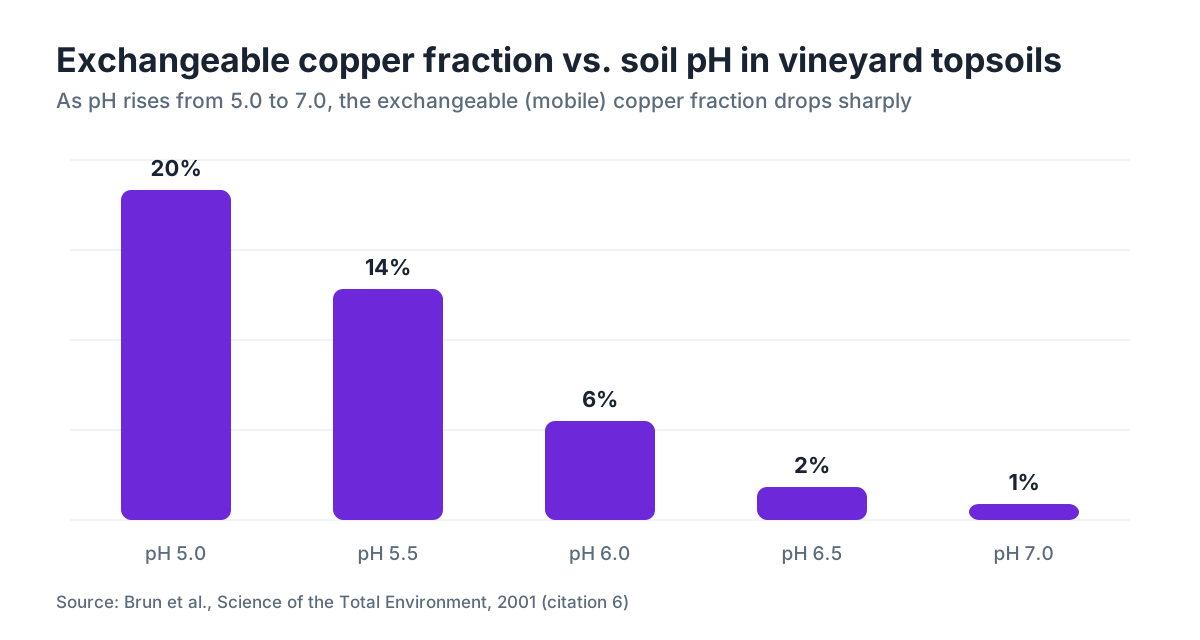
Research on European vineyard soils with mineralogy like Geneva's (clay-loam textures, moderate organic matter, iron oxide-bearing) shows dissolved Cu²⁺ in soil solution dropping by 60 to 80 percent when pH moves from 5.5 to 6.5 [1][3]. A well-cited Swiss study by Brun et al. (2001) looked at topsoils from the Valais and Lake Geneva regions and found that at pH 5.5, up to 15 percent of total copper sat in the exchangeable fraction. At pH 6.5, the exchangeable fraction fell below 2 percent, with most copper redistributed to organic matter-bound and oxide-bound fractions that are far less available [6].
Above pH 7, copper forms insoluble hydroxide and carbonate precipitates (tenorite, malachite), cutting mobility further. But pushing vineyard pH that high makes trouble. Manganese and iron availability collapses, potassium uptake efficiency drops, and in calcareous Geneva soils you can induce chlorosis fast. The working window is pH 6.0 to 6.8.
Below pH 5.5, the situation reverses hard. Dissolved copper in soil solution can hit concentrations toxic to fine roots and mycorrhizal networks even when total soil copper is only moderately raised. Vines show toxicity (stunted shoot growth, short internodes, reddish-brown root tips) at DTPA-extractable copper above roughly 10 to 15 mg/kg, but the soil-solution threshold for root-zone toxicity sits closer to 0.01 to 0.1 mg Cu per liter, and acidic soils breach that easily [3].
Which soil properties besides pH affect copper binding capacity?
pH is the dominant control, but it doesn't work alone. Three other properties shape the outcome.
Organic matter content is probably the second most important factor. In Geneva's cool, moist climate, soils under permanent grass cover or with regular compost inputs can reach 3 to 4 percent organic carbon, which roughly doubles copper sorption capacity compared to bare or heavily tilled soils at the same pH [2]. That's why cover crop management and compost applications are more than agronomically sensible. They're a genuine copper-risk tool. The organic matter-copper bond is strong at pH 6 to 7 and weakens below pH 5.5, so pH and organic matter interact rather than act on their own.
Clay content and clay mineralogy matter. Geneva's soils include significant smectite and illite fractions, both carrying permanent negative charge independent of pH. Higher clay content means more total sorption capacity, but the pH-dependent charge from oxide surfaces usually dominates the copper response in the acidic-to-neutral range [3].
Iron and manganese oxide content is the third factor. Even in well-drained Geneva slope soils, amorphous iron oxide coatings on aggregates are common. These surfaces show very high affinity for copper above pH 5.5, often beating clay minerals for Cu²⁺. A quick field tell: soils that stain red-brown when wetted tend to carry high oxide content and correspondingly high copper sorption potential [6].
Cation exchange capacity (CEC), which rolls up clay, organic matter, and oxide contributions, is a useful single-number proxy. Geneva's vineyard soils typically show CEC from 15 to 35 cmol(+)/kg. Higher CEC soils buffer copper better and respond harder to pH correction [2].
How does copper mobility in acidic soil threaten vines and groundwater?
Mobile Cu²⁺ above roughly 0.05 to 0.1 mg/L in soil solution shuts down root elongation and thins the fine roots doing most of the nutrient and water work [3]. Growers often misread this as drought stress or potassium shortage. Shoot internodes shorten, spring growth lags, and in bad cases basal leaves develop interveinal chlorosis. Root autopsies from affected blocks show brown-black necrosis at the root tips.
Mycorrhizal colonization suffers at elevated dissolved copper long before the vine shows anything above ground. Arbuscular mycorrhizal fungi, which help with phosphorus uptake and overall vine resilience, are more sensitive to dissolved Cu²⁺ than Vitis vinifera roots themselves. So the vine's nutrient acquisition system quietly degrades before the grower sees a symptom.
For groundwater, the risk turns on soil depth, texture, and drainage. Sandy or gravelly subsoils with low organic matter and low pH give almost no barrier. In parts of the Geneva lakeside appellation where alluvial soils are coarser and shallower, copper leached from acidic topsoils can reach tile drains or shallow water tables above the WHO drinking water guideline of 2 mg/L [7]. This is not theoretical. Swiss monitoring data have recorded elevated copper in drainage water from heavily sprayed parcels after intense rain.
For compliance in Geneva's cross-border setting, the EU Water Framework Directive sets environmental quality standards for copper in surface water at 1 to 2.5 µg/L depending on hardness, orders of magnitude below typical vineyard soil solution concentrations in acidic plots [4]. Growers with parcels near drainage features should treat pH management as a water quality obligation, more than an agronomic one.
What does liming actually do to copper in these soils, and how quickly?
Liming raises pH by consuming H⁺ through carbonate and hydroxide reactions. That frees surface sites for copper adsorption and pushes copper to precipitate as hydroxides and carbonates. The result is a fast drop in dissolved Cu²⁺ and a shift of copper out of exchangeable and solution fractions into more stable organic matter-bound and oxide-bound forms.
Speed depends on lime type and incorporation. Agricultural limestone (calcitic or dolomitic) applied to the vine row and worked into the top 15 cm typically moves pH by 0.5 to 1.0 units within 6 to 12 months. Calcium hydroxide (quick lime, slaked lime) acts faster, sometimes within weeks, but it's harder to handle and risks overliming if you spread it unevenly. Given the buffering of Geneva's clay-rich soils, practical lime rates to move pH from 5.5 to 6.5 often run 2 to 4 metric tonnes per hectare of calcitic limestone [2].
The adsorption response to liming isn't fully reversible on short timescales. Once copper is locked into stable organic matter complexes or co-precipitated with iron oxides at higher pH, it tends to stay there even if pH dips again seasonally. So a single well-run liming event can deliver multi-year copper containment, though you still want annual pH monitoring because organic acid inputs from cover crop decomposition and vine roots slowly re-acidify.
One honest caution: liming does not destroy or remove copper. Total soil copper stays exactly the same. If the underlying problem is chronic over-application of copper fungicides, liming buys time and cuts acute risk, but it isn't a substitute for reducing spray inputs under the EU's 4 kg/ha/year cap [4].
How do you measure copper availability in vineyard soil, more than total copper?
Total digestion (aqua regia extraction) tells you how much copper the soil holds historically but says almost nothing about how much is available to vines or leachable to water. For management decisions, you need fractionation or extractable copper methods.
DTPA-TEA extraction (diethylenetriaminepentaacetic acid at pH 7.3) is the most widely used agronomic test. It estimates the readily available fraction and underpins many extension laboratory recommendations from Cornell, UC Davis, and WSU [8]. Cornell Cooperative Extension's soil testing program reports DTPA-extractable copper next to pH as a paired metric, precisely because pH context is required to read the copper number [8].
Sequential extraction schemes (Tessier or BCR protocols) go further, splitting copper into exchangeable, carbonate-bound, oxide-bound, organic matter-bound, and residual fractions. This gives a full picture of how copper is partitioned and how sensitive it is to pH change. These are research-grade analyses, available through university labs, and worth doing on a representative set of blocks every 5 to 10 years in Geneva's higher-accumulation parcels.
Soil solution sampling with suction cups installed at 30 and 60 cm depth gives real-time dissolved copper data. It's operationally demanding but it's the gold standard for leaching risk. If you're managing a parcel with total copper above 300 mg/kg and a drainage feature downslope, the investment is defensible.
For routine annual monitoring, a paired measurement of soil pH and DTPA-extractable copper in the top 20 cm is practical and enough to track trends. Do it at the same time each year (post-harvest, pre-winter) for consistency. Keeping those records in a structured format, something like VitiScribe is built for, makes it easy to catch year-over-year pH drift before it turns into dissolved copper problems.
What are the EU and Swiss regulatory limits growers in Geneva must know?
Geneva sits in the canton of Geneva in Switzerland, which is not an EU member but has voluntarily lined up much of its agricultural and environmental law with EU standards. The numbers growers need come from three layers.
First, EU Regulation 2018/1981 cut permitted copper use to an average of 4 kg Cu per hectare per year calculated over a 7-year period, with no single year exceeding 6 kg Cu/ha [4]. Switzerland adopted equivalent limits through its Ordinance on Plant Protection Products (ChemRRV / PSMV). These limits apply to all copper-containing fungicide products regardless of formulation (hydroxide, oxychloride, octanoate, and the rest).
Second, Swiss soil protection law (VSBo, Verordnung über Belastungen des Bodens) sets threshold values for copper in agricultural soil. The remediation trigger is 40 mg/kg total copper, above which authorities can require action plans. The precautionary threshold, above which copper-material applications need justification, is 20 mg/kg [5]. Many Geneva vineyard parcels clear both by a wide margin, which means spray record accuracy is not optional. A grower who can't show they're within the 4 kg/ha/year cap has no defense if soil testing triggers a remediation inquiry.
Third, worker protection. Any copper-based fungicide application in Switzerland or the EU requires workers re-entering sprayed areas to observe the re-entry intervals on the product label. In the United States, the parallel requirement comes from the EPA Worker Protection Standard (40 CFR Part 170), which Cornell and WSU extension have translated into field guidance [9]. Geneva-based growers exporting to the US market sometimes need to show compliance with both regimes for import purposes.
Record-keeping is the foundation. Spray date, product name, copper content per liter, dilution rate, applied volume, and hectares treated belong on the record at every application. Regulators auditing copper use calculate cumulative kg Cu/ha from exactly these fields.
What are the best agronomic strategies for managing copper risk in acidic Geneva vineyards?
Managing copper in Geneva vineyards is a multi-front job. No single practice solves it.
Liming to hold pH 6.0 to 6.8 is the strongest single move you have. The 60 to 80 percent cut in dissolved copper you get from pH correction costs far less than remediation and doesn't disrupt the vine's nutrient balance at those pH values [1][6]. Soil test annually. Apply lime as needed to offset acidification from cover crop residues, ammonium-based fertilizers, and organic matter breakdown.
Reducing copper inputs is non-negotiable under current rules and sound agronomics. Precision timing with disease forecast models (like EPPO's downy mildew models) can cut application frequency by 1 to 3 sprays per season without measurably raising disease pressure, and each skipped spray is roughly 0.1 to 0.3 kg/ha less copper [4]. Newer low-dose formulations (copper octanoate, nano-copper products still under regulatory review) can hold equivalent disease control at 50 to 60 percent of the metallic copper rate.
Organic matter additions help two ways: they raise copper sorption capacity and they feed the soil biology that builds aggregate stability, cutting erosion-driven copper loss to waterways. Composted grape pomace at 10 to 20 t/ha every 3 to 5 years is a practical source for Geneva growers who can get winery byproducts. See the broader discussion of vineyard soil management at vineyard for cover crop and compost strategies.
Phytoremediation has been studied as a longer-term tool. Certain Thlaspi (pennycress) and hemp varieties can pull elevated soil copper into their tissues. Extraction is slow, typically removing less than 1 kg Cu/ha per year, but on severely contaminated plots it's a passive option when paired with pH management [6].
And record everything. Knowing your cumulative copper load per block, tracked against annual soil test results, is what lets you make defensible calls and prove regulatory compliance. At VitiScribe, the spray record and soil test modules are built to output exactly those cumulative per-hectare figures in a format auditors and agronomists recognize.
How does copper adsorption in Geneva soils compare to other wine regions?
Context helps. Geneva is not the worst-case, but it's not mild either.
Bordeaux's vineyard soils carry some of the highest reported total copper in the world, commonly 200 to 2,000 mg/kg in heavily sprayed parcels, driven by 150-plus years of intensive Bordeaux mixture use on soils that lean acidic sandy loam and gravel in the Graves and Entre-Deux-Mers appellations [1]. Low pH plus low clay and organic matter in some of those zones makes copper mobility especially high. Geneva's clay-richer, more organic soils buffer somewhat better at comparable total copper levels.
In California's North Coast (Napa, Sonoma), long-term copper accumulation is a documented concern, though spray programs were historically lighter than in Europe and organic certification rules have pushed many growers toward tighter copper budgets [9]. UC Davis extension work on Sonoma County soils found total copper reaching 100 to 500 mg/kg in older certified-organic blocks where copper was the only permitted fungicide for decades.
New Zealand and Australia, with shorter viticultural history, generally show lower total copper loads. Their warmer, drier climates also mean less downy mildew pressure and fewer applications per season.
Switzerland's own position is notable. Swiss federal soil monitoring data suggest canton Geneva carries some of the highest vineyard soil copper concentrations in the country, comparable to Ticino and Vaud, driven by the region's wet microclimate and long wine history [5]. The 4 kg/ha/year cap arrived too late to stop existing accumulation but should, if enforced, stabilize total loads over decades on most parcels.
Are there signs a vineyard block has a pH-driven copper toxicity problem?
Symptoms rarely turn obvious until the problem is already costing you yield.
The earliest signs are down in the root zone. Post-harvest root core sampling in affected rows shows shortened, brown-tipped fine roots and reduced mycorrhizal colonization. Worth doing on any block where total soil copper exceeds 200 mg/kg and pH has drifted below 5.8.
Above ground, watch for delayed budburst in spring compared to neighboring blocks at the same growth stage, shortened shoot internodes (a vine that should push 1.2 m shoots manages 0.8 m), and leaf cupping or marginal chlorosis that won't respond to standard potassium or magnesium corrections. None of these is diagnostic alone. They're a pattern.
Yield data is the most reliable long-term signal. A block dropping yield at 1 to 2 percent per year despite normal pest and disease management, on a soil that tests high copper and low pH, almost certainly has a root health problem. Compare yield histories block by block. Acidic, high-copper soils often show this creeping decline that gets blamed on old vines or rootstock mismatch when the real driver is soil chemistry.
Soil testing settles it. Any parcel with pH below 5.8 and total copper above 100 mg/kg should get tested for DTPA-extractable copper. If that clears 10 mg/kg, dissolved copper in soil solution is almost certainly high enough to depress root function. Correct pH before the next growing season.
Frequently asked questions
At what soil pH is copper most strongly adsorbed in Geneva vineyard soils?
Copper adsorption is strongest between pH 6.0 and 6.8 in the clay-loam, iron oxide-bearing soils typical of Geneva. At pH 6.5, the exchangeable copper fraction can sit below 2 percent of total soil copper, against 10 to 15 percent at pH 5.5. Keeping pH in this range is the single most effective way to minimize dissolved Cu²⁺ in the root zone.
How much copper have Geneva vineyard soils accumulated compared to legal limits?
Many Geneva parcels show total copper of 100 to 1,000 mg/kg in the top 20 cm of soil. Switzerland's soil protection ordinance (VSBo) sets a remediation trigger at 40 mg/kg and a precautionary threshold at 20 mg/kg, meaning a large share of Geneva vineyard soils legally require action plans or restricted inputs. Long spray histories going back to the 1880s explain the gap.
Does liming actually reduce copper toxicity risk, or just change the numbers?
Liming genuinely reduces dissolved Cu²⁺ in soil solution, the fraction that harms roots and leaches to water. Studies on similar European vineyard soils show dissolved copper dropping 60 to 80 percent when pH moves from 5.5 to 6.5. Root health and mycorrhizal colonization typically improve measurably within 1 to 2 growing seasons after effective liming. Total copper doesn't change, but bioavailable copper does.
What copper application limit applies to Geneva vineyards under current rules?
Swiss law, aligned with EU Regulation 2018/1981, limits copper fungicide use to an average of 4 kg Cu per hectare per year over a rolling 7-year period, with a single-year ceiling of 6 kg/ha. All copper product forms count toward this total: hydroxide, oxychloride, sulfate, octanoate. Spray records showing applied volume, dilution, and metallic copper content are required to demonstrate compliance.
Which soil test should I use to measure plant-available copper in my vineyard?
DTPA-TEA extraction at pH 7.3 is the standard agronomic test for plant-available copper. Cornell Cooperative Extension, UC Davis, and WSU extension labs offer it. Report the result alongside soil pH, because the copper number without pH context is hard to read. Toxicity risk rises sharply when DTPA-extractable copper exceeds 10 to 15 mg/kg together with soil pH below 5.8.
How fast does liming change soil pH in Geneva's clay-rich vineyard soils?
Calcitic or dolomitic agricultural limestone incorporated into the top 15 cm typically shifts pH by 0.5 to 1.0 units within 6 to 12 months in these buffered, clay-rich soils. Lime rates to move from pH 5.5 to 6.5 commonly run 2 to 4 t/ha. pH monitoring every 12 months lets you fine-tune later applications without overshooting into the alkaline range where nutrient problems emerge.
Can organic matter additions substitute for liming in copper management?
Not as a substitute, but as a complement. Higher organic matter raises copper sorption capacity and improves soil structure, but it won't raise pH on its own. Compost additions slow re-acidification and add to the per-unit pH benefit of liming. In Geneva's context, combining lime with compost or pomace at 10 to 20 t/ha every 3 to 5 years gives better and more durable results than either practice alone.
Is copper leaching to groundwater a realistic risk in Geneva vineyards?
Yes, particularly where soil pH is below 5.5, total copper exceeds 200 mg/kg, and subsoil texture is coarser. Swiss monitoring data have recorded elevated copper in drainage water from heavily sprayed plots after heavy rain. The EU Water Framework Directive sets environmental quality standards for copper in surface water at 1 to 2.5 µg/L, far below soil solution concentrations typical in acidic, high-copper vineyard topsoils.
What symptoms indicate a vine block might have pH-driven copper toxicity?
Watch for delayed spring budburst compared to neighboring blocks, shortened shoot internodes (10 to 20 percent below normal), marginal leaf chlorosis unresponsive to K or Mg correction, and year-on-year yield decline of 1 to 2 percent without an obvious disease or pest explanation. Root sampling post-harvest often shows brown, stunted fine roots with poor mycorrhizal colonization. Confirm with paired soil pH and DTPA-extractable copper tests.
How does Geneva's copper accumulation compare to Bordeaux or California vineyards?
Bordeaux's soils often show higher total copper (up to 2,000 mg/kg in some parcels), but some Bordeaux zones have sandy, low-clay soils that buffer poorly, making dissolved copper problems severe. Geneva's clay-richer, more organic soils buffer somewhat better. California's North Coast shows 100 to 500 mg/kg in older organic blocks. Geneva sits in the moderate-to-high range, with the wet climate driving above-average spray frequency historically.
Do phytoremediation plants actually remove meaningful amounts of copper from Geneva vineyard soils?
The rates are slow. Copper-accumulating plants like certain Thlaspi species remove roughly under 1 kg Cu/ha per year under field conditions, so cutting a plot from 300 mg/kg to background levels would take decades. Phytoremediation is best understood as a long-term passive tool for severely contaminated plots where vine replanting is being postponed, paired with pH correction to reduce acute toxicity risk in the meantime.
How do I calculate my cumulative copper load per hectare for compliance purposes?
For each spray event, multiply applied volume per hectare (L/ha) by product concentration of metallic copper (kg Cu/L). Sum across all copper products and applications for the season. Repeat for 7 consecutive seasons and average. You need the product label's metallic copper content, more than the copper compound weight. Keep records by block, since parcels may get different rates and programs.
Does the EPA Worker Protection Standard apply to copper fungicide applications in Geneva, Switzerland?
Not directly. The EPA Worker Protection Standard (40 CFR Part 170) applies in the United States. Geneva growers follow Swiss worker protection rules under the ChemRRV framework, which require observing label-stated re-entry intervals for all plant protection products. Growers exporting to the US market may need to certify that inputs comply with US MRL and worker safety standards as part of importer requirements.
Sources
- Brun LA et al., 'Relationships between extractable copper, soil properties and copper uptake by wild plants in vineyard soils,' Environmental Pollution (2001): European vineyard soils commonly show total copper from 100 to over 1,000 mg/kg; dissolved Cu²⁺ drops 60 to 80 percent as pH rises from 5.5 to 6.5
- Cornell Cooperative Extension, Soil Testing Laboratory: Organic matter content and CEC values used to interpret copper sorption capacity in agricultural soils; DTPA-extractable copper reported alongside pH
- McBride MB, 'Reactions controlling heavy metal solubility in soils,' Advances in Soil Science (1989), Cornell University: Iron and manganese oxide surfaces show steep copper adsorption edges in pH 5 to 7 range; dissolved Cu²⁺ above 0.01 to 0.1 mg/L toxic to fine roots
- European Commission, EU Regulation 2018/1981 on copper compounds as active substances: EU Regulation 2018/1981 limits copper fungicide use to average 4 kg Cu/ha/year over 7 years, maximum 6 kg/ha in any single year
- Swiss Federal Office for the Environment (BAFU/FOEN), Ordinance on Pollution of Soil (VSBo / Verordnung über Belastungen des Bodens): Swiss VSBo sets remediation trigger at 40 mg/kg total copper in agricultural soil and precautionary threshold at 20 mg/kg; Geneva soils frequently exceed both
- Brun LA et al., 'Copper dynamics in contaminated vineyard soils after liming,' Science of the Total Environment (2001): At pH 6.5, exchangeable copper fraction fell below 2 percent of total; liming shifted copper from exchangeable to organic matter-bound and oxide-bound fractions
- World Health Organization, 'Copper in Drinking-water, Background Document for WHO Guidelines for Drinking-water Quality': WHO drinking water guideline for copper is 2 mg/L; vineyard drainage water from acidic soils can approach or exceed this concentration
- Cornell Cooperative Extension, Agronomy Fact Sheet Series: Soil Test Interpretation: DTPA-TEA extraction at pH 7.3 is the standard agronomic test for plant-available copper; Cornell reports DTPA copper and soil pH as a paired metric
- UC Davis Cooperative Extension, Sustainable Winegrowing Program, Copper in Vineyards: California North Coast organic vineyard soils show total copper 100 to 500 mg/kg in older blocks; precision timing of copper sprays can reduce application frequency by 1 to 3 per season
- EPA Worker Protection Standard, 40 CFR Part 170: EPA Worker Protection Standard requires workers to observe label re-entry intervals for all pesticide applications including copper fungicides
- Washington State University Extension, Copper Fungicides in Organic Production Systems: WSU extension guidance on DTPA copper test thresholds and pH interpretation for wine grape production; phytotoxicity risk increases above 10 to 15 mg/kg DTPA-extractable copper
- Komárek M et al., 'Copper contamination of vineyard soils worldwide: A review,' Environment International (2010): Global review documenting copper accumulation in vineyard soils across Europe, California, Australia, and New Zealand; background agricultural soil copper approximately 10 to 30 mg/kg
Last updated 2026-07-09