Nozzle calibration check records for airblast vineyard sprayers
TL;DR
- A nozzle calibration check record documents output per nozzle (usually ounces per minute), spray pressure, and the date of the check.
- State pesticide rules and the EPA Worker Protection Standard require application equipment to be calibrated and the records to back up your spray record.
- Run a check at the start of each season and after every 25 to 50 acres sprayed.
What exactly is a nozzle calibration check record for an airblast sprayer?
A nozzle calibration check record is a written or digital log that proves your airblast sprayer was putting out the right volume of spray mix when you applied. It captures measured output per nozzle (or per set), operating pressure at the manifold or tip, the date, who ran the check, and which sprayer. Many operations also log nozzle type and tip size in the same entry, so you have a full snapshot if a regulator or crop consultant questions your rate later.
This is different from the spray application record. That document covers the product, rate, target pest, and field. The calibration record is the mechanical evidence that your equipment could deliver what the label called for. One is the product side of compliance. The other is the equipment side.
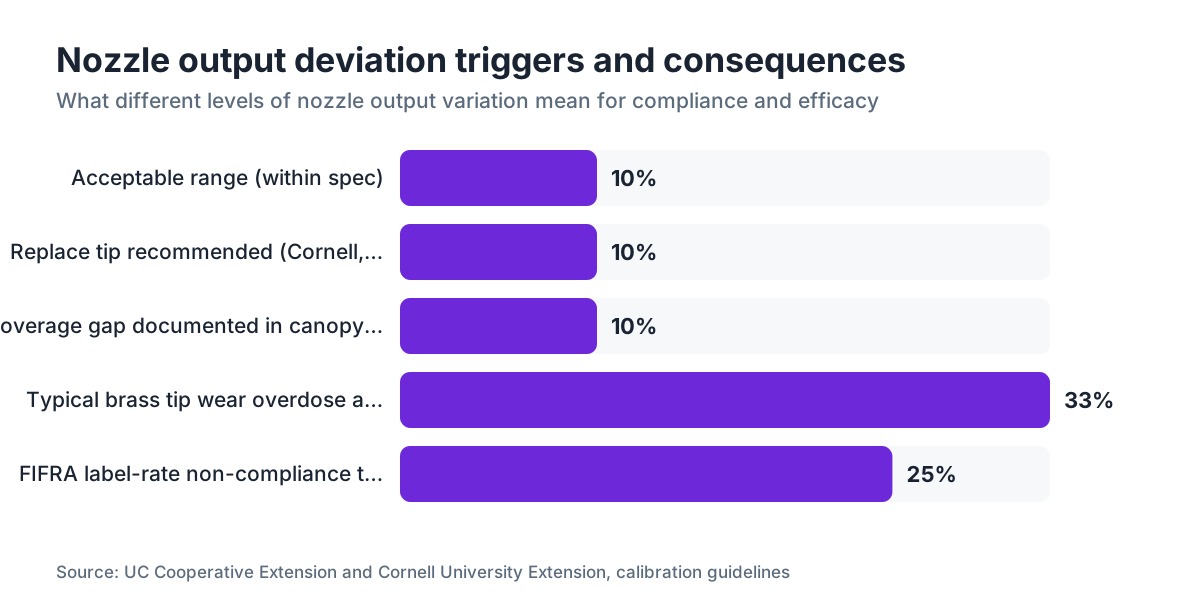
Calibration checks are more than paperwork. An airblast sprayer with one clogged or worn nozzle can deliver 20 to 40 percent less product to that zone of the canopy, which can drop you under the label's minimum rate (and therefore outside legal use) or leave gaps in disease control. University of California Cooperative Extension has documented that nozzle output varying more than 10 percent across a set warrants tip replacement [1]. Recording the check is how you prove you caught the problem before it became a violation.
What information must a nozzle calibration record include to satisfy regulators?
There is no single federal form for this. But the EPA Worker Protection Standard [2] combined with state pesticide reporting laws (California's is the most detailed, under Food and Agriculture Code Section 12981 and CCR Title 3 [3]) gives you a clear minimum field list.
A defensible calibration check record needs these fields:
- Date of the calibration check
- Sprayer identification (make, model, or your own equipment ID number)
- Nozzle type and tip size (hollow cone, D6-45, whatever you're running)
- Operating pressure during the check, in PSI
- Measured output per nozzle (ounces per minute or liters per minute)
- Name of the person who ran the check
- Any corrective action taken (tip replaced, screen cleaned, and so on)
California's Department of Pesticide Regulation does not mandate a specific log format. County agricultural commissioners can and do request equipment calibration records during inspections, especially when they're investigating a drift incident. In Washington, WSU Extension recommends calibration records travel with the pesticide application record whenever an inspector asks for documentation [4].
The EPA Worker Protection Standard at 40 CFR Part 170 requires agricultural employers to make sure application equipment is properly maintained and calibrated, and that handlers are trained to do so [2]. The rule doesn't spell out a record format. But "properly calibrated" is a legal standard, and a written record is your only real proof.
One more thing. If you hold a commercial applicator license in any state, that state's department of agriculture almost certainly has record-retention rules that pull calibration documentation in as supporting evidence for the application record. California requires application records to be kept two years [3]. New York's requirement is also two years, under 6 NYCRR Part 325 [5]. Keep your calibration logs at least as long as the application records they back up.
How often should you calibrate airblast sprayer nozzles in a vineyard?
Calibrate at the start of each spray season, after any nozzle change, and after every 25 to 50 acres sprayed. That's the WSU Extension recommendation [4]. UC Davis guidance adds a monthly check during an active spray program [1]. The single trigger that matters most is nozzle wear.
Ceramic and stainless tips resist wear better than brass, but every nozzle drifts out of spec eventually. A brass tip rated for 0.30 gallons per minute at 100 PSI can be flowing 0.40 gallons per minute after a few hundred acres because the orifice eroded. That's a 33 percent overdose. Cornell's viticulture program recommends replacing tips when output deviates more than 10 percent from the rated flow [6].
For a typical California wine grape operation running 3 to 6 spray passes a season, plan on a check at season start, one midseason, and one after any nozzle repair. Operations pushing heavy disease programs with 8 to 12 passes should check more often. Write the interval into your standard operating procedures so it isn't a judgment call every year.
One last trigger. If you switch products and the new label calls for a different application volume (say, moving from 50 GPA to 100 GPA), recheck calibration at the new settings before you spray.
How do you actually measure nozzle output on an airblast sprayer?
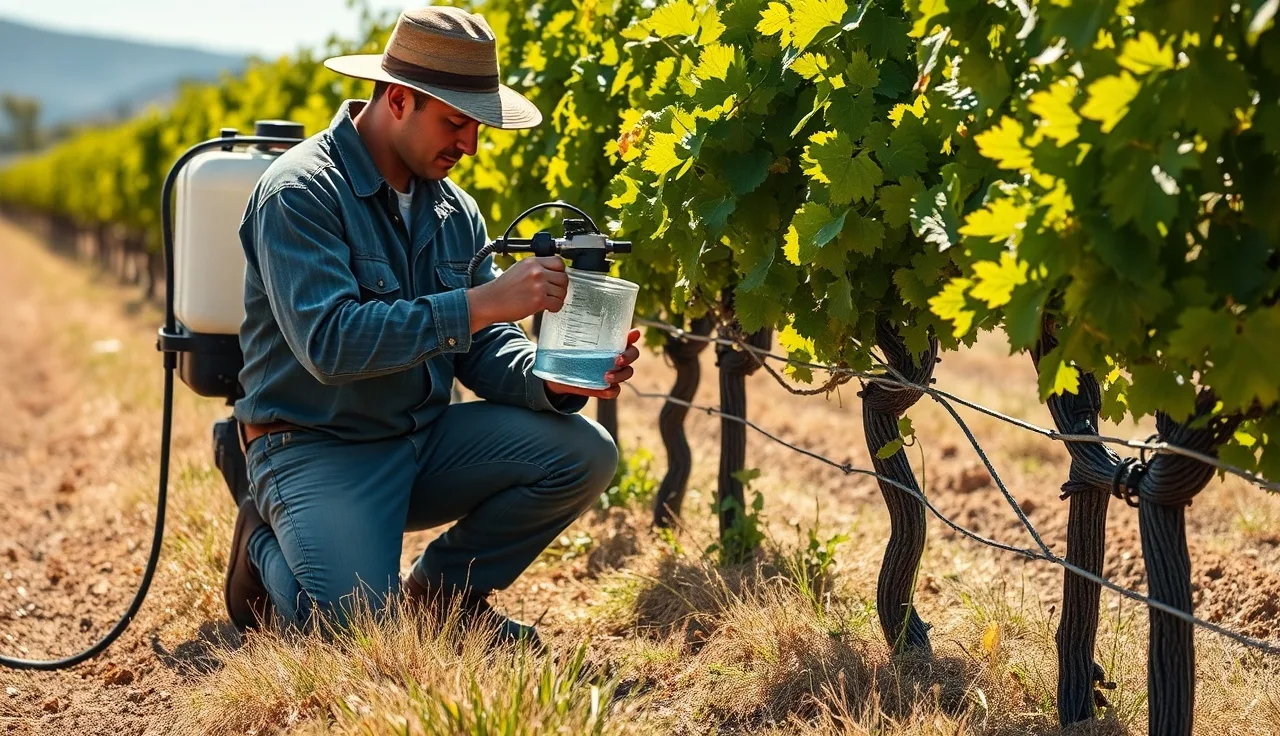
Use the catch-and-measure test. Put water in the tank, run the PTO at field speed (typically 540 RPM), hold a graduated container under each nozzle for exactly 30 seconds, then multiply by 2 for ounces per minute. Compare that number against the manufacturer's published flow rate for that nozzle at your pressure. Outside 10 percent of rated output, clean or replace the tip.
On an airblast sprayer you run this with the fan on but the tractor parked, so you have to deal with the air turbulence. Some operators tent a trash bag or tarp loosely over the discharge area to cut drift during the catch, though it's imperfect. The cleaner option is an in-line flow meter on each manifold branch, which some newer sprayers ship with as standard equipment.
Pressure is the other half of the math. A nozzle rated for 1.0 GPM at 100 PSI flows about 1.41 GPM at 200 PSI, because flow scales with the square root of pressure. Read your manifold gauge during the actual check and record it. If the gauge itself has never been tested, that's another source of error worth noting in the record. UC Cooperative Extension recommends checking pressure gauges annually against a calibrated reference gauge [9].
Write the results down right after the check. A field notebook works. So does a phone photo of a whiteboard with the numbers, timestamped. What doesn't work is reconstructing the numbers from memory three weeks later when a commissioner asks.
What's the right format for keeping these records, paper or digital?
Either one is legal in all 50 states as of this writing. The practical question is whether you can find the record two years from now and prove nobody altered it after the fact.
Paper logs in a binder by season are simple and need no technology. The weakness is water damage, fire, or plain disorganization. Paper also won't link itself to your spray records, so during an inspection you end up flipping between two binders trying to match dates.
Digital records, in a spreadsheet or dedicated farm software, are easier to search and easier to link. Some managers run a shared Google Sheet with a locked timestamp column. Others use purpose-built platforms. VitiScribe, for one, is built for vineyard compliance and links calibration check entries straight to the spray application records they support, which is the audit trail that saves you time during a county commissioner inspection. Whatever you use, the record needs a creation timestamp and needs to export as a PDF.
Digital has one real edge: it makes an overdue calibration check obvious. A paper binder never alerts you. A system with a scheduled reminder does.
For operations spread across multiple blocks or leasing several ranches, a vineyard management system that tracks equipment by block makes it far easier to show the calibration history for a specific location, which is exactly what a regulator wants when an incident is tied to one block.
How does the EPA Worker Protection Standard affect calibration record requirements?
The EPA Worker Protection Standard (WPS), codified at 40 CFR Part 170, was last significantly revised in 2015 and applies to any agricultural establishment where pesticides are applied and workers or handlers are employed [2]. Under the WPS, handlers must be trained to safely use application equipment, and employers must make sure that equipment is properly maintained.
The WPS has no line that says "keep a calibration log." It requires that equipment be calibrated and that handlers be trained to spot equipment problems. Your legal exposure shows up when an injury or complaint triggers an inspection. If you can't show the sprayer was calibrated, you have no defense against a failure-to-maintain-equipment finding.
The WPS also requires certain information be available at a central location for any application, including the equipment used. Calibration records stored next to application records meet the spirit of that requirement. EPA's own WPS compliance guidance treats proper calibration as part of handler training [2].
State-level enforcement varies a lot. California's DPR is the most active, and its county commissioners run field inspections that include equipment checks. Washington's Department of Agriculture handles WPS enforcement there and uses an inspection checklist that covers calibration status.
What do California, Washington, and New York require specifically?
These three states cover a big share of U.S. wine grape production and carry the most detailed requirements worth knowing.
California: The Department of Pesticide Regulation requires every pesticide application to be recorded on a Pesticide Use Report (PUR) submitted to the county agricultural commissioner within 7 days [3]. Calibration records aren't part of the PUR form itself, but commissioners routinely request supporting documentation that equipment was calibrated during inspections. Under CCR Title 3, Section 6614, equipment used for pesticide applications must be maintained so it functions as intended. That's the hook for calibration records.
Washington: The Washington State Department of Agriculture runs pesticide licensing and WPS enforcement. WSU Extension's airblast sprayer calibration guide recommends keeping calibration records in the application record file and retaining them at least two years [4]. Washington's Pesticide Application Act (RCW 17.21) requires licensed applicators to maintain records, and calibration documentation supports them [8].
New York: The Department of Environmental Conservation requires pesticide application records under 6 NYCRR Part 325 [5]. Cornell's viticulture program recommends attaching calibration records to spray records each season, noting that DEC or county inspectors may request them [6].
Outside these three states, assume calibration records should meet the same standard as application records, because they're the supporting evidence for the rates you reported.
| State | Primary regulation | Record retention | Calibration record required? |
|---|---|---|---|
| California | CCR Title 3 / CDPR | 2 years | Not a named form, but expected on inspection |
| Washington | RCW 17.21 | 2 years | Recommended by WSDA and WSU Extension |
| New York | 6 NYCRR Part 325 | 2 years | Recommended by Cornell, expected on inspection |
| Oregon | ORS Chapter 634 | 2 years | Calibration maintenance required under ODA rules |
What are the most common mistakes vineyard managers make with calibration records?
The biggest one is calibrating the sprayer and writing nothing down. The second biggest is recording only the pressure setting, not the actual measured output. Those two together probably account for 60 percent of the compliance gaps described in extension literature and grower forums, though nobody has a rigorous national study on this. The closest data comes from a 2018 UC Cooperative Extension survey of Central Valley applicators that found fewer than half of respondents kept a written calibration log separate from their application records [1].
The other repeat offenders:
Calibrating at the shop, not at field conditions. Nozzle output at 50 PSI in a stationary shop test is not the same as output at 80 PSI in a vineyard row over rolling ground. Record the field operating pressure, not the shop pressure.
Not identifying which sprayer was tested. Operations with two or more airblast units need equipment IDs on every record. A generic entry that reads "sprayer calibrated" is useless when you own three sprayers.
Skipping the check after a nozzle swap. Replace a worn tip mid-season and you've changed the calibration state. That warrants a fresh record entry.
Lumping all nozzles together. An airblast sprayer may carry 12 to 24 nozzle positions. A single average output hides the fact that three nozzles on one side are 30 percent over rate. Record each nozzle, or at least each manifold zone, on its own line.
Not dating the corrective action. If you found two clogged tips and replaced them, record the date of the fix, not only the date of the initial check.
How should you handle a calibration check that shows nozzles are out of spec?
Stop. Don't spray until you fix the problem and recheck.
When a nozzle runs more than 10 percent above or below rated output, Cornell and UC both recommend replacing the tip instead of adjusting pressure to compensate [1][6]. Changing pressure changes the droplet spectrum and can hurt coverage uniformity and drift behavior. Replacing the tip restores the manufacturer's intended performance.
In the record, note the finding ("nozzle position 7, left side: output 1.8 oz/min vs rated 1.4 oz/min at 100 PSI, 29% over, tip replaced"), the corrective action, and the recheck result after the fix. This three-part entry, find, fix, verify, is the record that actually holds up.
If you already sprayed before you knew a nozzle was out of spec, that's a harder spot. When the nozzle was significantly overdosing and you applied a restricted-use pesticide, talk to your county farm advisor or PCA about whether a retroactive PUR amendment is needed. Some county commissioners take the view that if the equipment was in spec at the previous check and the problem developed between checks, you're covered. Others are less generous. Getting ahead of it always beats waiting for a complaint.
For operations tracking block-level application history across a vineyard, keeping the calibration check date and the spray date in the same record makes it easy to show the equipment was in spec when you applied.
How do calibration records connect to pesticide label compliance?
The pesticide label is a federal legal document. Applying a pesticide at a rate inconsistent with the label violates FIFRA, the Federal Insecticide, Fungicide, and Rodenticide Act [7]. A nozzle 25 percent over rate puts you outside label compliance on the high side. A clogged nozzle leaving half the canopy under-treated can drop you below the minimum effective rate, which the label may also specify.
The label rate is usually written as product per acre or per 100 gallons of water. To hit it, your sprayer has to deliver a specific volume of water per acre (gallons per acre, or GPA) at a known concentration. If the nozzles are out of spec, your GPA is wrong, your concentration per acre is wrong, and the application is non-compliant no matter what you wrote on the PUR.
EPA's position, stated in FIFRA Section 12, is that it is unlawful to use a pesticide inconsistent with its labeling [7]. A calibration record showing your equipment was within 5 percent of target at the time of application is direct evidence you made a good-faith effort to hit the label rate. It doesn't guarantee immunity from enforcement. It's the evidence that separates a technical violation from a negligent one.
WSU Extension puts it plainly in its sprayer calibration guide: "Calibration is not optional. It is required for label compliance." [4]
What tools and equipment do you need to run a proper calibration check?
The list is short and cheap. A graduated container (a 32-ounce clear plastic cup with ounce markings works fine), a stopwatch, a pressure gauge you trust, and a way to record results on the spot.
For a more systematic setup, WSU Extension recommends a nozzle flow test kit with multiple collection containers, so you can measure every nozzle on one manifold at once and compare them side by side [4]. These kits run roughly $30 to $80 from ag supply retailers. That's small money next to a mis-dosed application.
Some operations run in-line flow meters on each manifold section, giving continuous output readings with no catch test. They cost $150 to $600 per meter depending on the technology (turbine vs. electromagnetic). They're accurate and convenient, but they need periodic calibration themselves against a known standard, and that calibration should get recorded too.
A refractometer helps if you're checking that water-soluble formulations mix at the right concentration, but that's a tank-mix check, not a nozzle check.
For the record itself, a laminated field card with pre-printed columns for nozzle position, rated output, measured output, pressure, and date is the simplest durable paper option. Waterproof field notebooks work too. Digital entry on a phone or tablet at the sprayer is the fastest path to a timestamped, searchable record. VitiScribe's mobile field entry form is built for exactly this kind of equipment check, so the calibration record and the spray record link automatically from the start.
How do calibration records support worker safety and drift incident response?
When a drift event happens or a worker is exposed during or after an application, the first questions from a regulator, attorney, or insurance adjuster are: What was applied? At what rate? Was the equipment working right? Calibration records answer that third question directly.
The EPA Worker Protection Standard requires that workers stay out of treated areas during the restricted-entry interval and that application equipment not malfunction in ways that expose them [2]. A sprayer with a stuck valve or a nozzle throwing a wide, uncontrolled pattern is exactly the malfunction the WPS worries about. A calibration check log showing you inspected the equipment before use is documentary evidence you exercised due care.
On the insurance side, most agricultural liability policies carry a care, custody, and control clause that can come into play when equipment malfunction contributes to a loss. A calibration record doesn't erase exposure. It supports the argument that you ran the operation responsibly.
Drift complaints keep rising in wine regions where vineyards border homes, as in parts of Sonoma, Napa, and the Willamette Valley. When a neighbor calls the county agricultural commissioner, the investigation covers application records and equipment condition. Calibration records showing normal output and correct pressure are the kind of documentation that keeps a complaint from turning into a citation.
Frequently asked questions
How often should I calibrate nozzles on my airblast vineyard sprayer?
At minimum, calibrate at the start of each spray season, after any nozzle replacement, and after every 25 to 50 acres sprayed during active programs. UC Davis and WSU Extension both recommend a mid-season check for operations running 6 or more spray passes per year. Any time you change tip size or operating pressure, recalibrate before the next application.
What's the acceptable variation in nozzle output before I need to replace a tip?
Cornell University and UC Cooperative Extension both use 10 percent as the threshold. If a nozzle's measured output is more than 10 percent above or below the manufacturer's rated flow at your operating pressure, replace the tip. Trying to compensate with pressure adjustments changes the droplet spectrum and can increase drift risk.
Do I legally have to keep nozzle calibration records?
No federal law names a specific calibration log form, but EPA FIFRA requires label-rate compliance and the Worker Protection Standard requires properly maintained equipment. California, Washington, and New York regulations require application records that imply calibration documentation as supporting evidence. Calibration records are your proof of equipment compliance. In practice, county inspectors in California and New York routinely request them.
How long do I need to keep airblast sprayer calibration records?
Keep them at least as long as your pesticide application records. California, Washington, and New York all require pesticide application records for two years. Since calibration records support those applications, retaining them for the same period is the safe standard. Some attorneys advise three years to cover any statute of limitations on pesticide-related civil claims.
Can I use a phone app or spreadsheet for nozzle calibration records instead of paper?
Yes. All U.S. states accept digital records for pesticide compliance as of this writing. The key requirements are a creation timestamp and the ability to produce the record in a readable format on request. A locked-column Google Sheet, farm management software with an export function, or any system that produces a dated PDF all satisfy this. Paper works too, as long as it's legible and stored safely.
What should I do if my calibration check reveals a nozzle is significantly out of spec after I already sprayed?
First, document exactly what you found and when. Then talk to your certified crop advisor or PCA about whether the application fell outside the label rate and whether a corrected pesticide use report is needed. For restricted-use pesticides in California, significant overdoses may warrant notification to the county agricultural commissioner. Getting ahead of the issue is far better than waiting for a complaint to surface.
Does the EPA Worker Protection Standard require written calibration records?
The WPS at 40 CFR Part 170 requires that application equipment be properly maintained and calibrated and that handlers be trained accordingly, but it does not specify a written calibration log format. Written records are the only practical way to demonstrate compliance during an inspection or after an incident. EPA's own WPS compliance guidance treats proper calibration as a handler training and equipment maintenance obligation.
How do I measure nozzle output on an airblast sprayer without getting soaked?
Use the 30-second catch method: with water in the tank and the PTO at operating RPM, hold a graduated container under each nozzle for exactly 30 seconds, then multiply by 2 to get ounces per minute. Some operators use a tarp or tent loosely over the discharge area to manage mist. Alternatively, in-line flow meters on each manifold branch give continuous readings without a catch test.
Should I record calibration checks by individual nozzle position or by zone?
By individual nozzle position if possible, or at minimum by manifold zone (left upper, left lower, right upper, right lower). A single average output for the whole sprayer hides localized problems. An airblast unit with 18 nozzles where 3 are 25 percent over rate will show an average that looks acceptable but is actually masking a real compliance and coverage issue.
What's the difference between a calibration record and a pesticide application record?
A pesticide application record documents what product was applied, at what label rate, to which field, on which date, and by whom. A calibration check record documents that the equipment was capable of delivering that rate accurately. They're complementary documents: the application record shows what you intended, the calibration record shows the equipment was set up to do it.
Do I need to calibrate after switching nozzle tip sizes mid-season?
Yes, always. A new tip size changes the flow rate and droplet spectrum entirely. The rated output for the new tip at your operating pressure may differ substantially from the old tip. Calibrate with the new tips before the next application and record a new calibration entry noting the tip change, the new rated output, and your measured output at operating pressure.
How does poor nozzle calibration affect pesticide efficacy in a vineyard?
Under-application leaves disease pressure uncontrolled and may fall below the label's minimum effective rate, which is a FIFRA violation. Over-application wastes product, increases residue risk, and may exceed the label's maximum single-application rate. UC Cooperative Extension has documented that nozzle output variation above 10 percent across a sprayer set produces measurable coverage gaps in the grape canopy, reducing spray program effectiveness.
What pressure gauge accuracy do I need for a calibration check to be meaningful?
Most extension guidelines, including those from WSU and UC Davis, recommend checking pressure gauges annually against a calibrated reference. A gauge that reads 10 percent high will cause you to run lower actual pressure than intended, skewing your nozzle output measurements. Bourdon-tube gauges are adequate for field use but drift over time. Glycerin-filled gauges are more stable in vineyard vibration conditions.
Sources
- UC Cooperative Extension, UC Davis, Pesticide Application Technology, sprayer calibration guidelines: Nozzle output variation of more than 10 percent across a set warrants tip replacement; calibration recommended at season start, after nozzle replacement, and monthly during active spray programs
- U.S. EPA, Worker Protection Standard, 40 CFR Part 170: Agricultural employers must ensure pesticide application equipment is properly maintained and calibrated; handlers must be trained to recognize equipment problems
- California Department of Pesticide Regulation, Pesticide Use Reporting requirements and CCR Title 3: California requires pesticide use reports submitted within 7 days of application and application records retained for two years; CCR Title 3 Section 6614 requires equipment to function as intended
- Washington State University Extension, Airblast Sprayer Calibration Guide: WSU Extension recommends calibrating at season start, rechecking every 25 to 50 acres, and states: 'Calibration is not optional. It is required for label compliance.' Calibration records should accompany application records.
- New York State DEC, 6 NYCRR Part 325, Pesticide Reporting Law: New York requires pesticide application records to be retained for two years under 6 NYCRR Part 325
- Cornell University Cooperative Extension, Vineyard spray application and nozzle calibration recommendations: Cornell recommends replacing nozzle tips when output deviates more than 10 percent from rated flow and attaching calibration records to spray records each season
- U.S. EPA, Federal Insecticide, Fungicide, and Rodenticide Act (FIFRA), Section 12: FIFRA Section 12 makes it unlawful to use a pesticide inconsistent with its labeling, including applying at rates outside those specified on the label
- Washington State Department of Agriculture, Pesticide Application Act, RCW 17.21: Washington's Pesticide Application Act requires licensed applicators to maintain application records; calibration documentation supports those records
- UC Agriculture and Natural Resources, Integrated Pest Management, sprayer equipment calibration: Pressure gauges should be checked annually against a calibrated reference gauge; field-condition calibration recommended over shop-only testing
- Oregon Department of Agriculture, ORS Chapter 634, Pesticide Control Act: Oregon pesticide regulations under ORS Chapter 634 require equipment maintenance and application record retention for two years
Last updated 2026-07-09