How to calibrate a vineyard airblast sprayer for accurate application rates
TL;DR
- Calibrating a vineyard airblast sprayer means measuring your real output per acre against the label rate, then adjusting nozzle size, pressure, or ground speed to match.
- Plan on two to three hours.
- Done right, it cuts pesticide waste 20 to 40 percent.
- Recalibrate at the start of every season, and again whenever you change nozzles, tank mix, or canopy stage.
Why does airblast sprayer calibration matter so much in vineyards?
An uncalibrated airblast sprayer is a liability in two directions at once. Spray too little and you get disease breaks that cost you fruit. Spray too much and you burn canopy, waste product, and break the pesticide label, which is a federal document under FIFRA, not a suggestion. [1]
Vineyard canopies are not flat. That's the whole problem. Broadcast acre math assumes uniform ground coverage, but grapevines stack their leaves in three-dimensional walls that shift by variety, training system, and growth stage. The fix is a concept called Tree Row Volume, or TRV, which sizes your target rate to the actual canopy instead of the ground area beneath it. Cornell and UC Davis extension both teach it as the standard, and WSU's calibration guides say the same. [2][3][4]
The money is real. Cornell research on TRV-based calibration found growers cut spray volume by 25 to 40 percent in low-canopy years without losing disease control. [2] On 50 acres of wine grapes, at $30-plus per gallon for premium fungicides, that's thousands of dollars a season, not a rounding error.
Calibration also feeds your compliance paperwork. Under the EPA Worker Protection Standard, you have to keep accurate application records, and those records must show what actually landed on the crop, not what the label allowed. [5] Calibration is the only thing that makes those numbers mean anything.
What equipment and materials do you need before you start?
You need less than you'd think, and none of it costs much. The core kit: a set of catch jugs or graduated cylinders (at least one per nozzle, sold as sprayer calibration kits for roughly $20 to $40 at any ag supply), a stopwatch, a measuring tape, a pressure gauge you trust, and a notebook or your field record software.
Replace that gauge if it's more than two seasons old and hasn't been checked against a known reference.
For ground speed, use a GPS unit on the tractor or time a marked 100-foot run in the row. GPS wins because wheel slip on headlands throws off tractor speedometer readings by 5 to 10 percent in soft soils. Five minutes with GPS beats guessing.
Keep replacement nozzles and tips on hand. If a nozzle outputs more than 10 percent above or below its rated flow at your target pressure, swap it before you calibrate. You want to verify a system in good working order, not paper over worn tips with compensating adjustments.
For TRV calibration you also need a canopy measurement tool, which is just a tape for reading canopy height and width at several representative points. Take those readings at the growth stage you plan to spray. Canopy volume moves fast in spring.
How do you check nozzle output before you do any other calibration step?
Check nozzle output first, before any speed or volume math. This step gets skipped constantly, and skipping it makes everything downstream meaningless.
Run the sprayer at your target operating pressure (typically 100 to 200 PSI for most airblast units, but confirm against your manual), then hold a catch jug under each nozzle for exactly 30 seconds and record the volume. Do every nozzle, not a sample. A nozzle outputting 10 percent or more above its catalog rate is worn and needs replacement. [3]
A quick reference: a nozzle rated at 0.40 GPM at 100 PSI should deliver about 200 mL in 30 seconds. If it's putting out 230 mL every time, it's 15 percent over-rate. Multiply that drift across a 20-nozzle tower and you're drowning the block.
WSU Extension says to replace nozzles when output variation across a set tops 10 percent from the manufacturer's rated output, or when any single nozzle strays more than 10 percent from the set average. [3] Use that as your go/no-go line. Not your gut feeling about whether the tips look worn.
Once every nozzle is in spec, record the average output per nozzle at your operating pressure. That number feeds the volume-per-acre calculation below.
How do you calculate gallons per acre for a vineyard airblast sprayer?
The standard broadcast formula is: Gallons per acre = (GPM output x 5,940) / (mph x swath width in feet). In a vineyard, "swath width" means your row spacing, not a broadcast pass, and you need total GPM from all nozzles firing at once, not per-nozzle output.
Here's the clean walk-through:
- Add up the output of all nozzles (in GPM) at your target pressure. Twenty nozzles averaging 0.40 GPM each gives 8.0 GPM total.
- Measure your actual ground speed in the row. Use GPS or time a 100-foot run: mph = (feet per minute x 60) / 5,280.
- Use your row spacing as swath width. Most California and Pacific Northwest wine grape vineyards run 8 to 10 foot rows. [4]
- Plug in: (8.0 GPM x 5,940) / (2.5 mph x 9 feet) = 47,520 / 22.5 = 2,112 gallons per acre.
That result is absurdly high, which is exactly why real airblast units run faster or use lower-output nozzles. The math shows you which lever to pull. If your target is 50 GPA and you're calculating 80, you raise ground speed, cut nozzle flow, or do some of each.
For a direct field check, fill the tank to a known level, spray a measured number of acres, then measure what you used. This catch-and-calculate method is slower but doesn't need precise speed measurement. UC Davis extension recommends it as a verification step after formula-based calibration. [4]
What is Tree Row Volume (TRV) calibration and when should you use it?
Tree Row Volume calibration sizes your application rate to the canopy you're covering instead of the ground under it. It's the most defensible method for vineyard spraying because grapevine canopy varies so much. A flat-acre rate that suits a mature Cabernet on VSP is a huge overapplication on a second-year Pinot Noir.
The TRV formula, as published by Cornell's Terence Robinson, is: TRV = (canopy height in feet x canopy width in feet x 43,560) / row spacing in feet. [2]
That gives TRV in cubic feet per acre. You then apply a reference rate (commonly 400 GPA per 1,000,000 cubic feet of TRV, though it varies by pesticide class) to get your adjusted target volume.
Take a typical VSP-trained Chardonnay block: 5-foot canopy height, 2-foot canopy width, 10-foot rows.
TRV = (5 x 2 x 43,560) / 10 = 43,560 cubic feet per acre.
At 400 GPA per million cubic feet: target rate = (43,560 / 1,000,000) x 400 = 17.4 GPA.
That's far below the 50 to 100 GPA many growers still default to from older label guidance. Cornell's research shows TRV-calibrated applications hit equivalent disease control at those lower volumes, as long as canopy penetration holds up. [2]
WSU Extension and UC Davis both post free TRV worksheets you can download. [3][4] If you keep records digitally, tools like VitiScribe let you log canopy measurements block by block and watch how your calibrated rates move as the canopy fills in.
How do you set ground speed and pressure to hit your target rate?
Once you know your target GPA and your nozzle output at a given pressure, you have two dials: ground speed and pressure.
Pressure changes both flow rate and droplet size. Higher pressure means more output per nozzle but also finer droplets that drift more and drop coverage inside the canopy. Most airblast makers recommend 100 to 150 PSI as a starting point for standard hollow-cone nozzles. Push much above 200 PSI and you're making a fine mist that won't stick. Read your nozzle manufacturer's flow charts to know exactly how your tips behave at each pressure.
Ground speed is the cleaner adjustment most of the time. Slower means more GPA, faster means less, and the relationship is linear. If you're at 2.0 mph calculating 60 GPA against a 40 GPA target: new speed = (old GPA / target GPA) x old speed = (60/40) x 2.0 = 3.0 mph.
Most vineyard airblast calibration targets 2.0 to 3.5 mph in the row. Below 2.0 mph many units lose air-velocity effectiveness. Above 4.0 mph you start missing coverage in dense canopies. [3]
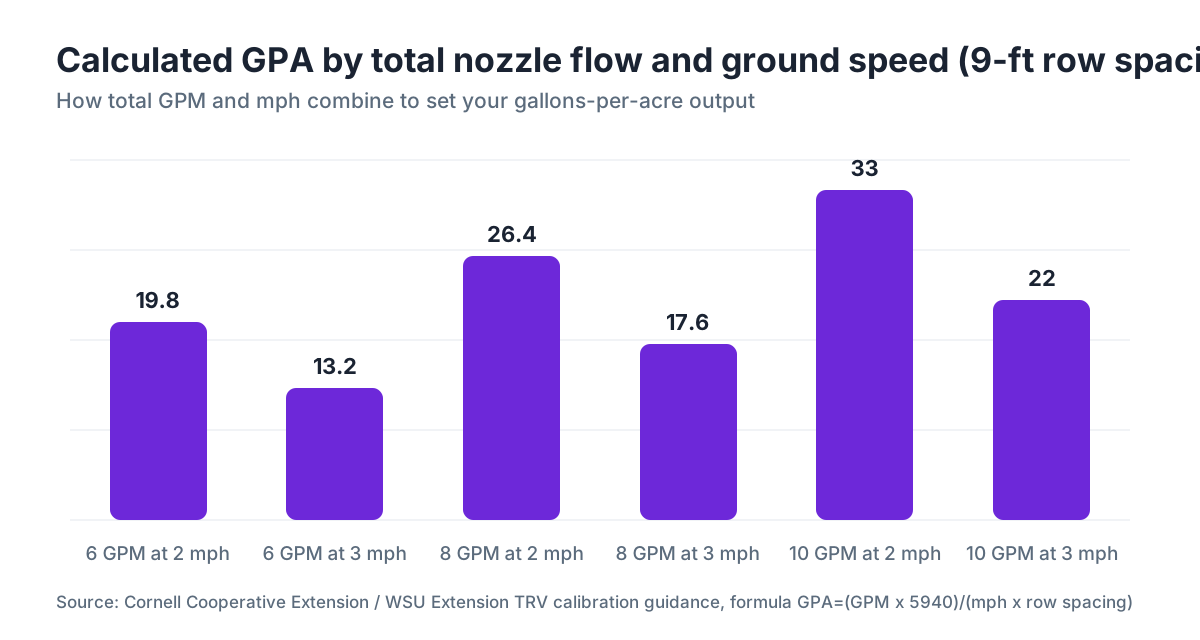
Here's how nozzle output, speed, and row spacing combine into GPA:
| Total GPM (all nozzles) | Speed (mph) | Row Spacing (ft) | Calculated GPA |
|---|---|---|---|
| 6.0 | 2.0 | 9 | 19.8 |
| 6.0 | 3.0 | 9 | 13.2 |
| 8.0 | 2.0 | 9 | 26.4 |
| 8.0 | 3.0 | 9 | 17.6 |
| 10.0 | 2.0 | 9 | 33.0 |
| 10.0 | 3.0 | 9 | 22.0 |
All calculated with GPA = (GPM x 5,940) / (mph x row spacing). Verify against your actual field measurement before you record it as your calibrated rate.
How do you use water-sensitive paper to check canopy coverage and droplet distribution?
GPA math gets you to the right volume. Water-sensitive paper tells you whether that volume actually lands inside the canopy, which is a different question.
The paper (sold in pads, roughly $15 to $25 per pack of 100 sheets from Syngenta or generic suppliers) turns blue where water hits it. Clip sheets at several canopy positions: outer upper, outer lower, inner upper, inner lower, on both the sprayer side and the far side of the row. Run the sprayer through at your calibrated settings, then pull the cards.
What you want: at least 30 to 50 droplet impacts per square centimeter across all positions, with no more than a 3:1 ratio between your best-covered and worst-covered zones. [4] If the outer upper is saturated and the inner lower is nearly blank, you have an air-volume or nozzle-angle problem, not a calibration problem. No amount of volume fixes poor air penetration.
Check at two canopy stages: early season when the canopy is open, then again at full canopy in midsummer. Settings that worked at budbreak often fail by veraison, especially in high-vigor blocks. [9]
For vineyards running GPS-guided systems, remember that water-sensitive paper is still the only direct proof of coverage inside the canopy, no matter how precise the volume delivery looks on the monitor.
How often should you recalibrate, and what triggers an unscheduled check?
Recalibrate at the start of every spray season. Full stop. Equipment sits over winter, fittings corrode, diaphragms stiffen, and nozzles that were borderline in October are junk by April.
Beyond the annual check, recalibrate anytime you swap nozzle sets, change tank formulations that alter viscosity (some adjuvants do this meaningfully), change tractors or drivers, see operating pressure shift at the same throttle setting, or spot coverage problems during scouting.
Pressure gauge drift is common and rarely discussed. A gauge reading 100 PSI that's really 115 PSI shifts your nozzle output by roughly 7 percent, because flow rate scales with the square root of pressure. [10] Replace gauges or verify them against a calibrated reference every season. They cost $8 to $15. The accuracy is cheap insurance.
WSU Extension recommends checking nozzle output at least twice per season, with a full calibration (speed, pressure, and volume-per-acre) at least once. [3] In a wet disease year when you're spraying on a 7-day program, a monthly nozzle check is reasonable.
What records do you need to keep from each calibration, and what does the EPA require?
Under FIFRA and the EPA Worker Protection Standard, you must keep application records for restricted-use pesticides for two years from the date of application, and those records must include the rate applied per acre. [5] A recorded calibration is what makes that rate number hold up.
At minimum, document the date of calibration, the sprayer ID, operating pressure, ground speed, nozzle type and size, total GPM, calculated GPA, and the target GPA from the label. If you used TRV, record the canopy measurements and the TRV calculation too.
Many states pile their own rules on top of FIFRA. California's Department of Pesticide Regulation requires application records be kept for three years and submitted to the county agricultural commissioner within seven days of a restricted-use pesticide application. [6] Washington and Oregon carry similar state-level recordkeeping layered over the federal baseline. [7]
The Worker Protection Standard at 40 CFR Part 170 requires that workers have access to pesticide application information, including the rate applied. [5] The rule requires that handlers have "pesticide application and hazard information" available, and the rate that counts is the one you actually applied, meaning the calibrated rate, not the label maximum.
This is where field record software earns its keep. Keeping calibration data in one binder and application records in another, then trying to reconcile them at tax time or during a county audit, is a mess. A tool like VitiScribe keeps both in the same record, so a county ag commissioner sees what was planned, what was calibrated, and what was applied, in one place.
What are the most common calibration mistakes vineyard operators make?
The biggest one: calibrating in the yard at idle, then running a different ground speed or RPM in the field. If the tractor governor drifts, or you slow down on headlands and forget the extra volume you're dumping there, your calibrated rate is fiction. Verify speed in the actual rows, every time.
Second: ignoring nozzle wear. Growers calibrate a fresh nozzle set, then run those tips two full seasons without a recheck. At 50-plus hours of spraying, the wear is real. UC Davis extension notes that polyacetal nozzles can wear to 10 percent above rated output within a single season under heavy use. [4]
Third: not accounting for canopy change across the season. A rate set at budbreak badly over-applies to a mature July canopy under TRV logic. Bigger canopy, different target, recalculate.
Fourth: trusting the tractor speedometer. Wheel slip on soft ground, tire inflation changes, and implement load on the rear axle all bend your actual ground speed. GPS verification takes five minutes and kills that error.
Fifth: calibrating for water alone and forgetting surfactants. Most tank mixes with adjuvants run a slightly different viscosity than water, which nudges flow through small-orifice nozzles. It's usually a 1 to 3 percent difference, inside acceptable range, but worth knowing when you're chasing a coverage problem.
How do you document a calibration for pesticide label compliance and county audits?
A compliance calibration record should read like a lab notebook entry: who did it, what they measured, how they measured it, what they got, and what they adjusted.
A standard calibration log entry includes:
- Date and location (block ID)
- Sprayer make, model, serial number
- Nozzle type, size, age (hours of use)
- Operating pressure (PSI)
- Ground speed (mph, and how measured)
- Row spacing (feet)
- Nozzle output per nozzle (mL/30 sec, converted to GPM)
- Total system GPM
- Calculated GPA
- Target GPA (from label or TRV calculation)
- Variance between calculated and target (aim for within 5 percent)
- Any adjustments made
- Signature of the person who ran the calibration
California's DPR provides a sample pesticide use record form with space for application rate, and your calibration log should map straight to that rate field. [6] In an audit, showing that you calibrated before the application season and that the calculated rate matches your use records is strong evidence of good-faith compliance.
Keep calibration records with your pesticide use records, not in a separate binder. Auditors want to see them together.
Frequently asked questions
How many gallons per acre should a vineyard airblast sprayer apply?
There's no single number because it tracks canopy size. Older standards used 50 to 100 GPA, but TRV-based calibration, now recommended by Cornell, UC Davis, and WSU extension, typically lands target rates of 15 to 50 GPA for mature VSP-trained vines. Larger, more open canopies like GDC or Smart-Dyson systems need more volume than compact VSP walls.
What is the catch-jug method for calibrating a sprayer?
The catch-jug method places a calibrated container under each nozzle for a set time (usually 30 or 60 seconds) while the sprayer runs at operating pressure, then measures the collected volume. You convert that to GPM per nozzle, sum all nozzles, and use the total flow rate with your ground speed and row spacing to calculate GPA. It's the most direct nozzle-output check available.
How does Tree Row Volume (TRV) affect my spray rate calculation?
TRV sizes your target volume to canopy size instead of ground area. A small early-season canopy needs less spray than a full midsummer wall on the same acre. Cornell's formula (canopy height x canopy width x 43,560 divided by row spacing) gives cubic feet per acre, which you multiply by a reference rate, typically around 400 GPA per 1,000,000 cubic feet of TRV, to get your adjusted target.
How do I convert nozzle output from milliliters per 30 seconds to GPM?
Divide mL per 30 seconds by 1,893 to get GPM. A nozzle delivering 400 mL in 30 seconds outputs 400 / 1,893 = 0.211 GPM. If you collected over 60 seconds, divide by 3,785 instead. Always verify against your nozzle manufacturer's flow chart at the pressure you tested, since even small pressure changes shift output.
How often should vineyard airblast sprayer nozzles be replaced?
Replace nozzles when output tops 10 percent above the manufacturer's rated flow at operating pressure, per WSU Extension guidance. In practice, heavily used polyacetal tips (50+ hours per season) often need replacing annually. Stainless steel and ceramic tips last longer but still deserve a check each season. Catch-jug tests take minutes and tell you exactly where you stand.
What pressure should I run on my airblast sprayer in a vineyard?
Most hollow-cone nozzles used in vineyards are rated for 100 to 200 PSI, with 100 to 150 PSI a common starting range for adequate droplet size and coverage. Above 200 PSI, droplets get too fine, drift risk climbs, and canopy penetration drops. Follow your sprayer manufacturer's manual and your nozzle manufacturer's pressure-flow chart for the specific tip you're running.
Can I use the same calibration settings year-round in the same block?
No. Canopy volume changes dramatically from budbreak to harvest, so TRV-based target rates move with it. A setting calibrated for a tight early canopy will over-apply by late summer as vines fill out. Recalibrate, or at least recalculate your TRV and adjust ground speed or nozzle selection, at least twice per season: early season and again at full canopy, roughly mid-July in most regions.
What federal laws govern pesticide application records in vineyards?
FIFRA requires application records for restricted-use pesticides to be kept for two years. The EPA Worker Protection Standard (40 CFR Part 170) requires that handlers have access to application information including the rate applied. States often add stricter rules: California requires records within seven days of application and retention for three years. Check with your state's department of agriculture for local overlays.
How does ground speed affect gallons per acre in an airblast sprayer?
Ground speed and GPA move in an inverse linear relationship. Double your speed and you halve GPA; halve your speed and you double it. That makes speed the easiest lever once your nozzles are set. Always verify your actual field speed with GPS, not the tractor speedometer, since wheel slip and load changes push speedometers several percent high.
What's the difference between calibrating by ground acres versus by canopy wall area?
Ground-acre calibration figures volume per flat acre of land covered. Canopy wall-area calibration (the basis of TRV) figures volume relative to the actual intercepting surface of the vine canopy. Ground-acre methods systematically over-apply to small or young canopies and can under-apply to very large, dense ones. TRV is more accurate but requires measuring canopy height and width at representative points in each block.
Do I need to recalibrate my sprayer if I switch pesticide products mid-season?
Not necessarily a full recalibration, but you do need to confirm that your current calibrated rate (in GPA) matches the new product's label rate for your canopy size. If the new label calls for a different GPA than your current setting, adjust ground speed or nozzle output and document the change. Viscosity differences between products rarely force nozzle changes but are worth noting.
What is water-sensitive paper and how is it used in vineyard spray calibration?
Water-sensitive paper is a yellow-coated card that turns blue where water droplets land. Pinned at multiple canopy positions (inner and outer, upper and lower, on both sides of the vine row), it shows whether your volume and air settings actually get coverage inside the canopy. Target at least 30 to 50 droplet impacts per square centimeter across all positions. It's cheap, fast, and the most direct proof your calibration is working.
How do I record my calibration data to satisfy a county pesticide audit?
Document date, sprayer ID, nozzle type and size, operating pressure, verified ground speed (and how you measured it), total GPM, calculated GPA, target GPA from the label or TRV calculation, and who ran the calibration. Keep this record with your pesticide use records, not separately. California's DPR and most state ag departments accept a well-organized handwritten or digital log as long as it includes the rate-per-acre field.
Sources
- EPA, Laws and Regulations (FIFRA overview): Pesticide labels are federal documents and applying a pesticide in a manner inconsistent with the label is a violation of federal law under FIFRA
- Cornell Cooperative Extension, Grapes and Wine program (Tree Row Volume spray calibration): TRV-based calibration reduced spray volume 25-40 percent in low-canopy years without sacrificing disease control; TRV formula published by Terence Robinson
- Washington State University Extension, Airblast Sprayer Calibration: Replace nozzles when output exceeds 10 percent above rated flow; nozzle output should be checked a minimum of twice per season; operating speed range of 2.0-3.5 mph recommended
- UC Statewide Integrated Pest Management Program (UC IPM), Grape Pest Management and sprayer calibration: Row spacing of 8-10 feet in California vineyards; catch-and-calculate verification recommended; polyacetal nozzles can wear 10 percent above rated output within a season; target 30-50 droplets per square centimeter for coverage
- EPA, Agricultural Worker Protection Standard (40 CFR Part 170): WPS requires that pesticide application records include the rate applied and that handlers have access to application and hazard information including rate applied
- California Department of Pesticide Regulation, Pesticide Use Reporting: California requires restricted-use pesticide application records to be submitted to the county agricultural commissioner within seven days of application and retained for three years
- Washington State Department of Agriculture, Pesticide Program: Washington State has pesticide recordkeeping requirements layered on top of federal FIFRA requirements for agricultural applications
- Cornell Cooperative Extension, Grapes and Wine program (Vineyard Disease Management and Spray Timing): TRV-calibrated applications achieve equivalent disease control at lower volumes when canopy penetration is adequate; settings that work at budbreak often fail by veraison in high-vigor blocks
- WSU Extension, Pest Management Guide for Grapes: Most airblast manufacturers recommend 100-150 PSI as a starting point for standard hollow-cone nozzles; flow rate scales with the square root of pressure
Last updated 2026-07-09