Vineyard airblast sprayer: how to choose, calibrate, and operate one

TL;DR
- An airblast sprayer uses a high-volume fan to carry pesticide droplets into the vine canopy.
- The right machine, calibrated correctly and run at 3 to 5 mph, decides whether your spray program actually works.
- A Cornell study found 40% of tested sprayers were off their target rate by more than 20%.
- That gap causes disease escapes and residue violations.
What does an airblast sprayer actually do in a vineyard?
An airblast sprayer atomizes pesticide into droplets and then throws those droplets into the canopy on a stream of air. The air stream is what separates it from the boom sprayers used on row crops. Grapevine canopies are dense and three-dimensional. You can't lob liquid at the outside leaves and call it done. The air blast physically opens the canopy, deposits material on both leaf surfaces and interior clusters, and pushes treated air out so the droplets don't hang and drift.
The fan is the heart of the machine. On a standard axial-fan unit, fan diameter runs from about 22 inches on a small single-row rig up to 36 inches or more on a tower sprayer. Fan RPM sets air velocity at the outlet. Most manufacturers target an outlet air velocity between 80 and 120 mph for vineyards, though the right number depends on canopy density and row spacing [1].
The pump pressurizes the liquid side. Centrifugal and piston-diaphragm pumps are the common types. Piston-diaphragm pumps handle abrasive materials like wettable powders better and hold pressure more consistently as nozzles wear. They cost more to buy and maintain. In a program running 8 to 12 passes a season, that reliability earns its keep.
Nozzles turn pressurized liquid into droplets. Nozzle type, orifice size, and pressure together set droplet size, measured in microns and expressed as VMD (volume median diameter). Finer droplets slip into canopy gaps and coat leaf undersides. Coarser droplets drift less but skip interior surfaces. For most vineyard fungicide programs, a VMD of 150 to 250 microns is a reasonable target [2].
What are the main types of airblast sprayers used in vineyards?
Four practical categories cover the market. The right one depends on vineyard size, row spacing, training system, and budget.
Conventional radial-fan (tower) sprayers. A tower-mounted fan and nozzle arrangement throws air outward in a radial pattern, covering two rows in one pass. These are the most common machine in large commercial vineyards in California and Washington. Models from Gregoire, Revo, and Caffini own this segment. A new 400-gallon tower sprayer runs roughly $25,000 to $60,000 depending on configuration [3].
Axial-fan single-row sprayers. The fan sits behind the tractor and blows forward through a duct that routes air left and right into the vine row. Older technology, still widely used in smaller operations and hillside blocks where a compact machine turns easier. Used units in decent shape run $5,000 to $15,000.
Air-assisted boom sprayers. A horizontal boom carries nozzles alongside the row, and a small blower behind each nozzle pushes the droplet into the canopy. Interior cluster coverage is usually worse than a full-volume airblast unit, but drift drops hard. WSU Extension found these machines can cut drift by 50 to 80% versus conventional airblast in certain conditions [4].
Tunnel sprayers (recycling sprayers). A tunnel shroud closes around the vine row and catches overspray on the far side, sending it back to the tank. Drift is near zero and product use drops 30 to 50% in studies. The price is the catch: $80,000 to $150,000 or more for a new unit, and limited compatibility with tightly spaced rows or low-wire training.
Here's what I'd do. For a 20 to 40 acre vineyard on standard 8-foot spacing with vertical shoot positioning, a used or mid-range axial-fan unit is the practical call. Past 100 acres, the per-acre math on a tower or tunnel unit starts to make sense.
How do you calibrate an airblast sprayer correctly?
Calibration is where most operations bleed money and efficacy. A Cornell University study found 40% of sprayers tested in New York vineyards were applying rates more than 20% off their intended target [5]. That's wasted product or under-application, and either way you lose.
The goal is simple. Confirm the sprayer delivers your intended gallons per acre (GPA) at your intended travel speed and gear. Here's the method from UC Cooperative Extension [1]:
Step 1. Measure your flow rate. Collect output from each nozzle for 30 seconds using a graduated container. Record ounces per nozzle. Multiply by 2 to get ounces per minute, then divide by 128 for gallons per minute (GPM) per nozzle. Add all nozzle GPMs for total GPM.
Step 2. Measure your effective swath. This is the row spacing, not the row-to-row distance. Cover one row per pass in 8-foot rows and your swath is 8 feet.
Step 3. Measure your travel speed. Drive a 200-foot course in the gear and throttle you'll use in the field, and time it in seconds. Speed (mph) = 200 ÷ time × 0.682.
Step 4. Calculate GPA. GPA = (GPM × 5,940) ÷ (speed mph × swath feet).
Target is 50 GPA and you're delivering 35? Slow down, open nozzles, or raise pressure. Delivering 70? Speed up or swap to a smaller orifice.
Check nozzle output one at a time. A nozzle running more than 10% above or below the average for that set is worn and needs replacing. Nozzle tips are cheap. One worn tip skews your whole calibration.
Recalibrate at least once a season, and any time you change nozzle types, products, or carriers.
What travel speed and gear should you use when spraying?
The short answer is 3 to 5 mph for most vineyards. Go faster and the fan can't keep up with the air the canopy displaces, so interior zones stay uncoated. Go slower and you deposit too much volume, which means runoff, slow throughput, and higher per-acre cost.
Speed drives GPA directly. At 3 mph versus 5 mph, everything else equal, you apply 67% more volume per acre. That matters a lot when you're near a maximum label rate, because label rates are expressed per acre.
WSU Extension recommends confirming field speed with a GPS unit rather than trusting tractor speedometers, which run off by 10 to 15% [4]. A $100 handheld GPS pays for itself the first season.
Gear selection ties to engine RPM and PTO speed. Many airblast sprayers are PTO-driven, so fan speed follows engine RPM. Running at 540 RPM PTO gives you rated fan performance. Drop RPM to slow down without shifting and you cut fan speed, which kills your air velocity. Always shift gears to change speed. Keep the engine at rated RPM.
In dense canopy stages, veraison through harvest, slowing to 2.5 to 3 mph and bumping volume slightly usually improves interior cluster coverage. Early season, with a thin canopy, 4 to 5 mph is fine.
How do you set nozzle angle and air volume to get good canopy coverage?
Most growers under-invest here, and it shows up as botrytis in the interior clusters.
Air volume and direction have to match canopy geometry. For a standard VSP (vertical shoot positioned) vine, the spray zone runs from the cordon wire up to the shoot tips. Aim your upper nozzles slightly inward and upward toward the top of the canopy, and set your lower nozzles to sweep underneath the fruiting zone. Point nozzles above the canopy top and you're spraying sky. Point them all horizontally and you coat the outside leaves while the clusters sit dry inside.
Many manufacturers publish a nozzle angle guide for their duct setup. Use it as a starting point, then verify with water-sensitive paper cards placed inside the canopy at cluster level. The cards turn blue where droplets land and give you a visual map of your real coverage. UC Cooperative Extension recommends placing cards at three canopy positions (outside, middle, inside) and at top, mid, and bottom of the fruiting zone [1].
Air volume adjustment, on machines that have it, comes from changing fan RPM (PTO speed on some, variable sheave on others) or partially blocking air outlets. Blocking outlets is crude and can create turbulence. Variable-speed fan drives are worth the premium if you grow multiple varieties with different canopy densities.
For sparser training systems like lyre or GDC, cut air volume or you'll blow product straight through the canopy and out the far side.
What does drift control mean for airblast sprayers and why does it matter?
Pesticide drift is spray droplets or vapor moving off-target and landing on adjacent crops, waterways, or non-target areas. It's a regulatory problem, a neighbor problem, and a product-waste problem at once.
The EPA Worker Protection Standard and most state lead agencies treat drift as the applicator's responsibility [6]. Spray that drifts onto adjacent property can trigger label violations under FIFRA Section 12, which makes it unlawful to use a pesticide in a manner inconsistent with its labeling [10]. Fines in California can reach $5,000 per violation per day [7].
For airblast sprayers, the main drift-reduction tools are these.
Droplet size. Coarser droplets (VMD above 300 microns) drift far less than fine ones. Air-induction (Venturi) nozzles produce coarser droplets at the same flow rate. They work well for herbicides and many fungicides, though some fungicide labels demand finer coverage.
Air curtain direction. Angle your end nozzles inward, not outward, and shut off nozzles facing an adjacent field or road during row-end turns.
Speed and fan RPM. Higher ground speed throws a bigger share of fine droplets sideways before they reach the canopy. Slow down near field edges.
Buffer zones. Many labels set buffer distances from surface water. Read them. The label is the law.
Wind is the biggest single factor. California DPR guidance recommends avoiding applications when wind exceeds 10 mph [7]. Most labels say something similar. Early morning usually gives you the lowest wind, and temperature inversions are less likely then. Some growers spray at night, legal in most states for certain materials, but check your state rules and re-read the label.
Tunnel sprayers essentially wipe out off-target drift. If your vineyard borders sensitive areas (schools, organic farms, waterways), that price premium deserves a hard look.
What EPA Worker Protection Standard rules apply to vineyard pesticide spraying?
The EPA's Worker Protection Standard (WPS), revised in 2015 and enforced at 40 CFR Part 170, applies to any agricultural establishment using pesticides. Vineyards are covered [6].
The requirements that hit airblast operations directly:
Restricted Entry Intervals (REIs). Each label sets an REI, the minimum time after application before workers can enter the treated area. Vineyard REIs run from 4 hours for many fungicides to 48 hours for some organophosphates. During an active application, only the applicator and workers required for the operation may be in the treated area. Post the REI on the pesticide safety information at the central location within 24 hours of application.
Application exclusion zones (AEZ). The 2015 revision added AEZ rules. For airblast sprayers outdoors, the AEZ is 100 feet in the direction the air is blowing and 25 feet in all other directions. Workers not involved in the application must stay outside the AEZ while the sprayer runs [6]. The WPS regulation states that agricultural employers "must not allow or direct any worker to enter an Application Exclusion Zone during pesticide application." [6]
Personal protective equipment (PPE). The label governs required PPE. Applicators on airblast machines typically need chemical-resistant gloves, protective eyewear, and often a respirator for concentrated handling. Keep PPE records.
Training. Workers and handlers must get WPS safety training. Handler training, required for applicators, covers pesticide safety, label reading, and emergency procedures. It has to happen before handlers perform their first handling task, not after.
Small operations trip on recordkeeping most often. California's DPR requires a Pesticide Use Report (PUR) submitted monthly [7]. Oregon and Washington run similar programs. The record must include product name, EPA registration number, amount used, site location, date and time, and applicator name. Paper logs work but they're easy to lose. Digital logs with GPS coordinates are what auditors increasingly expect.
That's where a tool like VitiScribe earns its keep: spray records tied to field maps, with REI tracking and the paper trail ready for a DPR inspection.
How much does an airblast sprayer cost to buy and operate per acre?
Purchase price runs from about $4,000 for a basic used pull-behind axial unit to $150,000 or more for a new tunnel recycling sprayer. The middle of the market, a serviceable new single-row to two-row axial-fan machine with a 200 to 400 gallon tank, runs $18,000 to $35,000.
Operating cost per acre is the number that helps you plan. It covers fuel, labor, product, equipment depreciation, and maintenance.
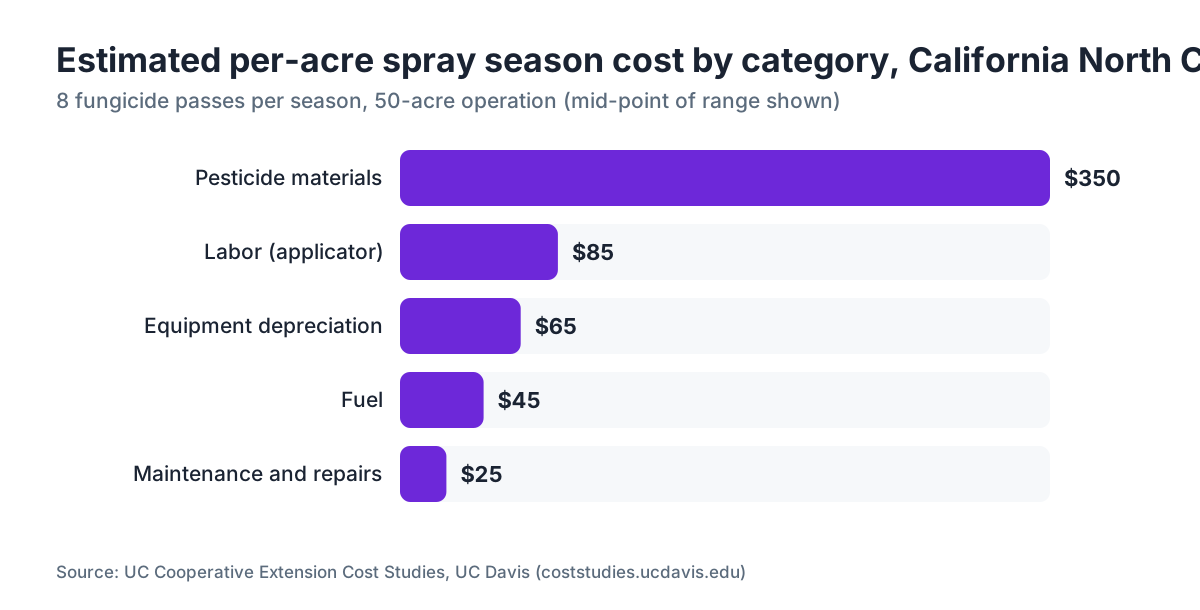
Here's a representative breakdown for a California North Coast operation running 8 fungicide passes a year on 50 acres. UC Cooperative Extension cost studies are the best public source for these figures, though exact numbers shift year to year with fuel and labor [8].
| Cost category | Per acre per season (est.) |
|---|---|
| Pesticide materials | $200 - $500 |
| Fuel (tractor + sprayer) | $30 - $60 |
| Labor (applicator) | $50 - $120 |
| Equipment depreciation | $40 - $90 |
| Maintenance and repairs | $15 - $35 |
| Total | $335 - $805 |
Product cost dominates. That's why calibration matters so much. A 20% over-application on an $80/gallon sulfur-copper program adds up fast across a season, on top of the residue risk.
Custom application is worth considering for operations under about 15 acres. California custom rates typically run $35 to $80 per acre per pass depending on region and material [8]. Run 10 acres and 8 passes and that's $2,800 to $6,400 a year, which pencils out against equipment ownership.
For a wine-focused operation getting started, your vineyard planning should include an honest comparison of custom spray contracts versus owning equipment before you commit capital.
How often should you service and inspect your airblast sprayer?
Most failures during a spray season trace back to deferred maintenance. A clogged strainer, a cracked pressure gauge, a sticky pressure-relief valve. They all show up at the worst moment, usually two days before a forecasted rain when you have to get sulfur down.
Pre-season service checklist, every year before first use:
- Clean and inspect the whole tank. Look for cracks, residue buildup, and scale.
- Replace all nozzle tips. Tips are cheap. Worn nozzles cost you far more in misapplication.
- Inspect all hoses and fittings for cracks, especially near clamps. Flex a hose to find hidden cracks that don't show under pressure.
- Clean all inline strainers (tank outlet, pump inlet, nozzle strainers).
- Check pump diaphragms and valves if you run a piston-diaphragm pump. Replace diaphragms every 2 to 3 seasons as a rule.
- Check fan belts for tension and wear. A loose belt loses fan RPM you'll never catch on a gauge.
- Grease all zerks per the manufacturer schedule.
- Calibrate. Do it on water before any product goes in the tank.
During the season, run a quick nozzle-by-nozzle output check every 3 to 4 applications. One afternoon catching a worn nozzle prevents a disease escape that costs you far more in lost fruit.
Pressure gauges deserve special attention. A glycerin-filled gauge reading wrong makes your calibration numbers meaningless. Replace gauges every 2 to 3 years even when they look fine.
What are the most common sprayer mistakes that lead to disease or residue problems?
Reading the extension literature and listening to vineyard managers, the same five mistakes come up over and over.
1. Skipping calibration and trusting last year's settings. Nozzles wear. Pressure changes. Hoses age. Last season's numbers are not reliable this season. Calibrate every year.
2. Spraying too fast. A grower covering ground at 6 mph to beat weather is often applying half the label rate while throwing a plume of fine droplets off the row end. Fast is not the same as efficient.
3. Ignoring canopy density changes through the season. The program that worked at 12-inch shoots falls apart when those shoots hit 36 inches and the canopy goes solid. Adjust nozzle angles, raise volume or slow down, and check your coverage cards after every major canopy transition.
4. Applying outside the labeled wind window. Most contact fungicides sprayed at 12 mph wind lose a meaningful fraction off-target. You waste product and buy liability.
5. Poor recordkeeping. REI violations, overlapping applications, missing site IDs. These are administrative failures that produce regulatory consequences whether or not the application itself was correct. VitiScribe was built to catch these gaps before an inspector does.
The Cornell Pesticide Management Education Program has published diagnostic guides for coverage failures in vineyards that are worth bookmarking for your spray crew [5].
How do university extension programs recommend you evaluate spray coverage?
UC Davis, Cornell, and WSU all recommend the water-sensitive paper card method as the most accessible field check, and all three have published protocols freely online [1][4][5].
Water-sensitive paper cards (sold as Teejet cards, among others) turn bright blue when a droplet hits them. Place them inside the canopy before a water-only calibration run, drive your normal pass, then pull the cards and photograph or assess coverage.
What you're after is reasonable dot density across the whole card, including the inside face. Sparse coverage (below 20 to 30% of card surface) on interior cards at cluster level means poor canopy penetration. A card gone entirely blue on the exterior with sparse interior coverage means your air volume is too low or your ground speed is too high.
WSU's Viticulture and Enology Extension recommends at least three card placements per assessment: one at the outer canopy surface, one at mid-canopy, one at the interior cluster zone [4]. Place cards on both sides of the row and at top, middle, and bottom of the fruiting zone for a full picture.
Fluorescent dye tracers are a step up from paper cards. Add a small amount of tracer to a water-only run, then inspect the canopy under UV light after dark. That gives you a detailed deposition map across all leaf surfaces and is especially useful for diagnosing botrytis pressure zones. Cornell AgriTech has published tracer protocols for New York vineyard conditions [9].
Do this at least once early in the season after you've set your nozzle configuration, and again mid-season at full canopy density. Adjust based on what you find.
Frequently asked questions
What's the difference between an airblast sprayer and a boom sprayer for a vineyard?
A boom sprayer hangs nozzles on a horizontal boom and relies on liquid pressure alone to reach the target. In a vineyard canopy, it can't get past the outermost leaf layer. An airblast sprayer adds a high-volume fan that carries droplets through the canopy and coats interior leaf surfaces and clusters. For grape disease control, the airblast approach is necessary for most programs.
How many gallons per acre should I spray in a vineyard?
The range is wide. Early season with a thin canopy, 20 to 40 GPA is often enough. At full canopy density (shoot length 24 inches and up), 50 to 100 GPA is more typical for thorough coverage. The product label sets the upper bound. Some concentrated products cap label rates at 50 GPA regardless of canopy size. Read the label rate first, then calibrate to that number.
What is the application exclusion zone for an airblast sprayer?
Under the EPA Worker Protection Standard (40 CFR Part 170), outdoor applications with airblast equipment require a 100-foot AEZ in the direction the air is blowing and a 25-foot AEZ in all other directions. Workers not involved in the application must stay outside those boundaries while the sprayer runs. The 2015 WPS revision codified these requirements.
Can I spray a vineyard with an airblast sprayer in high wind?
Most labels prohibit application above 10 to 15 mph wind. California DPR guidance recommends avoiding spray when winds exceed 10 mph. In practice, any meaningful wind pushes fine droplets off-target before they reach interior canopy zones, so efficacy drops regardless of legality. Early morning, before diurnal heating drives afternoon winds, is usually your best window.
How do I know if my nozzles are worn out?
Collect output from each nozzle for 30 seconds in a graduated container. Any nozzle delivering more than 10% above or below the average for that set is out of spec and needs replacing. Worn nozzles produce finer droplets at higher flow rates, raising drift and shifting your GPA with no visible sign. Check every 3 to 4 applications during the season.
What's the best sprayer for a small vineyard under 10 acres?
A used single-row axial-fan unit with a 100 to 200 gallon tank is the practical choice for most small operations. Serviceable units run $5,000 to $12,000. For very small plantings under 5 acres, custom application contracts at $35 to $80 per acre per pass often beat ownership once you factor in maintenance, storage, and licensing.
How do tunnel sprayers reduce pesticide use in vineyards?
A tunnel sprayer closes a shroud around the vine row. Overspray that passes through the canopy is caught on the far side and returned to the tank instead of landing on the ground or drifting. Studies show product savings of 30 to 50% versus open-air airblast. Drift is essentially zero. The tradeoff is high initial cost, typically $80,000 to $150,000 or more, and limited compatibility with some training systems.
Do I need a pesticide applicator license to operate an airblast sprayer?
It depends on your state and the materials. Applying Restricted Use Pesticides (RUPs) requires a licensed applicator in all states. General use pesticides applied by the landowner or a supervised employee have lower thresholds, but several states require at least a private applicator license. Check your state lead agency. In California, any commercial application for hire requires a Pest Control Adviser and a licensed applicator.
How do I reduce pesticide drift from my airblast sprayer?
Four tools make the biggest difference: switch to air-induction (Venturi) nozzles that produce larger droplets; slow down near field edges; angle end nozzles inward rather than outward; and shut off nozzles on the side facing adjacent property during row-end turns. Avoid spraying when wind exceeds 10 mph. If your vineyard borders sensitive areas, a tunnel sprayer is the most complete solution.
What pesticide records do I need to keep for airblast applications?
At minimum: product name, EPA registration number, active ingredient, amount applied, application date and time, field location, acreage treated, and applicator name. California requires monthly Pesticide Use Reports submitted to the county agricultural commissioner. Oregon and Washington run similar programs. REI postings must also stay at the central WPS information location within 24 hours of each application.
How often should I replace the nozzle tips on my vineyard sprayer?
Most manufacturers rate nozzle tips for 15 to 25 hours of use before output drifts beyond 10% of rated flow. In a typical vineyard season with 8 to 10 passes at 2 to 4 hours each, that's one full nozzle replacement per season, or more if you run abrasive formulations like wettable powders. Stainless steel or ceramic tips last longer than brass in abrasive service.
What PTO speed should I run for an airblast sprayer?
Most airblast sprayers are designed for 540 RPM PTO. Running below rated RPM cuts fan speed and air volume, undermining canopy penetration with no visible warning. Check fan RPM with a tachometer if you suspect you're running low. Never reduce engine RPM to slow field speed. Shift to a lower gear instead and keep the engine at rated RPM.
Are there airblast sprayers designed for steep or hillside vineyards?
Yes. Several manufacturers offer low-profile or track-drive units for steep terrain. Mtrac, Fendt, and Aebi make track-drive tractors compatible with airblast units. Some growers on extreme slopes use cable-pulled or motorized monorail spray systems. Stability is the main constraint: standard wheel-drive tractors are typically rated to a maximum 30 to 35 degree slope, though safe real-world operation is often lower depending on soil and conditions.
What is the Restricted Entry Interval for common vineyard fungicides?
REIs vary by product and concentration. Common examples: sulfur-based fungicides often 24 hours; copper-based materials commonly 48 hours; many FRAC Group 3 DMI fungicides (myclobutanil, tebuconazole) 24 hours; captan 24 hours. Read the specific product label. The label REI governs, not a general category rule. Post the REI at the WPS central information location within 24 hours of application.
Sources
- UC Cooperative Extension, Sprayer Calibration for Vineyard Applications: UC Cooperative Extension calibration methodology for vineyard airblast sprayers, including GPA formula and water-sensitive paper card placement protocol
- UC Davis Viticulture and Enology, Pesticide Application Technology: VMD target range of 150-250 microns for fungicide applications in vineyards using airblast equipment
- UC Cooperative Extension, Vineyard Pest Management Cost Studies: Purchase price range of $25,000-$60,000 for new tower airblast sprayers and per-acre operating cost ranges for California vineyards
- Washington State University Extension, Vineyard Spray Application Guidelines: WSU findings that air-assisted boom sprayers reduce drift by 50-80% versus conventional airblast; recommendation to use GPS for ground speed verification; three-position card placement protocol
- Cornell University Pesticide Management Education Program, Vineyard Spray Calibration and Coverage: Cornell study finding 40% of sprayers tested in New York vineyards applied rates more than 20% off their intended target; diagnostic guides for coverage failures
- US EPA, Worker Protection Standard 40 CFR Part 170: EPA WPS requirements including Application Exclusion Zones (100 feet downwind, 25 feet all other directions for airblast sprayers), REI posting, and handler training requirements; direct quote on AEZ worker entry prohibition
- California Department of Pesticide Regulation, Pesticide Use Enforcement: California DPR 10 mph wind speed guideline for spray applications; monthly Pesticide Use Report requirement; FIFRA Section 12 fine authority up to $5,000 per violation per day
- UC Cooperative Extension, Sample Costs to Establish a Vineyard and Produce Wine Grapes: Custom spray application rates of $35-$80 per acre per pass in California; per-acre seasonal cost breakdown for spray operations
- Cornell AgriTech, Grape Disease Management and Spray Coverage Research: Fluorescent tracer dye methodology for evaluating airblast sprayer coverage in New York vineyard conditions
- EPA, Federal Insecticide Fungicide and Rodenticide Act (FIFRA) Section 12: FIFRA Section 12 makes it unlawful to use a pesticide in a manner inconsistent with its labeling, providing the legal basis for drift-related enforcement actions
Last updated 2026-07-09