Phylloxera spread monitoring records for vineyard replanting decisions
TL;DR
- Phylloxera monitoring records document vine decline patterns, root sampling results, and population spread across blocks over time.
- Those records let you compare block-by-block yield loss against the cost of replanting, pick the right rootstock for your soil, and defend your decisions to lenders, insurers, and regulators.
- Most growers need at minimum three to five years of mapped data before a replanting decision holds up financially.
What is phylloxera and why does monitoring matter for replanting?
Phylloxera (Daktulosphaira vitifoliae) is a root-feeding aphid-like insect native to eastern North America. On susceptible Vitis vinifera rootstocks or own-rooted vines, it feeds on root tissue, triggers galling and secondary fungal infection, and eventually kills the vine. The insect spreads slowly in dry soils and fast in certain soil textures, particularly loamy sands and clay loams that let the crawlers (called "first instars") move through pore spaces toward new roots. [1]
Phylloxera doesn't kill a block overnight. That's why monitoring matters. A single detection tells you almost nothing about whether you have a two-acre hot spot or a problem that takes your whole vineyard in eight years. Without a time-series of mapped records, you're guessing at both the rate of spread and the economic tipping point where replanting beats propping up a declining block.
The records matter the moment you talk to a bank about a replanting loan, file for a federal crop insurance indemnity, or negotiate a long-term grape contract. Every one of those parties wants documented evidence, not your recollection of when the vines started looking bad. Good monitoring records are your paper trail.
For growers in California, the UC Cooperative Extension has been the main technical resource since the AXR1 rootstock failures of the late 1980s and 1990s, when phylloxera devastated more than 25,000 acres in Napa and Sonoma counties alone. [2] Cornell's viticulture program and Washington State University Extension cover monitoring protocols for eastern and Pacific Northwest regions where phylloxera pressure differs a lot from California. [3]
What should a phylloxera monitoring record actually contain?
A useful monitoring record has five core elements: location data, vine condition scores, root and soil sampling results, spread boundary maps, and yield history tied to each block.
Location data. GPS coordinates or a georeferenced block map with a consistent grid. Minimum resolution is one observation point per five vines in high-risk areas, one per ten vines in low-risk areas. Mark the observation point ID, row number, vine number, and the date.
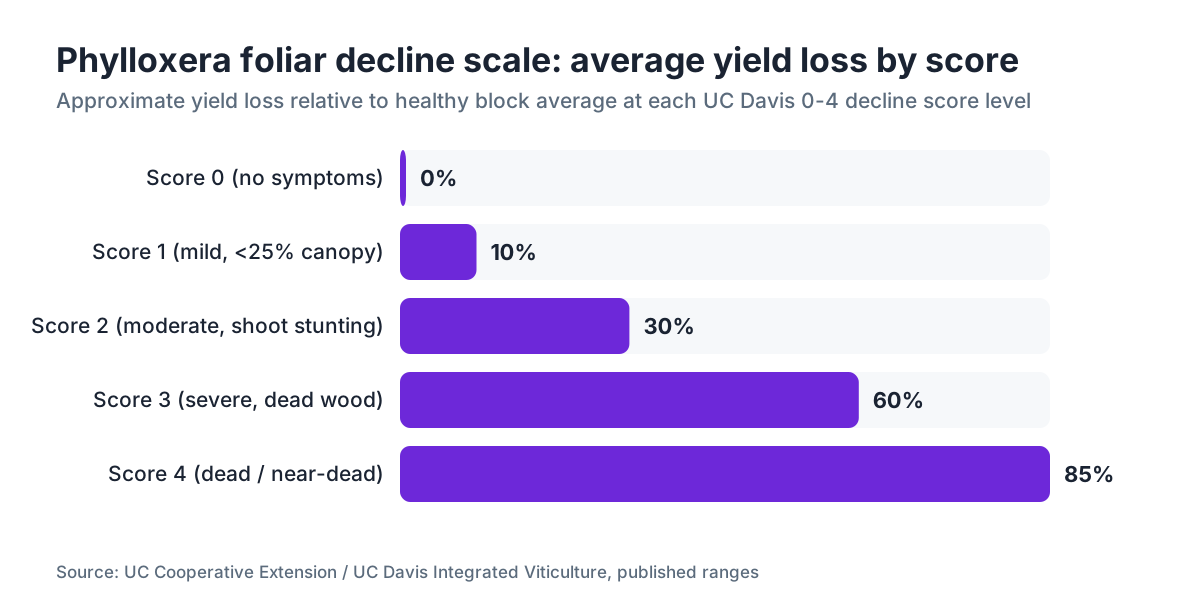
Vine condition scores. Use a standardized rating scale. The most common in California extension literature is a 0-to-4 foliar decline scale developed from UC Davis research: 0 means no symptoms, 1 is mild chlorosis on less than 25% of canopy, 2 is moderate chlorosis plus some shoot stunting, 3 is severe decline with significant dead wood, 4 is dead or nearly dead. [2] Whatever scale you use, write it into the record header so anyone reading the file years later knows what the numbers mean.
Root and soil sampling results. Visual root inspection (galling presence/absence, gall stage) and, where budget allows, a PCR-based population density estimate from a certified lab. UC Davis has published sampling protocols that recommend collecting root samples from at least 10 vines per suspected infested acre, pulling feeder roots from 15-30 cm depth. [1] Record the lab name, date submitted, date results returned, and the result itself.
Spread boundary maps. Plot the infestation boundary each season. A simple polygon on a georeferenced aerial is fine. The key is that you draw the same boundary at the same time of year (late summer, when foliar symptoms peak) so year-over-year comparisons are clean.
Yield history. Tons per acre by block, ideally with vineyard weight tickets as the source document. This is the economic engine of your replanting decision. Phylloxera-infested blocks in Napa typically show a 10-15% yield decline in early infestation, progressing to 50-80% decline by year six to eight post-detection on susceptible rootstocks, though that range varies widely by soil and vine age. [2]
Keep every version of the map. A stack of annual boundary overlays is much more convincing evidence than a single current-year snapshot.
How do you map phylloxera spread across a vineyard block?
Mapping starts with a baseline survey, ideally done before you have any confirmed infestation. Once you have a baseline, annual re-survey lets you calculate rate of spread in linear feet per year or acres per year, which is the number that actually drives replanting timeline decisions.
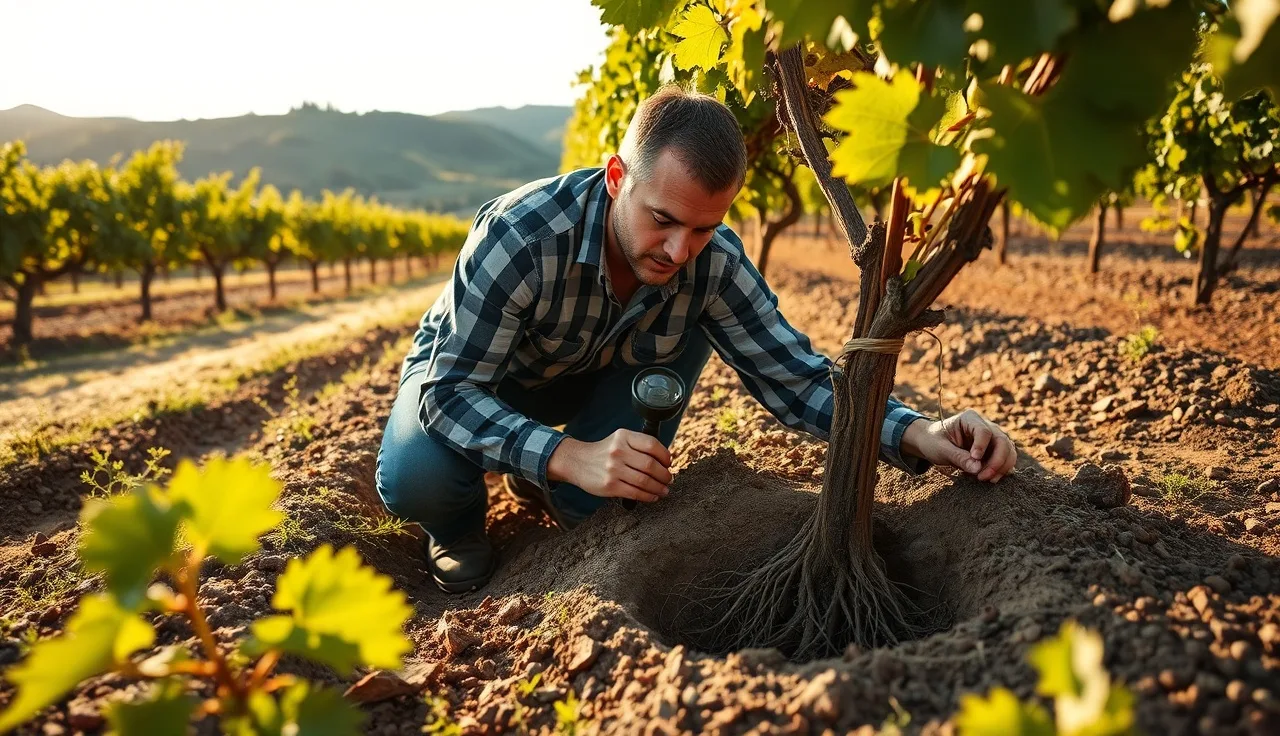
The field protocol runs like this. Walk every row in suspected blocks during late July through early September (in the Northern Hemisphere), when vine water stress amplifies foliar symptoms and makes affected vines easier to spot. Mark symptomatic vines with flagging tape or a handheld GPS waypoint the same day. Dig a small root inspection hole (20-30 cm deep, 30 cm from the trunk) at every symptomatic vine and at five to ten neighboring asymptomatic vines to establish the spread front. Look for yellow-brown galls on fine roots; fresh galls are cream to yellow, old galls are brown and rotting. Photograph the galls with a scale bar or a coin for reference and keep those photos with the sample records.
For an aerial view, many California and Oregon growers now use drone-based normalized difference vegetation index (NDVI) imagery taken in mid-summer. NDVI picks up canopy stress earlier than the naked eye in some conditions, though it can't distinguish phylloxera from other stress causes without ground-truthing. If you use NDVI, archive the raw image files, the processing date, the imaging platform, and the flight altitude so the data set can be reproduced later.
WSU Extension recommends keeping the survey grid consistent from year to year and flagging or GPS-marking the exact root inspection holes so re-inspection in later years samples comparable root zones. [3] This is easy to skip in a busy harvest season, but it's the difference between a scientific spread record and anecdote.
How do you use monitoring records to decide when to replant?
The replanting decision is an economic threshold calculation, not a biological one. Vines with phylloxera don't all die at the same pace, and some blocks limp along at reduced yields for a decade. The question you're answering with your records is: at what point does the net present value of replanting and waiting for a new block to come into production beat the net present value of keeping the declining block?
Your monitoring records feed that calculation in three ways. First, the spread boundary maps let you project how many additional acres will be affected in years three through ten. If your spread rate is two acres per year and your block is 20 acres, you know roughly when you'll hit total loss. Second, the yield history lets you quantify the revenue decline per year in dollars per acre. Third, root sampling data helps you assess whether the infestation is early-stage (population still building) or late-stage (root system already severely damaged), which affects how many productive years you can reasonably expect.
A general rule used by California farm advisors is that blocks where infestation covers more than 20-25% of vine area and foliar decline scores average 2.5 or higher across the block are past the economic threshold where replanting pays. But that's a starting point, not a formula. Grape price, debt service, irrigation system salvage value, and block age all shift the math. Run actual numbers.
The records also tell you which parts of a block can be replanted in phases rather than all at once. If the spread front is clearly moving from the northeast corner, you might pull and replant that corner two years before the rest of the block, which smooths cash flow and keeps some of the block producing while the replanted section establishes.
This is exactly the kind of multi-year, multi-block data set that farm management software is designed to handle. If you're tracking this across more than two or three blocks, a purpose-built tool like VitiScribe keeps your survey grids, root inspection notes, yield records, and map overlays in one place so the year-five comparison doesn't require hunting through three binders and a spreadsheet from a previous employee.
What rootstock records do you need before replanting a phylloxera-affected block?
Rootstock selection is where monitoring records pay off in a different way. Your soil data, spread history, and block-level performance records all inform which rootstock makes sense for the replanted block.
Phylloxera resistance in rootstocks comes from V. rupestris, V. riparia, and V. berlandieri parentage. Rootstocks like 3309 Couderc, 101-14 Mgt, 1103 Paulsen, and 110 Richey have different resistance levels, rooting depths, and vigor profiles. The UC Davis Foundation Plant Services and UC Cooperative Extension have published rootstock selection guides that correlate soil characteristics (particularly soil depth, calcium content, nematode pressure, and water-holding capacity) to rootstock performance. [4] Your monitoring records should include soil texture and pH data from the affected blocks so you can match rootstock to site.
Document the rootstock you choose and why. Write down the supplier, the variety/rootstock combination, the graft type (bench graft, field bud), and the source block certification status. In California, certified planting material must meet the California Department of Food and Agriculture's (CDFA) grapevine registration and certification program requirements, which include pathogen testing for phylloxera, viruses, and bacterial diseases. [5] Keep the nursery certificate with your monitoring file.
For organic certifications or certain export markets, the rootstock source documentation also matters for traceability. A replanting file that has the monitoring records (why you replanted), the soil data (how you chose the rootstock), and the nursery certificates (where the plant material came from) tells a complete story. Auditors and certifiers find it much easier to work with.
What records do regulators and insurers want to see after a phylloxera loss?
Federal crop insurance for wine grapes falls under USDA's Risk Management Agency (RMA) policies, specifically the Actual Production History (APH) policy and the Whole-Farm Revenue Protection (WFRP) policy. [6] When you file a phylloxera-related loss claim, the insurance adjuster will ask for production records (yield by block by year) and evidence of the cause of loss. Your monitoring records are directly relevant to getting an indemnity paid.
The EPA Worker Protection Standard (WPS) is a separate but related compliance layer. If any pesticide application is made in response to phylloxera or to protect replanted vines, those applications must be recorded per 40 CFR Part 170. [7] Specifically, you need the product name, EPA registration number, active ingredient, application rate, date, time, location (by block or field), applicator name, and re-entry interval (REI). Even though there are no fully effective foliar or soil pesticides for phylloxera in commercial vinifera production, soil fumigants used ahead of replanting (such as metam sodium or methyl bromide alternatives) are covered by WPS, and their records must be retained for two years. [7]
Some states have additional requirements. California's Department of Pesticide Regulation (CDPR) requires pesticide use reports (PURs) for any licensed pesticide application, and those records are submitted to the county agricultural commissioner within 30 days of the month of application. [8] If you're in California, your replanting project almost certainly involves at least some PUR-reportable applications.
For lenders financing a replanting project, expect to provide three to five years of yield history, the monitoring records showing the progression of the infestation, and your rootstock selection rationale. The Small Business Administration's agricultural loan programs and many farm credit institutions use this documentation to assess replanting loan viability.
How long should you keep phylloxera monitoring records?
The short answer: longer than you think you need to.
For pesticide application records tied to replanting, federal WPS requires two years minimum. [7] California CDPR requires three years for PUR records. [8] But those are floors, not ceilings. A phylloxera monitoring file that only goes back two years is nearly useless for establishing spread rate or proving the progression of loss to an insurer.
Keep the full monitoring record for the life of the replanted block plus five years. A replanted vineyard typically has a productive life of 25-40 years. The monitoring data from the previous block becomes a site history document, useful if phylloxera re-infests the replanted block (possible, though good rootstock selection dramatically reduces risk), if you sell the property, or if you apply for certification programs that require agricultural history documentation.
Store records in at least two formats: a physical copy in a binder kept off-site (a locked file at your accountant's office works fine) and a digital backup. GPS waypoint files, NDVI imagery, and lab reports are digital by nature; a cloud backup with a local copy handles those. Scan handwritten field notes every year.
If you use a farm management platform, check whether the data export function produces standard formats (CSV, KML, PDF) that you can read without the software. Vendor lock-in is a real problem for long-term record keeping.
How does phylloxera spread rate affect replanting timeline planning?
Spread rate is probably the most underused piece of data in monitoring records. Most growers know they have phylloxera. Fewer have calculated how fast it's moving.
Phylloxera spreads by three mechanisms: crawlers moving through soil (slow, typically measured in meters per year within a block), infested soil moved by equipment (fast, can jump to a new block in a single cultivation pass), and infested plant material (rare if certification programs are working). The spread rate through soil in a single block under California conditions was studied by UC Davis researchers who found radial spread averaging 0.5 to 2.0 meters per year in dry soils, faster in wet years and in certain soil textures. [1] Equipment-mediated spread is effectively instantaneous across the vineyard but leaves a geographic signature (multiple new foci rather than a single expanding front) that your maps will show.
Once you have two or three years of boundary maps, draw concentric spread zones on the overlay and measure the distance the boundary moved each year. Average that over your data set. Now you have a site-specific spread rate you can use to project when adjacent blocks will be at risk.
That projection drives your replanting schedule. If block A is already past economic threshold, block B has two years before it hits 20% infestation, and block C is currently clean, you might replant A now, plan B's replanting for year two, and run strict equipment sanitation protocols to protect C. Without the spread rate calculation, you'd probably replant A reactively and get surprised by B.
Equipment sanitation records belong in the monitoring file too. If you have a protocol for cleaning tractors and ATVs between blocks (a simple pressure wash of wheel wells and undercarriage followed by a 70% isopropyl alcohol spray), document it. WSU Extension recommends logging the sanitation date, the block sequence, and the person performing the sanitation. [3] If phylloxera later appears in a block you thought was clean, those records help you identify the likely introduction pathway.
What are the record-keeping differences between organic and conventional vineyards for phylloxera?
For certified organic vineyards, the monitoring and replanting records carry extra weight because organic certification requires an "organic system plan" updated annually, and any change to the vineyard (including replanting decisions and the inputs used) must be documented and approved by the certifier. [9]
The National Organic Program (NOP) under USDA requires that organic producers maintain records for five years. [9] Those records must be sufficient to demonstrate compliance with NOP standards, which means the phylloxera monitoring data, rootstock source certificates, any fumigant or input use records, and the rationale for input choices all need to be in the organic system plan or accessible to the certifier on request.
For conventional vineyards, the record-keeping burden is lower but not absent. The main drivers are WPS compliance, state pesticide use reporting, and the financial documentation lenders and insurers require, described earlier. Conventional growers do have access to pre-plant fumigation options that organic growers don't, and those applications generate their own records requirements.
One practical difference: organic certification records often go to a third-party certifier (CCOF, Oregon Tilth, WSDA for Washington growers) rather than a government agency, and those certifiers have their own audit formats. Ask your certifier for their preferred record format before you design your monitoring log, because retrofitting data into a different format three years later is painful.
How do you organize a phylloxera monitoring file for a multi-block vineyard?
Organization is where most monitoring programs fall apart. The data gets collected but it lives in three places and nobody can find the 2019 root samples when the bank calls in 2025.
A practical structure has one folder (physical or digital) per block, and inside each block folder, one subfolder per year. Each annual subfolder holds: the survey map (georeferenced PDF or KML file), the vine condition score sheets (spreadsheet or PDF), root inspection notes (scanned field forms), any lab results, yield records for that block that year, pesticide application records tied to that block, and any aerial imagery. A one-page annual summary document at the top of the subfolder pulls out the key numbers: infestation extent in acres, average decline score, spread rate versus prior year, and yield compared to the five-year average.
Across the whole vineyard, keep a master index that lists every block, the rootstock currently planted, the year planted, the first phylloxera detection date, and the current infestation status (clean, suspected, confirmed-early, confirmed-severe, replanted). Update that index every fall after harvest.
For growers managing multiple properties or blocks across different AVAs, digital organization is almost mandatory at some scale. Paper is fine for a three-block farm. At ten or more blocks, tools built for vineyard record-keeping, including VitiScribe, save real time by linking map data to survey records and generating the kind of summary reports that lenders and certifiers want.
See related coverage on vineyard operations for broader context on field record organization.
What do university extension programs say about phylloxera monitoring best practices?
UC Davis, Cornell, and WSU have published the most detailed publicly available guidance on phylloxera monitoring.
UC Davis / UC Cooperative Extension has been the most prolific, largely because of California's phylloxera crisis. Their key recommendations: survey every block at least once per year, use root excavation (more than foliar observation) to detect infestations before foliar symptoms appear, and keep site-indexed records over multiple years to calculate spread rates. UC Cooperative Extension farm advisors in Napa and Sonoma have published case studies showing that early detection through root excavation can extend the economic life of a block by three to five years by allowing targeted irrigation and canopy management adjustments. [2]
Cornell's viticulture program (Geneva, NY) notes that phylloxera behavior in cool, humid eastern climates differs from California, with higher above-ground (leaf-galling) populations in some eastern Vitis vinifera and hybrid varieties. Their monitoring protocols add leaf gall counts to the root inspection protocol and recommend surveying in early summer when leaf galls are most visible. [10]
WSU Extension's guidance covers Pacific Northwest conditions, noting that sandy volcanic soils in eastern Washington may slow phylloxera spread compared to heavier California soils. WSU recommends integrating phylloxera monitoring with nematode surveys, since both pests often co-occur in replanting decisions and the rootstock choices for nematode pressure sometimes conflict with those for phylloxera resistance. [3]
The common thread across all three programs is the emphasis on multi-year records. No single year's survey tells you enough. The University of California's Integrated Viticulture Online resource states directly: "A single survey establishes presence or absence; a series of surveys establishes the rate and pattern of infestation, which is what growers need to make sound replanting decisions." [2]
Frequently asked questions
How often should I survey for phylloxera in an established vineyard?
Survey every block at minimum once per year, timed to late summer (July through September in the Northern Hemisphere) when foliar symptoms peak. If you have a confirmed infestation, twice-yearly surveys (once in early summer for leaf galls, once in late summer for root gall and foliar severity) give you better spread rate data. UC Davis recommends annual root excavation in addition to foliar observation, since root galls appear one to three years before visible foliar decline.
Can phylloxera be confirmed without a lab test?
Yes, visual root excavation is the standard field confirmation method. Trained scouts can reliably identify phylloxera galls on fine roots with a hand lens. Fresh galls are cream-yellow, roughly 1-2 mm, on root tips and lateral roots. Lab PCR testing adds quantitative population density data useful for tracking infestation severity over time, but it is not required for a legal or regulatory confirmation. UC Davis provides reference images for field identification in their integrated viticulture resources.
What rootstocks are resistant to phylloxera and how do I document that choice?
Fully resistant rootstocks include those with V. rupestris, V. riparia, and V. berlandieri parentage: 3309 Couderc, 101-14 Mgt, 1103 Paulsen, 110 Richey, and St. George (Rupestris du Lot) are the most common in California. Document your choice by recording the rootstock name, the soil data and pest pressure that drove the selection (cross-reference UC Davis rootstock selection guides), the nursery supplier, and the CDFA certification number for the planting material.
Does phylloxera spread on farm equipment, and how do I record sanitation steps?
Yes, equipment is one of the fastest spread mechanisms. Infested soil on tractor wheels, ATV tires, or cultivation equipment can introduce crawlers to a clean block in a single pass. Record sanitation by logging the date, the blocks worked in sequence, the sanitation method (pressure wash plus isopropyl spray is common), and the person who performed it. WSU Extension recommends keeping this log with the phylloxera monitoring file so you can trace potential introduction events if a new focus appears.
How do I calculate the economic tipping point for replanting a phylloxera-affected block?
Compare the net present value of keeping the declining block (current revenue minus production costs, declining by your measured yield-loss rate each year) against the NPV of replanting (zero revenue for three to four years of establishment, then full production on new vines). Your monitoring records provide the yield decline data. California farm advisors generally put the tipping point at 20-25% infestation coverage combined with an average foliar decline score above 2.5, but grape price and replanting cost shift that threshold significantly for each site.
What records does USDA crop insurance require for a phylloxera loss claim?
USDA RMA's Actual Production History (APH) policy requires yield records by unit (typically by block or farm unit) going back as many years as the policy has been in force, with a minimum of four to ten years depending on the coverage type. For a phylloxera cause-of-loss claim, the adjuster will also request evidence of infestation: root inspection records, foliar survey data, or lab results. Multi-year monitoring records documenting decline progression are the strongest evidence you can provide.
Do phylloxera monitoring records count as required pesticide application records under the EPA WPS?
No, monitoring records and pesticide application records are separate documents with separate legal requirements. EPA's Worker Protection Standard (40 CFR Part 170) mandates records for pesticide applications in agricultural plants, including pre-plant fumigants used before replanting. Monitoring records (survey maps, vine scores, root samples) are not WPS documents but should be kept alongside application records in a unified replanting file for practical and audit purposes.
How do I record phylloxera monitoring for an organic vineyard?
Organic producers must maintain records sufficient to demonstrate compliance with the USDA National Organic Program for five years. Your phylloxera monitoring data belongs in the organic system plan as part of the site history and pest management documentation. Include survey dates, methods, findings, and any inputs used (even those allowed under organic certification). Your certifier's preferred format matters here; ask before you design your monitoring log to avoid reformatting work later.
Can I use drone NDVI imagery as part of my phylloxera monitoring record?
Yes, drone-based NDVI imagery is increasingly used to flag canopy stress patterns consistent with phylloxera, but it cannot replace root excavation as a confirmation method because multiple stress causes produce similar NDVI signatures. If you use NDVI, archive the raw image files, flight date, platform, altitude, and the processing workflow. Ground-truth at least 10-15% of NDVI-flagged vines with root inspections and document those cross-checks to give the imagery evidentiary weight.
What is the typical spread rate of phylloxera within a vineyard block?
UC Davis research found radial spread averaging 0.5 to 2.0 meters per year through soil within a block, with faster movement in wetter years and certain soil textures. Equipment-mediated spread is much faster and leaves a signature of multiple scattered new foci rather than a single expanding boundary. Your own multi-year boundary maps will give you a site-specific spread rate that is far more useful for planning than any published average.
How do I prepare phylloxera monitoring records for a vineyard sale or acquisition?
A buyer or their lender will want to see the full monitoring history: annual survey maps, vine condition score trends, yield history by block, rootstock records, and any replanting projects completed or underway. Organize the file with a one-page summary per block covering first detection date, current infestation extent, spread rate, and replanting status. Missing records or gaps in the time series will raise questions about what was happening in those years, so assemble the file early in a sale process.
How long does a replanted vineyard take to return to full production after phylloxera?
Grafted vines planted in replanted phylloxera blocks typically produce a commercial crop by year three or four, with full production by years five to seven depending on variety, training system, and site. That three-to-four-year non-bearing period is the main financial cost of replanting beyond the direct expenses, and it's exactly what lenders need your monitoring records to justify: that the replanting was necessary and timely, not premature or delayed past the economic optimum.
Should I survey clean blocks adjacent to a confirmed infestation?
Yes, and that's actually where monitoring records have some of their highest value. Annual root excavation surveys in the buffer rows between a confirmed infestation and adjacent clean blocks give you the earliest possible warning of spread. WSU and UC Extension both recommend extending the survey perimeter at least two to three rows beyond the last known infestation boundary each year, because root-to-root spread often moves ahead of visible foliar symptoms by one to three years.
Are there any chemical treatments that work well enough to document in place of replanting?
No currently registered chemical treatment reliably controls phylloxera in established vineyards at a commercially viable cost. Imidacloprid (a systemic neonicotinoid) showed some suppression in early research but is not labeled for this use in most states and has pollinator concerns. Pre-plant soil fumigation before replanting does temporarily reduce phylloxera populations in the soil, and those fumigant applications need full WPS and state pesticide use records. There is no chemical substitute for resistant rootstocks.
Sources
- UC Cooperative Extension, Napa/Sonoma Viticulture Advisors, Phylloxera Management Guidelines: More than 25,000 acres of Napa and Sonoma vineyards were devastated by phylloxera on AXR1 rootstock in the late 1980s and 1990s; foliar decline scale 0-4 used in California; early detection through root excavation can extend block economic life 3-5 years; 20-25% infestation coverage with mean decline score above 2.5 is a general replanting threshold
- Washington State University Extension, Viticulture and Enology Program: WSU recommends consistent survey grids with GPS-marked root inspection holes re-sampled yearly; equipment sanitation log recommended including date, block sequence, method, and person; sandy volcanic eastern Washington soils may slow phylloxera spread; integrating phylloxera and nematode surveys for rootstock decisions
- UC Davis Foundation Plant Services, Grape Rootstock Information: Rootstock selection guides correlate soil depth, calcium content, nematode pressure, and water-holding capacity to rootstock performance for phylloxera-resistant varieties including 3309C, 101-14, 1103P, and 110R
- California Department of Food and Agriculture, Grapevine Registration and Certification Program: California certified planting material must meet CDFA grapevine registration and certification program requirements including pathogen testing for phylloxera, viruses, and bacterial diseases
- USDA Risk Management Agency, Actual Production History Policy: USDA RMA APH policy requires yield records by unit going back four to ten years depending on coverage type; phylloxera loss claims require evidence of infestation and cause of loss documentation
- EPA Worker Protection Standard, 40 CFR Part 170: WPS requires records of pesticide applications including product name, EPA registration number, active ingredient, rate, date, time, location, applicator name, and REI; records must be retained for two years; covers soil fumigants used ahead of replanting
- California Department of Pesticide Regulation, Pesticide Use Reporting: California CDPR requires pesticide use reports submitted to the county agricultural commissioner within 30 days of the month of application; records must be retained for three years
- USDA National Organic Program, Record-Keeping Requirements: NOP requires organic producers to maintain records for five years sufficient to demonstrate compliance; any change to the vineyard including replanting decisions and inputs must be documented in the organic system plan
- Cornell Cooperative Extension, Viticulture Program, Geneva NY: Cornell's monitoring protocols add leaf gall counts to root inspection for eastern and hybrid varieties; early summer surveys recommended when leaf galls are most visible in cool humid climates
- USDA RMA, Whole-Farm Revenue Protection Policy: WFRP policy covers wine grape revenue losses including phylloxera-related decline when supported by farm records and cause-of-loss documentation
Last updated 2026-07-10