How to document a trap monitoring network in vineyard IPM records
TL;DR
- A defensible vineyard IPM trap monitoring record needs four things: a site map with GPS or fixed-point coordinates for each trap, dated catch counts per species, the economic threshold or action threshold you compared against, and the scouting decision that followed.
- Keep records for at least two years to satisfy EPA Worker Protection Standard and most state pesticide audit requirements.
Why does trap monitoring documentation actually matter for IPM compliance?
An inspector shows up and asks why you sprayed for grape berry moth. "I checked the traps" is not a defensible answer. A documented trap network turns that answer into evidence. Most state departments of agriculture treat spray decision records as part of pesticide use reporting, and a clear trap log is the paper trail that shows your spray was justified by actual pest pressure, not a date on the calendar.
The EPA Worker Protection Standard (40 CFR Part 170) doesn't mandate a specific trap log format, but it does require that pesticide application records be kept for two years and that the basis for applications be traceable [1]. Several state WPS programs, California's among them, tie CDFA pesticide use report requirements to documented scouting decisions. Show catch counts against a recognized threshold and you've built a record that holds up.
Good trap records earn their keep past compliance. They let you compare pressure year to year, catch a population spike early, and stop spraying when pressure drops. That last part saves money. A vineyard running a tight monitoring network often makes two fewer spray passes per season than one spraying on a fixed calendar, and each pass costs real dollars in material and labor.
What information must each trap location record include?
Every trap needs a permanent identifier, more than a mental note. A solid record contains six things:
Trap ID. A simple code works fine. Block letter plus number (e.g., B3-T2) reads fast in the field and searches fast in a spreadsheet.
Permanent location description. GPS coordinates are ideal. A Garmin handheld or your phone gets you to 3-5 meters of accuracy, which is plenty. If you skip coordinates, write a description specific enough that someone who has never seen the block can find the trap: "NE corner post, row 12, Cabernet Sauvignon block, 8 ft from irrigation valve." Vague notes like "middle of the block" cause problems at audit time and in the field when the person who set the trap is on vacation.
Target pest(s). One trap, one primary target. If you're running a Pherocon AM yellow sticky for leafhoppers and a delta trap with a grape berry moth lure on the same stake, log them separately. They have different replacement schedules and different threshold interpretations.
Trap type and lure. Record the brand or model (e.g., Pherocon 1C delta trap, Scenturion GBM lure) and the lure batch or lot number if you have it. Lure efficacy degrades, and lot tracking helps diagnose odd results later.
Date installed and lure replacement date. Most pheromone lures for vineyard pests need replacement every 4-6 weeks depending on manufacturer specs and temperature. Write the replacement date on the physical trap with a paint pen, and record it in your log.
WSU Extension's IPM program recommends that trap records also note "environmental conditions at time of check" because high wind and rain events affect catch counts and can explain anomalous spikes [2].
How do you set up and map a trap network across multiple vineyard blocks?
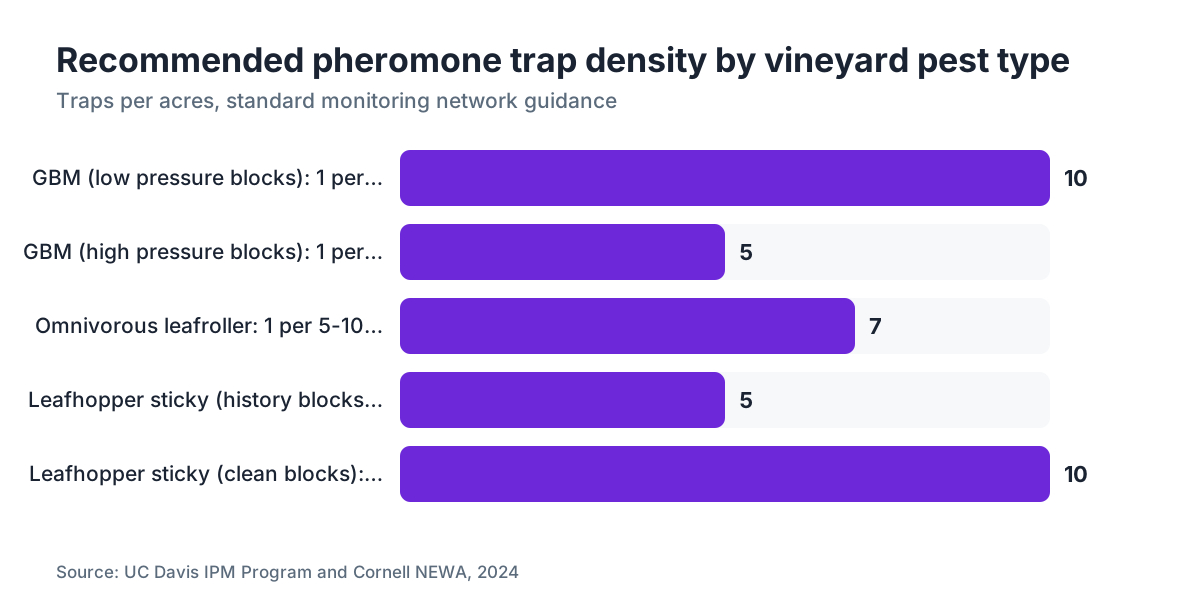
The standard density from UC Davis and Cornell is one trap per 5 to 10 acres for pheromone-baited traps monitoring species like grape berry moth or omnivorous leafroller [3][4]. For sticky card or yellow pan traps targeting leafhoppers or thrips, UC Cooperative Extension suggests one trap per 5 acres in blocks with a pressure history, one per 10 acres elsewhere.
Your network map doesn't need to be art. A hand-drawn sketch on graph paper with labeled rows works. A satellite image from Google Maps or your farm management software with colored pins works better because it's reproducible and shareable. Whatever format you pick, date it each time you add or move a trap. If you moved trap B3-T2 in April because you replanted the block, that matters for year-over-year comparisons.
| Block | Acres | Target Pest | Trap Type | Count per Block | Threshold Source |
|---|---|---|---|---|---|
| Cabernet A | 8 | Grape berry moth | Delta + GBM lure | 2 | Penn State / NEWA model |
| Cabernet A | 8 | Western grape leafhopper | Yellow sticky | 2 | UC IPM guideline |
| Chardonnay B | 12 | GBM | Delta + GBM lure | 2 | Penn State / NEWA model |
| Chardonnay B | 12 | Omnivorous leafroller | Pherocon AM | 2 | UC IPM guideline |
| Zinfandel C | 6 | GBM | Delta + GBM lure | 1 | Penn State / NEWA model |
For grape berry moth in particular, Cornell's Network for Environment and Weather Applications (NEWA) lets you match trap catch data to degree-day accumulations and gives you a model-based spray timing recommendation [4]. That's only useful if your trap IDs in NEWA match your field log IDs exactly. Set the naming convention once and don't change it.
Once you're past a handful of blocks, keeping the map and the catch log linked in one place is where most vineyard managers struggle. Paper binders work until they don't. A field-ready tablet or phone app that lets you photo-tag trap locations and enter catch counts right in the row is faster and less error-prone. VitiScribe is built around that workflow, with trap location maps that sync against spray records automatically, which simplifies the audit trail a lot.
How often should you check traps and record catch counts?
Check frequency depends on the pest and the time of year. During peak flight, weekly checks are standard for most lepidopteran pests. In early spring or after harvest, every 10-14 days is often fine.
For grape berry moth, the practical rule is simple: once you hit first catch, move to weekly checks through the end of the third generation [3]. Catch counts tell you relative pressure, not absolute population, so a steady check interval matters. A two-week gap followed by a one-week check makes the counts incomparable.
Record the count for each trap on its own, not as a block average. Averaging hides localized hotspots, and you'll want that spatial data when you're deciding whether to spot-treat or spray the whole block.
Record zero catches too. A log with blank cells looks incomplete. "0" tells the story that pressure was below threshold and you made a deliberate no-spray decision. That's a real record.
What economic or action thresholds belong in the record?
Every catch count entry needs a reference threshold next to it. Without one, the count is just a number. The threshold is what turns that number into a decision.
For the most common vineyard monitoring targets:
Grape berry moth: The threshold varies by region and by codling moth management program, but the most commonly cited action threshold from Penn State Extension is 5-8 moths per trap per week during the growing season [5]. Cornell's NEWA model uses degree-day accumulation combined with trap catch to refine timing further [4].
Western grape leafhopper: UC IPM guidelines recommend 15-20 nymphs per leaf in the pre-bloom/bloom period for wine grapes, based on economic damage studies [6]. Some blocks with high-value fruit warrant a lower threshold. Record which number you're using and cite the source.
Omnivorous leafroller (OLR): UC IPM suggests 1-2 moths per trap per week as a monitoring alert level, not a hard spray threshold, and recommends parasitism surveys to see whether biocontrol is doing the job [6].
Thrips: No universally agreed pheromone trap threshold exists for western flower thrips in wine grapes. UC Davis research has suggested monitoring via blue sticky cards with action at 5+ thrips per card per week during bloom, but the researchers are frank that nobody has great data on this; thresholds shift by site and variety sensitivity. Record the source you're using even if it's an informal extension recommendation.
Record the threshold, the source, your actual count, and the decision. Four columns. That's the core of a defensible record.
What does a complete catch count log entry look like?
Here's a minimal template that works on paper or in a spreadsheet:
| Date | Trap ID | Block | Target Pest | Trap Count | Cumulative (season) | Threshold | Action Threshold Exceeded? | Decision | Checked By |
|---|---|---|---|---|---|---|---|---|---|
| 2025-06-12 | CA-T1 | Cab A | GBM | 3 | 9 | 5/week (Penn State) | No | No spray | J. Rivera |
| 2025-06-12 | CA-T2 | Cab A | GBM | 7 | 22 | 5/week (Penn State) | Yes | Spray scheduled 6/14 | J. Rivera |
| 2025-06-19 | CA-T2 | Cab A | GBM | 4 | 26 | 5/week (Penn State) | No | No spray, monitor | J. Rivera |
That's it. Every entry is a complete sentence in data form. Note that catch counts are trap-specific, not block averages. The "decision" column is the one most paper logs omit, and it's the one that matters most.
The "Checked By" field earns its space for two reasons. First, it lets you flag records where the checker might be less calibrated (a new hire, a contractor). Second, it supports the EPA WPS training documentation trail, because only trained handlers should be near traps placed in recently treated areas [1].
For digital records, add a photo field. A photo of the trap card before you change it, dated by your phone's metadata, is corroborating evidence that the count was real.
How do you link trap monitoring records to pesticide application records?
This is where most small vineyards have a gap. Trap records and spray records live in different binders, different apps, or different people's heads. That gap is a compliance risk.
The link is simple. Your pesticide application record should include a field called "Scouting basis" or "Monitoring trigger," and that field should reference the specific trap log entry (date, trap ID, count) that justified the spray. California's CDFA pesticide use report form has a comments field most people leave blank. Fill it in: "GBM trap CA-T2, count 7, 6/12/25, exceeded Penn State 5/week threshold."
If you keep records in a spreadsheet, a lookup column linking the application record row to the trap log row by date and block does the job. Some farm management software does this natively.
WSU Extension's Vineyard IPM publications recommend that "monitoring records and spray records be kept together or cross-referenced so that the rationale for each application is immediately apparent" [2]. That's the standard to aim for.
How long do you need to keep vineyard IPM trap records?
The federal floor is two years. EPA's WPS requires pesticide application records be kept for two years from the date of application [1]. Since your trap monitoring record is the basis for the application decision, keep it on the same retention schedule.
California goes to three years for pesticide use records under Food and Agriculture Code section 12979 [7]. Washington state requires two years under WAC 16-228-1470 [8]. Oregon matches the federal two-year floor. Check your state's specific rule.
Keeping records for five years costs you nothing but a little storage, and the year-over-year pressure data becomes genuinely useful after three or four seasons. You'll start to see patterns: which blocks are chronic hotspots, which traps consistently read low, whether your spray timing is drifting ahead of or behind actual flight peaks. That's real agronomic value, independent of any compliance requirement.
Store a backup off-site or in cloud storage. Paper binders burn and flood. If your entire IPM record history lives in a single filing cabinet in the equipment barn, that's a risk worth solving.
What are the most common trap monitoring record mistakes that fail audits?
Read enough extension IPM audit guidance from UC, Cornell, and WSU and the same failures keep surfacing:
Missing trap location specificity. "Near the oak tree" fails. GPS or a detailed fixed-point description passes.
Blank cells instead of zero counts. A blank looks like a missed check. A zero is data.
No threshold recorded. A count without a reference threshold is uninterpretable.
No decision recorded. Inspectors want to see that the data led somewhere. "No spray" is a valid and important entry.
Inconsistent trap IDs. If your trap log calls it "Trap 2" and your spray record calls it "the second trap in Cab block," they're not linkable at audit time.
Lure change dates not recorded. An uncalibrated lure produces unreliable counts. Skip the change dates and you can't defend the data quality.
Cumulative season data not tracked. Degree-day models run on cumulative catch and cumulative degree days together. Record only weekly catch and you lose the ability to use the model retroactively to explain a spray decision.
None of these are exotic. They're all fixable with one consistent template, used every time, by every person who checks traps.
How do you train a new scouting employee to use the monitoring log correctly?
The record is only as good as the person filling it in. A new scout who eyeballs moth counts, rounds to the nearest five, and leaves the threshold column blank has created a record that looks complete but isn't.
EPA WPS requires that agricultural handler employees (which includes scouts working in areas treated with certain pesticides) complete handler training before working in those areas [1]. That training covers re-entry intervals and PPE, but it doesn't cover record-keeping craft. You add that yourself.
A 30-minute field walkthrough covers most of it. Walk the new person through the trap network, have them record a check while you watch, and review the log together. Cover how to count a sticky card accurately (both sides, hand lens for small insects), what to write in the "decision" column when no threshold is exceeded, and what to do when a trap is missing or damaged (log it, replace it, note the gap).
Cornell's New York State IPM program publishes a free vineyard pest management guide that includes scouting protocols and works as a training reference [10]. UC ANR's IPM guidelines are online and are routinely used as training material by California PCAs [6]. Hand your new scout a copy and make it part of onboarding.
For vineyards running digital records, a field app that enforces required fields before it accepts a submission is the most reliable training tool because it won't let the scout save an incomplete entry. That's not surveillance, it's good record design. VitiScribe's mobile scouting module does exactly that, flagging incomplete trap entries before they sync to the main record.
Does a trap monitoring network help with organic certification record-keeping too?
Yes, and in one respect it's actually simpler. If you're running an organic program, your material choices are already restricted, so the monitoring record's job is to show that you applied any permitted material only when pest pressure justified it, not on a schedule.
USDA National Organic Program regulations (7 CFR Part 205) require certified operations to keep records that "disclose all activities and transactions of the certified operation" for five years [9]. That's a longer window than WPS's two years. It also means your trap logs, scouting notes, and spray decisions all count as NOP records.
Organic certifiers look for exactly what a good IPM record shows: evidence that you identified the pest, measured its population, compared it to a threshold, and chose the least disruptive effective material. A well-kept trap monitoring log is a strong piece of that evidence.
For mating disruption systems, you don't have a trap count to spray from, but you still need a deployment record: date installed, product and lot, acres covered, and monitoring results showing the program is working. Trap catch under mating disruption reads differently (very low catches are expected) but still needs to be recorded and flagged as being under a disruption program.
What software or tools actually work for keeping vineyard trap records?
The honest answer is that a well-designed spreadsheet beats a badly designed app every time. If you're small (under 20 acres, one or two blocks), a Google Sheet with the columns from the template above, shared with anyone who checks traps, is fully adequate and costs nothing.
The friction point is field entry. Writing on a clipboard in the rain, then transcribing to a computer, introduces errors and delays. For 30+ acre operations with multiple blocks and multiple target pests, field-entry apps that work offline (because plenty of vineyard blocks have no cell signal) and sync when you're back in range make a real difference in data quality and completeness.
Farm management platforms like Granular, AgriWebb, and AgCode all have some scouting record functionality. The questions to ask of any platform: Can I define trap IDs and assign them to map locations? Does the entry form enforce required fields? Can I export a clean report that links trap records to spray records? Does it work offline?
Whatever tool you pick, use it consistently. A spotty digital record is worse than a complete paper record because it looks like something's missing.
For a broader look at vineyard operations documentation across the season, the same field discipline that makes trap records defensible carries through all your compliance paperwork.
Frequently asked questions
How many traps do I need per acre for a vineyard IPM network?
UC Davis and Cornell both recommend one pheromone trap per 5-10 acres for lepidopteran pests like grape berry moth. For sticky card traps targeting leafhoppers or thrips, UC Cooperative Extension suggests one per 5 acres in historically pressured blocks and one per 10 acres elsewhere. Denser networks give more spatial resolution but cost more in time and materials to maintain.
What is the minimum information a trap log entry must contain?
At minimum: the date, the trap ID, the target pest, the catch count (including zero if nothing was caught), the action threshold you compared against and its source, and the management decision you made. Adding the checker's name and weather conditions takes 30 seconds and makes the record much more useful for audits and year-over-year analysis.
Do I need to record zero catches in my trap log?
Yes. A blank entry looks like a missed check, not a zero catch. Recording zero is data, and it's the data that shows you made a deliberate no-spray decision because pest pressure was below threshold. Auditors and certifiers look for zero entries; their absence raises questions about whether monitoring was actually consistent.
How long do I legally have to keep vineyard pesticide and monitoring records?
Federal EPA WPS requires two years from the application date. California requires three years under Food and Agriculture Code section 12979. Washington state requires two years under WAC 16-228-1470. USDA National Organic Program requires five years for certified operations. Keep the longest window that applies to you, and back the records up off-site.
Can trap monitoring records satisfy California CDFA pesticide use reporting requirements?
Trap monitoring records don't replace the CDFA pesticide use report form, but they support it. California requires growers to submit use reports for each pesticide application; the trap monitoring log is the evidence that documents why the application was made. Fill in the comments field on your use report with the trap ID, date, and count that triggered the spray.
What is the action threshold for grape berry moth in a pheromone trap?
Penn State Extension cites 5-8 moths per trap per week as a commonly used action threshold during the growing season. Cornell's NEWA system combines trap catch with degree-day accumulation for a more precise timing recommendation. Record whichever threshold source you're using in your log so the basis for the decision is clear.
How do I document mating disruption if I don't have reliable trap catches?
Under a mating disruption program, low trap catches are expected and not a reliable measure of pest pressure. Record the mating disruption product name, lot number, deployment date, acres covered, and application method. Log trap checks as usual and note that the operation is under a disruption program so that low counts are not misinterpreted as low pest pressure.
How often should pheromone lures be replaced and how do I document it?
Most pheromone lures for vineyard lepidopteran pests need replacement every 4-6 weeks; check the manufacturer spec for your specific lure because temperature affects degradation. Record the replacement date in your trap log and write it on the physical trap with a paint pen. Tracking lure condition lets you defend data quality if catch counts are questioned later.
Do trap monitoring records count as organic certification documentation?
Yes. USDA National Organic Program regulations (7 CFR Part 205) require certified operations to keep records of all activities for five years. Trap monitoring logs that document pest identification, population measurement, threshold comparison, and material selection are exactly the records NOP certifiers look for to verify that materials were applied based on demonstrated need.
What GPS accuracy do I need when recording trap locations in a vineyard?
Consumer-grade GPS from a phone or handheld unit gets you to 3-5 meters of accuracy, which is more than sufficient for trap documentation. The goal is that a different person can find the trap without asking you. GPS coordinates are more reliable than fixed-point descriptions, which can become inaccurate after replanting, infrastructure changes, or staff turnover.
How do I link my trap monitoring records to my pesticide application records?
Add a 'scouting basis' field to your pesticide application record that references the specific trap log entry: date, trap ID, count, and threshold exceeded. In California, use the comments field on the CDFA pesticide use report. WSU Extension recommends keeping monitoring and spray records cross-referenced so the rationale for each application is immediately traceable.
What trap monitoring records do I need for a wine grape pest management plan submitted to a state or federal program?
Most NRCS-funded pest management plans (such as those under EQIP) require documentation of scouting activity, pest identification, population counts, threshold comparisons, and treatment decisions. Trap monitoring logs that contain all those elements satisfy the standard. Check with your local NRCS office for any state-specific required formats.
Sources
- U.S. EPA, Worker Protection Standard (40 CFR Part 170): EPA WPS requires pesticide application records be kept for two years and that the basis for applications be traceable; agricultural handler employees must complete training before working in treated areas.
- Washington State University Extension, Vineyard IPM: WSU Extension recommends monitoring records and spray records be kept together or cross-referenced so the rationale for each application is immediately apparent, and that environmental conditions at time of trap check be noted.
- UC Davis IPM Program, Grape Pest Management Guidelines: One pheromone trap per 5-10 acres is the standard density for monitoring lepidopteran pests in vineyards; for grape berry moth, weekly checks are standard once first catch is recorded through the end of the third generation.
- Cornell University, Network for Environment and Weather Applications (NEWA), Grape Berry Moth Model: NEWA uses trap catch data combined with degree-day accumulations to provide model-based spray timing recommendations for grape berry moth; trap IDs in NEWA must match field log IDs for records to be linkable.
- Penn State Extension, Grape Berry Moth Management: Penn State Extension cites 5-8 moths per pheromone trap per week as a commonly used action threshold for grape berry moth during the growing season.
- UC ANR, UC IPM Pest Management Guidelines: Grape: UC IPM guidelines recommend a threshold of 15-20 nymphs per leaf for western grape leafhopper during pre-bloom/bloom for wine grapes, and 1-2 moths per trap per week as a monitoring alert for omnivorous leafroller.
- California Department of Food and Agriculture, Food and Agriculture Code Section 12979: California requires pesticide use records be retained for three years under Food and Agriculture Code section 12979.
- Washington State Department of Agriculture, WAC 16-228-1470: Washington state requires pesticide application records be kept for two years under WAC 16-228-1470.
- USDA National Organic Program, 7 CFR Part 205: USDA NOP regulations require certified operations to maintain records disclosing all activities and transactions for five years, including pest monitoring and treatment decisions.
- Cornell University, New York State IPM Program, Vineyard Pest Management Guide: Cornell's NY State IPM program publishes scouting protocols and pest management guides used as training references for vineyard scouts and pest control advisers.
Last updated 2026-07-10