Posting pesticide application information at vineyard field entry points

TL;DR
- EPA's Worker Protection Standard (40 CFR Part 170) makes agricultural employers post pesticide application information at every usual point of entry to a treated field before or at the start of any restricted-entry interval.
- The posting stays up until the REI expires.
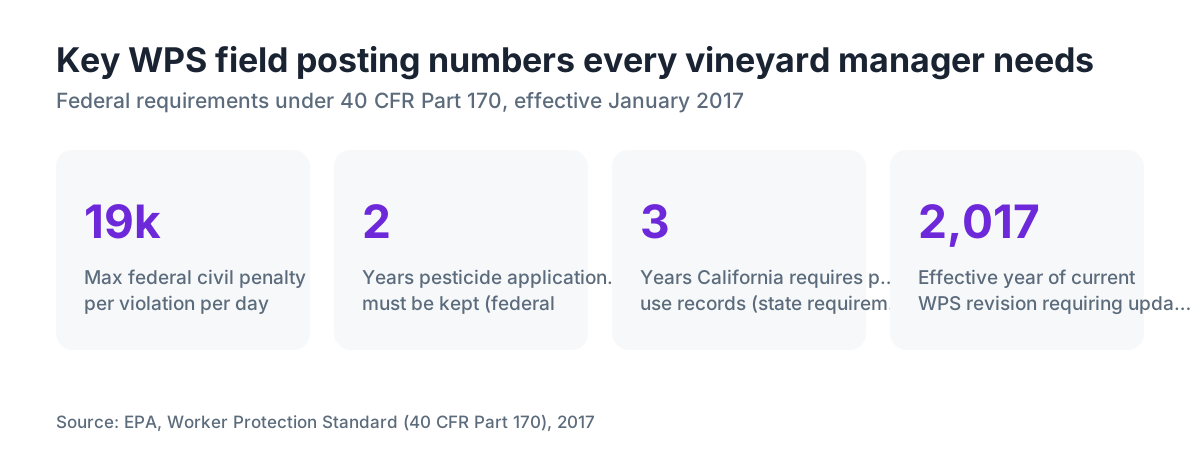
- Miss it and federal fines run up to $19,017 per violation per day.
- Here's exactly what to post and how.
What law requires posting pesticide information at vineyard field entries?
EPA's Worker Protection Standard, the WPS, sets this rule. You'll find it at 40 CFR Part 170. [1] It covers any agricultural employer who uses pesticides on a farm, vineyards of any size included, and it protects both the handlers who apply the products and the workers who might walk into a treated block afterward.
The WPS came out in 1992. It got a big rewrite that took effect January 2, 2017. [7] That revision tightened the posting rules and killed most of the small-farm exemptions some operators had leaned on. If your compliance program still runs on pre-2017 guidance, throw it out and read the current rule.
California, Washington, and other major wine states layer their own pesticide rules on top of federal WPS. In California, the Department of Pesticide Regulation (CDPR) runs requirements that match or exceed WPS. [2] In Washington, WSU Extension publishes plain summaries of how state law meets the federal standard. [3]
The federal rule is the floor. Your state can raise it, and often does.
What information must be included on a field entry point posting?
Eight things. The WPS is specific here. Under 40 CFR 170.409, [1] each field posting has to carry the product name, EPA registration number, and active ingredients; the date and time the application started; the restricted-entry interval (REI) from the label; the date and time that REI expires; a warning not to enter; and instructions to contact the employer for more.
That last line matters more than people think. The posting isn't the safety data sheet or the label. It's a pointer. It tells a worker a hazard exists and where to get the full story. The complete product label and safety data sheet live at the central posting location (usually the main building), not on every stake in the field.
The rule says nothing about font size or exact layout. EPA publishes a model posting format, and UC Davis has adapted that model for California vineyards. [4] Use a template. It saves time and it stops you from leaving out a required field at 6 a.m. when you're rushing.
| Required field | Notes |
|---|---|
| Product name | As it appears on the EPA-registered label |
| EPA registration number | On the front panel of the label |
| Active ingredient(s) | List all; herbicide + adjuvant blends list each |
| Application start date and time | More than the date alone |
| REI duration | From label; in hours |
| REI expiration date and time | Calculated from start time + REI |
| Entry warning | "Do not enter treated area" or equivalent |
| Employer contact info | How workers can get more information |
When must field postings go up and how long must they stay?
Postings go up before any worker could enter the treated block, and no later than the start of the REI. [1] In plain terms: post before the spray rig leaves, if there's any chance someone could wander in behind it.
The sign stays in place and legible until the REI expires. [1] Say the label REI is 4 days and it rains on day two. That posting still has to be readable on day four. Laminated cards or weatherproof sign holders fix this for a few dollars. Ink-jet paper taped to a stake is not a field solution in a wet climate.
Once the REI expires, the sign comes down. Federal WPS doesn't make you archive the physical sign, but you do keep records of the application (date, product, rate, location, REI) for two years. [1] Some states want longer. California requires three years for pesticide use records. [2]
Here's a timing trap that catches vineyard managers. Multi-day applications. If you spray a big block over two days, the REI clock starts at the beginning of the application, not when you finish. [1] Read 40 CFR 170.405 on this before you assume otherwise.
Exactly where do field entry point postings need to be placed?
At every usual point of entry to the treated area. That's the standard. The WPS phrases it as "all usual points of entry to the treated area." [1] A block with a single access road probably needs one sign at the road end. A block with three tractor entrances needs three.
The sign goes at the perimeter of the treated block, not back at the shop where nobody walking toward the field would ever see it. EPA's whole point is that a worker heading for a treated block hits the warning before they step in, not after.
Height and sightline matter too, even though the rule skips exact measurements. Cornell's pesticide safety education program recommends posting signs at eye level, somewhere a person on foot would naturally see before entering the treated zone. [5] If contractors run your cover crop mowing, they're covered by WPS. They need to see the sign as much as your own crew does.
Working vineyards with tasting rooms near the blocks get complicated fast. Some Paso Robles operations [see /articles/paso-robles-wineries] have blocks that run right up against visitor areas. WPS still applies. Keeping visitors out during an REI is a separate compliance question, but a related one.
What are the penalties for failing to post pesticide application information?
Up to $19,017 per violation per day. That's the federal civil penalty ceiling under FIFRA Section 14, last adjusted for inflation in January 2023 under the Federal Civil Penalties Inflation Adjustment Act. [6] State penalties stack on top. California's CDPR issues its own fines under the California Food and Agricultural Code. [2]
First-offense penalties for small farms often land lower than the ceiling. But "often lower" is not a plan. EPA weighs good faith, cooperation, and economic impact when it sets a number. A record of missing postings at prior inspections burns through that goodwill fast.
EPA and the states run WPS compliance inspections through their state lead agencies. In California, the County Agricultural Commissioners do it. In Washington, the state Department of Agriculture handles it. [3] Inspectors show up without notice. They check for current field postings, confirm every required element is there, and cross-reference the signs against your application records.
The fines aren't the whole story. A missing posting becomes civil liability exposure if a worker gets a pesticide injury and there was no sign up. Courts have treated an absent or incomplete posting as evidence of negligence.
Does the WPS posting requirement apply to organic vineyards?
Yes, with one nuance. If you apply any pesticide, synthetic or exempt-from-registration organic, that carries an REI on its label, the WPS posting rules kick in. [1] Most OMRI-listed pesticides in organic viticulture carry REIs. Copper hydroxide products commonly run a 24-hour REI, and sulfur often carries a 24-hour REI too. [8]
WPS doesn't care whether you're certified organic or conventional. The trigger is the label REI, not your certification. A certified organic vineyard spraying a copper fungicide with a 24-hour REI posts exactly the same information as the conventional neighbor spraying a synthetic.
One exception. If you're running a soap or oil spray that carries no REI on the label, there's nothing to post under WPS. Read the label before you assume a posting is or isn't required. The label decides, every time.
How do you handle postings for multiple spray applications in the same block?
Multiple applications to the same block in one season is the normal case in viticulture. A block sees powdery mildew sprays every 7 to 14 days from bud break through veraison. Each application triggers a fresh posting obligation.
A few things work in practice. Some managers keep a reusable field sign with a sleeve that holds an insertable card showing the current application's date, product, and REI expiration. New application, new card. The post stays put all season and you spend almost nothing on sign stock.
Others run a binder or clipboard at the block entry, dated cards piling up until the season ends. It works, but it clutters and it loses cards to wind.
Record-keeping is where this gets ugly. Tracking which blocks got sprayed, with what, on which date, at what REI, and when signs went up and came down is the kind of repetitive compliance task that field record tools like VitiScribe are built for. A good system generates the posting text straight from your spray record and logs posting dates, so your two-year records more or less write themselves.
Cornell Extension's Pesticide Safety Education Program has vineyard spray record templates that line up with WPS record-keeping. [5]
Are vineyard employees and contractors both covered by the WPS posting requirement?
Both are covered, and knowing who owns the obligation matters. Under WPS, the agricultural employer, the person who employs the agricultural workers, is responsible for the posting. Hire a custom spray contractor who brings a crew, and you, the agricultural employer, still own the posting at the field entries. The contractor applies the pesticide. You post the information. [9]
With farm labor contractors who bring workers to your vineyard, WPS defines "agricultural employer" broadly enough that both the vineyard owner and the labor contractor can carry obligations. UC Davis's Agricultural Health and Safety group has published guidance on this contractor-employer split. [4]
Farmers' market crews and wine country tour groups don't get a pass. Anyone a vineyard employer allows or directs into or near a treated field is covered. The working rule: if there's an REI, assume everyone nearby needs to see the sign.
What records do you need to keep for WPS field posting compliance?
Two years of application records, federal minimum. Each record has to carry the product name, EPA registration number, active ingredients, the location and size of the treated area, the date and start time of the application, and the applicable REI. [1] The rule doesn't explicitly make you log "posting placed at 7:02 a.m.," but proving compliance at an inspection depends on being able to tie the sign to the application.
States go further. California requires pesticide use reports filed monthly with the County Agricultural Commissioner. [2] Those reports capture the application data but not posting compliance directly. If an inspector asks whether a sign was up during a specific REI, your application log date and the sign's date have to match.
Some managers photograph the sign after placing it, phone timestamp on. Not required. Cheap, fast, and hard to argue with.
WSU Extension recommends keeping spray records in a format you can cross-reference against inspection records fast. [3] A spreadsheet does it. A purpose-built field operations log does it better when you're running dozens of blocks across a season.
How does the WPS central posting location relate to field entry point postings?
WPS has two posting requirements, and people mix them up constantly.
The field entry point posting (the subject of this article) is the physical sign at each usual point of entry to a treated block. Its job is to warn workers before they enter.
The central posting location is a different animal. Under 40 CFR 170.311, employers designate a central spot, accessible to all workers, where they keep a pesticide safety poster, copies of product labels and safety data sheets, and decontamination supplies. [10] That's where a worker goes for the detailed safety information after the field sign flags a hazard.
On a small family vineyard, the central posting might sit in the farm shop or equipment barn. On a bigger operation with crews spread across multiple blocks, you may need more than one accessible central location. The rule says it has to be accessible "during all work activities." [10]
Field postings and the central location work as a pair. Don't confuse them, and don't treat one as a stand-in for the other.
What practical systems do vineyard managers use to stay current with posting requirements?
The common failure isn't ignorance of the law. It's forgetting to post, usually during a compressed spray window when you're racing rain. A good system takes memory out of the equation.
A few approaches hold up in the field.
Pre-printed block sign kits. Keep a laminated backing board at each block's entry point year-round, printed with your vineyard name and where to find more information. A clear sleeve holds the current application card. Card goes in before the rig moves.
Spray log triggers. Build posting into the spray record workflow. Don't close the application record until you've logged "posting placed." Paper binder or digital app, the record doesn't end at the spray tank.
Contractor checklists. Using custom sprayers? Hand them a checklist with "return posting materials to farm operator for placement." Don't assume they'll post. Under WPS that obligation is usually yours.
End-of-day posting audit. Send the spray operator or a designated person to walk the posted blocks at the close of each spray day and confirm signs are up and readable. Five minutes of walking prevents a four-figure fine.
For vineyards running multiple blocks across a larger property, a block map that tracks current posting status, product, and REI expiration is worth the setup time. Tools like VitiScribe can generate posting checklists tied to spray records, which pulls one more thing off your plate during a busy week.
Frequently asked questions
Does the WPS field posting requirement apply to vineyards with fewer than 11 employees?
Yes. The WPS has no small-employer exemption for field postings. Any agricultural employer who applies a pesticide with a label REI on a farm or vineyard must post at field entry points. The 2017 revision eliminated most prior small-farm carve-outs that some operators had relied on. If you're applying a product with a label REI, the posting obligation applies no matter how many people you employ.
What do I do if a field posting blows down or gets damaged during the REI?
Replace it right away. Under 40 CFR 170.409 the posting has to stay in place and legible until the REI expires. A sign blown off its stake and lying in the vine row is not compliant. Use weatherproof holders, wire stakes, or zip-tied sign boards that survive normal vineyard weather. If an inspection lands while a sign is down mid-REI, you won't have a good defense.
Can I use electronic or digital field postings instead of physical signs?
Current federal WPS rules require physical postings at field entry points. EPA has not approved electronic-only field postings as a substitute. Some state pesticide programs offer guidance on supplemental electronic notification, but that adds to the physical sign rather than replacing it. Check with your state lead agency for pesticide regulation before relying on any digital-only approach.
How far in advance of harvest do I need to stop posting, and does the REI affect harvest timing?
The REI and the pre-harvest interval (PHI) are separate label requirements. An REI restricts worker entry into the treated area. A PHI restricts harvest. A product can carry a 4-hour REI and a 14-day PHI. You stop posting when the REI expires. PHI compliance is tracked separately and must be met before grapes can be harvested commercially. Check both intervals on the product label.
Who is responsible for posting if a pest control company or PCA applies the pesticide?
The agricultural employer, usually the vineyard owner or operator, owns WPS field postings. A pest control operator or licensed applicator who sprays on your property is not the employer under WPS definitions unless they also employ the agricultural workers who might enter the treated area. Get the application start time and product information from any contractor right after the spray so you can post without delay.
Do I need to post for pesticide applications made when no workers are present?
Yes, if the REI extends into a period when workers could enter the block. The posting requirement is keyed to the REI, not to whether workers were present at application time. Spray at 6 a.m. before crews arrive with a 24-hour REI, and you must post because workers will be on-site during that window. The question isn't "were workers present" but "could workers enter the treated area during the REI."
What's the difference between an REI and a re-entry interval on a California label?
They're the same thing. REI stands for restricted-entry interval. California labels and federal WPS use the same terminology. California's CDPR enforces the REI through County Agricultural Commissioners, and the state's requirements largely mirror WPS, though California sometimes adds protections. If a label carries an REI, that interval applies in every state, and California's enforcement of it tends to be strict.
How should I handle field postings when I'm spraying blocks adjacent to a public trail or visitor area?
WPS postings cover agricultural worker protection and don't directly govern public visitor exclusion. But many state pesticide laws and county ordinances require warning signs when pesticides go on near public access areas. Separately, your liability exposure from a visitor who enters a treated block with no warning is real. Post WPS-compliant signs at field entries, and add public-facing signage or physical barriers near visitor corridors during any REI.
Do I need field postings for sulfur or copper fungicide applications in an organic vineyard?
If the product label carries a restricted-entry interval, yes. Most sulfur fungicides carry a 24-hour REI, and many copper-based products carry a 24-hour REI too. The WPS posting requirement depends on the label REI, not on whether the vineyard is certified organic. Read the label for every product you apply, OMRI-listed ones included, and post if an REI is listed.
Can the WPS field posting serve as the only safety communication with workers, or do I need to do more?
Field postings are one piece of WPS compliance. You also must train all agricultural workers before they work in areas where pesticides are applied, keep a central posting location with labels and safety data sheets, provide decontamination supplies, and give workers access to application information. The field posting warns of an immediate hazard. It doesn't replace training or the central location requirements.
How long do I need to keep records of pesticide applications that triggered field postings?
Federal WPS requires two years of pesticide application records. California requires three years plus monthly pesticide use reports filed with the County Agricultural Commissioner. Washington has similar multi-year record-keeping. Keep the application date, product name, EPA registration number, active ingredients, REI, treated block location, and treated acreage for each application. Some operators also log posting placement and removal times as extra documentation.
What is the WPS central posting location and how is it different from field entry postings?
The central posting location is a designated spot, usually the farm's main building or shop, where you keep the pesticide safety poster, product labels, safety data sheets, and decontamination supplies. Field entry postings are physical signs at block entry points warning workers of specific current applications. They work together: field signs flag a hazard, the central location holds the full safety information and resources. Both are required under 40 CFR Part 170.
Are there WPS posting requirements for greenhouse or hoop-house grape production?
Yes. WPS applies to greenhouses and enclosed production facilities along with open field production. The posting rules are the same: post at all usual points of entry before or at the start of any REI, include all required label and timing information, and keep the posting up until the REI expires. Enclosed structures may carry extra ventilation-related REI considerations spelled out on individual product labels.
Where can I find a compliant WPS field posting template I can use today?
EPA's worker protection standard page has guidance on required posting content. UC Davis Agricultural Health and Safety has adapted templates for California vineyards. Cornell's Pesticide Safety Education Program has templates for Northeast conditions. WSU Extension has Washington-specific resources. Any template you use must carry all eight elements required under 40 CFR 170.409: product name, EPA registration number, active ingredients, application start date and time, REI duration, REI expiration date and time, entry warning, and employer contact information.
Sources
- EPA, Worker Protection Standard for Agricultural Pesticides (40 CFR Part 170): WPS requires field entry point postings with specific information before or at the start of any REI, postings must remain until REI expires, and records must be kept for two years
- California Department of Pesticide Regulation, Pesticide Use Reporting: California requires pesticide use reports filed monthly with County Agricultural Commissioner and three-year record retention
- Washington State University Extension, Pesticide Safety and Worker Protection: WSU Extension has published guidance on how Washington state pesticide law interacts with federal WPS and recommends spray records be kept in a format cross-referenceable against inspection records
- UC Davis, Agricultural Health and Safety Program: UC Davis has adapted EPA model posting formats for California vineyards and published guidance on contractor-employer WPS obligations
- Cornell University, Pesticide Safety Education Program: Cornell recommends placing WPS field postings at eye level where workers encounter them before entering treated zones; Cornell also provides vineyard spray record templates aligned with WPS record-keeping requirements
- EPA, Civil Penalty Inflation Adjustments under FIFRA: Maximum civil penalty under FIFRA Section 14 is $19,017 per violation per day as adjusted for inflation effective January 2023
- EPA, 2015 Final Rule Revising the Worker Protection Standard (80 FR 67496): The WPS revision published November 2, 2015 took effect January 2, 2017 and expanded posting requirements including eliminating prior small-farm exemptions
- UC ANR, Integrated Pest Management Program, Pesticide Label Reading Guide: Most sulfur fungicides and many copper-based products used in organic viticulture carry 24-hour REIs requiring WPS field postings
- EPA, Agricultural Worker Protection Standard: A Guide for Agricultural Employers: The agricultural employer, not the pesticide applicator or contractor, bears primary responsibility for WPS field entry point postings under 40 CFR 170.409
- EPA, Worker Protection Standard Central Posting Requirements (40 CFR 170.311): Central posting location must maintain pesticide safety poster, product labels, safety data sheets, and decontamination supplies accessible to workers during all work activities
Last updated 2026-07-11