What information must be on a pesticide application record for wineries

TL;DR
- Federal law (FIFRA and the EPA Worker Protection Standard) requires pesticide application records to show the product name, EPA registration number, application date, location, pest treated, amount applied, and applicator identity.
- Many states add crop, growth stage, weather, and equipment fields.
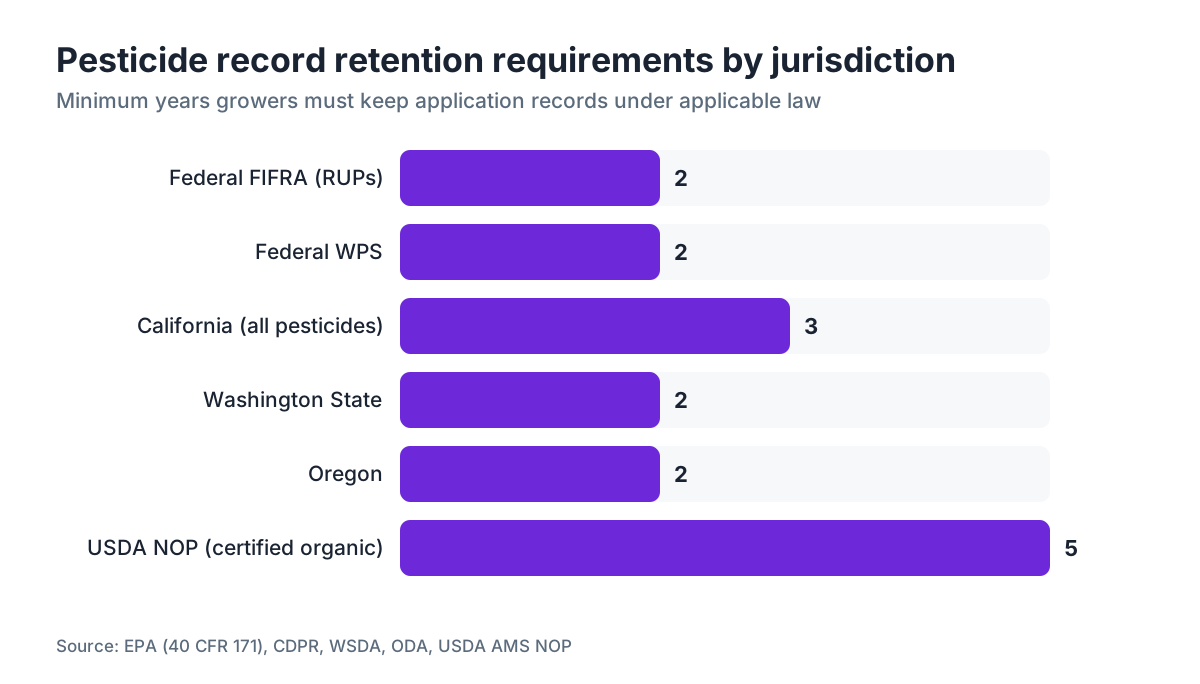
- Keep records at least two years under federal law.
- California requires three.
- Certified organic operations must keep them five.
What federal law actually requires on a pesticide application record
Seven core fields. Every one has a reason behind it.
Under the Federal Insecticide, Fungicide, and Rodenticide Act (FIFRA) and the EPA Worker Protection Standard (WPS), any commercial pesticide application on an agricultural establishment has to be documented. The record-keeping rules for restricted-use pesticides (RUPs) sit at 40 CFR Part 171.11 [1]. For WPS-covered establishments, the rules live at 40 CFR Part 170.309 [2].
The seven federally required elements for restricted-use pesticide records are:
| Field | What to record |
|---|---|
| Product name | The exact brand name on the label |
| EPA registration number | The number printed on the label (e.g., EPA Reg. No. 62719-556) |
| Total amount applied | In the unit on the label (oz, lb, fl oz, gal) |
| Size of area treated | Acres, square feet, or row feet |
| Location of application | Field, block, or GPS coordinates |
| Date of application | Month, day, and year |
| Certified applicator | Name and certificate number |
If a product is general-use rather than restricted-use, FIFRA's written record mandate technically does not apply at the federal level. But every major wine state pulls general-use products into mandatory record-keeping anyway, and the WPS requires records regardless of product class when workers may re-enter treated areas.
The WPS language at 40 CFR 170.309 is worth reading verbatim. The rule requires the agricultural employer to keep "records of each pesticide application" including the "location and description of the area treated, the product name, the EPA registration number, the active ingredient(s), the date(s) of application, and the restricted-entry interval." [2] That last field, the restricted-entry interval (REI), is WPS-specific and easy to forget.
Which fields do wine states add beyond the federal minimum
California, Washington, and Oregon grow most of the country's wine grapes, and all three ask for more than the federal baseline.
California's Department of Pesticide Regulation (CDPR) requires the fullest records in the country. Under California Food and Agricultural Code Section 12978 and the implementing regulations at 3 CCR Section 6624, licensed pest control operators and growers must record [3]:
- Operator name, license or permit number
- Business address
- Date and time of application (start and end for some applicators)
- Location by county, township, range, section, and field name or APN
- Commodity and variety (e.g., Vitis vinifera, Cabernet Sauvignon)
- Pesticide product name and EPA registration number
- Amount of product applied and acres or units treated
- Application equipment type
- Dilution rate and total volume applied per acre
- Pest or disease targeted (e.g., Botrytis cinerea, powdery mildew)
- REI (restricted-entry interval) from the label
- The licensed applicator's signature
California growers submit use reports to their county agricultural commissioner monthly, within the first week of the following month. The commissioner forwards the data to CDPR. That county reporting layer is unique to California, and it means your spray records feed a public database. Your data is not private [3].
Washington State requires records under RCW 17.21 and WAC 16-228 [4]. The fields track California closely but skip start/end times and dilution rates in some cases. WSU Extension's pest management guides walk through the state form in useful detail [5].
Oregon's ODA record rules (OAR 603-057-0400) require crop, site, amount applied, weather conditions at the time of application, and the applicator's Oregon license number [6]. Weather is the one field Oregon mandates as a standalone entry that neither federal law nor California requires, though it shows up on most commercial spray records regardless because the label often ties application to wind and temperature ranges.
| Requirement | Federal (RUP/WPS) | California | Washington | Oregon |
|---|---|---|---|---|
| Product name & EPA Reg. No. | Yes | Yes | Yes | Yes |
| Amount applied + area | Yes | Yes | Yes | Yes |
| Applicator ID | Yes | Yes | Yes | Yes |
| Application date | Yes | Yes | Yes | Yes |
| REI | WPS only | Yes | Yes | Yes |
| Crop/variety | No | Yes | Yes | Yes |
| Weather conditions | No | No (recommended) | Partial | Yes |
| Equipment type | No | Yes | No | No |
| Monthly county report | No | Yes | No | No |
| Record retention | 2 years | 3 years | 2 years | 2 years |
How long do wineries have to keep pesticide application records
Two years is the federal floor. California is three. Certified organic is five.
FIFRA requires certified applicators to keep restricted-use pesticide records for two years from the date of application [1]. The WPS says worker safety information, including the application records workers can access, must be kept two years as well [2].
California goes further. CDPR regulations require three-year retention [3]. If your winery operates in California and has any employee who could re-enter a treated block, you are effectively on the three-year standard for all records, more than RUPs.
Oregon and Washington default to two years. New York's DEC pesticide regulations also require two years at minimum.
UC ANR viticulture guidance points growers toward keeping spray records indefinitely in a digitized archive if they can, because wine grape records surface years later in residue disputes, sales due diligence, and organic transition paperwork [7]. Paper degrades. It gets lost in floods and fires. It is slow to search. The two-year legal floor is the absolute minimum you can get away with, not a target.
Does the pesticide label itself dictate what goes in the record
Yes, and this is the part growers most often miss.
The EPA label is a federal legal document. Under FIFRA, using a pesticide in a manner inconsistent with its label is a federal violation. Some labels carry language like "record-keeping required" or spell out that the applicator must document the crop, target pest, and rate used. If the label says to document something, that field is legally required for that product, even when state rules do not list it.
Fungicides sold under resistance management groups (FRAC codes) increasingly carry record-keeping language tied to the number of applications per season. Strobilurin fungicides like Pristine (FRAC Group 11) and SDHI fungicides like Luna Privilege (FRAC Group 7) often cap applications per season per site, and proving compliance means having dated records. The same goes for insecticides with pollinator-protection language that restricts timing relative to bloom [8].
Read the full label, every time, for every product, before you design your record template. If the label asks for data your form does not capture, your form is non-compliant for that product. Simple as that.
What do WPS worker re-entry requirements add to the record
The WPS covers any agricultural establishment where field workers or pesticide handlers may be exposed to pesticides. Wineries with vineyard employees fall under it.
The 2015 WPS revision, in full effect since 2017, expanded the information that has to be accessible to workers [2]. The central document the WPS requires is not identical to the spray record. It's the "pesticide application and safety information" that has to be posted or otherwise available in a central location on the establishment.
For each application, the posted information must include:
- Product name, EPA registration number, and active ingredient(s)
- Date and time the application is expected to end
- Location of the treated area (detailed enough that workers can avoid it)
- REI end date and time
- Whether the product is classified as highly toxic to workers (some labels require specific posting)
That information has to go up within 24 hours after the application ends and stay current for 30 days or until the REI expires, whichever is later. Workers must be told where to find it during their WPS safety training, which happens before their first entry to an agricultural establishment and again every year.
The WPS retention period for pesticide application safety information is two years, matching FIFRA. One practical note: inspectors checking WPS compliance usually look first at whether the posted information is actually posted and legible, not whether a copy exists somewhere in a filing cabinet.
What counts as the 'location' field on a spray record
This field causes more record-keeping failures than any other. It sounds simple. It isn't.
At the federal level, "location" means enough geographic detail to identify the treated site. In California that means county, APN (assessor parcel number), or legal land description (township, range, section), plus the field or block name you use internally. CDPR inspectors have cited growers who wrote only "Back 40" with no parcel reference [3].
For WPS purposes, the location description has to be specific enough that a worker who did not watch the application can figure out which areas to avoid. "Vineyard" does not clear that bar. "Block 7, rows 1 through 24, north of the barn" does.
A lot of vineyards now use GPS coordinates or GIS block identifiers. Those are legal in every state reviewed here, and they are better because they leave no room for argument. If you farm across multiple properties or AVAs, the location field also has to say which property the application happened on, since residue liability and county reporting both hinge on that.
For certified organic vineyards, or blocks in organic transition, the location record matters even more. A misidentified block can put the whole certification at risk if a prohibited substance gets logged to the wrong parcel [7].
Does a winery need separate records from the vineyard spray records
Yes, if the winery uses pesticides inside the building itself, more than in the vineyard.
Most wineries do. Sulfur dioxide for winemaking, sanitizers with pesticidal claims (some quaternary ammonium compounds register as pesticides), fumigants for barrel storage, rodenticides in the cellar. Each of those creates its own record-keeping obligation.
Inside the winery, pesticide applications generally are not WPS-covered, since the WPS applies to agricultural fields and nurseries, not processing facilities. But FIFRA and state licensing rules still apply. California, for one, requires a licensed pest control operator to handle and document any RUP application indoors, and even general-use products used inside can trigger county reporting when a licensed pest control business applies them.
So keep separate logs for in-winery and in-vineyard pesticide use. They have different regulatory homes and different inspection paths (CDPR and county ag for the vineyard, potentially OSHA and the fire marshal for the winery). Mixing them creates confusion and risks having a vineyard compliance gap hidden behind indoor records, or the reverse.
City wineries and urban production sites like those at city winery locations carry mostly in-facility compliance, while estate vineyards carry the full field-record burden.
Can you keep spray records digitally, or do they have to be on paper
Digital records are fully legal under federal and state rules, with one caveat.
FIFRA and the WPS do not require paper. CDPR accepts electronic records as long as they are legible, complete, and printable on demand for inspection [3]. Washington and Oregon are just as permissive on format.
The caveat is retrieval. An inspector at your gate does not want to hear that your spray data is in a cloud app behind a login you left at home. The workable habit, backed by UC Cooperative Extension advisors, is to keep a rolling printed copy of the current season's records in a binder at the ranch office or in the spray rig, and to back up digital records to a second location at least monthly.
For WPS posting, a tablet mounted in a visible central location satisfies the requirement in states that allow digital posting. Check your state, because some county agricultural commissioners have issued guidance requiring physical paper for posted safety information.
Platforms like VitiScribe are built for this workflow. You enter spray data once in the field, and the system formats it to meet California, Washington, and Oregon field-reporting requirements at the same time, with a print-ready compliance report on demand. That kind of setup kills the transcription errors most inspection findings trace back to.
What happens if a spray record is incomplete or missing
Penalties run from a written warning to a criminal referral, depending on the state, the product, and your history.
In California, failing to keep required pesticide use records is a misdemeanor under Food and Agricultural Code Section 11501, punishable by up to one year in county jail and a fine of up to $5,000 per violation [3]. Each missing or incomplete record is its own violation. In practice, first-time administrative violations draw civil penalties from the county agricultural commissioner, typically $250 to $1,000 per violation, with escalation for repeats. CDPR can impose penalties of up to $25,000 per day for serious violations.
Washington's Department of Agriculture can impose civil penalties up to $7,500 per violation under RCW 17.21.320 [4]. Oregon's ODA can assess up to $10,000 per violation for pesticide law violations under ORS 634.
For WPS violations, the EPA's enforcement office handles federal cases. Willful or repeat violations draw much higher penalties than first-time citations.
Fines are the visible cost. The bigger one is liability. Incomplete records leave you exposed in worker health complaints, neighbor drift cases, and food safety recalls. If you cannot document that you applied a pesticide within the pre-harvest interval (PHI), you may be unable to defend against a wine residue finding. That downstream risk dwarfs the cost of clean record-keeping.
What is a pre-harvest interval and does it go in the spray record
The pre-harvest interval (PHI) is the minimum number of days that must pass between the last application of a pesticide and harvest. The EPA sets it during product registration, and it's printed on every label.
PHI is not always listed as a required field in state spray record regulations, but it belongs in your record anyway. Here's why. If a question ever comes up about whether you observed the PHI, a record showing both the application date and the expected harvest date is your primary evidence. Without it, you are relying on memory.
For wine grapes, PHIs range widely. Sulfur products often run zero to seven days. Captan is commonly 0 days for grapes. Newer SDHI fungicides may carry PHIs of one to seven days. Pyrethroid insecticides used against grape leafhopper or mealybug often run one to seven days. Some neonicotinoid products carry PHIs as long as 28 days for certain grape uses [8].
Record the PHI from the label and the estimated harvest date at the time of application, and you have a built-in check. Your spray record should have a field for PHI and a field for "earliest legal harvest date" even when neither is explicitly mandated in your state. Best-practice templates from WSU Extension and UC ANR both include PHI [5][7].
How do certified organic vineyards handle pesticide records differently
Organic certification does not remove the need for pesticide records. It makes them more demanding.
National Organic Program (NOP) regulations under 7 CFR Part 205 require certified organic operations to keep records for five years, not two, covering every input applied, including OMRI-listed materials most people would not think of as pesticides [9]. Sulfur, copper, spinosad, and neem oil are all EPA-registered pesticides. Use them in an organic vineyard and you need full application records, including:
- Product name and OMRI/EPA status
- Lot number (for some certifiers)
- Rate, volume, and acres treated
- Pest targeted and cultural practices tried before the input
- Signature of the person authorizing the application
Your certifier may want documentation beyond the NOP minimums. Most require an annual summary of all inputs used, drawn straight from your spray records. Sloppy records put your renewal at risk.
Certified organic vineyards also face drift from neighboring conventional applications. If a prohibited substance drifts onto your blocks, NOP guidance says you are not automatically decertified, but you need records showing the application was not yours and that you took steps to prevent it. Your spray records, showing you did not apply the product, are the evidence [9].
For how organic record-keeping fits into an estate operation's overall compliance posture, the vineyard hub on VitiScribe covers it in depth.
What does a complete, inspection-ready spray record actually look like
Put every requirement together and a complete spray record for a California wine grape block looks like this:
Header fields (once per application event):
- Grower name, business name, and mailing address
- Ranch or property name
- County, APN or legal land description
- Block identifier and block acreage
- Commodity: wine grapes, variety (optional but strongly recommended)
- Application date
- Start time and finish time (required in California for licensed PCA-directed work)
- Application equipment type (airblast sprayer, backpack, drone, etc.)
- Weather at time of application: temperature, wind speed, wind direction, relative humidity (required in Oregon; best practice everywhere)
Product fields (repeat for each product in the tank mix):
- Trade name exactly as on the label
- EPA registration number
- Active ingredient(s)
- Formulation concentration
- Application rate (oz/acre or lb/acre of product)
- Dilution rate and gallons of water per acre
- Total product applied to this block
- FRAC or IRAC group (not legally required anywhere but essential for resistance management documentation)
- REI from the label
- PHI from the label
- Earliest legal harvest date (calculated)
Certification fields:
- Licensed pest control adviser (PCA) name and license number (California; whoever made the recommendation)
- Applicator name and certification number
- Signature
This template satisfies federal WPS, FIFRA RUP, CDPR, and NOP requirements at once. Farm in Washington or Oregon and you can drop a few California-specific fields (start/end time, dilution rate) without losing compliance there, but there is no downside to keeping them.
A record like this takes three to five minutes per block application event. The time cost is small. The compliance value is not.
Frequently asked questions
Do winery tasting rooms or event spaces need pesticide application records?
Only if pesticides are actually applied on the premises. If a licensed pest control company treats for rodents or insects in the tasting room, that operator keeps the required records and must give you a copy. For WPS purposes, tasting room buildings are not agricultural establishments, so WPS posting rules do not apply there. Retain any service receipts and contractor records for at least two years.
What is the difference between a pest control adviser recommendation and an application record?
A pest control adviser (PCA) recommendation is the written document a licensed PCA must provide before a pesticide is applied in California. It is a separate legal document from the application record. The application record documents what was actually done in the field. Both are required in California. The recommendation must be kept two years; the application record three. Other states generally have no separate PCA recommendation requirement.
Can a spray record be completed after the fact if I forgot to fill it out on application day?
Technically yes, if you have accurate data from a calibrated flow meter, product invoices, and field notes. California CDPR requires records to be submitted to the county commissioner within the first week of the following month, so the window is short. Backdating a record with inaccurate data is falsification, a separate and more serious violation. Document what you know and flag any fields reconstructed from secondary sources.
Does the applicator's name on the record have to be the person who physically drove the sprayer?
For restricted-use pesticides, the certified applicator of record is legally responsible for the application and must be identified. If an uncertified employee runs the equipment under a certified applicator's direct supervision, the certified applicator is still the person named in the record. 'Direct supervision' has a specific legal meaning: the certified applicator must be reachable by phone or in person to give instructions, not necessarily standing next to the sprayer.
What spray record fields are required for sulfur applications in a vineyard?
Sulfur is an EPA-registered pesticide. If it's a general-use product (most elemental sulfur products are), federal FIFRA record-keeping requirements for RUPs do not apply, but state requirements may. California requires all pesticide use to be reported to the county commissioner regardless of classification. WPS requires records if workers re-enter treated areas. Your record should still include product name, EPA reg number, date, location, rate, area, REI, and applicator.
How do I record a tank mix with multiple pesticide products?
Each product in the tank mix gets its own product-level fields: trade name, EPA registration number, active ingredient, rate applied, and REI. The header fields (date, location, equipment, weather, applicator) apply once to the whole application event. The REI that governs worker re-entry is the longest REI among all products in the mix, and that controlling REI should be noted explicitly in your record.
Are there federal record-keeping requirements for general-use pesticides in vineyards?
FIFRA's written record-keeping requirement at 40 CFR Part 171.11 applies specifically to restricted-use pesticides. General-use products carry no standalone federal record mandate, but the WPS requires documentation of any application where workers may re-enter, regardless of product class. State law fills the rest of the gap: California requires records for all pesticide use, and most other major wine states have similar broad rules.
Who can inspect my vineyard pesticide records and how much notice do they give?
In California, county agricultural commissioners can conduct unannounced inspections, and CDPR compliance officers do the same. EPA inspectors can review WPS records with no advance notice during normal business hours under FIFRA Section 9. Washington's WSDA and Oregon's ODA have similar authority. Federal WPS inspections often follow a worker complaint, so there may be no warning at all. Keep current records accessible on the farm, not in an off-site office.
Do I need to record applications made by a hired custom spray contractor?
The contractor is legally required to give you a copy of the application record within a set window (30 days in California). You keep that record just as you would your own. The contractor files the county use report in California; you do not file a duplicate. But you must have the contractor's record on file. Confirm before you hire any custom applicator that they will provide compliant documentation, because their record gap becomes your compliance gap.
Does a drone pesticide application need a different type of record?
The required fields are the same, but drone applications add complexity. The FAA requires drone operators to hold a Part 107 certificate, and some states (California included) require the drone to be registered as a pesticide application device with the state. Your record should note 'unmanned aerial system' or 'drone' as the equipment type and include the drone operator's state pesticide applicator license number. GPS flight logs from the drone platform back up the written record.
How do pre-harvest interval records protect a winery from liability?
If a wine sample tests positive for a pesticide residue, your documented PHI compliance is your primary defense. Without a dated application record and an explicit PHI notation, you cannot demonstrate the interval was observed. The FDA and TTB do not routinely test finished wine for pesticide residues, but the EU, UK, and Japan all test imported wine, and a positive finding can trigger shipment rejection or withdrawal from market.
What records do I need for rodenticide use around vineyard posts and equipment?
Rodenticides used outdoors in vineyards are typically restricted-use pesticides, especially second-generation anticoagulants. They require full FIFRA RUP records: product name, EPA reg number, amount applied, site, date, and certified applicator ID. California requires county reporting. Many rodenticide labels also require bait station placement records (number of stations, location). Keep those with your spray records, and document that you followed all label precautions to protect non-target wildlife.
Can workers see my pesticide application records under WPS?
Yes. The 2015 WPS revision at 40 CFR 170.309 gives workers and their designated representatives the right to review pesticide application records for any application in a field they entered or will enter, for the preceding two years. You must make records available within 15 days of a request. This right extends to a worker's physician or an authorized representative such as a union official. Denying access is a separate WPS violation.
Sources
- EPA, Agricultural Worker Protection Standard (40 CFR Part 170): WPS at 40 CFR 170.309 requires records of each pesticide application including location, product name, EPA registration number, active ingredients, dates of application, and restricted-entry interval, retained for two years.
- California Department of Pesticide Regulation, Pesticide Use Reporting: California requires pesticide use records for all pesticide products, monthly county reporting, and three-year retention. Failure to maintain records is a misdemeanor under California Food and Agricultural Code Section 11501.
- Washington State University Extension, Pest Management Resource Center: WSU Extension provides state-specific pesticide record-keeping templates for Washington wine grape growers including PHI and REI fields.
- UC Agriculture and Natural Resources (UC ANR), Pest Management Guidelines: Grape: UC IPM grape guidelines recommend retaining spray records beyond the legal minimum and including PHI and earliest legal harvest date fields in vineyard spray records.
- EPA, Pesticide Labels: Pre-Harvest Intervals and Resistance Management: Neonicotinoid insecticides registered for grapes can carry PHIs as long as 28 days; SDHI and strobilurin fungicides carry seasonal application limits documented on product labels.
- USDA Agricultural Marketing Service, National Organic Program (7 CFR Part 205): NOP at 7 CFR Part 205 requires certified organic operations to maintain all input records, including OMRI-listed pesticides, for five years from the date of application.
- Cornell University, New York State IPM Program, Vineyard Pest Management: Cornell's NYS IPM grape program provides record-keeping guidance including FRAC group notation for resistance management documentation in vineyard spray logs.
- EPA, 2015 Agricultural Worker Protection Standard Final Rule: The 2015 WPS revision, effective 2017, grants workers the right to review pesticide application records for any field they entered within the preceding two years, with records to be provided within 15 days of request.
Last updated 2026-07-09