What information must be recorded on a pesticide application record for winegrapes

TL;DR
- EPA regulations (40 CFR Part 170 and FIFRA Section 8) require a written record for every pesticide application to a farm site.
- The core fields: product name and EPA registration number, application date, location, crop treated, total area, applicator name, and amount used.
- Wine-grape states add site maps, pre-harvest intervals, and restricted-entry interval data.
- Keep records at least two years.
What does federal law actually require on a pesticide application record?
Seven core fields, minimum. That's the federal floor, set by the Federal Insecticide, Fungicide, and Rodenticide Act (FIFRA) Section 8 and the EPA Worker Protection Standard (WPS) at 40 CFR Part 170. [1] Any commercial applicator, and any farm employer whose workers walk into treated blocks, has to document each spray.
Here's what the feds want on every record:
- Product name and EPA registration number (the code on the label)
- Date of application
- Location of application (field or site identification)
- Crop, commodity, or site treated
- Total area treated in acres (or square footage for non-field settings)
- Name and certification number of the licensed applicator, if a restricted-use pesticide (RUP) was applied
- Amount of pesticide applied
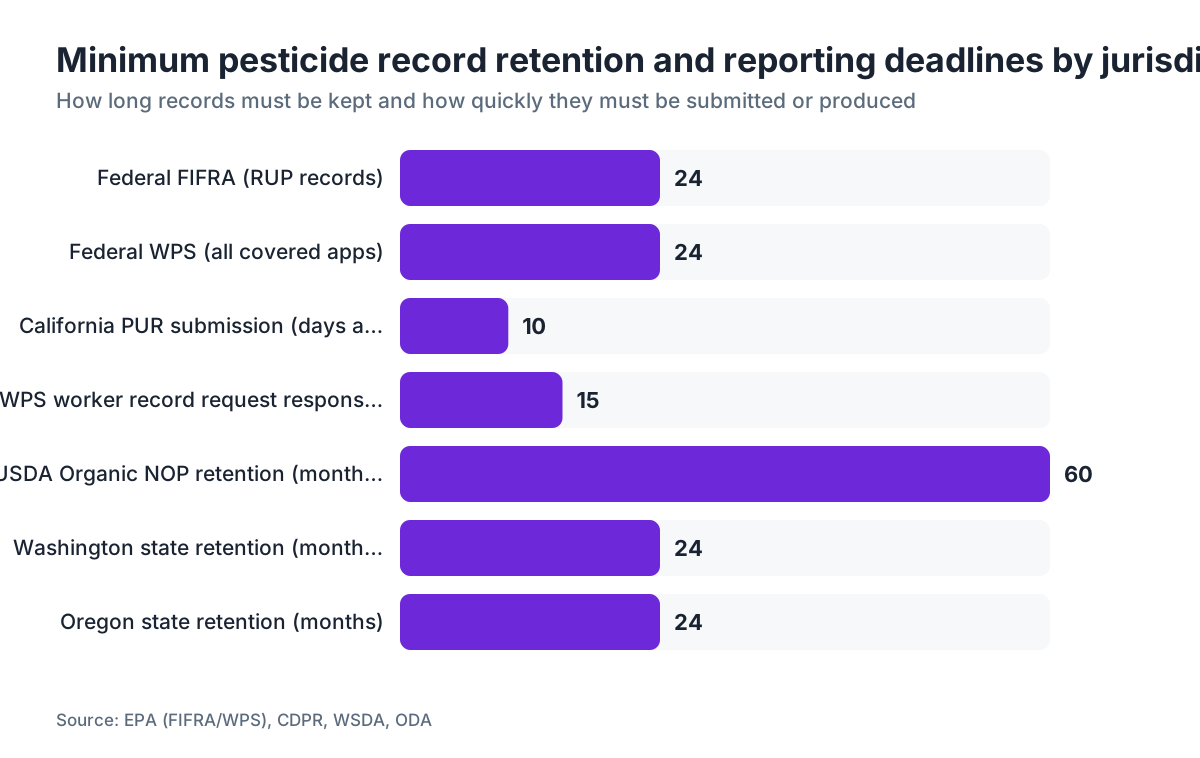
For restricted-use pesticides, FIFRA Section 8(a) tells the licensed private or commercial applicator to hold those records two years from the application date. [2] General-use pesticide records under WPS also run two years, and they have to be handed to workers or their representatives within 15 days of a written request. [1]
States build on that floor. All three big wine-grape states, California, Washington, and Oregon, go further than the federal seven.
Which fields are required specifically for winegrape applications in California?
California asks for more than any other wine state. County agricultural commissioners (CACs) run the program under the California Department of Pesticide Regulation (CDPR). [3] The Pesticide Use Report (PUR) system makes growers file monthly, and the underlying field record carries more detail than the federal minimum.
CDPR's required fields for farm pesticide use include:
| Field | Federal Req. | California Req. |
|---|---|---|
| Product name | Yes | Yes |
| EPA registration number | Yes | Yes |
| Application date | Yes | Yes |
| Field/site ID | Yes | Yes (must link to CAC-assigned site) |
| Crop or commodity | Yes | Yes (specific variety level) |
| Acres treated | Yes | Yes |
| Applicator name and cert # (RUP) | RUP only | All pesticides |
| Amount of product used | Yes | Yes |
| Application method/equipment | No | Yes |
| Target pest | No | Yes |
| Adjuvants used | No | Yes |
| Operator ID (grower) | No | Yes |
| County site number | No | Yes |
| Pre-harvest interval (PHI) on label | No | Yes (confirm compliance) |
California growers submit PUR data to their county agricultural commissioner by the 10th of the month after application. [3] Skip it and you face civil penalties up to $5,000 per violation under California Food and Agricultural Code Section 12999. [4]
The CDPR PUR database is one of the most detailed public pesticide datasets anywhere, and researchers at UC Davis and elsewhere use it to track spray trends across Napa, Sonoma, San Luis Obispo, and other wine AVAs. [5]
What do Washington and Oregon require beyond the federal minimum?
Both states add a few fields on top of the federal seven, but neither makes you file monthly the way California does. That's the short version. The Washington State Department of Agriculture (WSDA) requires licensed applicators to keep records for applications made under a commercial or private applicator license. [6] The fields mirror the federal list, but the state adds equipment type, application method (airblast sprayer versus hand gun, say), and wind speed and direction at spray time for some products.
WSU Extension's pesticide record-keeping guide (EM067E) tells growers to also note temperature and relative humidity, because those conditions affect label compliance and get pulled during spray drift investigations. [7] Washington records must be ready for WSDA inspectors on demand.
Oregon Department of Agriculture (ODA) follows the two-year federal retention rule and wants the applicator's Oregon Pesticide License number on RUP records. Oregon also wants the restricted-entry interval (REI) documented so early-entry workers can be tracked. Willamette Valley growers fighting botrytis or powdery mildew on Pinot Noir often reach for products with 4-hour to 48-hour REIs, and they need those entry times logged precisely for WPS. [1]
Farm in more than one state? Record everything California requires. It's the superset. It covers Washington and Oregon automatically.
What is a pre-harvest interval and how does it get recorded on the application record?
The pre-harvest interval (PHI) is the minimum number of days between your last spray and harvest. It's printed on the label, and the label is the law. [8] For winegrapes, blowing the PHI is a legal violation and a food safety problem at once, because residue can carry into juice and then into wine.
Your record should capture three PHI-related things: the label PHI for the crop, the application date, and the planned or actual harvest date. That combination lets you or any auditor calculate the interval on the spot.
Some common PHIs for winegrape fungicides and insecticides:
- Captan (various formulations): often 0 to 7 days depending on formulation
- Mancozeb-based fungicides: commonly 66 days for wine grapes (check the label version)
- Pyrethroids (lambda-cyhalothrin, for one): typically 7 days
- Sulfur-based materials: usually 0-day, though some labels set a minimum interval
Those numbers move with label and registration revisions. Read the current label every time. Cornell's grape pest management guidelines are a solid secondary reference for checking PHIs against products registered in the Northeast. [9]
Harvesting blocks on different dates? Run a separate PHI check for each block. A single property-wide record falls apart when blocks come off weeks apart.
What is a restricted-entry interval and how does it appear on application records?
The restricted-entry interval (REI) is the EPA-mandated window after a spray when workers can't enter a treated area without specific personal protective equipment. It's a WPS requirement. [1] In a vineyard, where tractor operators, canopy crews, and irrigation staff move through blocks all day, REI documentation is one of the riskiest spots in a compliance inspection.
Your record needs the REI for each product (it's on the label), the exact date and time the application finished, and the date and time the REI expires. Tank mixes complicate this. When you mix two or three products, each carries its own REI. The longest one governs entry, and that's the number you record as the effective REI.
The WPS also requires a treated-area warning, posted or spoken to workers, for any pesticide with an REI of 30 hours or more. Note that posting in your records too, even though it's a separate WPS obligation.
Common vineyard REIs run from 4 hours (many organophosphates at low rates, though this varies a lot) to 48 hours for some systemic fungicides. Fumigants for nematode control can hit 5 days or more. Check the label every time. UC Cooperative Extension's safe pesticide use guides cover REI in detail. [5]
How should you record application location and site identification for compliance?
Vague location descriptions fail audits. "North vineyard" or "block 4" won't hold up unless those names tie back to a field map or a site identification system your county agricultural commissioner can cross-reference.
Assign each block a unique alphanumeric ID ("V-04-PN" for block 4, Pinot Noir, say), tie that ID to GPS-referenced boundaries on a field map, and use the same ID across every application record, scouting log, and harvest record. CDPR's PUR system uses site numbers assigned by the CAC, so California growers have to link internal block codes to those state numbers. [3]
In a spray drift complaint or a residue investigation, GPS boundaries and consistent block IDs beat memory every time. WSU Extension tells growers to keep a current block map with acreage figures as a companion to the pesticide record. [7]
Acreage matters too. Record the area you actually treated, not the full block. Treat 8 of a 12-acre block and you write 8 acres. Overclaim and you inflate pesticide load numbers and invite audit questions. Underclaim and you open a compliance gap if residue turns up in ground you called untreated.
For winegrape operations in Paso Robles or other California AVAs with layered ownership and management, name the operator of record clearly on every record, separate from the applicator who pulled the trigger.
What equipment information belongs on a pesticide application record?
Federal law skips equipment for general-use pesticides. California requires it, and common sense backs that up.
For California PUR and WPS defensibility, record the application equipment type (airblast sprayer, boom sprayer, backpack, drone), the nozzle type and size if drift is a concern, the spray volume (gallons per acre), the carrier (water or oil), and the operating pressure if you want to prove label compliance.
Spray volume earns its place because it lets you back-calculate the application rate. Say the label calls for 2 to 4 quarts per acre in 50 to 100 gallons of water. Your record of 75 gallons per acre plus the product mixed gives an auditor everything needed to confirm the rate was legal.
Drones are a newer wrinkle. California and Washington are both writing updated guidance on record-keeping for UAV applications. For now, drone sprays should document the model, GPS flight logs if available, application altitude, and swath width, on top of all the standard fields. WSU has published early guidance on this. [6]
How long must you keep pesticide application records and who can ask to see them?
Two years is the federal floor for restricted-use pesticide records, counted from the application date under FIFRA Section 8. [2] The WPS holds general-use pesticide records to the same two years and requires you to hand them to workers or their designated representatives within 15 days of a written request. [1]
California matches two years for grower records and adds the monthly PUR filing to the county. County commissioners keep their own copy, so California growers get a third-party backup sitting in the government system for free. [3]
Hold records longer than the minimum for real reasons:
- Winery audits and certifications (organic, Certified California Sustainable Winegrowing, LIVE in Oregon) often want three to five years of history
- Personal injury or property damage lawsuits over drift can surface two to three years after the spray
- Export buyers sometimes ask for multi-year residue trend data
Who can ask to see records? In California, county agricultural commissioners have inspection authority and CDPR inspectors can audit. EPA inspectors can request records under FIFRA. Under the WPS, workers and their representatives get a 15-day turnaround. Organic certifiers want them at renewal. Wine buyers running supplier audits may ask informally.
Store records so you can pull a specific block, date range, or product in a couple of minutes. Paper binders organized by year work fine. A searchable digital system is faster when an auditor is standing in your office.
What are the most common mistakes vineyard managers make on pesticide records?
Incomplete tank-mix documentation tops the list. Mix three products in one tank and you need a separate entry (or a clearly linked combined entry) for each product's name, registration number, rate, and REI. Auditors keep finding tank-mix records that list one product plus a note like "+ fungicide." Those fail.
Timing errors come second. Under California rules, the record must be finished before the end of the day the application was made. Reconstructing a record a week later from memory bakes in errors on rates, times, and coverage that are hard to defend.
Third: missing applicator credentials. California wants the operator of record on every use report, more than RUPs. Growers who hire a custom applicator often forget to grab the applicator's license number at the time of the spray. Getting it a month later is technically non-compliant.
Fourth: no documented PHI check. The label is the law, but with no note confirming you checked the PHI against the expected harvest date, you can't show you complied.
A tool like VitiScribe can pre-fill product details from a database and flag PHI and REI conflicts as you enter them, so you catch these before they turn into citations.
For vineyard operations of any size, a one-page template that prompts for every required field is a cheap fix that pays off fast.
Do organic winegrape operations have additional record-keeping requirements?
Yes. USDA National Organic Program (NOP) certified operations keep records for five years, longer than the FIFRA two-year floor, and have to document that every input is NOP-compliant, meaning it's on the OMRI list or approved by the certifier. [10]
For organic winegrape blocks, your record carries the same fields as any other, plus the OMRI listing number or certifier approval letter for the product, confirmation the product stayed out of any required buffer zone, and the reason the application was needed (a scouting record or threshold trigger).
Many certifiers also want the Organic System Plan (OSP) updated when new inputs go in, and your application records feed that OSP review at annual renewal. Washington State University's small farms and specialty crops program has organic record-keeping guidance that fits vineyard settings. [7]
One practical point: farm both certified organic and conventional blocks, and keep the records completely separate. Mixed or shared records create audit headaches and can trigger a certifier inquiry about contamination.
How can you build a compliant pesticide record template that works across states?
Start with California, since its requirements are the widest. A template that satisfies California satisfies the feds and meets Washington and Oregon with nothing extra.
A complete template needs fields for:
- Operator/grower name and license/permit number
- Property address and county
- Internal block ID and CAC site number (California) or equivalent
- Block acreage and acres actually treated
- Crop (winegrapes) and variety
- Target pest
- Application date and start/end time
- Product name, EPA registration number, and formulation
- Amount of product applied (lbs or fluid oz of product, not active ingredient) and per-acre rate
- Carrier volume (gallons per acre)
- Application method and equipment type
- Applicator name, license number, and signature
- REI (from label) and REI expiration date/time
- PHI (from label) and earliest allowed harvest date
- Weather: temperature, wind speed, wind direction, relative humidity
- Adjuvants: product name, rate, purpose
- Tank mix partners (repeat fields 8-10 for each additional product)
- Worker notification completed (yes/no and method)
Eighteen categories, some with sub-fields. It reads like a lot. A well-built paper form or digital entry screen still gets it done in 5 to 8 minutes per application.
Cornell Cooperative Extension publishes grape pest management worksheets with many of these fields, free to adapt. [9] UC Cooperative Extension also keeps sample pesticide use record forms. [5]
What happens if a pesticide application record is incomplete or missing?
Penalties vary by state and severity, and they're real.
In California, failing to maintain or submit required records brings civil penalties from $250 to $5,000 per violation under the Food and Agricultural Code. [4] Willful or repeat violations can cost you your license. CACs run random field audits and must report significant violations to CDPR.
At the federal level, FIFRA violations carry civil penalties up to $500 per offense for private applicators and up to $5,000 per offense for certified commercial applicators. [2] WPS violations carry their own separate EPA penalties.
Fines aside, a thin record hurts you in practical ways. A worker reports exposure during the REI and your records show no REI logged? You have no defense. A winery buyer runs a residue test and finds a compound? Without the date, rate, and PHI calculation on record, you can't show the application was compliant. Organic certification is at risk the moment records go missing.
Nobody keeps perfect records forever. The goal is a documented, good-faith system. An auditor who finds a consistent template with the odd handwritten correction is in a very different mood from one who finds records clearly rebuilt after the fact.
Frequently asked questions
Do I need to record pesticide applications made by a contract spray company on my behalf?
Yes. As the operator of record and farm employer, you keep application records even when you hire a custom applicator. The contractor should hand you a completed record at the time of application. In California, both you and the applicator may have separate reporting obligations. Get a copy of their license number and the completed record before they leave the property.
Is a pesticide application record the same as a pesticide use report (PUR) in California?
They're related but different. The application record is the field-level document you keep on-farm. The Pesticide Use Report is the monthly summary you submit to your county agricultural commissioner by the 10th of the following month. The PUR is built from your application records. Keep both, and make sure the underlying records support whatever you report on the PUR.
Can I keep pesticide application records electronically, or do they need to be on paper?
Electronic records are fine under federal FIFRA and WPS rules and under California regulations, as long as they're legible, accurate, and retrievable. CDPR accepts electronic records provided you can produce them within the required timeframe during an inspection. Back them up. A system crash that wipes two years of records is not a compliance excuse.
Does the 'operator of record' have to be the same person who physically made the application?
No. The operator of record is the grower or farming entity responsible for the property. The applicator is the person who applied the product, and they carry their own record-keeping obligations if they hold a commercial applicator license. Both names and license numbers belong on the application record. They can be the same person or two different people.
What weather conditions need to be on a pesticide application record?
Federal law doesn't require weather data for most applications. California requires wind speed and direction for certain applications near sensitive sites. Best practice, backed by WSU and UC extensions, is to record temperature, wind speed, wind direction, and relative humidity at the start of every application. It's your primary defense in a spray drift complaint and takes 60 seconds to add.
How do I record a tank mix with multiple pesticide products?
Each product in the mix gets its own complete entry: product name, EPA registration number, amount used, and per-acre rate. The REI for the mix is the longest REI among all products in the tank. You can record tank mixes on one line per product on a multi-product form, or list them in sequence on the same record for the same date and block. Don't lump them under a single product line.
What is the pre-harvest interval for mancozeb on winegrapes and how does it get documented?
Mancozeb-based fungicides commonly carry a 66-day PHI for wine grapes, though that varies by formulation and registration. Always read the specific product label, since revisions can change the PHI. On your record, note the label PHI and the calculated earliest allowable harvest date (application date plus PHI). If harvest falls before that date, the application was non-compliant.
How does the EPA Worker Protection Standard affect pesticide record-keeping for vineyard employees?
The WPS requires application information for any pesticide with a label REI to be kept two years and provided to workers or their designated representative within 15 days of a written request. The required information includes product name, EPA number, active ingredient, location treated, date, and REI. You must also post or communicate this in a way field workers can access before they enter treated areas.
Do I need pesticide application records for sulfur and other minimum-risk pesticides?
Sulfur, copper, and other minimum-risk materials registered for wine grape use still need records in California and under the WPS if workers could enter treated areas during an REI. Even a 0-day REI product should be recorded, because it shows up in your PUR and winery auditors often ask about every spray material. Organic certifiers definitely want records of every input, minimum-risk or not.
How do I handle pesticide records for blocks I farm under a custom farming or management agreement?
For reporting purposes, the operator is usually the party making the farming decisions, which under most management agreements is the management company or vineyard manager. Both parties should be named in the agreement as to who bears compliance responsibility. In California, whichever party holds the Pesticide Use Permit from the county commissioner carries the reporting obligation.
What records do I need for pesticide applications made under a Certified Naturally Grown or USDA Organic certification?
USDA Organic requires five years of records (versus the two-year federal floor), documentation of input approval (OMRI listing or certifier sign-off), a reason for each application tied to a scouting or threshold trigger, and confirmation the input followed the certified system plan. Certified Naturally Grown has similar requirements. Keep these records separate from any conventional blocks to avoid cross-contamination questions.
Are pesticide application records required for winery estate blocks that farm their own fruit?
Yes. An estate winery growing its own winegrapes is a farm operator, subject to the same FIFRA, WPS, and state record-keeping rules as any independent grower. The fruit never changing hands doesn't change the obligation. Some winery auditors and third-party sustainability certifiers actually want more detail than the legal minimum.
Can I use a smartphone app to record pesticide applications in the field?
Yes, as long as the app captures every required field and stores records in a retrievable format for at least two years. Many vineyard management platforms let field crews log applications during the spray, which satisfies California's rule to finish records by end of the application day. Confirm the app exports records in a format your county agricultural commissioner accepts before relying on it alone.
What's the difference between an application record and a spray log, and do I need both?
They're often the same document in practice. 'Spray log' is informal; 'pesticide application record' is the legally defined term. Your spray log becomes your application record when it holds every required field. Some growers keep a running spray log in a binder and then transfer data to a formal record or PUR. That works, as long as the field log itself is complete and retained. Don't toss the original field notes after transferring data.
Sources
- EPA, Worker Protection Standard (40 CFR Part 170): WPS requires application information to be kept two years and provided to workers within 15 days of a written request; requires REI documentation and treated-area communication.
- EPA, FIFRA Section 8 and Restricted-Use Pesticide Record-Keeping: FIFRA Section 8(a) requires licensed applicators to maintain RUP application records for two years; civil penalties up to $5,000 per offense for commercial applicators.
- California Department of Pesticide Regulation, Pesticide Use Reporting: California requires monthly PUR submission to county agricultural commissioners by the 10th of the following month, with site-level detail including CAC-assigned site numbers, target pest, and operator ID.
- California Food and Agricultural Code Section 12999: Civil penalties for failure to maintain or report required pesticide use records range from $250 to $5,000 per violation.
- UC Cooperative Extension, Integrated Pest Management for Grapes: UC Cooperative Extension provides safe pesticide use guidance and sample record forms applicable to California winegrape operations; REI ranges and PHI data for common grape pesticides.
- Washington State Department of Agriculture, Pesticide Management: WSDA requires licensed applicators to maintain pesticide records; Washington regulations add equipment type and application method to required fields; preliminary UAV application guidance published.
- Washington State University Extension, Pesticide Record-Keeping for Agricultural Producers (EM067E): WSU Extension recommends documenting temperature, relative humidity, wind speed, and wind direction at time of application; advises maintaining GPS-referenced block maps as companion documents to pesticide records.
- EPA, Pesticide Labels and Label Review: The pesticide label is enforceable law; PHI and REI are stated on the label and must be followed.
- Cornell Cooperative Extension, New York and Pennsylvania Pest Management Guidelines for Grapes: Cornell's grape pest management guidelines provide PHI data for common grape pesticides and include sample record-keeping worksheets for vineyard applications.
- USDA Agricultural Marketing Service, National Organic Program Regulations: NOP certified operations must retain records for five years; all inputs must be documented as approved (OMRI listed or certifier-approved); applications must be tied to a scouting or threshold trigger in the Organic System Plan.
Last updated 2026-07-11