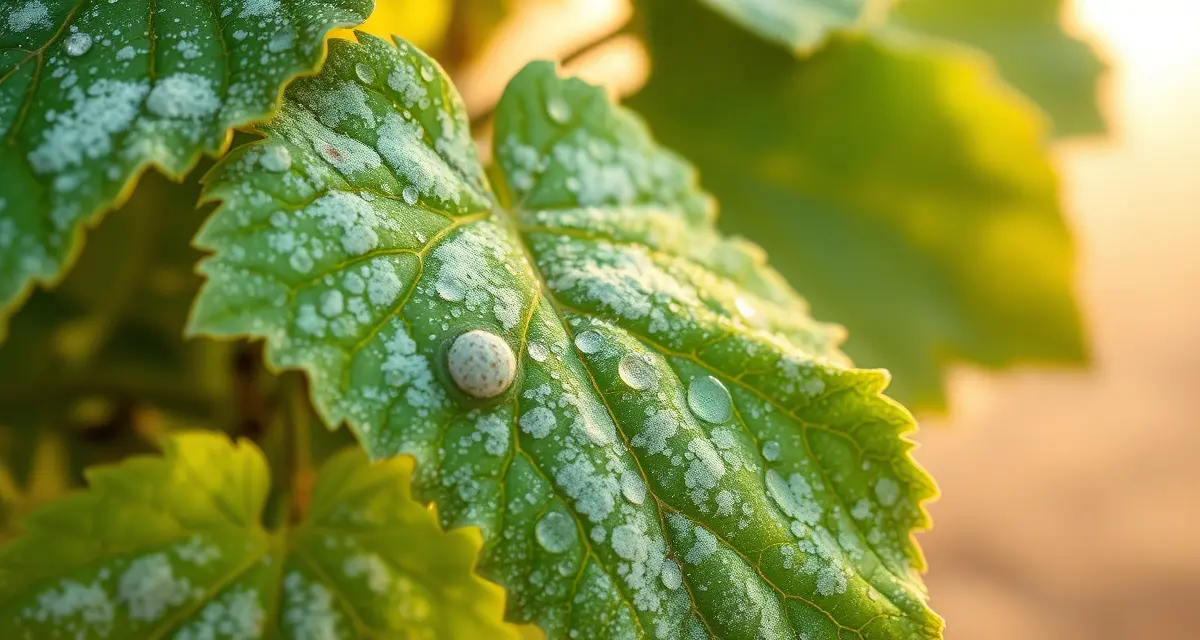
Powdery Mildew Management for Chardonnay in Sonoma
Coastal fog in Sonoma raises nighttime humidity, increasing powdery mildew infection risk in ways that don't show up in daytime weather summaries. A Sonoma Chardonnay block that looks fine at 2pm -- sunny, 70°F, light breeze -- may have spent the night at 90%+ relative humidity under a marine fog layer. That overnight humidity window is exactly what Erysiphe necator needs to germinate and infect.
Coastal Sonoma fog creates unique morning humidity conditions that extend powdery mildew risk compared to warmer, drier interior California wine regions. Your spray program for Sonoma Chardonnay needs to account for this extended infection window, which means shorter spray intervals during the fog season and careful attention to which materials work best under cool, humid conditions.
TL;DR
- Coastal fog creates sustained overnight humidity above 85% RH -- the threshold where Erysiphe necator can germinate and infect without free moisture on leaf surfaces -- extending the effective infection season well beyond what interior California programs experience
- Sonoma Chardonnay programs typically run 10-14 powdery mildew applications from budbreak through veraison, with programs starting at 1-2 inch shoot growth rather than the 4-6 inch timing common in warmer interior regions
- California DPR records for Sonoma County require weather conditions at application including wind speed, temperature, and relative humidity -- weather station data logged at application time is best practice for documenting fog-driven spray timing decisions
- Quinoxyfen (FRAC Group 13 -- Quintec) has a 14-day PHI and excellent efficacy under cool, humid coastal conditions -- useful at bloom, but PHI planning must account for Sonoma Chardonnay's August-October harvest window
- Organic Sonoma Chardonnay programs face particular challenges because coastal fog extends the infection window while limiting the OMRI-listed tool set -- sulfur at 3-6 lbs/acre with 7-day intervals is the backbone, with potassium bicarbonate (0-day PHI) for late-season applications
- CCOF-certified organic Chardonnay programs must satisfy both DPR's weather-condition documentation and CCOF's OMRI status documentation for every application -- one application entry needs to satisfy two compliance requirements simultaneously
How Fog Changes Your Powdery Mildew Risk Profile
Powdery mildew is unusual among fungal pathogens because it doesn't need free moisture on leaf surfaces to infect. It thrives in high relative humidity -- typically above 85% -- but can infect in dry conditions when daytime temperatures are between 60°F and 90°F. Coastal fog creates a humidity profile that's nearly ideal for powdery mildew: cool nights with sustained high humidity, followed by warm days that drive vine growth and maintain inoculum.
What this means for Sonoma Chardonnay growers is that your spring spray program needs to start earlier and maintain tighter intervals than growers in warmer interior regions. By the time fog clears most mornings in the Russian River Valley or Petaluma Gap, you may already have had 6-8 hours of high-humidity conditions favorable for infection.
Your weather station data is essential here. Log relative humidity alongside your spray decisions so your records show that you were responding to actual conditions, not just a calendar. In VitiScribe, spray record entries can capture weather conditions at the time of application -- that data trail documents an IPM-based program rather than a calendar spray.
For the complete FRAC group rotation framework applicable to Sonoma Chardonnay, see the fungicide FRAC groups guide.
Building the Program from Budbreak
Chardonnay is considered moderately susceptible to powdery mildew, and Sonoma coastal conditions push it toward the high end of that range. A typical Sonoma Chardonnay program runs 10-14 applications from budbreak through veraison.
Early budbreak through 6-inch shoot growth: Start your program at 1-2 inch shoot growth -- earlier than you might in Napa or the Central Valley. This is when overwintering flag shoots begin releasing ascospores and primary inoculum is at its peak. Under coastal fog conditions, the infection window at this stage can begin before sunrise when temperatures are still in the 55-60°F range.
Open with sulfur if temperatures are reliably above 55°F at application time. Wettable sulfur at 3-4 lbs/acre provides both contact protection and some eradicant activity against early infections. Avoid sulfur when overnight temperatures drop below 50°F or daytime highs exceed 90°F -- both conditions increase phytotoxicity risk.
Alternatively, open with a DMI fungicide (FRAC Group 3) -- Rally (myclobutanil), Elite (tebuconazole) -- if you want a systemic material with some eradicant activity for early-season catch-up protection after a wet foggy period.
Pre-bloom through bloom: This is your highest-priority window. Spray interval: 7 days, no exceptions during fog season. Alternate FRAC groups to build resistance management into your records.
A practical FRAC rotation for Sonoma Chardonnay:
- Sulfur or potassium bicarbonate (FRAC M2/45)
- DMI fungicide (Group 3 -- Rally, Elite, Tebuzol)
- QoI strobilurin -- if no resistance suspected (Group 11 -- Flint, Abound)
- Quinoxyfen (Group 13 -- Quintec)
- SDHI fungicide (Group 7 -- Luna Privilege, Luna Sensation)
- Metrafenone (Group U8 -- Vivando)
- Back to sulfur or potassium bicarbonate
Track this rotation in VitiScribe's FRAC group history by block. You'll want documentation showing you rotated through multiple modes of action when a certifier or PCA reviews your program.
Bloom: 7-day intervals. Applications that slip to 10-12 days during bloom create a gap that powdery mildew can exploit, especially after foggy periods. Quintec (Group 13) at bloom is particularly effective -- it has activity against powdery mildew under the humid conditions that coastal fog creates.
Bunch closure through veraison: Extend to 10-14 day intervals if early-season pressure was well-managed. If you see any powdery mildew on leaves -- white powdery colonies, angular or circular lesions -- tighten back to 7-10 days. Cluster-stage powdery mildew at bunch closure is an indication that your program has gaps.
PHI Management for Sonoma Harvest Timing
Sonoma Chardonnay harvest typically runs late August through October depending on appellation and style. Your PHI calendar should be planned 30 days before target pick.
Materials with short PHI values that work well for late-season Sonoma Chardonnay protection:
- Pristine (boscalid + pyraclostrobin) -- 0-day PHI
- Flint Extra (trifloxystrobin) -- 0-day PHI
- Sulfur -- 0-day PHI
- Potassium bicarbonate -- 0-day PHI
- Quintec (quinoxyfen) -- 14-day PHI
If you're using Luna Privilege or Luna Sensation (fluopyram products) in your late-season program, their 0-day PHI makes them viable options for botrytis suppression late in the season when you can't risk residue issues.
VitiScribe calculates PHI for every product in your spray log and displays the harvest clearance date for each block on the dashboard. If fog drives you to make an unplanned late application, the system flags any PHI conflicts with your intended harvest date before you go to the field.
For the complete PHI reference for fungicides, see the fungicide PHI guide.
California DPR Compliance for Sonoma County
Sonoma County operates under California DPR's expedited spray record filing requirements. Pesticide use reports for restricted-use pesticides must be submitted to the Sonoma County Agricultural Commissioner within 7 days of application (24-hour filing is required in some California counties -- check current Sonoma County Commissioner requirements).
Every spray record requires:
- Applicator name and CA pest control license number
- Product name, EPA registration number
- Application date and time
- Block, acreage, and application rate
- Weather conditions at time of application (wind speed and direction, temperature)
- Target pest (powdery mildew)
For organic Sonoma Chardonnay operations, CCOF requires the same DPR-compliant records plus documentation of OMRI-listed product status for every input. Sulfur, potassium bicarbonate, and copper-based materials are OMRI-listed -- verify that the specific formulation you're using maintains current OMRI status.
Fog Season Record Keeping
One of the most valuable documentation practices for Sonoma Chardonnay growers is recording the weather conditions that drove spray timing decisions. When your record shows "Applied Quintec on May 12 following 72-hour foggy period with overnight RH averaging 91% at the Petaluma Gap station," you're building a record that tells the story of a conditions-based program. That documentation serves you in audits, in certification reviews, and in your own program review at the end of each season.
VitiScribe's weather station integration can pull local temperature and humidity data automatically at the time of spray entry, so you don't have to manually look up weather data. The conditions are captured as part of the record, not as a separate step.
Frequently Asked Questions
How does coastal fog affect powdery mildew risk in Sonoma Chardonnay?
Coastal fog creates sustained overnight humidity above 85% relative humidity -- the threshold range where Erysiphe necator can germinate and infect. Unlike free moisture from rain, which powdery mildew doesn't need, high humidity is sufficient for infection without wet leaf surfaces. In Sonoma's coastal and transitional AVAs (Russian River Valley, Sonoma Coast, Petaluma Gap), fog can maintain high nighttime humidity from April through September, extending the infection season well beyond what growers in warmer interior regions experience. The practical effect is that spray intervals need to be tighter during the fog season and programs need to start earlier than standard California powdery mildew timing guidelines suggest.
How should I adjust my powdery mildew spray program for Chardonnay in Sonoma?
The main adjustments compared to interior California programs: start at 1-2 inch shoot growth rather than waiting for 4-6 inch; maintain 7-day intervals throughout bloom and pre-bloom regardless of how conditions look during the day (fog creates overnight infection windows that daytime observation misses); use materials with good efficacy under cool, humid conditions (quinoxyfen and SDHI products perform well under coastal conditions); and don't reduce to 14-day intervals until your weather station data shows overnight humidity consistently below 85%. Keep your weather station data in your spray records to document the conditions that drove interval decisions.
What organic options work for powdery mildew in Sonoma certified organic Chardonnay vineyards?
Sonoma organic Chardonnay growers have several OMRI-listed options. Wettable sulfur is the backbone of most organic programs at 3-6 lbs/acre per application -- avoid during fog events when temperatures are below 50°F or above 90°F. Potassium bicarbonate (Kaligreen, MilStop) provides good contact eradication and can be applied at 0-day PHI. Copper-based materials (copper hydroxide, copper octanoate) have some suppressive activity against powdery mildew. Regalia (extract of Reynoutria sachalinensis, FRAC P5) provides induced systemic resistance with a 0-day PHI. In coastal Sonoma's fog-influenced conditions, organic programs need to maintain strict 7-day intervals during spring and early summer to stay ahead of the extended infection window.
How should a Sonoma grower document that a spray interval was shortened due to fog conditions for an IPM review?
The documentation sequence is: weather station record showing overnight RH for the period between your last application and this application, scouting observation (or absence of symptoms with note that the fog-driven risk period justifies preventive action before symptoms develop), and the spray record noting the shortened interval. In a Sonoma Russian River Valley program, applying at 7-day intervals all spring without fog documentation looks the same as applying at 7-day intervals as a calendar schedule. The weather station humidity data that shows you had 4 consecutive nights above 90% RH between applications is what demonstrates the conditions-based interval decision. VitiScribe's weather integration captures overnight RH alongside spray records automatically when your station is connected.
What is the practical difference in spray program cost between a well-documented Sonoma Chardonnay IPM program and a standard calendar-based program?
The documentation difference is primarily relevant for certification and winery buyer compliance requests, but there is also a cost efficiency argument. A calendar-based 10-day interval program regardless of fog conditions applies the same number of sprays in both high-pressure foggy periods and dry stretch periods. An IPM-documented program may extend to 12-14 day intervals during dry mid-summer periods where overnight RH consistently drops below 85%, reducing the total application count. In a 10-application conventional calendar program, eliminating 1-2 unnecessary applications represents $200-400/acre in fungicide cost savings at typical program costs -- savings that the scouting records justify and document. VitiScribe's block cost-per-acre tracking shows you the application cost history that makes this argument visible across seasons.
What is Powdery Mildew Management for Chardonnay in Sonoma?
[FAQ_ANSWER_PLACEHOLDER: This answer needs to be generated by AI with specific data, examples, and actionable advice relevant to Powdery Mildew Management for Chardonnay in Sonoma. Target 50-150 words.]
How much does Powdery Mildew Management for Chardonnay in Sonoma cost?
[FAQ_ANSWER_PLACEHOLDER: This answer needs to be generated by AI with specific data, examples, and actionable advice relevant to Powdery Mildew Management for Chardonnay in Sonoma. Target 50-150 words.]
How does Powdery Mildew Management for Chardonnay in Sonoma work?
[FAQ_ANSWER_PLACEHOLDER: This answer needs to be generated by AI with specific data, examples, and actionable advice relevant to Powdery Mildew Management for Chardonnay in Sonoma. Target 50-150 words.]
What are the benefits of Powdery Mildew Management for Chardonnay in Sonoma?
[FAQ_ANSWER_PLACEHOLDER: This answer needs to be generated by AI with specific data, examples, and actionable advice relevant to Powdery Mildew Management for Chardonnay in Sonoma. Target 50-150 words.]
Who needs Powdery Mildew Management for Chardonnay in Sonoma?
[FAQ_ANSWER_PLACEHOLDER: This answer needs to be generated by AI with specific data, examples, and actionable advice relevant to Powdery Mildew Management for Chardonnay in Sonoma. Target 50-150 words.]
How long does Powdery Mildew Management for Chardonnay in Sonoma take?
[FAQ_ANSWER_PLACEHOLDER: This answer needs to be generated by AI with specific data, examples, and actionable advice relevant to Powdery Mildew Management for Chardonnay in Sonoma. Target 50-150 words.]
Related Articles
- Fungicide Resistance Management for Vineyard Powdery Mildew
- Downy Mildew Fungicide Resistance Management for Vineyards
Sources
- California Department of Pesticide Regulation (CDPR)
- Sonoma County Agricultural Commissioner
- UC Cooperative Extension Viticulture
- American Vineyard Foundation
- Wine Institute
Get Started with VitiScribe
Sonoma Chardonnay powdery mildew programs require overnight humidity data to justify tight fog-driven intervals, FRAC rotation tracking across 6+ groups in a 10-14 application season, PHI management through an August-October harvest window, and California DPR weather condition documentation at each application -- documentation layers that manual records and generic farm apps handle separately. VitiScribe's Sonoma weather station integration auto-captures overnight RH and temperature at spray entry, tracks FRAC rotation by block, calculates PHI clearance dates, and generates DPR monthly reports automatically. Try VitiScribe free and log your first fog-condition-documented Sonoma Chardonnay spray record today.