Powdery mildew on grapes: causes, symptoms, and control
TL;DR
- Powdery mildew, caused by the fungus Erysiphe necator, is the most economically damaging grape disease in most U.S.
- wine regions.
- It thrives in moderate temperatures (65 to 77°F) without needing wet weather, can slash yields by 20 to 80% in bad years, and is managed through early-season fungicide timing, canopy management, and FRAC group rotation.
- Sulfur remains the backbone of most programs.
What is powdery mildew of grapes and what causes it?
Powdery mildew of grapes is caused by the obligate biotrophic fungus Erysiphe necator (formerly classified as Uncinula necator). Obligate biotrophic means the fungus can only grow and reproduce on living plant tissue. It cannot survive in the soil or on dead debris for more than a season, which shapes everything about how you approach it.
The pathogen is thought to have originated in North America alongside native Vitis species, many of which show partial tolerance to it. When European winemakers brought Vitis vinifera to the New World, they essentially handed E. necator a highly susceptible host. Vitis vinifera varieties have almost no genetic resistance, which is why the disease showed up in Europe in the 1840s and wrecked vineyards before growers understood what they were dealing with [1].
Two overwintering structures matter for your spray timing. The fungus overwinters as chasmothecia (formerly called cleistothecia) on bark and canes. It also overwinters as dormant mycelium inside dormant buds, and that second route matters more day to day. Infected buds push out already-colonized shoot tissue in spring, called flag shoots, and those become the earliest infection sources of the season before any ascospore release from chasmothecia. UC Davis IPM research reports that flag shoots appear in roughly 5 to 30% of shoots in infected vineyards, depending on the prior season's disease pressure [1].
Ascospores release from chasmothecia once cumulative temperatures reach roughly 50°F after budbreak, usually tied to rainfall events of 0.1 inch or more. Those spores drive primary infection. Secondary spread through the season happens through conidia, the asexual spores produced on infected tissue and carried by wind. Conidia need no free water on the leaf surface to germinate. That single fact is the biggest ecological difference between powdery mildew and most other grape fungal diseases.
What do powdery mildew symptoms look like on grapevines?
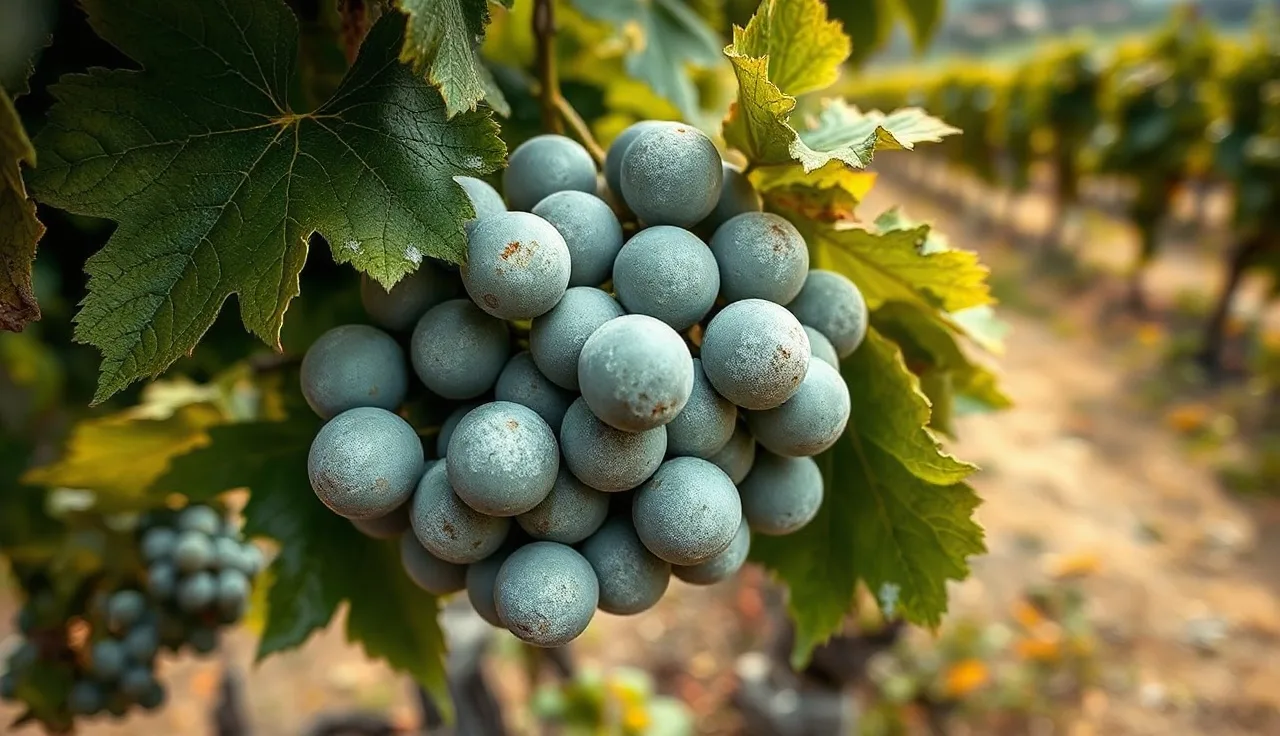
The most recognizable sign is the white to grayish powdery coating on green tissue. That coating is fungal mycelium and conidia sitting on the surface of the plant cell. The fungus does not penetrate deeply into plant tissue. It sends feeding structures called haustoria into epidermal cells while the rest of the colony sits exposed on the surface, which is why surface-applied protectant fungicides work well if you get there before infection.
On leaves, look for pale yellowish patches on the upper surface first, with white powdery growth on the undersurface below those patches. Young leaves are far more susceptible than mature ones. On shoots, the fungus causes dark reddish-brown blotches or webbing that can look like spray burn if you're not careful.
Berry infection is where you lose real money. Berries are susceptible from just after bloom through the point when berry sugar reaches about 8 Brix, generally 3 to 5 weeks post-bloom [2]. Infected berries show the white powder early, but after the skin toughens, visible powder can vanish. The damage stays. The skin cells stop growing while the pulp keeps expanding, and the skin cracks. Cracked berries invite Botrytis and other secondary rots. Even without cracking, a heavy infection at fruit set can cause shot berries (failure to develop) and loose clusters.
Flag shoots are a spring symptom pattern worth watching closely. These are shoots where overwintering mycelium in the bud resumes growth as the shoot pushes. The whole shoot looks stunted and curled, often covered in white powder. One flag shoot per vine can produce millions of conidia that spread to surrounding tissue [1].
Here is a quick in-field check. Drag your thumb across a pale patch on a berry. If a white powdery residue transfers and you catch a faint mushroom or fishy odor, that's E. necator. Downy mildew grows on the underside of leaves with a more cottony texture, but the two diseases can show up together.
What weather conditions favor powdery mildew and when is infection risk highest?
This disease does not need rain. That's the headline. Many growers from wet-weather regions import habits from managing Botrytis or downy mildew and apply them to powdery mildew, which leads to timing errors.
E. necator grows best at 68 to 77°F (20 to 25°C) [3]. Conidia can germinate across a wider range, roughly 50 to 95°F, but growth is slowest at the extremes. Temperatures above 95°F actually inhibit and can kill surface mycelium, which is one reason severe outbreaks sometimes stall in extreme heat. Relative humidity above 40% is generally enough to support infection. Humidity above 80% helps, but is not required.
Free water on leaves inhibits germination of powdery mildew conidia. Counterintuitive, but real. A heavy rain can temporarily wash spores off tissue and knock down surface colony viability. The bigger effect of rainfall early in the season is triggering ascospore release from chasmothecia.
Here's the practical upshot. The foggiest, most overcast, moderate-temperature coastal regions (parts of the Sonoma Coast, parts of the Willamette Valley) carry the most consistent season-long pressure, because temperatures rarely cross the inhibitory threshold and humidity stays adequate. Hot interior valleys like the San Joaquin get relief from summer heat spikes, but they still see dangerous windows in spring and fall when temperatures fall back into the optimal range.
Degree-day risk models help you separate the days that need a spray from the days that don't. The UC IPM Powdery Mildew Risk Index and WSU's Pacific Northwest tools both use temperature accumulation to tell you when to tighten or stretch intervals [3][11]. Worth bookmarking if you're in a high-pressure region.
Which grape varieties are most susceptible to powdery mildew?
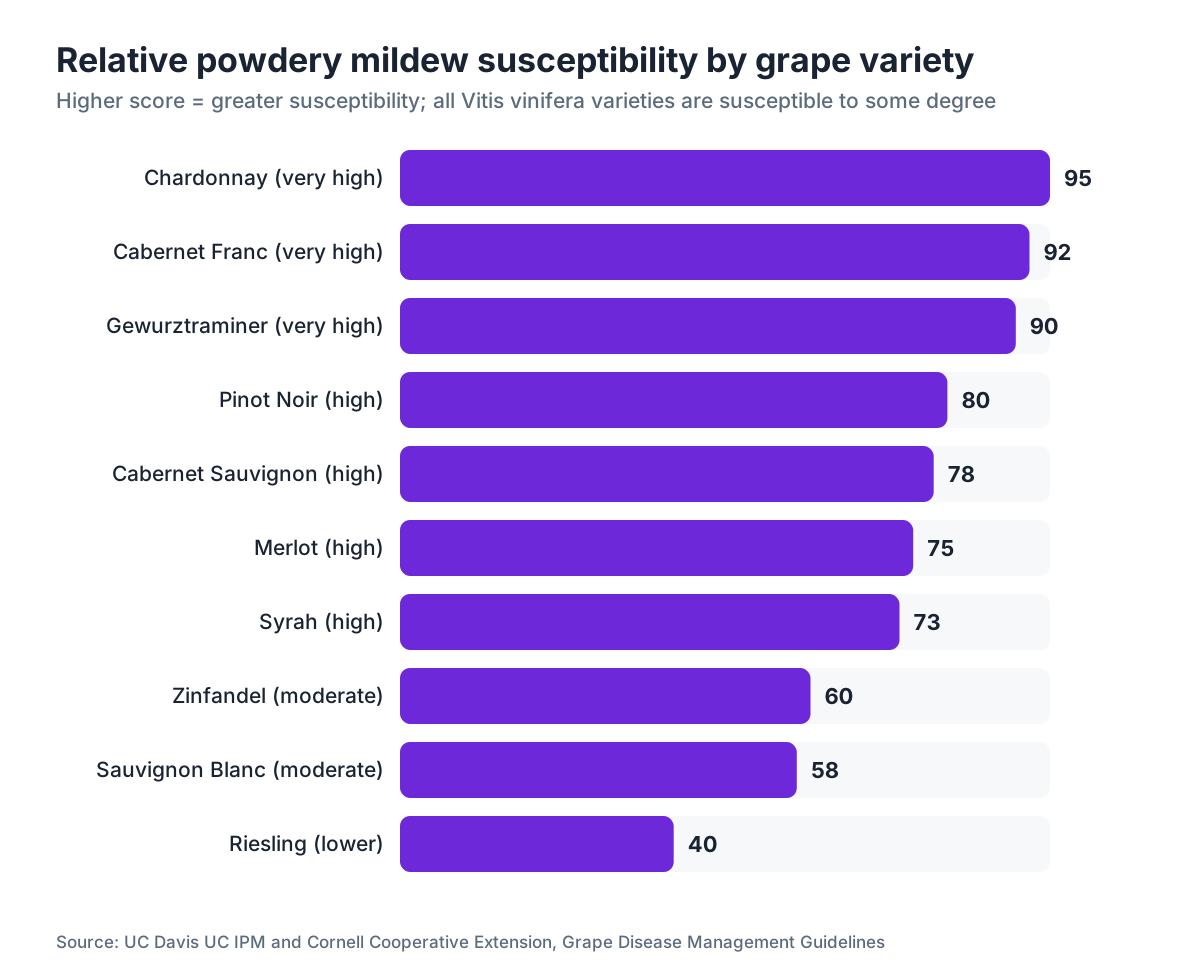
All Vitis vinifera varieties are susceptible. None are immune. Susceptibility varies enough among varieties, though, that it should shape your spray schedule and interval targets.
| Susceptibility Level | Varieties (examples) |
|---|---|
| Very high | Chardonnay, Cabernet Franc, Gewurztraminer, Carignane |
| High | Cabernet Sauvignon, Merlot, Pinot Noir, Syrah |
| Moderate | Sauvignon Blanc, Zinfandel, Grenache |
| Lower (but not resistant) | Riesling, Muscat Blanc |
This table reflects general consensus from UC Davis and Cornell extension literature [1][4]. Individual clone performance and regional adaptation matter too. Treat these as starting points, not hard rules.
Native American species like Vitis labrusca, Vitis rupestris, and Vitis rotundifolia carry varying degrees of tolerance, which is why interspecific hybrids (Marquette, Traminette, Vidal Blanc) tend to run lower powdery mildew pressure. If you grow any of these, your spray program can often be shorter or lighter than it would be on straight vinifera blocks [4].
Clonal selection matters at the margins. Within Chardonnay, some clones seem to show slightly slower mildew development in field observations, though replicated controlled data is thin. Nobody has good peer-reviewed data that cleanly separates vinifera clones on mildew resistance. The closest evidence comes from field trials comparing regional clones, and results swing from site to site.
How do you build an effective powdery mildew spray program for grapes?
Timing beats product. A perfectly chosen fungicide applied two weeks late is worth less than sulfur applied at the right growth stage.
The critical window runs from budbreak through about 3 to 5 weeks post-bloom, and especially the period right before and just after flowering through berry set. Berries more than 4 weeks past bloom start losing susceptibility as skin cells mature [2]. Concentrating your best chemistry and shortest intervals in this window is the single biggest thing you can do.
Here's a standard program structure, using California conditions as a baseline.
Early season (1-inch shoot through bloom): Every 10 to 14 days depending on variety susceptibility and weather. Sulfur works well here, especially when daytime temperatures top 60°F and allow volatilization. Do not apply sulfur when temperatures will exceed 90°F within 24 hours, since phytotoxicity risk climbs [1].
Bloom through berry set (the most critical window): Tighten intervals to 7 to 10 days. This is where you spend your best DMI (demethylation inhibitor), QoI (strobilurin), or SDHI fungicides if budget allows, rotating among FRAC groups to slow resistance [5].
Post-lag phase through veraison: Risk drops as berry skin matures. Intervals can stretch to 14 to 21 days. Sulfur is adequate for many situations if the early-season program held the disease down.
After veraison: Most programs stop or go to very long intervals. Sulfur has a 10-day pre-harvest interval, and some DMI fungicides run longer, so check labels before applying anything late [5].
FRAC group rotation is where programs live or die. E. necator has documented resistance to DMI fungicides, QoIs, and more recently to some SDHI products across multiple regions [5][6]. Never apply two consecutive sprays from the same FRAC group. The simplest approach: sulfur as your baseline, at most 2 to 3 applications from any single FRAC group per season, alternated with materials from different groups.
If you manage spray records across multiple blocks and multiple fungicide programs, software that logs application timing, FRAC group rotation, and pre-harvest intervals in one place saves real time and heads off the errors that turn into compliance headaches. VitiScribe is built for this kind of field record-keeping, with spray log templates that flag pre-harvest interval conflicts as you enter data.
Calendar-based programs should use degree-day models as a sanity check. The UC IPM Powdery Mildew Risk Index (developed by Gubler and colleagues) is a standard reference. It assigns risk on a 0 to 100 scale from temperature accumulation and tells you when intervals need to tighten or can safely stretch [3].
What fungicides are approved for powdery mildew on grapes and how do they compare?
The table below lays out the main chemistry groups and their practical tradeoffs. Every product must be on a current EPA-registered label for grapes in your state, and state registration can differ from federal. Always check CDPR, WSDA, or your state's equivalent [7].
| FRAC Group | Mode of Action | Example Active Ingredients | Resistance Risk | Curative Activity? |
|---|---|---|---|---|
| M2 (inorganic sulfur) | Multi-site | Sulfur | Very low | Minimal |
| 3 (DMI) | Sterol biosynthesis | Myclobutanil, Tebuconazole, Metconazole | Medium-high | Yes (up to 72-96 hr) |
| 11 (QoI/strobilurin) | Respiration inhibition | Azoxystrobin, Trifloxystrobin | High | Minimal |
| 7 (SDHI) | Succinate dehydrogenase | Fluopyram, Fluxapyroxad | Medium | Some |
| U8 | Unknown | Cyflufenamid | Medium | Some |
| P5 | Sterol biosynthesis | Spiroxamine | Medium | Some |
| BM02 (biological) | Multiple | Potassium bicarbonate | Very low | No |
Sulfur is cheap, effective, and resistance is essentially a non-issue. The main constraints are the heat phytotoxicity window and almost no curative activity. Miss a spray with disease already present, and sulfur will not knock it back much.
DMI fungicides like myclobutanil (Rally) offer genuine curative activity up to 72 to 96 hours after infection, which is worth a lot when equipment failure or weather blows your spray window. But resistance is real. Cornell plant pathology work has documented DMI resistance in New York vineyards [6], and California samples show similar trends. That does not mean DMIs stopped working. It means you can't lean on them as your only tool.
QoI fungicides (FRAC 11) should always ride with a partner product that has a different mode of action. Standalone QoI use has driven fast resistance in several pathogens, and UC IPM and EPA label language increasingly reflect that [7].
Organic programs lean on sulfur as the backbone, supplemented with potassium bicarbonate (Kaligreen, Milstop) and copper. Biological fungicides (Bacillus subtilis products, Reynoutria sachalinensis extract) have some efficacy data but generally need shorter intervals to keep pace with synthetic programs in high-pressure years. An OMRI listing does not guarantee efficacy in your conditions.
How does canopy management reduce powdery mildew pressure?
Spray programs do not work alone. A dense, shaded canopy wrecks fungicide coverage and builds exactly the microclimate E. necator loves: moderate temperatures, high humidity, and dead air.
Leaf removal in the fruit zone is the most consistently supported cultural practice for powdery mildew. Pulling 1 to 3 basal leaves per shoot on the sun-exposed side of the canopy (the east side in most Northern Hemisphere vineyards for morning sun) does several things at once. It improves spray penetration to the cluster zone. It pushes fruit zone temperature above the optimal mildew growth range during afternoon hours. It moves more air through the canopy and dries it faster after morning dew or fog.
Timing of leaf removal matters. Early leaf removal around bloom has cut mildew severity on clusters more than late removal in both UC Davis and Cornell trials [4]. Early removal also tends to reduce Botrytis susceptibility in tight-clustered varieties like Pinot Noir.
Shoot positioning and thinning to a sensible shoot density (roughly 4 to 6 shoots per foot of row for most VSP-trained vinifera) keeps the canopy open enough for sprays to reach interior tissue. A Ravaz index consistently above 10 means you're overcropping and carrying excess vegetative growth, and both track with higher disease pressure.
Cover crop management affects understory humidity and can move disease pressure at the margins, though the data here is thinner than for direct canopy work. In dry regions, avoiding evening overhead irrigation that leaves foliage wet overnight is common sense, but it's worth stating.
What are the EPA worker protection standard requirements for spraying powdery mildew fungicides in vineyards?
The EPA's Worker Protection Standard (WPS), codified at 40 CFR Part 170, sets minimum requirements for agricultural workers who handle or are exposed to pesticides, including fungicides used against powdery mildew [8]. If you have employees who enter treated fields or mix and load products, WPS compliance is not optional.
Here are the WPS requirements that hit vineyard spray programs hardest.
Restricted-entry intervals (REIs): Every fungicide label lists an REI, the minimum time workers must stay out of treated areas after application. Sulfur typically carries a 24-hour REI. DMI and QoI fungicides run from 12 to 24 hours. Always check the specific product label rather than assume a class default. California has state-specific REI requirements that can be stricter than the federal baseline [7].
Pesticide safety training: All agricultural workers and handlers must get WPS safety training before they work in treated areas. Training has to come from a certified trainer or an EPA-approved method, and it must be documented.
Personal protective equipment (PPE): Label language governs PPE. Mixing and loading concentrated fungicides typically calls for chemical-resistant gloves, protective eyewear, and sometimes a respirator. Keep PPE available, in good condition, and make sure workers are trained to use it.
Application exclusion zones (AEZ): Under the 2015 WPS revision, applicators must keep an AEZ around the equipment during application, typically 100 feet for airblast sprayers. Workers cannot enter that zone while spraying is active [8].
Central posting: Treated block information must be posted at a central location workers can reach, including the product applied, the REI, and the date and time of application. Spray records that double as WPS posting documentation cut your paperwork burden.
California, Washington, and New York each layer supplementary state rules on top of WPS. The California Department of Pesticide Regulation (CDPR) and Washington State Department of Agriculture (WSDA) publish state-specific guidance [7][9]. If you operate in those states, read both the federal WPS and the state-level rules.
How do you accurately record powdery mildew spray applications for compliance?
Most states require pesticide application records for restricted-use pesticides, and many require records for general-use pesticides applied commercially. California requires pesticide use reports (PURs) submitted monthly to the county agricultural commissioner for all pesticide applications on commercial vineyards, whether or not the product is restricted-use [9]. Washington requires similar records under RCW 17.21.
A compliant spray record captures at minimum: the applicator's name and license number (where required), the date and time of application, the location and acreage treated, the pest target, the product name and EPA registration number, the application rate and total amount used, the equipment used, and the REI. For WPS purposes, the record also has to be accessible to workers or their representatives.
Paper spray logs are legal, but they create real problems at audit time. Finding the record for the third spray in Block 4 three years back, or reconstructing whether you stayed within label rates for a specific product when the county asks, is painful with paper binders. The real argument for digital spray records isn't features. It's answering a compliance question in three minutes instead of three hours.
VitiScribe tracks application records by block, flags when an REI from a prior spray overlaps a planned entry, and exports PUR-formatted reports. The trial is free if you want to test whether it fits your operation.
Whatever system you run, keep records for at least 2 years (California requires 3 years for PURs). If you have gaps from prior seasons, document what you can reconstruct and note the uncertainty. A partial record beats a missing one in most compliance settings.
What economic losses does powdery mildew cause in grape production?
The range in yield loss estimates is wide, and that range honestly reflects how variable the disease is across regions, seasons, and management levels.
In unmanaged or poorly managed vineyards, yield losses of 20 to 80% have been documented in high-pressure years [1]. That's a huge spread, but it maps to real conditions. A cool, moderate-humidity spring that favors infection, plus a missed early spray, can cost you nearly the entire crop on susceptible varieties.
Quality losses are harder to quantify and often matter more to small winery owners than raw yield. Cracked berries from mildew raise Botrytis incidence, which lifts laccase enzyme activity and drives oxidation problems in the winery. Even low levels of mildew on berries can add an off-character often described as musty or mousy in the finished wine, traceable to compounds including 1-octen-3-ol and related fungal metabolites. Studies have found detectable sensory effects at as few as 3% mildew-infected berries in a lot [2].
A preventive spray program runs roughly $150 to $400 per acre per season in the U.S., depending on chemistry choices, number of applications, and equipment costs. Sulfur-heavy programs sit at the low end. Programs leaning on SDHIs or combination products push toward the high end. That's a real cost, but it's a fraction of the value of lost fruit on even a modest planting.
Calendar spray programs run without regard to risk tend to over-apply chemistry and pay for applications that don't line up with actual infection periods. Risk-model-guided programs (the Gubler-Thomas Powdery Mildew Index is the most cited reference here [3]) cut total applications by 2 to 3 per season in some California studies without raising disease severity. That's real input-cost savings.
What does current research say about resistance to powdery mildew fungicides?
Resistance to single-site fungicides (DMIs, QoIs, SDHIs) is documented and practically significant. It is not theoretical.
Cornell's plant pathology group has run statewide resistance monitoring in New York wine regions. Research there found E. necator isolates from New York vineyards with reduced sensitivity to multiple DMI fungicides, and the degree of sensitivity loss tracked with how often DMIs were used in those blocks [6]. The stated conclusion: "resistance to DMI fungicides is widespread in New York vineyards and should influence fungicide program design."
QoI (strobilurin) resistance in E. necator was first documented in the early 2000s and is now considered widespread across most U.S. wine regions. The mechanism, a point mutation in the cytochrome b gene (G143A), confers essentially complete resistance [10]. That's why QoI fungicides now show up mostly in premix products alongside a partner with a different mode of action, and why applying them solo is generally considered poor practice by extension pathologists at UC Davis, Cornell, and WSU [5][6].
SDHI resistance monitoring is more recent. A California study identified E. necator isolates with reduced SDHI sensitivity in Napa and Sonoma County vineyards that had high SDHI use histories. The authors flagged the need to limit SDHI applications to 2 per season maximum, consistent with current label restrictions on most products [5].
Practical resistance management rules:
- Do not exceed label-stated maximum applications per season per FRAC group
- Never apply two consecutive sprays from the same FRAC group (sulfur excepted)
- Include at least one multi-site mode of action (sulfur, copper) in your program each season
- Use locally adapted resistance monitoring reports if your state extension service publishes them
What grape-growing regions in the U.S. have the highest powdery mildew pressure?
Any region that holds temperatures in the 65 to 80°F range for extended stretches with adequate humidity can carry serious powdery mildew pressure. Some regions get it consistently worse than others.
The Willamette Valley in Oregon and coastal California regions like the Sonoma Coast, Anderson Valley, and parts of the Santa Cruz Mountains sit among the highest for season-long pressure. Temperatures rarely climb high enough to suppress the fungus, fog supplies humidity, and the growing season runs long. Willamette Valley Pinot Noir growers often make 10 to 15 or more applications per season on standard vinifera blocks.
Washington's Columbia Valley has lower humidity and hotter summer temperatures, which cuts pressure a lot. But spring and early summer, before temperatures climb, still allow primary infections that turn into problems if you let them go. WSU extension notes plainly that the dry climate does not remove the need for early-season fungicide coverage [11].
New York's Finger Lakes and Hudson Valley regions run moderate to high pressure, made harder by erratic weather patterns and a compressed season. Cornell's extension recommendations are tuned to these conditions and are among the most detailed available anywhere [4].
California's Central Valley (Lodi, San Joaquin Valley) gets relief from summer heat, but spring and fall windows can bite. The Gubler-Thomas Index was developed in part from San Joaquin Valley vineyard data and remains the best-validated risk model for California conditions [3].
If you're touring wine country or thinking about sourcing from specific regions, the Paso Robles wineries region in California's interior makes a useful comparison. Warmer, drier summers push mildew pressure below coastal areas, though spring applications stay necessary. Coastal South Coast Winery operations in Southern California face a different profile again, with marine influence shaping both humidity and temperature.
Frequently asked questions
What is Erysiphe necator and is it the same as Uncinula necator?
Yes, same organism. The fungus was reclassified from Uncinula necator to Erysiphe necator based on molecular phylogenetic analysis. Both names appear in older and current literature, respectively. It is an obligate biotrophic ascomycete that causes powdery mildew exclusively on Vitis species. You'll still see Uncinula necator on older extension publications and powdery mildew presentations from the 1990s and 2000s.
How do I tell the difference between powdery mildew and downy mildew on grapes?
Powdery mildew shows white to gray powdery growth on the upper leaf surface and on berries, and it does not need wet weather to spread. Downy mildew (Plasmopara viticola) shows oily yellow spots on the upper leaf surface with white cottony sporulation strictly on the underside, and it needs wet weather and free water for spore release. The two can occur at once but come from completely different organisms needing different fungicide chemistry.
Can powdery mildew survive without a grapevine host?
Practically, no. E. necator is an obligate biotroph and cannot grow on dead organic matter. It overwinters as dormant mycelium inside infected buds or as chasmothecia on bark. Once plant tissue dies, the fungus on it dies too. So destroying crop or sanitizing pruning debris will not eliminate the pathogen if infected canes stay on the vine. Inoculum comes from the vine itself, not the soil.
When should I stop spraying for powdery mildew before harvest?
Berry susceptibility drops sharply once sugar exceeds about 8 Brix, roughly 3 to 5 weeks post-bloom. Practically, most programs finish active powdery mildew protection by veraison. Pre-harvest intervals (PHIs) on product labels are the legal minimum: sulfur is typically 10 days, and DMI fungicides run from 7 to 30 days depending on the product. Check each product's label and use the longest applicable PHI for your timing.
Does rain wash away powdery mildew infections?
Rain can wash conidia off surfaces and briefly slow secondary spread, but it does not cure established infections. Heavy rain can actually trigger ascospore release from chasmothecia early in the season, raising primary infection risk. The disease does not need rain to germinate or spread once conditions are right. Do not treat a rain event as a reason to skip or delay a spray during a high-risk period.
Is sulfur safe to use on all grape varieties at all times?
No. Sulfur can cause phytotoxicity (leaf and berry burn) when applied within 24 hours of temperatures above 90°F. Some varieties, notably Concord and some muscat types, are more sensitive to sulfur phytotoxicity than others. Wettable sulfur and dusting sulfur carry different risk profiles. Check your specific product label for temperature restrictions, and avoid sulfur when heat is forecast inside the label-specified window.
What FRAC groups should I rotate for a powdery mildew program?
Core rotation groups for grape powdery mildew include FRAC M2 (sulfur, multi-site, low resistance risk), FRAC 3 (DMIs like myclobutanil, tebuconazole), FRAC 11 (QoIs like azoxystrobin, always with a partner), FRAC 7 (SDHIs, limit to 2 applications per season), and FRAC U8 (cyflufenamid). Never apply consecutive sprays from the same single-site group. Many growers use sulfur every other spray to stretch season-use limits on more expensive chemistries.
What does a flag shoot look like and why does it matter for spray timing?
Flag shoots are spring shoots that emerge already colonized with powdery mildew mycelium that overwintered inside the dormant bud. They look stunted, with small distorted leaves covered in white powder, often curled or with shortened internodes. They matter because they show up before any weather-related infection events and serve as the first source of secondary conidia in the vineyard. Seeing flag shoots tells you inoculum is present and your early-season program needs to be running now.
How does the Gubler-Thomas Powdery Mildew Risk Index work?
The Gubler-Thomas index, developed at UC Davis, uses 7-day average temperatures to assign a daily risk value (0 to 100) that accumulates over time. If 7-day average temperatures stay between 70 to 85°F, risk builds fast and spray intervals should tighten to 7 days. Averages cooler or hotter than that range lower the daily index value and allow longer intervals. Once 30 risk units accumulate, a spray is recommended. It's free through UC IPM's online tools.
Do I need a pesticide applicator license to spray fungicides in my own vineyard?
Requirements vary by state and product category. For restricted-use pesticides (RUPs), a licensed private or commercial applicator must perform or supervise the application in most states. General-use fungicides like sulfur usually don't require a license for application by the owner-operator on their own land, but employee applicators may face added requirements. California, Washington, and New York have state-specific licensing rules. Check with your state department of agriculture for the rules that apply to your operation.
Can I use biological fungicides alone to manage powdery mildew on grapes?
In most vinifera vineyards with moderate to high pressure, biological fungicides alone are not reliable enough. Products based on potassium bicarbonate, Bacillus subtilis, or Reynoutria sachalinensis can contribute meaningfully to a program, especially in low-pressure years or on less-susceptible varieties. In certified organic vineyards, sulfur stays the backbone, with biologicals used to complement or extend intervals. Relying only on biologicals on a variety like Chardonnay in a high-pressure region is a real financial risk.
What records do I need to keep for powdery mildew fungicide applications?
At minimum: product name and EPA registration number, active ingredient, application date and time, location and acres treated, target pest, application rate and total volume, equipment used, applicator name, and the REI. California also requires monthly pesticide use reports to the county agricultural commissioner for all commercial pesticide applications. Most states require records kept for at least 2 years; California requires 3 years. WPS requires treated-area information posted and accessible to workers.
How much does a powdery mildew spray program cost per acre per year?
A realistic range in the U.S. is $150 to $400 per acre per season for fungicide inputs alone, not counting labor and equipment. Sulfur-heavy programs with 8 to 12 applications on a medium-pressure site might run $150 to $200 per acre. Programs adding SDHIs and combination products on high-pressure, highly susceptible varieties can reach $350 to $400 per acre or more. These are input costs only; labor and tractor time add significantly to the total.
Are there powdery mildew-resistant grape varieties available for commercial planting?
No commercially planted Vitis vinifera variety is resistant. Interspecific hybrids bred with native American Vitis parentage, such as Marquette, Traminette, Frontenac, and Vidal Blanc, carry partial resistance that meaningfully reduces spray needs. University of Minnesota, Cornell, and other breeding programs are actively developing new hybrids with better resistance profiles. For winery-focused growers committed to vinifera, resistance is not a near-term option, and active spray management stays necessary.
Sources
- UC Davis UC IPM, Grape Powdery Mildew Disease Management Guidelines: Flag shoots appear in 5-30% of shoots in infected vineyards; overwintering mycelium in buds is a primary early-season inoculum source; all Vitis vinifera varieties are susceptible
- UC Davis Plant Pathology, Powdery Mildew of Grape (Erysiphe necator) berry susceptibility window: Berry susceptibility to powdery mildew extends from just after bloom through approximately 8 Brix sugar content, roughly 3-5 weeks post-bloom; detectable sensory effects found at as few as 3% infected berries
- UC Davis UC IPM, Powdery Mildew Risk Index (Gubler-Thomas model): Optimal E. necator growth at 68-77°F; Gubler-Thomas index uses 7-day average temperature to assign daily risk values on a 0-100 scale; risk-model-guided programs can reduce applications by 2-3 per season
- Cornell Cooperative Extension, Grape Disease Management: Interspecific hybrid varieties have lower powdery mildew pressure; early leaf removal around bloom reduces mildew severity on clusters more than late removal; variety susceptibility table consensus
- UC Davis UC IPM, Fungicide Resistance Management for Grape Powdery Mildew: SDHI resistance documented in Napa and Sonoma County vineyards; limit SDHI applications to 2 per season; QoI fungicides should not be used solo due to resistance risk
- Cornell University College of Agriculture and Life Sciences, DMI Resistance in Erysiphe necator, New York Vineyards: DMI resistance widespread in New York vineyards correlated with use frequency; research stated 'resistance to DMI fungicides is widespread in New York vineyards and should influence fungicide program design'
- California Department of Pesticide Regulation, Pesticide Registration and Use: California state registration can differ from federal EPA registration; state-specific REI requirements may be stricter than federal; QoI label language increasingly restricts solo use
- EPA Agricultural Worker Protection Standard (WPS), 40 CFR Part 170: WPS requirements for REIs, pesticide safety training, PPE, and application exclusion zones of 100 feet for airblast sprayers; 2015 WPS revision added AEZ requirements
- California Department of Pesticide Regulation, Pesticide Use Reporting: California requires monthly pesticide use reports for all commercial pesticide applications on vineyards; records must be kept 3 years
- USDA National Agricultural Library: FRAC group classifications for fungicide mode of action rotation; G143A point mutation in cytochrome b gene confers complete QoI resistance in powdery mildew pathogens
- Pacific Northwest Plant Disease Management Handbook (WSU, OSU, UI): Columbia Valley dry climate does not eliminate need for early-season fungicide coverage; regional risk model tools for powdery mildew timing
Last updated 2026-07-09