Powdery mildew on grape leaves: identification, timing, and control
TL;DR
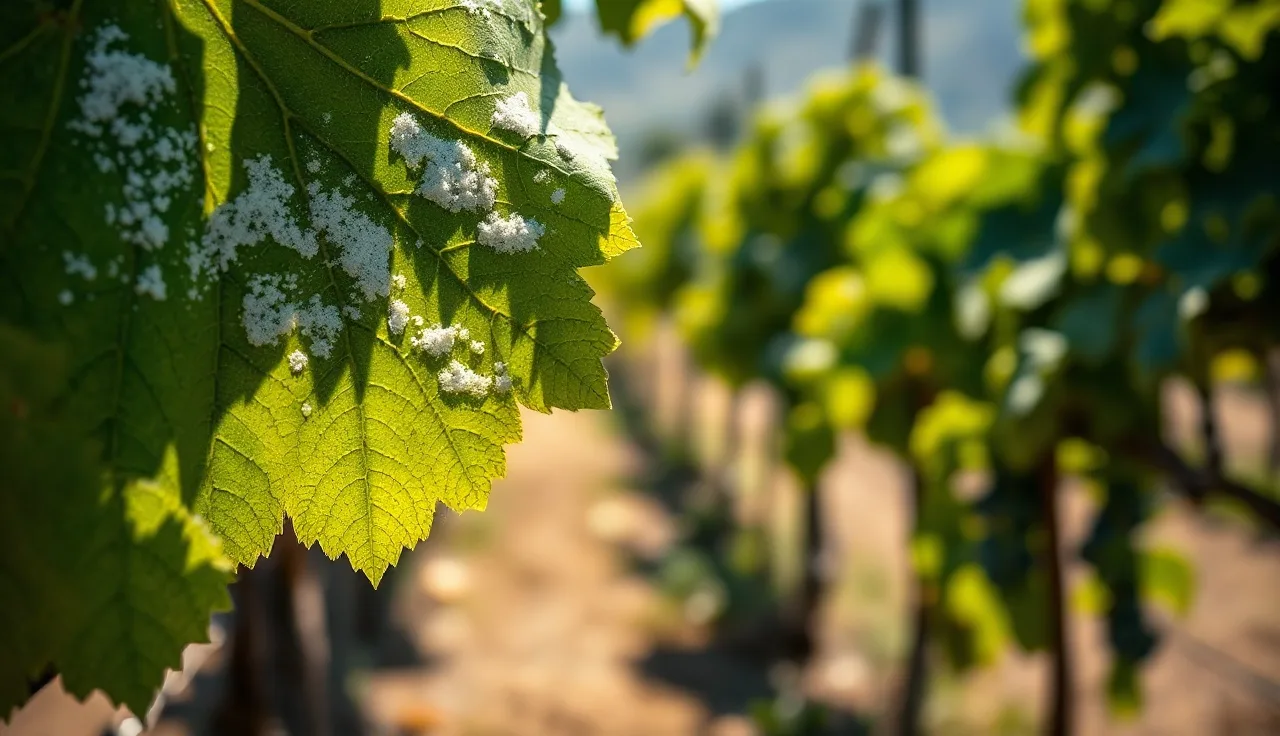
- Powdery mildew on grape leaves shows as white-gray powder on the upper leaf surface and can destroy 30 to 80% of a crop if pressure is high.
- It spreads fastest between 70 to 85°F with no rain needed.
- Downy mildew is a separate pathogen that requires leaf wetness and appears as yellow oil spots on top, white fuzz below.
- Control programs differ significantly for each.
What does powdery mildew look like on grape leaves?
The first thing you'll notice is a white or light gray powdery coating on the upper surface of young leaves. It looks almost like someone dusted the vine with flour. That coating is the mycelium and conidia of Erysiphe necator (formerly Uncinula necator), and it's living right on the leaf surface rather than inside the tissue.
Older infections turn grayish-brown, and infected tissue often puckers or distorts. Leaves that get hit early, when they're still expanding, may become cupped, stunted, and fail to flatten out normally. You'll also see the same powdery coating on green shoot tips, petioles, and cluster stems.
On berries, powdery mildew causes a different set of symptoms: surface russeting early in the season, then cracking and splitting as berries expand and the infected skin loses its elasticity. Split berries invite Botrytis and other secondary rots. At harvest, heavily infected fruit delivers reduced sugar, elevated pH, and off-aromas in the finished wine. A 2009 UC Davis study found that even moderate powdery mildew on clusters reduced must sugar by up to 2 Brix and increased volatile acidity in wine made from that fruit [1].
Under a hand lens (10x is fine), you'll see chains of oval spores on short stalks called conidiophores. That's diagnostic. Nothing else on a grapevine leaf looks like that structure.
What is the difference between powdery mildew and downy mildew on grapes?
This is the question that trips up new vineyard managers more than any other. They're completely different organisms that happen to share part of a common name.
Powdery mildew is caused by Erysiphe necator, an obligate biotrophic ascomycete. It does not need free water on the leaf to infect. In fact, rain can actually wash spores off. It spreads best in warm, moderate humidity conditions, and it grows on the surface of plant tissue, visible as that white powder on the upper leaf side.
Downy mildew is caused by Plasmopara viticola, an oomycete (water mold, not a true fungus at all). It absolutely requires free water on the leaf surface for spore germination and penetration. The classic symptom on the upper leaf surface is a pale yellow, oily-looking spot, sometimes called an "oil spot." Flip the leaf over during a wet morning and you'll see white, cottony sporulation on the underside where the stomata are. That's the diagnostic tell.
Here's a quick comparison to keep in your field notebook:
| Feature | Powdery Mildew | Downy Mildew |
|---|---|---|
| Pathogen | Erysiphe necator (ascomycete) | Plasmopara viticola (oomycete) |
| Free water needed? | No | Yes (leaf wetness required) |
| Upper leaf symptom | White-gray powder | Yellow oil spot |
| Lower leaf symptom | Powder sometimes visible | White cottony fuzz |
| Berries affected? | Yes, cracking/russeting | Yes, rotting/brown leather rot |
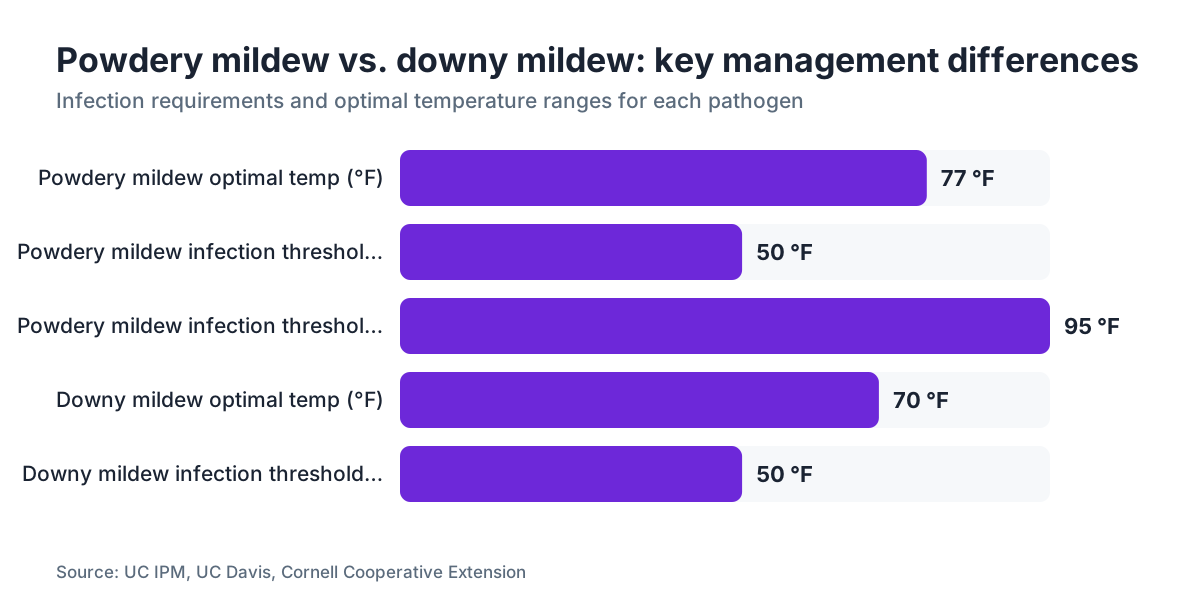
| Temperature optimum | 70 to 85°F (21 to 29°C) | 64 to 75°F (18 to 24°C) |
| Fungicide class that works | DMIs, strobilurins, sulfur | Phenylamides, phosphonates, copper |
The two diseases can occur at the same time in the same vineyard block, which is one reason confused diagnosis leads to spray failures. If you spray sulfur to manage powdery mildew during a wet, cool spring, you're doing nothing for the downy mildew establishing next to it [2].
Cornell's viticulture program puts it plainly: the diseases have "opposite environmental requirements" and "require separate management programs" [3]. That's the key sentence to remember.
What conditions cause powdery mildew to spread on vines?
Erysiphe necator overwinters primarily as chasmothecia (sexual fruiting bodies) on infected cane bark and as dormant mycelium inside infected buds. When temperatures warm above about 50°F in spring, those overwintering structures begin maturing. The first rain event of the season, or even just high humidity, triggers chasmothecia to release ascospores, and those primary infections land on emerging shoot tissue.
From there, the asexual cycle takes over. Conidia (the asexual spores that form the white powder) spread by wind and splash. Infection can happen in as little as 5 hours at 77°F when relative humidity is above 40%. The latent period, from infection to visible symptoms, runs about 7 days in warm conditions and up to 14 days when cooler [4].
The temperature sweet spot is 70 to 85°F. Below 50°F, infection basically stops. Above 95°F, high light and heat can actually suppress the pathogen temporarily, though this protection disappears the moment temperatures drop back into range. Growers in hot interior valleys sometimes see a summer lull followed by a damaging fall peak when September temperatures moderate.
High humidity without rain is fine for this pathogen. That means fog, heavy dew, and dense canopies with poor air circulation all amplify risk. Tucked-in, unhedged canopies in coastal regions are among the worst situations you can be in.
Early-season tissue is far more susceptible than mature tissue. UC Davis research has consistently shown that the 3-inch shoot through berry set window, roughly bloom through 4 to 5 weeks post-bloom, is when infections that cause real yield damage happen [1]. Getting behind during that window is hard to recover from.
How much yield loss does powdery mildew on grapes actually cause?
Numbers here matter and they're sobering. In unmanaged or poorly managed vineyards, powdery mildew can cause 30 to 80% crop loss in susceptible varieties [1]. Even in managed programs with occasional gaps, losses of 10 to 20% are common in high-pressure years in California's North Coast and the Willamette Valley.
Berry loss is only part of the picture. Infected clusters that don't drop still deliver poor fruit quality. The UC Davis work mentioned earlier documented measurable wine quality reductions from moderate cluster infection, including sulfur-compound off-aromas in finished wine [1]. For wineries paying premium prices on contracts tied to quality, that's the more financially damaging outcome.
Carryover inoculum is also a real issue. A block that takes a powdery mildew hit one season enters next year with dramatically higher chasmothecia populations on the bark. That's not a one-year problem; it compounds.
Washington State University Extension estimates that powdery mildew management, across all approaches, costs Washington growers somewhere between $150 and $450 per acre per season depending on the spray program, spray intervals, and whether they're using electrostatic applicators or conventional airblast [5]. Those numbers are a few years old and input costs have moved, but the relative scale is right.
Which grape varieties are most susceptible to powdery mildew?
Almost all Vitis vinifera is highly susceptible. There are no commercially relevant vinifera varieties with genuine field resistance, though there are differences in relative susceptibility worth knowing.
Among the more susceptible vinifera: Chardonnay, Cabernet Sauvignon, Merlot, Zinfandel, and Riesling are frequently cited as requiring intensive programs. Muscat varieties tend to be hit hard. Gewürztraminer in cool coastal sites can be bad.
Somewhat less pressure is typical on Sauvignon Blanc, Pinot Gris, and Grenache in hot, dry interior sites, though "less pressure" does not mean "no program needed."
American species and many hybrid varieties carry meaningful resistance. Concord, Niagara, and most Vitis labrusca show far less powdery mildew than vinifera. Disease-resistant hybrid varieties like Marquette, Frontenac, and the Geneva series from Cornell were specifically bred with powdery mildew resistance as a target trait [3]. For growers in the Northeast or Midwest who have the option of variety selection, this matters.
There's also a canopy architecture component that intersects with variety. Vigorous varieties on productive rootstocks in wet regions build dense canopies that trap humidity and shade out fungicide penetration. The variety choice and the trellis system together determine baseline risk.
When should you start spraying for powdery mildew on grapevines?
Start earlier than you think you need to. Most experienced advisors in California's North Coast will tell you to put your first spray on at 1-inch shoot growth, or even at bud swell in blocks with a history of bad pressure. By the time you see white powder on leaves, you're already 7 to 14 days behind the infection that caused it [4].
The UC Davis Integrated Pest Management program uses degree-day models to time first sprays in relation to primary ascospore release. Their UC Powdery Mildew Risk Index, accessible through the UC IPM website, lets you input local temperature data to get a relative risk score [4]. It's free, it's well-validated, and a surprising number of growers still don't use it.
For most programs, the spray calendar looks something like this:
- 1-inch shoot growth: first application, sulfur or oil-based program
- 6-inch shoot through bloom: highest intensity window, 7 to 10 day intervals
- Post-bloom through 4 to 5 weeks after bloom: maintain tight coverage on clusters
- Berry touch (when berries begin touching in the cluster): sulfur timing becomes critical, sulfur can cause phytotoxicity on heat-stressed berries, so switch materials as needed
- After veraison: risk drops substantially, most programs thin or stop
If you're tracking spray intervals in a spreadsheet or paper log, you're probably missing coverage gaps you don't realize are there. A tool like VitiScribe centralizes spray records against your block history and flags when an interval has stretched, which matters during a season when you're juggling multiple spray programs across blocks at different risk levels.
EPA's Worker Protection Standard requires that you maintain application records for pesticides applied to agricultural establishments for at least two years, and those records must include the date, location, product name, EPA registration number, amount applied, and applicator name [6]. That's a compliance floor, not a ceiling.
What fungicides work against powdery mildew on grape leaves?
You have real options here, and the choice of what to rotate matters as much as what you pick for any single spray.
Sulfur is still the workhorse. It's cheap, effective, has no resistance issues after a century of use on grapes, and is approved for organic programs. The downsides: it has a short residual (5 to 7 days in hot, dry conditions), it can cause phytotoxicity above 95°F or within two weeks of an oil application, and it does nothing for downy mildew. Use sulfur to anchor your early-season program and at key intervals through the season.
DMI (demethylation inhibitor) fungicides, the sterol-biosynthesis inhibitors like tebuconazole, myclobutanil, and trifloxystrobin-containing premixes, are more effective in protective and curative applications. They have a 3 to 7 day kick-back window, meaning they can stop an established infection if applied within that window of initial penetration. Resistance to DMIs in Erysiphe necator populations is documented in California and the Pacific Northwest, which is why strict rotation is non-negotiable [7].
Strobilurin (QoI) fungicides like azoxystrobin and pyraclostrobin are effective but carry a high resistance risk. Many programs limit them to 2 applications per season and never in consecutive sprays. FRAC code rotation, alternating FRAC 3, FRAC 11, FRAC 7, and FRAC M2 (sulfur), is the current recommendation from most extension programs [3][10].
Kaolin clay, potassium bicarbonate, and biological products like Bacillus subtilis-based materials have a place in lower-pressure situations or as season-extenders after veraison. They're not strong enough to anchor a program in a high-pressure site.
For organic programs, copper is commonly used against downy mildew but has little activity on powdery mildew. Don't confuse the two. Organic powdery mildew programs rely primarily on sulfur, oils (neem, mineral), and potassium bicarbonate, and they require tighter intervals because residual activity is shorter [8].
How do you manage powdery mildew differently from downy mildew in the same vineyard?
Running a dual-disease program in a rainy-spring region like the Willamette Valley or Finger Lakes is the normal situation. It requires thinking about two different pathogens with different timing triggers, different fungicide modes of action, and different application thresholds.
For downy mildew, the primary infection model is the "10-10-24" rule from the Goidanich system (or its regional adaptations): infection risk is high when temperatures stay above 50°F (10°C), there are at least 10 mm of rainfall, and the following 24 to 48 hours are warm. WSU and Cornell both publish regional disease forecasting tools calibrated to local conditions [3][5].
For powdery mildew, the trigger is temperature accumulation and leaf wetness plays almost no role in the infection decision.
In practice, most growers in dual-pressure regions use premix fungicides that combine an oomycide (for downy mildew) with a DMI or strobilurin (for powdery mildew) during the high-risk spring window. Products like Revus Top (mandipropamid + difenoconazole) or Zampro (ametoctradin + dimethomorph) with a tank-mix DMI cover both diseases in one pass. That approach works as long as you're managing resistance across both pathogen populations at once, which means your FRAC rotation now has two sets of constraints to track at the same time.
Spray records that capture product, FRAC code, rate, and date by block are the only way to stay honest about your rotation. Paper logs work, though the pattern analysis is tedious. The point is: you have to actually do it, not approximate it from memory at season's end.
Can powdery mildew on grape leaves be identified without lab testing?
Yes, in most cases. The visual diagnosis is reliable enough for experienced eyes, especially with a hand lens.
The key confirmation is the white-to-gray powdery coating on the upper leaf surface, chains of oval conidia visible under 10x magnification, and the absence of a leaf-wetness requirement (if you found it after a dry stretch, it's almost certainly powdery mildew).
Where field diagnosis gets harder: early-season infections in tight canopies where you're seeing leaf distortion before visible mycelium, sites with mixed pressure where both pathogens are present, or any situation where a spray program has partially suppressed symptoms and the remaining signs are ambiguous.
In those cases, submitting a sample to a plant diagnostic lab is worth the $30 to 60 fee. UC Davis, Cornell, and most land-grant university plant pathology departments run diagnostic labs that can confirm the pathogen from a fresh sample. Results usually come back in 3 to 7 business days [3].
For the field, the fastest distinguishing test between powdery and downy mildew remains the simplest one: flip the leaf. Powdery mildew has the powder on top. Downy mildew has the cottony sporulation on the underside. Both can coexist on the same leaf in high-pressure seasons, so check both surfaces every time.
What records do you need to keep for powdery mildew spray applications?
Federal law under the EPA Worker Protection Standard (WPS) requires that all pesticide applications to agricultural establishments be recorded and kept for a minimum of two years. The required data fields are: crop or site treated, location of application, date, product name and EPA registration number, amount of product applied, and the name and certification number of the certified applicator if the product is restricted-use [6].
California has stricter requirements through the California Department of Pesticide Regulation's use reporting system. In California, every pesticide application (restricted or not) must be reported to the county agricultural commissioner within 7 days of application, and records must be maintained for 3 years [9]. Several other states have similar state-level reporting layers on top of federal minimums.
For growers selling to wineries under sustainability certification programs (Lodi Rules, CSWA, LIVE, Deep Roots), the record requirements typically go further. You'll need application timing relative to phenological stage, target pest, efficacy ratings, and sometimes weather conditions at application.
If you're scaling spray records across multiple blocks with different varietals, pressure histories, and spray windows, the administrative load compounds quickly. VitiScribe was built specifically for this situation, capturing block-level spray records in a format that satisfies WPS, state reporting, and third-party sustainability audits from the same data entry.
Keep copies of your pesticide labels in the field or cab during application. The label is a legal document, and applying at an off-label rate or to an unlabeled site is a federal violation regardless of your record-keeping quality.
Are there organic options for powdery mildew control on grapevines?
Yes, and they're more effective than they used to be, though they still require more attention to interval timing than conventional programs.
Sulfur remains the backbone of every organic powdery mildew program. It's OMRI-listed, inexpensive (roughly $15 to 25 per acre per application at typical label rates), and has no resistance concerns. The liability is phytotoxicity risk above 90 to 95°F and the relatively short residual that demands 7-day intervals in peak-pressure windows.
Neem oil and other plant-based oils are registered and useful as protectants. They're often rotated with sulfur to extend the program and reduce sulfur application frequency. The 2-week sulfur-oil buffer (some labels require 2 to 3 weeks between applications of oil and sulfur to avoid phytotoxicity) is a real operational constraint that catches growers off guard.
Potassium bicarbonate products (like Kaligreen or Milstop) work by disrupting the osmotic environment on the leaf surface where E. necator lives. They're good for late-season programs or in seasons where pressure has dropped and you're maintaining rather than fighting. Efficacy data from the Washington State University organic trial work suggests they're roughly comparable to sulfur under low to moderate pressure, but fall short under high pressure [5].
Biological fungicides based on Bacillus subtilis (Serenade) or Trichoderma species are in the toolkit but generally work best as supplements, not anchors, in high-pressure vinifera programs. The University of California IPM program classifies them as "supplemental" in their powdery mildew guidelines [4].
For certified organic vineyards, you also need to verify that any product you use has an OMRI listing or NOP-compliant status before purchase, not after. Keep that documentation with your spray records.
How does canopy management affect powdery mildew pressure?
Enormously, and it's probably the most underrated lever in the whole program.
Dense, unmanaged canopies create the microclimate that powdery mildew loves: moderate temperatures, elevated humidity, and poor spray penetration. A vine with 14 layers of leaves in the fruit zone is not going to get adequate fungicide coverage regardless of what you spray or how good your airblast calibration is.
Leaf pulling in the fruit zone, done before or at bloom in warm regions, does multiple things at once. It improves air circulation, reduces humidity around the clusters, exposes fruit to UV radiation (which has some direct suppressive effect on E. necator), and dramatically improves spray deposition on clusters and shoot bases where early infections originate.
Hedging shoot tips removes the youngest, most susceptible tissue and also opens the canopy top. Timing matters: hedging too early just stimulates lateral growth and you end up with more canopy, not less.
Research from UC Davis found that leaf removal at bloom in Chardonnay reduced powdery mildew cluster incidence by 30 to 50% compared to non-leaf-pulled controls in moderate-pressure years, even without adjusting the spray program [1]. That's a big effect for something that costs $150 to 300 per acre in labor and is happening anyway for quality reasons.
For grapevines growing on steep hillside sites where airblast access is limited, canopy management is even more important because spray coverage is harder to achieve mechanically.
Frequently asked questions
What does early powdery mildew on grape leaves look like before the white powder appears?
Before visible powder develops, infected young leaves often show a slight chlorotic (yellow-green) puckering or cupping. The tissue looks a bit off but nothing definitive. Under a 10x hand lens, you may see faint mycelium starting to develop on the upper surface. By the time white powder is obvious to the naked eye, the infection is already 7 to 14 days old and sporing heavily.
Can powdery mildew on grape leaves spread to fruit?
Yes, and berry infection is the commercially damaging outcome. Erysiphe necator infects young berries easily from shortly after fruit set through the period when berries reach about 8 to 10mm diameter. Infected skin loses elasticity, causing cracking and splitting as berries expand, which invites secondary Botrytis rot. Even berries that don't crack deliver reduced sugar, elevated pH, and off-aromas in wine.
Is powdery mildew on grapes the same pathogen as powdery mildew on other crops?
No. Grape powdery mildew is caused by Erysiphe necator, which is host-specific to Vitis species and does not infect vegetables, roses, cucurbits, or other common powdery mildew hosts. Each crop has its own specific powdery mildew species. You cannot spread grape powdery mildew to a rose bush, and the powdery mildew on your squash plants is not a threat to your vines.
What is the difference between powdery mildew and downy mildew on grapes in terms of treatment?
They require completely different fungicide classes. Powdery mildew responds to sulfur, DMI fungicides (FRAC 3), and strobilurins (FRAC 11). Downy mildew requires oomycide-active materials like phenylamides (FRAC 4), phosphonate fungicides (FRAC 33), or copper. Copper is often used against downy mildew but has little activity on powdery mildew, which confuses growers who use copper and then wonder why powdery mildew persists.
How often should you spray for powdery mildew on grapevines during bloom?
At bloom, most programs use 7-day intervals in high-pressure sites and 10-day intervals in lower-pressure situations. This is the most important window in the season. Infections that establish at bloom and shortly after are responsible for most berry-level damage and yield loss. Letting intervals stretch to 14 days during bloom in a warm, moderate-humidity season is one of the most common and costly mistakes in powdery mildew management.
Does rain help or hurt powdery mildew on grape leaves?
Light to moderate rain can actually knock conidia (the wind-dispersed asexual spores) off leaf surfaces, giving brief suppression. But rain does nothing to stop primary ascospore release, and wet weather that follows dry warm periods can still trigger primary infections if the timing lines up with spore maturation. Heavy rains also wash off sulfur residues, forcing re-application. Rain is more of an operational complication than a reliable control factor.
What temperature kills or suppresses powdery mildew on grapevines?
Sustained temperatures above 95°F, especially combined with high solar radiation, can suppress or temporarily kill surface mycelium and conidia. Below 50°F, infection essentially stops. But the pathogen doesn't die at these extremes; it pauses. As soon as temperatures return to the 70 to 85°F optimal range, infections resume from any surviving mycelium or from overwintering structures that release new spores the following spring.
How do I know if my grape variety is high-risk for powdery mildew?
All Vitis vinifera is high-risk by default. Among vinifera, Chardonnay, Cabernet Sauvignon, Merlot, Zinfandel, and Muscat are frequently cited as most susceptible by UC Davis and Cornell extension materials. American species like Concord and disease-resistant hybrids like Marquette carry meaningful natural resistance. If you're growing vinifera in a humid region, assume high risk regardless of variety and build your spray program accordingly.
How long do powdery mildew fungicide residues last on grape leaves?
Sulfur residues are effective for about 5 to 7 days under hot, dry conditions and up to 10 days in cooler weather. DMI fungicides have residual activity of 7 to 10 days and a 3 to 5 day curative kick-back window. Strobilurins run 10 to 14 days protectively. Rain or heavy dew shortens all of these estimates. Re-apply sulfur within 5 days of any rain event exceeding 0.25 inches during peak pressure windows.
What are the EPA record-keeping requirements for powdery mildew spray applications?
Under EPA's Worker Protection Standard, all pesticide applications to agricultural establishments must be recorded and kept for at least two years. Required fields include: crop and application location, date, product name and EPA registration number, amount applied, and the certified applicator's name and certification number for restricted-use products. California requires records for three years and mandates reporting to the county agricultural commissioner within 7 days of application.
Can you see powdery mildew on the underside of grape leaves?
Occasionally, but it's not the primary sign. Powdery mildew mycelium and spores develop predominantly on the upper leaf surface because E. necator penetrates through the epidermal cells on the adaxial side. You may see faint powdery residue on the underside in heavy infections, but this is secondary. The definitive diagnostic difference: downy mildew shows its sporulation on the underside, powdery mildew shows it on top.
Is there a powdery mildew disease forecasting model I can use for free?
Yes. UC Davis and UC IPM publish the UC Powdery Mildew Risk Index online, which uses local temperature data to estimate spore release and infection risk throughout the season. It's available through the UC IPM website at no cost. WSU Extension also publishes DM and PM forecasting tools calibrated to Pacific Northwest conditions. Cornell's Network for Environment and Weather Applications (NEWA) offers disease models for Northeast growers, also free.
How do dual-disease premix fungicides work for managing both powdery and downy mildew?
Premix products combine an oomycide-active ingredient (effective on downy mildew, which is an oomycete) with a DMI or strobilurin (effective on powdery mildew). One spray covers both pathogens in a single pass. The trade-off is that you're now advancing the resistance clock on two separate pathogen populations at the same time, which makes disciplined FRAC code rotation across the full season even more important than when managing the diseases separately.
Sources
- UC Davis Viticulture & Enology, Powdery Mildew of Grape: Powdery mildew can cause 30 to 80% crop loss in unmanaged vineyards; moderate cluster infection reduced must sugar by up to 2 Brix and increased volatile acidity in finished wine
- UC IPM, Grape Powdery Mildew Management Guidelines: Powdery mildew does not require free moisture for infection; sulfur has no activity on downy mildew
- Cornell University Cooperative Extension, Grape Disease Management: Powdery and downy mildew have opposite environmental requirements and require separate management programs; disease-resistant hybrids like Marquette bred with powdery mildew resistance
- UC IPM, UC Powdery Mildew Risk Index for Grapes: Infection can occur in as little as 5 hours at 77°F; latent period is 7 to 14 days depending on temperature; degree-day models used to time first sprays
- Washington State University Extension, Pacific Northwest Pest Management Handbooks, Grape: Powdery mildew management costs Washington growers $150, $450 per acre per season; potassium bicarbonate is comparable to sulfur under low-moderate pressure but falls short under high pressure
- EPA Worker Protection Standard, 40 CFR Part 170: Pesticide application records must be maintained for at least two years and include date, location, product name, EPA registration number, amount applied, and certified applicator name
- University of California Cooperative Extension, Fungicide Resistance in Erysiphe necator: DMI fungicide resistance in Erysiphe necator populations is documented in California and the Pacific Northwest
- USDA National Organic Program, Allowed and Prohibited Substances: Sulfur, copper, and plant-based oils are among the materials allowed in certified organic production for disease management
- California Department of Pesticide Regulation, Pesticide Use Reporting Requirements: California requires all pesticide applications to be reported to the county agricultural commissioner within 7 days and records maintained for 3 years
- FRAC (Fungicide Resistance Action Committee), Mode of Action Classification: FRAC code rotation guidelines recommend alternating FRAC 3, FRAC 11, FRAC 7, and FRAC M2 (sulfur) to manage resistance in powdery mildew populations
- Cornell NEWA, Network for Environment and Weather Applications, Disease Forecasting: Cornell NEWA provides free disease forecasting models for Northeast grape growers including powdery and downy mildew models
- WSU Extension, Downy Mildew of Grape, Pacific Northwest Plant Disease Management Handbook: Downy mildew infection requires free water on leaf surface and temperatures above 50°F for spore germination and penetration; the 10-10-24 infection model used for timing
Last updated 2026-07-09