Supplemental label use requirements for vineyard spray records

TL;DR
- A supplemental label is a legally binding extension of the master pesticide label.
- Its directions (application rates, restricted-entry intervals, PPE, and site-specific restrictions) are enforceable under FIFRA.
- Your vineyard spray records must show the supplemental label existed, was on-site during application, and that you followed it, more than the container label.
What is a supplemental label and why does it bind you legally?
A supplemental label is an extra document, registered with the EPA and often a state lead agency too, that a pesticide registrant attaches to a product to expand, restrict, or clarify use directions that don't fit on the container. It carries the same legal weight as the printed label under the Federal Insecticide, Fungicide, and Rodenticide Act (FIFRA), 7 U.S.C. § 136 et seq. [1]. "The label is the law" is more than a catchy line from your pesticide safety course. It is the legal standard.
A supplemental label that restricts application to certain growth stages, tightens the restricted-entry interval (REI), or demands a different spray volume beats any conflicting statement on the original container. Follow the container label but ignore the supplemental label and you have made an inconsistent use. That is a federal violation.
Supplemental labels come in a few forms. Some registrants issue them to add new crops or use sites. Others use them to respond to new resistance data, environmental concerns, or conditions attached to a registration renewal. California's Department of Pesticide Regulation (CDPR) often attaches California-specific supplemental labeling to federal registrations, especially for materials with surface-water runoff risk in wine-grape regions [2]. Washington also issues supplemental labeling through the Washington State Department of Agriculture (WSDA) for certain organophosphates and fungicides where bee-protection language differs from the federal label [3].
The practical point is simple. Before you spray anything, get the current supplemental label along with the container, and confirm your application matches both.
Where do you find supplemental labels before an application?
The EPA's label database, the Pesticide Product Label System (PPLS), holds master labels for federally registered products [4]. But supplemental labels don't always land there right away, and state-specific ones live on state agency sites. Check a few sources before every spray.
- The registrant's product website. Big ag-chem companies (BASF, Corteva, Syngenta, Bayer) post current supplemental labels in their product portals, and those update faster than the federal database.
- Your state department of agriculture's pesticide registration section. CDPR, WSDA, and New York DEC all run searchable registration databases.
- The EPA's pesticide registration pages, which link to PPLS.
- Your pest control adviser (PCA) or certified crop adviser (CCA). In states like California, they're legally obligated to give you the current label before making a recommendation [2].
Download and print or save a PDF of the supplemental label before the day of application. "Current at time of application" is the standard. A label you pulled two years ago that has since been revised does not protect you.
If you buy a restricted-use pesticide (RUP), the seller is supposed to hand you the current labeling. Don't lean on that as your only check. Sellers sometimes move older stock.
What exactly must a vineyard spray record capture about supplemental labels?
FIFRA and the Worker Protection Standard (WPS) set a floor for pesticide use records. Most states pile more on top. Here is what the federal floor and common state rules demand together.
| Record element | Federal WPS requirement | Typical state-level addition |
|---|---|---|
| Product name and EPA registration number | Required [5] | Often also require formulation type |
| Active ingredient(s) | Required [5] | Some states require concentration |
| Amount applied and area treated | Required [5] | CA requires pounds of active ingredient per acre |
| Application date and time | Required [5] | Some states require time of day for bee-protection windows |
| Restricted-entry interval (REI) from the label | Required [5] | CA requires REI source (label vs. supplemental label) |
| Supplemental label identifier | Not explicitly required federally | CA, WA, NY require notation when a supplemental label governs the application |
| Pre-harvest interval (PHI) | Not in WPS but required by CDPR and WSDA | Often requires specifying which label document set the PHI |
| Applicator name and license number | Required [5] | RUP applications require license number everywhere |
The single most useful thing to add when a supplemental label is in play: note its title, version date, or EPA registration amendment number in your spray log. This one habit closes most compliance gaps. If a state or federal inspector shows up after a reported drift incident or a food-safety audit, you need to prove you knew the supplemental label existed, had it at the application site, and applied the product consistent with it.
UC Cooperative Extension advises growers to reference the supplemental label number in the pesticide use report (PUR) entry for that application [6]. That guidance comes out of California practice, but it's sound procedure in every state.
How do REIs on supplemental labels differ from the container label, and how do you record both?
Restricted-entry intervals are where supplemental labels most often tighten the rules. A broad-spectrum fungicide's container label might list a 12-hour REI for enclosed spaces and a 4-hour REI outdoors. A supplemental label written for California coastal fog-belt conditions might push the outdoor REI to 24 hours based on residue dissipation data. You follow whichever REI is more protective [5].
Write both in your spray record. Something like: "Container label REI: 4 hours outdoor. Supplemental label (CA-2021 revision): 24 hours outdoor. REI applied: 24 hours." That notation takes thirty seconds and documents your decision. If a worker re-enters at hour 14 and gets exposed, your record shows you intended the 24-hour interval. Without it, the inspector has no way to tell whether you ever read the supplemental label.
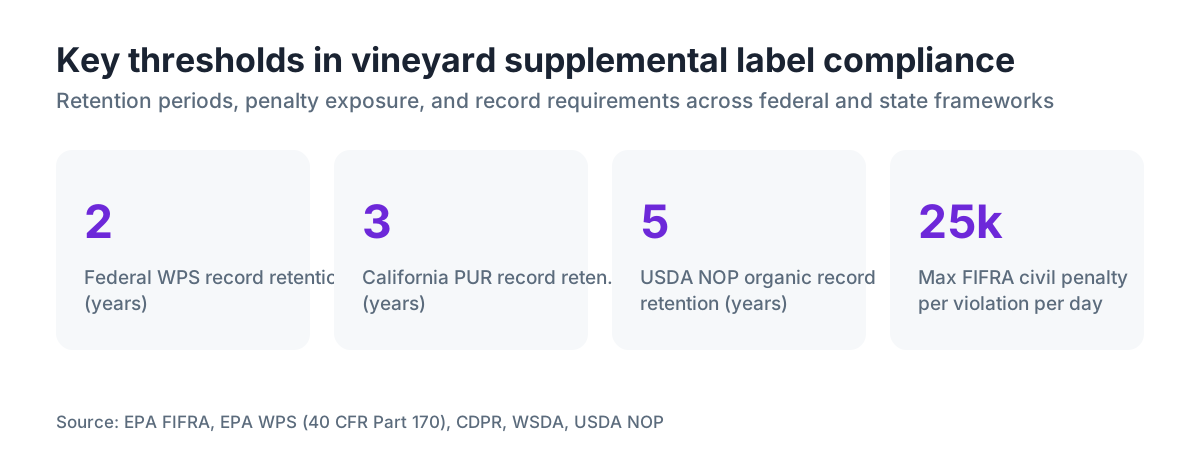
The WPS requires the REI be posted at the field entry before application [5]. If the supplemental label governs the REI, post that longer interval. Some growers keep a laminated card at each block entry and update it the morning of each application. That is not overkill. A WPS posted-interval violation runs into civil penalty territory that starts around $1,000 per violation and can escalate to $25,000 per day for willful violations under FIFRA Section 14 [1].
If you run an electronic spray records platform like VitiScribe, the REI field is a required entry, and attaching a PDF of the supplemental label to the record builds a time-stamped document chain that satisfies most state audit requests.
Do pre-harvest intervals on supplemental labels override the container label PHI?
Yes, always. The pre-harvest interval (PHI) is the minimum number of days between the last application and harvest, and it exists to keep residues under tolerance. When a supplemental label lists a longer PHI than the container label for wine grapes specifically, you follow the longer interval. No exceptions.
This matters for wine grapes because many broad-spectrum fungicides carry container-label PHIs set for table grapes or multiple fruit crops. The supplemental label may then specify a wine-grape PHI that accounts for harvest timing and winery processing. Captan is a commonly cited example. Its container-label PHI is 0 days for grapes in some formulations, but California supplemental labeling for wine grapes has historically restricted timing relative to fermentation concerns, and some registrants have issued supplemental PHIs of 7 or 14 days for specific regional registrations.
Record the PHI source flat out: "PHI: 14 days, per supplemental label dated 03/2023." Then work backward from your expected harvest window and block it in your records. California cross-references PURs against winery receipts. A PHI violation that surfaces in that cross-check is a serious problem, both for your license and for the winery's food-safety certification.
WSU Extension's Pacific Northwest pest management resources stress that PHI verification belongs at the moment you create the application record, not at harvest [7]. They're right. Finding a PHI problem after the grapes are picked is much worse than catching it before.
What PPE requirements in supplemental labels must appear in spray records?
PPE requirements in supplemental labels get logged less often than REIs and PHIs, but they're just as enforceable. A supplemental label might demand a full-face respirator where the container label only calls for a half-face piece, or add chemical-resistant gloves for mixing when the container label lists them only for application.
Under WPS, the employer must ensure applicators use the PPE required by the labeling in effect at the time of application [5]. "Labeling in effect" includes the supplemental label. Your spray record should capture the PPE actually used and match it to what the controlling label document required. Some growers log this as a checklist: "Supplemental label PPE required: full-face respirator, chemical-resistant apron, nitrile gloves. PPE used: [checkboxes]." That level of documentation is standard in organic certification audits and is becoming a best practice in food-safety audits tied to winery contracts.
Cornell Cooperative Extension's pesticide safety training for agricultural handlers points out that the handler training record and the PPE documentation should cross-reference each other [8]. If your handler training log shows training on supplemental-label PPE, and your spray records confirm that PPE was used, you have a coherent compliance story.
Are there state-specific spray record requirements that go beyond federal minimums?
Plenty. California has the most extensive rules. Every California grower files a Pesticide Use Report (PUR) with the county agricultural commissioner within 30 days of application for any pesticide [2]. That PUR data feeds CDPR's statewide database, so an error in your farm records becomes an error in a state database. CDPR audits PURs against county commissioner records and winery receipts.
For supplemental labels specifically, California requires the county registration number appear on the PUR if the product carries a California-specific supplemental registration. Not optional. The county ag commissioner's office can flag your PUR for correction if the registration number doesn't match their database, and repeated errors trigger compliance reviews.
Washington requires RUP application records be kept for two years and made available to WSDA [3]. Washington also has extra requirements for applications near salmon-bearing waters, which often show up as conditions in supplemental labels for vineyards in the Columbia Valley and Yakima Valley. Those conditions, things like buffer distances and no-application windows, have to appear in your spray records.
New York requires RUP records to include the specific label source for any use-rate or REI determination. Cornell Cooperative Extension's record-keeping guidance for New York growers covers this [8].
State record retention requirements for vineyard spray logs:
| State | Minimum record retention | Who inspects |
|---|---|---|
| California | 3 years (PUR) [2] | County ag commissioner, CDPR |
| Washington | 2 years (RUP) [3] | WSDA |
| New York | 2 years [8] | NYSDEC, DEC regional offices |
| Oregon | 2 years | ODA Pesticides Division |
| Federal (WPS) | 2 years [5] | EPA, state WPS agency |
What happens if your spray record doesn't document the supplemental label?
The consequences stack up fast. At the mild end, an inspector notes a record-keeping deficiency and you fix it. That still creates a compliance history that follows you into future inspections.
A step up: a residue violation shows up at harvest or the winery, and your records can't show you followed the PHI in the governing supplemental label. Now you're facing a food-safety contract dispute with the winery, a possible pesticide violation under FIFRA, and a state PUR correction that flags your file. California wine contracts increasingly carry audit clauses requiring growers to produce spray records on demand, and "I followed the container label" is no defense if a supplemental label was registered and applicable.
At the serious end, willful or repeated FIFRA labeling violations carry civil penalties up to $25,000 per violation per day for commercial applicators [1]. Apply a restricted-use material without documenting the supplemental-label REI, and if a worker exposure incident follows, the WPS enforcement pathway alone can generate several simultaneous violations.
The EPA's WPS guidance is blunt on the access requirement: handlers must have the labeling for every pesticide they apply, and that labeling has to be accessible for the entire application [5]. If the supplemental label governs the REI, PPE, or use-rate and it wasn't on-site, that's a violation whether or not anyone got hurt.
How should you organize and store supplemental labels for audit readiness?
A folder on your desktop beats nothing. A real system beats the folder.
The minimum viable setup: one physical binder per spray season, tabbed by product name, with the container label and any supplemental labels behind each tab. Each spray record entry cites the tab. At season's end, the binder goes into archive storage for at least three years, which satisfies the most conservative state requirement. This works for a small operation doing 20 to 30 applications a year.
For larger operations, or anyone under a winery food-safety audit program (PrimusGFS, SQF, or a winery's internal GAP program), digital storage with version control is the practical standard. You have to show that the label document on file today was the one in effect on the application date, not a later revision. A document management system that timestamps uploads and locks versions solves this. Some growers use a shared drive with a naming convention: ProductName_SupplementalLabel_EffectiveDate.pdf. That convention alone prevents most confusion.
VitiScribe attaches label PDFs directly to spray records at the block level and timestamps the attachment, which builds the audit trail most winery GAP auditors actually want to see.
One thing to watch: supplemental labels get revised. Set a calendar reminder at the start of each spray season to pull current versions from CDPR, WSDA, PPLS, or the registrant's website. Don't assume last year's supplemental label is still current.
Do organic vineyards have to track supplemental labels differently?
Yes and no. Certified organic vineyards are already limited to materials on the National Organic Program (NOP) approved list, so the pool of products with active supplemental labels is smaller. But the record-keeping obligation is identical, and organic certifiers add a layer on top.
USDA's NOP requires certified organic operations to keep records of all materials applied to crops, including the product name, rate, and the specific label governing the application [9]. If an organic-approved fungicide like copper hydroxide carries a supplemental label that caps the per-acre copper load for water-quality reasons, that restriction lands in your organic system plan and your spray records have to reflect it. Your certifying agent will check. A copper overapplication that violates a supplemental label restriction can jeopardize your organic certificate on its own, separate from any state pesticide enforcement.
Organic certification records generally must be kept for five years under NOP [9], longer than most state pesticide record requirements. If you're certified organic, use the five-year standard for everything. It keeps the system simple.
How do you train your applicators to handle supplemental labels in the field?
Training is where record-keeping systems get used or don't. If your applicator doesn't know what a supplemental label is or why it matters, the best documentation system in the world won't save you.
WPS handler training, required annually for handlers who work with pesticides at agricultural establishments, covers label interpretation [5]. But most standard WPS training programs, including those from UC Cooperative Extension [6] and Cornell [8], give supplemental labels only a passing mention. You have to add to the training.
Here's what works. At the start of each spray season, run a 20-minute tailgate session using an actual product packet that includes both a container label and a supplemental label. Walk through the differences. Show your applicators exactly how to identify the controlling REI, PHI, and PPE requirements when both documents apply. Then have each applicator sign a training record noting the products covered and the date.
Add one rule: if the product packet includes any document beyond the container label, the applicator writes "supplemental label on file" in the spray record and confirms the governing REI and PHI with the supervisor before mixing. That single rule catches most problems before they start.
WSU Extension's applicator training materials make the same point, that applicators should be trained to identify every label component, including any attached supplemental labeling, before each application [7]. Exactly right.
Frequently asked questions
Is a supplemental label legally required to be at the application site during spraying?
Yes. The EPA's Worker Protection Standard requires handlers to have access to the labeling for every pesticide they apply during the entire application. If the supplemental label governs the REI, PPE, or use-rate, it must be on-site. A digital copy on a phone or tablet counts in most state jurisdictions, but check with your county ag commissioner because a few states still want a physical printed copy.
What's the difference between a supplemental label and a Section 18 emergency exemption label?
A supplemental label is a permanent registration document issued by the registrant and approved by EPA and sometimes a state agency. A Section 18 emergency exemption is a temporary, time-limited authorization issued by EPA directly to a state for a use that isn't registered. Section 18 approvals also demand rigorous record-keeping, and the exemption document itself acts as the governing label. Both require explicit documentation in your spray records.
Can I use a product if I only have the supplemental label but not the container label?
No. The supplemental label is not a standalone use document. You read it alongside the registered container label. You need both. If you have only the supplemental label, pull the container label from the EPA's PPLS database or the registrant before applying. Applying a product with incomplete labeling is an inconsistent use under FIFRA.
How often do supplemental labels get updated, and how do I know when mine is outdated?
There's no set schedule. Supplemental labels can be revised anytime the registrant submits an amendment or a state agency imposes new conditions. Safest practice is to pull the current label from CDPR, WSDA, or the EPA's PPLS at the start of each spray season and again mid-season for materials you apply multiple times. The registrant's product website usually shows the effective date of the current supplemental label.
Do I need to record supplemental label information on the California pesticide use report (PUR)?
California requires the EPA registration number on the PUR to match the registered product, including any California-specific supplemental registration. If a product carries a California-specific supplemental registration number, that number should appear in your records and may be required on the PUR. Check with your county agricultural commissioner for current PUR field requirements, since CDPR updates its guidance periodically.
What records do I need to keep if a supplemental label has a buffer-zone requirement near waterways?
Record the buffer distance the supplemental label requires, the specific field block applied, and the distance to the nearest waterbody or drainage. A simple sketch or GPS coordinate in the record helps. For California coastal vineyard applications and Washington applications near salmon-bearing waters, these records are likely to be requested in any compliance audit. Retain them for at least three years.
Does the worker protection standard (WPS) explicitly mention supplemental labels?
The WPS at 40 CFR Part 170 uses the term 'labeling,' which under FIFRA includes all supplemental labels and other written materials accompanying the product. So while WPS doesn't always say 'supplemental label' outright, every WPS obligation tied to labeling (REI, PPE, application exclusion zones) covers supplemental labels by statutory definition.
Are there penalties for missing supplemental label information in spray records even if no one was harmed?
Yes. FIFRA violations aren't limited to harm-based enforcement. Record-keeping deficiencies are citable violations on their own. Civil penalties under FIFRA Section 14 vary by violation type and commercial applicator status. California's county ag commissioners can issue notices of violation for incomplete PURs even with no spray incident. Repeat record-keeping deficiencies push penalty levels higher.
How do I handle a supplemental label that was issued in the middle of the spray season?
From the new supplemental label's effective date forward, the new document governs. Any application before that date was compliant if you followed the prior labeling. Update your product file right away, train your applicators on any changed REI, PHI, or PPE, note the new label's effective date in your spray records going forward, and keep the old document with a notation of when it was superseded.
Do wine grapes have unique supplemental label situations compared to table grapes or raisin grapes?
Yes. Several fungicides and insecticides carry use-rate or PHI restrictions specific to wine grapes because fermentation chemistry and residue carry-over into wine differ from fresh consumption. Captan and some pyrethroids come up often. Wine-grape specific supplemental labels are more common in California and Washington than elsewhere, and the differences from the container label can be big enough to change your spray timing entirely.
Who is responsible for providing the supplemental label, the applicator or the grower?
Both, under FIFRA. The grower, as the agricultural employer, must ensure handlers have current labeling available during application. The applicator must verify they have it before starting. In California, a licensed pest control adviser making a recommendation must provide current labeling with it. For purchased products, the licensed dealer must provide current labeling at sale. If you apply pesticides yourself, the responsibility lands entirely on you.
How long do I need to keep supplemental label documents themselves, beyond the spray records?
Most states require spray records for two to three years. Keeping the supplemental label documents for the same period as the records they govern is the practical standard. For California organic operations, that means five years. Since label documents are PDFs that take almost no storage space, keeping them indefinitely is reasonable, especially if a liability question comes up years after an application.
Can a certified crop adviser (CCA) or PCA help me set up my supplemental label tracking system?
Yes, and in California a PCA's license requires familiarity with current labeling for any product they recommend. Many PCAs will walk you through which supplemental labels apply to your product list and which carry California-specific restrictions. UC Cooperative Extension farm advisors in major wine-grape counties also offer record-keeping guidance during seasonal grower meetings.
Sources
- U.S. Government Publishing Office, Federal Insecticide, Fungicide, and Rodenticide Act (FIFRA), 7 U.S.C. § 136 et seq.: FIFRA establishes that pesticide labeling including supplemental labels is legally enforceable and that penalties for violations can reach $25,000 per day for willful violations by commercial applicators.
- California Department of Pesticide Regulation (CDPR), Pesticide Use Reporting: California requires every grower to file a Pesticide Use Report with the county agricultural commissioner within 30 days of application, and California-specific supplemental registrations must be reflected in the PUR.
- Washington State Department of Agriculture (WSDA), Pesticides: Washington State requires restricted-use pesticide application records to be kept for two years and available for WSDA inspection, with additional requirements for applications near salmon-bearing waters.
- U.S. EPA, Pesticide Product Label System (PPLS): The EPA's PPLS database holds master labels for federally registered pesticide products and is the authoritative federal source for current label documents.
- U.S. EPA, Agricultural Worker Protection Standard (WPS), 40 CFR Part 170: The WPS requires handlers to have labeling accessible during application, mandates REI posting at field entry, and specifies that pesticide use records including REI and applicator information must be retained for two years.
- University of California, Agriculture and Natural Resources (UC ANR), Pesticide Safety and Record Keeping: UC Cooperative Extension recommends that growers reference the supplemental label number in the pesticide use report entry for each application where a supplemental label governs the use.
- Washington State University Extension, Pesticide Safety Education: WSU Extension states that label compliance including PHI verification should occur at the time of application record creation, and that applicators should be trained to identify all label components including supplemental labeling before each application.
- Cornell Cooperative Extension, Pesticide Record Keeping Requirements for New York: Cornell Cooperative Extension covers New York's requirement that RUP application records include the specific label source for any use-rate or REI determination, and recommends that handler training records cross-reference PPE documentation.
- USDA Agricultural Marketing Service, National Organic Program (NOP), 7 CFR Part 205: USDA's NOP requires certified organic operations to maintain records of all materials applied to crops including the governing label, and records must be retained for five years.
- U.S. EPA, Pesticide Enforcement (FIFRA Section 14 civil penalties): Civil penalties under FIFRA Section 14 for labeling violations start at defined per-violation levels and can escalate to $25,000 per violation per day for willful or knowing violations by commercial applicators.
Last updated 2026-07-09