Recording nozzle type and pressure settings in spray logs for compliance
TL;DR
- Federal EPA Worker Protection Standard and most state pesticide regulations require spray records that include nozzle type, operating pressure, and application rate for each pesticide application.
- Missing these fields can trigger fines, void pesticide labels, and create liability in drift or worker exposure incidents.
- Records must generally be kept for two years from the application date.
Why do spray logs need nozzle type and pressure settings at all?
Most vineyard managers know they have to log the pesticide name, EPA registration number, and rate. Far fewer realize nozzle type and operating pressure are not optional extras. They are the two variables that decide whether your application actually matched the label, and the label is the law.
Here's the short version. A flat-fan nozzle at 20 PSI delivers a completely different droplet spectrum than the same nozzle at 60 PSI. Smaller droplets drift. Larger droplets run off. Either condition can mean you applied a pesticide outside its labeled use pattern, which is a federal violation under FIFRA (the Federal Insecticide, Fungicide, and Rodenticide Act, 7 U.S.C. §136 et seq.) [1]. The label's use requirements include application method, and nozzle and pressure govern that method in practice.
You're working inside two overlapping frameworks. The first is the EPA Worker Protection Standard (40 CFR Part 170), which requires that pesticide application records be maintained and made available to workers and their designated representatives [2]. The second is your state's pesticide regulatory program, which in most wine-producing states goes further than the federal floor and explicitly lists equipment settings as required fields. California's DPR, Washington's WSDA, Oregon's ODA, and New York's DEC all have record-keeping requirements with varying specificity.
The practical reason to care is drift and liability. If there's a drift incident onto a neighboring property or a worker exposure complaint, your spray log is the first thing investigators ask for. A log that shows nozzle type, PSI, boom height, and wind speed at application time tells a much cleaner story than one that doesn't. It's either your best defense or your prosecutor's best exhibit.
What does federal law actually require you to record?
The EPA Worker Protection Standard at 40 CFR Part 170 sets the federal floor. Under the revised WPS rule finalized in 2015 and effective January 2017, agricultural employers must keep a copy of application-specific information for each pesticide applied in an agricultural establishment [2]. The required fields under federal law are:
- Product name and EPA registration number
- Active ingredient(s)
- Location and description of the treated area
- Date and start/end times of the application
- Applicator name and certification number (if the product is restricted-use)
- Amount applied
Federal law does not, by itself, mandate nozzle type or operating pressure as named fields. That's the honest reading of 40 CFR 170.309 [2]. So why is this article telling you to record them? Three reasons.
First, the pesticide label itself often does. Labels for many fungicides and insecticides used in vineyards specify nozzle type (air-blast, hollow-cone, flat-fan) and a pressure range or droplet size category. When the label says "apply with a nozzle producing medium to coarse droplets per ASABE S572.1 classification," you have to be able to show you did that. Your spray log is the only contemporaneous documentation you have [3].
Second, most state programs add fields. California requires records under Title 3 CCR Section 6624 that include "method of application" and enough detail to calculate whether the application was within label parameters [4]. Washington State's pesticide record-keeping rule under WAC 16-228 requires similar specificity [5]. If you're in a state like California with a County Agricultural Commissioner permitting system, you may have additional local requirements on top of that.
Third, USDA GAP and organic certification audits both ask for equipment records. If you're selling to buyers who require Good Agricultural Practices certification or you're operating under a USDA National Organic Program certificate, "method of application" documentation is part of what the auditor reviews [11].
Here's the bottom line. The federal floor sits lower than you need for label compliance, state compliance, and audit readiness. Record the nozzle type and pressure. Two more fields. The paperwork cost is nothing next to the exposure if you can't produce them.
What specific nozzle and equipment fields should every spray log entry include?
Here's a practical field list that satisfies the label requirement, common state rules, and audit expectations at the same time. If your paper form or software doesn't have all of these, build them in now.
| Field | Why it matters | Example entry |
|---|---|---|
| Nozzle brand and model | Matches the droplet spectrum to label requirement | TeeJet TTI11004 |
| Nozzle type | Flat-fan, hollow-cone, air-induction, twin-fan | Air-induction flat-fan |
| Nozzle size (orifice) | Determines flow rate at a given pressure | 04 (0.4 gpm at 40 PSI) |
| Operating pressure (PSI) | Controls droplet size and output volume | 40 PSI |
| Nozzle spacing (inches) | Affects overlap and coverage | 20 in |
| Boom height (inches above canopy) | Affects coverage pattern and drift potential | 18 in |
| Ground speed (mph) | Combined with pressure and nozzle size, confirms GPA | 3.5 mph |
| Gallons per acre (GPA) | The applied volume rate, links to label min/max | 50 GPA |
| Equipment calibration date | Shows you verified output before the season | 04/10/2025 |
Nozzle type is the single most important field here. UC Davis Cooperative Extension's guidelines on spray equipment for wine grapes identify nozzle type as the primary variable affecting canopy penetration, coverage uniformity, and off-target drift in trellis systems [7]. WSU's wine grape spray management resources make the same point for Pacific Northwest conditions [8].
Pressure matters because it interacts with nozzle type to produce your actual droplet spectrum. Most air-induction nozzles are rated for 30-60 PSI. Running them at 80 PSI because your tractor pump runs hot will produce finer droplets, increase drift risk, and may take you outside the labeled application parameters. Write down what the gauge actually said during the application, not the target pressure you planned for.
One more thing worth logging even though it's not always a required field: wind speed and direction at the time of application. It takes ten seconds with a Kestrel meter or your phone's weather app, and it is powerful documentation if anyone ever argues your application drifted.
How do state rules differ from federal minimums for California, Washington, and New York vineyards?
The three states with the most vineyard acres each add requirements on top of the federal WPS floor, and they are not identical.
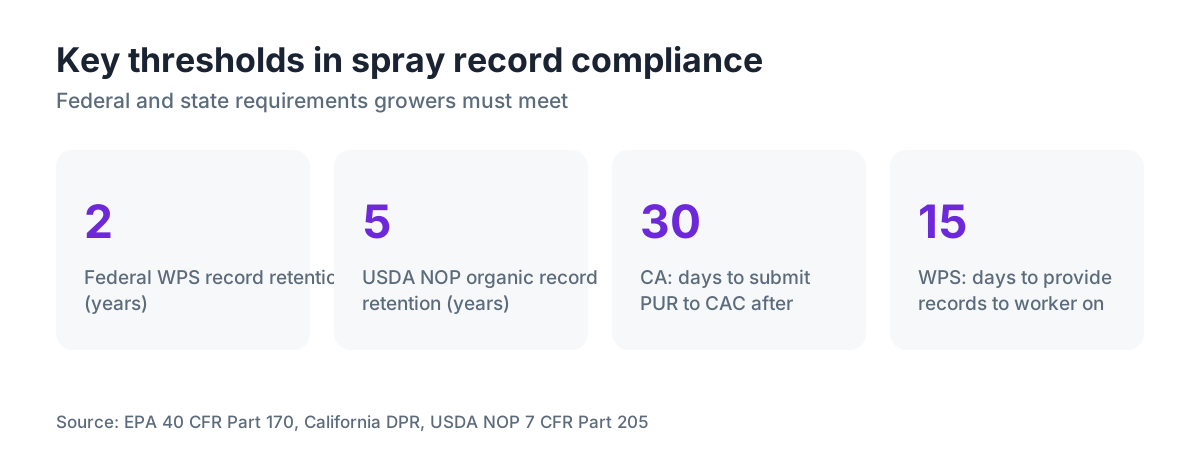
California is the strictest. Title 3 CCR Section 6624 requires pesticide application records to include the product name, registration number, license/certificate number, site description, amount applied, date and time, and, most important for our purposes, "method of application" including equipment type [4]. Restricted-use pesticide records must be submitted to the County Agricultural Commissioner within 30 days of application, and all records must be retained for two years. California Department of Pesticide Regulation's Pesticide Use Reporting page explains the full PUR system, which covers both RUPs and many general-use products in agriculture [4]. If you're in Napa, Sonoma, or any California wine-growing county, your CAC may add local spray permit requirements beyond the state minimum.
Washington requires pesticide application records under WAC 16-228-1500 for commercial applicators and agricultural employers. The rule requires location, product, rate, date, applicator identity, and method of application [5]. Washington State University Extension's integrated pest management resources for wine grapes include spray record templates that add equipment pressure and nozzle type as standard practice fields, even when the rule doesn't name them explicitly [8].
New York requires records under 6 NYCRR Part 325 and, like California, mandates retention for two years [9]. Cornell Cooperative Extension's viticulture program publishes spray record forms that include boom pressure and nozzle type, and Cornell's recommendations are widely treated as the practical standard across the Finger Lakes and Hudson Valley regions [10].
Operate in multiple states, or grow under contract for wineries in different states? Use the most rigorous standard (California's) as your baseline everywhere. You won't be over-compliant. You'll be audit-ready.
How does nozzle and pressure documentation connect to pesticide label requirements?
Pesticide labels in the U.S. are legal documents. Under FIFRA Section 12(a)(2)(G), using a pesticide in a manner inconsistent with its labeling is a federal violation [1]. Courts and EPA enforcement actions have repeatedly read "inconsistent with labeling" to include application method, not only rate or timing.
Many wine grape fungicide and insecticide labels specify application equipment in terms that require you to know, and be able to prove, your nozzle configuration. Some of the language you'll run into:
- "Apply with properly calibrated spray equipment capable of delivering adequate coverage."
- "Do not apply with equipment that produces fine or very fine droplets as classified by ASABE S572.1."
- "Apply in sufficient water volume to achieve thorough canopy coverage; minimum 50 GPA for dense canopies."
That last one, minimum GPA, is a function of nozzle size, pressure, and ground speed working together. Your spray log entry for pressure and nozzle size is how you document that you hit the required GPA. Without it, you can't prove label compliance from the record alone.
The ASABE S572.1 droplet size classification system (very fine, fine, medium, coarse, very coarse, extremely coarse) shows up on more labels every year, especially for products with drift reduction requirements [3]. Nozzle manufacturers publish droplet size data for their products at various pressures. If your log shows nozzle model and PSI, you can look up the droplet classification after the fact if anyone asks. If your log shows nothing, you can't.
How long do you need to keep spray records with equipment settings?
Two years is the federal minimum for WPS records under 40 CFR 170.309(d) [2]. Most state rules also specify two years, though California's PUR system effectively requires you to submit data to the CAC within 30 days, which makes the record permanent in the state database automatically.
For organic certification, the USDA National Organic Program requires that records demonstrating compliance be maintained for five years under 7 CFR Part 205.103 [6]. If any part of your vineyard is under organic or transitional certification, use five years as your retention standard for all spray records from those blocks, well past the two-year floor.
For GAP (Good Agricultural Practices) audits, USDA's GAP/GHP program asks auditors to verify records for the current season and often one previous season [11]. Two years covers that comfortably.
Digital records stored in a cloud-based system cost nothing to retain forever, so the "minimum" question is a little academic if you're keeping records electronically. On paper, two years means you're filing and storing spray logs from two full seasons at once. For a 50-acre vineyard with 10-15 spray applications per season, that's 100-150 individual application records. Organized binders by year and block work fine. So does a simple spreadsheet with one row per application.
What are the most common mistakes growers make when logging nozzle and pressure data?
Based on what extension agents and state ag department inspectors actually cite in enforcement actions, the errors cluster into a few patterns.
Recording target pressure instead of actual pressure. You plan to run at 40 PSI, but your pump is running at 55 PSI during the application because you forgot to readjust after switching chemicals. If you log "40 PSI" from your pre-spray setup without confirming during application, your record is wrong. Confirm gauge pressure mid-application and at the end. Write down what you saw.
Logging nozzle type generically. "Flat-fan" isn't enough if the label calls for a specific droplet size category. "TeeJet AIXR11004 at 40 PSI" is the kind of entry that proves compliance with a medium-coarse droplet requirement. Nozzle brand and model take five seconds to write once you know what's on the boom.
Not noting nozzle condition. A worn nozzle produces different output than a new one. You don't need to log wear state on every application, but logging your last calibration date and nozzle replacement date in the equipment record covers this.
Leaving pressure blank for airblast applications. Some growers think pressure logging is only for boom sprayers. Airblast sprayers have PTO-driven fans and nozzle pressures too. Both are worth recording, along with fan speed or RPM if the label specifies air volume requirements.
Logging GPA from calculation only, not from a calibration check. Calculated GPA and actual GPA diverge when nozzles wear. If you haven't calibrated your sprayer at the start of the season, your calculated GPA is an estimate, not a measurement. Note in the log whether your GPA figure comes from a recent calibration or a calculation.
What format works best for spray logs that include equipment settings?
Paper forms still work, and for small operations with two or three spray rigs and under 30 acres, a well-designed paper form is genuinely fine. The problems with paper are version control (old forms missing new required fields), legibility in the field, and the time it takes to aggregate data for reports.
A spreadsheet is the next step up. One row per application, one column per field. Cornell Cooperative Extension's spray record template is a good starting point [10], and WSU Extension publishes its own version for Washington growers [8]. Download one, add columns for nozzle model and PSI if they're not already there, and print copies for each applicator to fill out in the field.
Digital field-recording tools kill the transcription step and let you pull a compliance report for a specific block, date range, or product across the whole operation in minutes. VitiScribe's spray record module is built specifically for wine grape operations and includes equipment fields, label upload, and two-year retention by default. That said, any digital tool that lets you structure the data fields above and export them for audit works. The format matters less than how complete and consistent your capture is.
One structural tip regardless of format: organize records by block, not by date. When a CAC inspector or organic certifier asks for all applications to Block 7 in the past two years, you want to pull that fast. Sorting or filtering by block is trivial in a spreadsheet or digital system. In a binder of loose paper forms sorted by date, it's an hour of hunting.
For vineyard operations running multiple spray programs across different varietal blocks, a block-indexed digital system pays for itself the first time an auditor shows up unannounced.
How do calibration records relate to spray log compliance?
Calibration records aren't the same as spray application records, but they support them. A spray log entry that says "50 GPA at 40 PSI, TeeJet AI11004" only means something if you can show your equipment was actually delivering what those settings predict. Calibration is how you establish that link.
UC Davis Cooperative Extension recommends calibrating vineyard spray equipment at the start of each season and after any nozzle change or tip replacement [7]. The basic calibration check, catching nozzle output in a jug for 30 seconds at operating pressure and calculating GPM per nozzle, takes less than 20 minutes for a full boom. Do it. Write down the date, the nozzles tested, the measured output per nozzle, and whether any nozzles got replaced as a result.
For organic certification under NOP, calibration records also serve as part of the documentation that you applied at the labeled rate and no more. Over-application of an OMRI-listed product can still be a violation if it exceeds the labeled rate.
The other calibration note worth making: nozzle manufacturers generally recommend replacing flat-fan and hollow-cone tips when output has increased by 10% over the rated flow at a given pressure, which signals wear [3]. If you're doing your calibration check and a nozzle is running 15% high, replace it and log the date. That entry becomes part of your equipment record that backs up your spray log GPA calculations for the rest of the season.
What happens if your spray records are audited or you get a complaint?
The sequence moves faster than most growers expect. In California, a drift complaint to the County Agricultural Commissioner typically triggers an inspector visit within 24-48 hours. The inspector asks for your spray log for the date in question on the spot. If you can't produce it, or if it's missing required fields, that's a separate violation from whatever the complaint alleged.
California DPR's enforcement data shows record-keeping violations are among the most commonly cited in annual pesticide enforcement reports, and they often accompany but stay separate from substantive application violations [4]. The fine structure varies by state. In California, pesticide violations can reach $5,000 per violation per day under Food and Agricultural Code Section 12999 [4]. Missing records and incomplete records get treated as separate violations.
In federal enforcement under FIFRA Section 14, civil penalties for record-keeping violations can reach $5,500 per violation for private applicators and $19,507 per violation for commercial applicators (amounts adjusted periodically for inflation) [1].
Here's the practical lesson. A well-maintained spray log is the cheapest insurance you can buy. It doesn't eliminate the risk of a complaint. It eliminates the risk of a complaint becoming a record-keeping violation on top of whatever else is being investigated. Complete logs that include nozzle type and pressure settings also let you reconstruct your application parameters and demonstrate you were within label requirements, which is your primary defense in a drift or efficacy dispute.
For how spray compliance fits into broader vineyard record-keeping systems, operations like those profiled at Gervasi Vineyard and South Coast Winery typically maintain integrated spray and compliance records across multiple production blocks.
What do university extension programs recommend for spray record fields?
UC Davis, Cornell, and WSU have each published spray record guidance, and they largely agree on what fields matter, with some regional differences.
UC Davis Cooperative Extension's wine grape pest management resources emphasize canopy coverage documentation and equipment settings as part of IPM record-keeping [7]. Their spray record templates include nozzle type, operating pressure, and application volume (GPA) alongside the standard legal fields. UC Davis researchers have also published on the relationship between nozzle selection and spray deposition in trellis canopies, which is the scientific basis for treating nozzle type as a material variable worth logging.
Cornell Cooperative Extension's viticulture program publishes seasonal spray schedules and record-keeping templates for New York growers [10]. Cornell's templates include boom pressure and nozzle type, and their pest management guides often specify nozzle type recommendations alongside fungicide or insecticide recommendations, treating equipment as part of the application protocol rather than a separate logistics question.
WSU Extension's wine grape production resources for Washington and Oregon include spray record templates and calibration guidance that build in equipment settings [8]. WSU's tree fruit and vine IPM program also provides online tools for spray volume calculation that take nozzle size and pressure as inputs, reinforcing that these aren't separate from rate calculations but fundamental to them.
All three programs are free online. If you want a tested, extension-backed spray log template, start with any of them and add fields as needed rather than designing one from scratch. The URL for each is in the citations below.
VitiScribe's record-keeping templates were built to match these extension recommendations, so if you're comparing a digital system to an extension paper form, the required fields should map directly.
Frequently asked questions
Is recording nozzle type required by law or just best practice?
It depends on your state and the specific label. Federal WPS (40 CFR 170.309) requires "method of application" and "amount applied" but doesn't name nozzle type explicitly. California (3 CCR 6624) and Washington (WAC 16-228) require enough equipment detail to verify label compliance, which in practice means nozzle type and pressure. If your label specifies a droplet size category, logging nozzle and pressure is required to prove label compliance, making it legally necessary regardless of state rules.
What happens if I record the wrong pressure in my spray log?
An inaccurate log entry can void your compliance documentation even if the application itself was fine. If investigators compare your logged PSI against the nozzle's output tables and the numbers don't match your stated GPA, it raises questions about the entire record. Record the pressure you actually ran during the application, confirmed by reading the gauge, not the pressure you planned for. If pressure fluctuated, log the range.
Do I need to log nozzle information for every application or just restricted-use pesticides?
For restricted-use pesticides (RUPs), detailed records are unambiguously required at the federal level and by all state programs. For general-use pesticides in agriculture, federal WPS requires records for any pesticide applied in an agricultural establishment where workers may enter. California's PUR system covers many general-use pesticides. Best practice is to log nozzle and pressure for every application regardless of classification; the extra time is negligible and the protection is real.
How do I record nozzle settings for an airblast sprayer vs. a boom sprayer?
Airblast sprayers add a few fields beyond boom sprayers: fan speed or PTO RPM, air volume setting if adjustable, and tower/jet orientation if applicable. Nozzle type, size, and pressure at the nozzle manifold still apply. Some airblast units don't have a nozzle manifold gauge, in which case log the pump outlet pressure and note the sprayer model so the relationship between pump pressure and nozzle pressure is at least traceable. Calibration records are especially important for airblast units.
Can I use a mobile app or spreadsheet instead of a paper spray log?
Yes. Neither federal WPS rules nor state pesticide regulations specify paper as the required format. Electronic records are acceptable provided they are legible, include all required fields, can be made available within the required timeframe (typically within 30 days of request under WPS, immediately in some state programs), and are retained for the required period (two years federal, five years for organic NOP). Back up digital records; a crashed hard drive is not an accepted defense.
What is the ASABE S572.1 droplet size classification and why does it appear on pesticide labels?
ASABE S572.1 is an American Society of Agricultural and Biological Engineers standard that classifies spray droplets into categories from very fine to ultra coarse based on volume median diameter. Pesticide labels reference it to specify drift risk requirements; products with groundwater or environmental concerns may require coarse or very coarse droplets to limit fine-droplet drift. If your label cites an ASABE category, log the nozzle model and pressure so you can verify compliance against the manufacturer's droplet data tables.
How often do I need to calibrate my sprayer to support accurate spray log entries?
UC Davis and WSU Extension both recommend calibrating at the start of each season and after any nozzle replacement. The practical standard is: calibrate whenever you change nozzle type or size, after 50-100 hours of use during the season, and any time output seems inconsistent. Log the calibration date and measured output per nozzle in your equipment record. Your spray log GPA entries are only as accurate as your most recent calibration.
Do organic vineyards have different spray record requirements than conventional?
Organic vineyards certified under the USDA National Organic Program must keep records demonstrating compliance for five years under 7 CFR Part 205.103, compared to two years for federal WPS. Records must show that only approved materials were used and that they were applied at labeled rates, which requires equipment documentation including nozzle type and GPA calculations. Certifying agents typically review spray records at annual inspections, and gaps in equipment documentation are a common finding.
What is the penalty for incomplete spray records in California?
California Food and Agricultural Code Section 12999 sets civil penalties up to $5,000 per violation per day for pesticide law violations, including record-keeping failures. Missing required fields and failure to submit PUR reports within 30 days are treated as separate violations. County Agricultural Commissioners handle local enforcement and have discretion to issue warning notices for first-time minor violations, but repeat or serious omissions draw fines. State DPR can add penalties on top of county action for egregious cases.
How should I handle spray records for multiple vineyard blocks with different nozzle setups?
Create a separate record entry for each block if you change nozzle type, pressure, or GPA between blocks, even in the same day. A single log entry covering "all blocks" that had different application parameters is not compliant. Organize records by block identifier so you can quickly pull all applications to a given block for audit. Most digital spray log tools let you select a block at the start of each entry; on paper, put the block identifier at the top of each form.
Does the EPA Worker Protection Standard require I make spray records available to workers?
Yes. Under 40 CFR 170.309, employers must provide application-specific information to workers, their physicians, and their designated representatives upon request, within 15 days under the 2015 revised WPS rule. This access requirement applies to restricted-use pesticides and to general pesticide use under agricultural employer coverage. Records must be kept for at least two years and be accessible at the establishment. Workers do not need to provide a reason for requesting records.
Can nozzle wear affect my compliance documentation even if I log the correct original nozzle specs?
Yes, and this is a real exposure. If you log "TeeJet AI11004 at 40 PSI" but the nozzle is worn and delivering 15% more volume than rated, your actual GPA is higher than your log shows. If the label sets a maximum application rate, that discrepancy could mean you over-applied. Calibration records showing you checked nozzle output and replaced worn tips are what close that gap. Without them, your logged specs and your actual application diverge silently over the season.
What records do I need if I hire a PCA or contract applicator to spray my vineyard?
The agricultural employer (you, the vineyard owner or manager) is responsible for WPS record availability even when a contractor does the application. In California, the licensed commercial applicator must provide you with a copy of the pesticide application record within 30 days. Get it in writing in your contractor agreement, and file the records yourself. Don't assume the contractor's own files satisfy your obligation to maintain accessible records at your establishment.
Sources
- EPA, Federal Insecticide, Fungicide, and Rodenticide Act (FIFRA), 7 U.S.C. §136: Using a pesticide inconsistent with its labeling is a federal violation under FIFRA; civil penalties for record-keeping violations reach $5,500 per violation for private applicators.
- EPA, Worker Protection Standard 40 CFR Part 170, Pesticide Application and Safety Information: Agricultural employers must keep application-specific pesticide records and make them available to workers within 15 days of request; records must be retained for two years (40 CFR 170.309).
- ASABE, Spray Nozzle Classification by Droplet Spectra, Standard S572.1: ASABE S572.1 classifies spray droplets from very fine to ultra coarse; nozzle manufacturers publish droplet size data at various pressures referenced by pesticide labels.
- California Department of Pesticide Regulation, Pesticide Use Reporting: California Title 3 CCR Section 6624 requires pesticide application records including method of application and equipment type; records must be submitted to the County Agricultural Commissioner within 30 days; penalties up to $5,000 per violation per day under Food and Agricultural Code Section 12999.
- Washington State Department of Agriculture, Pesticide Recordkeeping (WAC 16-228): Washington WAC 16-228-1500 requires commercial applicators and agricultural employers to keep pesticide records including location, product, rate, date, applicator identity, and method of application.
- USDA Agricultural Marketing Service, National Organic Program, 7 CFR Part 205: NOP certified operations must maintain records demonstrating compliance for five years under 7 CFR Part 205.103; records must show approved materials applied at labeled rates.
- UC Davis, UC Statewide Integrated Pest Management Program, Grape Pest Management: UC Davis Cooperative Extension identifies nozzle type as the primary variable affecting canopy penetration and off-target drift in trellis systems; recommends calibration at season start and after any nozzle change.
- Washington State University Extension, Wine Grape Production and IPM Resources: WSU Extension publishes spray record templates and spray volume calculation tools that include nozzle type and operating pressure as standard fields for Pacific Northwest wine grape growers.
- New York State Department of Environmental Conservation, Pesticide Regulations 6 NYCRR Part 325: New York 6 NYCRR Part 325 requires pesticide application records with two-year retention for agricultural operations.
- Cornell University, College of Agriculture and Life Sciences, Viticulture and Enology Program: Cornell Cooperative Extension publishes spray record forms for New York growers that include boom pressure and nozzle type fields; Cornell's templates are widely used as a practical compliance standard across Finger Lakes and Hudson Valley regions.
- USDA Agricultural Marketing Service, Good Agricultural Practices Audit Program: USDA GAP/GHP audit program requires auditors to verify current and prior-season records including method of application documentation.
Last updated 2026-07-11