How to record a spray cancellation due to weather in compliance logs
TL;DR
- When weather cancels a planned spray, your compliance log needs at minimum: the intended application date, the product and target pest, the field block, the specific weather condition that stopped you, any measured weather data (wind speed, temperature, RH), the decision-maker's name, and a rescheduled or 'deferred' status.
- Most state lead agencies and the EPA Worker Protection Standard require you keep those records for two years.
Why does a cancelled spray even need a log entry?
A cancelled spray needs a log entry because the gap it leaves in your records looks worse than the cancellation itself. Auditors read silence as a red flag. A three-minute note turns that silence into a defensible decision.
A lot of vineyard managers assume you only write something down when product actually hits the canopy. That assumption has burned people at audit time.
The EPA Worker Protection Standard (WPS), codified at 40 CFR Part 170, requires agricultural employers to maintain records of pesticide applications, and several state lead agencies read that to include documented decisions not to apply when an application was planned and the product was already staged. California's Department of Pesticide Regulation requires a pesticide use report (PUR) for every completed application, and CalDPR also tells county agricultural commissioners that growers should retain supporting records that explain deviations from planned schedules [1][2]. Picture an auditor holding your scouting records (which show disease or pest pressure that justifies a spray) next to an application log with a gap and no cancellation note. You look either negligent or, worse, like you applied without logging it.
Cancelled spray records protect you in three concrete ways. They show you acted on label wind-speed restrictions. They document compliance with the product's environmental hazard language (many fungicide and insecticide labels prohibit application above a specific wind speed, temperature, or when rain is imminent). They also build an audit trail that defends your worker re-entry interval (REI) decisions, because if an REI clock never started, workers need to know why and when it actually will.
The paperwork takes about three minutes. Skipping it can cost you a re-inspection, a fine, or in California a civil penalty that starts at $1,000 per violation under Food and Agricultural Code Section 12999 [2]. Our spray records guide shows where this note lives in your day-to-day logging.
What federal rules govern pesticide spray records?
Federal pesticide recordkeeping for agricultural producers comes from two overlapping frameworks: the FIFRA restricted-use pesticide rule and the Worker Protection Standard. Neither one explicitly requires a cancellation entry. Both create indirect pressure to keep one anyway.
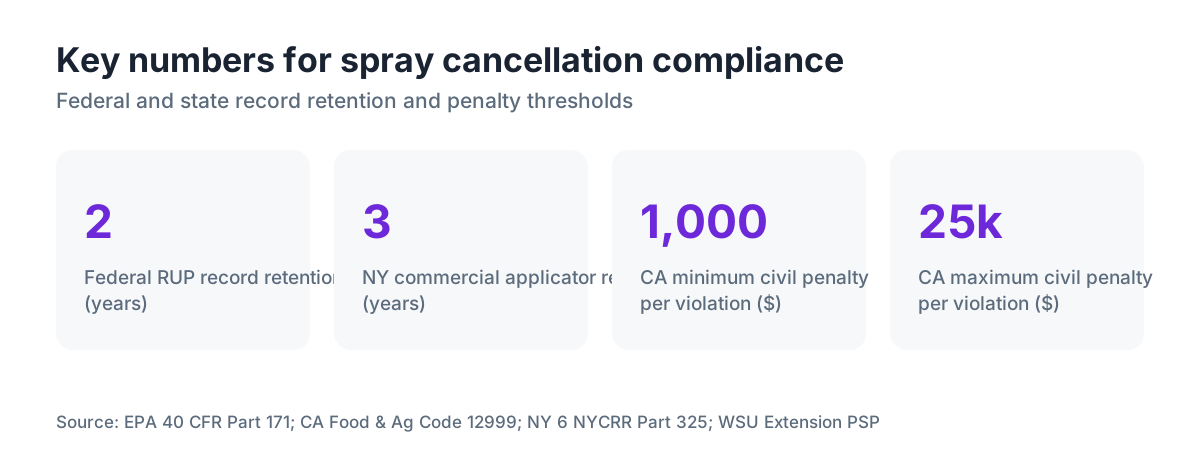
The Federal Insecticide, Fungicide, and Rodenticide Act (FIFRA) and the EPA restricted-use pesticide (RUP) recordkeeping rule at 40 CFR Part 171 require certified applicators who use RUPs to keep records of each application for two years [3]. Those records must include the product name and EPA registration number, the total amount applied, the location and size of the area treated, the date of application, and the name and certification number of the applicator. A cancellation is technically not an application, so the RUP rule does not require a cancellation entry on its own. Most state lead agencies do, and FIFRA's general record-retention expectation is broad enough that many compliance attorneys tell growers to keep cancellation notes regardless.
The WPS at 40 CFR Part 170 requires agricultural employers to keep application records for 30 days after each application and to post central location information for workers [4]. This too is application-focused. The real pressure comes from the label. The EPA treats pesticide labels as legally binding, and most modern fungicide and insecticide labels for vineyard use carry environmental hazard language that names conditions under which application is prohibited (wind above a set speed, temperature inversions, buffer zones near water). If your log shows you applied under those conditions, you violated FIFRA Section 12(a)(2)(G). A cancellation record is your evidence that you did not.
Federal law sets the floor. State law usually sets the real requirements. Your product label sets conditions that make cancellation records smart no matter what any rule says out loud.
Which weather conditions legally require or strongly justify cancellation?
The specific triggers depend on the product, but a handful of thresholds show up again and again across vineyard-use labels: wind speed, imminent rain, high temperature, and inversions. Each one has a number or a symptom you should measure and write down.
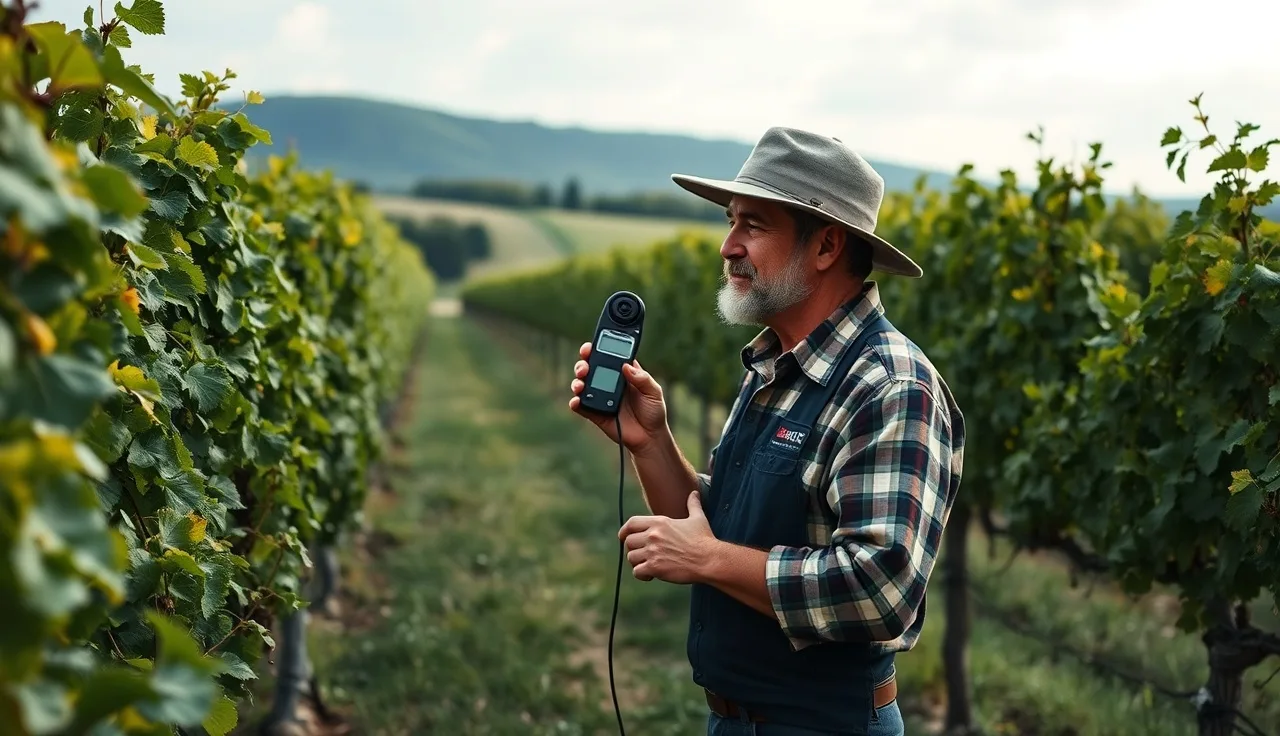
Wind speed is the most litigated. The EPA Label Review Manual recommends that labels instruct applicators not to apply when wind speeds exceed 10 mph for ground applications, though individual labels may set lower limits, especially for products with drift-sensitive buffer zones near water bodies [5]. Some newer labels go to 15 mph for dilute sprays from an airblast sprayer pointed into the canopy, but check your specific label. When you cancel for wind, note the measured speed from a calibrated anemometer or a credible nearby weather station. Not "it was windy."
Rain, imminent or active, is another clear trigger. Systemic fungicides need a rain-free period for uptake, usually listed on the label as 1 to 4 hours. If rain is forecast inside that window, applying wastes product and can create runoff, which is an environmental violation under the Clean Water Act in some circumstances. Note the forecast source (NOAA, a nearby station ID, your on-site station ID) and the predicted precipitation timing.
Temperature extremes matter for some products. Sulfur can cause phytotoxicity at temperatures above about 90 degrees F, and many sulfur labels restrict application above 85 to 90 degrees F or when temps will reach those levels within 24 hours [6]. Captan carries similar heat-phytotoxicity concerns. Record the ambient temperature and the forecasted high.
Temperature inversions are a drift risk. An inversion traps pesticide droplets near the ground and moves them unpredictably. If you're near a neighbor, a school, or a water body, this is a real concern and worth noting.
Here's a quick reference table of common conditions and what to record:
| Weather condition | Typical label threshold | What to measure and record |
|---|---|---|
| Wind speed (ground app) | 10 mph, some labels lower | Anemometer reading, time, station ID |
| Wind speed (airblast) | 10-15 mph depending on label | Same |
| Rain imminent | Rain-free period on label (1-4 hrs) | Forecast source, predicted precip time |
| Active rain | Any amount | Start time of rain, estimated mm if possible |
| High temp (sulfur/captan) | 85-90 degrees F depending on product | Current temp, forecasted high |
| Temperature inversion | No universal number; judgment call | Observed symptoms (smoke, fog behavior), time |
Always read your specific label. "The label is the law" is a phrase EPA enforcement has leaned on for decades, and it applies here [3].
What exact fields should a weather cancellation log entry include?
A complete cancellation entry has ten fields: decision date, block ID, crop and growth stage, intended product and EPA reg number, target pest, cancellation reason, measured weather data, decision-maker, disposition, and a signature. Some are legally required depending on your state. The rest just save you an argument later.
Date the cancellation was decided. Not the rescheduled date. The date you decided not to go.
Block or field ID. Use the same identifier you use everywhere else in your records. If you've got Block 4A in your spray log, use Block 4A here.
Crop and growth stage. "Chardonnay, BBCH 57" or whatever notation you use. Growth stage affects REI interpretation and disease pressure context.
Intended product(s) and EPA registration number(s). If you had two products in the tank mix you were going to apply, list both. This matters most for RUPs.
Target pest or disease. "Powdery mildew preventive" or "Grape berry moth." This connects the application decision to your scouting records.
Reason for cancellation. Be specific. "Wind speed 14 mph sustained, label max 10 mph, measured at 08:15 with Kestrel 3000 at vineyard entrance" is useful. "Too windy" is not.
Weather data recorded. Wind speed and direction, temperature, relative humidity, precipitation amount or forecast. Include the source: on-site weather station, NOAA station KXXX, or a specific app with a station ID.
Decision-maker name and credentials. Who made the call, plus their pesticide applicator license number if they're licensed.
Disposition. Is this application rescheduled, deferred pending scouting, or cancelled outright because the disease window passed? Note it.
Signature or initials. A real signature or logged digital timestamp ties the record to a person.
WSU's Pesticide Safety Education Program recommends applicators keep contemporaneous notes (written at the time, not reconstructed) because those carry more weight with state regulators than after-the-fact summaries [7]. Write it down the same day.
How is a cancellation record different from a regular application record?
An application record documents what happened. A cancellation record documents a planned action and why it never happened. The two share most fields, but the cancellation record swaps "amount applied" for weather data and a disposition line.
A standard application record under 40 CFR Part 171 needs product name, EPA reg number, amount applied, treated area, date, and applicator ID [3]. It does not require weather data, though best practice includes it.
A cancellation record needs everything above except amount applied (nothing was applied), plus the specific weather readings that triggered the decision, the label threshold that was exceeded, and the outcome. You're building a causal chain: label says X, conditions were Y, so we did not apply.
Link the cancellation record back to your IPM scouting record so the disease or pest pressure context stays attached. Say your Botrytis pressure was moderate and you cancelled two consecutive planned applications because of rain (which is also ideal Botrytis weather). You want that context on paper so you can show the re-evaluation that led to your next actual application.
One thing that trips people up. If workers entered a field after you'd partially staged for spraying (mixed a tank, then stopped), some states require a note that workers were not exposed to treated areas even though no application occurred. Check your state's WPS extension guidance on this point. Our vineyard recordkeeping overview walks through how these records sit together.
What do state regulators and auditors actually check first?
Auditors check the same things first almost everywhere: whether your RUP records are present and complete, whether your application dates line up across your spray log, PUR, and worker notification log, and whether any date gaps hint at unrecorded applications. A cancellation note fills those gaps with an explanation instead of silence.
California, Washington, Oregon, and New York are the four biggest wine grape states, and their approaches differ around the edges.
California county agricultural commissioners run PUR audits and can request all supporting records. CalDPR guidance says auditors cross-reference your application records against scouting logs, weather data, and any drift complaints [2]. If there's a gap, they'll ask for an explanation, and a contemporaneous cancellation note is the best one you can hand them.
Washington WSDA pesticide inspectors focus heavily on RUP records and label compliance. WSU Extension has published a grower checklist that specifically includes "record of conditions preventing application" as a best-practice field [7].
New York DEC requires licensed commercial applicators to keep records for three years, longer than the federal two-year minimum, and Cornell Cooperative Extension's pesticide safety program treats cancellation records as part of defensible recordkeeping [8].
Oregon ODA pesticide inspectors have stepped up their review of airblast sprayer drift incidents in recent years, which makes wind-speed documentation at cancellation time especially relevant for Oregon growers.
If compliance paperwork is your weak spot, start with our compliance checklist and work backward from what an auditor asks for.
Should you use a paper log, spreadsheet, or digital system for this?
The format matters less than the habit. A handwritten field notebook entry, made the same day, signed, and stored in a binder you can actually find, beats a fancy software system you update once a quarter.
Paper has real limits for cancellation records. When an auditor asks "what was the wind speed at 7 AM on June 14th in your Block 3 area," a paper log that reads "too windy" loses to a digital record that pulled weather station data automatically and timestamped the entry.
If you manage multiple blocks across more than one property, or run a custom crush operation handling fruit from several growers, keeping cancellation records synchronized by hand gets messy fast. Digital tools that tie a block map to a spray calendar and let you log a cancellation with a weather-data pull earn their keep at that scale. VitiScribe was built for this kind of field operations workflow, letting you log a cancellation in about 60 seconds against the planned application record, with weather data attached. Our field operations tools connect the calendar and the log so nothing drops.
For a sole operator with one block and a working filing system, a two-page paper template covering all the fields above is fine and costs nothing. Download a template from your state's extension service before you buy anything.
One structural point: whatever system you use, store cancellation records with your application records, not separately. If your application binder gets pulled in an audit, the cancellation entries should sit right there in chronological order.
How long do you need to keep spray cancellation records?
Keep spray cancellation records as long as you keep your application records. Federal RUP records must be kept for two years under 40 CFR Part 171 [3]. WPS application information must stay accessible for 30 days post-application [4]. Several states run longer.
| State | Minimum retention period | Authority |
|---|---|---|
| California | 2 years (PUR records at county) | Food and Ag Code 12997 |
| Washington | 2 years | WAC 16-228-1350 |
| New York | 3 years (commercial applicators) | 6 NYCRR Part 325 |
| Oregon | 2 years | ORS 634.372 |
For cancellation records specifically, these same windows apply when the records are part of your pesticide use documentation. Even where statute doesn't name cancellation records outright, keeping them for the same period as your application records is the safe move. If a drift complaint surfaces 18 months after a spray season and you can't produce your cancellation record for the day in question, you're in a harder spot than you need to be.
Store digital records with a backup. A spreadsheet on a single laptop is one spilled coffee away from a compliance gap. Cloud backup or a second physical copy matters.
What happens if you skip the cancellation record and get audited?
In most states, failing to maintain required pesticide records is a civil violation. California's penalty range under Food and Agricultural Code Section 12999 starts at $1,000 per violation per day and can reach $25,000 for willful violations [2]. Washington's civil penalties under RCW 17.21 run up to $7,500 per violation. New York's can reach $5,000 per violation under Environmental Conservation Law Article 33.
A missing cancellation record by itself rarely draws maximum fines. Growers get into real trouble when a missing cancellation record combines with a neighbor drift complaint and leads an inspector to assume an unrecorded application occurred. At that point you're defending against an alleged unlicensed or unreported application, which is a much bigger problem than a paperwork gap.
Auditors also read pattern. One gap in a season's records might get a warning. Multiple gaps look like systemic non-compliance, which is how fines climb from the low end of the range to the high end.
The pragmatic view: fine risk alone probably doesn't justify elaborate recordkeeping for every cancelled spray. The combination of fine risk, drift complaint exposure, and the cost of reconstructing your decision-making months later does. Three minutes of documentation per cancellation is a fair trade.
Is there a template or standard form you can use?
No single federal template exists. The EPA has model forms, but they're built for completed applications [5]. Most states publish their own.
USDA NRCS and several land-grant university extension programs have developed spray record templates that include cancellation fields. UC Davis's Integrated Pest Management program provides a Pesticide Use Log you can adapt [9]. Cornell Cooperative Extension's agricultural pesticide safety resources include recordkeeping templates for New York growers [8]. WSU Extension's Pacific Northwest Pest Management Handbooks carry recordkeeping guidance and sample forms [7].
For a cancellation specifically, the simplest approach is to take your standard application record form and add a checked box for "Application completed: Yes / No," then a free-text or structured field for cancellation reason, weather readings, and disposition. Use the exact same form whether or not a spray happened. The only difference is that the "amount applied" field is blank or zero and the weather/cancellation section is filled in.
If you want to build your own, the fields in the "What exact fields" section above cover everything a state auditor is likely to ask for. Print a stack at the start of the season and keep them on a clipboard in the spray equipment shed. Physical proximity to where the decision gets made is the whole game. Records that require a walk back to an office get written later, and "later" usually means never.
For anyone managing records across a larger estate or multiple properties, tools like VitiScribe centralize these records and connect them to your spray calendar automatically, which kills the "forgot to log it" risk.
How do you connect a cancellation record to your IPM and scouting records?
You connect the two by carrying a shared block ID, date, and target pest through every record so an auditor can trace one decision from scouting to spray to cancellation to reschedule. That linked chain is what turns a compliance record into a genuinely useful operational one.
Your scouting record shows disease pressure or pest counts on a given date. Your spray schedule shows what you intended to apply and when. A cancellation record shows you couldn't execute. If you then reschedule and apply three days later, the chain reads like this: scouting entry (June 10, powdery mildew pressure rating 2/4 in Block 4A) to planned spray (June 12, Luna Sensation 500g/ha) to cancellation (June 12, wind 16 mph sustained at 08:00, label max 10 mph, deferred) to application (June 15, Luna Sensation 500g/ha, Block 4A). Any auditor or crop consultant reading that understands exactly what happened.
Where this matters most: California's organic certification through CDFA, and USDA NOP for federally certified organic operations, requires you document every input decision including deferrals [10]. A cancellation tied to a scouting record proves you were following an IPM protocol rather than spraying on a calendar, which supports organic eligibility claims.
Even for conventional operations, the linked chain sharpens your spray timing over seasons. Look back at five years of cancellations, see that June in your area produces 30 to 40 percent scheduled spray cancellations from afternoon wind, and you've got a reason to shift your spray windows to early morning.
What about digital weather station data, can it substitute for manual readings?
Yes, and it's often better evidence than a manual reading because it's timestamped, continuous, and harder to dispute.
On-site weather stations from vendors like Davis Instruments or Campbell Scientific log wind speed, direction, temperature, and relative humidity at intervals as short as one minute. If your station was logging at 08:00 on the day you cancelled and shows a sustained wind average of 14 mph, that's documentary evidence that doesn't lean on anyone's memory. Most modern stations export to CSV or connect to cloud dashboards that are easy to archive.
NOAA's Automated Surface Observing System (ASOS) and the Climate Reference Network (CRN) provide free historical data for nearby stations through NOAA's Climate Data Online portal [11]. If your on-site station was offline or you don't have one, pulling the hourly ASOS record for the nearest airport or ag weather station and attaching it to your cancellation record is a reasonable substitute. Note the station ID and its distance from your vineyard.
Many states run cooperative agricultural weather networks. California has CIMIS (California Irrigation Management Information System), with over 145 stations statewide providing hourly ET and weather data [12]. Washington has AgWeatherNet. Oregon has AgriMet. These networks exist partly to support exactly this kind of decision documentation.
One caution: if your on-site station and the nearest NOAA station disagree sharply on wind speed, note both and explain which you used and why. "On-site Kestrel reading 14 mph; KMOD ASOS 8 mph; on-site reading used as it reflects actual microclimate at block elevation" is a reasonable note.
Frequently asked questions
Do I have to log a spray cancellation if the product is not a restricted-use pesticide?
Federally, the two-year recordkeeping rule under 40 CFR Part 171 applies only to restricted-use pesticides. For general-use products, there's no federal mandate to log cancellations. But most state lead agencies require complete pesticide use records regardless of RUP status, and your product label's hazard language still gives you a practical reason to document the weather that stopped you. When in doubt, log it.
What wind speed triggers a mandatory spray cancellation for vineyard applications?
There is no single universal federal threshold. The EPA Label Review Manual recommends labels prohibit ground applications above 10 mph, and most vineyard fungicide and insecticide labels follow that guidance. Some labels set lower limits, especially for products near water bodies. Always read the specific product label. Airblast sprayer labels sometimes allow up to 15 mph in some conditions, but check the label and your state's requirements.
How do I write a cancellation entry if I don't have an on-site weather station?
Use a NOAA ASOS station, your state's ag weather network (CIMIS in California, AgWeatherNet in Washington, AgriMet in Oregon), or a calibrated handheld anemometer. Record the station ID or instrument used, the reading, and the time. A smartphone weather app alone is weak evidence because it's not traceable or defensible. A NOAA station ID with a downloaded hourly record is strong evidence even if it's 10 miles away.
Can I backfill or reconstruct a cancellation record after the fact?
You can use historical weather data to support a reconstruction, but regulatory bodies in California, Washington, and New York all prefer contemporaneous records, meaning written the same day. WSU Extension specifically notes that reconstructed records carry less weight with state regulators. If you're filling in records weeks later, note the reconstruction date and the data sources you used. Don't date a reconstructed record as if it were written on the day.
Does a cancelled spray reset or affect the re-entry interval (REI) clock?
No. The REI clock starts when an application is completed. If no application occurred, no REI clock started for that planned event, and workers can enter the block under normal conditions. The risk to document is the opposite: if you had a prior application with a running REI and then cancelled a follow-up spray, make sure workers know the original REI still applies. Your cancellation record should reference any active REIs from prior applications in the block.
Do organic vineyards have different cancellation record requirements?
USDA National Organic Program (NOP) certification requires certified organic operations to keep records of all inputs and management decisions, including deferrals of planned applications, as part of their Organic System Plan documentation. The same weather threshold rules apply, but your certifier may review cancellation records at annual inspection. Tying cancellation records to your IPM scouting data is especially important for showing your spray decisions follow a protocol, not a calendar.
What is the penalty for missing pesticide records in California?
California Food and Agricultural Code Section 12999 sets civil penalties starting at $1,000 per violation per day and up to $25,000 for willful violations. County agricultural commissioners run the audits. A single missing record rarely triggers maximum penalties, but a pattern of gaps, especially combined with a drift complaint or residue finding, can escalate quickly. The $1,000 starting point applies per violation, and each missing record can count as a separate violation.
Should a cancelled spray appear on California's pesticide use report (PUR)?
No. California PURs are filed for completed applications only and go to the county agricultural commissioner within a set reporting window (monthly for most operators). A cancelled application is not reported on a PUR. But supporting records explaining the gap between your planned schedule and your actual PUR entries should stay in your internal files. If an auditor cross-references your scouting records and sees disease pressure without a corresponding application, the cancellation note explains the gap.
How many years do New York growers need to keep pesticide records?
New York requires commercial pesticide applicators to keep records for three years under 6 NYCRR Part 325, longer than the federal two-year minimum for RUPs under 40 CFR Part 171. Cornell Cooperative Extension recommends keeping all supporting records, including cancellation notes and weather data, for the same three-year period. If you operate across multiple states, defaulting to the longest state requirement for all records simplifies compliance.
Can I use a mobile app reading for wind speed in my cancellation record?
Smartphone wind-speed readings are generally not considered reliable for regulatory documentation because they're not calibrated, not independently verifiable, and vary a lot between devices. A handheld calibrated anemometer (a Kestrel, for example, costs roughly $100 to $200) is defensible. A NOAA ASOS station ID with a downloaded record is defensible. A weather app reading beats nothing, but expect a skeptical auditor to ask follow-up questions.
Does a spray cancellation need to be reported to workers under WPS?
Not directly. The WPS central posting requirement at 40 CFR Part 170 requires you to post completed application information (product, location, REI) where workers can see it within 24 hours of application. A cancelled spray means no posting is required for that event. If workers were already told about a planned application and an REI that would have applied, it's good practice to update them that the application did not occur and no new REI is in effect. There's no specific WPS form for this.
What is the best way to format a cancellation record if I use paper logs?
Use the same pre-printed form as your application records, leaving the 'amount applied' field blank or writing 'NOT APPLIED.' Add a cancellation section below with the weather condition observed, measured value, label threshold exceeded, data source, and disposition (rescheduled, deferred, or abandoned). Sign and date it the same day. Attach a printout or screenshot of the weather data if you have it. File it in chronological order with your completed application records for that block.
How do I document a cancellation when I had already mixed a tank load?
If you mixed product and then cancelled before applying, that creates two additional records. First, your standard cancellation record noting the weather reason. Second, you need to document disposal or storage of the mixed product per label instructions and state hazardous waste guidelines. If you stored the mix for a next-day application, note the storage conditions. If you disposed of it, follow label disposal instructions and record the method. Some states require reporting of disposed mixed loads above certain volumes.
Sources
- EPA, 40 CFR Part 170 - Worker Protection Standard: EPA WPS requires agricultural employers to maintain pesticide application records and post application information for workers.
- California Department of Pesticide Regulation, Pesticide Use Reporting: CalDPR requires pesticide use reports for completed applications and retains authority to audit supporting records; civil penalties under Food and Agricultural Code Section 12999 start at $1,000 per violation.
- EPA, Pesticide Registration and RUP Recordkeeping (40 CFR Part 171): Certified applicators who use restricted-use pesticides must keep records of each application for two years, including product name, EPA registration number, amount applied, treated area, date, and applicator certification number.
- EPA, 40 CFR Part 170 - Worker Protection Standard Application Records: WPS requires application information to be accessible at a central location for 30 days after each application.
- EPA, Label Review Manual, Chapter 7 - Directions for Use: EPA Label Review Manual recommends labels instruct applicators not to apply when wind speeds exceed 10 mph for ground applications to reduce drift risk.
- UC Davis IPM Program, Grape Pest Management: Sulfur applications to grapevines can cause phytotoxicity at temperatures above approximately 90 degrees F; UC IPM recommends avoiding application when temperatures exceed label thresholds.
- WSU Pesticide Safety Education Program and Pacific Northwest Pest Management Handbooks: WSU recommends contemporaneous recordkeeping and includes 'record of conditions preventing application' as a best-practice field; reconstructed records carry less weight with state regulators.
- Cornell Cooperative Extension, Pesticide Safety and Agricultural Recordkeeping: Cornell Cooperative Extension advises New York growers that commercial pesticide applicators must keep records for three years under 6 NYCRR Part 325, longer than the federal two-year minimum.
- UC Davis IPM Program, Pesticide Use Log and Record-Keeping Resources: UC Davis IPM provides pesticide use log templates for California growers that can be adapted to include cancellation fields.
- USDA Agricultural Marketing Service, National Organic Program: USDA NOP requires certified organic operations to maintain records of all input decisions including deferrals of planned applications as part of their Organic System Plan documentation.
- NOAA National Centers for Environmental Information, Climate Data Online: NOAA Climate Data Online provides free historical hourly weather records from ASOS stations that can be used to document weather conditions at the time of a spray cancellation decision.
- California Department of Water Resources, CIMIS - California Irrigation Management Information System: CIMIS operates over 145 stations statewide providing hourly evapotranspiration and weather data including wind speed and temperature useful for supporting cancellation documentation.
Last updated 2026-07-11